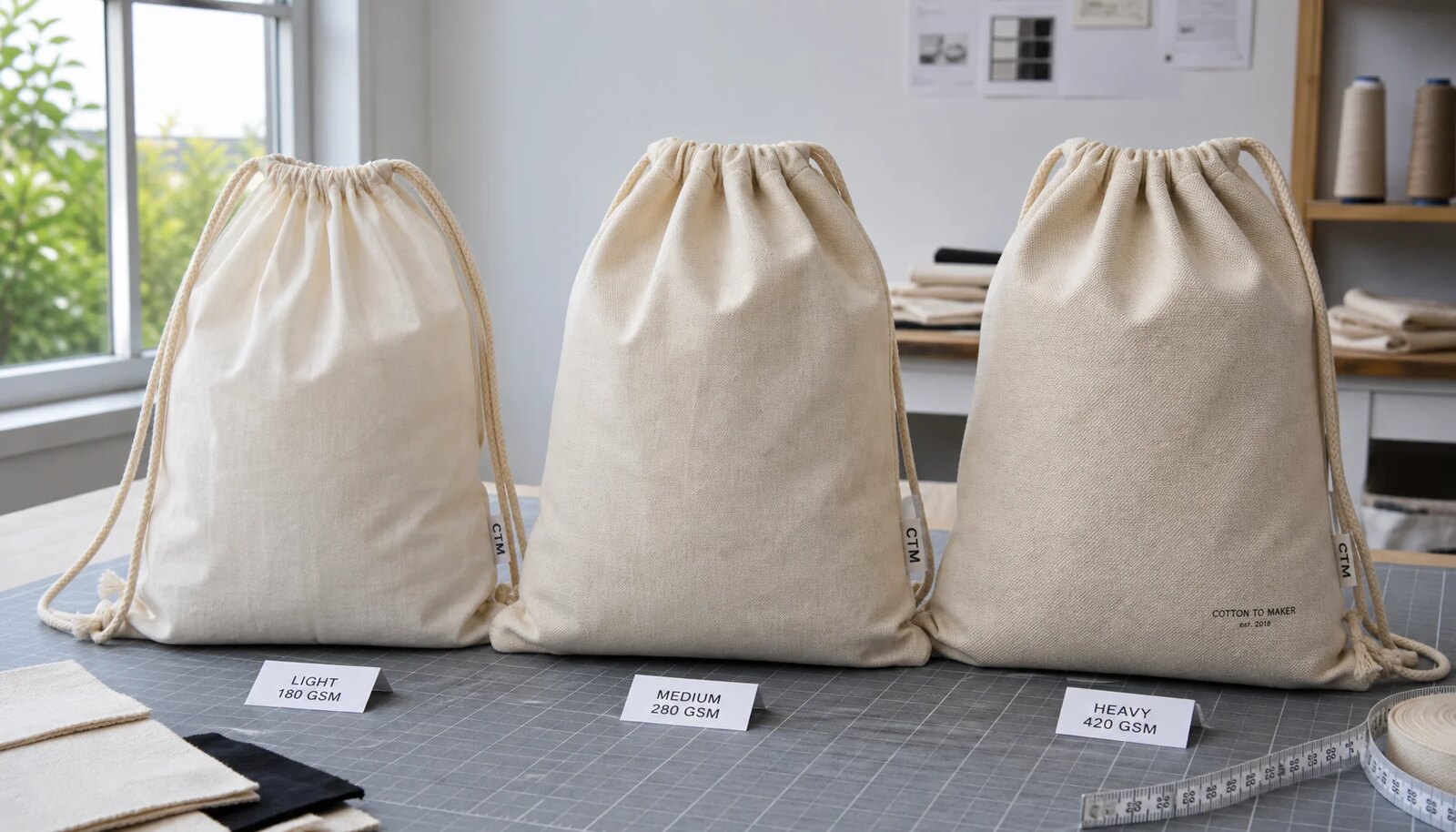
Start With the Gift Contents, Not the GSM
A cotton drawstring backpack is specified poorly when the brief starts and ends with fabric weight. GSM matters, but the correct GSM depends on what the bag must carry, how the recipient will use it, and what the brand expects the bag to communicate. A trade show handout with a brochure and folded T-shirt has different stress points than an employee kit with a stainless bottle, notebook, charger, snack box, and welcome letter. The hard edges of the contents can stretch corners, distort the front print area, and expose weak seams even when the quoted fabric weight looks acceptable.
For B2B procurement, the first control is a contents schedule. List every item going into the bag, approximate packed size, total weight, and whether any item has rigid corners or high point pressure. If the kit will be assembled by a third-party warehouse, ask whether the bag must survive automated handling, pallet compression, repacking, or event-site distribution. These conditions influence fabric weight, seam construction, cord diameter, and packing method as much as the brand logo does.
The goal is not to buy the heaviest bag available. The goal is to choose the lowest-risk construction that supports the gift experience, decoration quality, freight budget, and delivery date. A 120 GSM bag can be perfectly reasonable for a soft, low-cost event giveaway. It becomes risky when the same bag is expected to carry a bottle and journal while still looking like a premium employee gift.
- For light contents under about 1 kg, 120-140 GSM can work if the bag is mainly a giveaway container and the buyer accepts lighter opacity and hand feel.
- For mixed corporate kits around 1-2 kg, 140-160 GSM is often the most practical starting range for reuse, print quality, and cost control.
- For heavier or premium gift sets, 170-200 GSM usually gives better body, opacity, seam confidence, and perceived value.
- For hard-edged contents, increase bag size slightly and check seam stress so corners do not push sharply into the fabric or logo panel.
- For executive gifting, review touch, shade, print finish, cord quality, and folding presentation with the same discipline as the headline GSM.
Read GSM as a Control Point, Not a Complete Specification
GSM means grams per square meter. It is a useful common language for comparing cotton fabric weight, but it does not fully predict how a finished drawstring backpack will feel or perform. Two suppliers can both quote 160 GSM and deliver different bags because yarn count, weave density, finishing, shrinkage, and sewing quality all affect the final result. A tight 150 GSM plain weave can print more cleanly and feel more stable than a loose 170 GSM cloth with an open structure.
Procurement buyers should ask for finished GSM, not an undefined fabric-weight claim. Greige fabric weight before dyeing, washing, and finishing is not always equal to finished fabric weight after processing. Some finishes add body; others change shrinkage and hand feel. The purchase order should state the measurement stage, the acceptable tolerance, and the approved sample reference. In many sewn cotton programs, a practical GSM tolerance needs to be discussed in the range of roughly +/-5% to +/-10%, but the exact tolerance should be agreed with the supplier and tied to a retained standard.
GSM also affects landed cost. Heavier cotton raises material cost, product weight, and often carton volume because thicker bags fold bulkier. For corporate gifting, that can matter when thousands of pieces ship by air for an event deadline or when a warehouse charges by storage volume. A sourcing team should compare fabric weight alongside print method, carton cube, destination, and in-hands date rather than treating GSM as an isolated quality score.
- 120-130 GSM: lightweight, compact, and cost-sensitive; best for soft contents, short campaigns, and simple branding.
- 140-160 GSM: balanced range for many corporate drawstring backpacks; better opacity and hand feel without excessive freight impact.
- 170-180 GSM: stronger presence and improved support for premium kits, larger prints, or compact embroidery.
- 190-200 GSM: more canvas-like structure; useful for heavier gifts but can increase cord-channel bulk and carton cube.
- Above 200 GSM: possible for special premium concepts, but often less efficient for bulk corporate distribution unless the brand experience justifies it.
Build a Quote Sheet Suppliers Can Price Equally
Comparable quotations require controlled inputs. If one supplier prices a 35 x 45 cm bag in 140 GSM natural cotton with bulk packing and another prices a 40 x 50 cm bag in 180 GSM dyed cotton with individual packing, the lower unit price tells procurement very little. The quote sheet should remove ambiguity around size, fabric, color, cord, decoration, packing, delivery term, and sample expectations.
A useful sourcing brief includes finished width and height, fabric composition, finished GSM range, fabric color route, cord diameter and material, decoration method, logo size, print placement, label requirement, quantity tiers, packing method, carton marking requirements, Incoterm, and required arrival date. It should also define which alternates are allowed. For example, ask suppliers to quote the target 160 GSM natural cotton specification, plus optional alternates at 140 GSM and 180 GSM. That gives procurement a controlled cost-quality comparison rather than a pile of unrelated offers.
The quote sheet should expose variation costs. Corporate gifting programs often split by region, business unit, language, employee group, or event. Each logo change can trigger new screens or embroidery setup. Each fabric color can create separate dyeing or fabric MOQ. Each carton mark or barcode can add packing labor. These details belong in the quote stage because they are much cheaper to clarify before deposit than after artwork approval.
- Specify finished dimensions and tolerance, such as width and height, instead of relying on nominal catalogue sizing.
- State whether cotton is natural, bleached, dyed, canvas, organic-certified, recycled-blend, or conventional; require documentation for any claim used in marketing.
- Provide artwork size, color references, placement measurements from bag edges, and whether the supplier should quote screen print, embroidery, transfer, or label branding.
- Ask for line-item costs for base bag, decoration, labels, special packing, cartons, samples, and documentation.
- Require suppliers to identify any proposed substitution, such as different cord material, different GSM, different fabric color, or outsourced decoration.
Set Practical Tolerances Before the Purchase Order
Sewn cotton goods need tolerances because fabric moves during cutting, sewing, dyeing, finishing, folding, and handling. A realistic tolerance does not lower quality; it makes inspection enforceable. Without written tolerances, receiving teams may reject acceptable goods or accept weak goods because the standard is unclear. For cotton drawstring backpacks, the most important tolerances usually cover GSM, finished dimensions, shade, print placement, label placement, and order quantity overrun or underrun.
Dimensional tolerances should reflect the construction. A drawstring backpack is not a molded plastic part. A common sourcing conversation might land around +/-1 cm on width and height, with tighter or looser limits depending on size, fabric, and factory capability. Print placement tolerance should be measured from defined reference points, such as the top edge below the cord channel and the side seam, because visual centering alone can cause disputes. If the logo must align with a kitting insert or retail sleeve, say so in the specification.
Color tolerances need special care. Natural undyed cotton will normally include cotton specks and modest shade variation. Dyed cotton should be compared against an approved lab dip or production sample under agreed lighting. Cord color may not match fabric exactly unless it is dyed or sourced as a matched component. For repeat orders, procurement should expect a new shade approval unless the supplier confirms fabric from the same reserved lot.
- Agree on finished GSM tolerance and require the supplier to state how and when GSM is tested.
- Agree on size tolerance for width, height, opening width, and cord channel depth.
- Agree on print placement tolerance measured from fixed edges, not only by visual judgment.
- Agree on shade tolerance for natural cotton, dyed fabric, cord, print ink, embroidery thread, and labels.
- Agree on overrun and underrun tolerance, especially for custom dyed, custom labeled, or made-to-order fabric.
Choose the Supplier Route Based on Control Needs
Supplier type changes sourcing risk. A direct bag factory may cut, sew, trim, coordinate decoration, pack, and inspect the order under one production plan. That can be helpful for repeat corporate gifting programs where consistency, sample traceability, and schedule control matter. Even direct factories may source fabric, dyeing, or printing externally, which is normal in textile supply chains, but procurement should still know who controls each step and who accepts responsibility for defects.
A trader or sourcing agent can be useful when the buyer needs options quickly, wants one coordinator for several gift items, or must find available capacity during a busy season. The risk is limited visibility. If procurement does not know where sewing or decoration occurs, it becomes harder to investigate shade variation, seam defects, or print failures. A sourcing agent can still be a strong partner if they provide production-site transparency, sample traceability, and clear responsibility for inspection and replacements.
Local decoration on imported blanks is often the fastest path for urgent regional events. It can reduce import timing risk if blanks are already in stock, but it does not automatically improve quality. A local printer can decorate a weak blank, and the finished bag will still have weak seams, thin fabric, or poor cord function. Buyers using blanks should inspect the blank backpack before approving decoration and calculate total cost after local setup, repacking, rejects, freight, and handling.
- Use a direct factory when specification control, repeatability, and production traceability are priorities.
- Use a trader or sourcing agent when supplier consolidation, options, or capacity coordination is more valuable than direct factory contact.
- Use local decoration when timing is tight or quantities are low, while treating blank quality as a separate approval item.
- For hybrid programs, consider factory-made blank bags with local kitting or regional insertion when distribution complexity is high.
- Require the approved sample to identify the fabric lot, decoration method, cord, label, and packing route used for bulk production.
Match Fabric Weight to Decoration Risk
Decoration is where many cotton drawstring backpack programs become visibly good or visibly cheap. Screen printing is usually the safest starting point for simple corporate logos because it is repeatable, cost-effective, and easy to inspect. On 140-180 GSM cotton with a tight weave, a one- or two-color logo can look clean if ink selection, mesh, curing, and pressure are controlled. On lighter or rougher fabric, small text can soften, large solid areas can feel stiff, and poor cure can cause tackiness or transfer.
Water-based ink is often chosen for a softer hand on natural cotton, but opacity must be checked, especially on darker dyed fabric. Plastisol can provide stronger opacity in some cases, but buyers should evaluate hand feel, cure, and any compliance requirements relevant to the customer or market. Heat transfer can support gradients and fine detail, but it needs bend, rub, and edge-lift checks because drawstring bags fold, compress, and flex during packing and use.
Embroidery can make a cotton drawstring backpack feel more premium, but it is not automatically the best choice. Dense embroidery adds thread weight and needle tension. On thin cotton, that can pucker the panel or distort the logo. Embroidery is usually safer on heavier fabric, compact logos, and designs with controlled stitch density. A woven label is another strong option for repeat programs where the brand wants subtle identification without a large print on the front panel.
- Screen print: best for simple logos, event marks, one-color branding, and most mid-volume corporate orders.
- Water-based print: softer feel, especially on natural cotton; check opacity, cure, and rub resistance.
- Plastisol print: useful for opacity in some designs; check hand feel, cracking, blocking, and market compliance needs.
- Embroidery: best on heavier cotton or canvas and compact logos; control backing, stitch density, and puckering.
- Heat transfer: useful for gradients or detailed artwork; test edge adhesion, cracking, folding marks, and plastic-like surface feel.
- Woven label: good for understated branding, repeat programs, or when a large print could conflict with the natural cotton look.
Control MOQ, Setup Charges, and Price Breaks
MOQ is driven by more than sewing capacity. Cotton drawstring backpacks may involve fabric booking, dye lots, cutting setup, cord sourcing, decoration setup, label production, carton preparation, and packing labor. A supplier may accept a small run using stock natural cotton and standard cords but require a higher minimum for custom dyeing, custom cord colors, woven labels, multiple print versions, or retail-style individual packing. Procurement should ask for MOQ by variable, not only total order quantity.
Line-item quotation is the best defense against late surprises. Separate the base bag from decoration, labels, packing, samples, cartons, and freight assumptions. If budget pressure appears, the buyer can then make targeted decisions: reduce print size, use standard cord, change embroidery to screen print, remove individual packing, choose natural cotton instead of custom dyeing, or consolidate artwork versions. A single blended unit price makes negotiation less precise and can hide missing costs.
Price breaks should match likely reorder behavior. Many corporate gifting programs begin as one event and then expand to another region, department, or season. Asking for 500, 1,000, 3,000, 5,000, and 10,000 pieces gives procurement usable planning data. If the unit price does not move much between tiers, ask which cost factor is limiting the reduction. The answer may be material cost, decoration labor, low machine efficiency, label MOQ, packing complexity, or freight method.
- Ask MOQ separately for fabric weight, fabric color, bag size, print design, label design, cord color, and packing format.
- Confirm screen charges, embroidery digitizing, lab dips, woven-label setup, sample charges, carton mark setup, and color-change fees.
- Ask whether sample fees are refundable, credited to bulk production, or charged independently.
- Clarify overrun and underrun tolerance because exact quantities can be difficult for custom textile production.
- For split shipments, request separate costs for carton marks, packing lists, destination sorting, palletizing, and documentation.
Use Samples as Procurement Evidence
Samples are not souvenirs from the sourcing process; they are the evidence that links the quotation to the purchase order. A digital proof can confirm artwork placement, but it cannot prove fabric density, seam strength, cord movement, print cure, embroidery puckering, shade, odor, or packing presentation. For most B2B programs, procurement should review at least a swatch or blank sample and a pre-production sample. For larger or higher-risk orders, a top-of-production sample helps confirm that bulk output matches the approved standard before the factory completes the full run.
The pre-production sample should use production fabric or a clearly disclosed equivalent, the correct cord, the planned decoration method, approved logo size, label placement, and intended folding method. If a sample is made from old stock or a different fabric lot, it should be treated as a reference sample only. The approval record should name the sample version, date, fabric weight, decoration method, accepted deviations, and who approved it. This record prevents confusion when receiving or third-party inspection compares bulk goods.
Sample review should be physical and practical. Load the bag with the intended gift items or equivalent weight. Pull the cords open and closed repeatedly. Check whether knots slip, cord ends fray, and the channel twists. Rub the print with a dry white cloth and a slightly damp cloth. Bend the printed area after it is folded. Place the filled bag upright and flat to see how the seams and bottom behave. Review shade and cotton specks under normal office or warehouse lighting, not only under ideal studio light.
- Artwork proof: confirms logo size, placement, color references, and decoration boundaries before physical sampling.
- Fabric swatch: confirms GSM, hand feel, weave tightness, shade, opacity, and whether natural specks are acceptable.
- Blank sample: confirms size, stitching, cord function, seam quality, and basic carrying performance before decoration cost is added.
- Pre-production sample: confirms actual construction, decoration, cord, label, folding, and packing presentation.
- Top-of-production sample: checks early bulk output before the full order is finished, useful for larger or event-critical programs.
- Shipment sample: gives the receiving team and future reorders a retained reference after production is complete.
Write QC Criteria Before Production Starts
Quality control should be agreed before deposit or production release. Once goods are sewn, printed, packed, and shipped, it is much harder to solve defects without schedule or cost damage. For cotton drawstring backpacks, the main QC areas are fabric condition, finished measurements, stitching, cord function, load performance, decoration, labels, cleanliness, odor, carton count, and packing integrity. If a formal inspection is used, define AQL, defect classification, sampling level, and inspection timing in advance.
Defect classification makes inspection more objective. Critical defects may include contamination that creates safety or regulatory concern, wrong country-of-origin labeling, severe mold, or incorrect branding that makes the goods unusable. Major defects may include wrong fabric weight outside tolerance, open seams, print peeling, serious shade mismatch, missing labels, incorrect carton counts, or decoration placed visibly wrong. Minor defects may include small loose threads or slight natural cotton variation within the approved range. The exact list should reflect the buyer's brand standard and distribution channel.
Functional checks are essential because a flat bag can look acceptable and still fail when used. Load testing should reflect the intended contents and handling, including repeated lifting by the cords. Seam inspection should include bottom corners, cord exits, side seams, and any reinforced areas. Print checks should include opacity, cure, rub resistance, bend performance, color, registration, and placement. Embroidery checks should include puckering, backing, thread trimming, needle damage, and thread color.
- Check GSM against the approved range and retained sample; investigate any visible change in density or opacity.
- Measure width, height, opening, cord channel, print placement, and label placement against agreed tolerances.
- Inspect skipped stitches, loose threads, seam allowance, bottom corners, cord exits, knots, and cord movement.
- Perform a practical load check using the intended kit weight or a documented equivalent.
- Test print with dry rub, damp rub, bend, fold, and visual cure review before approving shipment.
- Verify carton quantity, carton marks, gross weight, net weight, carton condition, and whether mixed designs are separated correctly.
Specify Packing for Warehouses and Events
Packing is part of product quality. Cotton bags crease, absorb odor, and can be affected by moisture or pressure. Decoration can be damaged if the logo is folded sharply, pressed against rough carton surfaces, packed before ink is fully cured, or compressed under heavy cartons. A good packing instruction states fold direction, pieces per inner pack, pieces per carton, carton dimensions, carton weight limit, and whether the printed or embroidered area needs protection.
Corporate gifting often passes through kitting centers, warehouses, regional distributors, and event teams. Carton marks must help those teams work quickly and accurately. Specify PO number, item code, design version, quantity, destination, carton sequence, gross weight, net weight, and any barcode or SKU label needed for receiving. If the same order includes multiple departments or countries, carton-level separation can prevent costly sorting work later.
Sustainability requirements should be converted into operational packing rules. If the buyer wants no individual polybags, the factory still needs a way to protect goods from dirt and moisture. Options may include bulk packing with a carton liner, paper bands, recyclable inner packs where available, tissue separation for premium decoration, or carton dividers for embroidery. The right option depends on freight route, climate exposure, warehouse handling, and the recipient presentation standard.
- Define bulk pack, inner pack, paper band, individual pack, or kit-ready pack instead of leaving packing to factory habit.
- Confirm fold direction so the logo is not creased through the center or hidden inside the fold.
- Set pieces per carton, carton dimensions, maximum carton weight, carton material strength, and pallet requirements if any.
- Require carton marks for PO, SKU, design version, destination, quantity, and sequential carton numbering.
- For humid routes or long sea freight, ask how moisture, odor, mildew risk, and carton compression will be controlled.
Specification comparison for buyers
| Buying scenario | Practical specification starting point | Typical tolerance or control point | Procurement risk to close before PO |
|---|---|---|---|
| High-volume event giveaway | 120-140 GSM finished cotton, standard size, one-color screen print, bulk packed | Finished GSM tolerance commonly needs to be agreed around +/-5% to +/-10%, tied to the approved sample | Check opacity with actual contents, seam allowance, print cure, and whether the quoted GSM is finished fabric or greige fabric |
| Standard corporate gifting kit | 140-160 GSM finished cotton, tighter plain weave, smooth cord channel, 4-6 mm cord | Finished size tolerance often needs written agreement, such as +/-1 cm on width/height for sewn cotton goods | Compare hand feel, weave density, cord function, and print sharpness against the pre-production sample, not only the quote sheet |
| Premium or heavier gift set | 170-200 GSM cotton or cotton canvas, stronger side seams, reinforced cord exits where needed | Load test should reflect the intended kit weight plus handling stress, for example repeated lifting and closing cycles | Confirm embroidery puckering, screen-print cracking, carton compression, and the increase in carton cube and freight weight |
| Natural undyed cotton program | Natural cotton with approved shade band, visible cotton specks accepted within limits | Define acceptable natural specks separately from rejectable stains, oil marks, holes, mildew, or heavy slubs | Do not expect optical-white uniformity; approve shade under standard lighting and keep a retained sample for receiving |
| Custom dyed brand-color program | Lab-dip approved dyed cotton, reserved fabric lot where possible, matching cord if required | Color tolerance should reference an approved lab dip or sample, preferably with a written shade range for bulk | Ask whether dye lot, cord lot, and any repeat-order shade matching are guaranteed, approximate, or subject to reapproval |
| Direct factory sourcing | Factory manages fabric sourcing, cutting, sewing, decoration coordination, packing, and final inspection | Require traceability from approved sample to bulk fabric lot, decoration method, and packing line | Verify which steps are in-house versus outsourced, especially dyeing, screen printing, embroidery, and inspection |
| Trader or sourcing agent route | One coordinator sources fabric, sewing, decoration, labels, and packing across vendors | Responsibility matrix should identify who owns defects, replacements, shipment timing, and documentation | Require disclosure of production site, decoration site, sample origin, and final QC process before deposit |
| Imported blanks with local decoration | Stock cotton drawstring backpack decorated regionally for urgent or small programs | Blank bag dimensions, GSM, seam construction, and print compatibility must be checked before decoration | Total cost may rise after blank freight, decoration setup, repacking labor, rejects, and local handling are included |
| Screen print decoration | Water-based or plastisol screen print matched to fabric color, logo size, and cotton surface | Check ink opacity, registration, rub resistance, cure, and hand feel after bending and folding | Small type, fine lines, and large solid ink areas need sampling because cotton weave texture affects edge sharpness |
Buyer checklist before sampling
- Define the gift contents by item, size, approximate total weight, edge hardness, and packing sequence; a soft T-shirt kit and a bottle-and-notebook kit should not use the same default bag specification.
- State a target finished GSM range, not only a single number, and require suppliers to confirm whether the quoted value is measured after dyeing, washing, finishing, and production handling.
- Lock finished width, height, cord channel depth, opening width, seam allowance expectation, drawcord diameter, cord material, cord length, and knot or tip treatment before comparing prices.
- Specify fabric route: natural undyed cotton, bleached cotton, stock dyed cotton, custom dyed cotton, cotton canvas, or cotton blend if allowed; do not let suppliers substitute without written approval.
- Provide print-ready artwork with logo size, color count, Pantone or brand references, placement from bag edges, acceptable print area, and any regional or department artwork variations.
- Ask for MOQ by fabric color, fabric weight, bag size, print design, label design, packing style, and shipment split because each variable may create a separate setup or minimum.
- Request quote tiers at realistic volumes such as 500, 1,000, 3,000, 5,000, and 10,000 pieces using the same specification, delivery term, and packing method for each tier.
- Separate base bag cost, decoration cost, label cost, lab dip cost, sample cost, inner packing, carton packing, documentation, inspection support, and freight assumptions instead of accepting one unexplained unit price.
- Require a sample plan that identifies swatch or blank sample, artwork proof, pre-production sample, top-of-production sample if needed, and retained shipment sample for receiving or repeat orders.
- Approve written quality criteria before deposit: GSM tolerance, dimensional tolerance, shade tolerance, seam strength expectation, cord function, print durability, defect classification, AQL if used, and carton count control.
Factory quote questions to send
- What is the finished GSM of the cotton fabric after dyeing, washing, finishing, cutting, and sewing, and what GSM tolerance can you hold in bulk production?
- Is the proposed fabric stock, custom woven, custom dyed, reserved from an existing lot, or purchased after order approval, and how does that affect sampling, lead time, and repeat orders?
- What yarn count, weave type, fabric width, shrinkage expectation, and fabric lot control are you using, and can the swatch come from the same lot proposed for production?
- What are the finished bag width and height, seam construction, bottom construction, seam allowance, cord channel depth, opening width, cord diameter, cord material, and cord length after tying?
- Which decoration method are you quoting, what is the maximum safe decoration area on this fabric, and what setup, screen, digitizing, plate, or color-change charges apply?
- Can you separate the quotation into base bag, fabric upcharge if any, decoration, woven label or care label, individual packing, carton packing, sampling, inspection support, and export documentation?
- What is the MOQ by fabric color, fabric weight, print design, label design, cord color, and packing format, and what changes if the order is split across departments, events, or destinations?
- Can you quote price breaks for 500, 1,000, 3,000, 5,000, and 10,000 pieces with the same specification, same Incoterm, same packing, and the same inspection assumptions?
- Which sample stages do you recommend, how many calendar days are needed for each stage, and will the pre-production sample use actual bulk fabric, actual cord, and the final decoration process?
- What dimensional tolerance, GSM tolerance, shade tolerance, print placement tolerance, and overrun/underrun tolerance do you propose, and are these included in the purchase order terms?
Quality-control points to confirm
- Finished fabric weight matches the approved GSM range and retained sample; bulk goods should not feel visibly thinner, looser, more transparent, or stiffer than the approved production standard without written acceptance.
- Fabric surface is commercially clean, with no stains, oil marks, holes, mildew, strong odor, heavy slubs, dye streaks, foreign fibers, contamination, or shade panels that fall outside the approved range.
- Finished dimensions are within the agreed tolerance, including width, height, opening width, cord channel depth, side seam alignment, bottom shape, label placement, and print placement from defined reference points.
- Cord channel stitching is straight and secure, with smooth cord movement, no skipped stitches, no trapped fabric, no twisting that blocks closure, and no excessive resistance when the bag is opened and closed repeatedly.
- Cord exits, side seams, bottom corners, and reinforced areas hold under a practical load test based on the intended gift contents, including repeated lifting by the cords rather than a single static pull.
- Print color, opacity, edge sharpness, registration, and placement match the approved artwork and control sample within agreed tolerances, especially on natural cotton where texture can soften small details.
- Print cure or adhesion passes dry rub, damp rub, fold, and reasonable bend checks without excessive cracking, flaking, tackiness, color transfer, odor, or blocking against adjacent bags in the carton.
- Embroidery, if used, has controlled stitch density, stable backing, trimmed thread tails, no puckering, no needle damage, no loose top or bobbin thread, and no distortion of the front panel.
- Labels are positioned consistently, stitched securely, readable, and aligned with brand requirements, care instructions, country-of-origin rules, fiber content claims, SKU requirements, or customer routing labels.
- Cartons are correctly counted, sealed, marked, and packed to prevent print creasing, embroidery crushing, moisture exposure, dye transfer, odor buildup, or deformation during transit and warehouse handling.