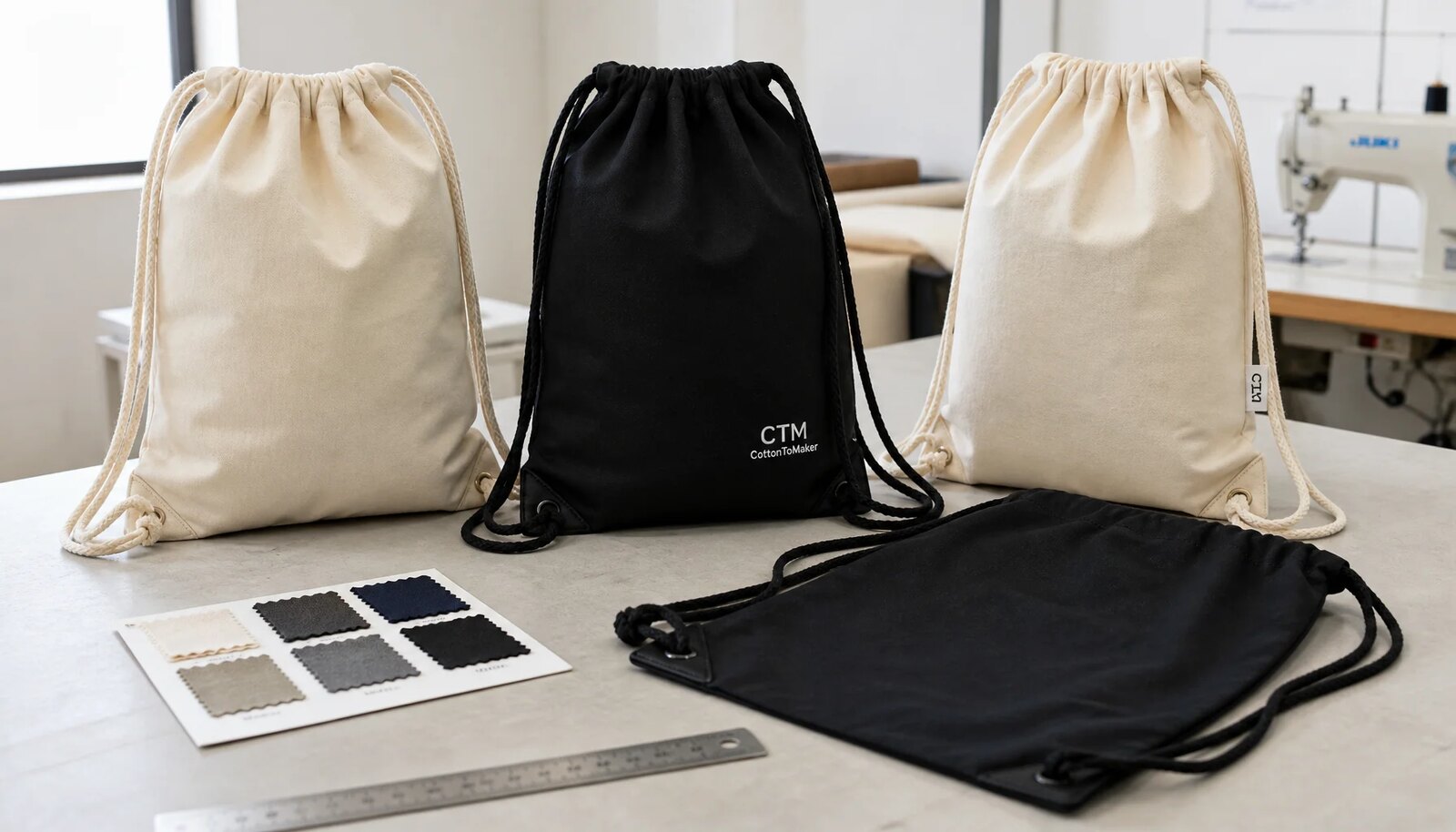
The Buying Problem
Craft fair backpacks sit in an awkward position between a cheap event giveaway and a paid retail accessory. Buyers often request cotton drawstring backpacks, receive several low quotes, and later discover that each factory quoted a different fabric weight, cord type, reinforcement method, and packing style. The bags may all be called cotton, but a 140 GSM promotional cotton bag and a 270 GSM cotton canvas backpack do not perform or look the same.
The main buying problem is not simply choosing the lowest GSM. It is choosing a fabric weight that matches how the backpack will be used at craft fairs: carrying flyers, packaging handmade products, selling as branded merchandise, or bundling with maker kits. A clear RFQ should define the expected load, finished size, decoration method, and presentation level before the factory calculates fabric consumption and production cost.
- For free booth giveaways, lightweight cotton may be acceptable if the load is only paper literature.
- For resale, 6 oz or 8 oz cotton usually gives a stronger hand feel and better shelf value.
- For heavy craft purchases, fabric weight alone is not enough; corner reinforcement and cord anchoring matter more.
- For multi-design craft fair programs, MOQ by artwork version can drive cost more than the fabric upgrade.
How GSM Changes Performance
Fabric weight is usually quoted as GSM or ounces per square yard. In practical sourcing, 4 oz cotton is often around 130 to 150 GSM, 6 oz is around 190 to 210 GSM, 8 oz is around 260 to 280 GSM, and 10 oz canvas is around 330 to 350 GSM. Exact conversion depends on construction, yarn count, weave, finishing, and supplier naming habits, so the RFQ should use both oz and GSM where possible.
For cotton drawstring backpacks at craft fairs, 6 oz cotton is the safest starting point for a balanced quote. It has enough body for screen printing and simple retail use while keeping carton weight and unit cost under control. 8 oz cotton is better when the backpack is part of a paid merchandise line or must carry small purchased goods. 10 oz cotton canvas can look premium, but it may become stiff at the top channel and less comfortable when pulled closed.
- 140 GSM to 160 GSM: suitable for very light promotional use, not ideal for resale.
- 190 GSM to 210 GSM: practical middle range for craft fair logo backpacks.
- 260 GSM to 280 GSM: stronger hand feel for boutique retail and branded merchandise.
- 330 GSM to 350 GSM: premium look, higher cost, bulkier folding, and more sewing strain.
- Tolerance target: specify plus or minus 5 percent unless your program needs stricter control.
Match Weight To Craft Fair Use
A distributor supplying event organizers may need low-cost backpacks for sponsors, while a brand owner selling through artisan markets may need a bag that feels intentional beside handmade goods. The same backpack size can require different fabric depending on whether it carries brochures, yarn kits, small ceramics, candles, or packaged food items. The correct specification starts with use case, not with a factory catalog photo.
For adult use, many buyers specify around 34 x 42 cm or 35 x 45 cm. Smaller sizes can work for kids’ craft events or product packaging, but they may not sit well on adult shoulders. As fabric weight increases, the top channel, cord diameter, and bottom anchor construction should be adjusted. A heavy fabric backpack with thin cord and weak corner stitching is a common false economy.
- Literature bag: 4 oz to 6 oz cotton, simple drawcord, basic screen print.
- Retail craft fair bag: 6 oz to 8 oz cotton, cleaner sewing, stronger cord, better folding.
- Maker kit packaging: 6 oz cotton if contents are light, 8 oz if the kit has tools or jars.
- Reusable shopping companion: 8 oz cotton with reinforced bottom corners and longer cord length.
- Premium merch item: 8 oz to 10 oz cotton canvas, but sample the closure comfort before approval.
Cost Drivers Beyond GSM
Fabric weight is important, but it is not the only cost driver. A 6 oz backpack with a large two-color front print, custom dyed fabric, reinforced corner tabs, and individual retail packing may cost more than a plain 8 oz natural cotton backpack. Buyers comparing quotes should separate fabric, printing, sewing complexity, accessories, packing, and carton data instead of judging a single unit price.
MOQ also changes the cost picture. Natural cotton in common weights is usually easier to source at lower quantities. Dyed cotton, Pantone-matched fabric, washed finish, custom cord color, and multiple artwork versions may require higher minimums or surcharges. For craft fair programs with many small vendors or seasonal designs, the commercial issue is often how to group colors and prints without creating too many low-volume SKUs.
- Fabric: heavier GSM increases material cost and carton weight.
- Dyeing: custom colors add MOQ, lead time, and shade-control risk.
- Printing: each color or screen can add setup cost and production time.
- Cord: thicker cotton cord improves feel but increases accessory cost.
- Reinforcement: bartacks or corner patches add labor but reduce failure risk.
- Packing: individual polybags, belly bands, hangtags, and barcode labels add handling cost.
Print Method Choices
Most cotton drawstring backpacks for craft fairs use screen printing because it is cost-effective for solid logos, event names, sponsor marks, and simple artwork. Screen print works well on 6 oz and 8 oz cotton when the fabric surface is stable and the ink is properly cured. For coarse canvas or dark fabric, the factory may need an underbase, thicker ink deposit, or adjusted artwork to keep edges clean.
Digital print and heat transfer are useful when the order contains gradients, full-color illustrations, or many low-quantity designs. They can solve MOQ pressure for seasonal craft fair artwork, but buyers should evaluate hand feel, edge appearance, wash durability, and whether the decoration cracks when the bag is folded. Embroidery is less common on drawstring backpacks because it can pucker lightweight cotton and add cost, but it may work for small premium logos on 8 oz or heavier fabric.
- Screen print: best for 1 to 3 solid colors and medium to large quantities.
- Heat transfer: useful for full-color logos, but sample the transfer edge and folding performance.
- Digital print: good for artwork variety, but confirm color consistency across fabric shades.
- Embroidery: suitable only for small logos on heavier fabric with backing control.
- Print placement: define distance from top edge, center line, and bottom seam to avoid drawcord distortion.
Construction Details That Prevent Returns
Drawstring backpacks fail at predictable points: the top cord channel, the side seams, and the bottom cord anchors. When fabric weight increases, these areas need more attention because users pull harder on the cord and the bag carries more weight. A buyer should not approve a premium GSM without confirming the construction standard that supports it.
For craft fair retail, the visible finish also matters. Uneven top openings, loose threads, misaligned side seams, and puckered print panels make a cotton backpack look like a low-grade giveaway. A practical RFQ can specify double-fold top channel, clean side seam allowance, reinforced bottom eyelets or fabric tabs, and trim standards. If the bag will carry heavier goods, request a simple load test that reflects actual use instead of relying only on visual inspection.
- Top channel: enough width for smooth cord movement without bunching.
- Side seams: straight stitch with secure backtack at opening and bottom.
- Bottom anchors: reinforced stitched tabs or metal eyelets depending on brand preference.
- Cord diameter: thick enough for comfort, not so thick that it jams the channel.
- Thread trimming: no long tails visible around print area, side seams, or cord exits.
- Load test: define a practical weight and duration based on expected contents.
Sample Approval Workflow
A fabric swatch alone is not enough for approval because GSM, sewing, cord movement, and print behavior interact. For a new cotton drawstring backpack program, the sample path should include a fabric swatch, print strike-off if artwork is important, fit sample for dimensions, and pre-production sample made with final materials. The retained pre-production sample becomes the factory reference during bulk production and inspection.
Buyers should measure samples the same way the factory will measure production. Define whether finished height includes the top channel, where width is measured, and whether dimensions are checked flat before or after pressing. For print approval, record ink color, print size, position, curing result, and any acceptable fabric slub or natural cotton variation. Natural cotton is not perfectly uniform; the issue is whether the variation matches the approved standard.
- Approve actual GSM, not only fabric appearance in photos.
- Test whether the drawcord closes fully without tearing the top corners.
- Load the sample with expected fair contents and wear it on shoulders.
- Fold the bag as planned for packing and inspect print creasing.
- Compare natural cotton shade under normal daylight and retail lighting.
- Keep one signed sample at the factory and one with the buyer or inspector.
Packing And Retail Handling
Packing is often treated as a final detail, but it affects both appearance and receiving cost. Cotton drawstring backpacks can be folded flat, bundled in dozens, individually polybagged, or packed with hangtags and barcode labels. Craft fair buyers may need fast booth setup, distributor warehouse receiving, or retail shelf display. Each route needs a different packing instruction.
The main packing risk is damage to the printed panel. If screen-printed bags are packed before full curing or folded directly across thick ink areas, the print can block, crack, or leave marks. For natural cotton, dirty cartons or rough handling can also create visible stains. The RFQ should specify folding direction, inner quantity, carton count method, carton lining if needed, and whether mixed SKUs are allowed.
- Bulk pack: lowest cost, suitable for internal event distribution.
- Individual polybag: cleaner for resale but adds material and labor cost.
- Belly band or hangtag: useful for retail story, barcode, and product information.
- Carton label: should show PO number, SKU, color, print version, quantity, and carton number.
- Carton weight: keep practical for manual handling; heavy GSM bags increase gross weight quickly.
- Mixed cartons: avoid unless inner bags or labels clearly separate each SKU.
Lead Time And Schedule Risk
Lead time depends on fabric availability, color, printing, sample approval speed, and inspection requirements. Natural cotton in common weights can move faster than custom dyed cotton. Multi-color screen printing may need additional setup and curing time. If the order includes several small artwork versions for different craft fair vendors, production planning becomes more complex even if the total quantity looks simple.
A realistic schedule should start from confirmed artwork, approved sample, and deposit or purchase order, not from the first inquiry date. Buyers should protect the event date by setting internal deadlines for artwork approval, sample feedback, packing confirmation, and pre-shipment inspection. For seasonal fairs, shipping congestion and last-minute artwork changes are bigger risks than sewing capacity.
- Fastest route: stock natural cotton fabric, one-color screen print, simple bulk packing.
- Longer route: custom dyed fabric, multiple print colors, retail labels, and individual packing.
- Critical path: fabric sourcing, sample approval, print setup, bulk sewing, inspection, and shipping.
- Schedule buffer: allow time for one sample correction if this is a new supplier or new size.
- Event deadline: set cargo-ready date earlier than the fair date, not equal to it.
Quote Data For Fair Comparison
A useful quotation for cotton drawstring backpacks should explain what is included. If one factory quotes 6 oz natural cotton with basic cord and bulk packing, while another quotes 8 oz cotton canvas with reinforced corners and individual polybags, the unit prices are not comparable. Procurement teams should request a line-by-line quote format and require the supplier to state assumptions.
For landed-cost comparison, carton details matter. Heavier fabric increases gross weight, and bulky folding can increase carton volume. If the buyer is importing by air for an urgent fair, a jump from 6 oz to 10 oz may affect freight more than expected. For sea freight, carton volume, palletization, and warehouse handling can still change the final cost. Quote data should support both product comparison and logistics planning.
- Product data: finished size, GSM, fabric color, cord type, reinforcement, and print method.
- Commercial data: MOQ, unit price by quantity tier, sample charge, screen charge, and tooling charge.
- Packing data: pieces per inner pack, pieces per carton, carton dimensions, gross weight, and net weight.
- Timing data: sample lead time, bulk lead time, inspection window, and cargo-ready date.
- Risk data: fabric tolerance, color tolerance, print tolerance, and replacement policy for defects.
- Comparison rule: reject quotes that do not identify fabric weight and packing method.
Specification comparison for buyers
| Spec decision | Recommended option | When it fits | Buyer risk to check |
|---|---|---|---|
| Base fabric weight | 6 oz cotton, about 200 GSM | Balanced choice for craft fair giveaways, light retail resale, and printed art merchandise | Too light if buyers expect heavy jars, books, candles, or repeated daily carrying |
| Premium fabric weight | 8 oz cotton, about 270 GSM | Better for paid retail items, maker-market gift sets, and brands wanting stronger perceived value | Higher fabric cost and freight weight; confirm drawcord strength and seam reinforcement also upgrade |
| Heavy-duty option | 10 oz cotton canvas, about 340 GSM | Useful for higher-ticket craft fair bags, weekend event kits, or heavier contents | Can feel bulky as a drawstring backpack; print hand feel and folding pack size need approval |
| Fabric finish | Washed or softened cotton only after shrinkage testing | Fits artisan, natural, or boutique craft fair positioning where a softer hand matters | Garment-style wash can distort panels, reduce size, and change logo color if not controlled |
| Logo method | Screen print for 1-3 solid colors | Best for most craft fair orders needing clean logos, line art, or simple sponsor branding | Ink bleed and cracking on coarse cotton if mesh, curing temperature, or ink type is wrong |
| Artwork-heavy print | Heat transfer or digital print for gradients and small art runs | Works for seasonal illustrations, maker artwork, and low-MOQ SKU variety | Transfer edges, wash durability, and hand feel may disappoint retail buyers if not sampled |
| Construction detail | Reinforced bottom cord channel or corner tabs | Needed when backpacks may carry catalogues, water bottles, small purchases, or craft kits | Low quotes may use single stitching only; request seam photos and pull-test result |
| Packing format | Flat packed by SKU in export cartons with logo protected | Best for distributors and event teams that need fast counting and clean shelf presentation | Over-tight cartons crease print areas; mixed colors without inner labels slow receiving |
Buyer checklist before sampling
- Define the intended load: giveaway literature only, paid retail item, or bag for carrying craft purchases.
- State fabric weight in GSM or oz plus tolerance, not only the word cotton or canvas.
- Specify finished size, drawcord type, cord length, corner reinforcement, and whether the bag must fit adult shoulders.
- Match print method to artwork: screen print for solid logos, transfer or digital print for gradients and short artwork runs.
- Request pre-production samples with actual fabric, cord, stitching, logo, packing method, and carton label format.
- Set acceptance criteria for fabric weight, finished dimensions, print position, seam strength, color shade, and carton mix.
- Require quote data by line item: fabric, printing, accessories, packing, sample cost, tooling or screen charge, freight-ready carton details.
- Check MOQ logic for each color and print version, not only the total order quantity.
- Approve folding direction and inner packing before bulk production to avoid print creasing and retail presentation issues.
- Build schedule buffer for fabric dyeing, print curing, sample revisions, and pre-shipment inspection.
Factory quote questions to send
- What exact fabric weight will be used, in GSM and oz, and what tolerance do you control during incoming fabric inspection?
- Is the fabric greige, dyed, bleached, natural, washed, or pre-shrunk, and what shrinkage can we expect after basic washing?
- What is the MOQ by fabric color, print design, and finished backpack size?
- Which print method do you recommend for this artwork, and what are the setup charges, curing requirements, and wash-test expectations?
- What drawcord material and diameter are included in the quote, and can you provide a pull-test or seam-strength reference?
- Are reinforced bottom corners, bartacks, or double stitching included, or quoted as optional upgrades?
- How many pieces per polybag and per export carton, and what are the estimated carton dimensions and gross weight?
- What sample types are included: fabric swatch, printed strike-off, fit sample, pre-production sample, and retained production sample?
- What is the normal production lead time after sample approval, and which steps are on the critical path?
- Can the quotation separate fabric, printing, accessories, packing, testing, and inland freight so we can compare suppliers fairly?
Quality-control points to confirm
- Fabric weight should match the approved swatch within the agreed GSM tolerance, normally plus or minus 5 percent unless otherwise contracted.
- Finished dimensions should be checked after sewing and trimming, with practical tolerance such as plus or minus 1 cm for width and height.
- Drawcords should run smoothly through the top channel and bottom anchor points without fraying, twisting, or cutting into the fabric.
- Bottom corners should withstand a simple loaded pull test suitable for the intended use, especially on 6 oz and 8 oz cotton backpacks.
- Print position should match the approved sample, with clear limits for off-center placement, skew, ink stains, and pinholes.
- Printed panels should pass basic rub and adhesion checks before packing, especially if bags are folded against the printed face.
- Needle holes, skipped stitches, loose thread tails, and uneven top openings should be controlled because they are visible at retail display.
- Cartons should be counted by SKU, color, and print version, with inner labels matching the buyer packing list.