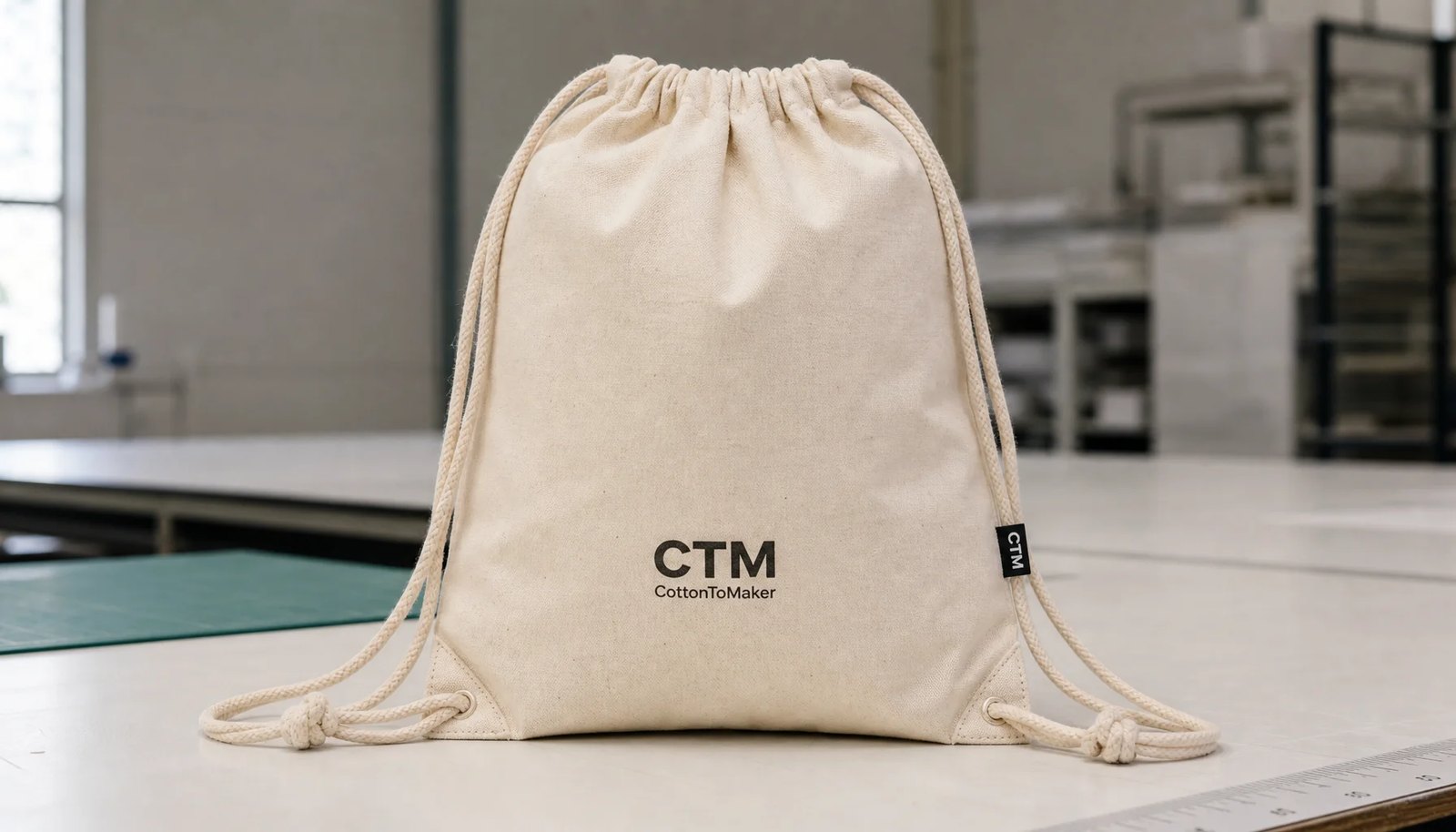
Define the Duty Cycle Before You Discuss Price
A cotton drawstring backpack for a trade show is not just a giveaway. It is a short-life logistics item, a walking brand surface, and sometimes the container for a day-long kit. Those jobs are different. A literature-only handout may carry a few brochures and a pen. A conference kit may hold a notebook, charger, catalog, sample box, and water bottle. Staff bags may be reused for setup, show days, and teardown. Procurement needs to define that duty cycle before talking to suppliers, because the right construction depends on load, handling, reuse, and brand visibility.
The most useful buying brief does not begin with a product photo. It begins with contents, event timing, handout method, and the failure modes the buyer cannot accept. If the order is for a registration desk giveaway, fast packing and low carton volume may matter more than premium finishing. If it is for a sponsor kit, the bag may need better handfeel, cleaner print, and a more polished interior. That is the real purpose of a cotton drawstring backpacks durability testing checklist for trade show exhibitors: the test should mirror how the bag will actually be filled, folded, shipped, unpacked, and carried.
The simplest internal question is the one buyers should ask first: what would make this order fail even if it ships on time? Common answers are split seams, crooked logos in attendee photos, cord anchors pulling out, damp odor after storage, carton shortages, or bags that cannot hold the promised kit. Put those risks into the RFQ. Suppliers quote better when the buyer describes the job instead of asking for a generic cotton drawstring backpack.
- Define the buyer role for the bag: giveaway, kit carrier, staff use, sponsor gift, retail-adjacent item, or reusable post-show bag.
- List expected contents and total target load in kilograms before setting GSM or seam specs.
- State event date, delivery location, warehouse hold time, and handout method because packing and moisture control depend on them.
- Name the unacceptable failures: seam split, cord pull-out, print cracking, wrong logo, odor, stains, or carton count errors.
Set Fabric Specifications Buyers Can Compare
Cotton fabric is often quoted too vaguely. Terms like heavy cotton, canvas feel, eco cotton, or premium fabric do not give procurement enough control. A comparable quote should state fiber content, weave, GSM, color, finishing process, and whether the fabric is greige, dyed, washed, pre-shrunk, or otherwise treated. If recycled cotton or a cotton blend is proposed, the supplier should state the blend and any expected effect on strength, shade variation, print behavior, and linting. Otherwise, two quotes may sound similar and still produce very different bags.
For trade show drawstring backpacks, fabric weight should follow the expected load. A 120-160 GSM cotton bag can work for light literature, but it is usually not the right choice for dense catalogs, bottles, sample kits, or repeated use. A 180-240 GSM range is a common practical zone for stronger event bags because it improves body stability without making carton volume excessive. Above 240 GSM, buyers usually move toward a more premium handfeel and better abrasion resistance, but cost, sewing difficulty, and freight volume can increase. GSM is not a warranty by itself; a loose 240 GSM weave can perform worse than a tighter 200 GSM fabric.
Ask when GSM is measured. Fabric may lose or gain apparent weight after dyeing, washing, calendaring, or finishing. Finished size can also drift if cotton shrinkage is not controlled. If the bag must fit a boxed kit or a die-cut insert, request finished-size tolerance after sewing and packing, not only cutting size. A good RFQ asks the factory to quote the same bag at two fabric weights using the same seam and cord construction, so the buyer can see the actual cost and performance trade-off instead of guessing from product photos.
- Use 120-160 GSM only for light, short-use literature giveaways.
- Use 180-240 GSM for most trade show kits with brochures, notebooks, and light samples.
- Use 240 GSM plus for heavier kits, higher perceived value, or repeated use, while checking carton volume and sewing quality.
- Specify weave and finish: plain weave, canvas, duck, drill, twill, washed, pre-shrunk, dyed, natural, or undyed.
- Ask for GSM tolerance and the measurement method used in production.
Control Size, Shape, and Load Path
Finished dimensions need tolerances. A buyer may request a 380 x 420 mm bag, but production can drift if cutting, sewing, washing, or pressing is not controlled. For many promotional programs, +/-10 mm on finished width and height is workable. For bags that must hold a specific folder, boxed sample, or kitted insert, tighter tolerances may be needed and should be tested before bulk. Measurement method matters too: the bag should be laid flat and smoothed without stretching, with width measured seam to seam and height measured from the top edge to the bottom seam.
Durability comes from the load path. The body panel rarely fails first. Failures usually appear at the top hem, cord channel, side seam junctions, bottom corners, and cord anchor points. A bag can look acceptable from the front while hiding weak inside seams, uneven seam allowance, or skipped stitches. Procurement should ask for construction photos and a simple stitch diagram when the order is important. That is especially useful when comparing suppliers, because two bags with the same GSM and size can have very different strength.
For drawstring backpacks, the cord is both closure and shoulder strap. If the cord tunnel is too narrow, the bag is hard to close. If the cord is thin or abrasive, it is uncomfortable when loaded. If anchor stitching is weak, the cord can tear out. Buyers should specify cord diameter in millimeters, material, color, length, end finish, and anchor method. A 4 mm cord may be acceptable for light bags; 5-6 mm can feel better for heavier kits, though it changes cost and packing volume. The best choice depends on the actual load, not only appearance.
- State finished width and height with tolerance, such as 380 x 420 mm +/-10 mm for standard promotional use.
- Specify seam type and seam allowance at side seams, bottom seam, top hem, cord channel, and cord anchor points.
- Request 8-10 stitches per inch as a starting point when suitable, then confirm the factory standard for the fabric weight.
- Require reinforcement at cord exits and anchor points using bar tack, box stitch, or another agreed method.
- Measure cord diameter, total cord length, and finished hanging balance on the approved sample.
Choose Logo Decoration for Handling, Not Just Color
Trade show bags are folded, stacked, rubbed in cartons, unpacked quickly, and carried against clothing. Decoration must survive that handling. For simple logos and one- to three-color event artwork, screen printing is often the most practical method on cotton. Water-based ink can give a softer handfeel, especially on natural or light cotton. Plastisol can provide opacity, depending on the market requirements and curing controls. Discharge printing, pigment printing, and other methods may be possible, but buyers should confirm fabric compatibility and final appearance on the actual cotton.
Heat transfer is useful for small runs, full-color artwork, or complex gradients, but it needs careful testing on cotton drawstring backpacks because folded packs can crease through the transfer. Transfers can also feel less integrated with the fabric. Embroidery can look premium, but dense embroidery on a lightweight cotton panel may pucker, distort the panel, or add a stiff area against the wearer. Woven labels are durable and useful for side branding, care information, sponsor marks, or a cleaner front panel, but the label seam must be sewn consistently and should not irritate the user.
Artwork approval should include real measurements. The buyer should specify print width, height, color reference, placement from top edge or side seam, and acceptable placement tolerance. A common placement tolerance might be +/-5 mm for many promotional orders, but the buyer should tighten or loosen that based on design sensitivity and factory capability. Do not approve decoration only from a digital proof. A physical decorated sample, folded in the final pack method, gives a better view of cracking, transfer, distortion, and crease placement.
- Use screen print for most high-volume cotton trade show backpacks with simple logos.
- Use water-based ink when soft handfeel is important and the fabric color supports the desired opacity.
- Use heat transfer for short runs or full-color art only after checking fold resistance and edge adhesion.
- Use embroidery only when the fabric weight and backing prevent puckering.
- Define print placement by measurement from fixed bag edges, not by visual centering alone.
Build a Test Plan Around the Actual Event Kit
A durability test is only useful if it reflects the real filled bag. Start by loading the sample with the event contents: brochures, notebook, catalog, bottle, charger, sample box, badge insert, or whatever the attendee is expected to carry. Weigh that kit and add a small margin if the show floor is likely to add more items. For a light literature bag, a 3 kg test may be enough. For a more substantial conference kit, 5 kg may be more realistic. If the bag is expected to carry heavy samples, test the actual maximum and make sure the supplier agrees to that target in writing.
Use both static and dynamic checks. A static hang test can reveal immediate seam or anchor weakness, but attendees do not carry bags like laboratory weights. They lift by one cord, pull both cords to close the top, swing the bag onto one shoulder, set it on the floor, and pick it up again. The sample should be carried, lifted, opened, closed, dropped gently onto a table or floor, and inspected after repeated handling. The goal is not to create an artificial torture test. The goal is to discover whether the construction matches the real event.
After the load test, check the details that often get missed: cord slip, knot security, distortion at the top hem, seam opening at the lower corners, fabric tearing near stitching, print cracking across fold lines, and shoulder comfort. If the bag passes only when handled carefully, it is not robust enough for a crowded trade show environment. Keep the tested sample with notes and photos so the buyer and factory have a shared standard before bulk begins.
- Weigh the real event kit and test the bag at that load, not at a vague promotional standard.
- For literature-only use, consider testing around 3 kg if that reflects the actual contents.
- For typical conference kits, test around 5 kg or the real filled weight, whichever is higher.
- For heavy sample programs, define the exact target load with the supplier and verify the construction before PO.
- Inspect after repeated lift, carry, close, open, set-down, and refold cycles.
Use a Procurement-Ready Durability Checklist
A checklist should help the buyer make decisions, not merely collect signatures. For cotton drawstring backpacks, the checklist should move from product use to material, construction, decoration, packing, and inspection. It should also separate must-have requirements from nice-to-have upgrades. A simple giveaway does not need every premium feature, but it still needs enough seam strength, cord quality, and print durability to avoid complaints during the event.
The checklist should be included with the RFQ and then updated after sample approval. If a supplier proposes a lower price by changing fabric, cord, seam method, packing, or print process, the buyer should be able to see the change immediately. This prevents quote comparisons from turning into a race to the thinnest acceptable bag. It also helps internal stakeholders understand why a slightly higher unit price may reduce rework, freight surprises, or event risk.
Use the checklist during final inspection too. Procurement often writes strong requirements but then inspects only logo appearance and carton count. That misses the failures that matter most in use. A final inspection should include measurements, load checks on samples from production, seam review, decoration review, odor and moisture check, and carton verification. That is the point where the buyer decides whether the goods are ready for the show or need hold-and-sort action.
- Use case: event type, handout method, expected contents, target load, reuse expectation, and delivery date.
- Material: cotton content, weave, GSM, color, finish, shrinkage expectation, and approved fabric swatch.
- Construction: finished size, tolerance, seam allowance, stitch density, reinforcement, cord diameter, and anchor method.
- Decoration: method, ink or thread details, artwork size, color reference, placement tolerance, curing or adhesion check, and fold test.
- Packing: fold method, inner pack count, master carton count, carton dimensions, gross weight, carton marks, and polybag policy.
- QC: defect classification, AQL or pass-fail rule, inspection timing, retained samples, photo records, and rework procedure.
Make Sampling Mirror Bulk Production
A sample is only useful if it predicts bulk production. For cotton drawstring backpacks, the most reliable sequence is blank sample, decorated sample, and pre-production sample. The blank sample confirms size, handfeel, seam method, cord behavior, and basic load performance. The decorated sample confirms logo color, placement, curing, fold resistance, and visual impact. The pre-production sample should use the same bulk fabric, cord, label, print method, and packing method planned for the full order.
Do not treat a sales sample as a full approval unless the supplier confirms it matches the quoted construction. Sales samples are often made to show a style, not to lock a production spec. They may use a different fabric lot, better sewing, hand-cut panels, or a decoration process that is not used on the bulk line. For time-sensitive events, buyers sometimes must approve faster, but they should at least require a clear written list of differences between the sample and production.
Sampling should include packing. If the final bag will be folded across the logo, compressed in bundles of 25 or 50, and packed 100 or 200 per carton, the sample should be folded the same way. If individual polybags, barcode labels, hangtags, or insert cards are required, the sample should show them. Packing changes can affect print creasing, carton volume, labor cost, and distribution speed at the venue. A perfect loose sample on a table is not enough.
- Blank sample: approve fabric, size, sewing, cord, handfeel, and initial load behavior.
- Decorated sample: approve logo method, color, placement, curing, fold resistance, and appearance after handling.
- Pre-production sample: approve bulk materials, construction, decoration, label, packing, and carton plan before mass production.
- Retained sample: keep a signed or clearly recorded reference for final inspection and reorder comparison.
- Sample notes: record every deviation instead of relying on memory, photos, or informal chat approvals.
Define QC Defects and AQL Before Production
Quality control must be defined before the purchase order, not after a shipment problem appears. For event goods, timing makes this especially important because there may be no opportunity to remake goods before the show. Critical defects should have zero acceptance. These include wrong logo, wrong color, missing cords, open seams, broken cord anchors, mildew, strong odor, oil contamination, sharp foreign objects, or any defect that makes the bag unusable or unsafe. A shipment with critical defects can create immediate event risk.
Major defects affect function, saleability, or brand presentation. Examples include severe size deviation, weak stitching, skipped stitches at stress points, noticeably crooked print, ink cracking, incorrect label position, stains, mixed shade lots beyond approval, wrong pack count, or carton damage that affects the goods. Minor defects are small issues that do not affect function or overall presentation, such as small thread ends or light fold marks within the approved standard. Buyers should define these categories in the PO so the factory knows what will trigger rework or sorting.
Many B2B buyers use AQL sampling for final inspection. A common starting point for promotional textile items is AQL 2.5 for major defects and 4.0 for minor defects, with critical defects not accepted. However, the right plan depends on order size, risk, customer requirements, and inspection budget. If a buyer does not use formal AQL, it should still define a pass-fail rule. Vague language like good quality or export standard is not enough to manage a fixed-date trade show order.
- Critical defects: wrong artwork, open seams, missing cords, broken anchors, mildew, contamination, strong odor, or unusable bags.
- Major defects: weak stitching, severe size drift, crooked print, print cracking, stains, mixed lots, incorrect labels, or wrong carton counts.
- Minor defects: loose thread tails, slight fold marks, or small cosmetic variation within the approved standard.
- Inspection timing: use in-process checks for large orders and final random inspection before shipment release.
- AQL reference: consider 0 critical, 2.5 major, and 4.0 minor only if it fits the buyer's risk level and is accepted by the supplier.
Treat Packing, Moisture, and Cartons as Durability Issues
Packing is part of the product because poor packing can damage otherwise acceptable bags. Cotton bags can pick up odor, moisture, creases, stains, and carton marks during storage and transit. A tight carton can crush print areas. A loose carton can shift and scuff. A fold line through a thick transfer or heavy ink deposit can cause cracking. The buyer should approve the fold method and carton count with the same seriousness as the logo proof.
For booth giveaways, bulk inner packs are often more efficient than individual polybags. For example, bags may be bundled in 25s or 50s and packed into master cartons, depending on size, fabric weight, and distribution plan. Individual polybags add labor, material, volume, and unpacking time, and they may conflict with the buyer's sustainability policy. However, individual packing may still be required for retail distribution, direct mail, kitting, or barcode control. The correct choice depends on how the bags will move after delivery.
Freight comparison requires carton data. A low unit price may become less attractive if cartons are oversized or packed inefficiently. Ask for pieces per carton, carton dimensions, net weight, gross weight, and estimated CBM. For cotton goods moving through humid routes or waiting in warehouse storage, discuss moisture control. Desiccants, dry storage, clean cartons, and avoiding damp packing conditions are practical safeguards. The buyer should also check odor before shipment release because odor complaints are difficult to fix at the event site.
- Approve fold direction so hard creases do not run through the logo or stress points.
- Specify inner pack count, master carton count, carton marks, and whether mixed SKUs are allowed in one carton.
- Request carton dimensions, gross weight, net weight, and CBM before comparing landed cost.
- Avoid individual polybags unless distribution, retail, barcode, or cleanliness requirements justify them.
- Check moisture, odor, carton crush, and contamination during final inspection.
Compare Quotes on Total Risk, Not Only Unit Price
Cotton drawstring backpack quotes can look similar while hiding different assumptions. One supplier may quote 160 GSM cotton with single stitching and bulk packing. Another may quote 220 GSM cotton, reinforced anchors, better cord, tested screen print, and stronger cartons. If the buyer compares only unit price, the cheaper quote will usually win on paper and lose in use. The RFQ should force each supplier to price the same fabric, construction, decoration, and packing requirements.
Break the quote into components. Ask for the blank bag price, decoration price, label cost, setup charges, sample cost, packing cost, inspection cost if applicable, and carton data. This helps procurement see whether a cost increase is coming from material, labor, decoration complexity, or packing. It also gives the buyer room to value-engineer intelligently. For example, dropping embroidery in favor of a clean screen print may save money without reducing function, while reducing reinforcement at cord anchors may create real failure risk.
Lead time should be quoted from final sample approval and material confirmation, not from the first email. A useful production calendar includes material booking, cutting, sewing, decoration, curing or finishing, trimming, inspection, packing, and shipment handover. Buyers should ask what happens during peak season, public holidays, or fabric shortages. If the event date is fixed, late discovery of these risks is expensive. Quote discipline is durability control in another form, because a rushed factory is more likely to miss sewing, curing, packing, and inspection details.
- Ask every supplier to quote the same GSM, size, seam construction, cord diameter, print method, and packing method.
- Separate unit price from setup, sample, label, packing, inspection, and freight-related carton data.
- Request cost options only where trade-offs are clear, such as 180 GSM versus 220 GSM or 4 mm cord versus 5 mm cord.
- Do not remove reinforcement, inspection, or moisture controls just to meet a target price if the bag carries real load.
- Confirm lead time by stage and tie production start to written approval of the pre-production sample.
Specification comparison for buyers
| Sourcing route | Best-fit program | Specification control to request | Main procurement risk |
|---|---|---|---|
| Direct cut-and-sew factory with in-house printing | Recurring trade show programs, annual buying, or orders where sample-to-bulk consistency matters | Written fabric spec, finished size tolerance, seam map, cord diameter, decoration method, packing plan, and inspection standard | The factory may quote from a generic sample unless the buyer locks the approved spec and pre-production sample |
| Cut-and-sew factory plus outside decorator | Custom sewing with specialty transfer, embroidery, or multi-step decoration | Clear responsibility split for blank inspection, decoration approval, curing, rework, and packing release | Seam defects and print defects can be disputed unless ownership is defined before the PO |
| Trading company managing several factories | Multi-SKU promotional programs, mixed textile accessories, or buyers wanting one export contact | Named production site, QC process, material source, and written approval required for any factory substitution | The production site may change after sample approval, creating drift in fabric feel, stitching, or packing |
| Stock blank bag with added logo | Rush shows, pilot events, low-volume campaigns, or simple one-color branding | Measured blank data sheet, cord length, finished size, stock color lot, and a decoration test sample | Speed can come with limited control over seam strength, cord quality, and carton packing |
| Domestic decorator using imported blanks | Very short deadlines, event-specific imprinting, or approved blank styles already held in inventory | Incoming blank inspection, print compatibility check, cure settings, and pack count after decoration | A strong print cannot fix weak anchors, open seams, shrinkage, odor, or inconsistent blank dimensions |
| Audited export factory with testing records | Brand-controlled programs, retail-adjacent giveaways, or shipments needing traceability | Audit scope, recent test reports for comparable cotton bags, material traceability, and inspection photos | Documentation is useful only if it matches the same construction, fabric weight, and production line |
| Dual-source program with approved backup supplier | Large event calendars, recurring regional shows, or continuity planning | One master spec sheet, one approved artwork file, one measurement method, and matched tolerances for both factories | Backup production may look close but still vary in shade, cord feel, stitch density, or print position |
| Marketplace or low-MOQ supplier | Concept validation, photo samples, or small internal events | Actual sample measurements, pack photos, and written confirmation of repeatability | Useful for exploration, but repeat-order consistency and formal QC control are often limited |
Buyer checklist before sampling
- Write the event use case first: literature-only giveaway, attendee kit, staff bag, VIP gift, retail-adjacent item, or reusable post-show bag.
- List the expected contents and target filled weight. Use kilograms and include the heaviest likely combination, not the average handout.
- Specify finished bag size with tolerance, for example 380 x 420 mm with +/-10 mm unless the application needs tighter control.
- Quote fabric by fiber content, weave, color, GSM, and finishing status. Ask whether GSM is measured before or after dyeing, washing, or calendaring.
- Set a practical fabric range: 120-160 GSM for light literature only, 180-240 GSM for most event kits, and 240 GSM plus for heavier or premium reusable bags.
- Define seam construction at the side seams, bottom seam, top hem, cord channel, and cord anchor points. Do not rely on the phrase reinforced stitching without details.
- State stitch density target, seam allowance, and reinforcement method where possible. A common buyer check is 8-10 stitches per inch, then confirm the factory standard for the chosen fabric.
- Specify cord material, diameter, length, color, end finish, and knot or stopper method. Ask for diameter in millimeters, not only a product photo.
- Choose decoration by use: screen print for simple logos, water-based ink for softer handfeel, plastisol for opacity where suitable, transfer for short runs or full-color art, and woven labels for durable secondary branding.
- Require a decorated sample to pass fold, rub, and packing checks before the print file is released for bulk.
Factory quote questions to send
- What exact fabric are you quoting: cotton content, weave, yarn style if known, GSM, color, and finishing process?
- Is the GSM measured before or after dyeing, washing, shrinking, or finishing, and what GSM tolerance do you control in production?
- What are the finished dimensions and tolerances for width, height, cord length, print placement, and label placement?
- What seam construction will be used at the sides, bottom, top hem, cord channel, and cord anchor points?
- What stitch density and thread type are included in the quote, and will stress points use bar tack, box stitch, or extra backstitching?
- What cord material and diameter are included, and can you quote alternatives such as 4 mm, 5 mm, or 6 mm cotton cord?
- What target load has this construction previously been used for, and can you perform a simple loaded hang and carry test on the pre-production sample?
- Which decoration method are you quoting, and what ink, transfer, embroidery, or label limitations apply to this cotton fabric?
- What setup charges apply for screens, plates, embroidery digitizing, transfer artwork, woven labels, or color matching?
- What is included in the unit price: blank bag, sewing, cord, decoration, label, folding, inner pack, master carton, and export carton marks?
Quality-control points to confirm
- Classify open seams, missing cords, wrong artwork, wrong bag color, mildew, strong odor, contamination, sharp objects, and broken anchor points as critical defects with zero acceptance.
- Classify weak stitching, severe size deviation, crooked print, print cracking, stains, skipped stitches at stress points, incorrect carton count, and mixed lots as major defects.
- Classify loose thread ends, small fold marks, slight shade variation within the approved range, and minor trimming inconsistency as minor defects when they do not affect use or brand appearance.
- Measure finished width and height on a flat bag without stretching. A common promotional tolerance is +/-10 mm, but tighter programs should state their own requirement.
- Measure cord length from exit to end under the same method used for approval. Uneven cord length can make the bag hang crooked even when the body is acceptable.
- Check fabric GSM with a cutter and scale when possible, or require factory measurement records if inspection tools are not available at the buyer site.
- Inspect seam allowance, stitch density, backstitching, and reinforcement at top corners, cord exits, side seams, and bottom corners.
- Perform a loaded hang test using the agreed target weight. For many trade show programs this may be 3-5 kg; heavier kits should be tested at the real expected filled weight plus a sensible margin.
- Perform a carry simulation: lift by both cords, carry for several minutes, set down, repeat, and inspect for cord slip, seam opening, fabric tearing, and panel distortion.
- Run a dry rub check on the logo with a white cotton cloth. If color transfer appears, confirm ink curing or decoration suitability before bulk release.