Start with the craft fair job the bag must do
Cotton drawstring backpacks for craft fairs are not all bought for the same reason. Some are free visitor bags handed out at the entrance. Others become maker kit packaging, sponsor merchandise, artist collaboration items, exhibitor welcome bags, or retail resale products. Those use cases look similar in a catalog photo, but they should not share the same specification. A giveaway can be lighter, bulk packed, and printed with a simple event logo. A bag sold beside handmade goods needs a better hand feel, cleaner stitching, stronger corners, and a fold that looks presentable when unpacked.
This is where many wholesale projects drift off course. The RFQ says cotton drawstring backpack, and every supplier fills in the blanks differently. One quote may be based on 5 oz cotton, thin polyester cord, no lower reinforcement, and loose bulk packing. Another may include 8 oz cotton canvas, cotton rope, reinforced corners, a printed strike-off, and individual packing. The cheaper unit price is not necessarily wrong, but it is not the same product.
Before chasing prices, write down the real craft fair environment. Bags may be pulled from cartons quickly, opened and closed repeatedly, worn on the shoulder, placed on dusty tables, and filled with catalogs, small purchases, greeting cards, candles, yarn, water bottles, or boxed craft supplies. If the bag is tied to a dated fair, delivery reliability may matter as much as the last few cents of unit cost.
- For giveaways, prioritize predictable quantity, low defect rate, clear logo printing, and fast unpacking.
- For retail resale, prioritize fabric hand feel, stitch consistency, print durability, front-panel cleanliness, and unit presentation.
- For maker kits, prioritize usable capacity, weight-bearing strength, cord comfort, and carton organization by kit version.
- For sponsor merchandise, prioritize logo accuracy, approved color standards, and protected approval dates.
- For distributor stock, prioritize repeatable specs, simple artwork changes, and usable production records for reorders.
Build the RFQ around measurable specifications
A strong wholesale buying checklist turns preferences into numbers and named construction details. Instead of asking for a natural cotton drawstring backpack, specify finished size, fabric weight, GSM range, fabric finish, cord material, cord diameter, cord length, reinforcement method, print method, print area, label requirements, packing format, carton data, and inspection expectations. That may sound detailed, but it is faster than trying to fix vague quotations later.
Separate the base product from upgrades. A practical craft fair specification could be: 35 x 42 cm finished size, 8 oz natural cotton canvas at about 250-280 GSM, one-color front screen print, cotton rope cord, reinforced lower corners, and bulk packing by dozens. Optional add-ons might include individual polybags, hangtags, barcode stickers, custom dyed fabric, extra print colors, embroidery patches, or insert cards. When these items are listed separately, buyers can see exactly what drives cost.
Commercial details belong in the RFQ too. State target quantity, number of artwork versions, required delivery date, destination country, Incoterm, sample requirements, inspection plan, and whether the supplier must provide carton dimensions before order confirmation. If the product is for a fixed seasonal craft fair, ask for the latest safe approval date. A production lead time is only useful when the trigger point is clear.
- Specify finished size after sewing, not only approximate panel size.
- Ask all suppliers to quote the same GSM, fabric finish, cord diameter, reinforcement, print method, and packing format.
- List must-have requirements separately from optional upgrades.
- State how many artwork versions, SKUs, barcode stickers, and carton marks are needed.
- Request unit price, setup charges, sample cost, lead time trigger, carton data, inspection access, payment terms, and delivery term.
Control fabric by GSM, finish, shade, and shrinkage
Fabric is one of the biggest cost drivers in cotton drawstring backpacks. It also shapes the buyer’s first impression. Cotton bags are often quoted in ounces per square yard, while mills and factories may also use GSM. As a working guide, 4-5 oz cotton is often around 140-170 GSM, 6 oz around 180-220 GSM, 8 oz around 250-280 GSM, and 10 oz around 300-340 GSM. For simple craft fair giveaways, 6 oz may be acceptable. For resale, maker kits, and stronger event merchandise, 8 oz usually feels more substantial without pushing the product into a heavy canvas category.
Natural unbleached cotton is popular at craft fairs because it suits handmade, organic, and artisan branding. It also brings variation: seed flecks, yarn slubs, neps, and shade differences between fabric lots. These are not automatically defects. They become defects when the buyer expected a cleaner surface or when bulk production is far away from the approved sample. Bleached cotton creates a cleaner print base and can make graphics look brighter, but it may show handling marks more easily. Dyed cotton supports brand color programs, yet it adds lab dip approval, dye lot controls, rubbing checks, and often higher MOQ.
Do not treat cotton canvas as a generic material. Two fabrics described as 8 oz cotton can feel different because of yarn, weave density, finishing, and shrinkage. Ask whether the fabric is stock or made to order. If repeat orders are likely, confirm whether the supplier can maintain the same fabric construction or at least keep an approved reference standard. If end users may wash the bag, request shrinkage information and decide whether a wash test is necessary. For most craft fair use, the immediate priority is simpler: the fabric must match the approved weight, shade, hand feel, and print base.
- Write fabric as both oz and approximate GSM, for example: 8 oz cotton canvas, about 250-280 GSM.
- Reject quotes that only say 100 percent cotton without weight, weave, finish, and sample reference.
- For natural cotton, approve the acceptable level of flecks, slubs, neps, and shade variation before cutting.
- For bleached cotton, check print brightness and handling-mark visibility.
- For dyed cotton, require lab dip or swatch approval, shade tolerance, and dry/wet rubbing expectations.
Specify size, cords, channels, and corner reinforcement
A common adult cotton drawstring backpack size is about 35 x 42 cm finished. Smaller sizes, such as 30 x 38 cm, suit kids’ packs, compact retail bundles, lightweight kits, or small sample assortments. Bigger bags can look more generous, but they increase fabric consumption, carton volume, and stress at the lower drawcord points. If the bag may carry catalogs, notebooks, bottled drinks, or boxed craft materials, treat size and reinforcement as functional requirements, not styling notes.
The cord system is often where low-cost bags feel cheap or fail early. Thin cords can dig into shoulders, twist inside the channel, fray, or make the closure uneven. Cotton rope or thicker cotton cord supports a natural craft look, though it may cost more and may show slight shade variation. Polyester cord usually pulls smoothly and has consistent color, but it changes the overall feel. The RFQ should state cord material, diameter, color, length, and end finish. A 5-8 mm diameter range is common for craft fair bags, but the approved sample should decide the final comfort and look.
Pay close attention to the bottom cord attachment. It carries the load when the bag is worn. Common options include metal eyelets, sewn fabric tabs, triangular reinforcement patches, and sewn corner channels. Eyelets must be set firmly and should not cut into the fabric. Fabric tabs should have enough seam capture and backtacking. Triangular patches add strength, but they require clean alignment. Whatever method is selected, pull both cords firmly on the sample several times. Look for tearing, loose stitches, distorted fabric, or slipping knots.
- Adult general-use size: about 35 x 42 cm finished.
- Compact size: about 30 x 38 cm for kids, small kits, or compact resale packs.
- Natural craft positioning: cotton rope or thick cotton cord, commonly 5-8 mm, confirmed by sample.
- Baseline construction: double-fold top channel, lockstitch seams, reinforced bottom corners, and backtack at stress points.
- Avoid vague wording like strong cord or good sewing; name the cord diameter, seam allowance, stitch type, and reinforcement method.
Choose the print method from the artwork, not from habit
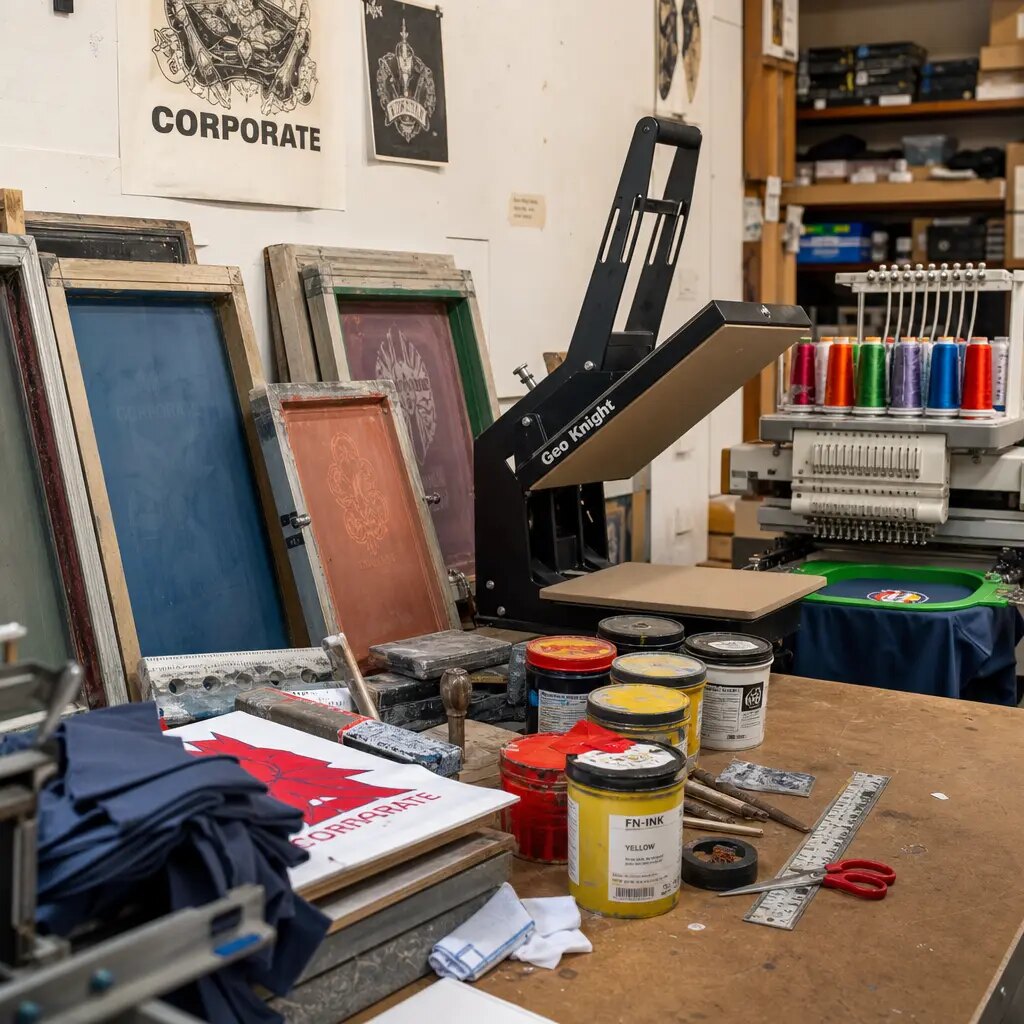
Most cotton drawstring backpacks for craft fairs use screen printing. It is efficient for one to three solid colors, event names, sponsor logos, artist marks, and simple illustrations. It also works well at wholesale quantities. The catch is fabric texture. Tiny text, hairline details, distressed effects, and tight registration may not print on cotton canvas exactly the way they appear on a digital mockup. Buyers should provide vector artwork where possible and define print size, position, color count, Pantone or brand references, and placement tolerance.
Ink and fabric finish change the result. Water-based or pigment inks can give a softer hand feel that suits natural cotton. Dark dyed fabrics may need different ink systems or an underbase to achieve opacity. Heat transfer is useful for gradients, photos, full-color artwork, or lower quantities with many design versions, but buyers should check edge adhesion, hand feel, fold marks, and transfer durability on cotton. Embroidery can look premium for a small logo or patch, yet it is usually expensive and slow for large front graphics and can pucker lighter fabric.
A printed strike-off is worth the time when the supplier, artwork, fabric, or print process is new. It should be produced on the approved cotton, not a smooth substitute. Review color, opacity, line clarity, registration, hand feel, curing, placement, and behavior after rubbing or folding. A print that saves a little on the quote can become expensive if sponsor logos are wrong, ink feels tacky, or the goods miss a dated fair because the first bulk run was not acceptable.
- Use screen print for simple logos, event text, sponsor graphics, and solid-color artwork.
- Use heat transfer for full-color art, gradients, photos, or low quantities split across many versions.
- Use embroidery for small premium marks or patches, not large economical front panels.
- Provide final artwork size, placement, Pantone references, orientation, and color count.
- Require a printed strike-off on approved fabric for new artwork, dark fabric, tight brand colors, or a new supplier.
Plan MOQ by version, material, and packing style
MOQ is not just a factory rule. It is the result of fabric availability, dyeing, screen setup, label production, packing labor, and how many versions must be controlled. A basic natural cotton backpack with a one-color print may be workable at lower wholesale quantities, often around 300-500 pieces depending on fabric stock, factory workload, and season. Add custom dyed cotton, four artwork versions, woven labels, custom cord colors, hangtags, barcode stickers, and individual polybags, and the same total quantity becomes a far more complicated order.
Separate total order quantity from version quantity. A 1,000-piece order in one artwork is not the same as 1,000 pieces split across five designs. Every artwork may need separate screens, print setup, counting, packing checks, and carton marks. Every fabric color needs its own material control. Every barcode or hangtag version creates another possible mix-up. If a craft fair program includes multiple artists, sponsors, or booth categories, standardize the bag body first. Vary only the front print unless there is a strong commercial reason to do more.
Ask suppliers to quote several split scenarios. For example: 500 pieces with one artwork, 1,000 pieces with one artwork, 1,000 pieces split into two artworks, and 1,000 pieces split into five artworks. This exposes setup costs early. If the first order is a market test, keep the product simple: one size, one fabric color, one cord, limited print colors, and a packing format that the warehouse or event team can handle.
- Confirm MOQ per artwork, fabric color, cord color, label type, hangtag, barcode sticker, and packing style.
- For test orders, use natural fabric, one size, limited artwork versions, and simple packing.
- Avoid custom dyed fabric for small trials unless brand color is essential.
- Treat labels, hangtags, barcode stickers, and polybags as MOQ drivers.
- Ask for artwork-split pricing before finalizing the creative plan.
Compare supplier quotes by what is included, not just unit price
The best quote is not always the lowest number. It is the quote that makes the product clear enough to buy, inspect, and reorder. For cotton drawstring backpacks, compare fabric weight, fabric finish, finished size, cord diameter, reinforcement, print method, number of print colors, sample process, packing, carton CBM, inspection access, payment terms, Incoterm, and lead time trigger. A low price with unspecified GSM, unknown cord material, no carton data, and vague printing details leaves too much risk with the buyer.
Supplier type also matters. A direct factory may be best when the buyer has a clear spec and wants repeatable production control. A trading company can help when the program includes several categories, such as tote bags, pouches, aprons, and drawstring backpacks in one shipment. A local decorator may be useful for urgent small runs, but blank quality and print cost may differ from factory production. Choose the sourcing route based on timeline, order complexity, inspection needs, and reorder plans.
Do not rely only on catalog images. Ask for photos of similar production, including the top channel, lower cord corners, seam close-ups, inside finishing, and printed panels. If repeat programs are likely, ask whether the supplier keeps sealed reference samples, artwork files, and production notes. For mixed shipments, confirm who is responsible for final inspection, SKU separation, carton labels, and consolidation accuracy.
- Compare price together with GSM, finished size, cord diameter, reinforcement, print method, packing, CBM, and lead time trigger.
- Ask whether screen charges, sample charges, lab dips, hangtags, barcode application, carton marks, and inland freight are included.
- Request close-up photos of comparable bulk production, not only polished catalog images.
- For repeat orders, prefer suppliers who keep approved samples and production records.
- For consolidated shipments, clarify inspection control, SKU separation, carton labeling, and mixed-carton rules.
Use samples to approve production standards, not just looks
A sample should prove how the bag will be made. For cotton drawstring backpacks, inspect fabric weight, hand feel, shade, finished size, cord thickness, cord pull, top-channel smoothness, corner reinforcement, seam tension, print color, print placement, and packing style. A photo can confirm basic appearance, but it cannot tell you enough about canvas weight, print hand feel, shoulder comfort, or corner strength. New buyers should not approve bulk production from a digital mockup alone.
Different sample stages answer different questions. A fabric swatch confirms weight, weave, finish, and shade. A blank construction sample confirms sewing, size, cord, and reinforcement. A printed strike-off confirms ink behavior on the approved fabric. A complete pre-production sample brings everything together: fabric, print, cord, labels, hangtags, barcode stickers, folding, and unit packing. For repeat orders, a retained production sample may be enough if all materials, artwork, trims, and packing remain unchanged.
Keep the approval record practical and specific. Include dated photos, measured dimensions, fabric reference, artwork file version, print size, print position, cord specification, label placement, packing method, and allowed deviations. The buyer should keep one approved sample, and the factory should keep one sealed or signed reference sample for production and QC. If natural cotton variation is acceptable, document it now. Do not leave that decision for inspection day.
- Measure the sample after sewing, not before.
- Compare fabric weight against the quoted GSM or approved swatch where practical.
- Pull both cords repeatedly to check channel movement and lower-corner strength.
- Rub the print to check tackiness, powdering, weak adhesion, transfer lifting, or residue.
- Check whether folding creates unwanted creases through the artwork.
- Keep one approved sample with the buyer and one sealed reference sample with the factory.
Set QC tolerances before goods are inspected
Quality control becomes much easier when acceptance rules are written before production. Typical checks include fabric weight, finished dimensions, print placement, print defects, seam defects, loose threads, cord length, drawcord function, corner reinforcement, odor, stains, moisture, and packing accuracy. For natural cotton, the approved sample should define acceptable seed flecks, slubs, neps, and shade variation. Otherwise, one inspector may accept natural texture while another treats it as a defect.
Functional failures should carry more weight than minor cosmetic variation. A small cotton slub may be fine for a natural craft fair look. A torn lower corner, missing cord, open seam, wrong artwork, wet carton, mildew odor, or severe front stain is not fine. For retail resale, visible stains and off-center logos are more serious because customers judge the product on presentation. For giveaways, buyers may allow wider cosmetic tolerance, but the bag still must function and represent the event brand properly.
Inspection should cover both the product and the cartons. Product checks verify sewing, print, appearance, cord function, and measurements. Carton checks verify quantity, artwork version, carton marks, inner bundle count, barcode labels, carton condition, odor, and dryness. If multiple artwork versions are included, inspectors should confirm counts by version. Random mixing should only happen if the buyer approved it. The final report should include defect photos, measurement records, carton photos, and a clear shipment release recommendation.
- Fabric weight tolerance: commonly plus or minus 5 percent unless a tighter retail standard is agreed.
- Finished size tolerance: commonly plus or minus 1 cm for sewn cotton drawstring backpacks.
- Print placement tolerance: commonly plus or minus 5 mm to 10 mm depending on artwork size and panel construction.
- Major defects: wrong artwork, missing cord, open seam, broken corner, severe stain, mold odor, incorrect packing, or wet carton.
- Minor defects: small loose thread, light slub, slight seed fleck, or shade variation within the approved standard.
- Carton checks: quantity, artwork version, carton marks, inner bundle count, barcode accuracy, carton strength, odor, and dryness.
Match packing to distribution, retail handling, and freight cost
Packing should match what happens after the shipment arrives. Bulk packing by dozens or 25s is efficient for event teams and booth operators who need to open cartons quickly. Individual polybags protect against dust and improve retail handling, but they add material, labor, packing time, carton volume, and cost. If the bag will be sold in a shop or handled by a distributor, barcode stickers, hangtags, insert cards, or a clean fold standard may be necessary. If it will be handed out at a fair entrance, those details may slow the team down and waste budget.
Carton data affects landed cost and warehouse planning. Request pieces per carton, carton dimensions, gross weight, net weight, total carton count, and total CBM before the order is confirmed. Cotton goods are not fragile, but they can absorb moisture, dust, and odors if stored badly. Natural cotton also shows dirt more easily than dark dyed fabric. Cartons should be clean, dry, and strong enough for export handling. If cartons are too heavy, event staff struggle to move them. If they are underfilled, freight efficiency suffers.
Mixed artwork programs need especially clear packing rules. Random mixing may be convenient for the factory, but it can create event-day sorting problems. If designs go to different artists, booths, sponsors, or retail SKUs, cartons should be marked by artwork and quantity. Inner bundles can be tied or bagged by count for fast distribution. Barcode stickers should be tested for scanability and SKU accuracy before shipment, not after the goods reach the warehouse.
- For event distribution, use bulk packing, inner bundles by quantity, and large clear carton marks.
- For retail resale, consider individual polybags, barcode stickers, hangtags, clean folding, and tighter cosmetic standards.
- For mixed artwork, avoid random mixing unless the buyer has approved the separation method.
- For import planning, require carton size, carton quantity, gross weight, net weight, and CBM.
- For natural cotton, require clean, dry cartons and packing that protects against dust, moisture, and warehouse odor.
Specification comparison for buyers
| Spec decision | Recommended option | When it fits | Buyer risk to check |
|---|---|---|---|
| Fabric weight | 6 oz, about 180-220 GSM, for light giveaways; 8 oz, about 250-280 GSM, for craft fair resale, maker kits, and stronger event merchandise; 10 oz, about 300-340 GSM, only when a heavier canvas hand feel is part of the offer | Craft fair vendors need bags that can hold catalogs, small purchases, boxed craft supplies, sample kits, or a water bottle without feeling disposable | Quotes that only say cotton canvas are not comparable. Request oz, GSM range, weave, finish, shrinkage expectation, and finished sample weight |
| Fabric finish | Natural unbleached cotton for artisan positioning; bleached cotton for a cleaner print base; dyed cotton only when brand color is important enough to absorb MOQ, lab dip, and crocking controls | Natural cotton works well for handmade markets because seed flecks and small slubs can support an organic visual style | Unbleached cotton has shade and fleck variation; dyed cotton needs lab dip approval, color tolerance, shrinkage control, and dry/wet rubbing checks |
| Backpack size | 35 x 42 cm finished size for adult general use; 30 x 38 cm for kids, lightweight kits, or compact retail packs; confirm tolerance after sewing, not before cutting | A 35 x 42 cm bag balances capacity, fabric consumption, front print area, and carton efficiency | Oversized bags increase unit cost and stress at lower cord points; require reinforcement and seam allowance details before approving a large size |
| Cord material | Cotton rope or thick cotton cord, commonly 5-8 mm diameter, for natural positioning; polyester cord when lower cost, smoother draw, or color consistency is the priority | Cotton rope supports craft and eco-style branding, while polyester may suit high-volume promotional distribution | Thin cords reduce shoulder comfort and perceived value. State cord diameter, length, end finish, color, and whether knots, heat seal, or metal/plastic tips are used |
| Print method | Screen print for 1-3 solid colors; heat transfer for gradients, photos, or lower quantities; embroidery only for small premium marks or patches | Most craft fair orders use simple logos, event branding, sponsor graphics, artist marks, or kit names where screen print is economical and durable | Fine artwork on textured cotton may lose detail. Require artwork size, Pantone references, print placement tolerance, print hand feel, and a strike-off on approved fabric |
| Construction | Double-fold top channel, lockstitch seams, backtack at stress points, reinforced bottom cord corners, and seam allowance typically around 8-10 mm unless otherwise specified | Backpacks used at fairs are repeatedly opened, pulled, carried, stacked, and distributed quickly from cartons | Low quotes may omit reinforcement, reduce seam allowance, use loose stitch tension, or skip backtacking, causing tearing at the lower cord points |
| MOQ logic | 300-500 pieces may be workable for basic natural stock fabric with simple print; expect higher MOQ for dyed fabric, custom cords, woven labels, hangtags, or multi-version packing | Buyers testing a craft fair assortment can start with natural fabric, one size, and limited artwork versions before adding trims | MOQ is not only a factory rule. Fabric dyeing, label weaving, screen setup, barcode stickers, and retail packing can each create minimums |
| Packing format | Bulk pack by dozens or 25s for event distribution; individual polybag for retail cleanliness; barcode or hangtag only when checkout, warehouse, or inventory systems require it | Craft fair distributors often need fast unpacking, while retail brands may need a clean unit presentation and scannable product data | Overpacking adds labor, plastic, carton volume, and cost; underpacking can create dust marks, stains, mixed SKUs, or event-day sorting problems |
| Lead time trigger | Production lead time should start only after deposit, final artwork, approved sample or strike-off, and approved packing information are complete | Seasonal craft fairs have fixed dates, so approval milestones matter as much as quoted production days | A quote saying 25 days is vague unless it states the trigger point, sampling time, inspection window, and shipment handover date |
Buyer checklist before sampling
- Define the intended use: craft fair giveaway, maker kit packaging, event merchandise, sponsor bag, artist collaboration, retail resale, or distributor stock.
- Create a one-page specification sheet with finished size, fabric weight, GSM range, cotton finish, cord material, cord diameter, cord length, reinforcement method, print method, label details, and packing format.
- State fabric weight in oz and approximate GSM, such as 8 oz cotton canvas, about 250-280 GSM, and ask the supplier to confirm the production fabric tolerance before sampling.
- Specify natural, bleached, or dyed cotton, and define whether seed flecks, slubs, shade variation, and fabric neps are acceptable against an approved reference sample.
- Lock finished bag dimensions after sewing, with dimensional tolerance, seam allowance expectation, top channel construction, drawcord routing, and lower corner reinforcement method.
- Provide artwork in vector format where possible, with final print size, print position, Pantone or brand color references, color count, orientation, and no-print or fold areas.
- Choose the print method based on artwork detail, fabric texture, color count, volume, print hand feel, opacity requirement, and durability expectation.
- Request a fabric swatch, blank construction sample, and printed strike-off before bulk production when the supplier, artwork, fabric finish, or print method is new.
- Define MOQ by version, not only total order quantity, when there are multiple artwork designs, fabric colors, cord colors, labels, hangtags, barcode stickers, or packing styles.
- Confirm whether the quoted price includes screen charges, sample charges, lab dips, label application, hangtags, folding, individual packing, barcode stickers, carton marks, export cartons, and inland freight to port.
Factory quote questions to send
- What exact fabric are you quoting: cotton type, weave, oz, GSM range, finish, shrinkage expectation, and whether it is natural, bleached, or dyed?
- Is the fabric stock fabric or made to order, and what happens to lead time, shade, or MOQ if the same fabric lot is unavailable?
- What is the finished bag size after sewing, and what dimensional tolerance will production follow for width, height, and print position?
- What seam allowance, top-channel fold, stitch type, stitch density, and stress-point backtacking are included in the quote?
- What cord material, diameter, color, length, end finish, and pull-through construction are included?
- How are the bottom cord corners reinforced: metal eyelets, fabric tabs, triangular reinforcement patches, sewn corner channel, bartack, or another method?
- Which print method is included, how many colors are priced, what is the maximum printable area, and are screen charges or setup charges included?
- Is the print ink water-based, pigment, plastisol, discharge, digital, or transfer, and what curing, adhesion, rub, or wash-resistance checks are used?
- What artwork file format do you require, and what placement tolerance can you maintain for the front print on sewn cotton bags?
- What is the MOQ per artwork, per fabric color, per cord color, per label type, per hangtag, per barcode sticker, and per packing style?
Quality-control points to confirm
- Fabric weight should match the approved standard within the agreed tolerance, commonly plus or minus 5 percent unless the buyer requires a tighter retail standard.
- Finished size should stay within the agreed tolerance, commonly plus or minus 1 cm for cotton drawstring backpacks unless a tighter tolerance is approved during sampling.
- Print placement should remain centered and within the approved tolerance, commonly plus or minus 5 mm to 10 mm depending on artwork size and panel construction.
- Print color should be checked against the approved strike-off, Pantone target, or brand color standard, allowing only the documented effect of natural cotton texture.
- Print should not show obvious cracking, poor curing, ink bleeding, major registration shift, visible pinholes, scumming, transfer edge lifting, adhesive residue, or tackiness at normal viewing distance.
- Drawcord should pull smoothly through the top channel without twisting, binding, slipping into the channel, fraying at the ends, or causing uneven closure.
- Bottom cord attachment points must withstand firm manual pulling without seam burst, loose eyelets, torn fabric tabs, broken stitches, or fabric distortion beyond the approved sample.
- Seams should use consistent lockstitch tension with no skipped stitches, broken threads, open seams, needle holes outside the seam line, or excessive loose thread ends.
- Top channel should be evenly folded and stitched so cords run cleanly and the opening closes evenly on both sides.
- Natural cotton seed flecks, slubs, yarn irregularities, and shade variation should be controlled against the approved sample, not judged for the first time after bulk production.