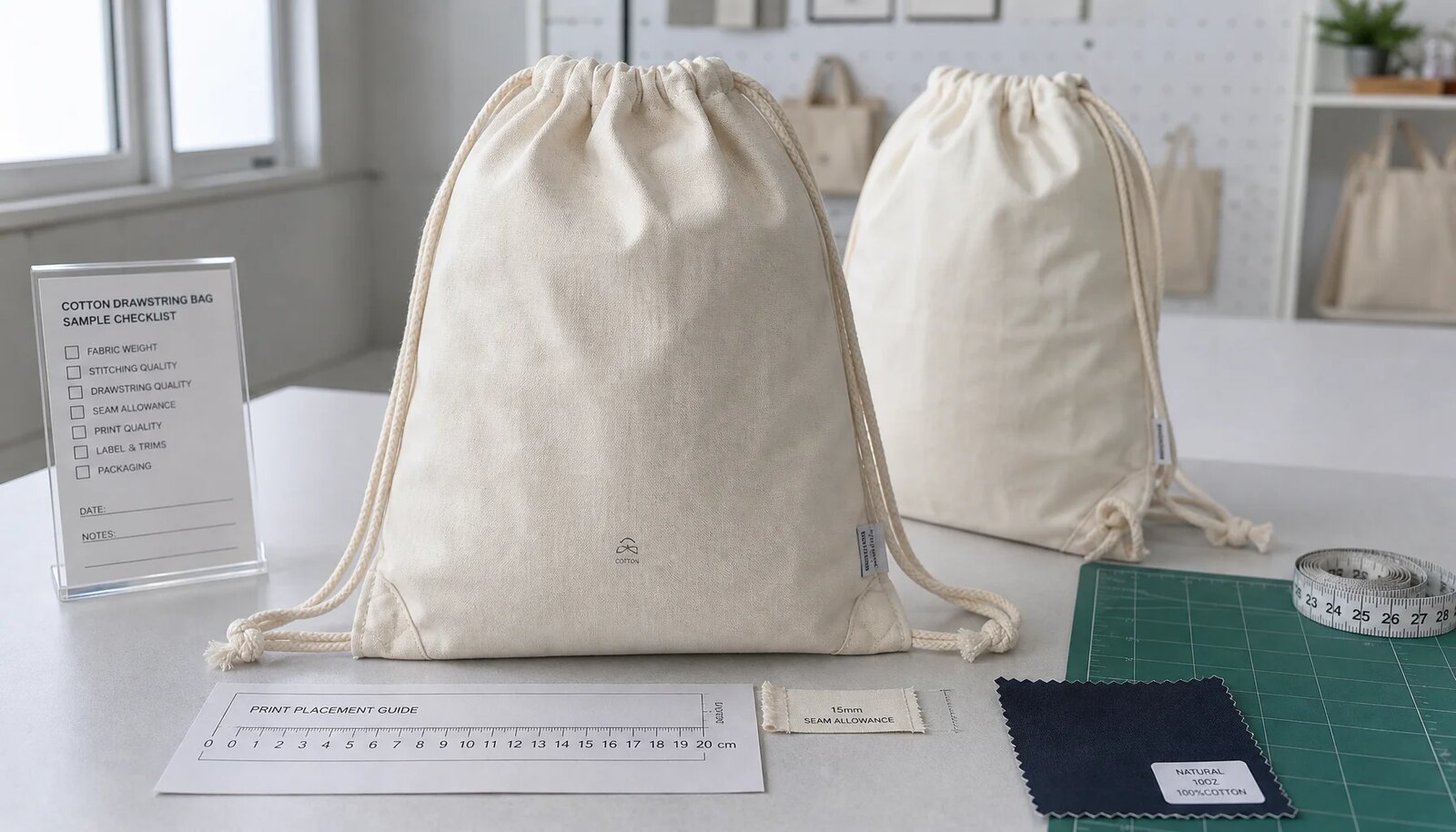
Start With the Event Risk, Not the Bag Photo
Cotton drawstring backpacks for craft fairs look simple in a supplier catalog. In use, they are anything but invisible. They may carry workshop tools, sponsor inserts, vendor credentials, small retail purchases, catalog sheets, or attendee gifts. If the fabric is too sheer, the cord cuts into shoulders, the print lands off-center, or cartons are mixed by artwork, the problem shows up at the registration desk or booth table where there is no time for sorting or rework.
That is why a cotton drawstring backpacks supplier compliance checklist for craft fairs should be written before suppliers quote. It turns a loose request such as "natural cotton drawstring bag with logo" into buying terms a factory can price and an inspector can check: GSM, finished size, cord, reinforcement, logo method, carton plan, inspection rules, and delivery date. It also prevents false price comparisons. One supplier may quote 5 oz natural cotton in bulk cartons. Another may quote 8 oz canvas with barcode labels and reinforced corners. The cheaper unit price may not be the better landed decision.
Treat the item as a small sewn product with a fixed event deadline. The purchase order should say what is acceptable, how it will be measured, and who approves any deviation. This does not need to become a heavy compliance program, but it does need enough detail for the merchandiser, fabric mill, sewing line, printer, packing team, and inspector to work from the same version of the truth.
- Use the checklist for giveaways, sponsor packs, workshop kits, vendor kits, booth merchandise, and resale programs.
- Separate visual requirements from load requirements; a clean-looking bag can still fail at the cord or bottom corners.
- Compare suppliers only after GSM, size, print, reinforcement, packing, QC, and delivery assumptions are aligned.
- Put the fixed craft fair date, required arrival date, and latest acceptable inspection date into the RFQ.
- Keep written approvals for swatches, artwork proofs, PP samples, carton marks, and inspection criteria.
Define the Use Case Before You Pick GSM
A good specification starts with how the bag will be used. A one-day attendee giveaway carrying a map, coupons, and a few samples does not need the same construction as a paid merchandise bag displayed at an artist booth. A vendor welcome kit may hold catalogs, badges, cords, packaged samples, and small tools. A sponsor pack may need a neater finish because several brands are represented on one product. When suppliers do not know the use case, they usually quote the easiest available material and construction.
For B2B procurement, describe the expected contents and target load. A light attendee bag may carry less than 1 kg of paper goods and small items. A workshop or vendor kit may need to handle 2 kg to 3 kg without the cord tabs opening or the seams pulling. A resale-oriented bag may need repeat-use construction and a cleaner table presentation. These figures are practical design targets, not universal performance guarantees, so confirm them through sampling and inspection.
Use case also drives packing. If bags are handed out at registration, bulk bundles of 25 or 50 pieces may be faster than individual polybags. If the bags are sold as merchandise, hangtags, barcodes, folded presentation, and clean cartons matter more. If one order is split across several craft fair locations, destination-specific carton marks and one artwork per carton can save hours of receiving labor.
- Attendee giveaway: 5 oz to 6 oz cotton may be acceptable with simple print and bundle packing.
- Vendor or workshop kit: consider 6 oz to 8 oz cotton, stronger cord, and reinforced lower corners.
- Sponsor pack: prioritize clean shade, consistent print, controlled folding, and carton allocation by sponsor or date.
- Retail merchandise: use tighter finishing standards, barcode-ready packing, retained samples, and stricter visual inspection.
- Artist collaboration: allow more sampling time for custom color, detailed artwork, labels, patches, and presentation details.
Specify Fabric So Suppliers Quote the Same Product
Fabric is usually the largest cost and quality driver. Suppliers may describe cotton drawstring backpacks by ounces, GSM, or vague terms such as "thin cotton" and "canvas." Procurement should request GSM and ounce where possible, then approve a physical swatch. As a practical reference, around 140 to 170 GSM is often treated as lightweight cotton for low-cost promotional use, around 180 to 220 GSM is a midweight range with better hand feel, and around 260 to 280 GSM is commonly associated with 8 oz cotton canvas. The final feel still depends on weave, finishing, shrinkage, and opacity, so the approved swatch is the control sample.
Do not approve fabric from photos alone. Natural cotton can show seed flecks, neps, and shade variation. That may support an artisan or eco-positioned look, but it may be wrong for a clean white retail presentation. Dyed cotton needs shade approval, ideally through a lab dip or strike-off before bulk cutting. If the order uses recycled cotton, organic cotton, or any environmental claim, ask for a material declaration and keep the label wording conservative unless the documentation supports it.
Set measurable tolerances before sampling. Fabric weight tolerance is often discussed around plus or minus 5%, but the buyer and supplier should agree how the check is done and whether the tolerance applies to fabric before sewing or to bulk evaluation. Finished size can shift because of shrinkage, cutting, seam allowance, and pressing. If the bag must fit A4 documents, boxed goods, or workshop kits, specify usable dimensions rather than relying on a catalog size.
- Quote fabric by GSM and ounce, such as 170 GSM/5 oz, 200 GSM/6 oz, or 270 GSM/8 oz cotton canvas.
- Approve a physical swatch card marked with color, GSM, weave, supplier, date, and intended order reference.
- State whether natural cotton seed flecks, slubs, neps, and off-white shade variation are acceptable.
- For dyed fabric, approve a lab dip or strike-off before bulk cutting and define the shade reference sample.
- Ask whether fabric is preshrunk or washed, and confirm shrinkage tolerance if wash performance matters.
- Require the bulk fabric lot to match the approved swatch before printing, cutting, or sewing begins.
Control Construction: Size, Cord, Casing, and Corners
The weak points on drawstring backpacks are predictable: cord system, casing, side seams, and lower corners. A low-price bag can look fine when flat on a desk and still perform poorly once filled. Procurement should specify finished dimensions, casing depth, seam allowance, cord diameter, cord material, cord length, knot or end finish, and reinforcement method. These details are small on paper but decide whether the bag closes smoothly and carries the intended contents.
Common craft fair sizes include 34 x 42 cm, 35 x 45 cm, and 14 x 17 in. The right size depends on the kit. If the bag must hold documents, measure against the document size plus closure allowance. If it must hold a water bottle, notebook, and purchases, test the pre-production sample with real contents. Many buyers use plus or minus 1 cm for overall dimensions and tighter tolerances for print placement or smaller construction details, but the PO should state the final rule.
Cord choice affects function and brand story. Cotton cord gives a natural look but can twist, shrink, or fray if the stock is inconsistent. Polyester cord is often smoother and may be stronger, but it changes the material message. A cord diameter around 5 mm to 7 mm is common when shoulder comfort matters, while thinner cord may be enough for light giveaways. Confirm the approved sample rather than relying on a diameter claim alone.
- State finished size, measurement points, and tolerance before sampling; do not use catalog size as the only control.
- Specify casing depth and check that the cord pulls smoothly after the sample is filled and closed.
- Define cord material, diameter, color, length tolerance, knot style, and whether cord ends are heat-sealed or left natural.
- Require bartacks, reinforced tabs, or corner patches when the bag may carry 2 kg or more of event materials.
- Check stitch density and seam allowance on the approved sample; weak seams are difficult to correct after bulk sewing.
- Confirm whether metal eyelets are used because they may add cost, weight, corrosion risk, and extra compliance review.
Choose a Print Method You Can Inspect
Print method should follow the fabric, artwork, order quantity, and expected use. Screen printing is usually suitable for simple one- to three-color logos on cotton drawstring backpacks. It can be durable when the ink matches the fabric and is cured correctly. It is less convenient for fine gradients, full-color illustration, or many small logo versions unless the supplier has the right setup and the buyer accepts the extra cost.
For complex artwork, consider heat transfer, digital printing, DTG, woven labels, or sewn patches. Each option needs a different check. Heat transfer can reproduce detailed graphics, but buyers should look for edge lift, cracking, gloss mismatch, and heavy hand feel. DTG or digital printing can work for detailed art and smaller runs, but curing and wash behavior should be tested. Embroidery can look premium on heavier fabric, yet it may pucker a thin cotton panel. A woven label or sewn patch may be the safer route when the front print area is small or the bag is retail-facing.
Make the artwork instruction measurable. Include file type, print size, placement from the top edge and centerline, Pantone or brand color reference, acceptable variation, and placement tolerance. For example, specify a 180 mm wide logo centered on the front panel, 110 mm below the top edge, with placement tolerance within plus or minus 5 mm. Ask for a digital proof and then a printed strike-off or PP sample before bulk production.
- Send vector artwork where possible, plus Pantone references or approved brand color standards.
- Confirm print size, placement, orientation, and tolerance in millimeters or inches, not only by mockup image.
- Ask for setup charges by color and artwork version; multiple craft fair logos can change the real MOQ and cost.
- For screen print, check curing, dry rub, light scratch, fold behavior, and ink coverage on natural cotton texture.
- For heat transfer, check edge adhesion, cracking, gloss level, and whether the transfer feels too heavy on the panel.
- Keep one approved printed sample with the buyer and one sealed reference sample with the supplier.
Compare MOQ, Price Breaks, and Landed Cost
MOQ is rarely one simple number. The blank bag, fabric color, cord color, printed artwork, label, hangtag, and packing method may each have a separate minimum. A supplier may accept 500 pieces total but require more for custom dyed fabric or special cord. Another supplier may have stock natural cotton and a low MOQ, then charge separate screen fees for each artwork. Ask for MOQ by component so restrictions do not appear after design approval.
Price breaks need the same discipline. Request tiers such as 500, 1,000, 2,500, and 5,000 pieces when they match the buying plan. Separate the blank bag from print, labels, hangtags, packing, and freight. A quote that includes individual barcode labels, carton sorting, and export-ready packing cannot be compared directly with a quote for unprinted bags packed loose in plain cartons. For bulky orders, carton dimensions and freight basis may affect landed cost more than a small unit-price difference.
Normalize Incoterms before awarding the order. EXW may look attractive but leaves inland freight, export handling, and documentation to the buyer or forwarder. FOB is often easier for international comparison. DDP or delivered warehouse pricing may help when the buyer wants a clearer final cost. Include sample fees, setup charges, inspection, reinspection risk, freight, duties, brokerage, local delivery, and any receiving labor caused by weak packing or poor allocation.
- Request MOQ separately for bag style, fabric color, cord color, print version, label type, and packing configuration.
- Ask for line-item pricing: blank bag, print setup, print run charge, label, hangtag, packing, carton upgrade, and freight.
- Compare price breaks only when the same GSM, size, cord, reinforcement, print, and packing standard is used.
- Normalize EXW, FOB, CIF, DDP, and delivered quotes to one landed-cost model before supplier selection.
- Confirm carton dimensions and gross weight; bulky low-cost bags can become expensive by air or courier.
- Build event buffer into the cost decision because a cheaper supplier with a late schedule can create rush-freight exposure.
Check Supplier Evidence Before You Pay for Samples
Supplier compliance in this category is mainly about traceability, process control, documentation, and honesty about capability. A credible supplier should explain where the fabric comes from, where the bags are cut and sewn, whether printing is in-house or outsourced, who inspects the goods, and how nonconforming product is handled. Sales photos alone are not enough for procurement approval.
Before paying for samples, request current fabric swatches, close-up photos of similar construction, workshop or sewing-line images, and examples of packing labels or inspection sheets if available. If the supplier is a trader, ask for the factory name where possible, or at least a clear written explanation of the production arrangement and quality owner. If printing is outsourced, include that step in the timeline. Outsourced printing can add color, curing, handling, and transport risk.
Be careful with compliance language. If the buyer needs organic cotton, recycled cotton, restricted-substance testing, retailer labeling, or country-of-origin documentation, state those requirements in the RFQ and review them through the buyer's compliance process. Do not allow a supplier to add environmental or safety claims to hangtags, labels, or product pages unless the documents support the exact wording.
- Ask for the actual production setup: factory-direct, subcontracted sewing, outsourced printing, or trader-managed program.
- Request current swatches and similar construction photos rather than relying on catalog images.
- Confirm who signs the PP sample, who approves bulk deviations, and who pays for rework after failed inspection.
- Require material declarations or relevant documents before using organic, recycled, or sustainability claims.
- Keep supplier, fabric, artwork, sample version, and approval records together in the PO file.
- Treat missing evidence as a sourcing risk, not automatic failure; ask follow-up questions before awarding.
Use Sampling to Prevent Bulk Surprises
The pre-production sample should become the control standard for bulk production. It should use actual fabric, actual cord, actual print method, actual label, and actual packing whenever feasible. If any component is substituted, mark the sample clearly as a prototype or construction sample. A substitute fabric sample can help approve size and sewing, but it cannot approve final shade, GSM, shrinkage, or print behavior.
Sample comments should be specific enough for production. Instead of saying the print is "too low," state that the logo must be centered and positioned 100 mm from the top edge with plus or minus 5 mm tolerance. Instead of saying the bag feels "cheap," specify the target GSM, cord diameter, seam allowance, or reinforcement change. Vague feedback creates revision loops and weakens quality enforcement later.
The handoff from sample approval to production matters. The supplier should prepare a final specification sheet or sample tag covering size, fabric, cord, print, stitch, label, packing, and carton details. The buyer should retain one approved sample, and the supplier should keep one sealed reference sample for the production floor and inspection team. For event-driven orders, first-piece photos after bulk setup can catch errors before thousands of panels are printed or sewn incorrectly.
- Measure width, height, casing depth, cord length, print size, print placement, and reinforcement location on the PP sample.
- Record fabric GSM, color reference, cord material, cord diameter, thread color, stitch density, and label placement.
- Mark the approved sample with date, version number, artwork file name, buyer approval, and supplier confirmation.
- Require first-piece photos from bulk production before full printing or sewing continues.
- Do not approve bulk cutting if fabric shade, GSM, or construction differs materially from the approved swatch or sample.
- Use written deviation approval if the supplier proposes any change after sample sign-off.
Write a QC Plan That Inspectors Can Follow
Quality control should be set before the purchase order is released. Buyers may use an internal inspection plan, a third-party inspection service, or a mutually agreed final random inspection approach. For larger or event-critical orders, many procurement teams reference AQL concepts such as critical, major, and minor defects. The exact AQL target should match the buyer's risk tolerance, but defect definitions need to be clear. Otherwise, inspection disputes become subjective.
Critical defects for craft fair bags include wrong artwork, wrong event name, wrong destination allocation, mildew, contamination, unsafe foreign objects, or severe odor. Major defects include open seams, broken cords, missing reinforcement, severely off-center print, incorrect size outside tolerance, poor print adhesion, and carton quantities that do not match the packing list. Minor defects may include loose threads, slight shade variation inside the approved range, minor slubs on natural cotton, or small cosmetic issues that do not affect function or brand presentation.
Keep practical tests simple and repeatable. Inspectors should measure bags from multiple cartons, compare fabric to the approved swatch, check print placement with a ruler, pull the cords through the casing, examine stress points, and open cartons from different parts of the shipment. For heavier kits, define a basic load check using the expected kit weight for a short handling period. Agree on the method before final inspection so the test is not improvised at the factory.
- Define critical, major, and minor defects in the PO or inspection brief.
- Use the approved sample and written spec as inspection references, not verbal expectations.
- Measure finished size and print placement with a ruler; do not rely on visual judgment alone.
- Check cords, knots, casing ends, bottom corners, bartacks, side seams, and thread trimming across multiple cartons.
- Perform dry rub, light scratch, fold, and adhesion checks on printed areas before approving shipment.
- Open cartons from different parts of the shipment to verify count, artwork separation, odor, moisture, and carton marks.
- Hold shipment for wrong artwork, mildew, contamination, severe odor, missing cartons, or allocation errors that would disrupt the event.
Make Packing and Carton Marks Event-Ready
Packing is a compliance issue for craft fair programs because receiving windows are short. A well-made bag can still create a costly problem if versions are mixed, carton marks are vague, or warehouse staff must open every carton to identify sponsor logos. Write the packing plan into the RFQ and reconfirm it before bulk packing begins.
Define packing from the unit level to the outer carton. Some buyers avoid individual polybags to reduce waste. Others require individual recycled polybags to keep resale bags clean. Paper bands can look neat, but they should be checked for scuffing and whether they stay in place during transit. Bulk bundles of 25 or 50 pieces help registration teams count quickly. For multi-version orders, one artwork per inner bundle or one artwork per carton reduces sorting errors.
Carton requirements should include pieces per carton, gross weight, dimensions, carton strength, carton marks, and maximum weight. Many buyers use maximum carton weights around 15 kg to 18 kg for easier manual handling, although the correct limit depends on warehouse policy. Natural cotton should be packed dry, especially during humid production seasons or ocean freight. If desiccants or moisture-control bags are used, confirm placement so they do not stain the product.
- Specify no polybag, individual recycled polybag, paper band, or bulk bundle before the quote is finalized.
- Use 25-piece or 50-piece inner bundles when fast event counting is more important than retail presentation.
- Require one artwork or destination per carton unless mixed packing is intentionally approved.
- State carton marks clearly: PO number, item, artwork version, quantity, destination, carton number, and gross/net weight.
- Set maximum carton weight and confirm carton dimensions for freight and warehouse planning.
- Check moisture, odor, carton damage, and count accuracy before final shipment release.
Specification comparison for buyers
| Supplier option | What to verify | Commercial advantage | Buyer risk to control |
|---|---|---|---|
| Direct sewing factory | cord material proof, reinforcement close-ups, load-test photos, approved sample tag, and bulk-line first-piece record | Better sample-to-bulk control and faster production feedback | May be weaker on export paperwork or branded packing unless checked early |
| Trading company | Factory name, production photos, trim-source proof, and who owns QC decisions | Can coordinate small mixed orders and extra services | Markup can hide real factory capability and slow defect decisions |
| Specialized bag workshop | cord diameter, eyelet or reinforced channel, bottom corner reinforcement, seam allowance, bar-tack position, and load target | More practical for detailed construction, trims, and repeat programs | Capacity may be limited during peak seasons |
| Low-price general supplier | 6-10 oz cotton canvas, 210D polyester, rPET, or blended cotton with shrinkage and colorfastness expectations set before sampling | Useful for simple promotional runs with loose specs | Material downgrades, weak packing, and vague inspection scope can erase savings |
| Retail-ready supplier | fold direction, cord protection, bundle count, carton compression, moisture bag, and retail label position | Can handle labels, SKU separation, carton marks, and receiving rules | Higher unit cost must be compared against reduced warehouse work |
| Compliance-focused supplier | Fabric records, labeling review, test plan, and production traceability | Safer for retail programs and repeat brand orders | Documentation claims need evidence, not only sales language |
| Local sample room plus bulk factory | Signed sample, bulk factory handoff, first-piece photos, and deviation owner | Good for complex branding before large production | Sample room quality may not match bulk line unless handoff is controlled |
Buyer checklist before sampling
- Define the commercial use first: attendee giveaway, vendor welcome kit, workshop supply bag, sponsor pack, paid merchandise, artist collaboration, or retailer-facing resale item.
- State finished dimensions and tolerances, such as 34 x 42 cm or 14 x 17 in, and confirm the bag must fit A4 or letter documents, a water bottle, boxed craft goods, flat-pack materials, or several small purchases.
- Specify fabric by GSM and ounce with acceptable tolerance; common buying references include 170 GSM/5 oz for light giveaways, 200 GSM/6 oz for midweight use, and 270 GSM/8 oz canvas for a stronger retail feel.
- Clarify cotton appearance: natural unbleached cotton with seed flecks, dyed cotton, organic cotton, recycled cotton blend, or conventional cotton canvas; define shade tolerance and whether slubs are acceptable.
- Lock the cord specification, including material, diameter, color, knot style, cord length tolerance, cord-end finish, and whether bottom corner tabs, metal eyelets, bartacks, or reinforced patches are required.
- Send print-ready artwork with vector files where possible, Pantone or brand color references, color count, print size, placement distance from top and side seams, and acceptable placement tolerance.
- Require a pre-production sample using actual bulk fabric, actual cord, actual print method, and actual packing whenever feasible; label any substitute-material sample as construction-only.
- Define inspection standard before PO placement, including defect categories, AQL target or sample size, measurement points, carton-opening plan, print checks, load checks, and reinspection responsibility after failure.
- List packing requirements, including bundle count, individual polybag or paper-band policy, barcode needs, carton quantity, carton marks, maximum carton weight, pallet rules, and event allocation by artwork or destination.
- Separate quote lines for blank bag cost, print setup, print run charge, sample fee, label or hangtag cost, packing upgrades, inland freight, export charges, inspection fee, tooling, and rush surcharge if applicable.
Factory quote questions to send
- What is the actual fabric weight in GSM and ounce, what tolerance do you control in bulk, and can you send a swatch from the same lot or planned mill source?
- Is the backpack sewn in your own facility or subcontracted, and which processes are in-house: cutting, sewing, screen printing, heat transfer, label sewing, packing, and final inspection?
- What is the MOQ for the bag style, each fabric color, each cord color, each label type, each packing method, and each artwork version? Please quote practical breaks such as 500, 1,000, 2,500, and 5,000 pieces if available.
- What finished size tolerances do you propose for width, height, casing depth, print position, cord length, fabric weight, stitch quality, and carton weight?
- Which print methods are suitable for this cotton fabric, and what are the setup charges, maximum print area, minimum line width, color-count limit, curing method, expected hand feel, and known limitations?
- Can the pre-production sample be made with actual bulk fabric, actual cord, actual label, actual print, and intended packing? If not, which details are substitutes and which are production-confirmed?
- How many days are required for swatch approval, artwork proof, PP sample, revision sample, bulk production, packing, pre-shipment inspection, and handover after deposit or PO release?
- What are the common failure points on this bag style in your factory, such as cord fray, open seams, print migration, casing distortion, uneven shade, carton moisture, or mixed artwork, and what controls do you use?
- What reinforcement do you recommend for a bag expected to carry 2 kg, 3 kg, or 5 kg of event materials, and what cost difference applies for bartacks, reinforced tabs, stronger cord, or heavier fabric?
- What internal inspection method do you use: first-piece approval, in-line inspection, final random inspection, measurement report, pull check, print rub check, load check, and carton count verification?
Quality-control points to confirm
- Fabric weight should match the approved swatch and specification within the agreed tolerance, commonly controlled around plus or minus 5% when verified by a defined test method or supplier measurement process.
- Finished backpack dimensions should stay within buyer-approved tolerance; common commercial targets are plus or minus 1 cm for overall width and height and plus or minus 0.5 cm for print position or smaller construction details.
- Natural cotton should be checked for stains, oil marks, mildew, strong odor, unacceptable dark slubs, uneven dyeing, weaving holes, panel shade mismatch, and carton-to-carton shade drift.
- Drawcords must pull evenly through the casing, close the mouth without jamming, and show no fraying, weak knots, mismatched left and right length, or cord diameter deviations from the approved sample.
- Bottom corners, cord tabs, and casing ends should have the agreed reinforcement, such as bartacks or double stitching, especially for resale bags, sponsor kits, and heavier event contents.
- Stitching should be consistent, with no skipped stitches, loose seams, open seams, broken threads, raw edges outside the approved construction, or excessive untrimmed threads on visible panels.
- Print should match the approved artwork, color range, size, and placement; it should pass dry rub, light scratch, fold, and visual curing checks before packing.
- Labels, hangtags, barcode stickers, and country-of-origin markings should match the PO, destination rules, and approved placement sample.
- Bulk packing must match the carton plan, including quantity per inner bundle, quantity per carton, artwork separation, carton label, gross weight, carton dimensions, and destination allocation.
- Random carton checks should include odor, moisture, carton damage, count accuracy, mixed-version risk, and whether natural cotton was packed dry before sealing.