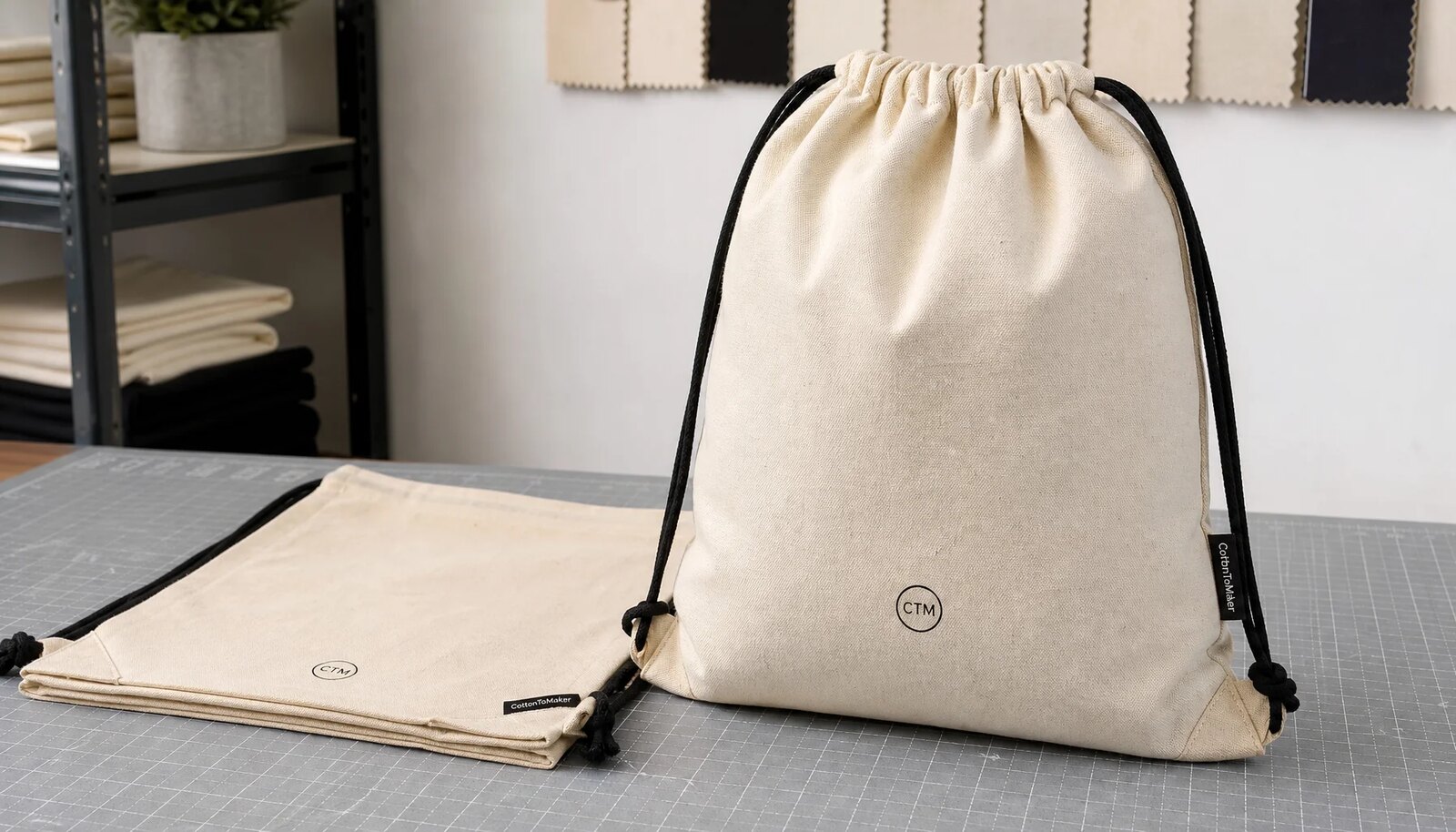
Start With A Procurement-Ready RFQ Scope
Cotton drawstring backpacks for craft fairs look simple at first glance. They are usually cotton body panels, a top channel, and cords that close the bag and work as shoulder straps. In a factory quote, though, that simple product name can cover very different goods. One supplier may be pricing a thin giveaway sack with basic eyelets. Another may be pricing 8 oz cotton, reinforced corners, controlled screen printing, inner bundles, and carton data ready for freight planning. Both may call the item a cotton drawstring backpack.
That is why the RFQ has to do more than ask for a price. For craft fairs, maker markets, vendor pop-ups, artist events, workshops, and sponsor programs, the bag may carry catalogs, folded apparel, candles, jars, stationery, small ceramics, event badges, product samples, or customer purchases. The buyer should state the business use, expected contents, branding standard, distribution route, and deadline before asking suppliers to quote.
A strong RFQ turns the product into clear decisions: finished size, cotton weight, drawcord specification, corner reinforcement, print method, print area, MOQ split, sample route, packing plan, QC checkpoints, and shipping terms. That structure helps procurement teams compare like with like. It also gives the factory enough information to recommend a workable construction instead of guessing at the cheapest interpretation.
- Primary use cases: craft fair giveaways, vendor welcome kits, sponsor packs, workshop supply bags, retail add-ons, and paid merchandise.
- Main sourcing risk: suppliers quote different fabric weights, cords, print methods, and reinforcements under the same item name.
- RFQ objective: make every supplier price the same finished product, sample route, packing format, and delivery assumptions.
- Acceptance baseline: the approved sample should carry expected contents without corner tearing, open seams, cord slippage, or visible print failure.
- Cost-control point: compare unit price with setup charges, samples, packing, carton volume, labels, inspection support, and Incoterm.
Specify Fabric Weight In Performance Terms
Fabric weight is one of the biggest drivers of cost, hand feel, and perceived value. Buyers often discuss cotton drawstring backpacks in ounces, while factories may quote in GSM. Either unit is fine if the RFQ is specific. Avoid phrases such as “good cotton,” “standard cotton,” or “medium weight.” They invite assumptions. A 5 oz or 6 oz cotton bag may be enough for postcards, flyers, and light sponsor materials. A 7 oz or 8 oz cotton bag is usually a better starting point for reusable craft fair bags, vendor kits, and handmade product packaging. A 10 oz cotton canvas version can work for paid merchandise or premium retail programs, but it adds material cost, carton weight, and sometimes more print handling.
Weight alone does not solve durability. A heavier cotton bag with weak eyelets can still fail at the bottom corners. A medium-weight bag with clean seams, secure cord attachment, and proper reinforcement may perform better than a heavier bag made carelessly. Connect the fabric weight to the actual load. If the bag may carry candles, jars, books, boxed goods, or workshop tools, say so in the RFQ and ask the supplier how the construction will support that use.
The cotton finish affects both brand impression and print results. Natural cotton can show seed flecks, slubs, and shade variation, which often suits craft and maker positioning. Bleached cotton gives a cleaner background for bright artwork. Dyed cotton needs tighter shade control, and dark colors may require different inks for opacity. If the program claims organic cotton, recycled content, or another material attribute, request documentation and chain-of-custody details. Do not rely on a product description alone.
- Light promotional use: 5-6 oz cotton for brochures, postcards, tags, and small samples when dense products are not expected.
- Reusable event use: 7-8 oz cotton for vendor kits, catalogs, folded apparel, notebooks, and mixed craft fair purchases.
- Merchandise use: 8-10 oz cotton or canvas when the bag is sold, reused often, or positioned as a premium retail item.
- Fabric quote detail: request oz/yd², GSM, bulk tolerance, weave type if relevant, finish, shade standard, and whether the fabric is stock or custom made.
- RFQ wording example: 8 oz cotton, approximately 270 GSM, natural shade, finished size 35 x 42 cm, reinforced bottom corners, suitable for a 2 kg event load.
Define Finished Size, Capacity, And Tolerance
A common adult event size is about 35 x 42 cm, but it should not become an automatic default. Start with what needs to go inside the bag. A vendor welcome kit might include a folded T-shirt, booklet, stickers, lanyard, and product samples. A workshop kit may include yarn, tools, paper, or a guidebook. A retail event bag may need to hold candle boxes, notebooks, small ceramics, or framed prints. The right size is the one that fits the contents without forcing the opening, stretching the print area, or overloading the bottom corners.
Smaller sizes such as 30 x 40 cm can reduce fabric usage and carton volume for light kits, children’s activities, or basic sponsor packs. Larger sizes such as 38 x 45 cm give more room for bulkier goods but increase unit cost and may reduce pieces per carton. For a multi-location craft fair program, a small size change can affect freight, storage, kit packing, and event allocation. If the buyer has a carton target, shelf limit, or kit-packing workflow, share it early.
Finished-size language needs to be exact. Some suppliers discuss cut-panel size; buyers usually care about finished size after sewing. Cotton can shift during cutting, sewing, pressing, and packing. The RFQ should say how to measure: lay the bag flat, smooth it without stretching, measure width seam-to-seam, measure height from bottom seam to top edge, and exclude the cords. A common commercial tolerance is ±1 cm on width and height unless a different tolerance is written into the PO.
- Light kit size: about 30 x 40 cm for flyers, craft cards, small samples, children’s activity items, and lightweight sponsor contents.
- Standard event size: about 35 x 42 cm for catalogs, folded apparel, notebooks, postcards, lanyards, and small boxed goods.
- Bulky goods size: about 38 x 45 cm for larger workshop materials, thicker kits, small retail boxes, or layered craft fair purchases.
- Tolerance language: specify finished size after sewing and packing, measured flat, with ±1 cm or supplier-declared tolerance.
- Buyer validation: load the sample with expected contents, close the cords, wear it briefly, and inspect distortion at corners, seams, and print area.
Treat Cords And Corners As Load-Bearing Parts
The drawcord is not decoration. It closes the bag, becomes the shoulder strap, and carries much of the stress during use. Cord material, diameter, length, color, and finish affect comfort, appearance, and complaint risk. Cotton cord supports a natural craft-market look. Polyester cord may help with lower cost, brighter colors, and easier color matching. Flat cotton tape or webbing can feel better on the shoulder, but it changes the style and usually requires a wider top channel.
The top channel has to suit the cord. If the cord is too thick, users struggle to close the bag. If it is too thin, the bag can feel cheap and the cord may dig into shoulders. Cord ends also need a defined finish. Knotted ends are common and economical. Plastic or metal tips look more finished but add cost and may not fit low-waste or natural-material positioning. Polyester cord can often be heat sealed; cotton cord needs a different fray-control approach.
Corners are the next failure point. Basic drawstring backpacks often use metal eyelets, which are familiar and economical. Poorly set eyelets, however, can loosen, scratch, or raise rust concerns in humid storage. Fabric loops, sewn patches, and bartacks can avoid metal and distribute load well when sewn correctly. If the bag will carry dense items such as jars, books, candles, or small ceramics, do not leave corner construction to the factory default. Specify it, sample it, and test it.
- Cord specification: material, diameter or tape width, length, color, end finish, channel width, and color-matching standard.
- Cotton cord checks: shade consistency, fraying, knot security, lint level, and whether shrinkage matters if the bag may be washed.
- Polyester cord checks: colorfastness, heat-sealed ends, shoulder comfort, and whether the appearance fits the brand position.
- Eyelet checks: finish color, inner diameter, setting quality, clean edges, and rust-resistance expectation during normal storage and transport.
- Sewn reinforcement checks: patch size, bartack placement, stitch density, and pull-test method based on expected event load.
Match Print Method To Artwork And Fabric Texture
Screen printing is often the practical choice for cotton drawstring backpacks used at craft fairs. It works well for solid logos, market names, sponsor marks, and one- to three-color artwork. The quote still needs detail: number of colors, print size, setup charges, artwork separation, print side, placement, and whether the price includes one print location or more. A one-color screen print quote should not be compared with a full-color heat transfer quote unless the buyer understands the difference in look, cost, and production process.
Cotton texture changes print behavior. Fine lines may fill in. Small type can lose sharpness. Natural cotton flecks may show through light ink. If the design includes delicate script, small sponsor names, QR codes, thin illustration lines, or detailed graphics, approve it at actual print size on the chosen fabric. A digital mockup helps with layout, but it cannot prove ink opacity, edge definition, curing, adhesion, or hand feel.
Heat transfer can be useful for multi-color artwork, short runs, or designs that are difficult to separate for screen printing. Review transfer edge visibility, flexibility, adhesion, and hand feel on the final cotton. Digital printing can support complex artwork but needs careful color management and fabric preparation. Embroidery may look premium for a small mark on heavier cotton or canvas, but it can pucker lighter fabric and is usually inefficient for large front graphics.
- Screen print RFQ: number of colors, Pantone targets, ink type if specified, print size, placement, setup charge, and included print area.
- Transfer RFQ: artwork resolution, transfer type, edge visibility, adhesion expectation, hand feel, and sample approval on final fabric.
- Embroidery RFQ: logo size, thread colors, stitch count estimate, backing, placement, and puckering review on the selected fabric weight.
- Artwork file standard: vector file with outlined fonts, Pantone references, print dimensions in centimeters, and placement from top edge and center line.
- Print QC standard: check color, registration, opacity, curing, rub resistance, cracking, tackiness, blocking, and position against the approved sample.
Build MOQ And Version Control Into The Quote
MOQ is rarely just one total number. For cotton drawstring backpacks, minimums may apply by fabric color, cord color, print design, print method, accessory version, packing format, and destination. A 5,000-piece inquiry sounds straightforward until it is split across ten logos, three cord colors, two packing formats, and several shipping addresses. Then the supplier must manage multiple artworks, setup changes, sample approvals, sorting steps, carton labels, and inspection lines.
Use an order matrix instead of a loose paragraph. Each line should show design name, quantity, fabric color, cord color, print method, print colors, packing requirement, carton mark, and destination. This format gives the supplier a clean basis for pricing. It also shows the buyer where complexity is adding cost. If regional craft fairs or sponsors are still confirming numbers, separate firm quantities from forecasts so the factory does not treat the whole program as final.
The easiest way to reduce cost and mistakes is to standardize the base product. One fabric color, one cord color, one size, one reinforcement method, and one packing method can support several print designs. The print stage still requires version control, but cutting, sewing, and packing become simpler. MOQ negotiation is much more productive when the buyer can show what stays common and what truly needs to vary.
- Quote tiers: request 1,000, 3,000, 5,000, and 10,000 pieces for the same fabric, cord, size, print method, and packing.
- Design split: show 5,000 total pieces as separate lines, such as 3,000 pcs logo A and 2,000 pcs logo B.
- Version-control fields: design name, artwork file, print colors, quantity, destination, carton mark, inner bundle count, and approval contact.
- Cost lever: standardize fabric, cord, size, reinforcement, and packing so only the print artwork changes between versions.
- Operational risk: many small versions increase setup cost, sample rounds, sorting labor, carton-label mistakes, and inspection time.
Ask For A Quote That Supports Landed Cost
A buyer-ready quote includes more than a unit price. It should show the cost basis behind the number: fabric weight, finished size, construction, cord, reinforcement, print method, number of colors, included print area, packing, carton data, sample charges, setup fees, lead time, payment terms, and Incoterm. When those details are missing, the lowest quote may simply be the quote with the most assumptions left open.
Logistics data matters because cotton drawstring backpacks are light but not weightless in the supply chain. Heavier fabric, thick cords, loose folding, hangtags, and individual polybags can all increase carton size. Depending on route and mode, freight may be charged by volumetric weight rather than actual weight. If bags ship to craft fair locations, distributor warehouses, or kit packers, carton marks and inner bundles become real operational cost items.
Ask the supplier to separate inclusions and exclusions. Does the price include one-color printing only? Is the print area capped? Are sample courier fees included? Is the fabric stock natural cotton or a custom dyed lot? Are barcode labels, hangtags, care labels, or individual polybags included? How long is the quote valid? These details keep supplier comparisons fair and reduce late-stage surprises.
- Commercial terms: unit price by quantity tier, Incoterm such as EXW, FOB, FCA, CIF, or DDP if offered, payment terms, and quote validity date.
- Separate charges: screen setup, artwork separation, sample fee, revised sample fee, courier fee, label surcharge, special packing, and inspection support.
- Product basis: fabric weight, finished size, cord spec, reinforcement, print method, print size, number of colors, and packing format.
- Carton data: carton dimensions, pieces per carton, gross weight, net weight, CBM, carton mark format, and estimated carton count per version.
- Documentation: request packing photos, sample approval records, material claim documents if applicable, and final inspection report format.
Use Sampling To Lock The Standard
Sampling should move in stages: material approval, construction approval, print approval, and packing approval. A photo or digital mockup is not enough. Cotton hand feel, shade, cord movement, reinforcement strength, print opacity, and print texture can only be judged reliably on a physical sample. If timing is tight, approve a fabric swatch and blank construction sample first, then approve a printed pre-production sample after final artwork is ready.
The pre-production sample should represent the intended bulk product. It should use the correct cotton weight, fabric shade, cord, cord color, reinforcement method, print technique, print size, and packing reference. A shape sample made with substitute fabric can still be useful for size review, but do not treat it as final approval unless the buyer accepts that bulk fabric, print behavior, and hand feel may change.
Good sample records prevent arguments later. Keep photos, measurements, fabric weight, print size, print position, cord details, reinforcement notes, packing notes, and any accepted deviations. If a sample is approved with a visible issue, the approval note should say whether that issue is accepted for bulk or must be corrected. The final inspection team should be working from the same standard as the merchandiser, buyer, and factory.
- Swatch approval: fabric weight, color, weave, hand feel, natural flecks, shade standard, and any certification documentation needed for claims.
- Blank sample approval: finished size, seam construction, cord channel, cord length, corner reinforcement, shape, and target load check.
- Printed sample approval: color, placement, opacity, registration, curing, hand feel, and interaction between ink and cotton texture.
- Packing approval: folding method, inner bundle count, polybag or no polybag, label placement, carton quantity, and carton mark.
- Approval record: sample version, date, supplier name, measurements, photos, written comments, accepted deviations, and agreed tolerances.
Control Packing For Event Distribution
Flat packing is usually efficient for cotton drawstring backpacks. Depending on fabric weight, print area, cord thickness, and carton strength, suppliers may pack 50 or 100 pieces per export carton. Inner bundles of 10, 25, or 50 pieces make counting easier when multiple craft fair locations, sponsor logos, or kit-packing teams are involved. Individual polybags can help with retail handling, but they add cost, labor, and packaging waste, and they may conflict with low-waste event goals.
The packing plan should match how the bags will move after delivery. If bags are handed out in bulk at one venue, simple flat packing by design may be enough. If they are inserted into vendor kits, inner bundles that match the kit-packing workflow can save labor. If they are sold as merchandise, barcode labels, hangtags, belly bands, care labels, or individual packaging may be required. Quote each extra packing element separately so the buyer can judge whether it adds value.
Packing also protects the print. Printed panels need to be fully cured and cooled before tight stacking. If prints are packed too early or compressed too heavily, buyers may see blocking, offset marks, tacky surfaces, cracking, or shine changes. Carton compression can crease the logo area. Ask for packing photos and confirm whether interleaving, tissue, or a specific stacking direction is needed for large or sensitive prints.
- Bulk event packing: 50 or 100 pieces per carton, flat packed, design separated, carton mark by event, design, quantity, and destination.
- Distributor packing: inner bundles of 10, 25, or 50 pieces for counting, allocation, repacking, and regional order fulfillment.
- Retail packing: barcode, hangtag, belly band, care label, or polybag only when required by sales channel or warehouse process.
- Print protection: confirm curing time, stacking method, crease control, and interleaving needs before final packing approval.
- Carton acceptance: correct piece count, no unintended mixed designs, stable carton dimensions, readable carton marks, and no crushed export cartons.
Set Inspection Criteria Before Production
Quality control should be defined before the purchase order is placed. For cotton drawstring backpacks, inspection should cover appearance and function. Appearance checks include fabric defects, shade, print color, print position, loose threads, stains, and packing presentation. Functional checks include size, GSM, seam strength, cord movement, corner reinforcement, and whether the sample construction carries the expected contents without obvious stress.
The approved sample and written specification should drive inspection. If a third-party inspection agency is involved, list the critical checkpoints and tolerances in the RFQ and PO. Finished size is commonly controlled at ±1 cm, but the actual tolerance should be agreed with the factory. Fabric weight should be checked against the approved swatch and stated GSM tolerance. Print position should be measured from fixed reference points, not judged only by eye on a loose fabric bag.
Shipment release should include packing verification, not just product appearance. A shipment can look acceptable but still create problems if designs are mixed, carton labels are unclear, inner bundle counts are wrong, or the packing list does not match the cartons. Craft fair dates are fixed, and incoming rework time is often short. Clear QC criteria help buyers catch problems before the goods leave the factory.
- Size and material checks: finished dimensions, GSM, shade match, fabric defects, odor, and consistency against the approved sample.
- Construction checks: side seams, bottom seam, top channel, cord movement, cord length, knots, reinforcement, and loose-thread trimming.
- Print checks: color, opacity, registration, position, curing, rub resistance, blocking, tackiness, cracking, peeling, and offset marks.
- Packing checks: carton dimensions, gross weight, pieces per carton, inner bundle count, design separation, carton marks, and packing photos.
- Release rule: unresolved critical defects such as open seams, loose eyelets, wrong artwork, uncured print, or major quantity errors should block shipment approval.
Specification comparison for buyers
| RFQ decision | B2B specification to request | Typical working range | Procurement risk to control |
|---|---|---|---|
| Fabric weight | Quote in oz/yd² and GSM, with the supplier’s bulk tolerance stated | 5-6 oz for light giveaways; 7-8 oz for reusable event bags; 10 oz canvas for merchandise programs | A low quote may use thin cotton that shows contents, distorts under load, or feels too weak for a handmade retail event |
| Finished size | Finished bag size after sewing, measured flat seam-to-seam, excluding cords | 30 x 40 cm for light kits; 35 x 42 cm for adult event use; 38 x 45 cm for bulkier goods | Some quotes use cut-panel size instead of finished size; define the measurement method and tolerance before comparing prices |
| Load expectation | Expected contents, approximate weight, and target load for sample testing | Brochures under 1 kg; vendor kits around 1-2 kg; dense goods need stronger construction | GSM alone will not prevent failures at eyelets, cord loops, side seams, or bottom corners |
| Drawcord | Material, diameter or tape width, length, color, end finish, and channel width | Cotton cord for a natural look; polyester cord for color and cost; flat tape for comfort | Thin cords dig into shoulders; thick cords jam in the channel; loose knots or fraying create returns |
| Bottom reinforcement | Eyelets, fabric loops, sewn patches, or bartacks, with a stated pull-test expectation | Eyelets for basic programs; sewn patches or bartacks for heavier loads or metal-free requirements | Loose eyelets, poor setting, rust concerns, or weak corner stitching can fail during event use |
| Print method | Method, colors, ink type if known, print size, placement, Pantone targets, and setup charges | Screen print for solid logos; transfer or digital print for multi-color art; embroidery for small premium marks | Suppliers may quote different print methods; fine lines, QR codes, and small type need physical sample approval |
| MOQ structure | Break MOQ down by fabric color, cord color, print design, packing version, and destination | One standardized material spec with multiple print versions is easier than many full custom versions | A 5,000-piece order split into 10 logos may operate like 10 small production runs with higher setup and sorting risk |
| Packing format | Pieces per carton, inner bundles, polybag use, carton marks, labels, and packing photos | 50 or 100 pcs/carton; inner bundles of 10, 25, or 50 when counting matters | Changed carton dimensions affect freight, warehouse receiving, event allocation, and landed-cost comparison |
| Sample route | Swatch, blank construction sample, printed pre-production sample, and packing reference | Use bulk fabric and final cord, reinforcement, print method, and packing before mass production approval | Digital mockups do not prove fabric hand feel, print opacity, cord movement, or corner strength |
Buyer checklist before sampling
- Define the commercial use: free giveaway, sponsor item, vendor welcome kit, workshop supply pack, paid merchandise, retail add-on, or distributor stock.
- List expected contents and approximate load: brochures only, T-shirt plus catalog, candle boxes, jars, books, stationery kits, small ceramics, or mixed handmade purchases.
- Specify finished bag dimensions after sewing, measurement method, and tolerance; avoid relying only on cut-panel size or catalogue size.
- State cotton fabric weight in oz/yd² and/or GSM, and clarify natural, bleached, dyed, washed, organic-certified, recycled-content claim, or standard cotton.
- Confirm acceptable cotton appearance: natural flecks, slub level, shade variation, whiteness, fabric hand feel, shrinkage sensitivity, and odor standard after packing.
- Define drawcord material, diameter or tape width, length, color, end finish, top channel width, and whether the cord must match Pantone or supplier standard color.
- Select bottom reinforcement: metal eyelet, fabric loop, reinforcement patch, bartack, or metal-free construction, and request a pull-test method for the expected load.
- Send vector artwork with outlined fonts, Pantone references, print size, placement from fixed reference points, number of colors, and front/back print instructions.
- Ask whether the price includes screen setup, artwork separation, sample charge, revised sample charge, courier cost, export carton, inner packing, labels, and inspection support.
- Request carton dimensions, pieces per carton, gross weight, net weight, CBM, inner bundle count, carton mark format, packing photos, and estimated carton quantity per order line.
Factory quote questions to send
- What exact cotton fabric weight is included in the quote in oz/yd² and GSM, and what bulk GSM tolerance will you use for inspection?
- Is the fabric natural, bleached, dyed, washed, organic-certified, recycled-content, or standard cotton, and what documentation is available if a claim is required?
- What finished-size tolerance do you propose after cutting, sewing, pressing, and packing, and how should the buyer measure the bag at incoming inspection?
- What target load do you recommend for this construction, and how will you test the corners, seams, and cord attachment before shipment?
- What is the MOQ by fabric color, cord color, print design, print method, packing version, and shipment destination?
- Which print method is included, how many colors are included, what is the maximum print area, and what additional charges apply for extra colors or larger artwork?
- Are screen setup, artwork separation, sample printing, revised sample costs, courier fees, export cartons, inner bundles, labels, and inspection support included or separate?
- What cord material, cord diameter or tape width, cord length, channel width, end finish, and corner reinforcement are included in the base quote?
- Can you provide a pre-production sample using bulk fabric, final cord, final reinforcement, final print method, final artwork size, and final packing before mass production?
- What are the planned carton size, pieces per carton, net weight, gross weight, CBM, inner packing method, carton mark format, and estimated total cartons by SKU?
Quality-control points to confirm
- Finished size should be measured flat, seam-to-seam, excluding cords, against the approved specification; a common tolerance is ±1 cm unless the PO states another value.
- Fabric weight should be checked against the approved swatch and purchase specification, with the supplier recording actual GSM from bulk fabric before cutting.
- Fabric shade should be compared to the approved swatch by production lot, especially for natural, bleached, or dyed cotton where panels from different lots may vary.
- Fabric defects should be screened for holes, oil marks, stains, weaving faults, excessive slubs, shade panels, and visible defects in the front print area.
- Cord length, diameter or tape width, color, end finish, and knot security should match the approved sample, with left and right strap lengths reasonably balanced.
- Drawcords should pull smoothly through the top channel without catching, twisting, fraying, shedding fibers, exposing loose threads, or tearing the channel seam.
- Bottom reinforcement should be pull checked at eyelets, loops, patches, or bartacks using the agreed sample load and method before shipment release.
- Side seams, bottom seams, top channel seams, and reinforcement stitches should be locked, clean, trimmed, and free of skipped stitches, open seams, raw edges, or loose threads.
- Print position should be measured from fixed reference points, such as top edge and center line, rather than judged only by visual alignment on a loose bag.
- Print color should be checked under consistent lighting against the approved Pantone target or physical sample, with opacity reviewed on natural or dyed fabric.