Start With the Real Load
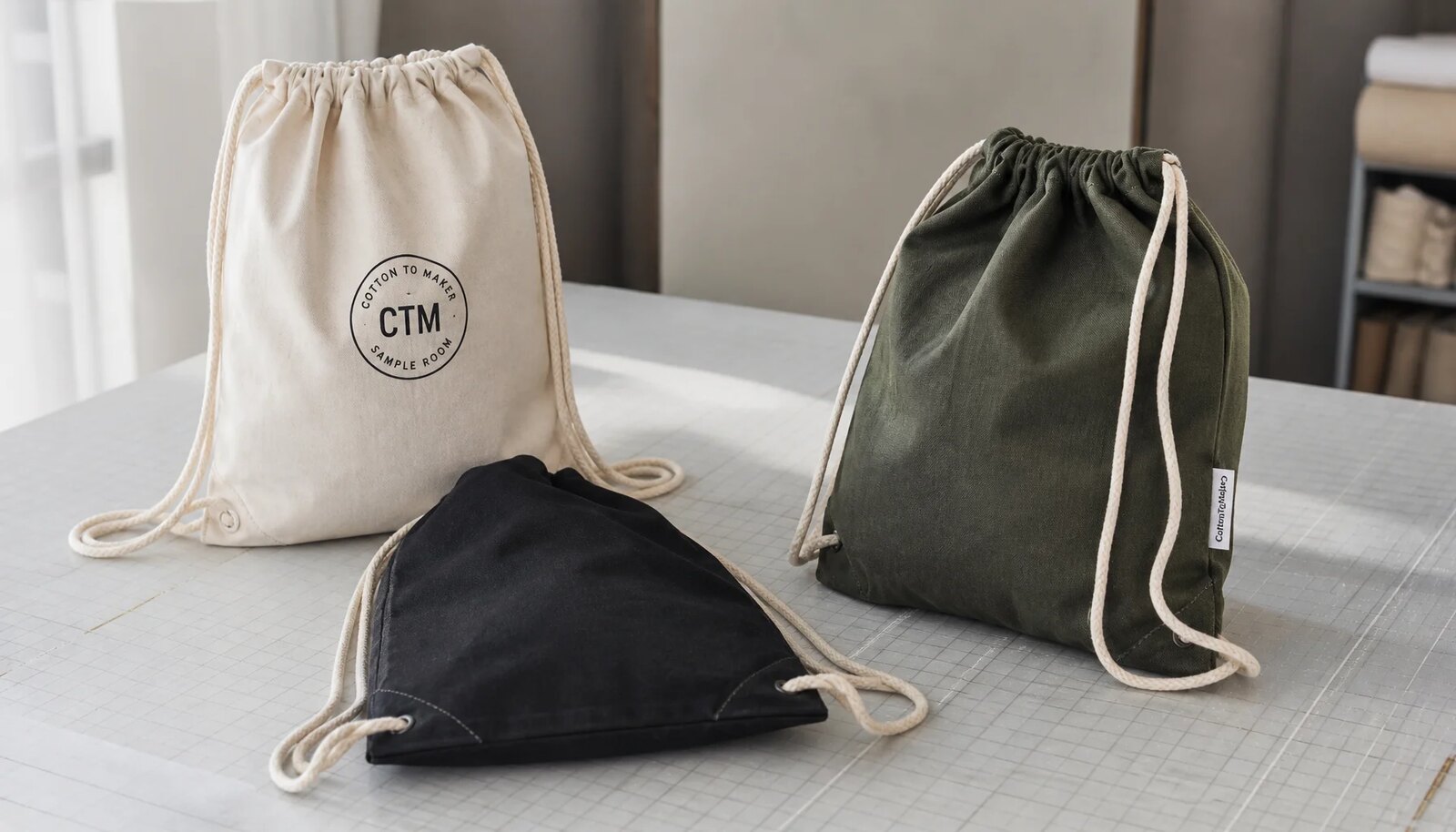
A cotton drawstring backpack looks like a simple item until it is full. At a craft fair, the user pulls on the cords, slides them through the top channel, wears them over the shoulders, and loads weight into the bottom corners. That is the load path. If the fabric is too light, the cord is uncomfortable, or the bottom exits are not reinforced, the weakness usually appears after the bag is handed out—not while the flat sample is sitting on a conference table.
For procurement teams, the first question should not be 'What fabric do you offer?' It should be 'What will people carry?' A sponsor giveaway filled with maps, badges, coupons, and postcards can use lighter cotton. A reusable maker-market carrier for soaps, candles, books, prints, jars, apparel, or boxed craft kits needs more body and better stress-point construction. A retail resale backpack has an additional requirement: it must look valuable enough for the selling price.
Write the heaviest normal use into the RFQ. Craft fair purchasing behavior is unpredictable. One attendee may carry only a program and a sticker sheet; another may add a candle, notebook, jar, and ceramic ornament. If the product mix is mixed or not controlled, 8 oz cotton with reinforced cord exits is usually a more practical baseline than 5 oz cotton. When dense or fragile items are common, move the discussion to 10 oz or 12 oz canvas, then test the finished bag under a realistic load.
- Define contents by product type and approximate total load before requesting prices.
- Separate giveaway, reusable carrier, and retail resale specifications instead of using one generic backpack spec.
- Use 5-6 oz cotton mainly for paper, soft samples, and short-use promotions.
- Use 8 oz cotton as the general craft fair starting point when reuse is expected.
- Use 10-12 oz canvas for dense goods, premium positioning, or higher retail value.
- Specify reinforcement and cord comfort with the fabric weight; fabric alone does not determine durability.
Convert Oz and GSM Without Guesswork
Cotton bag quotes often mix ounces and GSM. In strict textile terms, ounces usually means ounces per square yard, while GSM means grams per square meter. The mathematical conversion is about 33.9 GSM for every 1 oz/yd². In other words, a pure 6 oz conversion is roughly 203 GSM. Yet the cotton bag trade often uses shorthand weight names that do not always match that direct conversion. Finishing, regional naming habits, and supplier catalog language can all blur the comparison.
For sourcing work, buyers commonly see 5 oz cotton described around 140 GSM, 6 oz around 170 GSM, 8 oz around 220-240 GSM, 10 oz around 280-300 GSM, and 12 oz around 320-340 GSM. Treat those as practical quote ranges, not universal lab guarantees. A washed natural cotton, stiff-finished canvas, dyed twill, and brushed cotton can feel different even when the reported GSM is close. Surface texture, thickness, shrinkage, and print behavior may change with finishing.
The goal is not to argue terminology. The goal is to make quotes comparable. Ask every supplier to state the fabric weight in both oz/yd² and GSM, then confirm where the measurement is taken. Greige fabric before dyeing may not match finished fabric after washing or finishing. A mill certificate may not match the actual cut panels used for production. For repeat orders, keep an approved swatch, record the measured GSM, and compare bulk fabric before cutting. That one step prevents many 'same spec, different feel' surprises.
- Ask suppliers to quote both oz/yd² and GSM in the same line item.
- Confirm whether GSM refers to greige fabric, finished fabric, or production panels.
- Use an agreed tolerance such as ±5% when the supplier can support it.
- Compare finish, weave, thickness, and hand-feel along with numeric weight.
- Keep approved swatches for repeat programs and color or material disputes.
- Avoid quotes that only say 'heavy cotton' or 'canvas' without measurable weight.
Choose Fabric Weight by Product Mix
Craft fairs are different from many promotional events because the contents are often dense, handmade, and irregular in shape. Candles, jars, books, boxed kits, soaps, pottery, packaged foods, and small framed prints create concentrated pressure at the bottom corners. A lightweight drawstring backpack can look acceptable when empty and still deform quickly once the user starts adding purchases.
For paper-only or low-load distribution, 5 oz or 6 oz cotton can be the right choice. It keeps unit cost, carton weight, and storage volume down. It works best when the bag is a short-use sponsor giveaway rather than a retail product or a reusable shopping carrier. The tradeoff is clear: thinner hand-feel, more wrinkles, less structure, and lower resistance to hard corners. Large printed areas may also be less stable on lighter cloth.
For most mixed-use craft fair orders, 8 oz cotton is the balanced option. It has a more reusable feel, provides a steadier surface for screen printing, and remains efficient to pack and ship. If the event includes books, candles, jars, boxed kits, or multiple vendor purchases, 10 oz canvas is often the safer specification. For artist collaborations, premium gift packaging, ceramics, glass, or resale merchandise, 12 oz canvas may be justified. Just remember that heavier fabric affects more than price. It changes sewing speed, seam bulk, carton weight, freight cost, and print texture.
- Brochures, badges, maps, coupons, stickers: 5-6 oz cotton with basic construction.
- Apparel, prints, soft accessories, soaps, small gifts: 8 oz cotton with reinforced cord exits.
- Candles, books, jars, boxed kits, packaged foods: 10 oz canvas with stronger stitching.
- Ceramics, glass, premium resale: 12 oz canvas with load testing and careful packing.
- Unknown mixed-vendor load: avoid the lightest fabric unless budget is the controlling factor.
- Retail merchandise: choose weight and finish that match the selling price and brand position.
Specify Construction Alongside Weight
Fabric weight is only one part of durability. A 12 oz canvas shell can still fail if the cord exits are weak. A 5 oz cotton shell can tear if heavy eyelets are set without backing. The finished backpack has to survive repeated opening, shoulder wear, carton compression, and the occasional overloaded user. That means the spec sheet should describe construction details with the same precision as fabric weight.
Focus on the top channel, side seams, and bottom cord exits. The channel must be wide enough for the chosen cord diameter, even after sewing and packing. The side seams need enough seam allowance and consistent stitch density. The bottom corners need a reinforcement method matched to the target load: triangle stitching, bartacks, sewn tabs, or eyelets with backing. If the buyer wants a cleaner look, sewn reinforcement may be preferred. If the buyer wants metal eyelets, backing and setting quality become critical.
Cord choice also changes comfort. Cotton cord gives a natural look and fits craft-focused branding, but it can absorb moisture and may slide less smoothly. Polyester cord is often more consistent for repeated use. Thin round cord keeps cost low but can cut into the shoulder under load. Thicker cord feels better, yet it may jam in a narrow channel. A strong RFQ defines cord material, diameter, color, finished length, knot or end treatment, channel width, and bottom reinforcement instead of leaving those decisions to a factory default.
- Specify cord material, diameter, color, finished length, and end treatment.
- Define bottom exits as sewn corner, triangle stitch, bartack, reinforced tab, or backed eyelet.
- Set channel width to suit cord diameter and prevent jamming after sewing.
- Use stronger reinforcement for 8 oz and above if users may carry dense goods.
- Confirm seam allowance, thread type, and stitch density for 10 oz and 12 oz canvas.
- Ask for close-up photos of stress-point construction before approving bulk production.
Match Printing to the Fabric Surface
Printing is where many cotton drawstring backpack programs drift from acceptable to disappointing. Screen printing is usually the practical choice for craft fair orders when the artwork is a fair name, date, sponsor logo, badge graphic, or simple one-to-three-color design. It is efficient at wholesale quantities and can look sharp when the artwork is built for cotton rather than paper or plastic.
The fabric surface matters. Light cotton wrinkles during loading, printing, curing, and packing, which can affect large solid areas or precise registration. Heavy canvas is more stable as a panel, but its coarser texture can soften fine detail. Small reversed type, hairline outlines, tight sponsor marks, gradients, and photo effects are riskier on rough fabric. Do not approve a print based only on a digital mockup. Approve a strike-off on the final fabric weight and color.
For complex color artwork, short seasonal runs, vendor-specific versions, or artist editions, DTF, heat transfer, or digital printing may be the better route. These methods still need controls. Transfers can feel stiff, show a border or halo, crack when folded, or change after washing. Digital print results can vary with pretreatment and fabric shade. Embroidery can work for small premium marks on heavier cotton, but lightweight panels may distort without the right backing and stitch density.
- Use screen print for bold logos, dates, sponsor marks, and limited color counts.
- Use DTF, heat transfer, or digital print for complex artwork and short versioned runs.
- Avoid tiny reversed text unless a strike-off proves it holds on the final fabric.
- Define print size, location, side, color target, and placement tolerance in the PO.
- Approve print on the final fabric weight and color, not only a reference material.
- Test adhesion with rub, tape, fold, or wash checks based on the print method.
Make Supplier Quotes Comparable
A low price is not helpful if every supplier is quoting a different bag. Cotton drawstring backpack pricing changes with fabric weight, fabric finish, color, cutting yield, cord material, reinforcement, print method, print area, number of colors, labels, packing style, carton quantity, MOQ, and Incoterms. If the RFQ is vague, the supplier may quote the easiest version that fits the words rather than the version the buyer expects.
MOQ should be checked by component and version. Natural cotton in a common weight may be available at a lower MOQ. Custom dyed canvas can require lab dips, dye approval, shade control, and mill minimums. Custom cord colors may have separate minimums. Multiple sponsor or artist versions split the order quantity and can raise the effective MOQ per SKU. An order for 2,000 bags across five artwork versions is not the same production risk as one 2,000-piece version.
Ask the supplier to show what is included and what is excluded. Screen charges, transfer setup, artwork cleanup, Pantone matching, lab dips, strike-offs, pre-production samples, courier charges, hangtags, barcodes, carton marks, individual polybags, inspection support, and special inner packing may all be separate. Freight belongs in the comparison too. A 10 oz or 12 oz canvas backpack can raise gross weight and carton volume enough to change landed cost. Compare the full landed scenario, not the unit price alone.
- Use one spec sheet for all suppliers: size, GSM, finish, cord, reinforcement, print, packing, and Incoterms.
- Ask suppliers to list exclusions and assumptions in writing.
- Compare MOQ by fabric color, cord color, print method, label, packing style, and artwork version.
- Check whether quoted print area and color count match the actual artwork file.
- Request carton dimensions, gross weight, net weight, and CBM before choosing the supplier.
- Treat unusually low prices as a prompt to verify GSM, construction, packing, and setup charges.
Approve Samples as Control Documents
A sample should lock the specification, not just show the shape. Many B2B disputes begin with a showroom sample that looks fine, followed by bulk production using a different fabric weight, finish, cord, reinforcement, print method, or packing style. For cotton drawstring backpacks, the pre-production sample should be as close as possible to the bulk order: final fabric, final color, final cord, final print, final reinforcement, final labels, and final packing.
Sample review should be physical, not only visual. Measure the finished width and height after sewing. Check the usable opening, channel width, cord length, print size, and print position. Load the backpack with the intended craft fair contents and wear it by the cords. Open and close the channel repeatedly. Look at the bottom corners after the load test. Do the bartacks hold? Does the fabric stretch? Does the cord cut into the shoulder? Does the print crack when folded as packed?
Document approval like a production control record. Photograph the front, back, inside seams, top channel, bottom corners, cord ends, print close-up, label, and packed format. Record the sample date, supplier, material weight, measured size, print method, approved deviations, and packing method. Ideally, keep one sealed reference sample with the buyer and one with the factory. Final inspection should compare bulk goods against both the written specification and the approved physical reference.
- Approve a pre-production sample made with final materials and final construction.
- Measure finished size, usable opening, channel width, cord length, and logo placement.
- Check sample weight and fabric hand against the approved swatch or target GSM.
- Load-test the sample with intended contents plus a reasonable safety margin.
- Fold the printed panel as packed and check for cracking, sticking, or pressure marks.
- Keep signed photos or sealed samples as the bulk production reference.
Set Measurable QC Criteria
Quality control should be written before production starts, especially for date-sensitive craft fair orders. AQL inspection can be used, but the defect list must reflect the product. Wrong artwork, missing cords, mold odor, serious stains, open seams, unsafe metal burrs, and incorrect carton allocation can ruin an event even if the statistical defect rate looks acceptable.
Use numbers wherever possible. Finished size tolerance for simple cotton drawstring backpacks is often around ±1 cm, but it must be agreed with the factory because bag size, fabric weight, washing, and sewing method affect control. Print placement is commonly held within ±5 mm to ±10 mm from defined reference points, depending on artwork size and process. Fabric weight should be checked against the agreed GSM range or approved swatch. Shade should be checked against approved lab dips or swatches under consistent lighting.
Functional checks belong in the inspection plan. Pull the cords firmly and confirm smooth movement through the channel. Inspect bartacks, triangle stitches, tabs, or eyelets at bottom exits. Review seams for skipped stitches, broken threads, thread nests, needle cuts, puckering, and raw exposed edges outside specification. For printing, run dry rub, wet rub, tape pull, fold, or wash checks based on the method and reuse claim. Packing inspection should verify quantity, SKU, artwork version, color, carton marks, and destination labels.
- Classify wrong logo, wrong color, missing cord, mold odor, open stress seam, and serious stains as high-severity issues.
- Agree size tolerance, print tolerance, shade standard, and GSM range before cutting.
- Measure print placement from top edge, side seam, and center line rather than by eye.
- Inspect bottom cord exits for reinforcement, skipped stitches, tearing, and symmetry.
- Check drawcord length, sliding, knot security, end treatment, and comfort on a loaded bag.
- Verify carton quantity, SKU, artwork version, PO number, destination, and gross weight before shipment.
Control Packing, Cartons, and Freight
Packing affects appearance, cost, receiving labor, and event readiness. Bulk flat packing is usually the lowest-cost method and works well when a distributor, sponsor, or event team will kit the bags locally. The risk is compression. Heavy creases, pressure marks, or transfer print sticking can create visible defects when bags are unpacked at the fair.
Individual polybags protect against dirt and make allocation easier by booth, sponsor, attendee kit, or retail unit. They add cost, material, labor, and carton volume. If polybags are required, check whether suffocation warnings, barcode labels, or retailer-specific marks are needed. Paper belly bands and bundled packs can reduce plastic use, but they should be tested for abrasion, bending, and pressure on printed panels.
Carton planning must change when fabric weight changes. A carton quantity that works for 5 oz cotton may be too heavy for 12 oz canvas. Heavy cartons increase handling risk, warehouse fatigue, and corner crushing. Before confirming the order, request pieces per inner bundle, pieces per export carton, carton dimensions, gross weight, net weight, and CBM for each SKU. This information supports freight quotes, pallet planning, customs documents, distributor receiving, and event-site handling.
- Use bulk flat pack for lowest cost and efficient repacking.
- Use individual packing when cleanliness, retail presentation, or allocation control matters.
- Avoid tight compression on printed panels, especially transfer prints and dark ink.
- Confirm pcs/carton, carton size, gross weight, net weight, and CBM by SKU.
- Set carton weight limits that warehouse and event teams can handle safely.
- Require carton marks with PO number, SKU, artwork version, color, quantity, and destination.
Protect Fixed Event Timelines
Craft fair deadlines rarely move. If the backpacks arrive late, they may miss the event entirely. Schedule risk should be evaluated with the same seriousness as unit price. A realistic timeline includes artwork review, file correction, lab dips if needed, strike-off or pre-production sample, courier transit, buyer approval, fabric booking, cutting, printing, curing, sewing, trimming, packing, final inspection, export clearance, main transport, customs, inland delivery, and event kitting.
Specification choices affect lead time. Stock natural cotton in a common weight is usually easier to schedule than custom dyed heavy canvas. One-color screen printing is simpler than multiple sponsor versions with tight registration. DTF and heat transfer can support complex designs, but film preparation, press capacity, curing, and adhesion checks still take time. Custom cords, labels, hangtags, and retail packing can become bottlenecks if they are sourced separately.
The RFQ should ask for sample lead time, bulk lead time after approvals, inspection date, and earliest shipment date. It should also ask whether fabric, cord, print materials, labels, and packing materials are in stock. If the event date is close, simplify the specification: stock natural 8 oz cotton, standard cord, one-color front screen print, bulk flat pack, and one artwork version. A premium 12 oz custom dyed order may be a better fit for a longer planning window.
- Clarify whether delivery means factory completion, port handover, destination port, warehouse arrival, or event-site delivery.
- Reserve time for artwork correction, sample review, and buyer sign-off before bulk production.
- Choose stock fabric colors and standard cords when the event date is close.
- Limit artwork versions unless the supplier confirms print and packing controls by SKU.
- Book inspection before the shipping deadline, not after goods are already packed for export.
- Build buffers for customs, inland transport, distributor receiving, and event kitting.
Specification comparison for buyers
| Spec decision | Recommended option | When it fits | Buyer risk to check |
|---|---|---|---|
| Lightweight event giveaway | 5 oz or 6 oz cotton, typically about 140-170 GSM finished fabric | Paper maps, brochures, postcards, stickers, badges, coupons, soft samples, and short-use sponsor giveaways | Thin hand-feel, higher wrinkling during printing, weaker resistance to sharp corners, and lower perceived reuse value |
| General craft fair carrier | 8 oz cotton, typically about 220-240 GSM finished fabric | Mixed maker markets, attendee welcome bags, reusable event packaging, apparel, soaps, prints, small gifts, and lighter retail purchases | Confirm finished size, cord exit reinforcement, cord comfort, and print tolerance because users will expect more than one use |
| Dense handmade goods bag | 10 oz cotton canvas, typically about 280-300 GSM finished fabric | Books, candles, boxed kits, jars, packaged foods, multiple purchases, and higher-value vendor merchandise | Bulkier seams require the right needle, thread, bartacks, and channel width so the cord still moves smoothly |
| Premium resale backpack | 12 oz cotton canvas, typically about 320-340 GSM finished fabric | Retail merchandise, artist collaborations, premium gift packaging, ceramics, glass, heavier kits, and brand-forward event goods | Higher unit cost, higher freight weight, rougher print surface, slower sewing, and heavier cartons |
| Fabric weight control | Quote oz/yd² and GSM with a written tolerance, commonly ±5% when supplier capability supports it | Repeat programs, distributor orders, retail orders, and any comparison across multiple factories | Without a written tolerance, an '8 oz cotton' quote may arrive closer to a lighter promotional fabric |
| Finished size control | State finished sewn size and usable opening with tolerance, commonly around ±1 cm for simple cotton bags | Orders where catalogs, boxed kits, inserts, retail packs, or sponsor materials must fit cleanly | Panel dimensions are not the same as usable finished size after side seams and drawcord channel are sewn |
| Print position control | Define reference points and tolerance, commonly ±5 mm to ±10 mm depending on print method and artwork size | Front-center event logos, sponsor marks, dated designs, two-sided prints, and retail artwork | Misplaced logos are obvious on plain drawstring backpacks and may become a major defect even when the bag is otherwise usable |
| Artwork with simple logos | Screen print for 1-3 solid colors after strike-off approval | Fair names, dates, sponsor logos, simple icons, badge graphics, and line art at wholesale volume | Fine lines, gradients, and small reversed text can fill in on coarse canvas or bleed on softer cotton |
| Artwork with many colors | DTF, heat transfer, or digital print after testing on final fabric | Small MOQs, seasonal artwork, artist editions, vendor-specific versions, and frequent design changes | Approve hand-feel, edge halo, adhesion, cracking, rub resistance, fold resistance, and wash behavior on the actual fabric |
Buyer checklist before sampling
- Define the expected contents by product type and approximate load: paper inserts, apparel, soaps, candles, books, jars, ceramics, boxed kits, packaged foods, or mixed vendor purchases.
- State target fabric weight in both oz/yd² and GSM, and ask whether the GSM is nominal mill weight, finished fabric weight, or measured from production fabric.
- Write the acceptable fabric weight tolerance before production; for many cotton bag programs, buyers use a supplier-agreed range such as ±5% rather than a vague 'about 8 oz'.
- Confirm finished sewn bag size, usable opening width, drawcord channel width, cord length, and measurement tolerance instead of approving panel dimensions only.
- Specify fabric color, dye route if relevant, shrinkage expectation, colorfastness needs, acceptable slub/nep level, and whether natural cotton seed flecks are acceptable.
- Match print method to artwork: screen print for solid marks, transfer or digital for complex color artwork, and embroidery only when fabric weight, backing, and budget support it.
- Define artwork size, print position, reference points, Pantone or LAB color target if required, registration tolerance, print side, and whether the print must be centered after sewing.
- Specify drawcord material, diameter, color, knotting or end treatment, channel width, and whether eyelets, sewn tabs, triangle stitches, or bartacks are included.
- Require reinforced bottom cord exits for any backpack that may carry candles, books, jars, ceramics, boxed kits, multiple purchases, or retail merchandise.
- Approve a pre-production sample made with final fabric weight, final finish, final color, final print, final cord, final reinforcement, labels, and final packing method.
Factory quote questions to send
- What exact fabric weight is quoted in oz/yd² and GSM, and what production tolerance will be accepted in the purchase order?
- Is the GSM measured on greige fabric, finished fabric before cutting, or cut production panels, and can you provide a mill certificate or internal GSM test record?
- Is the fabric natural, bleached, dyed, washed, sanforized, brushed, calendered, stiff-finished, or otherwise treated, and what shrinkage range should we expect?
- Is the quoted size the finished sewn bag size after seam allowance and drawcord channel, and what width/height tolerance will be used during inspection?
- What is the minimum order quantity by fabric weight, fabric color, print method, cord color, label, packing style, and artwork version?
- What print method is included, how many colors and positions are included, what maximum print area is allowed, and what registration tolerance can you hold?
- Are screen charges, transfer setup, Pantone matching, artwork adjustment, strike-off samples, courier charges, lab dips, or pre-production sample fees included or separate?
- What drawcord material, diameter, finished length, color, end treatment, channel width, and bottom corner reinforcement are included in the unit price?
- What stitch type, stitch density, thread type, seam allowance, bartack length, and reinforcement method will be used at the side seams and cord exits?
- Can you follow agreed load, seam pull, drawcord pull, dry rub, wet rub, tape, fold, or wash tests on the final material and print?
Quality-control points to confirm
- Fabric weight should be checked by a GSM cutting method, approved swatch comparison, or supplier mill certificate, with the allowed tolerance written into the order before cutting.
- Finished size should be measured on flat finished bags, including width, height, usable opening, channel width, and symmetry; visibly uneven pairs or distorted channels should be classified before inspection.
- A practical finished size tolerance for simple cotton drawstring backpacks is often around ±1 cm, but the buyer and factory must agree based on bag size, fabric weight, and construction.
- Fabric color should be checked against the approved swatch, lab dip, or Pantone target under consistent lighting; shade bands should be separated before cutting where possible.
- Print position should be measured from defined reference points such as top edge, side seam, and center line; common tolerances are ±5 mm to ±10 mm depending on artwork size and process.
- Print adhesion should pass the agreed dry rub, wet rub, tape pull, fold, or wash test appropriate to the print method and the product's reuse claim.
- Screen print color, opacity, curing, and registration should be checked before bulk continuation, especially for multi-color logos, sponsor marks, and dated event artwork.
- Drawcords should be equal in usable length, pull smoothly through the channel, and show no severe fraying, broken yarns, loose knots, metal burrs, or inconsistent end treatment.
- Bottom corner reinforcement should be present, symmetrical, securely stitched, and free from skipped stitches, loose bartacks, fabric tearing, or eyelets set without backing where required.
- Seams should have no open stitching, serious puckering, thread nests, raw exposed edges outside specification, needle cuts, or broken stitches at stress points.