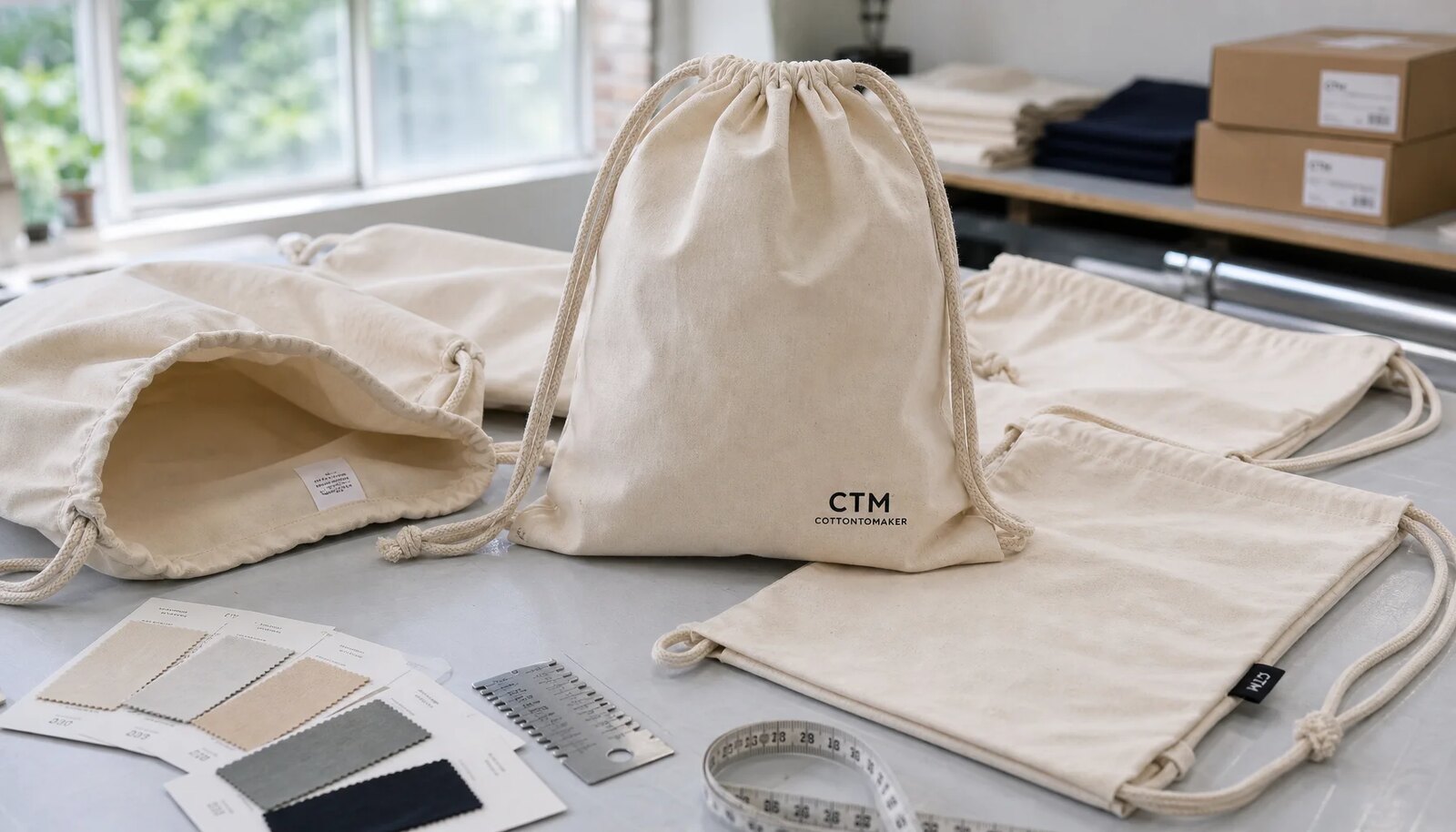
Start With How the Bag Fails
A cotton drawstring backpack looks simple in a quotation sheet, but the real durability risk is concentrated in a few stress areas. Complaints usually come from cord exits tearing, eyelets loosening, bottom corners opening, top channels fraying, print cracking, or cords becoming uncomfortable after the bag is loaded. The flat fabric panel may still look acceptable while the carry system has already failed.
For craft fair buyers, this matters because the bag is often used in a mixed-load environment. Customers may carry notebooks, candles, ceramic pieces, water bottles, flyers, and small purchases in the same bag. A lightweight promotional pouch can survive a showroom pull, yet fail after repeated opening, closing, and shoulder carrying. Procurement should therefore treat the item as a low-complexity load-carrying product, not only a printed cotton pouch.
The most useful specification starts with intended use and then works backward into fabric, reinforcement, print, and packing. If the bag is sold as merchandise, the tolerance for failure is much lower than for a free sponsor insert. If the buyer plans to reuse the same design across several events, repeatability becomes as important as first-order price.
- Identify stress points before comparing FOB prices: cord exits, bottom corners, side seams, top channel, and print area.
- Separate visual approval from functional approval; a good-looking sample can still fail a pull or rub test.
- Write internal durability targets into the RFQ and purchase order before bulk production starts.
- Keep one signed master sample for the factory and one for inspection comparison at shipment.
Define the Commercial Use Case
The same product name can describe several very different buying needs. A free giveaway bag, a paid craft fair merchandise bag, a workshop kit carrier, and a distributor stock item should not use the same durability assumptions. The buyer should state what the bag will carry, whether it will be sold or given away, whether customers are expected to reuse it, and whether the brand will make any durability, natural cotton, recycled, or washable claims.
This short use note prevents the factory from quoting the cheapest construction by default. It also helps internal teams align price with risk. A buyer testing demand at one weekend market may choose a simpler natural cotton bag to control MOQ. A brand selling the bag at a booth should usually prioritize better fabric, reinforced cord exits, cleaner print curing, and stricter inspection.
The use case should also define what not to optimize. For example, a heavier canvas may feel better on a booth table but increases carton weight and freight cost. A very soft cotton may support a natural brand story but may stretch around the cord channel. The best specification is the one that matches customer behavior, selling price, and acceptable defect risk.
- Free giveaway: prioritize clean print, low cost, and honest light-load expectations.
- Paid merchandise: prioritize seam strength, cord comfort, fabric hand feel, and visible finishing quality.
- Workshop kit bag: prioritize load capacity, bottom-corner reinforcement, and reliable closure cycles.
- Distributor program: prioritize repeatable material sourcing, carton efficiency, and inspection records.
Choose the Right Construction Tier
Procurement teams often receive quotes that appear comparable but are built on different construction tiers. A 5 oz cotton bag with a single stitch and narrow cord may be several cents or more cheaper than an 8 oz canvas bag with reinforced exits and a tested print. The drawing may look the same, but the risk profile is different. A direct buying comparison should therefore group suppliers by construction level, not just by item name.
For craft fair use, 8 oz to 10 oz cotton canvas is often a practical starting range for reusable bags, while 10 oz to 12 oz may be suitable for premium merchandise. Lighter cotton can still be valid for packaging-style or giveaway use if the buyer does not overstate durability. Exact strength depends on weave, sewing, thread, reinforcement, and cord design, so fabric weight should not be treated as the only quality marker.
The buyer should ask suppliers to quote at least two clear tiers when price pressure is high: a standard reusable version and a cost-reduced version. This makes trade-offs visible. If a supplier only says “cotton drawstring backpack” without seam, cord, reinforcement, and print details, the quotation is incomplete for procurement comparison.
- Request side-by-side quotes for light, standard, and premium construction when evaluating a new supplier.
- Record fabric weight in both oz and GSM, plus tolerance, because cotton lots vary.
- Specify whether the fabric is natural, bleached, dyed, washed, recycled blend, or cotton-poly blend.
- Avoid approving a cheaper tier unless the expected load and selling claim are also reduced.
Specify Fabric, Cord, and Reinforcement
Fabric selection should balance strength, print surface, hand feel, shrinkage, and shipping cost. Natural cotton canvas works well for many craft brands, but it shows stains, seed specks, and shade variation more clearly than darker dyed fabric. Dyed canvas can support brand colors but adds dye-lot control, colorfastness checks, and potentially longer lead time. If washability is promoted, pre-shrunk fabric and wash-tested print approval should be part of the sample process.
Cord design is just as important as fabric. A thin cord can cut into the shoulder, abrade the channel, or concentrate stress at the exit point. Cotton cord supports a natural look, while polyester cord may provide better abrasion resistance and moisture performance. The buyer should approve diameter, material, color, end finish, knot or stopper method, and how the cord sits when the bag is loaded.
Reinforcement needs to be visible in the specification. Metal eyelets can look clean but must be set without sharp edges and should not loosen under pull. Stitched buttonholes reduce metal content but need dense stitching to prevent fray. Bartacks, reinforcement patches, or folded fabric layers can strengthen high-stress areas. Without these details, factories may meet the appearance requirement while reducing the hidden construction.
- Specify cord diameter, commonly 6-8 mm for reusable cotton craft fair bags, subject to buyer comfort testing.
- Require reinforcement at lower cord exits, top channel ends, and bottom corners for reusable or paid merchandise bags.
- Define seam construction such as French seam, overlock plus safety stitch, or other approved method.
- Check the inside of the bag for seam allowance, trimming, skipped stitches, and loose threads.
Set Internal Durability Tests
Many buyers do not need a formal laboratory program for every craft fair bag order, but they do need repeatable internal tests. Load targets such as 5 kg or 7 kg should be framed as buyer-defined internal performance checks unless the supplier provides a recognized standard or lab method. The key is to define weight, duration, sample size, cycle count, and pass/fail criteria before production.
A practical approach is to test pre-production samples, first production pieces, and final random inspection samples. For a standard reusable craft fair bag, a buyer might set an internal static load test at 5 kg for 30 minutes. For a stronger paid merchandise version, the buyer may set 7 kg for 30 minutes. These numbers are not universal standards; they are procurement controls that should match the expected contents and claims.
Cycle testing should cover repeated opening and closing because drawstring channels fail from motion as well as weight. A basic drawcord cycle check can open and close the bag 100 times for standard use and 200 times for premium use. The inspector should look for cord fray, channel seam damage, eyelet movement, buttonhole fray, and knot failure. The result should be recorded with photos and sample IDs.
- Sample size: test at least 3 pre-production samples and include durability checks in final random inspection when order value or risk justifies it.
- Static load: hang the filled bag by both cords for the agreed duration, then inspect seams, channel, cord exits, and fabric distortion.
- Drawcord cycles: open and close the bag 100-200 times according to the approved tier and reject broken stitches, fray, or cord slippage.
- Cord pull: apply a controlled pull to each cord side and reject loose eyelets, torn holes, failed bartacks, or knots that pull through.
- Pass/fail: no seam opening, no fabric tearing, no hardware movement, no broken cord, and no function loss after the test.
Control Print Durability
Printing is a major buyer risk because a bag can pass sewing inspection and still be unsellable if the logo cracks, transfers, or peels. Screen print is usually practical for craft fair logos, sponsor marks, and one to three spot colors. It can be durable when cured correctly, but coarse canvas, heavy ink deposit, and rushed packing can create cracking or offset marks.
Heat transfer may be useful for detailed graphics, gradients, or small artwork changes, but the film must be tested on the actual cotton fabric. Some transfers look excellent on a smooth swatch and then lift when applied to textured canvas or folded into cartons. Embroidery and woven labels can support premium positioning, but embroidery may pucker lighter cotton and should not be placed where contents press against the wearer.
The buyer should approve print on the same fabric and color as production. If the artwork sits near the top channel, bottom fold, or cord exit, it is exposed to more movement and creasing. Placement tolerance should be written in measurable terms, commonly from bag edges rather than visual center. For simple front-panel logos, many buyers use a placement tolerance around +/-5 mm, adjusted for artwork size and sewing variation.
- Dry rub: reject obvious ink transfer, smearing, or surface breakdown after the agreed number of rubs.
- Light wet rub: check whether damp contact causes unacceptable color transfer or edge lifting.
- Fold/flex: fold the printed area several times and reject cracking, peeling, or loss of adhesion.
- Tape pull: use a consistent tape-adhesion check for transfers or thick ink areas when appropriate.
- Packing pressure: inspect print after bags have been folded and packed for at least 24 hours.
Use AQL and Defect Classes
AQL planning turns quality control from opinion into a shared acceptance rule. For many soft-goods final inspections, buyers use General Inspection Level II as a normal sampling approach, with Critical 0, Major 2.5, and Minor 4.0 as a common starting point. This is not a rule for every buyer; premium retail, safety-sensitive claims, or high-visibility brand orders may require tighter limits. The important point is to define the plan before the factory packs the order.
Inspection sampling should represent the shipment, not only pieces handed over by the factory. The inspector should select cartons across the production lot, open packed cartons, check loose units, and compare against the signed master sample. If the order includes multiple colors, designs, or carton assortments, the sampling plan should cover each variant. Packed-carton inspection is especially important because compression can reveal print offset, creasing, and moisture issues.
Defect classification must be specific. A severe stain on natural cotton may be major because it affects resale. A small slub might be minor if it was accepted in the natural fabric standard. A loose eyelet is major because it affects function; a sharp eyelet edge may be critical if it creates a safety hazard. Without classification, inspectors and suppliers may argue over subjective appearance.
- Critical defects: unsafe sharp edges, wrong material with compliance impact, severe contamination, or functional failure that creates safety concern.
- Major defects: failed load test, torn cord exit, seam opening, loose eyelet, wrong logo, print peeling, incorrect size outside tolerance, or major stain.
- Minor defects: loose thread, slight wrinkle, small approved slub, minor washable mark, or small placement variation inside tolerance.
- Sampling logic: pull units from multiple cartons, colors, and production batches instead of inspecting only top-carton samples.
- Decision rule: accept or reject according to the written AQL table and defect class counts, not verbal negotiation.
Approve Samples Before Bulk
A digital mockup is useful for artwork alignment, but it cannot prove fabric hand feel, shrinkage, seam strength, cord comfort, print curing, or packing behavior. The pre-production sample should be made with bulk fabric or a confirmed equivalent, final cord, final reinforcement, final print method, and proposed folding method. If the sample uses substitute fabric or sample-room cord, the buyer should record that limitation and request a corrected approval sample before mass production.
Sample approval should be documented with measurements and photos. Measure finished width, height, top channel height, cord length, logo size, logo position, seam allowance if visible, and carton fold method. For heavier programs, cut one sample open to confirm reinforcement layers and seam construction. This is not wasteful when the order will be repeated or sold as merchandise; it prevents thousands of units from being sewn with hidden shortcuts.
The factory should also submit first production pieces after bulk sewing starts. These pieces confirm that the line is following the approved sample rather than simply copying the look. If there is a difference in fabric hand feel, cord stiffness, print color, or stitch density, stop and resolve it early. Correcting ten first pieces is cheaper than sorting ten thousand packed bags.
- Keep one signed sample at the factory and one with the buyer, agent, or inspector.
- Record any approved deviations, such as natural slubs or slight shade variation, so they are not disputed later.
- Approve the carton packing with real folded bags, not only a written packing estimate.
- Require first-production approval before full-speed sewing and printing continue.
Plan Packing and Shipping Controls
Packing can create defects after the bag has already passed sewing and print checks. Heavy canvas can crease when compressed too tightly. Fresh ink can transfer to adjacent panels if curing time is too short. Natural cotton can pick up moisture marks, carton dust, or handling stains. For craft fair buyers, the bags need to arrive clean, countable, and ready for booth or retail handling.
A packing plan should specify whether bags are bulk packed, bundled, individually polybagged, paper banded, or retail packed. Plastic-free packing may support brand values, but it still needs protection against moisture and dirt during storage and freight. If the buyer chooses no individual bag, the carton liner, inner bundling, and warehouse handling rules become more important.
Carton weight should be realistic for the buyer’s warehouse or event team. Many buyers prefer cartons under about 15-18 kg for manual handling, but the actual limit should follow the buyer’s workplace rules. Heavier canvas increases carton weight and freight cost, so carton efficiency should be considered during quotation. The packing method should also support inspection: mixed assortments, barcodes, and carton marks must be clear before cartons are sealed.
- Confirm pieces per inner pack, pieces per carton, carton dimensions, gross weight, and carton strength.
- Use moisture protection appropriate to shipping route, season, and cotton color sensitivity.
- Avoid over-compressing printed panels, especially with thick screen ink or transfer film.
- Inspect packed cartons after at least 24 hours when print cracking or offset is a known risk.
- Verify carton labels, barcode labels, assortment ratios, and shipping marks before final release.
Compare Quotes on Landed Risk
The lowest unit price is not always the best procurement result. A cheaper bag can become expensive if it creates returns, damaged booth reputation, sorting labor, late rework, or unsellable printed stock. A stronger bag may cost more per piece and more to ship, but it can better support paid merchandise, repeat use, and distributor programs. The buyer should compare cost per acceptable bag, not only cost per ordered bag.
A useful landed-value comparison includes unit price, fabric tier, reinforcement, cord specification, print method, sample cost, screen charges, inspection cost, carton volume, estimated freight, and expected defect risk. It should also include reorder reliability. If the supplier uses available fabric without a stable source, the first order may look good while the second order changes shade, hand feel, or GSM.
Procurement should treat unclear specifications as a cost risk. If a quote does not state fabric weight tolerance, seam method, reinforcement, cord diameter, print curing, AQL acceptance, or packing details, the supplier has room to make cheaper choices during production. Clear RFQs reduce arguments and make suppliers easier to compare fairly.
- Compare construction tiers, not just product names and FOB prices.
- Separate one-time setup charges from repeat-order unit pricing.
- Include freight impact from heavier canvas and larger cartons.
- Score suppliers on sample accuracy, documentation quality, inspection cooperation, and reorder consistency.
- Use the approved durability checklist as a commercial tool, not only a QC document.
Specification comparison for buyers
| Buying option | Typical construction | Best fit | Procurement risk to control |
|---|---|---|---|
| Light promotional cotton bag | 5 oz to 6 oz cotton, simple side seams, narrow cotton cord, minimal reinforcement | Free giveaways, low-load packaging, short event use where the buyer does not market the bag as durable | May look similar in photos to stronger bags but can distort at cord exits, show print-through, and fail if customers carry bottles or heavy purchases |
| Standard craft fair reusable bag | 8 oz cotton canvas, overlock plus safety stitch or French seam, reinforced cord exits, 6-8 mm cord | Vendor merchandise, workshop kit bags, branded craft fair retail bags, and distributor stock programs | Requires clear test targets and inspection criteria; otherwise factories may downgrade thread, cord, or reinforcement to meet price |
| Premium maker-market backpack | 10 oz to 12 oz canvas, stronger bottom corners, bartacked stress points, tested print or woven label | Paid retail merchandise, brand stores, heavier kits, and orders where structure and hand feel affect resale price | Higher fabric weight increases shipping cost, sewing difficulty, needle-hole visibility, and packing crease risk |
| Natural cotton eco-positioned bag | Unbleached or natural cotton canvas, cotton cord, stitched buttonholes or low-metal reinforcement | Craft brands that prefer natural materials and simple recycling or low-hardware positioning | Natural fabric shows stains and shade variation more clearly; claims must match actual fiber content and packing choices |
| Custom dyed event-color bag | Dyed cotton canvas, color-matched cord or contrast cord, screen print or label branding | Events needing brand-color alignment, seasonal assortments, or private-label retail programs | Dye-lot variation, colorfastness, shrinkage, and longer lead time must be controlled before bulk cutting |
| Print-heavy graphic bag | Canvas selected for print surface, screen print or transfer based on artwork, controlled curing and packing | Sponsor logos, art graphics, limited-edition fair merchandise, and multi-color designs | Ink cracking, transfer peeling, rub transfer, and carton pressure marks can create rejects even when sewing quality is acceptable |
| Low-MOQ sampler order | Available fabric color, one print setup, simplified packing, limited customization | First fair season, buyer testing demand, small brand launch, or pre-order validation | Available fabric may not be repeatable; the buyer should record fabric weight, shade, cord, and supplier material source for reorders |
| Distributor reorder program | Locked fabric spec, approved trim library, repeat carton plan, sealed reference sample | Wholesale programs supplying multiple craft fairs or seasonal vendor packs | Small spec drift across reorders can damage consistency; incoming inspection should compare each lot against the retained master sample |
Buyer checklist before sampling
- Define the commercial use first: free giveaway, paid merchandise, workshop kit bag, sponsor pack, or distributor stock item.
- State the intended internal load target and do not present it as a certified standard unless the supplier provides an applicable test method or lab report.
- Specify finished dimensions, size tolerance, fabric weight in oz and GSM, fabric color, cord diameter, cord material, thread color, and reinforcement method.
- Require a pre-production sample made with bulk fabric or a confirmed equivalent, final cord, final stitching, final print method, and proposed packing.
- Set durability checks with sample size, duration, cycle count, pass/fail points, and who performs them: factory QC, buyer office, third-party inspector, or lab.
- Approve print only after dry rub, light wet rub, fold/flex, tape adhesion, and packing pressure review on the actual bag fabric.
- Define AQL levels before production; for many soft-goods inspections, buyers use General Inspection Level II with Critical 0, Major 2.5, and Minor 4.0, adjusted to brand risk.
- Classify defects in writing so inspectors know whether seam opening, loose eyelets, stains, logo misplacement, loose threads, and shade variation are critical, major, or minor.
- Confirm packing details: pieces per inner pack, pieces per carton, carton dimensions, gross weight, carton marks, moisture protection, barcode labels, and assortment logic.
- Keep a signed master sample and production inspection report for repeat orders, because cotton shade, GSM, cord quality, and print curing can drift between lots.
Factory quote questions to send
- What exact fabric will be used: cotton type, weave, weight in oz and GSM, weight tolerance, shrinkage expectation, and whether it is natural, bleached, dyed, recycled blend, or cotton-poly blend?
- Is the quoted price based on available fabric or fabric purchased specifically for this order, and will the same fabric source be available for reorders?
- What seam construction is included at the side, bottom, top channel, and bottom corners, and what stitch density or seam allowance will be used?
- Which stress-point reinforcement is included in the price: bartacks, extra folded fabric, reinforcement patches, metal eyelets, stitched buttonholes, or grommets?
- What cord material, diameter, color, end finish, knot, stopper, or heat-sealed method is included, and what pull or abrasion checks does the factory normally perform?
- Which print method is quoted, how many colors are included, what curing process is used, and what rub, wash, adhesion, or fold test does the supplier recommend?
- Can the pre-production sample be made from bulk fabric with final cord, final reinforcement, final print, and proposed packing, and what sample lead time and cost apply?
- What MOQ applies separately to fabric color, bag size, print design, cord color, label, packing style, and carton assortment?
- What is the production lead time after sample approval, and how many extra days are needed for fabric dyeing, custom cord, printed labels, or third-party inspection?
- What internal QC checks will be completed before shipment, including sample size, load-test duration, drawcord cycle count, print-rub method, and defect records?
Quality-control points to confirm
- Use General Inspection Level II for normal final random inspection unless order risk, buyer policy, or shipment size requires a tighter plan.
- Set AQL before production; a common soft-goods starting point is Critical 0, Major 2.5, and Minor 4.0, but buyers should adjust by selling channel and claim risk.
- Treat broken seams, torn fabric at cord exits, loose or sharp eyelets, incorrect material, severe stains, wrong logo, and unsafe metal edges as critical or major defects depending on severity.
- Treat skipped stitches near stress points, seam opening, incorrect cord diameter, obvious shade variation, print peeling, wrong carton labels, and failed load tests as major defects.
- Treat loose threads, minor slubs within approved standard, slight wrinkles, small washable marks, and minor logo placement variation inside tolerance as minor defects.
- Check finished size against the signed sample and written tolerance, commonly +/-1 cm for simple cotton drawstring backpacks unless the buyer approves otherwise.
- Verify fabric weight against the approved swatch or supplier report; large GSM variation changes strength, hand feel, shrinkage, and print appearance.
- Inspect both loose bags and packed cartons, because compression can reveal print cracking, ink offset, cord-channel deformation, and carton moisture issues.
- Document durability testing with photos, sample quantity, test weight, duration, cycle count, observations, and pass/fail result instead of relying on verbal confirmation.
- Compare production units to the retained master sample for fabric hand feel, cord feel, stitching density, reinforcement position, print color, logo placement, and folding method.