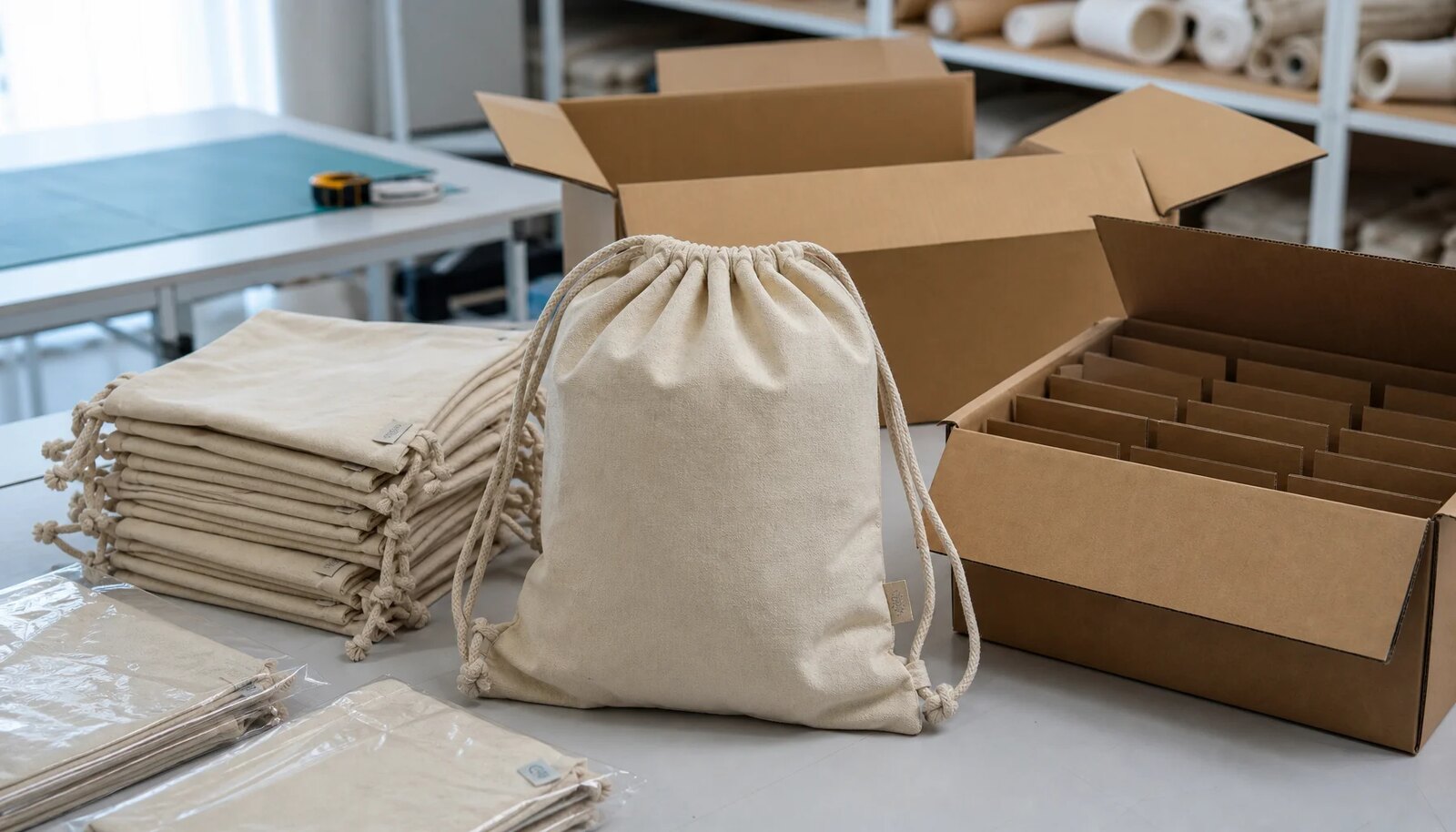
Start With The Carton Problem
For cotton drawstring backpacks used at craft fairs, the packing plan is not an afterthought. It affects freight cost, event setup speed, shortage control, print damage, and how easily booth staff can distribute the bags. A buyer who only asks for unit price may receive a good-looking product packed in a way that creates extra labor at the destination.
The central buying problem is simple: the carton must protect a soft cotton backpack while keeping the unit count easy to control. Unlike rigid retail goods, cotton backpacks compress, shift, wrinkle, and absorb pressure from neighboring items. If the print surface is folded badly or the cord hardware presses into the fabric, a clean sample can become a poor mass shipment.
- Treat packing as part of the product specification, not only a shipping detail.
- Quote unit price together with pieces per carton, carton size, gross weight, and folding method.
- Build the carton plan around the buyer's event workflow: warehouse receiving, kit assembly, booth replenishment, or direct retail sale.
- Use one approved packed-carton sample or packing photo before bulk shipment whenever the program has multiple SKUs.
Choose Fabric Weight Before Carton Quantity
Cotton drawstring backpacks for craft fairs are commonly made from 4 oz, 6 oz, 8 oz, or 10 oz cotton fabric. For most buyer programs, 6 oz to 8 oz cotton canvas is the practical range. It gives a better hand feel than thin promotional cotton, takes screen print well, and still packs efficiently. In GSM terms, that is roughly 200 to 270 GSM, depending on weave and finishing.
Carton quantity changes quickly when the fabric gets heavier. A 4 oz bag may allow a high piece count per carton, but it can look weak when used to carry brochures, craft kits, or small purchases. A 10 oz bag feels more substantial, yet freight volume and carton weight rise. For a fair program where staff may carry cartons by hand, a slightly lower carton quantity can be worth more than squeezing in extra pieces.
- 4 oz to 5 oz cotton: low-cost giveaways, light contents, higher transparency risk.
- 6 oz cotton: common event-grade option, better print surface, still compact in cartons.
- 8 oz cotton canvas: stronger retail feel, better for paid merchandise or brand programs.
- 10 oz cotton canvas: premium hand feel, but lower carton quantity and higher freight exposure.
Match Bag Size To Real Fair Contents
A typical adult cotton drawstring backpack is around 34 x 42 cm, but the right size depends on what the user will carry at the craft fair. A bag for postcards, stickers, and light craft samples can be smaller. A bag expected to hold folded apparel, catalogs, or multiple small purchases needs more body width and stronger cord attachment points.
Size also changes packing density. A wider bag may require a larger fold, which increases carton volume even if fabric weight stays the same. Before issuing the RFQ, procurement should list the expected contents and target use: giveaway at entrance, exhibitor welcome kit, branded retail item, or shopper carry bag. That one line helps the factory recommend a carton plan that will survive actual handling.
- Measure the largest item the backpack must hold and add practical clearance.
- Keep print position away from drawcord channels and heavy fold lines.
- For kits, test the filled bag with the actual sample items before approving carton quantity.
- For retail display, consider whether wrinkles from tight carton packing are acceptable.
Print Method And Folding Risk
Most cotton drawstring backpacks for craft fairs use screen printing because the artwork is often a solid logo, event mark, sponsor graphic, or simple one-color illustration. Screen print is cost-efficient when the order quantity supports setup, and it has a natural look on cotton. Heat transfer is useful for gradients, small color runs, or detailed artwork, but buyers should review hand feel and edge durability.
The packing plan must protect the printed face. Freshly cured ink may pass production checks but still mark neighboring bags if cartons are packed too tightly or if print faces rub during transit. For heavy ink coverage, the factory may need longer curing time, interleaving paper, or a fold that keeps printed panels from pressing directly against cords or seams.
- For screen print, specify Pantone colors, print size, print position, and acceptable registration tolerance.
- For heat transfer, approve edge finish, film hand feel, and wash or rub performance if relevant.
- Avoid placing large print areas exactly on the main fold line unless wrinkles are acceptable.
- For dark fabric with light print, review opacity on production fabric, not on a white proof.
MOQ Logic For Practical Buying
MOQ is usually driven by fabric sourcing, dyeing, printing setup, cutting efficiency, and packing labor. A natural cotton backpack with one-color screen print can often run at a lower MOQ than a custom-dyed bag with multiple print versions and individual retail packing. Buyers should separate the MOQ by fabric color, print design, and packing style instead of treating it as one flat number.
For craft fair programs, the mistake is creating too many low-volume artwork versions. Each sponsor logo, city name, or event date may require separate screens, packing labels, carton marks, and inspection records. If the total order is large but each design is small, the unit price and production risk rise. A cleaner approach is to standardize the backpack body and vary only a hangtag, paper insert, or carton destination label where possible.
- Lowest complexity: same fabric color, same print, same packing for all cartons.
- Moderate complexity: same bag, several print designs, shared carton quantity.
- Higher complexity: multiple bag colors, multiple prints, different destination carton marks.
- Most risky: small split quantities with unique folding, labels, inserts, or event kits.
Build The Carton Packing Plan
A useful carton packing plan states how many pieces go into each inner bundle, how bundles are arranged in the export carton, how the bags are folded, and whether individual polybags are used. For cotton drawstring backpacks, common master carton quantities may fall around 100 to 200 pieces, but the right number depends on GSM, size, cord thickness, print protection, and the buyer's carton weight limit.
Procurement teams should compare quotes using carton data, not only FOB unit price. A lower product price can become more expensive if cartons are oversized, underfilled, or too heavy for warehouse handling. Carton dimensions also affect courier charges for samples, LCL volume, palletization, and final delivery to fair venues.
- For event counting, use inner bundles of 10, 20, or 25 pieces.
- For retail replenishment, keep SKU and color split clear at the carton level.
- For print protection, fold with the print protected from cords, knots, and rough seam edges.
- For warehouse receiving, mark every carton with SKU, quantity, PO, carton number, and destination.
Individual Polybag Or Bulk Pack
Individual polybags make counting cleaner and improve presentation when backpacks are sold or handed out as premium items. They also protect against dust and minor moisture during warehouse handling. However, they add material cost, labor, packing volume, and potential plastic compliance issues. Some retail buyers or event organizers now prefer reduced plastic packaging.
Bulk packing is usually better for fast booth distribution and lower freight volume, provided the bags are bundled neatly. The buyer should decide based on the downstream process. If staff will open cartons and hand backpacks directly to attendees, bulk bundles may work. If the backpack is part of a retail-ready kit or must stay clean through multiple handling points, individual packing may be justified.
- Use individual polybags when resale condition, barcode control, or kit hygiene matters.
- Use bundle packing when speed, lower plastic use, and carton efficiency matter more.
- State whether suffocation warnings, recycling marks, or barcode labels are required.
- Confirm whether the factory price includes polybag material, labeling, and added packing labor.
Sample Approval That Prevents Packing Surprises
A product sample alone is not enough for this item. Buyers should approve the backpack and the packing style together. The sample should show bulk fabric, cord material, tab stitching, print method, print location, folding method, and any individual packaging. If the order is urgent, at minimum the factory should provide a pre-production sample plus packed-carton photos before mass shipment.
The sample review should be written as acceptance criteria. Instead of saying the bag looks good, record measurable points: fabric GSM, bag size tolerance, cord length, seam condition, print color, print position, and carton packing method. These notes become the reference when inspection finds variation. They also protect both buyer and factory from arguments based on memory or screen photos.
- Measure bag width, height, drawcord length, and print position on the physical sample.
- Weigh the sample fabric or request a GSM test record when fabric weight is critical.
- Fold the sample as planned and leave it packed for a short period to review crease behavior.
- Photograph the approved sample, label position, folding style, and carton arrangement.
Lead Time And Schedule Risk
Cotton drawstring backpack lead time depends on fabric availability, dyeing, print setup, sample approval speed, order quantity, and packing complexity. Natural cotton fabric with a standard cord and one-color print is usually faster than custom-dyed canvas with several artwork versions and individual barcoded polybags. Buyers should separate sample lead time from bulk production lead time in the RFQ.
Craft fair dates are fixed, so late packing decisions create real risk. Carton markings, destination splits, and inner bundle quantities should be finalized before production finishes. Changing carton allocation after the goods are packed can create rework, carton damage, incorrect counts, and shipping delays. A practical schedule includes time for pre-production sample approval, material preparation, printing, sewing, packing, inspection, and freight handover.
- Lock artwork before print screens or transfer films are made.
- Lock packing method before carton materials are ordered.
- Leave inspection time after packing, not only during sewing.
- For multiple fair locations, provide the carton split plan early so cartons are marked correctly.
Quote Data Needed For Landed Cost
A complete quote for cotton drawstring backpacks should include more than unit price. Buyers need fabric specification, print method, MOQ, sample cost if applicable, production lead time, packing details, carton dimensions, gross weight, and incoterm. Without carton data, landed-cost comparison is weak because freight volume and handling cost are unknown.
For importers and distributors, carton data also supports warehouse planning. A carton that contains 200 light bags may be efficient for freight but awkward for event staff if it is bulky. A carton with 100 heavier bags may be easier to carry and count. The right answer depends on the buyer's cost model and operational needs, so suppliers should quote a recommended plan and be willing to adjust it.
- Request FOB unit price and packing-inclusive price details.
- Compare CBM per 1,000 pieces, not only carton quantity.
- Record gross weight per carton for handling and air freight calculations.
- For DDP or delivered pricing, still request carton dimensions so the quote can be audited.
Specification comparison for buyers
| Spec decision | Recommended option | When it fits | Buyer risk to check |
|---|---|---|---|
| Fabric weight | 6 oz to 8 oz cotton canvas, roughly 200 to 270 GSM | Good balance for craft fair handouts, retail add-ons, and lightweight merchandise kits | Too light can look transparent after printing; too heavy increases carton weight and freight cost |
| Bag size | About 34 x 42 cm for adult event use, adjusted after measuring intended contents | Fits flyers, small craft items, apparel samples, or event purchases without looking oversized | A small change in size can change carton quantity, cord length, and print placement |
| Drawcord | Cotton rope or flat cotton cord with reinforced bottom tabs | Works for natural-brand positioning and comfortable shoulder carry at fairs | Thin cord may cut into shoulders; weak tab stitching can fail during loaded wear |
| Print method | Screen print for 1 to 3 solid colors; heat transfer only when artwork has gradients or small color runs | Screen print gives stable cost and good durability for most craft fair logos | Ink coverage, fabric shrinkage, and registration tolerance must be approved on real fabric |
| Individual packing | Fold once or twice into a clear OPP bag only when retail presentation or kit control is needed | Useful for booth distribution, store replenishment, or prepacked exhibitor kits | Extra bags add labor, material cost, carton volume, and sometimes plastic compliance issues |
| Inner carton plan | Bundle 10 or 25 pieces with paper band or polybag before master carton packing | Helps fair staff count units quickly and reduces handling mistakes during event setup | Loose packing saves cost but slows counting and can lead to mixed color or size quantities |
| Master carton quantity | Usually 100 to 200 pieces per export carton depending on GSM, folding method, and print protection | Keeps carton weight manageable while protecting print faces from abrasion | Cartons over practical weight limits may be rejected by warehouses or damaged in handling |
| Carton markings | PO number, SKU, color, quantity, gross/net weight, carton number, and destination code | Needed for distributors, retail DCs, event agencies, and multi-city craft fair programs | Missing or vague marks cause receiving delays and make shortage claims harder to verify |
Buyer checklist before sampling
- Define the bag size by the real craft fair contents, not only by a catalog image.
- Specify fabric weight in oz and GSM so supplier quotes are comparable.
- Decide whether the backpack is a giveaway, retail item, exhibitor kit bag, or merchandise carrier.
- Confirm drawcord material, cord diameter or width, bottom tab construction, and stitching method.
- Provide artwork size, color count, Pantone references, and the required print position.
- Approve a physical pre-production sample using the same fabric, cord, print, and folding method.
- Set carton quantity by weight, volume, event handling needs, and warehouse receiving rules.
- Request carton dimensions, gross weight, net weight, packing method, and pieces per bundle in the quote.
- State whether individual polybags are allowed, required, or prohibited for the destination market.
- Use carton drop, print rub, seam strength, and quantity checks as release criteria before shipment.
Factory quote questions to send
- What exact fabric construction and GSM are included in your price, and is it greige, bleached, dyed, or natural cotton?
- What is the standard shrinkage tolerance after washing or steaming, and will the sample be made from bulk fabric?
- Which print method are you quoting, and what is the maximum print area before the price changes?
- How many pieces are packed per inner bundle and per export carton, and what are the estimated carton dimensions?
- What is the gross weight and net weight per carton for the proposed packing plan?
- Are the bags folded with print facing inward, outward, or protected by paper, and how do you prevent ink abrasion?
- What MOQ applies per fabric color, print design, and packing style?
- How many days are needed for material preparation, print setup, production, packing, inspection, and shipment handover?
- Can you provide carton marking artwork and a packed carton photo before mass shipment?
- What inspection standard do you recommend for seams, cords, print defects, stains, size tolerance, and packing count?
Quality-control points to confirm
- Fabric weight should be verified against the approved sample, with tolerance agreed before production.
- Bag dimensions should be measured after sewing and normal finishing, not only before assembly.
- Drawcord length must allow comfortable carrying without excessive hanging ends.
- Bottom cord tabs or reinforced corners should pass a pull test suitable for the intended load.
- Print color should match the approved sample under consistent lighting, with reasonable fabric absorption allowance.
- Print adhesion should pass a rub test after drying and curing, especially when bags are folded print-to-print.
- Seams should be straight, locked, and free from open stitches, broken threads, or skipped areas.
- Carton quantity should be counted by bundle and master carton, with shortages recorded before sealing.
- Carton weight should remain practical for manual handling and compliant with buyer warehouse limits.
- Final packed cartons should match the quoted dimensions, marks, SKU split, and carton numbering.