What Makes This Order Different
Cotton drawstring backpacks for coffee roasters sit between promotional merchandise and retail textile product. The same backpack might be handed out at a cupping event, sold beside beans in a cafe, placed inside a subscription box, or packed with brewing tools for a wholesale customer. That mixed use creates sourcing risk because a generic promo-bag quote often excludes the details that matter once the product enters a retail or fulfillment workflow.
For B2B procurement, the useful question is not simply whether a supplier can make a cotton bag. It is whether the supplier can repeat the approved material, print, label, packing, and compliance evidence at the volume and schedule you need. A low unit price is not useful if the fabric is lighter than quoted, the drawcord is substituted, the barcode is wrong, or the final cartons arrive too tightly compressed for retail presentation.
Use this supplier compliance checklist to standardize quotes before you compare them. Lock the construction, test expectations, market requirements, and packing rules early. Then evaluate price, lead time, and supplier fit on the same basis.
- Treat the backpack as a branded textile item, not only a giveaway.
- Compare suppliers against one written spec sheet and one packing plan.
- Ask for evidence tied to the actual production site and material lot.
- Make sample approval, QC, and compliance part of the purchase order, not a side conversation.
Build The Product Spec First
Start with the intended use and contents. A bag used for one 250 g coffee bag and a leaflet can be lighter than one expected to carry two 340 g bags, a tumbler, and a small brewer. Common finished sizes are about 30 x 40 cm for inserts, 35 x 45 cm for gift packs, and 38 x 42 cm for general merchandise. If the bag needs to stand better when filled, a gusset may improve presentation, but it also adds material, sewing time, and carton volume.
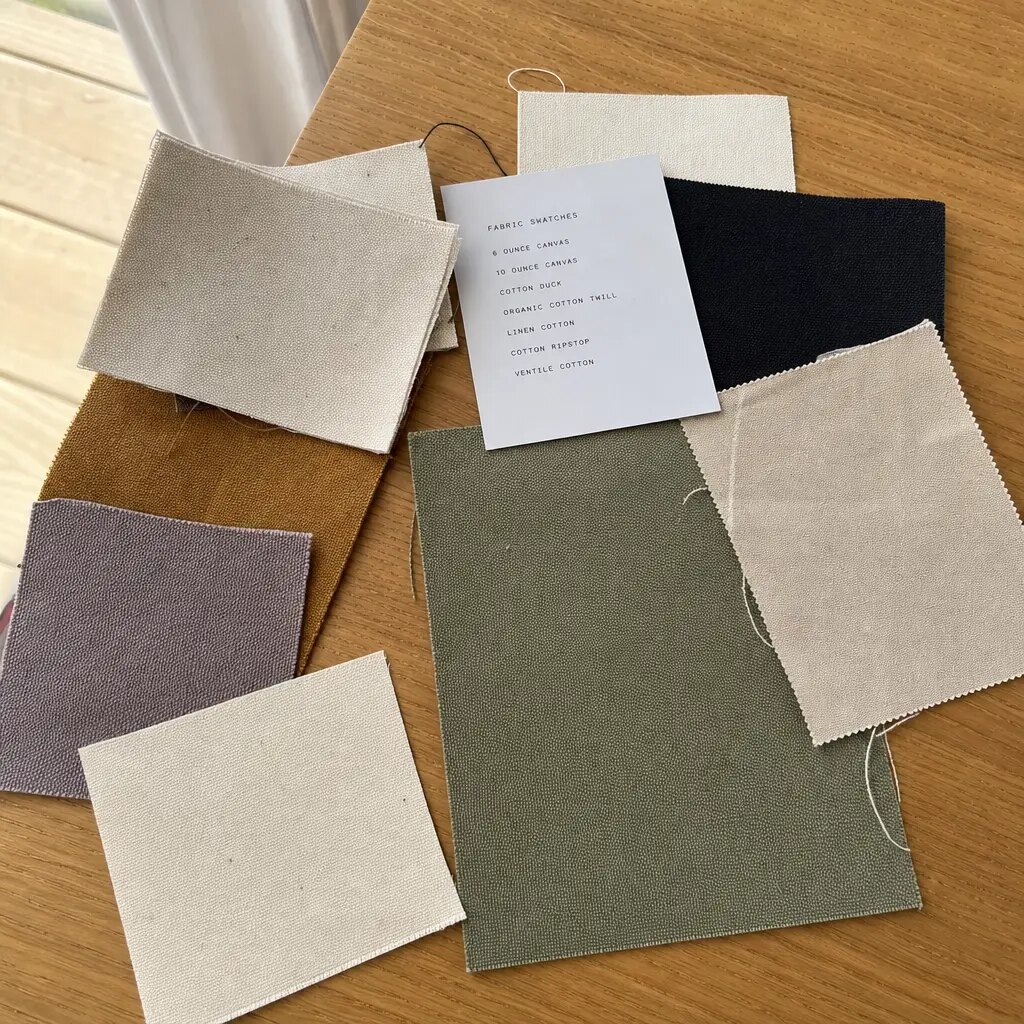
For most coffee roaster merchandise, 220-260 GSM cotton canvas is a practical middle range. It has more body than lightweight promotional cotton without pushing the product into heavy tote-bag territory. For paid retail merchandise or heavier kits, 260-300 GSM may be more appropriate. Below about 180-200 GSM, the unit price can drop, but the bag often feels promotional and stress points become more important.
Write the construction details in measurable terms. Include finished width and height, tolerance, seam finish, channel depth, cord diameter, and reinforcement method. A vague note such as strong stitching does not protect the buyer. A better note is bartacks at both lower cord exits, reinforced lower corners, and overlocked inside seams, with placement checked against the approved sample.
- Promotional handout: 180-220 GSM, simple print, bulk pack or simple unit pack.
- Cafe retail item: 220-260 GSM, clean print, controlled fold, barcode or hangtag as needed.
- Gift kit or staff carry: 260-300 GSM, reinforced lower corners, stronger cord, tighter QC.
- Custom dyed program: add lab dip, shade approval, and longer material lead time.
Control Material, Cord, And Reinforcement
Fabric weight is only one part of durability. Drawstring backpacks often fail where the cord exits the lower corners or rubs through the top channel. If the bag will be reused, specify reinforcement as part of the base construction. Options include folded corner reinforcement, triangular patches, bartacks, box stitches, or a stronger channel construction. The best method depends on the design, but the method must be visible in the sample and repeatable in bulk.
The cord must also be specified. Cotton cord supports a natural-material brand story and usually looks consistent with cotton canvas, but it can vary slightly in shade and may fuzz with use. Polyester cord is often more uniform and sometimes cheaper, but it can weaken an all-cotton claim and changes the product feel. If your copy says cotton backpack, define whether that includes the cord and sewing thread or only the body fabric.
Ask the supplier to quote the cord diameter and tolerance. A small change can affect draw feel, appearance, and wear at the channel. Also define cord color, whether the cord is braided or twisted, and whether knots, metal tips, plastic tips, or heat-cut ends are allowed. Metal and plastic components may trigger additional compliance checks depending on destination and age grading.
- Require fiber content for body fabric, cord, thread, labels, and any trim.
- Approve fabric lot, cord color, and reinforcement detail before bulk cutting.
- Do a practical pull check on the loaded sample rather than judging only by appearance.
- Do not allow material substitution without written buyer approval.
Choose The Decoration Method
Most coffee roaster artwork works well as screen printing: logos, cafe names, roast badges, simple typography, and one- or two-color marks. Screen printing is usually cost-effective once volume reaches a few hundred to a few thousand pieces, and it gives a clean result on cotton when the print is cured correctly. On natural cotton, colors can look warmer or duller than they do on a digital proof, so approve a strike-off for brand colors.
Heat transfer can be useful for short runs, complex artwork, or early launch tests. The tradeoff is hand-feel, folding behavior, and wear pattern. A large transfer may feel heavy on a soft cotton bag and can crease if the product is packed tightly. Embroidery can look premium on small marks but adds cost, creates puckering risk on lighter fabric, and is usually not ideal for large front graphics.
A precise artwork spec prevents many claims. State print size, placement from seams, placement tolerance, side of bag, number of colors, ink type if relevant, and color reference. For retail merchandise, also check whether the print surface faces outward after folding. A beautiful print hidden inside the fold will still create receiving and merchandising problems.
- Use screen print for most medium-volume coffee roaster logos and simple graphics.
- Use transfer only after checking hand-feel, folding, and rubbing performance.
- Require a strike-off when color, opacity, or print size matters.
- Include print setup and revision charges separately in the quote.
Compare Price, MOQ, And Cost Deltas
MOQ is usually layered. A supplier may offer 500 pieces for a stock natural cotton bag with one print color, but require 1,000-3,000 pieces per custom dyed color or 3,000-5,000 pieces if fabric must be woven, dyed, or specially finished. A split order of 3,000 pieces across three body colors and four artwork versions may price very differently from one 3,000-piece run in a single design.
Typical cost drivers are easy to miss. Moving from lightweight cotton to a sturdier canvas can add material cost but may reduce defect risk and improve retail value. A gusset can add fabric usage and sewing labor. Two-sided print can add screen setup, print time, and curing control. Individual packing, hangtags, and barcodes can add several handling steps per unit. Formal lab testing can add both cost and calendar time.
Ask suppliers to show price breaks at 1,000, 3,000, 5,000, and 10,000 pieces. Also ask for one-time charges separately: screens, lab dips, strike-offs, sample revisions, label setup, hangtag printing, barcode application, carton mark changes, and lab tests. This lets procurement compare the first order and the reorder fairly.
- Stock natural cotton is usually the lowest-risk low-MOQ route.
- Custom dyed fabric often increases MOQ and adds about 7-14 days for lab dip and approval before bulk material is ready.
- Retail packing can add meaningful labor cost, especially with multiple SKUs and barcode rules.
- Testing and claim documentation should be budgeted as program costs, not treated as supplier favors.
- The cheapest quote is weak if it excludes inspection support, packing accuracy, or required evidence.
Check Compliance By Market
Compliance evidence must match the destination market, product claim, and actual production article. A supplier declaration is useful for basic screening, but it is not the same as a laboratory report or certificate with the correct scope. Ask where the fabric is sourced, where printing is performed, where sewing is completed, and whether packing is subcontracted. If the site changes, the evidence may need to change too.
For the United States, textile labeling should support fiber content and country of origin under FTC rules. If the item is intended primarily for children 12 and under, CPSIA applies. For children's products, check for required tracking information and applicable limits such as lead in substrate materials at 100 ppm, lead in paint or surface coatings at 90 ppm, and phthalates at 0.1% for regulated plasticized components. Adult merchandise does not automatically fall under CPSIA, but print chemistry, labels, and claims still need review. For California distribution, evaluate Prop 65 exposure risk for dyes, prints, trims, and packaging.
For the EU, review textile fiber composition under Regulation (EU) No 1007/2011 and restricted substances under REACH Annex XVII. Common textile concerns include certain azo colorants that can release restricted aromatic amines, formaldehyde limits where required by buyer policy, nickel release for metal parts if present, and retailer restricted substance lists. For Great Britain, check the UK textile labeling approach, UK REACH, and general product safety expectations. Requirements can also vary by retailer, so the buyer's channel rules may be stricter than the legal baseline.
For claims, require evidence before artwork or hangtags are finalized. Organic cotton claims usually need chain-of-custody support such as GOTS or another applicable organic textile certification with the right scope. Recycled claims need GRS or RCS scope that covers the material and supplier. OEKO-TEX Standard 100 can support low-chemistry positioning only when the certificate covers the article or relevant components and remains current.
- Request ISO/IEC 17025 lab reports when formal testing is required.
- Match each report to the actual fabric, print, cord, trim, and production lot where possible.
- Do not accept an organic, recycled, or low-chemistry claim without scope evidence.
- Confirm label artwork before production, including fiber content and country of origin.
- Record whether the product is adult merchandise or a children's product before setting the test plan.
Plan Sampling And Approval
Sampling should prove bulk readiness, not only visual appeal. A development sample can be made with available fabric or hand-finished more carefully than mass production. Before bulk approval, require a pre-production sample using the intended fabric, cord, print method, label, and packing format. If the order uses custom color, approve lab dips or a physical shade standard before bulk cloth is cut.
Test the sample with real contents. Put in the coffee bags, tumbler, brewer, or kit components the backpack will actually carry. Pull the cords several times, check whether the lower corners distort, and inspect the top channel for twisting. Fold the unit as it will be packed and see whether the print creases, transfers, or hides in the wrong position. This is simple work, but it catches problems that a flat product photo will not show.
Document approval with photos, a signed spec sheet, and a tagged reference sample. The approved sample should define the standard for final inspection. Any later change to fabric, cord, print size, shade, label, or packing should be treated as a written revision, not a casual production adjustment.
- Use a digital mockup for layout approval, then a physical sample for construction approval.
- Require a strike-off for important artwork, ink color, or print opacity.
- Approve packing as part of the sample if retail or warehouse receiving matters.
- Keep one sealed sample with the factory and one with the buyer or inspector.
- Tie final inspection to the approved sample and purchase order spec.
Set Lead Time By Milestone
A single bulk lead time number hides too much risk. A simple stock natural cotton backpack with one-color print may be ready faster than a custom dyed, multi-SKU retail program. As a working range, sampling often takes 5-12 days after artwork and spec confirmation. Lab dips can add 5-10 days. Bulk production for standard cotton drawstring backpacks often falls around 20-40 days after sample approval, while custom dyed fabric, complex packing, or tight capacity periods can push the schedule to 45-60 days or more.
Break the schedule into milestones: artwork approval, material booking, lab dip if needed, pre-production sample, bulk fabric arrival, cutting, printing, sewing, inline check, final inspection, packing, and export handoff. Ask which stage is the longest path. For many coffee merchandise programs, the risk is not sewing time; it is late artwork approval, custom color approval, retail label setup, or waiting for test results.
Build time for rework. If inspection finds shifted prints, loose bartacks, barcode errors, or carton mark mistakes, the supplier needs time to sort and correct units. A schedule with no rework buffer can make an acceptable supplier look late when the real issue is an unrealistic calendar.
- Ask for milestone dates, not only an ex-factory date.
- Confirm whether testing happens before production, during production, or from finished goods.
- Add extra time for custom dyed colors, multiple SKUs, and retailer pack-out rules.
- Do not release final payment or shipment until inspection and document checks are complete.
Write Packing And Labeling Rules
Packing decisions affect cost, freight, receiving, and retail presentation. Cotton backpacks compress easily, so suppliers may pack high carton counts to save space. That can crease the print, tangle cords, distort folds, or make the first retail impression feel cheap. If the product is a giveaway, bulk packing may be acceptable. If it is sold in cafes or shipped through ecommerce, the fold, barcode, hangtag, and unit pack need to be controlled.
State the pack plan in the RFQ. Define whether each unit is polybagged, paper wrapped, tied with a band, or packed carton-only. If your brand avoids single-use plastic, state that before sampling. Also specify bundle count, carton quantity, carton size limit, gross weight target, moisture protection, desiccant use if needed, and whether mixed SKUs are allowed in one carton.
Labeling should be checked before bulk printing. Confirm fiber content, country of origin, care text if used, tracking label if required, SKU, barcode, hangtag, and carton mark. For wholesale or retail channels, run a barcode scan check and confirm placement. A correct backpack can still fail receiving if the label is missing, unreadable, or placed on the wrong surface.
- Define unit pack, inner pack, master carton, and pallet or routing rules if applicable.
- Keep gross carton weight practical for warehouse handling, often under about 15-18 kg unless the channel allows more.
- Require carton marks to match purchase order, SKU, color, quantity, and destination instructions.
- Check barcode readability before final packing begins.
- Include moisture protection for long sea freight or humid storage routes.
Inspect Before Shipment
Final QC should follow the risks in the spec. Start with material: fabric lot, GSM, shade, hand-feel, and visible defects. Then inspect construction: finished size, seam allowance, stitch density, top channel, cord length, cord movement, reinforcement, and loose threads. A small shift in print or a weak bartack can become very visible once the bag is handled by customers.
Use clear defect definitions. Critical defects may include unsafe sharp trim, illegal labeling, or contamination. Major defects may include wrong material, wrong size outside tolerance, missing reinforcement, badly shifted print, incorrect barcode, open seams, or failed pull checks. Minor defects may include small thread ends or slight cosmetic variation within the approved standard. If using AQL, set the level before inspection and make sure the factory understands what causes rejection.
Inspection should also cover packing accuracy. Count units, verify SKU separation, check carton labels, confirm unit pack materials, and compare carton quantities against the packing list. If the supplier substituted fabric, cord, print ink, label stock, or packing format without approval, record it as a lot-level nonconformance. Unauthorized substitution is not a cosmetic issue.
- Check measurements on a sample set across cartons, not only the top units.
- Pull-test cords and reinforcement points during inspection.
- Compare print color, placement, and cure against the strike-off or sealed sample.
- Scan barcodes and verify carton marks before shipment release.
- Photograph defects and require a written rework or sorting plan before accepting goods.
Specification comparison for buyers
| Supplier option | What to verify | Commercial advantage | Buyer risk to control |
|---|---|---|---|
| Direct sewing factory | cord material proof, reinforcement close-ups, load-test photos, approved sample tag, and bulk-line first-piece record | Better sample-to-bulk control and faster production feedback | May be weaker on export paperwork or branded packing unless checked early |
| Trading company | Factory name, production photos, trim-source proof, and who owns QC decisions | Can coordinate small mixed orders and extra services | Markup can hide real factory capability and slow defect decisions |
| Specialized bag workshop | cord diameter, eyelet or reinforced channel, bottom corner reinforcement, seam allowance, bar-tack position, and load target | More practical for detailed construction, trims, and repeat programs | Capacity may be limited during peak seasons |
| Low-price general supplier | 6-10 oz cotton canvas, 210D polyester, rPET, or blended cotton with shrinkage and colorfastness expectations set before sampling | Useful for simple promotional runs with loose specs | Material downgrades, weak packing, and vague inspection scope can erase savings |
| Retail-ready supplier | fold direction, cord protection, bundle count, carton compression, moisture bag, and retail label position | Can handle labels, SKU separation, carton marks, and receiving rules | Higher unit cost must be compared against reduced warehouse work |
| Compliance-focused supplier | Fabric records, labeling review, test plan, and production traceability | Safer for retail programs and repeat brand orders | Documentation claims need evidence, not only sales language |
| Local sample room plus bulk factory | Signed sample, bulk factory handoff, first-piece photos, and deviation owner | Good for complex branding before large production | Sample room quality may not match bulk line unless handoff is controlled |
Buyer checklist before sampling
- Define the commercial use: free cafe giveaway, paid merchandise, subscription-box insert, wholesale bundle, event kit, staff carry item, or children's promotion.
- State the expected contents and load. A bag holding two 340 g coffee bags is different from one carrying a grinder, tumbler, brewer, or mixed retail kit.
- Lock the finished size and tolerance. Example: 38 x 42 cm +/- 1 cm, measured flat and empty after sewing, excluding cord length.
- Choose flat or gusseted construction. A gusset improves capacity and presentation but usually adds fabric, sewing time, and carton volume.
- Specify fabric by fiber content, weave, and weight. Example: 100% cotton canvas, 220-260 GSM, natural unbleached, lot variation +/- 5% unless approved.
- Define the drawcord fiber, diameter, construction, color, and end finish. If the product is marketed as all cotton, do not allow polyester cord substitution.
- Write the reinforcement method: bartacks at cord exits, folded lower corners, triangular patches, box stitch, or other approved construction detail.
- State the decoration method, print size, placement tolerance, ink color reference, one-side or two-side printing, and whether a strike-off is required.
- Separate MOQ by body color, print design, size, cord color, and packing format so the supplier cannot hide split-order costs.
- Ask for price breaks at 1,000, 3,000, 5,000, and 10,000 pieces, plus one-time charges for screens, lab dips, labels, hangtags, barcodes, and testing.
Factory quote questions to send
- What exact material is included in this price: fiber content, weave, GSM or ounce weight, finish, and mill or fabric source?
- Is the quoted fabric stock natural, bleached, piece-dyed, garment-dyed, or custom dyed, and what approval step is included for shade?
- What is the expected shrinkage, GSM tolerance, shade tolerance, and acceptable panel-to-panel variation?
- Is the bag flat or gusseted, and what seam finish, cord-channel construction, and reinforcement method are included?
- What cord is quoted: cotton or polyester, braided or twisted, nominal diameter, color, end finish, and pull-strength expectation?
- What is included in the unit price versus charged separately: screen setup, print strike-off, lab dip, woven label, hangtag, barcode, unit pack, carton mark, and inspection support?
- What are the MOQ and price breaks by total quantity, color, design, size, and packing format at 1,000, 3,000, 5,000, and 10,000 pieces?
- What lead time applies by stage: artwork review, sampling, material booking, lab dip, bulk fabric, cutting, printing, sewing, inspection, packing, and export handoff?
- Which production steps are in-house and which are subcontracted, including printing, dyeing, label application, and packing?
- Which compliance documents can you provide for the actual production site and article: fiber declaration, country-of-origin statement, REACH or UK REACH support, CPSIA where relevant, and restricted substance evidence?
Quality-control points to confirm
- Verify the fabric lot number, shade, hand-feel, and GSM against the approved pre-production sample before cutting.
- Measure finished dimensions flat and empty, including width, height, channel depth, gusset if any, and cord length tolerance.
- Inspect fabric for stains, oil marks, holes, slubs outside the approved standard, broken weave, panel mismatch, and visible shade variation.
- Check seam allowance, stitch density, skipped stitches, loose thread trimming, inside seam finish, and bartack consistency.
- Confirm reinforcement at cord exits and lower corners, then run a practical pull check to see whether stitching opens, distorts, or tears.
- Pull both cords to check equal length, smooth movement, no missed threading, no fraying, and no sharp or noncompliant cord ends.
- Check print placement, registration, cure, opacity, hand-feel, color match, cracking, and rubbing behavior against the strike-off or sealed sample.
- Verify labels for fiber content, country of origin, care text where used, tracking label if required, barcode, SKU, hangtag, and carton mark accuracy.
- Review packing: fold direction, unit pack material, bundle count, carton count, gross weight, carton compression, moisture protection, and SKU separation.
- If lab testing is required, confirm the test plan before production and match each report to the actual fabric, print, trim, and production lot.