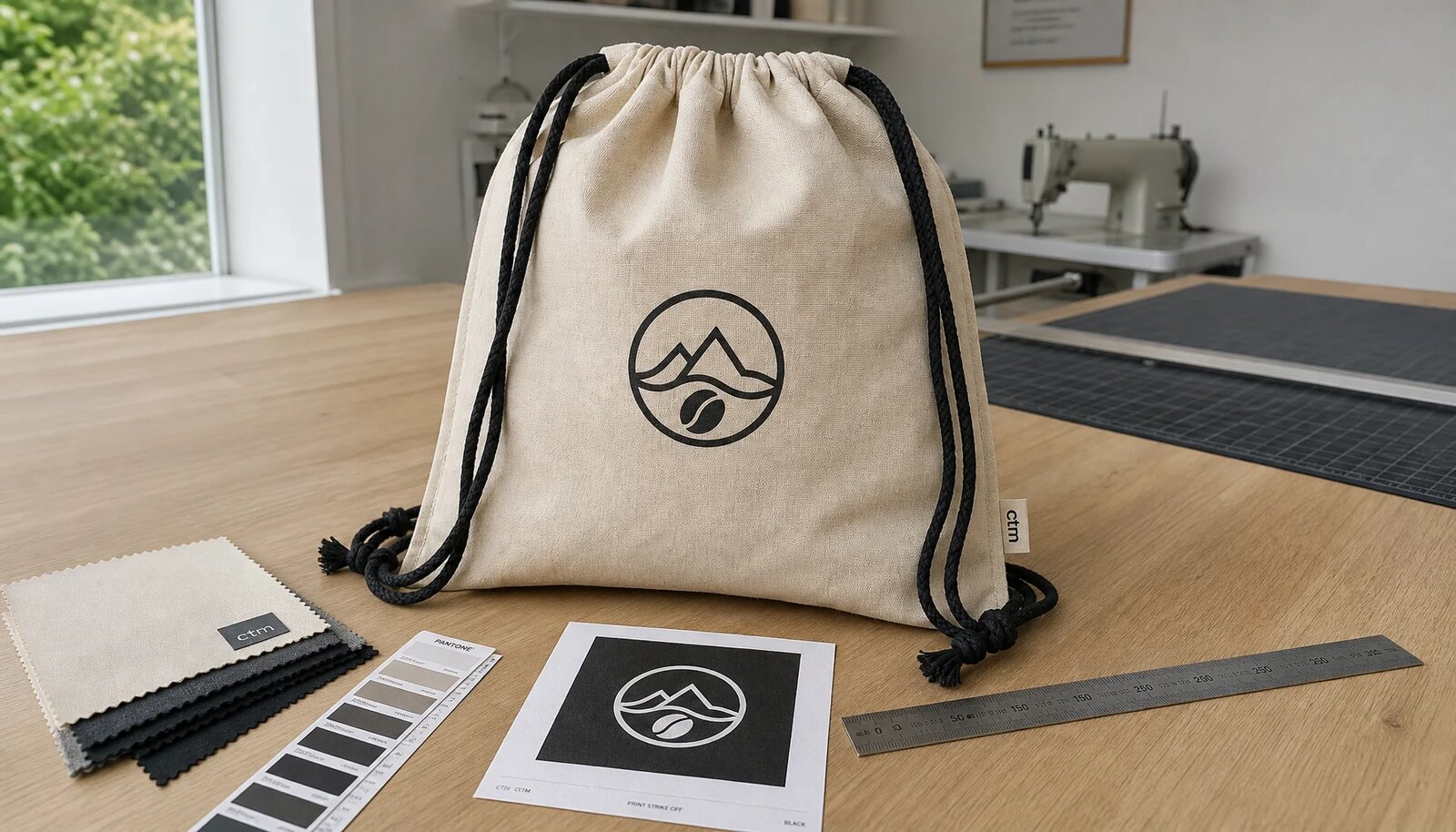
Why print proofing matters more on drawstring backpacks than on flat totes
Coffee roasters often approve artwork on a flat PDF and assume the same logo will behave well on a drawstring backpack. That is where problems start. A backpack has a cord channel at the top, side seams that pull tension into the front panel, and a usable print zone that is smaller than the total panel size. If the artwork is not proofed against the sewn construction, a centered logo on paper can look high, warped, or squeezed once the cords are installed and the bag is loaded with coffee.
The practical issue is not only appearance. Bad proofing creates commercial waste: rejected samples, re-screens, delayed launches, and quote disputes because the supplier printed exactly what the file showed, while the buyer expected a different visual result on the finished bag. For coffee roasters using these bags for subscription packs, brew tool kits, event merchandise, or retail gifts, print proofing should be treated as a construction approval step, not only an artwork approval step.
- Front panel print area is reduced by top hem, cord channel, and seam clearance
- Natural cotton texture changes ink coverage compared with coated paper proofs
- Bag filling can visually compress artwork near the center and lower panel
- Dark roast branding often uses dense black blocks that show pinholes more easily on open-weave cotton
Choose the right bag spec before you approve the logo
Print quality starts with the base bag specification. For coffee roaster use, a common starting point is 8 oz to 10 oz cotton canvas, roughly 270 to 340 GSM. This range is heavy enough to hold shape, support a cleaner screen print, and carry items such as a 250 g coffee bag, brewing accessories, or branded collateral without looking flimsy. Lighter 4 oz to 6 oz cotton can work for low-cost promotions, but on a drawstring backpack it tends to wrinkle around the logo and show more distortion once cords are pulled tight.
Size also matters to the print result. Many buyers focus on overall dimensions, but front panel geometry is the more useful number for proofing. If the finished backpack is 350 x 450 mm, the printable front zone may be closer to 260 x 280 mm after seam and channel deductions. If you do not define that zone in the RFQ, one supplier may quote based on a smaller print and another on a larger print, making unit prices look comparable when they are not.
- Common bulk spec for coffee merch: 350 x 450 mm or 380 x 420 mm finished size
- Typical seam allowance: 10 to 15 mm each side depending on construction
- Top channel deduction: often 35 to 50 mm from total panel height
- Practical print window: keep 20 to 30 mm away from side seams and top channel
Screen print or heat transfer: which proofing route makes sense
For most coffee roaster artwork, screen printing is still the most commercially stable option on cotton drawstring backpacks. It gives better cost per unit at bulk quantities, handles one-color and two-color logos well, and usually has a more integrated handfeel than transfer methods. It is especially suitable for simple roaster marks, café names, line icons, and bold statement graphics. It also makes sample approval easier because the strike-off can be produced on the actual fabric and read much closer to bulk output.
Heat transfer has a place, but usually for low-quantity pilots, highly detailed artwork, or short-term event runs where screen setup cost is not efficient. The tradeoff is feel, durability on fold lines, and edge appearance on textured cotton. For coffee brands trying to present a natural, reusable, premium accessory, a transfer that looks glossy or plastic can work against the product story. If a supplier recommends transfer only because the order quantity is low, compare the true all-in cost of a one-color screen print with a modest MOQ increase before deciding.
- Screen print works best for solid logo shapes, text, and simple 1 to 3 color artwork
- Heat transfer suits gradients or small runs but may create a less natural surface feel
- Water-based inks can look softer but require tighter opacity review on dark fabrics
- Plastisol or high-opacity systems may improve coverage but should be checked for handfeel and cure
How to build a print proof that a factory can actually run
A usable proof package is more than a logo file. The factory needs a print-ready instruction sheet that ties artwork to the finished bag. At minimum, show the front panel with dimensions, print size in millimeters, distance from the top edge of the finished bag, and distance from the side seams. If the logo must look visually centered below the cord channel, note whether positioning is measured from the top seam or from the bottom of the channel. Those are not the same reference points in production.
For coffee roasters with strict brand consistency, add Pantone references and note whether visual match takes priority over exact formula on natural cotton. This matters because natural base cloth can warm the ink appearance. A dark forest green or muted cream may need underbase treatment or revised ink mix to look right. If you only approve a digital mockup, the factory may hit the file but still miss the retail look you wanted.
- Provide vector artwork in AI, EPS, or editable PDF
- State Pantone code and whether coated or uncoated reference is being used
- Include print width and height, not only percentage scale
- Define measurement points from finished sewn edges, not from cut panels
- If artwork has thin lines, note minimum line thickness and negative space tolerance
Sample approval: what to review on the first strike-off and pre-production sample
The first physical review should usually be a print strike-off on the actual production fabric, not just a sewn sample with approximate artwork. A strike-off lets you evaluate ink opacity, edge sharpness, color shift on natural cotton, and overall handfeel before the bag enters full sewing and printing flow. This is the fastest way to catch problems such as porous fabric pinholes, over-absorption, or weak white coverage on black-dyed cotton.
After the strike-off, move to a pre-production sample made to final construction. This is where you review how the logo sits relative to the cord channel, whether the cords distort the front panel, and whether seam tension changes logo shape. Coffee roasters often skip this step on repeat merchandise orders, then later discover that a changed sewing template or fabric lot has altered print presentation.
- Strike-off review points: color, opacity, edge sharpness, handfeel, cure, odor
- PPS review points: final logo position, seam influence, cord tension, bag symmetry, opening function
- Reject samples with visible logo crowding into top channel or side seam drift
- Approve against an annotated sample photo to reduce later interpretation disputes
MOQ logic and quote structure: why cheap unit prices can mislead buyers
With cotton drawstring backpacks, MOQ is rarely one simple number. Fabric source, print color count, cord option, and label requirements all change the true commercial minimum. A supplier may advertise a 500-piece MOQ, but that may apply only to stock natural fabric, one print color, no woven label, and standard cord. If your coffee brand needs custom dyed black fabric, inside care label, and barcode sticker by SKU, the effective MOQ or setup cost can rise quickly.
This is why procurement teams should compare quotes by cost structure, not only by unit price. Break the offer into bag cost, screen charge, sample charge, label cost, polybag cost, carton cost, and any color matching surcharge. On lower-volume promotional orders, a supplier with a slightly higher unit price but lower setup burden can be the better landed option. On repeat annual programs, investing in screens and stable specifications usually lowers total cost over time.
- Lowest MOQ usually comes with stock fabric and one-color print
- Custom dyed fabric increases lead time and may require fabric minimum by color
- Large print area may trigger higher print cost even at same color count
- Woven labels and retail packing often carry separate MOQ or setup charges
- Always compare ex-works versus FOB on the same cost basis
Packing rules that protect print quality and reduce arrival complaints
Packing is often treated as an afterthought, but many print complaints start after the goods leave the factory. Freshly printed cotton bags that are packed too tightly or too soon can block, transfer ink, or trap odor. Drawstring backpacks also create bulk because of cord knots and channels, so over-compressing cartons can crease the print face and produce a poor retail opening experience.
For coffee roasters selling through retail or distributor channels, define a practical packing method early. Flat packing by fixed count per inner poly or bundle usually works well. Keep carton gross weight manageable, often below 15 kg, especially if the buyer will re-pack by SKU in a local warehouse. If the bags are for direct retail display, specify whether each item needs a barcode sticker, insert card, or hangtag and where those should be applied to avoid damaging the print area.
- Allow sufficient post-print drying and curing time before final packing
- Use inner packing counts that match receiving and recount processes, such as 25 or 50 pieces
- Avoid direct sticker placement on printed face unless adhesive and removal behavior are approved
- State carton dimensions or maximum carton weight if importer has warehouse handling limits
- Request moisture control if shipping in humid season or by long ocean transit
Lead time planning for coffee launches, event drops, and seasonal gift sets
Print proofing delays usually show up in calendar risk, not only in rework cost. Coffee roasters often run these backpacks around product launches, holiday sets, trade events, or subscription promotions with fixed ship dates. A late logo approval can push screen making, sample review, and mass printing into a compressed window where quality falls or freight cost rises. Backward planning from the in-market date is the safer method.
A realistic schedule should separate artwork approval, strike-off, pre-production sample, bulk production, inspection, and freight departure. Example only: 3 to 5 days for artwork clarification, 5 to 7 days for strike-off and sample, 15 to 25 days for bulk on stock fabric, plus booking and transit. Dyed fabric, multi-color prints, or peak season can extend this. Procurement teams should ask which stage is on the critical path. In many factories, printing capacity, not sewing, is the bottleneck during promo season.
- Lock artwork before booking sampling to avoid repeat screen output
- Reserve extra time if using custom fabric dyeing or multiple SKUs
- Plan inspection after at least a meaningful packed quantity is completed, not only first cartons
- Keep freight mode open until bulk progress is visible if launch date is tight
Quality thresholds that prevent avoidable disputes after shipment
A strong print proofing process should end with measurable acceptance criteria. Without defined thresholds, buyers and suppliers often argue after inspection about whether a logo is acceptable. For cotton drawstring backpacks, the most common disputes are print placement drift, weak opacity on natural or black fabric, pinholes in large solid areas, and sewing distortion that changes logo appearance. These can be managed if the QC standard is tied to the approved sample and written tolerances.
Set practical thresholds that reflect the product and sales channel. A promotional giveaway may tolerate slight fabric slub and minor handfeel variation. A retail merchandise program usually will not. The key is to separate unavoidable cotton character from preventable production defects. Procurement teams should also align these standards with final packing inspection so that cured print condition, odor, and carton integrity are reviewed before shipment release.
- Print placement tolerance example: within plus or minus 5 mm from approved reference points
- No major pinholes or voids in solid logo areas visible at normal viewing distance
- No significant smudging, double image, or ink offset onto adjacent bag surfaces
- Stitching should be straight with no open seams at cord channel or bottom corners
- Shade and print match should be reviewed under consistent light source, not mixed warehouse light
A practical RFQ workflow buyers can use to get cleaner quotes and better samples
The most efficient RFQs for printed drawstring backpacks are not the longest; they are the clearest. Start with one target specification, one artwork sheet, one packing instruction, and one timeline. Then allow alternates where the supplier can improve value, such as recommending 8 oz instead of 10 oz canvas or a different cord material for better wear. This keeps comparable pricing on the core item while still surfacing factory knowledge.
For coffee roasters sourcing from multiple vendors, build a simple comparison sheet that tracks base fabric, actual GSM, print method, quoted print size, MOQ basis, sample time, bulk lead time, and packing details. Many quote gaps come from hidden assumptions, not dishonest pricing. A supplier that writes 'screen print included' may be quoting a much smaller logo than another supplier. A disciplined RFQ turns those assumptions into visible commercial terms before sampling starts.
- Send one master spec sheet to all suppliers for apples-to-apples quoting
- Request actual printable area and artwork size confirmation in the quotation
- Ask suppliers to note exclusions line by line rather than with a generic disclaimer
- Require sample photos with ruler scale for logo placement and cord details
- Use approved sample code or date stamp in PO notes to tie production to the right version
Specification comparison for buyers
| Spec decision | Recommended option | When it fits | Buyer risk to check |
|---|---|---|---|
| Fabric weight | 8 oz to 10 oz cotton canvas, about 270 to 340 GSM | Best balance for coffee roaster promo packs, retail gift sets, and repeat-use merchandise | Too light under 6 oz can wrinkle heavily, show cord pull stress, and reduce print holdout on dark ink areas |
| Fabric construction | Plain weave canvas with pre-cut grain consistency | Suitable when artwork placement matters and bag shape must stay square after sewing | Loose weave can distort logo edges after printing and washing; ask for close-up fabric photo before sampling |
| Base fabric color | Natural or dyed black depending artwork contrast | Natural fits eco-style branding; black fits premium merch and high-contrast white print | Natural shade variation across lots can change print appearance; black fabric may need higher opacity ink and tighter curing control |
| Print method | Screen print for solid logo blocks; heat transfer only for small test runs or multi-color gradients | Screen print fits most coffee brand logos at bulk quantity and gives better cost per unit | Transfer prints can crack or feel plastic on fold lines; screen print registration on seams must be controlled for large front graphics |
| Logo size and location | Centered front print below top hem with 20 to 30 mm clearance from seams and cord channel | Works for most backpack formats and avoids distortion at cord exit points | Artwork too close to top channel or side seam can skew during sewing and create rejected retail appearance |
| Cord type | Cotton rope or polyester braided cord matched to use case | Cotton cord fits natural brand story; polyester cord improves abrasion resistance for heavier coffee pack inserts | Thin cords can cut into eyelet-free channels and deform the opening; ask for cord diameter in mm, not only material name |
| MOQ structure | Lower MOQ for stock fabric and one-color print; higher MOQ for custom dyed fabric or woven label add-ons | Useful for launch orders and regional promo runs with repeat reorder potential | Suppliers may quote low bag MOQ but exclude print screen cost, color matching setup, or label MOQ from the first offer |
| Packing format | Flat packed in inner poly by fixed count, export carton under 15 kg | Best for import handling, retailer counting, and reduced arrival creasing | Overpacked cartons can crush prints or create moisture retention if bags are packed before full ink cure |
| Approval route | Approve digital artwork plus physical print strike-off on final fabric before mass production | Critical when logo color, line sharpness, and ink handfeel affect brand presentation | PDF approval alone misses ink opacity, fabric show-through, and shrinkage after curing |
Buyer checklist before sampling
- Define finished bag size in millimeters, including width, height, and tolerance by seam type
- State target fabric weight in GSM or oz and whether recycled, conventional, or organic cotton is required
- Specify natural, bleached, or dyed fabric base and whether lot shade tolerance matters for retail display
- List print dimensions, print position from top and side seams, and maximum acceptable placement tolerance
- Provide artwork in vector format and identify Pantone references for each printed color
- Name the required print method or allow supplier recommendation with sample comparison
- Confirm whether cords must be cotton or polyester and give minimum diameter or strength expectation
- Decide if side label, hangtag, barcode sticker, or retail insert is required at production stage
- Set acceptable defect standard for print registration, pinholes, smudging, and fabric stains
- Define packing count per inner pack and carton, carton weight limit, and carton mark format
Factory quote questions to send
- What fabric weight do you recommend for this backpack size and intended coffee pack load, and what is the actual tested GSM tolerance?
- Is your quote based on stock natural fabric or fresh greige fabric, and how does that affect MOQ and lead time?
- Which print method is included in the quote, and does it cover Pantone matching, screen charges, and strike-off approval?
- What maximum print size can you produce on this bag without distortion from seams or cord channel?
- What is the finished size tolerance and how do you measure it after sewing and before packing?
- What cord material, diameter, and attachment method are included, and can you share pull-test experience for similar bags?
- Does the quoted MOQ apply per size, per color, per artwork, or combined across SKUs?
- Can you provide a photo or video of a bulk run with similar one-color or two-color screen prints on cotton canvas?
- How many days are needed for sample, strike-off, mass production, and final inspection after artwork approval?
- What is your standard AQL or internal quality standard for print defects, stitching defects, and carton count errors?
Quality-control points to confirm
- Fabric weight should stay within the agreed tolerance, commonly plus or minus 5 percent unless otherwise approved
- Finished size must match approved spec with consistent seam allowance and symmetrical cord channels
- Print color should match approved standard under agreed lighting condition, especially on natural cotton base
- Logo placement should remain within approved tolerance from top and side seams and should not drift toward the cord channel
- Ink coverage must be even with no visible pinholes, ghosting, smearing, or major edge saw-toothing
- Printed area should be fully cured with no blocking, offset transfer, or strong residual solvent odor in packed goods
- Cord ends should be secured consistently and should not fray, unravel, or pull out during moderate load handling
- Stitch density and bartack reinforcement at stress points should match approved sample construction
- Inner pack count and carton quantity must match packing list with barcode or item code accuracy if retail packed
- Cartons should remain dry, properly taped, and within agreed gross weight to reduce warehouse damage and handling claims