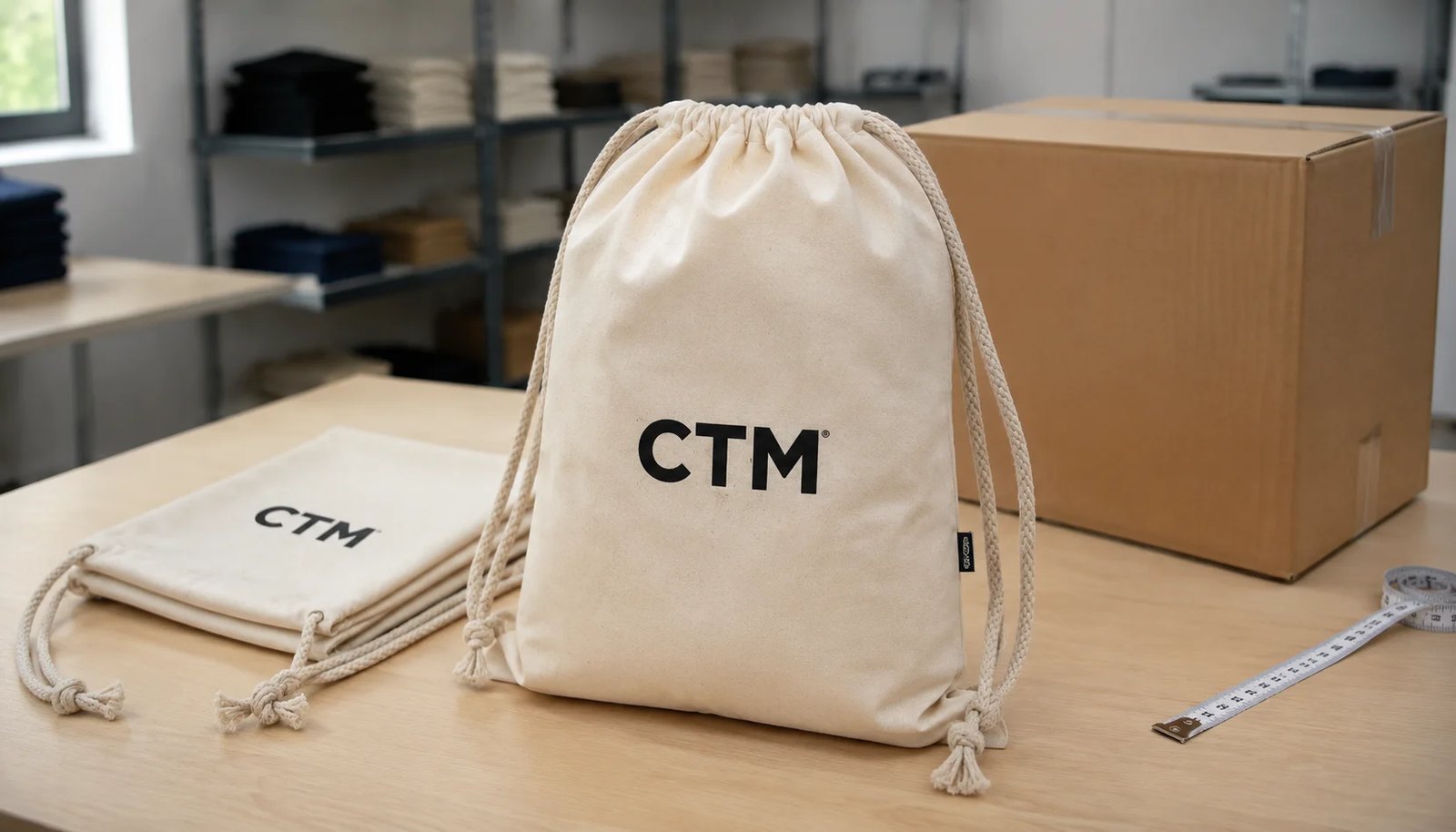
Why the carton plan matters as much as the bag spec
Cotton drawstring backpacks are simple products, but bulk buying problems usually come from packing, not from the visible sample alone. A bag can look acceptable in a showroom and still create avoidable cost once it is folded, bundled, loaded into export cartons, shipped by sea, and received through a grocery distribution network. For natural grocers, that matters because many programs move through central warehouses, then into store back rooms where labor is limited and repacking is unpopular.
A carton packing plan for cotton drawstring backpacks should therefore be treated as part of the product specification. It affects freight cube, carton weight, print protection, moisture exposure, count accuracy, and receiving speed. If suppliers quote with different assumptions on fold style, carton count, or liner use, the ex-factory prices are not directly comparable even if the bag size looks the same.
The practical goal is not to chase the highest pieces-per-carton number. The goal is to balance product protection, warehouse handling, freight efficiency, and count control. That is what makes the packing plan commercially useful rather than just technically complete.
- Weak packing can erase savings won in unit price negotiations
- Cotton goods are more exposed to moisture and odor issues than many synthetic bags
- Print transfer often appears only after folding, stacking, and transit pressure
- Receiving labor rises quickly when counts, marks, or carton weights are inconsistent
Set the bag specification first so carton math is real
Before discussing carton counts, buyers need a fixed working spec. For many natural grocer uses, a finished size around 35 x 45 cm to 38 x 42 cm is a practical range. It handles common promo and store-use scenarios without creating excessive bulk. Once bags get larger, cartons fill with more air, folded bundles become harder to stack, and pieces per carton usually fall.
Fabric weight is the next major driver. A common working range is about 200 to 270 GSM, roughly 6 oz to 8 oz cotton canvas. That range generally gives enough body for a clean logo, better durability than very light cotton, and still supports efficient folding. Lighter material may cut cost but often wrinkles more, shows seam distortion more easily, and can look flat after unpacking. Heavier fabric may feel more premium, yet it raises freight weight and often reduces packing density.
Small build details also change the carton plan. Bartacks, reinforced corners, thicker rope, woven labels, hangtags, and inserts each add bulk. On a per-unit basis the change may seem minor, but multiplied across 100 to 200 pieces in a carton, the packing outcome changes materially. Procurement teams should compare only like-for-like offers.
- Useful baseline spec: 35 x 45 cm, natural cotton canvas, about 220 GSM, one-color front print
- State size tolerance so suppliers do not quote against different sewing standards
- Ask whether quoted GSM is greige, finished, or post-wash if applicable
- Do not compare a plain bag with a reinforced bag as equal landed-cost options
Packing variables that change carton count most
Buyers often ask one simple question: how many pieces fit in a carton? The honest answer is that carton count depends on several linked variables. The biggest are fabric weight, finished size, cord diameter, fold style, reinforcement details, and whether inner bundling is required. If any one of those changes, the original carton count can become unreliable.
Cord bulk is commonly underestimated. A drawstring backpack with thicker cotton rope can consume noticeably more space than the same body made with slimmer polyester cord. Fold method matters as well. Flat folds with cords tucked inside usually stack more cleanly than loose external loops. Tri-folding may improve footprint but can increase crease visibility and print pressure points. None of these are universal rules, which is why actual packed samples are more useful than assumptions.
For many standard programs, a range of 100 to 200 pieces per export carton is workable. That should still be validated against the supplier's actual carton dimensions and gross weight. A high count that pushes cartons above your warehouse handling limit is not a procurement win.
- Fabric GSM affects both weight and fold thickness
- Cotton rope usually packs bulkier than slimmer polyester cord
- Reinforced corners and labels can lower the practical pieces-per-carton count
- Always review pieces per carton together with carton dimensions and gross weight
Use warehouse limits to decide carton size, not factory habit
Factories often have standard carton habits based on what runs fastest on their line. Buyers should still start from destination handling rules. If your warehouse has a gross weight limit, carton dimensions cap, or pallet height rule, those should drive the packing plan. Many import programs work around a 12 to 15 kg gross carton target, but that number is only a reference point. Your actual policy may be lower or higher depending on labor practice, region, and equipment.
The best RFQ asks for carton count, dimensions, net weight, gross weight, and pallet pattern. Those details reveal whether the shipment is really efficient. A slightly lower carton count can still be the better choice if the carton footprint stacks well, stays under handling limits, and reduces damage in the container or warehouse.
If the goods will be redistributed by a DC, inner pack logic matters too. Bundles of 10 or 20 often make recounting easier than one loose master carton filled to maximum density. That is especially useful when stores receive partial allocations or warehouse teams pick by bundle rather than by full carton.
- Set carton policy before quoting: max gross weight, max dimensions, and pallet rule
- Ask suppliers for both palletized and loose-load assumptions if your lane varies
- A stable carton footprint may be better than a maximum-fill carton
- Inner packs aligned to warehouse pick logic can reduce recount disputes
Print choice changes packing risk, not just decoration cost
For natural grocer programs, one-color screen printing is often the most practical choice. It offers a clean look, repeatability on reorders, and good unit economics at medium to larger volumes. But procurement teams should evaluate print as a packing variable, not only a branding one.
Large dark graphics and heavy ink deposits increase the risk of offset or blocking when folded bags are compressed soon after printing. Natural cotton makes transfer more obvious because the base fabric is light. A supplier may include the print process in the quote but not mention whether cooling time, stack height control, or delayed cartoning is needed to keep folded units clean.
That is why buyers should ask for a folded-pack simulation. The test does not need to be complicated: print on production fabric, fold the bag using the proposed bulk method, compress it as packed, and hold it for a day or two. If transfer, ghosting, or tackiness appears, the print process or the packing timing needs adjustment before mass production.
- One-color screen print is usually the value standard for this category
- Heavy print coverage can require longer drying or cooling before packing
- Water-based ink may suit brand positioning but still needs disciplined curing
- Ask whether the supplier has run fold-compression checks on similar cotton goods
Choose fold style and inner packing with receiving in mind
Fold style affects more than appearance. It changes how cords behave, where print surfaces touch, and how quickly warehouse staff can count or redistribute units. A factory may prefer the fastest fold for line efficiency, but that may not match downstream handling needs. If the product will be unpacked and moved in bundles, a neat and consistent fold often saves time later.
Common options include flat fold, half fold, or tri-fold, with cords tucked inside or arranged to one side. The right choice depends on the logo placement, cord bulk, and target bundle count. A messy cord arrangement can slow counting, while an over-tight fold can leave deep creases on natural cotton.
Inner packing is a second decision layer. Individual poly offers cleaner protection but adds cost and material. Master poly only can work well if print cure, carton liner use, and storage conditions are controlled. Paper bands can support reduced-plastic goals, but they should be tested to ensure they do not emboss the print or mark the fabric when bundles sit under compression.
- Specify cord arrangement before approval; do not leave it to factory preference
- Bundle counts of 10 or 20 are often easier for DC recounting
- Reduced-plastic packing needs replacement controls such as liners and dry storage
- Approve a real packed bundle, not just an open sample
Carton construction and moisture control are part of product protection
Cotton is vulnerable to moisture pickup, odor transfer, and carton contamination. For that reason, the outer carton specification matters. A common baseline is a 5-ply export carton for sea freight, but board strength still needs to match stacking height, route duration, and whether the goods are palletized. A thin or soft carton can collapse even when the piece count looks reasonable on paper.
Moisture control deserves specific discussion, especially for natural-fiber goods. If buyers are reducing plastic content, then they should ask what protection replaces it. A carton liner, dry storage before loading, and clean container conditions may become more important when individual poly is removed. In some supply lanes or seasons, desiccant may also be considered depending on buyer policy and packaging design.
None of these choices should be presented as universal requirements. The correct level of protection depends on route, season, loading method, and importer tolerance for packaging material. The key is to make those assumptions explicit in the quotation so suppliers are not comparing different protection levels under one price line.
- Confirm carton board grade, not just 'export carton' wording
- Ask whether cartons are lined when no individual polybags are used
- Review route risk: sea freight duration, humid season, and warehouse conditions
- Check that carton sealing method supports stacking and handling
Approvals should include packed samples, not only pre-production bags
For this product, one attractive pre-production sample is not enough. Buyers should build an approval path that covers material, print, construction, and pack-out. A fabric swatch confirms base weight and shade. A print strike-off shows how the logo sits on the real fabric. A pre-production sample confirms sewing, size, and cord details. A packed sample or sealed sample carton then shows whether the approved bag still performs after folding and compression.
This stage catches practical issues that open-sample reviews miss. Logos can offset, cords can tangle, bundles can be awkward to count, and cartons can feel too weak for stacking. These are not minor details once the order ships in bulk.
It also helps to define who signs what. Merchandising may approve visual appearance, quality may approve construction and print tolerance, and logistics may approve carton format and marks. Clear sign-off reduces the common situation where the bag is approved by one team but the packed shipment is challenged by another.
- Minimum useful sample path: swatch, strike-off, PP sample, packed bundle, sample carton
- Request measured carton photos before mass packing
- Use a packed sample to judge both appearance after unpacking and count handling
- Record approvals by function so post-production disputes are easier to avoid
QC points that prevent common receiving claims
Receiving claims on cotton drawstring backpacks are usually repetitive rather than dramatic. Typical issues are skewed prints, inconsistent cord lengths, stains on natural fabric, seam puckering, wrong carton marks, and count errors. The best prevention is to define measurable QC points before production, then inspect both the bag and the final pack-out.
For the product itself, buyers usually want control over size tolerance, print placement, print curing, stitch quality, knot security, and fabric cleanliness. For natural cotton, it is wise to clarify what is acceptable natural fiber character versus what counts as contamination. Without that distinction, one party may accept specking while another rejects it as a stain issue.
For packed goods, QC should also verify inner counts, carton count, dimensions, gross weight, dryness, seal integrity, and shipping marks. A carton-level check is essential because many errors are invisible until a random carton is opened.
- Check print cure with a fold or rub method suitable to your quality policy
- Define acceptable cord-length variation before production starts
- Separate natural slub acceptance from dirt, oil, or mildew rejection
- Open random cartons during inspection to verify real count and fold consistency
RFQ and PO details that make quotes easier to compare
A good RFQ for a cotton drawstring backpacks for natural grocers carton packing plan should force suppliers to quote against the same assumptions. That means more than asking for bag size and fabric. It means specifying fold style, bundle count, carton weight limit, carton dimensions if capped, moisture protection expectation, and shipping mark format.
The PO should then lock those decisions so the factory does not fill gaps with its own standard method. This is where many avoidable change charges begin. If labels, destination codes, or bundle counts remain open after production starts, the order can stall at final packing or move forward with inconsistent execution.
For buyers managing multiple suppliers, a simple packing appendix often improves quote comparison more than a long narrative specification. It keeps decision points visible and makes deviations easier to spot during supplier review.
- List exact bundle count and master carton count in the RFQ or appendix
- State if carton liner is required, optional, or supplier-recommended
- Include shipping marks, PO, SKU, origin, and destination coding format
- Ask suppliers to note all assumptions that affect carton count or gross weight
Specification comparison for buyers
| Spec decision | Recommended option | When it fits | Buyer risk to check |
|---|---|---|---|
| Fabric weight | 6 oz to 8 oz cotton canvas, about 200 to 270 GSM | Good balance for natural grocer promo programs where print clarity, bag body, and carton efficiency all matter | Below about 180 GSM may wrinkle heavily and show print shadowing; above about 300 GSM can reduce pieces per carton and push gross weight above warehouse targets |
| Fabric construction | Single-layer cotton with bartacks or reinforced bottom corners at cord stress areas | Suitable for produce kits, wellness packs, membership gifts, and reusable store-branded programs | If reinforcement is omitted, cord stress points can fail during store handling or consumer reuse |
| Bag size | Approx. 35 x 45 cm or 14 x 18 in | Common size for event giveaways, produce kits, and general reusable backpack promotions | Larger bags raise carton cube quickly and may force lower carton counts or unstable pallet patterns |
| Drawcord material | 8 mm cotton rope or polyester cord with secure knotting and finished ends | Cotton supports a natural look; polyester often slides more easily and sheds less lint | Loose knots, frayed ends, or uneven cord lengths create avoidable complaints and rework at receiving |
| Print method | 1-color screen print on one side | Best value for simple grocer logos and medium to large volume orders | Large dark coverage may offset onto folded fabric if curing, cooling, or stack timing is weak |
| Inner packing | Flat fold in bundles of 10 or 20 with master poly, carton liner, or paper banding according to buyer policy | Works well for DC distribution where count accuracy and fast recounting matter | Over-compression can crease print areas; paper bands can mark fabric if too tight; no inner protection raises moisture and scuff risk |
| Carton count | 100 to 200 pcs per export carton depending on GSM, size, reinforcement, and cord bulk | Useful for palletized bulk shipments where buyers want efficient handling and predictable weights | Cartons that exceed buyer limits, often around 12 to 15 kg gross depending on policy, may be rejected or repacked at destination |
| Carton board | 5-ply export carton with liner for sea freight | Useful for mixed-climate transit, longer routes, and reduced-plastic inner packing plans | Thin board can crush under stacking; no liner raises moisture, odor, and contamination risk on cotton goods |
| MOQ structure | MOQ by fabric color and print design, for example 1000 pcs per colorway | Practical for private-label, event, and seasonal grocer runs | Buyers comparing only total MOQ can miss charges from split labels, split destinations, or mixed carton ratios |
Buyer checklist before sampling
- Define end use before RFQ: event giveaway, produce kit, wellness pack, employee program, or retail support item
- Lock finished size, size tolerance, and expected fill use so suppliers quote against the same build
- Specify fabric type clearly: cotton sheeting, cotton canvas, recycled cotton blend, or organic cotton if documentation is required
- State fabric weight in GSM or oz and confirm acceptable tolerance, such as plus or minus 5 percent if your policy allows it
- Clarify whether natural ecru is acceptable or whether whiteness, shade band, or lot approval is required
- List print size, colors, placement, and whether the print must pass rub, fold, and blocking checks after packing simulation
- Specify cord material, diameter, end finishing, and whether cotton rope or polyester cord is preferred
- Set maximum carton dimensions and maximum gross weight based on your warehouse and labor-handling rules
- Decide inner pack format: no unit poly, master poly only, paper banding, or another plastic-reduced method
- Request packed sample photos, measured carton data, and pallet loading details before bulk packing approval
Factory quote questions to send
- What exact finished size, fabric GSM, construction, and tolerance are included in your quotation?
- How many pieces fit per carton at the quoted spec, and what are the carton dimensions, net weight, and gross weight?
- Does your carton count assume flat fold, half fold, tri-fold, cord tucked inside, or another packing method?
- What print process is included, and what controls do you use to prevent offset during compressed export packing?
- Are drawcords cotton or polyester, what diameter are they, how are ends finished, and what cord length tolerance do you control?
- What is the MOQ by fabric color, print design, label type, and packing configuration?
- Which sample stages can you provide: fabric swatch, print strike-off, pre-production sample, packed bundle sample, and sealed carton sample?
- What carton board grade and moisture protection are included for sea freight, and is a carton liner standard or extra?
- Which defects do you classify as major for this item, especially print misplacement, stains, seam issues, cord variation, and wrong counts?
- What is your lead time by stage for material approval, sample approval, production, final packing, inspection, and vessel booking?
Quality-control points to confirm
- Fabric GSM within approved tolerance and hand feel reasonably consistent across the lot
- Finished width and height within approved tolerance after sewing and before packing
- Print position, color density, edge sharpness, and curing matched to approved strike-off and pre-production sample
- No visible print offset, ghosting, blocking, or color transfer after folded packing simulation
- Cord lengths reasonably matched pair to pair and knots secure with no frayed or poorly finished ends
- Corner reinforcement and drawstring channel stitching free from skipped stitches, seam opening, or severe puckering
- Natural fabric clean enough for approval with no oil marks, mildew odor, excessive lint contamination, or unacceptable shade drift
- Inner pack count and master carton count verified against packing list and carton marks
- Carton dimensions and gross weight within buyer limit and booking requirement
- Cartons dry, clean, crush-resistant, correctly sealed, and labeled with clear shipping marks and item identifiers