Start With the Real Buying Problem
For hotel retail, cotton drawstring backpacks are judged when a gift shop manager, distributor, or property receiving team opens the carton. The product may look acceptable in a sample photo, but cartons can reveal hard fold lines across the logo, dusty natural cotton, bent hangtags, crushed paper bands, rubbed print, wrong barcode labels, or mixed hotel logos. These are not cosmetic details for a retailer; they affect whether goods can go directly to shelf.
Many procurement teams compare quotes by unit price, fabric weight, and logo charge. That is incomplete for a cotton drawstring backpacks carton packing plan for hotel retail. A supplier quoting 100 pieces per carton under heavy compression is not offering the same delivered result as a supplier quoting 80 pieces with cleaner folding, barcode control, and a stronger export carton. The first quote may appear cheaper at FOB level but create higher freight uncertainty, claims, sorting labor, and retail markdown risk.
The phrase standard export packing should not be accepted unless the supplier defines the standard. Drawstring backpacks have uneven bulk from cord, knots, reinforced corners, top channels, hangtags, and unit packaging. If these components are not considered before packing, cartons can bulge, tape can lift, and printed panels can crease. The carton plan should be part of the product specification, not a warehouse decision made after sewing.
- Primary use: hotel boutiques, resort gift shops, spa retail, welcome resale packs, destination merchandise, and activity kits.
- Main risk: a low unit price hiding poor folding, high carton cube, weak cartons, or unclear SKU control.
- Best control: approve the finished product and the packed-carton method before bulk production and shipment.
- Commercial comparison: review unit price, packing cost, carton CBM, gross weight, MOQ, lead time, and inspection support together.
- Receiving goal: each carton should identify SKU, logo version, quantity, destination, and barcode rules without being opened.
Lock Product Specifications Before Pricing
A reliable carton plan starts with a precise backpack specification. Small changes in body size, fabric weight, cord diameter, reinforcement, unit pack, and logo placement can change carton quantity and retail condition. Before requesting final prices, the buyer should define finished width and height, cotton type, fabric weight, body color, cord material, cord diameter, cord color, reinforcement method, print size, print position, unit packing, and target selling channel.
For many hotel retail programs, a finished body around 35 x 42 cm is a practical reference size. It is useful for light beach items, spa purchases, guest souvenirs, and activity kits while still folding efficiently. Larger sizes may be appropriate for towel bundles or resort excursions, but they increase carton cube and crease risk. Smaller sizes can work for children's programs or entry-level souvenirs, but may feel less useful to guests.
Fabric weight should be quoted in both ounce and GSM, and the RFQ should state that the value is finished fabric weight. A 6 oz cotton fabric may fit lower-cost amenity or promotional use. An 8 oz cotton canvas is often a balanced retail option because it improves hand feel while keeping carton weight manageable. A 10 oz cotton canvas can support a more premium position, but it increases material cost, carton weight, and stress at cord attachment points.
The buyer should also define the cotton story. Natural cotton usually has simpler sourcing and fewer dye-lot issues, but it can show seed specks, slubs, and shade variation. Dyed cotton can align better with hotel brand colors, but it requires shade approval and may increase MOQ. Organic, recycled, or certified cotton should not be described casually; the buyer should request the exact certificate or material declaration required by its compliance team.
- Minimum RFQ data: finished size, fabric weight, cotton type, body color, cord details, reinforcement, logo size, and unit packing.
- Reference size: about 35 x 42 cm for many retail programs, adjusted after confirming use case and folded footprint.
- Common fabric choices: 6 oz for lighter use, 8 oz for balanced retail, and 10 oz for premium hand feel.
- Typical tolerance: plus or minus 1 cm for finished size unless the fixture or packaging requires tighter control.
- Natural cotton note: agree on acceptable slubs, specks, shade variation, odor, and surface marks before bulk approval.
Specify Construction for Load Points
The predictable failure points on a cotton drawstring backpack are the lower cord attachment points, top drawcord channel, side seams, and cord ends. The drawcord acts as both closure and shoulder strap, so load concentrates at the bottom corners. If the cord is too thin, the corner construction is weak, or the fabric is too light for the intended use, the bag can tear during normal guest handling.
For retail-grade presentation, the construction should include a stable top channel, even stitching, trimmed threads, and reinforced lower cord points. Cotton cord in the 5-6 mm range is a common option for natural hotel merchandise because it feels softer and more aligned with cotton fabric. Polyester or PP cord can also be suitable when the buyer prioritizes cost, color availability, smooth sliding, or moisture resistance. The important point is to specify the cord instead of accepting whichever option the factory chooses to meet a target price.
Corner reinforcement should be visible in the approved sample and tested during inspection. Options include folded fabric triangles, sewn tabs, reinforced bottom channels, or metal eyelets. Eyelets can look clean, but poor setting can cause pull-out, distortion, rust risk, or staining. Sewn reinforcement is often simpler for flat packing, but it still needs adequate stitch density and bar tack control.
Procurement should ask the factory to explain exactly how the load points are built. A photo of the inside corner and a pull test on a loaded sample are more useful than a general claim such as strong stitching. This also helps the buyer compare suppliers fairly when one quote includes reinforced tabs and another includes only a basic seam.
- Cord diameter: specify 5-6 mm cotton cord or another approved material with sample confirmation.
- Cord details: define length, color, knot method, end finish, twist, and left-right symmetry.
- Reinforcement: require bottom tabs, fabric triangles, reinforced channels, bar tacks, or approved equivalent construction.
- Inspection points: check top channel stitching, side seams, bottom corners, bar tacks, loose threads, and skipped stitches.
- Use test: repeatedly open and close the sample and pull the loaded cord points before approving production.
Control Logo Method and Fold Risk
Hotel retail backpacks usually carry a property logo, resort name, destination graphic, spa mark, or event artwork. The logo is central to the product's retail value, so print method and placement need specific approval. The RFQ should define artwork size, color reference, print method, location from top edge, location from side seams, and placement tolerance.
Screen printing is often suitable for one to three solid colors on cotton canvas. It can offer predictable cost and good opacity when the supplier controls mesh, ink deposit, and curing. Water-based inks can provide a softer hand, while other ink systems may offer stronger opacity depending on fabric color and factory capability. The buyer should ask how curing is verified because under-cured ink can smell, rub, block, or crack.
Heat transfer can be useful for complex artwork, gradients, short test orders, or designs with many colors. It also carries risks: film edge lifting, cracking after folding, a plastic-like hand feel, shine on natural cotton, or heat marks around the image. If a transfer is proposed, the buyer should require a flex test, edge-lift review, light rub check, and folded-pack approval.
Print placement must be reviewed against the folding method. If the logo crosses a hard fold line, it may crease during ocean freight or long warehouse storage. If the logo faces inward in the unit pack, retail staff may need to refold units before display. If a belly band or barcode covers the logo, shelf presentation may suffer. The logo layout and packing layout should therefore be approved together.
- Screen print: suitable for solid hotel logos, repeat orders, and controlled unit cost.
- Heat transfer: acceptable for complex artwork only after cracking, edge-lift, hand-feel, and folded-pack checks.
- Placement tolerance: define allowable movement, often plus or minus 5 mm for cut-and-sew cotton goods.
- Strike-off checks: review color, opacity, edge sharpness, ink thickness, curing, rub result, odor, and hand feel.
- Packing link: approve print position only after seeing the actual folded unit pack and carton arrangement.
Plan MOQ and SKU Rules
MOQ is rarely one clean number unless every component is stock and every unit is identical. Natural cotton fabric may have the lowest minimum because it is commonly available. Dyed fabric may involve dye-lot minimums. Custom cord colors, woven labels, printed hangtags, barcode stickers, paper belly bands, and printed cartons can each create their own minimum or setup charge.
Hotel groups often order one base backpack across several properties. A distributor might buy 10,000 pieces total, split across five logos, several barcode labels, and multiple destination labels. This can be efficient if the body fabric, size, cord, and packing format are common. It becomes risky if each property changes body color, cord color, hangtag, carton mark, and delivery date without a clear SKU matrix.
The RFQ should separate total order quantity from quantity by SKU. Each logo version, barcode, body color, cord color, hangtag, packing type, and destination should be listed. If the supplier only sees a total quantity, it may assume one artwork and one carton mark. Late discovery of multiple logos or labels can cause added costs, delays, or packing mistakes.
Repeat-order planning matters for hotel retail. Natural cotton can vary by batch, and dyed cotton requires shade continuity. Buyers should retain approved swatches and print references, then require the factory to compare repeat production against the approved standard. This is especially important when the same product remains on a hotel boutique shelf across seasons.
- Lowest complexity: natural cotton body, stock cord color, one-color logo, common hangtag, and common carton mark.
- Higher complexity: dyed body, custom rope, multiple logos, property-specific barcodes, and separate destinations.
- SKU definition: treat any difference in logo, barcode, body color, cord color, packing, or destination as a separate SKU.
- Quote structure: ask for MOQ by fabric color, cord color, logo version, retail pack, label type, and shipment split.
- Repeat control: keep approved fabric, cord, print, label, and packing references for future shade and construction comparison.
Engineer Carton Quantity by Test
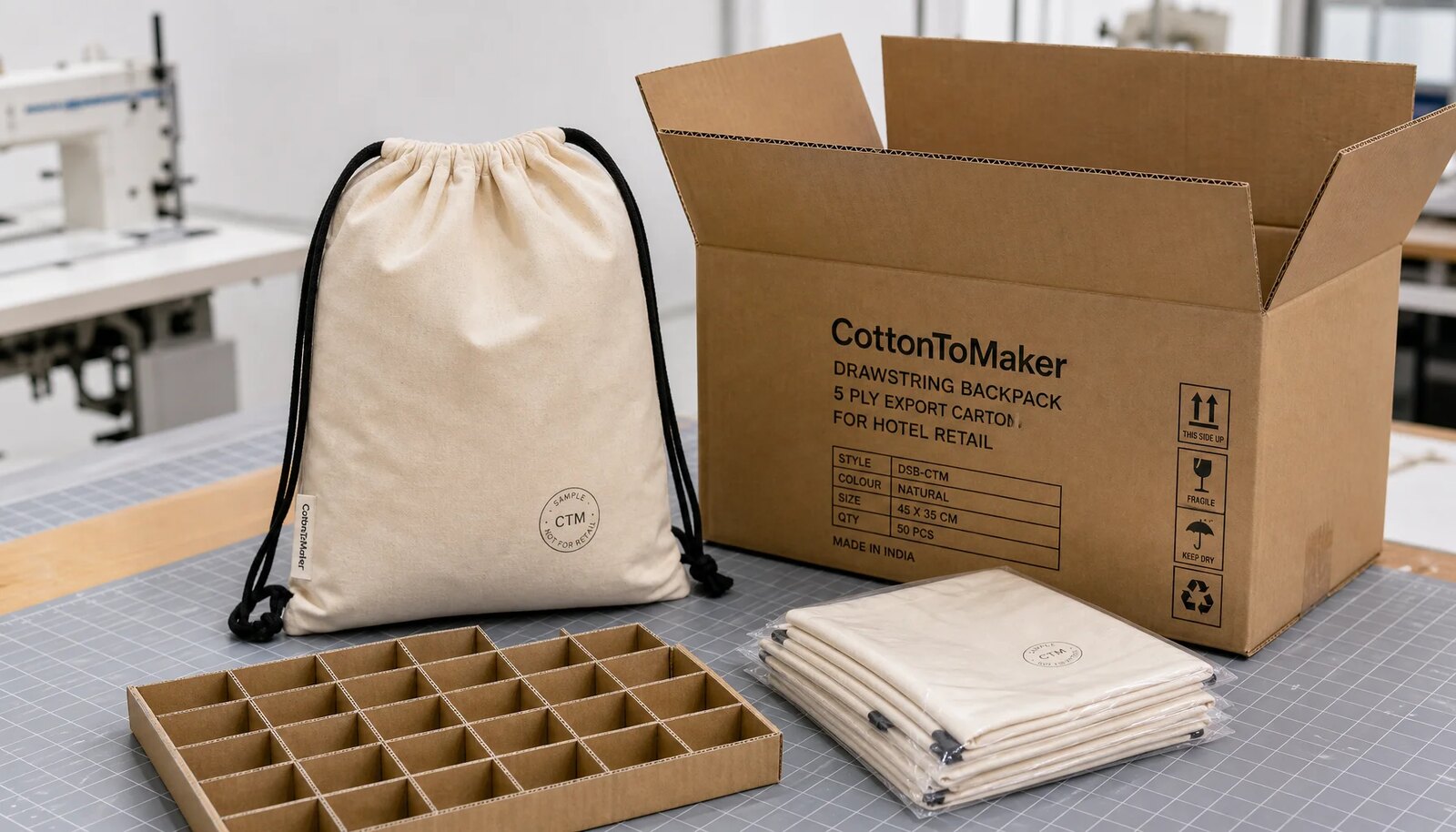
Carton quantity should be engineered with real samples, not copied from another soft-goods order. Cotton drawstring backpacks do not pack like flat totes because cords, knots, lower reinforcements, top channels, hangtags, and unit packs create uneven bulk. If every bag is folded with the cord in the same position, the carton can develop a pressure ridge that marks cotton panels or printed areas.
A physical fold test is the most practical control. The factory should fold finished samples using the planned unit pack, place them into the proposed carton, and show open-layer and closed-carton photos. The buyer should review fold direction, cord placement, bundle layers, logo exposure, hangtag position, carton fullness, top flap closure, tape method, carton dimensions, and scale weight.
For many 8 oz cotton drawstring backpacks around 35 x 42 cm, 80-100 pieces per carton can be a reasonable starting range. A 6 oz version with no unit pack may fit more. A 10 oz version with thick cotton cord, hangtag, paper band, or individual bag may require fewer pieces. The correct quantity is the number that allows clean closure, manageable gross weight, acceptable carton dimensions, and no retail damage.
Carton gross weight should be set before purchase order confirmation. Hotel retail cartons may move through forwarders, port handling, distributor warehouses, hotel receiving rooms, and stockrooms. Many buyers prefer a practical gross weight range such as 12-18 kg where suitable, but the actual limit should follow the retailer, distributor, or 3PL requirement. A carton that is too heavy is more likely to be dropped, dragged, or stacked poorly.
- Fold test inputs: actual fabric, cord, print, reinforcement, unit pack, hangtag, and carton board.
- Reference count: 80-100 pcs may work for many 8 oz 35 x 42 cm styles, but only after packed-carton validation.
- Closure rule: reject any plan that requires force to close cartons or causes bulging, crushed bands, or bent tags.
- Weight control: set maximum carton gross weight based on warehouse and 3PL handling rules.
- Evidence required: request photos of open layers, closed flaps, carton mark, tape method, dimensions, and scale weight.
Choose Unit Packing by Channel
Unit packing should match the way the backpacks are transported, stored, received, and displayed. A resort boutique may prefer a kraft belly band because it supports a natural retail story and lets guests feel the cotton. A distributor shipping to multiple hotels may prefer recyclable OPP bags with barcode labels because they reduce dust exposure and picking errors. A hotel group with a plastic-reduction policy may require paper-only packing, but that choice should be tested against humidity, odor, and warehouse conditions.
OPP bags provide basic protection from dust, moisture contact, rubbing, and mixed-carton handling. They also simplify barcode placement. If used, specify bag size, thickness if required, closure style, suffocation warning text where legally required, ventilation holes if needed, and barcode position. The bag should not be so tight that it bends the product or so loose that it looks messy.
Paper belly bands, kraft sleeves, or paper wraps create a boutique appearance and reduce plastic use. They are effective for natural cotton products displayed folded on shelves. Their weakness is protection: paper does not prevent dust, humidity, odor transfer, or abrasion during long transit. Paper bands can also crush or slide if cartons are overpacked.
Hangtags help communicate brand story, care information, sustainability claims, and barcode data. They also add packing risk because tags can bend, snag on cords, or compress at carton edges. The tag attachment point, string length, tag paper weight, barcode placement, and position after folding should be approved before bulk packing.
- OPP bag: stronger dust and barcode control, but less aligned with plastic-reduction goals.
- Paper band: better natural shelf presentation, but weaker protection against humidity, dust, and abrasion.
- Hangtag: useful for retail information, but must be tested for bending, snagging, and carton compression.
- No unit pack: lowest material use, highest risk for surface contamination, print rubbing, and SKU mix-ups.
- Approval sample: review the final unit pack exactly as retail goods will arrive, including fold direction and barcode position.
Define Carton Marks and Documents
Carton marks are a receiving control, not just a shipping label. Hotel retail orders may move through importers, distributors, central warehouses, property receiving rooms, and retail stockrooms. If carton marks are unclear, teams must open cartons to identify logos, quantities, destinations, and barcodes. That creates delay, repacking risk, shortage disputes, and mixed-SKU mistakes.
A practical master carton label should include buyer code, supplier reference, purchase order number, item or SKU number, product description, body color, logo version, quantity per carton, carton number, total cartons, gross weight, net weight, carton dimensions, destination, and country of origin if required. Some retailers also require routing labels, carton barcodes, or compliance label formats. These requirements should be approved before cartons are printed or labeled.
Mixed cartons should be avoided unless the receiving process is designed for them. If mixed cartons are necessary for small property quantities, the buyer should define the inner separation, mix list, label color, carton mark wording, and packing list format. A carton marked only as cotton drawstring backpacks is not enough when it contains several hotel logos or barcode versions.
Barcode requirements should be confirmed early. Some programs need a barcode on the hangtag, some on the OPP bag, some on both unit and carton, and some only on distributor labels. Buyers should specify barcode type, size, placement, human-readable number, scan expectation if applicable, and who provides artwork. A barcode that scans on a flat proof may fail when wrapped around a wrinkled unit pack or placed over a fold.
- Master carton data: PO, SKU, logo version, color, quantity, carton number, dimensions, gross weight, net weight, and destination.
- Mixed-carton rule: allow only with written approval, clear inner separation, and exact mix list on carton and packing list.
- Barcode control: define barcode type, number, label size, placement, scan check, and whether it applies to unit, carton, or both.
- Document match: align PO, invoice, packing list, SKU matrix, carton labels, and inspection report before shipment release.
- Receiving goal: staff should identify carton contents without opening cartons unless inspection or counting is required.
Request Quote Data for Landed Cost
A quote for cotton drawstring backpacks is not complete if it only gives EXW or FOB unit price. Soft goods can vary significantly in carton cube depending on fold method, unit pack, cord bulk, hangtags, and compression. A cheaper unit price can become more expensive after freight, warehousing, receiving labor, repacking, or retail claims.
Ask every supplier to quote in the same format. At minimum, the quote should include finished size, fabric weight, fabric type, body color, cord material, cord color, reinforcement method, logo process, number of print colors, unit packing, pieces per carton, carton dimensions, net weight, gross weight, CBM per carton, total cartons, total CBM, MOQ, sample cost, sample lead time, production lead time, payment terms, FOB port, and quote validity.
Packing materials should be identified clearly. OPP bags, paper belly bands, hangtags, barcode labels, warning stickers, printed inserts, moisture bags, stronger cartons, and palletization can all add cost. If one supplier includes these items and another excludes them, unit prices are not comparable. Ask for separate line items or a clear statement of what is included.
Freight forwarders need carton dimensions, total cartons, CBM, and gross weight to estimate ocean freight, air freight, truck loading, warehouse storage, and delivery. If a supplier cannot provide estimated carton data before production, treat the quote as preliminary. Final carton data should be confirmed after packed-sample approval and before shipment booking.
- Comparable quote: unit price, fabric details, print details, packing details, pieces per carton, dimensions, weight, and CBM.
- Cost visibility: identify screen charge, sample cost, hangtag, barcode, unit pack, carton upgrade, and special label costs.
- Freight planning: calculate total CBM and gross weight from the proposed carton plan before supplier selection.
- Validity control: confirm quote validity, FOB port, payment terms, sample lead time, bulk lead time, and assumptions.
- Commercial warning: the lowest unit price is not best if it creates larger cartons, more wrinkles, or receiving rework.
Approve Samples and QC Criteria
Sample approval should cover the backpack and the packing system. A flat finished sample confirms fabric, size, stitching, cord, reinforcement, and logo appearance. It does not prove the goods will arrive in retail condition. Hotel retail buyers should request a unit-packed sample and a packed-carton proof showing the exact fold method, unit pack, hangtag, barcode, carton arrangement, carton mark, and closure method.
The approval sequence can be staged to protect the schedule. First approve fabric swatch and cord quality. Then approve print strike-off for color, edge quality, opacity, ink thickness, hand feel, curing, rub result, and odor. Next approve a finished sample for size, construction, seam quality, cord pull, and appearance. Finally approve unit packing and packed-carton proof before bulk packing.
Quality control should be written before production begins. AQL visual inspection is useful for general workmanship, but it should be supplemented by product-specific checks. For this product, inspection should cover finished size tolerance, fabric weight verification, odor, stains, slub limits where relevant, seam strength, cord length, lower-corner pull, print rub, folded-print condition, barcode readability, carton count, carton dimensions, gross weight, carton marks, and SKU mix.
Inspection should include packed cartons, not only loose goods. Random cartons should be opened to confirm piece count, correct SKU, correct retail packaging, barcode presence, hangtag accuracy, carton mark match, and clean closure without bulging. If the order includes several hotel logos, inspection must verify every logo version and cross-check carton marks against the packing list.
- Sample sequence: swatch, cord sample, print strike-off, finished sample, unit-packed sample, and packed-carton proof.
- Product QC: measure size, verify fabric weight, inspect stitching, pull cord points, rub print, check odor, and review folded logo.
- Carton QC: verify count, SKU mix, carton marks, dimensions, gross weight, closure, tape adhesion, and retail pack condition.
- Reference samples: keep one approved sample with the buyer and one at factory QC for production comparison.
- Rework rules: define trimming, repacking, relabeling, replacement, rejection, and reinspection triggers before final inspection.
Specification comparison for buyers
| Procurement decision | Recommended control | Why it matters for hotel retail | Buyer risk to verify before PO |
|---|---|---|---|
| Finished fabric weight | Quote finished GSM and ounce, for example 6 oz, 8 oz, or 10 oz cotton canvas, and state whether the number is finished weight or greige weight | Hand feel, retail price position, carton weight, and fold recovery all change with fabric weight | Supplier may quote greige fabric, use a lighter substitute, or ship panels that wrinkle badly under carton pressure |
| Finished backpack size | Specify width, height, measuring method, and tolerance, commonly plus or minus 1 cm for cut-and-sew cotton goods | Shelf fixture fit, barcode position, fold footprint, and pieces per carton depend on finished size | Uncontrolled size variation can change carton CBM, make unit packs inconsistent, and create display problems |
| Cord and reinforcement | Define cord material, diameter, color, length, knot method, and reinforced corner construction such as tabs, triangles, or bar tacks | Guest load is concentrated at the lower cord points, and failures are highly visible in hotel retail | Thin cord, weak tabs, loose bar tacks, or poorly set eyelets can pass a visual check but fail in use |
| Logo process | Approve screen print or transfer method with artwork size, placement tolerance, color reference, curing or adhesion check, and folded-pack review | Hotel logos must stay clean after packing, handling, and shelf display | Under-cured ink can rub or block; transfers can crack, lift, or feel too heavy on cotton |
| Unit retail packing | Select OPP bag, paper belly band, kraft sleeve, hangtag, or no unit pack based on retail display and storage conditions | Unit packing controls dust protection, barcode scanning, plastic policy, shelf appearance, and packing density | Plastic-free packing can expose cotton to humidity, odor, abrasion, and mixed-SKU handling errors |
| Pieces per master carton | Validate a target such as 80-100 pcs for many 8 oz 35 x 42 cm styles by packed-carton test, not by estimate only | Carton quantity drives freight cube, gross weight, compression marks, receiving count, and landed cost | Overpacked cartons may bulge, crush hangtags, crease logos, or trigger dimensional-weight surprises |
| Carton specification | Use sized 5-ply export cartons for ocean freight when appropriate, with board strength, closure method, carton marks, and moisture controls confirmed | Hotel retail goods often move through forwarders, distributors, hotel receiving rooms, and stockrooms | Weak cartons or unclear marks create damage claims, slow receiving, and disputes over SKU mix |
| MOQ and SKU split | Separate total MOQ from MOQ per body color, logo, cord color, barcode, hangtag, and retail packing version | Hotel groups may share one base bag but need property-specific logos, barcodes, and destinations | Factory may add setup costs late, combine SKUs incorrectly, or delay production if split rules are vague |
| Inspection plan | Use AQL visual inspection plus product-specific checks for fabric weight, size, cord pull, print rub, odor, barcode, carton count, and carton dimensions | Retail condition depends on both the product and how it survives packing and transport | Visual-only inspection can miss carton bulging, wrong labels, blocking ink, weak corners, or mixed logos |
Buyer checklist before sampling
- Define finished backpack width and height, measuring points, size tolerance, fabric weight, cotton type, cord diameter, cord material, cord color, and reinforcement construction before asking for final pricing.
- State the selling channel: hotel gift shop, resort boutique, spa retail, welcome amenity resale, activity kit, event merchandise, or distributor replenishment.
- Require the quote to identify whether fabric weight is finished GSM after processing or greige weight before dyeing, washing, or finishing.
- Separate product specification, unit retail packing, and master carton packing in the RFQ; do not rely on the phrase standard export packing.
- Ask for folding method, pieces per carton, carton dimensions, net weight, gross weight, CBM per carton, total cartons, and total CBM for the quoted quantity.
- Set maximum carton gross weight and any carton dimension limits required by the hotel retailer, distributor, warehouse, or 3PL before confirming pieces per carton.
- Approve fabric swatch, cord sample, print strike-off, finished sample, unit-packed sample, barcode label, hangtag, carton mark, and packed-carton proof before bulk packing.
- Define SKU rules by hotel logo, body color, cord color, barcode, hangtag, destination, carton mark, and whether mixed cartons are allowed.
- Request inspection criteria covering size, fabric weight, stitch defects, cord pull, print rub, odor, stains, folded-logo condition, barcode readability, carton count, carton dimensions, and carton closure.
- Build the production schedule from artwork approval, material booking, sample approval, deposit, bulk production, packing proof approval, inspection, and shipment release rather than from the first RFQ date.
Factory quote questions to send
- What finished fabric weight are you quoting in GSM and ounce, and what tolerance or verification method will you use during production?
- Is the cotton natural, bleached, dyed, organic, recycled, or blended, and what certificates or material declarations can be supplied if the buyer requires them?
- What is the finished backpack size, measuring method, size tolerance, shrinkage allowance, and cutting method for bulk production?
- What drawcord material, diameter, length, color, knot method, and lower-corner reinforcement are included in the price?
- Which logo process is quoted, how many print colors are included, what ink or transfer type is used, and what curing, adhesion, rub, or flex checks are performed before packing?
- What unit packing is included: no unit pack, OPP bag, paper belly band, kraft sleeve, hangtag, barcode label, warning label, or insert card?
- How many pieces fit per master carton with the actual unit packing, and what are the carton dimensions, net weight, gross weight, and CBM per carton?
- Can you provide a pre-production sample packed exactly as bulk goods will be packed, including fold direction, unit pack, hangtag, barcode, carton marks, and carton closure method?
- What are the MOQ and price breaks for natural body fabric, dyed body fabric, custom cord color, each logo version, each barcode version, and each retail packing type?
- What carton material, ply, closure method, carton mark layout, moisture protection, palletization option, and drop or stacking expectation are included or available at extra cost?
Quality-control points to confirm
- Finished size should normally be controlled within plus or minus 1 cm for cut-and-sew cotton drawstring backpacks unless the hotel fixture, insert card, barcode placement, or display packaging requires a tighter tolerance.
- Fabric weight should be checked by cutting and weighing a known area from bulk fabric or finished goods, then converting to GSM, rather than relying only on supplier declaration.
- Natural cotton should be reviewed under agreed lighting for acceptable limits on slubs, seed specks, oil marks, yellowing, panel-to-panel shade variation, and fabric holes.
- Cord diameter, length, color, twist, fraying, knot size, and left-right symmetry should match the approved sample closely enough for consistent closure and hanging display.
- Lower cord attachment points, sewn tabs, fabric triangles, grommets, or reinforced channels should pass a practical pull test without seam opening, fabric tearing, or metal distortion.
- Top channels and side seams should be checked for skipped stitches, loose threads, needle holes, uneven seam allowance, trapped cord, and broken needle contamination risk.
- Screen print should pass dry rub and light wet rub checks, and folded printed areas should be inspected after unit packing to confirm no blocking, cracking, pressure transfer, or visible crease damage.
- Heat transfer prints should be checked for edge lifting, cracking after flexing, surface stickiness, color shift, and heat marks on cotton fabric before bulk packing.
- Barcodes should be verified for correct number, human-readable text, placement, and scanability on the actual unit pack or hangtag, not only on an artwork proof.
- Cartons should close without force, bulging, tape lifting, crushed corners, or excessive empty space, and packed cartons should be measured against quoted dimensions and gross weight.