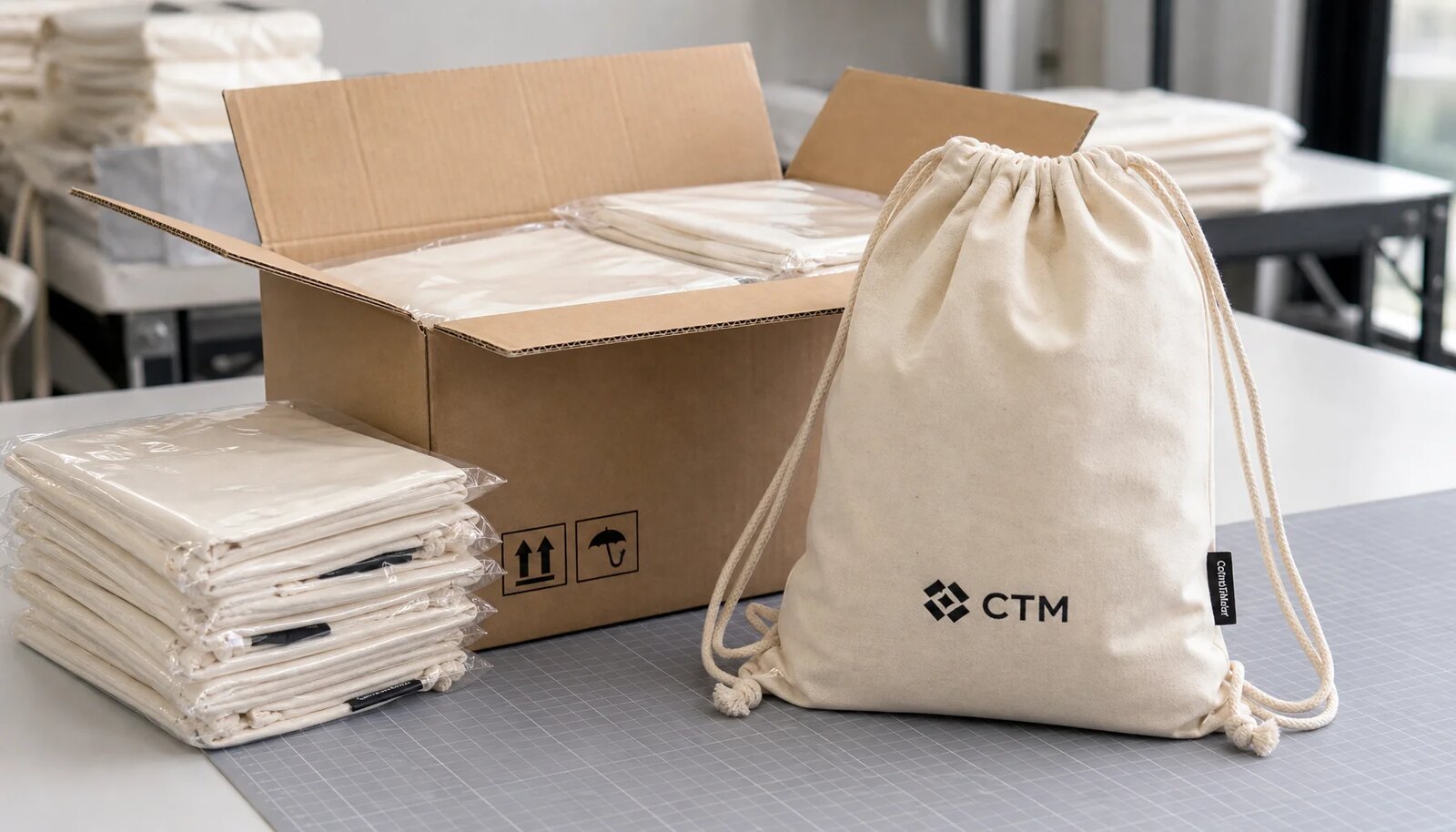
Start With Carton Requirements
A custom cotton drawstring backpack can look right in a sample photo and still create problems at a craft fair. The most common failures are operational: cartons are too heavy for volunteers, printed panels stick after being folded, sponsor versions are mixed, carton marks do not match the packing list, or booth staff cannot count units quickly during setup. For event buyers, the carton is part of the product specification, not an afterthought.
Put carton details into the first RFQ. Ask for pieces per carton, carton length-width-height, net weight, gross weight, total carton count, total CBM, fold direction, unit pack, inner bundle count, carton marks, and whether mixed SKUs are allowed. A quote that says only "standard export packing" hides too much for a fixed-date fair with venue splits, sponsor tables, retail booths, or kit assembly.
Think through who opens the cartons. A retail distribution center may need barcode-ready units and one SKU per carton. A school fundraiser may prefer cartons of 50 pieces that parent volunteers can lift and count. A fair organizer may ask for bundles of 25 so table staff can hand out stock quickly. The same bag can require a different packing plan depending on receiving labor, storage space, and distribution speed.
- Require carton quantity, carton dimensions, gross weight, and total CBM in the first RFQ.
- Define who receives cartons: 3PL, retailer, organizer, school staff, sponsor team, or temporary event staff.
- Replace vague export-packing language with exact pieces per carton, fold method, inner bundle count, and shipping marks.
- Use the same approved packing method for pilot carton and bulk production unless a written change is approved.
Specify Cotton Weight by Use
Most cotton drawstring backpacks for craft fairs sit in the 6 oz to 8 oz cotton canvas range, roughly 200-270 GSM. A 6 oz fabric can work for budget giveaways carrying brochures, postcards, and light purchases. A 7 oz fabric often gives a better hand feel without a major freight penalty. An 8 oz fabric fits merchandise, premium sponsor kits, or programs where the bag may carry heavier craft items.
Do not compare suppliers by logo size and bag dimensions alone. Cotton varies by yarn count, weave density, finishing, shrinkage behavior, and surface cleanliness. Lower GSM may save money but can feel limp, wrinkle sharply, and show ink strike-through. Higher GSM feels more substantial but can reduce pieces per carton, raise gross weight, increase sewing time, and push total CBM upward.
The RFQ should state fabric weight in ounces or GSM and give a measurable tolerance. A common purchasing standard is ±5% GSM against the approved swatch. Ask the supplier to identify the route as natural cotton, bleached cotton, dyed cotton, recycled cotton blend, or another blend. Natural cotton may show slubs and seed flecks; stains, holes, oily marks, and mismatched panels should not pass.
- Use 6 oz cotton for low-cost giveaways where light loading and carton efficiency matter most.
- Use 7 oz cotton when buyers need better hand feel and practical freight efficiency.
- Use 8 oz cotton for resale, premium sponsor kits, heavier contents, or a more substantial merchandise feel.
- Write GSM, tolerance, fabric color, construction, finish, and natural-fleck acceptance into the PO.
Confirm Finished Size and Capacity
A common finished size for cotton drawstring backpacks is around 35 x 42 cm, but buyers should start with what the attendee or exhibitor needs to carry. The bag may need room for a program, vendor postcards, a small box, a light bottle, raffle material, or sponsor inserts. Too small and it will not be used. Too large and it wrinkles the logo panel, collapses when lightly filled, and increases carton volume.
Confirm whether the quoted dimensions are cut-panel dimensions or finished sewn dimensions. Finished size is what the end user receives and what the carton plan must support. Seams, top channels, bottom corners, and drawcord exits reduce usable space. A typical tolerance is about ±1 cm for body width and height, but the PO should define measurement points so factory QC and buyer inspection use the same method.
Small construction decisions affect packing efficiency. A deep top channel adds thickness at the folded edge. Oversized bottom reinforcements make stacks uneven. Long cords left outside the body can tangle during counting and create lumpy cartons. For consistent carton stacks, cords are usually tucked inside the bag body before folding, or the fold method is designed so cords sit in the same place on every unit.
- Confirm finished sewn size measured flat, not cut-panel size.
- Define expected contents: program, brochures, small purchases, sponsor inserts, exhibitor material, or merchandise bundle.
- Keep key artwork away from fold lines where possible, especially large solid prints and heat transfers.
- Request packed sample photos showing fold direction, cord position, stack height, inner bundles, and carton fit.
Match Print Method to Packing Pressure
For many craft fair orders, screen printing is the practical default. Water-based or pigment screen print works well for one to three spot colors on cotton and suits event names, sponsor marks, school graphics, town artwork, and repeat annual fair logos. It also makes setup and repeat-order costing easier to understand.
Heat transfer can be useful for detailed logos, gradients, full-color sponsor artwork, or short artwork versions where separate screens would be inefficient. The risk is carton behavior. Transfer printing on cotton canvas should be checked for edge lift, cracking after folding, blocking against the next bag, odor, and pressure marks after compression. A crisp sample on a table does not prove the print will behave after weeks in a tight carton.
Digital printing may support short runs or complex artwork, but buyers should ask about pretreatment, production speed, color consistency, curing, wash expectations, and folded-storage performance. For a fixed-date craft fair program, the best print method is the one that meets color, durability, timeline, carton compression, and cost requirements at the ordered quantity.
- Use screen print for simple event logos, sponsor marks, and repeat artwork with one to three solid colors.
- Use heat transfer only after fold, rub, blocking, edge-lift, and carton-pressure checks.
- Provide vector files and Pantone references; define acceptable color variation before bulk production.
- Approve a physical strike-off on production fabric before mass printing.
Plan MOQ Around Real Splits
MOQ is not only the total order quantity. For a drawstring backpack factory, efficiency depends on fabric color, fabric lot, cutting batch, print setup, cord color, packing style, carton mark, and delivery route. A 3,000-piece order with one logo is straightforward. A 3,000-piece order split into 15 sponsor logos of 200 pieces each is a different job with more setup, QC reconciliation, carton labels, and packing-room control.
Craft fair programs often include sponsor tiers, school groups, regional fair dates, VIP batches, and limited-edition artwork. Share those splits in the first RFQ. If a buyer requests a quote for one artwork and later adds multiple versions, the supplier may need to revise unit price, sample schedule, print timeline, carton plan, and inspection scope.
Ask whether every sponsor version truly needs a separate printed backpack. In some programs, one common event logo plus a sponsor insert card, belly band, hangtag, or carton label reduces risk and cost. When separate prints are required, each artwork version should have its own code, quantity, print colors, packing method, carton mark, and destination.
- List every artwork version with quantity, print colors, file name, packing style, carton mark, and destination.
- Ask whether screens can be stored for repeat fairs and whether storage, remake, or cleaning fees apply.
- Expect higher unit cost for small sponsor splits because setup and QC time are spread over fewer pieces.
- Align artwork codes, carton marks, packing lists, barcode labels, and invoice descriptions before mass printing.
Build a Liftable Carton Plan
A workable carton packing plan starts with four inputs: finished bag size, fabric thickness, unit packing, and target carton gross weight. For a common 35 x 42 cm cotton drawstring backpack in 6 oz to 8 oz fabric, many programs plan 50 to 100 pieces per export carton. The final count depends on GSM, print area, cord diameter, polybag or bundle packing, hangtags, fold direction, and carton board strength.
Do not ask the factory to pack the maximum number that can be forced into a box. The better target is a carton that stays square, countable, protective, and liftable. Many buyers prefer a carton gross weight around 15-18 kg for manual event handling, subject to local warehouse practice and carrier rules. A carton may be acceptable for export shipping and still be impractical for staff moving stock during setup.
Carton dimensions and CBM belong in the quote because freight can change the supplier comparison. A cheaper unit price can cost more if loose packing increases total cube. This matters for courier, air, LCL sea freight, consolidated trucking, and split deliveries. Every serious quotation should show pieces per carton, carton L x W x H, net weight, gross weight, total carton count, and total CBM.
- Set a target gross weight per carton, often 15-18 kg for manual craft fair handling where appropriate.
- Require pieces per carton, carton L x W x H, net weight, gross weight, carton count, and total CBM in the quote.
- Use inner bundles of 10, 20, or 25 pieces to make receiving and event distribution faster.
- Specify shipping marks with item name, PO number, artwork code, carton number, quantity, GW, NW, and destination.
Choose Unit Packing by Route
Unit packing should follow the operating route, not the supplier’s default habit. Individual polybags keep cotton bags clean, support barcode labels, and help retailers or warehouses handle each piece. They also add material cost, packing labor, plastic use, and carton volume. For an entrance giveaway, individual bags may slow distribution because staff must remove or discard extra packaging before handing out the backpack.
Bulk bundle packing is often better for sponsor giveaways, school fundraisers, exhibitor kit assembly, or volunteer tables. The supplier can fold units consistently and group them in bundles of 10, 20, or 25 pieces. Counting becomes quick and individual packaging is reduced. The tradeoff is cleanliness, so consider a carton liner, kraft wrap, or protected inner bundle when natural cotton must stay clean.
Belly bands sit between bulk packing and individual polybags. They work when presentation matters but full polybagging is unnecessary. A band can carry a barcode, sponsor note, event message, or recycled-paper branding while keeping the folded unit compact. Test it on a folded sample. If it is too loose, it slides off during transit. If it is too tight, it bends the stack or leaves pressure marks on the printed panel.
- Choose individual polybags for retail, barcoded inventory, warehouse handling, or multi-touch distribution.
- Choose bulk bundles for entrance giveaways, sponsor desks, volunteer tables, or exhibitor-kit assembly.
- Choose belly bands when presentation matters and the buyer wants less plastic than individual polybags.
- Ask the supplier to quote polybag, belly band, label, hangtag, and extra labor costs as separate line items.
Approve Samples in Stages
A sewn sample alone is not enough for a carton-sensitive craft fair order. Approval should move through practical stages: fabric swatch, print strike-off, sewn sample, packing mockup, and carton-packed pilot carton when the order value, timeline, or SKU complexity justifies it. Each stage controls a different risk.
The swatch confirms GSM, shade, weave, and hand feel. The strike-off confirms print color, opacity, edge quality, and curing. The sewn sample confirms size, cord function, stitching, and print placement. The packing mockup shows how the unit is folded, where cords sit, whether printed panels touch, where labels are applied, and how bundles or polybags stack in the carton.
A carton-packed pilot carton is valuable when the event date is fixed, the shipment is routed through a distributor, or freight booking depends on accurate CBM. It confirms real pieces per carton, gross weight, dimensions, inner bundle count, carton marks, and print behavior after compression. For smaller orders, a full pilot carton may not be economical, but packed unit photos and detailed carton estimates should still be required.
- Approve fabric swatches for GSM, shade, weave density, hand feel, and natural-cotton surface character.
- Fold the print strike-off under light pressure for at least 24 hours to check blocking and ink transfer.
- Measure the sewn sample for width, height, channel depth, cord length, print size, and print placement.
- Request a carton-packed pilot carton for fixed-date orders, multiple SKUs, retail routing, or tight freight planning.
Inspect for Event-Critical Failures
Bulk inspection should focus on failures that disrupt event distribution: wrong artwork, short quantities, weak cord exits, visible print defects, unscannable labels, incorrect packing, and damaged cartons. Inspectors should check fabric GSM, shade, finished size, print color, print placement, print adhesion, seam security, cord function, unit packing, barcode accuracy, carton count, and carton condition.
The master reference should be the approved physical sample, not a digital mockup. Inspectors should compare production pieces to the approved swatch and print strike-off under consistent lighting. Finished size should be measured flat after sewing. Print placement should be measured from defined points, such as the top edge or side seam, because soft cotton can distort visual alignment.
Inspection also needs carton-level reconciliation. Open random cartons from different parts of the packed order, verify SKU or artwork code, count inner bundles, check label accuracy, and compare carton marks to the packing list. For craft fair programs, a wrong sponsor version can be more disruptive than a minor loose thread. If mixed cartons are approved, inspectors must verify the exact inner mix and labeling.
- Measure samples from several cartons and production stacks, not only top pieces from one carton.
- Use approved physical references for fabric feel, color, logo placement, cord type, stitch quality, and fold method.
- Check cord pull at both bottom corners and through the channel to catch weak stitching or blocked channels.
- Reject or rework cartons with wrong marks, wrong artwork, short counts, water damage, crushed structure, or unapproved mixing.
Protect the Fair Schedule
A realistic schedule includes artwork checking, material procurement, sample making, sample approval, cutting, printing, curing, sewing, trimming, unit packing, carton packing, inspection, export handover, and inbound receiving. Buyers often focus on sewing time and underestimate approval and packing time. For a fixed craft fair, late arrival can make the order commercially useless even if the backpacks are well made.
Schedule risk rises when Pantone references are missing, artwork changes after strike-off, fabric color is custom dyed, cord color is nonstandard, sponsor versions are added late, or retail labels are approved after production starts. Printing also needs curing or drying time before bags are folded and stacked. Packing too early can cause blocking, odor, ink transfer, or pressure marks inside cartons.
Plan around the real needed arrival date, not only the public fair date. If backpacks must be inserted into exhibitor kits, delivered to sponsor booths, split among school locations, or checked by a distributor, the required warehouse date may be one or two weeks earlier than the event. The carton plan should support that inbound workflow with correct marks, counts, and destination labels.
- Lock artwork, Pantone colors, label files, and SKU splits before sampling.
- Add buffer for curing, folding, packing, carton marking, inspection, freight pickup, and receiving reconciliation.
- Request milestone updates at fabric arrival, strike-off approval, cutting, printing, sewing, packing, inspection, and handover.
- Schedule delivery for warehouse, kit-assembly, or venue-prep deadlines, not only the first day of the craft fair.
Specification comparison for buyers
| Packing option | Best use case | Cost and speed impact | Protection and carton-volume tradeoff |
|---|---|---|---|
| Loose bulk pack | Lowest-cost entrance giveaways, internal kit assembly, and programs where units are handled once by the buyer before distribution | Fastest to pack and usually lowest material cost, but requires disciplined carton counts and may need extra receiving labor | Lowest added volume, but cotton is more exposed to dust, moisture, cord tangling, and counting errors if cartons are weak or opened repeatedly |
| Labeled inner bundles of 10, 20, or 25 | Craft fair volunteer tables, school fundraisers, sponsor desks, exhibitor packs, and destination splits that need quick counting | Moderate labor cost, usually faster at receiving because staff can count bundles instead of individual bags | Good carton efficiency; add kraft wrap, a carton liner, or bundle labels when natural cotton must stay clean and separated by artwork version |
| Individual recyclable polybag | Retail resale, barcode inventory, 3PL handling, multi-touch distribution, and orders needing clean units after warehouse movement | Higher material and labor cost; slower packing and slower giveaway distribution unless bags are handed out as packaged merchandise | Best unit cleanliness and label control, but increases plastic use, carton volume, and sometimes total CBM |
| Belly band or paper sleeve | Retail table presentation, sponsor kits, lower-plastic programs, and folded units that need a visible code or message | Moderate cost; faster than polybagging when the band design is simple and pre-approved | Adds less volume than polybags, but bands can slip, tear, scan poorly, or mark the print if sizing and placement are not tested |
| Retail hangtag plus barcode label | Booth resale, museum shops, school stores, and craft fair merchandise tables with point-of-sale scanning | Adds artwork approval, tag attachment, barcode testing, and label control time | Protects product identity and pricing, but does not protect the fabric surface unless paired with a polybag or protected bundle |
| One SKU per carton | Distributor, retailer, 3PL, or buyer warehouses where inventory accuracy matters | May increase carton count but reduces sorting labor, claim disputes, and receiving confusion | Strongest reconciliation method; carton marks, packing list lines, and barcode data stay clean |
| Approved mixed-SKU carton | Small sponsor-logo splits, venue kits, or shipments where full cartons by SKU would create too many fragments | Can reduce carton count, but increases packing-room control and inspection time | Acceptable only with exact inner bundle labels, carton mix details, and packing-list format approved before production |
| 50-piece carton | Manual venue handling, volunteer teams, tight storage rooms, and orders with heavier 8 oz fabric or individual packs | More cartons and more marks, but easier lifting and faster spot counts | Lower crush risk and easier opening at event sites; freight cube may rise if cartons are underfilled |
| 100-piece carton | Simple one-SKU orders, lighter 6 oz fabric, bulk bundles, and palletized warehouse delivery | Fewer cartons and often better freight efficiency, but carton weight must be checked | Efficient when cartons stay square; risky if forced packing crushes prints, bulges cartons, or exceeds manual handling limits |
Buyer checklist before sampling
- Define finished sewn backpack width and height, measurement points, tolerance, fabric weight in oz or GSM, fabric color, surface finish, cord type, cord diameter, cord color, print size, print location, and print placement tolerance before requesting quotes.
- State the use route: resale merchandise, sponsor giveaway, exhibitor kit, VIP gift, school fundraiser, attendee bag, or kit-insertion component because each route changes packing, labeling, carton count, and QC priorities.
- Provide vector artwork with Pantone references for spot colors, maximum print size, approved print position, and whether artwork may cross a fold line.
- Specify unit packing in measurable terms: loose bulk, inner bundle quantity, belly band, individual polybag, hangtag, barcode label, warning text if required, carton-only distribution, or retailer-ready pack.
- Set carton rules for pieces per carton, maximum gross weight, carton dimensions, board strength, inner moisture protection, sealing method, shipping marks, pallet rules, and whether mixed SKUs are allowed.
- Request carton data with the first quote: pieces per carton, L x W x H, net weight, gross weight, total carton count, total CBM, fold direction, inner bundle quantity, and assumptions behind the estimate.
- Require a packed sample or pilot carton when the event date is fixed, the order has several artwork versions, cartons will pass through a distributor, or freight booking depends on accurate CBM and gross weight.
- Include inspection points for fabric GSM, shade, finished size, print color, print placement, dry rub, blocking, cord pull, stitch density, seam security, barcode readability, carton quantity, carton marks, and carton condition.
- Ask the supplier to separate bag cost, print setup, screen charges, artwork-version charges, packing materials, export carton cost, sample fee, inspection support, inland logistics, Incoterms, and freight assumptions.
- Prepare receiving instructions before shipment: cartons per venue, SKU or artwork codes per carton, expected carton-number sequence, damage-report process, shortage-count process, and handling of broken seals, water damage, or wrong marks.
Factory quote questions to send
- What cotton fabric construction, ounce weight, and GSM are included, and what GSM tolerance will be controlled against the approved bulk swatch?
- Is the quoted backpack size a finished sewn size measured flat or a cut-panel size, and what tolerance applies to body width, body height, channel depth, cord length, and print placement?
- What cotton or polyester cord diameter is included, how are cord ends finished, and what reinforcement is used at the bottom corners or cord exits?
- Which print method is included, and are screen charges, film charges, Pantone matching, curing checks, sample strike-offs, or repeat-order screen storage charged separately?
- How many pieces fit per export carton for this exact size, GSM, cord diameter, print area, folding method, and selected unit-packing option?
- What are the estimated carton dimensions, net weight, gross weight, carton count, and total CBM for the quoted quantity and SKU split?
- Can you provide a print strike-off on the selected fabric and fold it under pressure for at least 24 hours to check blocking, crease marks, transfer edge lift, odor, and dry-rub performance?
- What is the MOQ by fabric color, print color count, artwork version, cord color, packing style, carton mark, and destination split, and what changes if one sponsor version falls below MOQ?
- Can one carton contain mixed artwork versions, or must each SKU be packed in separate export cartons with separate item codes, inner labels, shipping marks, and packing-list lines?
- What sample timeline, bulk material timeline, printing timeline, curing time, sewing period, packing period, inspection window, and buffer before courier, LCL, air, or vessel handover are included?
Quality-control points to confirm
- Fabric GSM should match the approved swatch within the written tolerance, commonly ±5% unless the purchase order sets and confirms a tighter standard.
- Finished size should be measured flat after sewing, not by cut-panel size; common tolerance is about ±1 cm for width and height unless otherwise specified.
- Cotton shade, weave density, slubs, cottonseed flecks, and surface finishing should be compared with the approved reference so acceptable natural character is separated from stains, holes, shade panels, or dirty marks.
- Drawcords should pull smoothly through the top channel with even left-right length, secure knots or bartacks, no sharp melted ends on cotton cord, and no loose threads blocking the channel.
- Print color should match the approved strike-off under consistent light, with no heavy ink ridge, pinhole clusters, smearing, visible registration shift, artwork distortion, transfer edge lift, or unacceptable opacity loss.
- Printed panels should pass practical dry-rub and blocking checks and should not stick, transfer, crack, or show severe pressure marks after folded storage under agreed carton-like pressure.
- Stress points at bottom corners, cord exits, side seams, and top-channel openings should show secure stitching with no skipped stitches, open seams, weak backtacks, loose chain ends, or uneven seam allowance that affects function.
- Unit packing should match the purchase order, including fold direction, cord position, inner bundle quantity, barcode placement, hangtag attachment, warning text where required, and correct artwork inside each carton.
- Carton quantity, carton-number sequence, gross weight, carton dimensions, destination labels, SKU marks, barcode labels, and packing-list totals should be reconciled before final loading or pickup.
- Cartons should be square, dry, not bulging, not underfilled, sealed consistently, and strong enough for the planned shipping route so printed bags are not crushed, exposed to moisture, or mixed during transit.