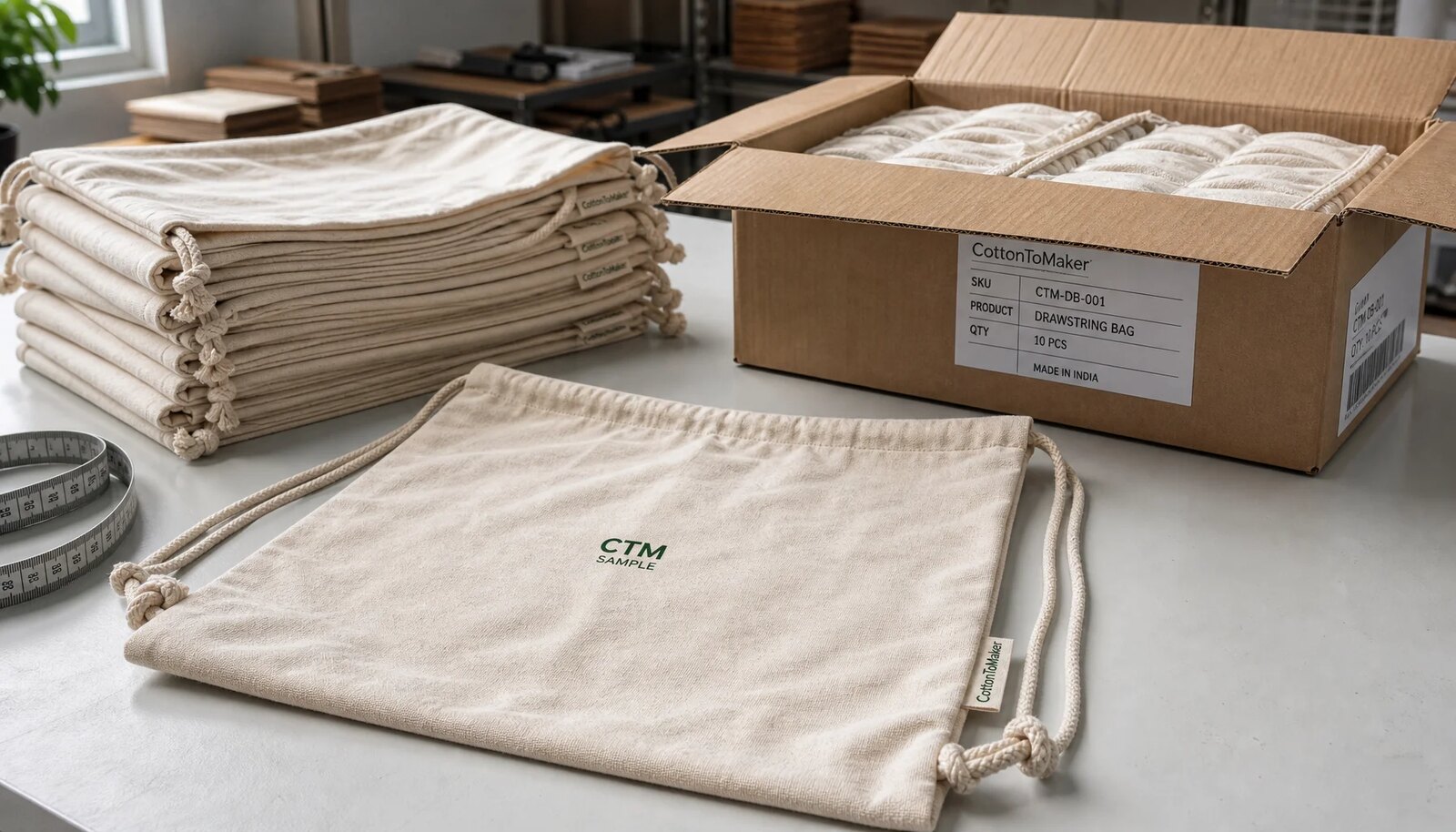
Start With the Carton Workflow
For a craft fair order, the buying problem is rarely just the backpack. The real test begins when cartons arrive and the team has to count them, split them by booth or sponsor, move them through a temporary venue, and display the bags without stains, crushed artwork, or mixed designs. That is why the carton packing plan belongs in the RFQ beside the fabric, size, cord, and logo details. If packing is treated as a last-minute warehouse choice, the factory may choose the tightest carton to reduce cube, even when that creates creases, print pressure, heavy cartons, or slow receiving.
Cotton drawstring backpacks compress easily. This helps freight efficiency, but it can also hide risk. A quote may look attractive because the supplier packs 100 pieces in a small carton, yet the same carton may bulge after the cords are tucked in or after individual polybags are added. Printed panels can sit under pressure for weeks. If the ink cure, fold line, or print-to-print contact is not controlled, the bags may arrive with blocking or transfer marks.
The buyer should describe the field workflow in plain language. Is the bag a free sponsor giveaway? A retail item for a maker market? A workshop kit that will be filled locally? A distributor stock item that needs to be split by region or sales representative? Each use changes the preferred fabric weight, inner bundle count, label format, and inspection threshold. The more urgent the event date, the less room there is for manual recounting after arrival.
A strong cotton drawstring backpacks carton packing plan for craft fairs connects product specification, sampling, labeling, packing, and inspection. Treat the approved packing plan as part of the purchase order, not an informal note. That gives procurement a measurable standard for carton count, carton marks, inner bundles, print protection, and presentation before the shipment leaves the factory.
- For booth giveaways, prioritize clean appearance, fast counting, and cartons light enough for temporary staff to move.
- For retail craft fair merchandise, add cleaner folding, stricter stain control, and individual or bundle protection when presentation matters.
- For vendor kits, confirm whether the backpacks ship empty or need space for local inserts after arrival.
- For distributor shipments, use one SKU per carton or clearly labeled inner bundles by artwork, fabric color, and quantity.
- For urgent events, request packing photos and carton label photos before shipment release so errors are caught before export.
Specify Fabric by GSM and Finish
Most cotton drawstring backpacks for craft fair programs sit in the 6 oz to 8 oz cotton canvas range, roughly 200-270 GSM depending on the mill standard and weave. This range usually gives better handfeel than thin promotional cotton while staying practical for sewing, folding, and carton packing. A lighter 140-160 GSM cotton can work for low-cost giveaways, but it may look transparent, wrinkle strongly, and feel weak beside handmade or premium goods. Heavier canvas can look more substantial, yet it also raises fabric cost, sewing stress, cord pressure, carton cube, and gross weight.
Procurement should not compare offers that simply say cotton canvas. Ask for GSM, ounce weight if the factory uses it, fabric construction if available, finish, color, and whether the cloth is greige, natural, bleached, dyed, washed, or softened. Natural cotton may show seed specks, slubs, and small shade variation. Those traits can support a handmade look, but they are not the same as oil stains, mildew odor, dye patches, watermarks, or poor finishing.
Fabric weight changes the carton result. A 35 x 45 cm bag at 160 GSM does not pack like the same size at 270 GSM. Thick fabric creates bulkier folds. Cotton cords add a surprising amount of volume when tucked inside bundles. Polybags, hangtags, barcode labels, and retail sleeves add more. Before approving a material, ask the supplier to estimate carton dimensions, net weight, gross weight, and cubic volume per 1,000 pieces.
The best specification is not always the heaviest one. It is the lowest fabric weight that still supports the brand position, expected load, print quality, and event use. A one-day sponsor giveaway may not need the same canvas as a reusable retail backpack. Separating those use cases prevents overpaying for unnecessary weight or buying a bag that looks too cheap for the booth.
- 140-160 GSM: suitable for basic giveaways, with higher risk of transparency, wrinkling, and weak handfeel.
- 200-230 GSM: a practical balance for sponsor bags, workshop kits, maker-market promotions, and light retail add-ons.
- 240-270 GSM: stronger perceived value for resale or premium event use, with higher carton weight and fold bulk.
- Above 300 GSM: premium look, but usually needs stronger seams, heavier cord planning, and lower carton counts.
- Natural cotton: define acceptable specks and slubs, and reject contamination, odor, dye defects, or obvious stains.
Lock Size, Cord, and Reinforcement
A common final sewn size for cotton drawstring backpacks is 34 x 42 cm or 35 x 45 cm. That size usually holds brochures, postcards, a notebook, light apparel, catalogs, and small boxed craft products without making carton volume jump too much. A few extra centimeters may look harmless in a drawing, but across thousands of units it changes fabric yield, sewing time, folding bulk, carton dimensions, and freight cost.
The quote should state final sewn size after seams, pressing, and cord insertion. Cut-panel size is not enough. A practical tolerance for many programs is +/-1 cm for overall width and height, unless the buyer requires a tighter standard. Also define where measurements are taken: flat body width, total height from top edge to bottom seam, opening width if relevant, and logo position from a fixed edge. If measurement points are vague, the supplier and inspector may both be measuring correctly in different ways.
Cord choice affects comfort, claims, durability, and carton cube. Cotton cord or flat cotton tape gives a natural look and supports craft-oriented positioning. Polyester cord may be cheaper or smoother, but it should be disclosed if the product is marketed as cotton. A common round cotton cord range is 5-7 mm, with the final choice based on bag size, fabric GSM, and expected load. Thin cord can cut into shoulders and stress the exits. Thick cord improves feel, but it adds bundle bulk and may push cartons out of shape.
Reinforcement should match real fair use. People may carry candles, books, jars, ceramics, apparel, catalogs, and multiple purchases in one bag. The top channel, side seams, bottom corners, and cord exits deserve more than a quick visual check. For heavier use, ask for bartacks, reinforced stitching, or another approved construction method at exits and lower corners. Test a sample with the intended load before bulk production.
- State final sewn size and tolerance in the purchase order, not only in artwork files or chat messages.
- Specify cord material, diameter, color, length, and whether the trim must be cotton, recycled, natural, or dyed-to-match.
- Require clean cord exits with no fraying, tearing, twisted cord, weak stitching, or needle damage near the pull point.
- Use reinforced stitching or bartacks when backpacks may carry heavy samples, catalogs, books, jars, or retail purchases.
- Check that cord bulk does not make cartons bulge, especially at 100 pcs per carton or with individual polybags.
Test Print Before Carton Pressure
Screen print is usually the safest choice for one to three solid-color craft fair logos. It is predictable in bulk, works well on cotton canvas, and suits many sponsor marks, maker graphics, and event designs. Heat transfer, digital print, DTG-style print, and embroidery can also work, but they need more sampling. Check handfeel, edge lift, cracking, registration, ink coverage, and color on the actual production fabric, not just on a digital mockup.
Print performance does not end at the printing table. The bags may be folded, stacked, compressed, and stored for weeks before the fair. If the ink is under-cured, prints can block, stick, or transfer to another unit. If a large logo sits on the main fold line, the most visible part of the artwork may take a permanent crease. If printed faces are packed print-to-print without separation, pressure marks can appear even when the first sample looked clean.
Artwork approval should cover size, position, reference color, and tolerance. A centered front logo can often be controlled with a position tolerance such as +/-5 mm from fixed measurement points. Large artwork may need a wider practical tolerance, but it still needs to be written down. Color matching should reference Pantone, a physical swatch, or an approved strike-off. Screen colors are not enough because natural, dyed, and bleached cotton all change how ink is seen.
Add a simple fold-pressure check before bulk. Ask the supplier to fold the printed sample using the proposed bulk fold, hold it under light pressure for at least 24 hours, and then inspect for blocking, transfer, cracking, peeling, and severe fold marks. If the result is not acceptable, adjust the cure, ink, fold line, carton count, tissue separation, logo placement, or print method before production starts.
- Use screen print for simple logos, sponsor marks, event branding, and repeat orders with solid colors.
- Use heat transfer only after testing edge feel, cracking, color stability, and pressure behavior in the packed fold.
- Use digital print for complex artwork when the buyer accepts higher cost, different handfeel, and slower production risk.
- Use embroidery mainly for small premium logos on heavier canvas; lightweight fabric can pucker under dense stitching.
- Approve print method, artwork size, position tolerance, color standard, cure requirement, and fold-mark limits before bulk.
Build MOQ Around Production Breaks
MOQ is shaped by production breaks, not only by a supplier's sales policy. Fabric color, dye lot, print design, screen setup, cord color, woven label, barcode label, hangtag, and packing style can each create separate work. An order for 2,000 pieces split across four designs, two fabric colors, and several barcode labels may be more complicated than a 5,000-piece single-SKU order. Ask the factory to separate MOQ by fabric color, print design, cord color, label type, and carton packing format.
Craft fair programs often include seasonal artwork, artist collaborations, sponsor logos, or limited-edition themes. Variation is manageable when the base product stays controlled. The lowest-risk approach is to keep fabric, size, cord, label position, carton count, and bundle count consistent while changing only the printed artwork. The factory can cut and sew in one flow, then separate printing and packing by SKU.
If every design also has a different cord, different fabric, different barcode, different hangtag, and different carton mark, the risk of mixing rises quickly. Sampling becomes more important too. White ink on natural cotton, black ink on dyed canvas, and pastel ink on bleached cotton will not behave the same. If the buyer approves artwork on one base fabric and later adds three more colors, additional strike-offs may be needed.
For quote comparison, ask suppliers to price the clean base order first. Then request separate adders for design splits, screens, labels, barcode application, individual packing, inner bundle labels, mixed-carton packing, and carton mark changes. This shows whether the supplier is competitive on the real order, not just on a simplified version. It also helps buyers decide when SKU consolidation will save time and reduce error risk.
- Lowest complexity: one fabric color, one cord color, one print design, one label, and one carton format.
- Moderate complexity: one fabric color with several print designs, each packed in separate labeled cartons.
- Higher complexity: multiple fabric colors with shared size, shared cord, shared label, and identical carton counts.
- Highest error risk: mixed colors, mixed designs, different barcodes, different labels, and mixed cartons in one shipment.
- Best RFQ practice: request base cost and separate adders so variation does not hide inside the unit price.
Set Carton Quantity and Bundles
A practical export carton count for cotton drawstring backpacks is usually 50 to 100 pieces. The right number depends on GSM, bag size, cord bulk, print thickness, fold method, and whether units are individually polybagged. Higher carton counts reduce the number of cartons and may lower handling steps, but they also increase compression and gross weight. Lower carton counts improve presentation and reduce print pressure, though they can increase carton cost and freight cube.
Fold style should be approved before mass packing. A backpack may be folded once, folded twice, rolled loosely, flat-packed, or folded with cords tucked inside the body. Each method changes carton dimensions and receiving presentation. For a large front print, avoid placing the main fold through the center of the logo when possible. For natural cotton, aggressive compression can leave strong crease lines that are difficult to remove at a temporary booth.
Inner packing is often the detail that makes the order usable. Bundles of 10 or 20 pieces help teams allocate stock to booths, sponsor tables, classrooms, workshops, sales reps, or vendor packets without counting every unit. Individual polybags can protect resale units and reduce handling stains, but they add plastic, labor, cost, and volume. If the buyer wants lower-plastic packing, discuss paper bands, kraft sleeves, or cotton ties and confirm they stay secure during export handling.
Approve carton dimensions and gross weight before freight booking. A carton of 100 light bags may be fine. A carton of 100 heavier canvas bags with thick cords and polybags may bulge or become awkward to move. The best carton plan balances freight efficiency, print protection, inspection access, receiving speed, and real fair-site handling.
- Use 100 pcs per carton for light fabric and basic giveaways only when carton weight and print pressure remain acceptable.
- Use 50 pcs per carton for heavier canvas, individual polybags, resale presentation, courier delivery, or premium print protection.
- Use bundles of 10 or 20 for faster booth allocation, shortage control, and receiving inspection.
- Avoid loose mixed-design packing unless the receiving team is prepared to open and recount every carton.
- Approve carton dimensions, net weight, gross weight, and cube per 1,000 pcs before confirming shipping terms.
Control Labels and Packing Lists
Many delivery problems happen after the backpacks are correctly sewn. Wrong carton labels, mixed SKUs, unclear counts, missing design names, or inaccurate packing lists can slow receiving when goods arrive close to a fair date. Carton marking should include buyer order number, item name, SKU, fabric color, print design, quantity, carton number, net weight, gross weight, carton dimensions, and country of origin if required. Provide a label template rather than letting the factory invent one.
SKU separation is the safest rule for first orders, urgent schedules, and shipments split across locations. One SKU per carton allows quick receiving and reduces shortage disputes. If mixed cartons are unavoidable, each inner bundle should be labeled by design and quantity, and the master packing list should show exactly what is inside each carton. A mixed carton without bundle labels may save time at the packing table but cost hours at the event warehouse.
Carton numbering should support the distribution plan. A shipment of 40 cartons should not simply show 1-40 if there are four designs, two fabric colors, and several destinations. The packing list should identify which carton contains which SKU and, when needed, which location or booth receives it. This prevents unnecessary opening, relabeling, repacking, and manual sorting after arrival.
Barcode and retail labels need their own approval. Confirm label size, material, adhesive, data format, scan quality, and placement. If labels are placed on individual polybags, they should not cover the front logo or make the item look messy at resale. If labels are placed on inner bundles, they should be readable without opening the bundle. For distributor orders, neutral carton marks may be required to avoid exposing factory or upstream buyer details.
- Use one SKU per carton for first orders, urgent event deadlines, and multi-location distributor shipments.
- If mixed cartons are required, use visible inner bundle labels and a carton-level packing list by SKU and quantity.
- Approve barcode label size, data, placement, scan quality, and whether labels go on units, polybags, bundles, or cartons.
- Keep carton marks neutral when goods ship through distributors, third-party warehouses, or marketplace fulfillment networks.
- Request final carton mark photos and the master packing list before shipment release.
Approve Samples in Shipping Form
A flat photo of a printed backpack is not enough when carton packing is part of the requirement. The sample path should include a fabric swatch, blank sample, print strike-off or printed sample, pre-production sample, and for larger or urgent orders, a carton packing mockup. The carton sample does not always need to contain the full carton quantity, but it should show the approved fold style, inner bundle method, individual protection if any, carton label, and carton material.
Sample review should include basic use testing. Put realistic craft fair contents inside the backpack: brochures, postcards, a small boxed item, a shirt, a catalog, or a sample kit. Pull the cords. Wear it briefly. Inspect the stress points. Then fold it exactly as the factory will pack it. If the logo looks good flat but creases badly after folding, change the fold style, logo placement, print method, or carton count before bulk production.
Keep an approved reference sample. This becomes the standard for fabric shade, handfeel, logo color, logo size, print position, cord type, sewing quality, and general presentation. If there are multiple SKUs, retain one full sample per important SKU or at least fabric and print references for each fabric and artwork combination. Without retained references, inspection disputes become subjective and slower to resolve.
For craft fair schedules, sample approval needs one responsible approver and clear deadlines. Late feedback on artwork, carton labels, barcode placement, or bundle counts can move the whole production calendar. Avoid changing carton marks or packing instructions after production starts unless the team accepts the added time, relabeling cost, and error risk.
- Approve fabric handfeel, GSM, shade, and acceptable natural cotton variation against a retained reference.
- Measure final size after sewing, pressing, and cord insertion, not only the cut panel or flat artwork file.
- Review logo size, position, ink coverage, registration, color, cure, and edge quality on actual production fabric.
- Fold the sample in the intended packing method and inspect crease impact, print blocking, transfer, and cord placement.
- Keep approved samples signed, dated, or sealed so final inspection has an objective comparison point.
Write Inspection Standards Clearly
Quality language such as clean sewing, good print, or export packing is too vague for a purchase order. The buyer and supplier need measurable acceptance criteria. For cotton drawstring backpacks, major defects commonly include wrong fabric, size outside tolerance, mispositioned logo, missing cord, broken seam, heavy stain, mold odor, print peeling, print transfer, wrong carton quantity, and mixed SKU packing without labels. Minor loose threads may be acceptable within agreed limits, but a loose thread across the front logo area may still be unacceptable for retail presentation.
Final inspection can use AQL-style sampling for unit quality, but carton count and carton marking need separate verification. Shortages are especially painful for event merchandise because there may be no time for replacement production. The purchase order should define whether overage is supplied, how shortages are handled, and what evidence is required before shipment release. At minimum, inspection should compare random cartons to the packing list and approved sample.
Print QC should include cure and pressure behavior, not only color. Inspectors should check for blocking, ink transfer, peeling, cracking, poor registration, pinholes, heavy ink buildup, weak opacity, and misalignment. On natural cotton, small slubs can interrupt the print surface, so acceptable limits should be defined. A defect in the main logo area should normally be judged more strictly than the same small imperfection on a hidden seam.
Sewing QC should focus on stress points: top channel, side seams, bottom corners, and cord exits. A practical pull check is useful because an empty visual inspection does not show whether the cord channel will survive normal use. Packing QC should confirm carton dryness, carton strength, tape quality, carton count, inner bundle count, carton mark accuracy, SKU separation, and whether print panels are crushed or stained by packing conditions.
- Critical defects: unsafe contamination, mold odor, severe ink transfer, wrong product, or unusable carton damage.
- Major defects: wrong size, wrong logo, broken seam, missing cord, heavy stain, uncured print, wrong SKU, or wrong count.
- Minor defects: small loose thread, slight natural cotton slub, minor fold mark, or small non-logo-area imperfection within limits.
- Packing defects: weak carton, wrong carton mark, mixed SKU without label, wet carton, crushed panels, or missing packing list.
- Receiving check: open random cartons, count bundles, verify SKU labels, and compare goods to the approved sample before booth distribution.
Compare Quotes by Landed Readiness
A low printed unit price can disappear once carton cube, packing labor, print setup, sample fees, inspection, inland freight, and repacking risk are included. Cotton drawstring backpacks are not as heavy as hardware, but carton volume becomes important when fabric is thick, cords are bulky, units are individually packed, or retail presentation is required. Compare offers using unit price, setup charges, sample charges, MOQ splits, carton count, carton dimensions, gross weight, delivery term, lead-time trigger, and packing assumptions.
When suppliers quote different carton quantities, normalize the comparison. A supplier quoting 100 pieces per carton may look freight-efficient, but if cartons are too heavy or prints are crushed, the claim and rework risk can exceed the freight saving. Another supplier quoting 50 pieces per carton may show more cartons, but it may handle better for retail distribution, courier delivery, and clean presentation. The best quote is the lowest total cost that still meets the arrival date, QC standard, and fair-site handling plan.
Lead time must be tied to approval points. A quote that says 25 days may mean 25 days after deposit, artwork approval, sample approval, fabric arrival, or final packing instruction approval. Clarify this before issuing the purchase order. Craft fair schedules should include time for sample shipping, sample review, artwork correction, production, inspection, carton packing, export handover, customs, and local delivery. Last-minute freight upgrades can cost more than a better planned production schedule.
The final sourcing decision should reward clarity. A slightly higher quote with confirmed GSM, print method, carton dimensions, bundle labels, sample stages, and QC standards may be stronger than a lower quote missing packing details. Missing gross weight, unclear MOQ, vague approval points, or no carton data are not administrative gaps. They prevent accurate landed-cost comparison and increase the chance that goods arrive late, mixed, or hard to distribute.
- Request EXW or FOB price plus carton details so forwarders can calculate freight accurately.
- Ask whether screen setup, sample shipping, carton labels, barcode labels, inner bundle labels, and packing list work are included.
- Compare gross weight, carton cube, carton count, and cartons per 1,000 pcs across all suppliers.
- Include inspection cost, repacking labor, shortage exposure, urgent freight risk, and event staffing impact in the decision.
- Treat missing carton data, unclear lead-time triggers, and vague packing assumptions as incomplete quote items, not savings.
Specification comparison for buyers
| Spec decision | Recommended B2B specification | When it fits | Buyer risk to control |
|---|---|---|---|
| Fabric weight | 6 oz to 8 oz cotton canvas, approximately 200-270 GSM, with a written GSM tolerance such as +/-5% unless the buyer requires tighter control | Craft fair giveaways, maker kits, sponsor bags, retail add-ons, and event merchandise needing better handfeel than thin promo cotton | Quotes that only say cotton canvas are incomplete; below 160 GSM can look thin, while above 300 GSM increases carton cube, gross weight, sewing stress, and cord pressure |
| Fabric finish | Natural, bleached, dyed, washed, or printed-base cotton stated in the RFQ and matched to an approved swatch | Natural cotton supports handmade positioning; bleached or dyed fabric improves contrast for specific brand artwork | Seed specks and slubs can be acceptable on natural cotton, but oil stains, mildew odor, dye patches, watermarks, and lot-to-lot shade mismatch should be rejected or limited |
| Final bag size | Typical 34 x 42 cm or 35 x 45 cm final sewn size, measured flat after sewing and cord insertion, with +/-1 cm tolerance unless otherwise agreed | Fits brochures, postcards, notebooks, light apparel, small boxed craft products, and booth giveaway inserts | Unclear cut-size versus finished-size language causes disputes; larger panels change fabric yield, carton dimensions, and freight cost across the whole order |
| Cord and exits | 5-7 mm cotton cord or flat cotton tape, color specified, with reinforced top channel, clean side exits, and secure stitching at stress points | Natural craft-market look, short-term comfort, and better alignment with an all-cotton product story when synthetic trims are avoided | Thin cord can cut into shoulders; polyester cord can conflict with cotton claims; weak exits tear when users carry books, jars, candles, or sample kits |
| Logo method | Screen print for 1-3 solid colors; heat transfer, digital, or embroidery only after sample and fold-pressure testing | Most event logos, sponsor marks, simple maker graphics, and repeat bulk programs | Poor curing, ink blocking, print-to-print transfer, registration error, pinholes, edge lift, and color shift on unbleached cotton must be tested before bulk |
| Carton quantity | 50-100 pcs per export carton, chosen after sample folding, GSM confirmation, cord bulk, and polybag decision | Balances freight efficiency, carton strength, manual handling, inspection access, and booth allocation | Overpacked cartons can crush prints, create deep creases, bulge, burst, or exceed warehouse and courier handling limits |
| Inner packing | Bundles of 10 or 20 pcs with SKU, artwork, fabric color, and quantity labels; individual polybags only when resale or handling protection justifies them | Craft fair booths, sponsor tables, sales reps, retail stalls, classroom workshops, or distributor splits | Loose mixed cartons slow receiving, increase shortage claims, and make urgent event distribution dependent on manual recounting |
| MOQ structure | Separate MOQ by fabric color, print design, cord color, label type, barcode requirement, and packing style | Seasonal craft fair programs with multiple designs or sponsor versions | Too many small splits create extra screens, changeovers, label errors, leftover fabric, mixed cartons, and delayed packing |
| QC method | AQL-style final inspection plus 100% carton count reconciliation by packing list, with defined critical, major, and minor defects | Importers, distributors, and event buyers needing booth-ready inventory without checking every piece | If defect categories are not written, suppliers may treat misprints, stains, wrong counts, or unlabeled mixed cartons as acceptable variation |
Buyer checklist before sampling
- Write the final sewn bag size, fabric GSM, GSM tolerance, fabric finish, fabric color, cord material, cord diameter, logo method, logo size, logo position, carton quantity, and inner bundle count in the RFQ and purchase order.
- State the intended use: free giveaway, retail craft fair merchandise, vendor kit, school-style carry item, sponsor bag, workshop kit, or distributor stock, because the use changes fabric weight, reinforcement, packing, and QC thresholds.
- Ask for a carton packing mockup or folded sample photos before bulk packing; carton volume depends on fold method, cord placement, print area, polybag choice, and inner bundle method, not only flat bag size.
- Approve fabric shade against a retained swatch under natural light and indoor light, and define which natural cotton specks, slubs, or weave variation are acceptable versus stains, oil marks, mildew, or dye defects.
- Set logo acceptance criteria for print position tolerance, ink coverage, color match reference, registration tolerance, curing, rub resistance, blocking, cracking, transfer, and visible defects after folding.
- Specify whether SKUs may be mixed in one carton; if yes, require inner bundle labels, bundle counts, carton-level SKU breakdowns, and a master packing list by carton number.
- Confirm export carton dimensions, net weight, gross weight, carton ply, burst or edge-crush requirement if available, tape method, moisture condition, carton marking, and pallet or loose-carton handling before mass packing.
- Request production photos at fabric receipt, cutting, printing, sewing, trimming, cord insertion, folding, inner bundling, carton sealing, and carton loading for first orders or urgent craft fair delivery windows.
- Add a realistic overage or buffer for booth samples, staff use, damaged displays, press kits, influencer kits, replacement stock, and last-minute distributor requests instead of ordering the exact booth count only.
- Compare supplier offers using packed carton cube, carton count per 1,000 pcs, gross weight, setup fees, label fees, sample fees, inspection needs, delivery term, and lead-time trigger, not only the printed unit price.
Factory quote questions to send
- What exact fabric construction, ounce weight, and GSM are quoted, and is the fabric greige, natural, bleached, dyed, washed, softened, or finished in another way?
- What GSM tolerance, shade tolerance, shrinkage expectation, pH or odor control if applicable, and natural cotton variation standard will be used during production and final inspection?
- What is the quoted final sewn bag size, size tolerance, seam allowance, cord channel width, cord material, cord diameter, cord length, and reinforcement method at the drawstring exits?
- Which print method is included, how many colors are quoted, what maximum print area is included, and are screen charges, film charges, artwork setup, color matching, or strike-off fees separate?
- Can you provide a printed pre-production sample folded in the proposed bulk packing method, and can you check ink blocking or transfer after the sample is held under light pressure for at least 24 hours?
- What is the MOQ per fabric color, print design, cord color, label type, barcode label, hangtag, individual polybag, inner bundle format, and carton packing style?
- How many pieces are packed per export carton, what are the carton dimensions, and what are the estimated gross weight, net weight, and cubic volume per 1,000 pieces?
- Are units individually polybagged, paper-banded, tied, packed in bundles of 10 or 20, or packed loose, and can you apply barcode, SKU, artwork, destination, or carton sequence labels?
- What sample types are available: fabric swatch, blank sample, print strike-off, printed sample, pre-production sample, size set if needed, and sealed carton packing sample or packing mockup?
- What lead time starts after which approval point: deposit, fabric approval, artwork confirmation, screen confirmation, printed sample approval, fabric arrival, or final packing instruction approval?
Quality-control points to confirm
- Fabric GSM should be checked against the approved standard within the written tolerance, commonly +/-5% for cotton canvas unless the buyer requires a tighter mill or inspection standard.
- Fabric shade should be checked by lot against the approved swatch, with acceptable natural cotton specks separated from unacceptable stains, oil marks, mildew, dye patches, watermarks, or shade bands.
- Final bag dimensions should be measured after sewing, pressing, and drawcord insertion, using defined points such as flat body width, total height, and opening width, not only cut-panel measurements.
- Logo position should be measured from fixed bag edges, with a clear tolerance such as +/-5 mm for a centered front screen print or a separately approved tolerance for large artwork.
- Screen print must be cured enough to resist blocking, peeling, cracking, and ink transfer when folded, bundled, and packed under normal carton pressure during storage and transport.
- Print color should be checked on actual production fabric, because natural, unbleached, dyed, or washed cotton can shift the visible tone of white, pastel, metallic, and light inks.
- Cord channels, side seams, bottom corners, and cord exits should pass a practical pull check using the intended craft fair load, not only an empty-bag visual inspection.
- Visible stains, oil marks, mold odor, heavy loose threads, broken stitches, skipped stitches, needle holes in the logo area, twisted cords, and distorted cord exits should be treated as major defects.
- Carton count must be verified by inner bundle count and random carton opening, especially for mixed-color, mixed-design, retail-labeled, or distributor-split shipments.
- Export cartons should be dry, square, correctly labeled, adequately taped, not bulging, and strong enough for stacking without crushing printed panels or bursting during handling.