Why coffee roasters need the carton plan before the PO
For coffee roasters buying cotton drawstring backpacks, carton packing is part of the specification. It is not a warehouse detail to sort out after the bags are sewn. The packing plan affects landed cost, freight cube, print condition, receiving speed, allocation accuracy, and the way the merchandise looks when it reaches cafés, subscription packers, events, distributors, or a 3PL warehouse.
If the RFQ only says standard export carton, the factory will usually choose the simplest packing method for its production line. That may work for a basic promotional order. It may not work for a roaster that needs café-by-café allocation, clean natural cotton presentation, event-date delivery, clear carton marks, or predictable LCL freight volume.
A cotton drawstring backpacks carton packing plan for coffee roasters should connect the product specification, print method, folding method, inner bundle count, carton dimensions, carton marks, and inspection checklist. Roaster programs often involve natural cotton fabric, dark one-color logos, multiple café locations, limited event graphics, and later repacking with coffee samples or printed collateral. When the plan is missing, buyers often discover the problem late: awkward carton quantities, mixed artwork versions, unapproved fold lines, or cartons that are difficult to count quickly.
The right time to lock the plan is during RFQ and pre-production sample approval. Fold direction may depend on logo placement. Bundle size affects both factory labor and warehouse receiving. Carton size affects CBM and, for courier shipments, dimensional weight. Destination sorting changes the packing-line workflow. If these decisions come after bulk sewing, the supplier may need to open cartons, re-count goods, print new labels, or replace cartons. Every extra handling step adds cost and increases the chance of dirt, wrinkles, print abrasion, and count mistakes.
- Put target pieces per carton in the RFQ, not only total order quantity.
- State whether the backpacks are for bulk stock, café allocation, subscription inserts, event kits, distributor replenishment, or retail sale.
- Ask for carton dimensions, gross weight, net weight, CBM per carton, and total estimated CBM in the quote.
- Treat carton marks as SKU-control documents when there are multiple designs, destinations, or launch dates.
- Approve fold direction and bundle style before bulk printing because print protection depends on it.
Product specs that drive carton cube and carton weight
The carton plan starts with the backpack, not the carton. A 34 x 42 cm cotton drawstring backpack in 6 oz canvas packs very differently from a 38 x 45 cm version in heavier canvas with thick round cords. On one sample, that difference may look minor. Across 2,000 or 10,000 units, it can change carton count, CBM, handling weight, and freight cost.
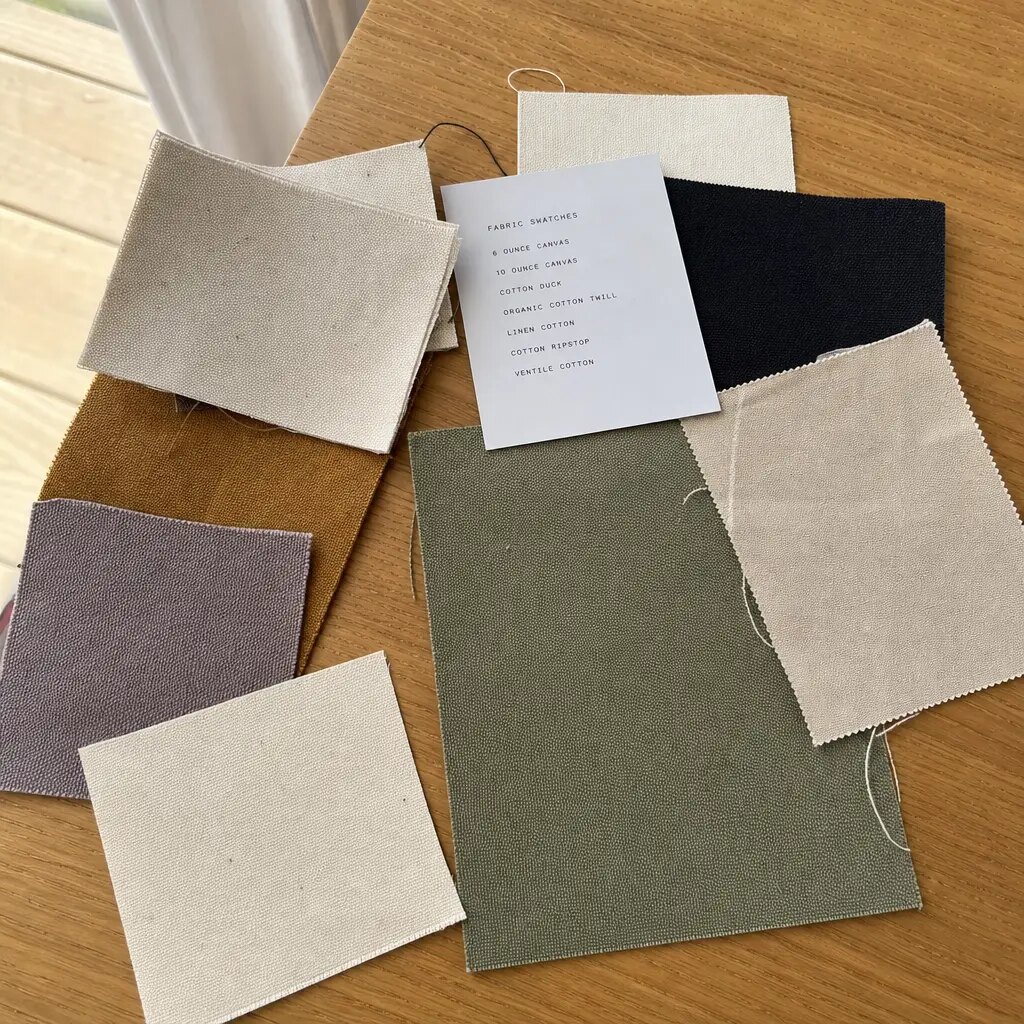
For many coffee roaster giveaways and light merchandise programs, 6 oz to 8 oz cotton canvas, approximately 200-270 GSM, is a practical range. It feels more substantial than very thin promotional cotton, usually supports a clean screen print, and still keeps carton weight manageable. If the bag will carry two retail coffee bags, a brochure, a sample cup, or a lightweight bottle, test that load during sample approval rather than assuming the bag will perform.
If the backpack is mainly a cupping-event giveaway with paper inserts, a lighter fabric may be acceptable. Still, check transparency, seam strength, and print appearance under normal light. Natural cotton is often chosen because it fits a craft coffee brand story, but that same fabric can reveal stains, shade variation, loose fibers, and weak ink coverage more clearly than darker fabric.
Size and cord choice affect packing efficiency. A general roaster backpack size is often around 34 x 42 cm. A larger 38 x 45 cm body may be better for retail packs or event materials, but the larger panel and longer cords reduce carton density. Flat cotton cord lies flatter. Round cotton rope can feel more substantial and more comfortable, yet it creates bulk near the side channels and can make stacks uneven if folding is inconsistent. Buyers should specify cord type, color, diameter or width, and finished loop length so quotes are comparable.
- Quote by finished size, not only cut size; inspect finished width and height after sewing and pressing.
- Common general-use size: 34 x 42 cm; larger merchandise size: 38 x 45 cm.
- Practical fabric range for many roaster programs: 200-270 GSM cotton canvas.
- Heavier canvas above 270 GSM can improve perceived durability but usually reduces carton quantity and increases gross weight.
- Specify cotton rope or flat cotton cord, diameter or width, color, loop length, and knot or finishing method.
- Do not rely on generic terms such as heavy cotton or standard cord in a B2B quote.
Set pieces per carton using handling weight, CBM, and receiving workflow
A procurement-ready carton plan balances three limits: how many backpacks fit without distortion, how much gross weight warehouse teams can handle repeatedly, and how easily receiving staff can count the goods. For many cotton drawstring backpack programs, 100 pcs per carton is a sensible starting point. With lighter fabric and flatter cords, 150 pcs may be possible. With heavier canvas, larger body size, thick rope cords, sensitive printing, or destination-sorted packing, 80-100 pcs is often safer.
Do not compare suppliers only by FOB unit price when their carton assumptions are different. One quote may be based on 150 pcs per carton. Another may use 100 pcs. The 150-pc carton can reduce carton count, but it may also create bulging sides, higher compression, print pressure marks, or dimensional-weight exposure. The 100-pc carton may use more cartons, yet it can improve counting, reduce compression, and support café allocation.
Ask suppliers to quote carton dimensions in centimeters and calculate CBM per carton. CBM is calculated as length x width x height in meters. A 60 x 40 x 35 cm carton is 0.084 CBM. If the shipment uses 20 cartons, the estimated cube is 1.68 CBM before pallets or consolidation allowance. That simple calculation helps a buyer compare landed cost, not just product cost.
Receiving workflow matters as much as freight. A 100-pc carton arranged as four 25-pc bundles is fast to audit. Ten 10-pc bundles may be better if cafés receive smaller allocations. Loose 150-pc cartons may look efficient at the factory but create slower counting and more handling at the buyer’s warehouse. The best carton count is the one that fits the whole supply chain.
- Common manual-handling target: approximately 12-18 kg gross weight per carton, subject to the buyer's warehouse rules.
- Simple audit format: 100 pcs per carton, often arranged as four bundles of 25 or ten bundles of 10.
- Higher-density format: 150 pcs per carton only after checking fabric weight, cord bulk, carton strength, and print pressure risk.
- Air or courier shipment: check dimensional weight as well as actual weight.
- Ocean LCL shipment: prioritize carton strength, moisture control, stack stability, and clear carton marks.
- 3PL receiving: choose carton quantities that match counting procedures and allocation rules.
Match print method, curing, and fold direction
Coffee roaster logos are often bold and simple: black, dark brown, cream, or one-color artwork on natural cotton. Screen printing is usually the practical choice for solid roaster logos, café marks, coffee festival graphics, and launch designs. Water-based ink gives a softer hand feel and suits natural cotton branding. Plastisol can provide stronger opacity, but it must be fully cured. Heat transfer may work for detailed multi-color artwork that cannot be screened cleanly, but transfer edges and fold lines need extra attention.
Print curing directly affects packing. A print can look dry on the table and still mark another bag if it is stacked too soon, folded through a heavy ink area, or compressed in a full export carton. The risk rises with large solid logos, dark ink, thick ink deposit, humid production conditions, or tight bundle packing. The supplier should state the ink type, curing or drying method, and rest time before folding.
Fold direction should be approved with the artwork, not chosen by the packing team at the end. If the factory folds through the center of a large logo, the shipment may arrive with creases, gloss marks, cracking, or ink transfer. If bags are stacked print-to-print, offset risk can increase. If the logo is folded inward, the print may be better protected but still compressed. Interleaving can help in some cases, although it adds cost, labor, and material.
A practical test is simple: pack several printed samples using the intended fold and bundle method, place light pressure on them for 24-48 hours, then check for tackiness, offset, cracking, edge lifting, and fold marks. This test is especially useful for first-time artwork, large dark logos, heat transfers, or any order that will travel by ocean freight or sit in storage before distribution.
- Use water-based screen print when soft hand feel and natural cotton appearance are priorities.
- Use plastisol only with confirmed curing and no tacky surface after cooling.
- Use heat transfer for artwork detail that cannot be screen printed cleanly, then test transfer edge lifting and fold marks.
- Specify print size, position, number of colors, ink type, and print-facing direction in the PO.
- Approve whether fold lines may cross the printed area.
- For large dark prints, require a packed pressure-test sample before bulk carton packing.
Inner packing choices: bulk, bundles, polybags, or kit-ready cartons
Bulk flat packing is usually the lowest-cost and lowest-waste option. It works when all backpacks are received into one inventory location and the buyer does not need retail presentation, unit barcodes, or small allocation pulls. The trade-off is counting speed. Loose flat bags can be counted, but shortage disputes take longer because receivers must handle every unit. Bulk packing also depends on disciplined folding, otherwise bags shift, wrinkle, and create uneven pressure on printed panels.
Inner bundles are often the best compromise for coffee roasters. The factory can pack 10, 20, or 25 pcs per bundle using a paper belly band, cotton tie, or light sleeve. A 100-pc carton with four 25-pc bundles is easy to audit. A 100-pc carton with ten 10-pc bundles is useful when café teams receive smaller quantities. Bundles reduce receiving time and make it easier to pull exact counts for events without the cost and waste of individual polybags.
Individual polybags should be specified only when they serve a real operational purpose. They are useful when each backpack is sold as a retail unit, scanned by barcode, fulfilled one by one, or protected from repeated handling. They add material cost, packing labor, carton volume, and packaging waste. If cleanliness is the main concern, a carton liner plus inner bundles may be enough for many roaster programs.
Kit-ready cartons are different from random mixed cartons. A kit carton may contain a defined mix for a café opening, sales team, coffee festival, or distributor launch. It should have a written allocation table, a carton mark identifying the kit, and a packing list that states contents by design and quantity. Random mixed cartons should be avoided because they slow receiving and make carton-level inspection unreliable.
- Bulk flat pack: lowest cost and lowest waste for simple warehouse stock.
- 10-pc bundles: useful for cafés, pop-ups, small events, and subscription packing teams.
- 20- or 25-pc bundles: efficient for distributor replenishment and fast carton audits.
- Individual polybags: use for retail sale, barcode scanning, direct-to-consumer fulfillment, or strict unit protection.
- Kit-ready cartons: allow only with an approved allocation table and dedicated carton marks.
- Carton liner: useful when natural cotton must stay clean during ocean freight or warehouse storage.
MOQ and cost drivers beyond total order quantity
MOQ is not only a sewing number. For cotton drawstring backpacks, MOQ is shaped by fabric purchasing, fabric color, cutting efficiency, print setup, packing method, carton mark separation, and destination sorting. A supplier may support a lower MOQ when all bags use natural cotton, one size, one cord, one print, and one carton mark. The same supplier may require a higher MOQ or add surcharges if the order includes dyed fabric, custom cord colors, multiple roaster logos, barcode labels, individual polybags, or several destination allocations.
Coffee roasters often underestimate artwork splits. Each café logo, event graphic, distributor version, or limited-release design is a separate control point. It may require separate screen setup, separate print approval, separate production counting, separate packing separation, and separate carton marks. Even when the total order is large, a 100-pc artwork split can be inefficient. Procurement should ask for MOQ and setup charges by artwork version, not only by total order quantity.
Packing splits can also create cost. For example, 1,000 pcs of one design packed bulk may be straightforward. The same 1,000 pcs split into ten café destinations with different carton labels requires more packing labor and creates more error risk. If multiple allocations are needed, the RFQ should include a matrix showing design, quantity, destination, bundle size, carton quantity, and carton mark. This lets the supplier quote the actual work instead of repricing after the PO.
Material claims should be handled carefully as well. If the program requires organic cotton, recycled cotton, or a specific certification document, state that before quoting. Documentation, fabric sourcing, segregation, labeling, and inspection requirements may affect lead time and MOQ. Do not add a material claim after the order is underway and expect the same price, schedule, or paperwork.
- Lowest-complexity order: natural cotton, one size, one cord, one print, one bulk carton mark.
- Higher-complexity order: dyed cotton, organic certification requirements, custom cord, multiple artwork versions, retail packaging, or barcode labels.
- Ask for MOQ per SKU, per artwork, per fabric color, and per packing method.
- Confirm screen charges, setup fees, and color-change charges for small artwork splits.
- Use a destination allocation table when cartons ship to cafés, events, distributors, or 3PL locations.
- Freeze packing splits before bulk sewing and printing to avoid recounting and repacking cost.
Sample approval must include packed samples, not only loose bags
A loose sample is necessary, but it is not enough. Buyers should approve the cotton drawstring backpack as a packed item because folding, compression, and bundling change the final presentation. Sample review should include fabric hand feel, finished size, cord comfort, seam strength, print color, print position, fold direction, inner bundle method, and open-carton layout. If the final shipment will use 10-pc or 25-pc bundles, the supplier should show that bundle style before bulk production.
The packed review is especially important when artwork is large, ink is dark, or fabric is natural cotton. Natural cotton may show seed flecks, small slubs, and shade variation. Those details may be acceptable if they match the approved sample. Dirty handling marks, oil stains, mildew odor, strong chemical odor, and weak print coverage are not acceptable for premium coffee merchandise. Roaster branding often depends on a clean dark logo, so buyers should review opacity and edge sharpness under normal light, not only in edited photos.
For a first order, request a physical pre-production sample when timeline allows, plus a packing photo set. A useful photo set includes the loose backpack front and back, close-up of print, ruler measurement of print position, cord channel, bottom seam, folded unit, inner bundle, open carton layout, sealed carton, carton marks, and carton weight. These photos become part of the quality file and make final inspection more objective.
If the order is large or the print is sensitive, ask the supplier to pack a small group of printed samples under pressure for 24-48 hours before confirming the fold method. This does not replace final inspection, but it can catch a bad fold line or uncured print before thousands of units are packed the same way.
- Measure finished width and height after sewing and pressing.
- Measure logo position from top edge and side seam with a ruler visible in the sample photo.
- Pull both cords several times to test draw function and channel stitching.
- Check cord length and shoulder-loop usability if the bag will carry coffee products.
- Press printed samples under light weight for 24-48 hours to identify offset, tackiness, cracking, or gloss marks.
- Approve fold direction, print-facing direction, and inner bundle style before bulk packing begins.
- Keep approved packed-sample photos attached to the PO or quality file.
Carton marks and packing lists that prevent receiving disputes
Carton marks should be treated like product labels. For simple receiving, a carton may need PO number, SKU, quantity, and carton number. For coffee roasters shipping to cafés, events, distributors, retail DCs, or 3PL warehouses, carton marks should also include product description, fabric color, print version, destination code, and carton sequence. Marks should appear on at least two adjacent sides so warehouse staff can identify cartons on a pallet without turning every box.
The packing list must mirror the physical carton plan. If cartons are packed by SKU, the packing list should show carton ranges by SKU. If cartons are destination sorted, it should show carton ranges by destination. If kit cartons are approved, it should list the contents inside each kit carton. Random mixed cartons should be avoided because they slow receiving, complicate inspection, and increase the risk of wrong café allocation.
A good carton sequence is easy to audit. For example, cartons 1-20 may contain SKU A, cartons 21-35 may contain SKU B, and cartons 36-40 may contain approved event kits. This is far easier to inspect than a shipment where artwork versions are scattered randomly. During final inspection, carton marks are not a paperwork formality. They are one of the main controls against wrong delivery, shortage disputes, and allocation errors.
If a buyer has routing-guide requirements, add them before carton labels are produced. This may include barcode labels, destination codes, retail DC wording, pallet labels, carton size limits, or country-of-origin details where required. Late label changes are easy to request and surprisingly easy to mishandle, especially after cartons are already sealed.
- Include PO number, SKU, product name, fabric color, print version, and quantity per carton.
- Add destination code for café allocations, event shipments, distributor programs, 3PL routing, or retail DC requirements.
- Use carton sequence numbers such as 1 of 36, 2 of 36, and so on.
- Mark mixed cartons only when the buyer has approved kit packing or allocation packing.
- Place marks on two adjacent carton sides for easier pallet identification.
- Request sealed-carton photos showing the actual marks before shipment release.
- Make the final packing list match carton sequence, not only total order quantity.
Final inspection: unit QC plus carton-level QC
Cotton drawstring backpacks are simple products, but inspection should not be casual. Common defects include uneven size, weak stitching at the cord channel, dirty natural cotton, print misalignment, print smudging, print offset, wrong cord length, missing cords, poor draw function, and carton count errors. For a coffee roaster brand, visible dirt or oil marks can be more damaging than a small measurement deviation because the bag may be handed directly to customers at a café, festival, or product launch.
Set acceptance criteria before production. Finished size can often be controlled within +/-1 cm for this type of sewn item. Print placement may be controlled within +/-5 mm to +/-10 mm depending on artwork size, fabric movement, and cutting tolerance. Fabric GSM should be checked against the approved sample with a stated tolerance, commonly +/-5% if the supplier agrees. For stitching, the functional requirements are no open seams, no skipped stitches across stress points, no cord-channel failure, and no loose reinforcement at cord exit points.
Inspection should include carton-level QC, not only unit appearance. The inspector should open selected cartons, count inner bundles, verify pieces per carton, compare contents with carton marks, check gross weight against the packing plan, and look for crushed corners, damp cartons, torn flaps, or bulging sides. If the order includes several artwork versions, carton selection should cover each design and destination code. A shipment can look fine on a table but still fail operationally if carton marks are wrong or quantities are inconsistent.
Defect classification should be practical. Wrong artwork, mold, severe odor, or major print transfer should be treated as critical because those issues can stop distribution. Open seams, missing cords, large stains, incorrect size beyond tolerance, or failed pull tests are major defects. Small thread ends or minor natural cotton slubs may be minor if they match the approved standard. The PO should state these expectations before production begins.
- Use AQL for general workmanship if required, but define critical defects separately in the PO.
- Critical defects: wrong artwork, mold, strong odor, severe print transfer, unsafe contamination, or completely wrong SKU.
- Major defects: open seams, missing cords, large stains, wrong size beyond tolerance, heavy print misalignment, failed cord-channel pull test, or wrong carton quantity.
- Minor defects: small thread ends, slight cotton slub, or minor shade variation within the approved standard.
- Functional checks: draw and close the bag, pull the cords, check shoulder loops, and inspect bottom seam strength.
- Carton checks: verify quantity, bundle count, carton marks, gross weight, carton condition, and open-carton presentation.
- Inspection photos should include representative defects and packed-carton evidence, not only clean product photos.
Lead-time risks caused by late packing decisions
A typical production schedule includes fabric preparation, cutting, printing, curing or drying, sewing, trimming, final QC, folding, bundling, carton packing, carton marking, and shipment booking. Packing decisions can add time when they require inner bundles, barcode labels, hangtags, destination sorting, special carton marks, pallet labels, or individual polybags. These tasks happen near the end of production, when the buyer has the least schedule flexibility.
If a coffee launch, subscription drop, café opening, or festival date is fixed, late packing instructions can create rush charges and mistakes. The supplier may have finished sewing, but not finished the work that makes the order ready to ship. Carton labels, bundle counts, allocation tables, pressure-tested fold methods, and inspection documents all need time.
The safest workflow is to approve the carton packing plan together with the pre-production sample. Before bulk printing starts, the factory should know the fold method, bundle count, carton quantity, carton dimensions, carton marks, destination split, and whether any cartons are mixed kits. Before carton labels are printed, the buyer should approve the exact mark layout and sequence logic. Before final inspection, the supplier should provide the packing table so the inspector knows what to verify.
Changes after sewing is complete are costly because they require physical rework. Repacking may mean opening cartons, removing bags, changing bundle counts, applying new labels, re-counting pieces, and resealing cartons. Every extra handling step increases the chance of dirt, wrinkles, print abrasion, or count mistakes. Procurement buyers should freeze packing details before production and reserve final inspection for verification, not decision-making.
- Reserve curing, cooling, and rest time before stacking printed bags under carton pressure.
- Approve carton marks before cartons are printed, labeled, or packed.
- Do not introduce destination sorting at final inspection; define it in the RFQ and PO.
- For multiple designs, build extra time for production separation, count checks, and carton verification.
- Ask for a production schedule that separates sewing completion from packed-carton readiness.
- If delivery is event-driven, add buffer time for final inspection, shipment booking, customs, and domestic receiving.
- Confirm whether palletization, pallet labels, or routing-guide carton limits are required before carton dimensions are locked.
Specification comparison for buyers
| Spec decision | Procurement-ready option | When it fits | Quote or QC risk to control |
|---|---|---|---|
| Fabric weight | 6 oz to 8 oz cotton canvas, approximately 200-270 GSM, with agreed GSM tolerance such as +/-5% unless otherwise specified | Coffee roaster merchandise, cupping event packs, café launch gifts, subscription inserts, distributor samples, and lightweight retail add-ons | Do not accept only the word canvas. Confirm GSM or oz, weave, color, shrinkage expectation, fabric hand feel, and whether the quoted price changes for dyed, recycled, or organic cotton. |
| Finished backpack size | 34 x 42 cm for general roaster use; 38 x 45 cm when the bag must hold larger retail packs or event collateral; common finished-size tolerance +/-1 cm | Programs carrying one or two coffee bags, catalogs, tasting cards, light bottles, café opening materials, or festival giveaways | Cut size is not the finished size. Inspect after sewing and pressing. Larger sizes reduce pieces per carton and may increase shipment CBM. |
| Pieces per export carton | Often 100 pcs/carton as a controlled baseline; 80-100 pcs for heavier canvas or thick cords; 150 pcs only when lighter fabric, flat cords, and print pressure risk are acceptable | Buyers needing predictable receiving, pallet planning, LCL calculation, courier dimensional-weight estimates, or café allocation | High carton counts raise handling cost, but overfilled cartons can bulge, crush corners, distort folds, and create print offset. Request carton size, NW, GW, and CBM in the quote. |
| Print method | Water-based screen print for soft one-color natural looks; plastisol screen print for opacity if fully cured; heat transfer for detailed artwork not suitable for screen print | Roaster logos, café marks, coffee festival graphics, launch designs, and limited merchandise drops | Specify print size, position, colors, ink type, curing process, rest time before packing, and whether folded samples pass 24-48 hour pressure testing without offset. |
| Drawcord specification | Natural cotton rope or flat cotton cord; specify diameter for rope or width for flat cord, color, finished loop length, and knot or finishing method | Brands wanting a cotton-based material story and a comfortable reusable promotional backpack | Thin cords can cut into shoulders; thick rope increases bulk and carton cube. Synthetic cords may conflict with natural cotton positioning unless disclosed and approved. |
| Stress-point construction | Secure side seams, cord channel stitching, reinforced cord exit points, and neat bottom seam; bar tack or reinforced stitching where load concentrates | Reusable bags expected to carry coffee bags, brochures, samples, or event giveaways | Open seams, skipped stitches, weak cord exits, and channel slippage are major defects. Include manual pull checks in final inspection. |
| Inner packing | Bulk flat pack in lined carton, or 10/20/25 pcs per bundle using paper bands, cotton ties, or light sleeves | Warehouse stock, café allocation, distributor replenishment, event team handout preparation, and subscription packing lines | No bundling slows counts. Individual polybags add cost, labor, waste, and volume. Approve bundle size based on receiving workflow, not factory convenience. |
| Export carton specification | 5-ply export carton where appropriate, sized to avoid bulging or underfill; target gross weight commonly controlled around 12-18 kg for repeated manual handling | Ocean freight, LCL consolidation, 3PL receiving, domestic truck movement, or storage near coffee inventory | Confirm carton grade, dimensions, edge condition, carton closure, liner, moisture control, and palletization needs before shipment booking. |
| Carton marks and packing list | PO, SKU, product description, fabric color, print version, quantity, carton sequence, destination code, country-of-origin or routing details when required | Coffee roasters shipping to cafés, events, retail DCs, 3PLs, distributors, or multiple regional warehouses | Mixed or vague cartons create receiving disputes. Carton sequence in the packing list must match the physical cartons. |
Buyer checklist before sampling
- Define the commercial use before quoting: giveaway, retail merchandise, subscription insert, café opening pack, event bag, distributor stock, or kit component.
- Specify finished backpack size, fabric GSM or oz weight, weave, fabric color, drawcord material, cord diameter or width, cord color, cord length, bottom construction, and cord exit reinforcement.
- Provide artwork with print size, print position, number of colors, ink preference, and whether logo fold lines are acceptable or prohibited.
- State whether cartons must be packed by SKU, artwork version, café/store allocation, event kit, distributor region, or as bulk inventory.
- Set a target pieces-per-carton range and maximum carton gross weight so the supplier does not choose a carton that is cheap to pack but expensive or awkward to ship.
- Ask every supplier to quote carton dimensions in centimeters, pieces per carton, net weight, gross weight, CBM per carton, estimated total CBM, and total carton count.
- Confirm the carton basis for the quote: bulk flat pack, bundled packing, individual polybag packing, retail-ready packing, barcode labeling, destination sorting, or palletized shipment.
- Approve the fold method, print-facing direction, inner bundle count, bundle material, carton liner, moisture-control method, and carton fill before bulk packing.
- Approve carton marks in writing, including PO number, SKU, product description, fabric color, print version, quantity, carton number, destination code, and routing-guide requirements.
- Decide whether mixed cartons are prohibited or allowed only for pre-approved kits with an allocation table.
Factory quote questions to send
- What exact fabric is included in the price: cotton type, weave, oz weight or GSM, color, shrinkage expectation, and GSM tolerance?
- Is the fabric greige, bleached, dyed, natural unbleached, recycled cotton, or organic cotton, and what documentation is available if a material claim is used?
- What finished size tolerance is quoted for the cotton drawstring backpack after sewing and pressing?
- What drawcord material, cord diameter or width, cord color, cord length, knot method, and shoulder loop length are included?
- What seam construction is included at side seams, bottom seam, cord channel, and cord exit points? Can you show production photos of the same construction?
- What print method is included, how many colors and positions are priced, what print size is assumed, and what setup or screen charges apply by artwork version?
- What curing or drying process will be used, and how long will printed bags rest before folding, bundling, and carton packing?
- For this artwork, will the fold line cross the print? If yes, can you provide a folded pressure-test sample or photos after 24-48 hours?
- Is interleaving required for the approved artwork, or can bags be safely stacked print-to-fabric after curing?
- What is the proposed carton size, pieces per carton, net weight, gross weight, CBM per carton, and estimated total CBM for the order?
Quality-control points to confirm
- Fabric GSM should be measured against the approved standard, with a stated tolerance such as +/-5% unless another tolerance is agreed in the PO.
- Finished size should be checked after sewing and pressing, not only after cutting; a common working tolerance for simple cotton drawstring backpacks is +/-1 cm.
- Fabric cleanliness is critical on natural cotton: inspect for oil marks, dirt, mildew, strong odor, excessive loose fibers, unacceptable slubs, and shade inconsistency beyond the approved sample.
- Print position should be measured from the top edge and side seam; approve a realistic tolerance such as +/-5 mm to +/-10 mm depending on logo size and fabric movement.
- Print color, opacity, edge sharpness, and coverage should be compared with the approved sample under normal light; dark roaster logos on natural cotton should not look weak or patchy.
- Print adhesion should pass dry rub, light scratch, and reasonable pressure checks after curing; ink should not transfer during normal carton compression.
- Heat transfer designs should be checked for edge lifting, cracking on fold lines, gloss marks, and distortion after the approved packing method is used.
- Cord channel, side seams, bottom seam, and cord exit points should be manually pulled during inspection to identify seam slippage, broken stitches, or weak reinforcement.
- Cord length and draw function should be checked so the backpack opens and closes smoothly and both shoulder loops are usable and reasonably symmetrical.
- Inner bundle counts should be verified before sealing; carton quantity should be counted by carton, by SKU, by artwork version, and by destination code when applicable.