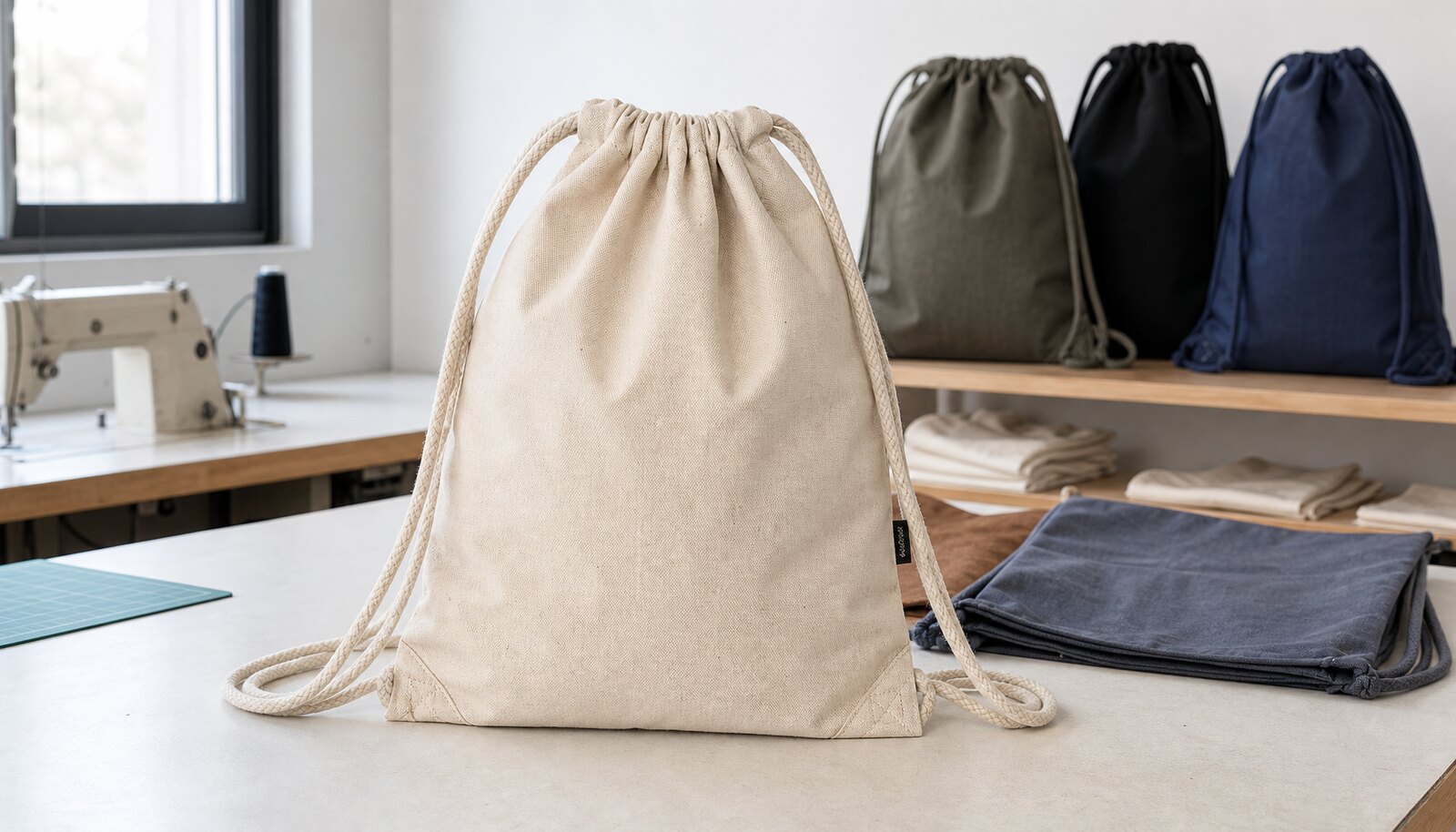
Why gift-shop buyers need a pricing plan, not just a unit price
Cotton drawstring backpacks sold in gift shops are not bought like office giveaways. They are retail items that must look neat on a shelf, feel substantial in hand, and support a margin after freight, duty, labeling, and store handling. That is why the cheapest factory quote is not always the best commercial choice. A low number can hide thin fabric, weak stitching, poor print registration, or packing that creates extra labor at receiving.
For procurement teams, the real question is not whether the backpack is cheap. It is whether the total landed cost supports your shelf price and sell-through rate. A good pricing plan compares suppliers on the same spec, the same decoration method, and the same packing assumptions. Without that discipline, the buyer is comparing apples to oranges and may end up with leftover inventory that looked inexpensive at the PO stage but underperformed in retail.
Gift-shop buyers also face a unique constraint: assortment clarity. A museum shop, park store, or destination retailer often needs one clean design that can move repeatedly rather than a wide variety of speculative options. That makes the price structure important. If a supplier’s quote becomes much more expensive when you request a reorder, add a label, or change the carton count, the apparent savings can disappear quickly.
A useful bulk pricing plan should therefore answer four questions before the first order is placed: what spec creates the right shelf appeal, what MOQ level keeps inventory risk manageable, what quote structure is comparable across suppliers, and what QC standard prevents avoidable returns. When those four items are clear, you can buy with confidence instead of negotiating from a vague sample photo.
In practice, the best gift-shop programs are usually the simplest ones. A stable cotton body, one strong print location, and a packing method that matches your warehouse flow often produce better commercial results than a more complex design with multiple setup points. The goal is not to minimize every cost item. The goal is to spend where customers notice value and save where the bag will not be judged at retail.
- Compare suppliers on a normalized spec, not on headline price alone.
- Treat the bag as a retail product with margin, not a blank commodity.
- The cheapest quote can become the most expensive if it increases returns, labor, or dead stock.
The spec decisions that drive cost the most
The two biggest price drivers are fabric weight and decoration complexity. For most cotton drawstring backpacks bulk pricing plans aimed at gift shops, 140-160 GSM cotton is the most practical range. It gives enough body for the bag to feel like a retail product, prints cleanly, and avoids the flimsy look that often comes with lighter promotional fabric. If the customer base expects a more premium souvenir item, 160 GSM or slightly above can be justified, but only if the finished retail price supports the additional cost and freight weight.
Fabric structure matters too. A plain cotton bag and a canvas-style bag may look similar in a photo, but the sewing behavior, hand-feel, and print result can differ. If the supplier quotes one line item without naming weave, finish, and actual measured GSM, the buyer cannot compare offers reliably. Ask whether the fabric is greige, dyed, washed, or finished, because each step can affect shrinkage, color consistency, and cost.
The second major lever is print coverage. A simple one-color logo on the front panel is much easier to price than artwork that crosses a fold, wraps around the bag, or requires multiple color separations. Gift shops usually do not need extreme decoration complexity. A crisp destination name, museum mark, or seasonal icon often sells better than an overcrowded graphic. That also helps procurement because a straightforward print spec reduces setup fees and sample revisions.
Cord and reinforcement are often overlooked because they do not stand out on a spec sheet. But the buyer should still ask whether the drawstring is cotton, cotton-poly, or another blend, how the ends are finished, and whether stress points are bar-tacked. A bag that looks fine at first glance can fail quickly if the cord channel is weak or the ends fray. Small construction upgrades may cost little, but they can improve both shelf confidence and customer satisfaction.
The practical way to manage cost is to freeze the spec before you collect quotations. Once the size, GSM, print method, cord style, and packing format are fixed, suppliers can quote on the same basis. If you keep changing these items after the fact, the cheapest quote will keep moving. Procurement control starts with specification discipline.
- A stable 140-160 GSM range usually works best for gift-shop retail positioning.
- Ask for actual weave/fabric type and measured GSM, not just “cotton” or “canvas.”
- Keep decoration simple unless the retail story truly requires more complexity.
A real comparison table for buyer economics
A commercial comparison table should do more than restate product options. It should help the buyer understand where the money goes and what the likely downstream effect will be. In this category, the important comparison is not only between fabrics or print methods. It is also between buying routes, packing choices, and MOQ structures. Those differences change unit price, lead time, repeat-order cost, and freight efficiency.
For gift shop procurement, the same product can price very differently depending on how the supplier structures the order. A direct factory quote may show a slightly higher unit price but include better control over sewing, packing, and QC. A broker or trading quote may look convenient but hide setup charges or use a weaker carton spec. That is why the buyer needs a side-by-side commercial view rather than a simple spec note.
Below is the most useful way to read supplier offers: compare the product by retail role, not by appearance alone. A lower-cost giveaway bag, a mid-tier souvenir bag, and a premium museum-shop bag are different products even if they share the same shape. When you classify them correctly, you can set a fair price target and choose the right production route.
- Normalize every quote to the same fabric, print, and packing assumptions.
- Use buying route as a commercial variable, not just a sourcing preference.
- Premium retail positioning only makes sense if shelf price and sell-through support it.
How to normalize supplier quotes so you can compare them line by line
The most common procurement mistake is comparing one supplier’s all-in number with another supplier’s bare ex-factory price. That creates a false savings story. To normalize quotes, ask each supplier to separate the same cost elements: fabric, sewing, printing, packing, carton, and any special labeling or retail insertion. Once those components are visible, the buyer can calculate a cleaner landed cost.
Here is a simple normalization example. Supplier A quotes $0.92 per bag but includes only the blank bag and basic packing. Supplier B quotes $1.04 per bag and includes one-color printing, size sticker, and carton reinforcement. On the surface Supplier A looks cheaper, but after adding printing and packing labor, the true cost may be higher. Procurement should never approve a quote before converting it to the same commercial basis.
Ask for the quote in the same Incoterm whenever possible. If one supplier quotes EXW, another quotes FOB, and a third gives DDP-style language, the comparison becomes noisy. If you cannot get the same Incoterm, then ask for the same carton dimensions, gross weight, and inland handling assumptions so freight can be estimated consistently. The goal is to reach one comparable landed number per unit and per carton.
A practical rule: if the supplier will not separate setup fees from recurring unit price, the quote is not procurement-ready. Setup fees should be visible because they affect reorder strategy. A higher initial setup fee may still be the better long-term option if the reorder price is lower and the quality control is clearer.
When you normalize the quote, also normalize the definition of the artwork. A one-color logo with a 10 cm print width is not equal to a 20 cm front panel print or a two-side decoration. Buyers often discover that a “same print” comparison is not actually the same at all. Put the print size in millimeters or centimeters, state the number of colors, and define whether the print can touch seams or must stay inside a safe area.
- Separate recurring unit cost from one-time setup cost.
- Compare quotes on the same Incoterm and packing basis.
- Write artwork size and color count into the RFQ to avoid false comparisons.
MOQ scenarios that change the economics for gift shops
MOQ is the point where product strategy and factory efficiency meet. For cotton drawstring backpacks bulk pricing plans, MOQ is usually driven by three things: fabric color, print setup, and packing configuration. If you keep one body color, one print position, and one packing method, MOQ can stay manageable. Every additional variable adds handling time, material staging, and leftover risk.
For a gift shop buyer, the right MOQ is usually the one that lets you test demand without creating too much dead inventory. A single destination design in one natural cotton color may be the safest first order. If it sells through, the reorder can be used to improve unit price or add a second colorway. If you launch too many variants at once, you split demand and make it harder to read what customers actually want.
A useful negotiation lever is the reorder split. Ask the factory to quote both first-order pricing and repeat-order pricing. Many factories are willing to lower the repeat price once the cutting pattern, print screens, and packing process are already established. That matters because gift shop lines often become repeat programs after the first season. If you do not secure the repeat price in advance, the long-term margin can be weaker than expected.
Another practical way to control MOQ is to reduce the number of customization points. For example, a single front print plus a standard woven side label is usually easier to manage than a bag that requires multiple labels, multiple print colors, and special packaging. The buyer should ask which element drives MOQ the most. In many cases, print setup or retail labeling has more impact than the blank bag itself.
For seasonal buying, consider whether the MOQ can be staged. Some suppliers will allow a first production run, then a follow-up quantity if the program performs well. This is not always possible, but it is worth asking. Staged commitments often work better for gift shops than a large one-time order because retail demand can be highly seasonal and location-specific.
- One body color and one print location usually keeps MOQ under control.
- Ask separately for first-run price and reorder price.
- Reduce customization points if you need to lower order risk.
Print method choices and what they do to retail value
Screen printing is still the workhorse for cotton drawstring backpacks in gift shops because it offers clean results on simple art and scales well in bulk. A one-color or two-color screen print is usually the most quote-friendly option. It is also easier for factories to repeat consistently than more experimental decoration methods. For destination names, logos, and short slogans, this method usually gives the best balance of cost and visual sharpness.
Water-based or softer-hand printing can improve the feel of natural cotton, especially when the buyer wants the print to look more integrated into the fabric. It may cost a little more, and it requires good curing control so the artwork does not crack, fade, or appear patchy after folding. For a gift-shop buyer, the question is whether that better hand-feel supports a higher shelf price. If it does not, the extra cost may not be worth it.
Digital printing is useful when the artwork is complex, the run is short, or the design changes often. But procurement teams should understand that the unit economics can become less attractive as volume increases. If the program is likely to repeat, it is smart to ask the supplier for both a small-run and bulk-run scenario. In some cases, digital printing is the right launch tool but not the right long-term production method.
The quote should also define print placement. Artwork that sits too close to a seam, draw channel, or fold line can distort during sewing or cinching. Ask for a safe area in millimeters and a reference mockup or strike-off. If the supplier only quotes “front print” without specifying the size or location, the sample approval process can become messy.
For gift shop use, print durability matters more than trendy special effects. Customers will handle the bag, fold it, and cinch it repeatedly. A decent, durable logo usually performs better than an ambitious effect that looks good in photography but fails after handling. Procurement should favor print consistency and repeatability over novelty unless the retail story truly depends on a special finish.
- Screen print is usually best for simple bulk art and repeat orders.
- Digital print fits short runs and artwork-heavy launches, but scale economics can be weaker.
- Define print size and safe area in the RFQ to avoid distortion disputes.
Packing, carton math, and freight efficiency
Packing is one of the easiest places to lose money without noticing it. A supplier may quote a good unit price but use cartons that are too large, too loose, or too heavy for efficient freight. For cotton drawstring backpacks, the bag itself is compressible, so packing discipline matters. A well-folded flat pack reduces void space and helps the buyer control inbound storage and shipping cost.
The quote should state pieces per carton, carton dimensions, and gross weight. Without those three numbers, freight cannot be estimated properly. A 200-piece order with poor carton utilization can cost more to ship than a 220-piece order with tighter packing. That is why procurement teams should not look only at piece price. Carton efficiency can materially affect landed cost, especially when international freight fluctuates.
Gift shops often need retail handling logic, not just bulk storage logic. If the bags go straight to the shelf, they may need a barcode sticker, hangtag, or presentation fold. If they go to a regional warehouse first, a clean bulk pack with consistent counts may be better. The supplier should tell you whether the retail labeling step is included or priced separately. If not, the warehouse may inherit extra labor later.
Inner protection also matters. If the print is prone to scuffing, the factory may need to add tissue, a polybag, or an interleaf. That adds cost, but it may be cheaper than handling damaged retail stock. Ask for the minimum packing method that still protects the artwork and preserves the bag shape. Overpacking is wasteful; underpacking causes avoidable rejects.
Carton marking should be treated as part of QC, not as an afterthought. SKU, size, color, quantity, lot number, and destination marks should match the packing list exactly. If the cartons are unlabeled or inconsistently marked, inbound receiving slows down and mistakes increase. A clean carton spec saves time at both ends of the supply chain.
- Always request carton dimensions, gross weight, and piece count.
- Choose packing based on downstream handling, not just factory convenience.
- Carton labels should match SKU and lot details to reduce receiving errors.
Landed-cost planning for gift-shop margins
The real buying question is how much the bag costs after everything is added up. That means factory price, decoration, packing, carton cost, inland transfer, export charges, freight, duty, and any receiving labor if your team repacks or labels the product. If you only compare ex-factory prices, the margin can look stronger than it really is. Gift shop buyers need to know whether a backpack can support a retail price point and still leave room for discounting or seasonal markdowns.
A simple way to evaluate the economics is to build a per-unit landed-cost worksheet before you issue the PO. Include the unit price, the setup fee spread over quantity, the packing cost per piece, the freight allocated per piece, and a small allowance for damage or sortation. That gives you a realistic cost base for margin planning. A bag that looks only slightly more expensive in the quote may actually be the better commercial option if it arrives with lower handling and fewer defects.
MOQ has a direct effect on margin because setup fees dilute differently at different volumes. For example, if you buy a limited run for a seasonal shop, the setup cost per piece is much higher than it would be on a larger reorder. That is one reason suppliers should quote first-run and repeat-run prices separately. The buyer can then decide whether to absorb the initial setup or plan a second run to improve the economics.
Gift shops also need to think about inventory turns. A backpack design that sells well at a moderate margin is often better than a premium-looking item that sits in storage too long. From a procurement standpoint, the right spec is the one that turns. This is why buyers should balance perceived quality against carry cost, not simply chase the thickest fabric or the most elaborate decoration.
If you are comparing suppliers internationally, ask for a landed-cost scenario on the same commercial basis: same quantity, same carton count, same Incoterm, and same packing format. If you can, model at least two volumes, such as a first test order and a repeat order. The difference between those two scenarios often reveals whether a supplier is suitable for a test-and-scale program or only for one-off purchases.
- Build a landed-cost worksheet before approving the PO.
- Spread setup fees across quantity so you can see true unit economics.
- Model both test-run and reorder scenarios to understand margin behavior.
QC standards that are detailed enough to protect a retail program
Quality control for cotton drawstring backpacks should go beyond “check stitching and print.” For gift shops, the visible finish and the functional reliability both matter. A bag can pass casual visual inspection and still fail in real use if the cord channel is weak, the seam tension is uneven, or the print cracks after repeated folding. The buyer should therefore define QC checkpoints before production, not after the goods arrive.
Start with a clear acceptance structure. Many buyers use AQL-based inspection so defects are classified as critical, major, or minor. For this category, critical defects would include broken seams, missing cords, severe contamination, or wrong product delivery. Major defects would include print misregistration, unstable stitching, size out of tolerance, or weak reinforcement. Minor defects might include loose threads or slight cosmetic variation that does not affect use. The supplier should know in advance which defects trigger rejection.
A production-matching pre-production sample is more valuable than a showroom sample because it reflects actual materials and the real print method. Once approved, the factory should retain a sealed reference sample for bulk comparison. During production, the inspector should compare the first-off pieces, mid-run pieces, and packed pieces against that reference. This helps catch drift early if the print color shifts or the sewing line starts varying.
Practical tests matter. Pull the cords through the channel and check whether both sides cinch evenly. Load the bag with a typical retail weight and see whether the top opening distorts or the seams stress. Check the stitching density at stress points and the bar-tack finish where applicable. For printed bags, fold and rub the surface lightly to see whether the artwork marks easily. These are simple tests, but they mirror how the product will be handled in real retail use.
If you want a stronger buyer-controlled QC process, ask for sample-to-bulk control steps. That means the approved sample is measured, photographed, and tied to the production record. The factory should confirm fabric lot, print batch, and carton marks against that sample. If the bulk differs materially from the sample, the buyer has a clear basis for correction before shipment. That is far better than discovering a mismatch after the goods clear customs.
- Use AQL with defined critical, major, and minor defects.
- Approve a production-matching sample and keep it as the bulk reference.
- Test cord function, seam strength, print durability, and packed condition before shipment.
Quote questions that uncover hidden cost and production risk
A strong RFQ does more than ask for a price. It forces the supplier to reveal how the quote was built and where the risk sits. For cotton drawstring backpacks, the most useful questions are the ones that expose material grade, setup charges, packing method, QC standard, and lead-time dependencies. If a supplier answers clearly, the buyer can compare offers and plan margin more accurately. If the answers stay vague, the quote is probably not ready for approval.
Ask whether the cotton is greige, dyed, washed, or finished, because those choices change cost and consistency. Ask how print is charged, because a quote that hides setup fees or repeat charges can distort your reorder plan. Ask which QC standard is used, because a supplier that cannot name an AQL level or defect list is unlikely to be aligned with a retail buyer’s expectations.
You should also ask about freight inputs. The carton dimensions, gross weight, and packing method affect shipping cost just as much as the unit price does. In a gift shop program, freight can be the difference between a viable margin and a marginal one. If the supplier refuses to state carton data, they may be quoting from an incomplete spec or a rough assumption.
A useful negotiation lever is to ask the supplier what would lower the price without hurting the retail value. Sometimes the answer is simple: reduce the print size, simplify packing, or keep to one body color. That is better than pushing for an arbitrary discount that causes quality compromise. Procurement works best when the supplier understands the commercial target and can suggest the cheapest way to meet it.
Finally, ask for a line-item quote on both the initial run and the reorder run. That gives you visibility into which costs are one-time and which costs are recurring. For seasonal gift-shop programs, this can be more important than the first order price itself. A modest first run is often a way to test demand; the reorder is where the long-term economics are proven.
- Ask for fabric type, print charge structure, packing cost, and AQL standard.
- Request carton dimensions and gross weight to estimate freight correctly.
- Get both first-run and reorder pricing before you commit.
Specification comparison for buyers
| Buying route / spec choice | Typical commercial use case | Pricing implication | Buyer watchout |
|---|---|---|---|
| 140 GSM plain cotton, one-color screen print, flat pack | Entry-level souvenir programs, seasonal gift-shop trials, simple destination branding | Lowest fabric cost and usually the lowest production friction, but the finished bag can feel soft and less premium at retail | Can look thin on shelf; ask for actual measured GSM, not just a fabric description |
| 150-160 GSM cotton, one- or two-color screen print, flat pack with size sticker | Core gift-shop assortment where perceived value matters and repeat orders are likely | Usually the best balance of fabric cost, print clarity, and freight efficiency; small premium over 140 GSM often buys better shelf appeal | Confirm shrinkage allowance and sewing tolerance because heavier cotton can still distort if cut poorly |
| 160+ GSM premium cotton, clean screen print, reinforced stress points, retail-ready packing | Museum shops, premium destination stores, higher-ticket souvenir assortments | Higher unit cost, heavier cartons, and better perceived value; useful when the bag is part of a premium retail story | Do not overbuild if your retail price ceiling is low; freight and labor can erode margin fast |
| Low-MOQ digital print, short-run custom artwork, mixed seasonal designs | Pilot runs, event-specific gift shop programs, limited-edition drops | Higher per-piece cost, lower setup barriers, and faster design changes for small quantities | Unit price can look attractive in small batches but scale poorly if you reorder |
| Direct factory with in-house cutting, sewing, printing, and packing | Repeat purchase programs, tighter QC control, clearer quote accountability | Often the cleanest path for line-item comparison and reorder pricing | Verify the factory actually controls each step; do not assume a broker quote reflects the production floor |
| Trading company or sourcing agent quote | Multi-category purchasing, consolidated shipments, or buyers needing sourcing support | Convenient for procurement teams but may bundle hidden costs into one line | Ask for factory name, actual process owner, and separate setup charges so the quote can be normalized |
Buyer checklist before sampling
- Lock the final bag size, gusset or no gusset, and usable carry volume before asking for prices.
- State fabric target in GSM/oz, color, shrinkage allowance, and whether the cotton is greige, dyed, or finished.
- Send vector artwork and define print size, print placement, Pantone references, and acceptable logo tolerance.
- Request a physical pre-production sample, not only a digital proof or sample photo.
- Ask the supplier to quote setup fees, per-color print costs, packing labor, carton specs, and reorder pricing separately.
- Confirm MOQ by body color, print color count, packing format, and retail-label requirements.
- Define the inspection plan in advance: AQL level, sample size, defect categories, and pass/fail thresholds.
- Approve carton counts, master carton marks, barcode stickers, and any retail hangtag requirements before bulk release.
Factory quote questions to send
- What exact fabric construction is quoted: plain weave, canvas, or twill, and what is the measured GSM tolerance?
- Is the cotton price based on greige, dyed, washed, or finished fabric, and does that include shrinkage control?
- How is print charged: per color, per side, per setup, or bundled, and what is the repeat charge on reorders?
- What is the MOQ by fabric color, print color count, and packing style, and which variable drives the MOQ most strongly?
- Can you separate material cost, sewing labor, printing labor, packing labor, carton cost, and inland handling in the quotation?
- What sample stage is included: fabric swatch, pre-production sample, sales sample, or production-matching pre-shipment sample?
- What size tolerance do you allow on body width, body height, strap length, and cord channel placement?
- What QC standard do you use, and can you share your AQL level plus the critical/major/minor defect list?
- What is the quoted lead time after sample approval, and what parts of the process can extend the schedule?
- What freight assumptions are you using: carton dimensions, gross weight, palletization, and Incoterm?
Quality-control points to confirm
- Fabric confirmation: verify GSM with a measured sample, check hand-feel, opacity, and color consistency against the approved swatch or lab dip.
- Cut and sew tolerance: inspect body width, height, seam allowance, and symmetry after sewing, pressing, and final drawstring assembly.
- Print quality: confirm placement within the approved safe area, color match against approved reference, edge sharpness, and no cracking after folding.
- Cord and reinforcement: test cord length equality, end finishing, bar-tack density, eyelet or channel reinforcement, and pull resistance at stress points.
- Packing control: verify each carton count, polybag or tissue usage if specified, inner packing sequence, and carton marks against the packing list.
- Pre-shipment sampling: inspect a statistically meaningful lot sample and compare against the approved pre-production sample before release.
- AQL discipline: define AQL for critical, major, and minor defects; reject for broken seams, missing cords, severe print misregistration, or count shortages.
- Functional test: load the bag with a typical retail weight, cinch and release the cords repeatedly, and check for seam slippage or opening distortion.