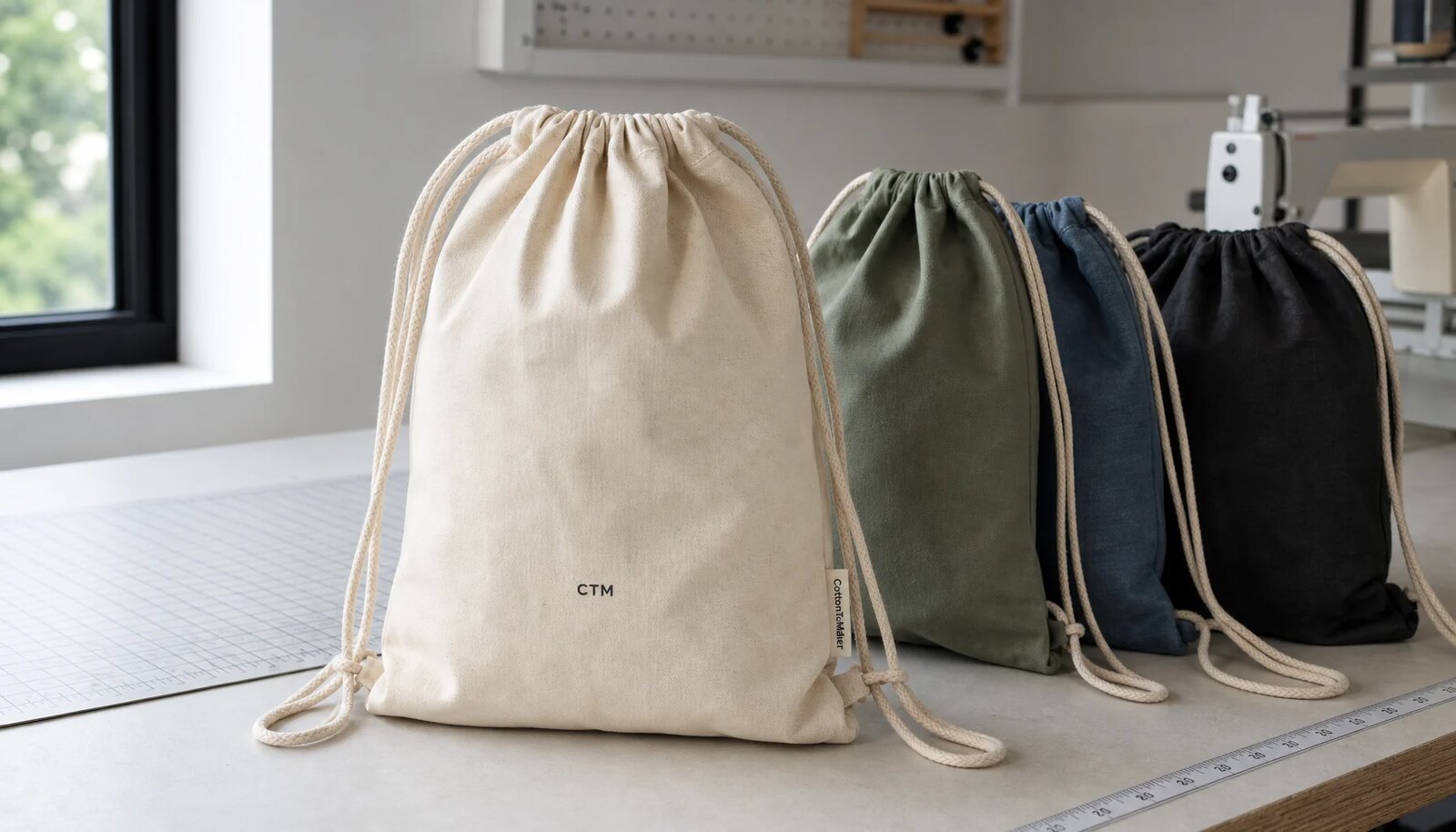
1. Start with the event job, not the cheapest bag
When buyers search for cotton drawstring backpacks for event planners bulk pricing plan, the useful answer is rarely the lowest number in a catalog. The real job is to buy a bag that carries the intended contents, presents the brand cleanly, packs without drama, and arrives before a fixed event date. A conference registration bag, sponsor giveaway, campus welcome pack, festival merchandise item, and distributor resale product can look almost identical in a product photo. In production, they often need different fabric weights, cord details, logo methods, packing plans, and inspection standards.
Begin with the event workflow. Will attendees receive the bag empty at a registration desk, or will it be filled locally with brochures, lanyards, bottles, samples, and sponsor inserts? Will cartons go to one venue, several hotels, a decorator warehouse, or a third-party fulfillment center? Does the receiving team need cartons separated by sponsor, hall, booth, city, or staff group? These are procurement details, but they affect carton marks, inner packing, version control, freight cost, and the chance of last-week confusion.
A strong sourcing brief makes suppliers price the same product instead of guessing. Instead of asking for 5,000 cotton drawstring backpacks, specify event date, required delivery date, target contents, finished size, fabric GSM, cotton color, cord type, print method, print size, number of logo versions, packing format, carton marking, and trade term. That level of detail protects both sides. Marketing can approve the look, finance can compare landed cost, and the supplier can flag risks before the order is already late.
- Define the event type: trade show, conference, festival, campus event, staff kit, sponsor pack, merchandise item, or distributor program.
- List contents by dimensions and approximate weight, including literature, notebooks, bottles, apparel, samples, inserts, and sponsor items.
- Clarify handling: empty bulk handout, local kitting, origin kitting, retail-ready packing, e-commerce fulfillment, or multi-city shipment.
- State the target role of the bag: low-cost carrier, reusable branded item, premium sponsor gift, or resale product.
2. Convert contents into size and fabric weight
Cotton drawstring backpacks are often sold as a standard shape, but the finished dimensions decide whether the bag actually works on event day. A common event range is about 33 x 40 cm to 38 x 45 cm. That range is only a starting point. If the bag must hold A4 folders, check usable opening width and corner fit after sewing. If it must carry a folded sweatshirt, drink bottle, or boxed sample, test how the contents push against the lower corners and side seams.
Fabric weight should match both load and brand impression. For light giveaways with brochures, pens, small notebooks, or simple inserts, 140-160 GSM cotton is often a practical range. For heavier sponsor kits, better opacity, repeat use, or a more substantial hand feel, 180-200 GSM is usually more suitable. Very light cotton may reduce the unit price, but it can look translucent, wrinkle sharply, and show strain around seams or large print areas.
Ask whether the quoted GSM is measured after finishing. Buyers sometimes receive descriptions such as cotton canvas, promotional cotton, or eco cotton without a usable specification. A procurement-ready quote should identify fabric composition, weave or fabric type when available, nominal GSM, approved color, and finishing process if relevant. Two bags with the same size and logo can perform very differently when one uses a loose lightweight cotton and another uses a tighter heavier fabric.
- Use 140-160 GSM for light event handouts, simple conference kits, and budget-sensitive giveaways.
- Use 180-200 GSM for heavier sponsor packs, better opacity, more substantial hand feel, and repeat-use expectations.
- Confirm finished width, finished height, and opening width after sewing, not cut-panel dimensions.
- Request sample photos or physical samples showing inside seams, bottom corners, drawstring channel, and reinforcement points.
3. Specify the construction points that fail first
Most event complaints about drawstring bags come from a short list: open seams, uneven cords, rough channels, torn lower corners, crooked logos, dirty panels, and loose threads. These details are easy to overlook when the quote only shows size, material, and logo. They are also the details attendees notice when the bag is filled and handled for the first time.
The drawstring channel deserves close attention. A single-fold channel may be acceptable for a light-duty promotional bag. A double-fold channel can create a cleaner edge and smoother cord movement. Cord length should be stated as a finished measurement with tolerance because short cords make the bag uncomfortable and uneven cords make the product look rushed. Lower cord exits should be reinforced or finished to match the approved sample, especially for catalogs, notebooks, bottles, and heavier gift kits.
Do not prescribe a construction method the supplier cannot reliably execute. Instead, approve a sample that clearly shows the construction and require bulk production to match it. Check stitch density, backstitching, inside thread trimming, side seam finish, channel ends, and bottom corners. If the supplier uses overlocking, lockstitching, bartacks, folded seams, or a specific reinforcement method, name it in the purchase order or attach detailed photos from the approved sample.
- Define cord material, diameter or width, finished length, knot method, and lower-corner attachment.
- Agree whether the channel is single-fold, double-fold, reinforced, or built to match the approved sample.
- Check side seams, bottom seams, channel ends, and cord exits during sample approval and inspection.
- Include loose threads, skipped stitches, open seams, weak knots, and rough cord movement in the defect list.
4. Choose cotton color with the schedule in mind
Fabric color is a design decision, but it is also a lead-time decision. Natural cotton is often the simplest choice for event programs because it has a familiar textile appearance, works with many logo colors, and may be easier to source quickly than dyed fabric. It also suits campaigns that want a plain cotton look. Natural cotton is not perfectly uniform, though. Seed flecks, yarn character, and small shade differences can be visible, so the approved sample should show the acceptable range.
Bleached white cotton gives stronger contrast for bright sponsor logos, detailed artwork, and multi-color prints. The trade-off is cleanliness. White fabric shows stains, oil marks, handling dirt, and packing marks more easily as the bags move through printing, sewing, trimming, packing, export handling, and venue receiving. If white is the right visual choice, set tighter inspection expectations for stains, smudges, and mixed-color contamination.
Dyed cotton makes sense when the bag color is central to the campaign, but it can add lab dips, bulk fabric approval, higher MOQ, longer lead time, and shade variation risk. A Pantone number is useful as a reference, yet a physical color standard is often more reliable because cotton does not behave like coated paper or a screen. For fixed-date events, use dyed cotton only when the brand value justifies the approval time. A late color decision can consume the buffer needed for sample revision, production, inspection, and freight.
- Choose natural cotton for simpler lead times, broad logo compatibility, and a classic cotton appearance.
- Choose bleached white when logo contrast and color brightness matter more than hiding handling marks.
- Choose dyed cotton when brand color is essential and the timeline allows lab dips or strike-off approval.
- Write the shade standard and acceptable variation into the purchase order before bulk fabric is cut.
5. Match decoration to artwork, fabric, and version count
Logo decoration can change the cost more than buyers expect. It affects setup charges, production speed, reject rate, hand feel, and inspection criteria. For simple one-color or two-color logos on stable quantities, screen printing is usually the most efficient method. It provides predictable setup, repeatable placement, and straightforward checks for opacity, registration, edge sharpness, curing, and smearing.
Heat transfer and DTF can be useful when the artwork has gradients, many colors, tight details, or smaller version runs. These methods may avoid separate screens for each color, but they must be approved on the actual cotton fabric. Ask to see hand feel, edge appearance, adhesion, cracking risk, and whether a visible film remains around the design. A print that looks polished on a smooth test sheet may feel heavy or show unwanted edges on natural cotton.
Embroidery can elevate a small premium mark, but it is not automatically the best answer. Dense stitching can pucker thinner cotton, distort panels, and make fine sponsor text hard to read. It works best for compact designs on heavier fabric where stitch density is controlled. Before choosing the method, send the supplier the vector artwork, intended print size, fabric color, quantity, and number of versions. Decoration should be selected for the actual job, not from a default menu.
- Use screen print for simple logos, larger quantities, and strong bulk pricing control.
- Use DTF or heat transfer for multi-color graphics, gradients, small details, or smaller version runs.
- Use embroidery for small premium marks on heavier cotton where puckering and stitch density can be controlled.
- Approve decoration on the production fabric color, with agreed print size, position, opacity, and tolerance.
6. Treat MOQ as several linked variables
MOQ is rarely one clean number. A supplier may advertise a low minimum, but that minimum may apply only to one stock fabric color, one size, one logo, and bulk packing. Once the buyer adds two sponsor versions, a dyed body color, a woven side label, custom hangtag, individual polybag, barcode sticker, or split shipment, the real minimum and cost structure can shift. Each change adds setup, material allocation, version separation, inspection, and packing control.
For a first order, keep the configuration controlled where possible. One body size, one cotton color, one print position, and one packing format make price breaks easier to compare and reduce the chance of version mix-ups. If sponsors require separate logos, ask the supplier to price each version at its true quantity and state whether the versions can share fabric preparation, cutting, sewing, or packing. This shows which costs are fixed and which costs scale with quantity.
A useful bulk pricing plan compares realistic tiers at the same specification. Ask for 1,000, 3,000, 5,000, and 10,000 pieces if those numbers match your buying range, then ask what changes when the order is split by artwork or destination. Do not compare a stock natural cotton bag with bulk packing against a dyed bag with individual barcode polybags as if they are equivalent. The cleanest procurement decision comes from seeing the variables, not hiding them inside a single unit price.
- Request MOQ by fabric color, body size, print version, print position, label, hangtag, barcode label, and packing method.
- Ask whether split shipments, mixed cartons, destination labels, or route-specific carton marks change labor cost or lead time.
- Treat each artwork change as a separate version unless the supplier confirms shared setup and production handling.
- Keep early programs simple, then add color, label, or sponsor complexity once demand and supplier performance are proven.
7. Build a quote sheet procurement can actually compare
A single unit price is not enough for B2B buying. The quote should show the base bag specification, fabric GSM, finished size, cotton color, cord, construction, decoration method, setup charges, label costs, packing method, carton data, sample charges, production lead time, inspection support, and trade term. Without that structure, the lowest unit price can win approval and then become expensive when artwork, packaging, cartons, or freight are clarified.
Give every supplier the same spec sheet. The base product line should state size, GSM, fabric color, construction, cord material, and quantity. Decoration lines should state print method, number of colors, print size, setup cost, sample cost, and extra cost for back print or additional positions. Packing lines should show bulk packing, individual polybags, inserts, barcode labels, carton marks, carton dimensions, units per carton, net weight, and gross weight.
Trade terms also need careful comparison. Ex-works, FOB, and delivered pricing can all be appropriate, but they include different responsibilities. A delivered quote may look higher because it includes freight or customs handling that another quote excludes. An ex-works quote may look attractive until local transport, export handling, freight, duties, inspection, and final delivery are added. For event planners, landed cost and arrival certainty matter more than a tidy-looking unit price.
- Require line items for base bag, decoration, setup, labels, hangtags, polybags, carton marks, samples, export documents, and special handling.
- Ask for carton dimensions, units per carton, gross weight, and net weight before supplier selection.
- Compare ex-works, FOB, and delivered pricing only after confirming what each term includes and excludes.
- Add freight, inspection, duties, warehousing, receiving labor, local kitting, and urgent delivery buffer to the approval sheet.
8. Make sampling a functional approval, not a photo exercise
Sampling should prove that the bag works. A physical pre-production sample lets the buyer check fabric hand feel, finished dimensions, opening width, cord movement, seam strength, print opacity, logo placement, label position, and packing presentation. For meaningful event orders, photo approval alone is weak. Photos can hide scale, stiffness, rough cord movement, weak seams, uneven panels, and print texture.
Measure the sample with a ruler and record the numbers. Check finished width, finished height, opening width, cord length, logo width, logo height, and logo distance from the top and side edges. Pull the cords repeatedly. Watch whether the channel bunches, snags, or frays. Load the bag with the real event kit or a realistic substitute weight, then lift it by one cord and by both cords. After that, inspect lower corners, side seams, and channel ends.
Once approved, the sample becomes the production reference. Mark it with the purchase order, date, fabric GSM, color standard, print method, print size, cord detail, packing method, and any accepted deviations. Keep one approved sample with the buyer and ask the supplier to keep a sealed matching sample at the factory. If fabric lot, cord, ink, print method, label, or packing changes after approval, require written notice and decide whether a revised sample is needed.
- Approve a physical pre-production sample for any order where event date, brand presentation, or contents matter.
- Use a measurement checklist instead of relying on visual judgment.
- Test the sample with the actual contents or a realistic substitute weight.
- Seal the approved sample and use it for inspection, reorders, and dispute resolution.
9. Set QC tolerances before bulk production starts
Quality control standards should be agreed before production begins. For cotton drawstring backpacks, the most visible defects are off-center logos, dirty fabric, shade mismatch, open seams, short cords, rough channels, stains, loose threads, wrong labels, and incorrect carton counts. These issues are manageable when the factory knows the standard early. They are expensive when found after cartons are sealed or after delivery to the venue.
Use practical tolerances. Finished body dimensions are commonly controlled within plus or minus 0.5 cm to 1 cm for standard cotton bags, depending on size and fabric behavior. Print placement should also have a tolerance, such as an acceptable range from the top edge, side edge, or centerline. The exact number depends on the design, but it must be written down. If a logo aligns with a label, pocket, or sponsor layout, small placement drift becomes visible.
Inspection should include early production, not just final random checking. The first 20-30 finished pieces can reveal print drift, wrong cord length, poor stitching tension, shade mismatch, or incorrect labels. For larger orders, request in-process photos from cutting, printing, sewing, trimming, and packing. Final inspection should sample across cartons, colors, and logo versions. Defects should be classified as critical, major, or minor so the supplier knows what must be reworked and what is acceptable within tolerance.
- Define critical, major, and minor defects before production begins.
- Check early production pieces against the sealed sample before the full run continues.
- Measure size, logo placement, cord length, opening width, and carton quantity during inspection.
- Keep photo records of approved details, rejected defects, corrective actions, and final packed cartons.
10. Control packing, freight, and the event calendar
Cotton drawstring backpacks are light, but freight can still surprise buyers because carton volume affects chargeable weight, especially by air. A low unit price can lose its advantage if cartons are oversized, packing is loose, units per carton are inefficient, or individual packaging is added without a clear need. Request carton size, units per carton, gross weight, net weight, and packing method with the first serious quote.
Packing should match distribution. Bulk packing is usually the most efficient choice for registration tables and general event handouts. Individual polybags may be useful for retail, e-commerce, sponsor kits, or clean storage, but they add material cost, labor, volume, and receiving waste. Barcode labels, warning labels, insert cards, destination labels, and carton marks should be specified early. If cartons need to route by hall, booth, sponsor, city, or team, send the carton-marking plan before final packing starts.
Build the schedule backward from event day. Many cotton drawstring backpack orders may require about 20-35 days of production after sample approval, but the exact timeline depends on fabric, color, decoration, quantity, packing, and factory capacity. Artwork cleanup, sample making, sample shipping, internal review, revisions, dyed fabric, custom labels, inspection booking, export packing, freight, customs clearance, receiving, and local distribution all need time. The most damaging delays often happen before mass production, when sponsor approvals or artwork files are incomplete. Set internal approval deadlines with the same seriousness as supplier lead times.
- Request carton dimensions, units per carton, gross weight, net weight, and carton marking details before comparing landed cost.
- Use bulk cartons for simple event handout programs unless individual packing is required by retail, sponsor, or fulfillment needs.
- Confirm SKU labels, barcode labels, destination labels, pallet labels, and event-site routing marks before packing begins.
- Work backward from event day and include sample revisions, inspection booking, freight, customs, receiving, and local distribution buffer.
Specification comparison for buyers
| Spec decision | Recommended option | When it fits | Buyer risk to check |
|---|---|---|---|
| Event use case | Define contents, handling route, expected load, reuse expectation, artwork versions, and event deadline before requesting pricing | Conference registration bags, sponsor kits, expo giveaways, campus welcome packs, staff onboarding, merchandise bundles, and light retail resale | A quote based only on quantity can miss load requirements, print visibility, carton routing, version control, final-mile handling, and approval deadlines |
| Finished size | Common event range around 33 x 40 cm to 38 x 45 cm; confirm against A4 inserts, apparel, boxed samples, bottles, and opening width | Flat literature kits, notebooks, light apparel, small samples, giveaway bundles, attendee handouts, and registration packs | Oversized bags raise fabric cost and carton volume; undersized bags slow kitting, crease literature, and can damage inserts at the corners |
| Size tolerance | Agree finished-size tolerance before production, often plus or minus 0.5 cm to 1 cm for standard cotton bags | Useful for event kits where inserts must fit consistently across thousands of units | No tolerance can lead to disputes over normal fabric variation, while loose control can result in visibly inconsistent bags |
| Fabric weight | 140-160 GSM cotton for light giveaway use; 180-200 GSM for heavier kits, better opacity, or more substantial hand feel | Budget-controlled event programs, reusable branded bags, sponsor packs, campus kits, and premium registration gifts | Below about 120 GSM can be translucent, wrinkle-prone, and weak at seams; confirm GSM after finishing, not only nominal greige fabric weight |
| Fabric color | Natural cotton for simpler schedules; bleached white for stronger logo contrast; dyed cotton when brand color is essential | Fast event programs, sponsor-branded campaigns, multi-city events, and color-controlled promotions | Dyed fabric can add lab dips, higher MOQ, longer lead time, and shade variation risk; require a color standard and approval method |
| Cord and closure | Cotton rope, flat cotton cord, or polyester cord with agreed diameter or width, finished length, knotting, and channel construction | Cotton cord suits natural branding; polyester cord can improve color consistency, strength, and abrasion resistance | Short cords, rough channels, weak knots, and unreinforced lower exits create failures even when the body fabric passes inspection |
| Print method | 1-2 color screen print for stable bulk orders; heat transfer or DTF for detailed multi-color artwork; embroidery only for small premium marks | Simple event logos, sponsor artwork, campaign graphics, merchandise marks, and limited version runs | Artwork complexity changes setup cost, opacity, registration, reject rate, hand feel, and lead time; approve on actual production fabric |
| MOQ strategy | Keep first orders to one size, one body color, one print position, and one packing format when possible | Best for first-time buyers, agencies managing approvals, budget-limited campaigns, and event planners with fixed deadlines | Every extra color, logo version, label, hangtag, barcode, or packing format may create a separate MOQ, setup, inspection lane, and carton plan |
| Quote basis | Compare ex-works, FOB, and delivered pricing only after every supplier uses the same spec sheet | Procurement teams building approval sheets, distributors quoting clients, and event buyers managing landed cost | A low unit price can disappear after setup, sample charges, packing, carton volume, inspection, duty, local kitting, and rush freight |
Buyer checklist before sampling
- Confirm event type, event date, delivery deadline, distribution channel, expected reuse, and whether bags ship empty, bulk packed, individually packed, or pre-kitted.
- List intended contents with approximate size and weight, including A4 materials, notebooks, bottles, apparel, boxed samples, inserts, sponsor items, retail tags, or barcode labels.
- Lock finished width, finished height, opening width, fabric GSM after finishing, cotton color standard, seam construction, cord material, cord length, and reinforcement requirements.
- Send vector artwork with exact print size, color references, logo position measured from edges, number of print colors, and every sponsor or event version change.
- Ask for MOQ and price breaks by fabric color, body size, print version, print position, label option, hangtag, individual packing, carton mark, and shipment split.
- Require quotes in a consistent format: base bag, decoration setup, extra print colors, labels, hangtags, polybags, carton printing, sample charge, inspection support, carton data, lead time, and trade term.
- Approve a physical pre-production sample using measurement, load testing, print review, cord pull testing, seam inspection, cleanliness review, and packing simulation.
- Keep one signed or sealed sample as the production reference and require written approval for any material, fabric lot, cord, print ink, label, or packing change.
- Set QC tolerances for finished dimensions, GSM, shade, logo placement, print opacity, stitching, stains, cord length, cord function, label position, carton quantity, and carton marks.
- Build landed cost with freight, chargeable weight, carton volume, inspection, duties, receiving labor, warehousing, local kitting, and emergency delivery buffer.
Factory quote questions to send
- What finished size do you recommend for my contents, and what tolerance do you apply to width, height, opening width, cord length, and print placement?
- What is the exact fabric type, weave, and GSM after finishing, and how will you verify GSM during production?
- Is the fabric natural, bleached, or dyed cotton, and what color standard, shade tolerance, and approval method will be used?
- What shrinkage, fabric skew, or panel distortion should we expect if the bags are steamed, pressed, folded tightly, or exposed to moisture during handling?
- Which cord material, diameter or width, finished length, knot method, and lower-corner construction are included in the quoted price?
- Are the side seams, bottom seams, and drawstring channel lockstitched, overlocked, double-folded, reinforced, or finished another way?
- Which print method will you use for this artwork, how many colors are included, what setup charge applies, and what maximum print size is included in the unit price?
- Can you print on the actual production fabric before bulk production so we can review opacity, registration, edge sharpness, curing, hand feel, and placement?
- What is the MOQ and price break by fabric color, logo version, print position, woven label, hangtag, individual polybag, barcode label, and carton-marking option?
- Can you separate base bag cost, printing, print setup, labels, hangtags, polybags, carton printing, sample cost, tooling, inspection support, and export documentation in the quotation?
Quality-control points to confirm
- Finished body width and height should stay within the agreed tolerance, commonly plus or minus 0.5 cm to 1 cm for standard event sizes unless the buyer requires a tighter range.
- Opening width should be checked after sewing because narrow openings slow event kitting and can crease A4 folders, brochures, boxed samples, or apparel packs.
- Fabric GSM should match the approved specification after finishing, with measurements taken from production material rather than relying only on supplier catalog descriptions.
- Fabric color, hand feel, weave appearance, and visible cotton flecks should match the approved sample within the agreed shade tolerance under normal viewing light.
- Stitch density should be even on side seams, bottom seams, and drawstring channels, with no skipped stitches, loose tension, open seams, broken threads, or unsecured backstitching.
- Stress points at lower cord exits, bottom corners, and channel ends should follow the approved reinforcement method, especially for bags carrying catalogs, notebooks, bottles, or gift kits.
- Cord material, cord diameter or width, cord length, knot security, and left-right balance should match the sealed sample, with smooth movement through the channel and no snagging or fraying.
- Logo print should be centered according to the approved placement, with agreed tolerance for distance from top edge, side edges, and bag centerline.
- Print quality should show acceptable opacity, registration, edge sharpness, curing, and hand feel, with no smearing, pinholes, scorch marks, adhesive residue, heavy cracking, or unwanted transfer-film edges.
- Embroidery, if used, should be checked for puckering, loose threads, backing visibility, thread color, readable fine text, and needle damage to the cotton panel.