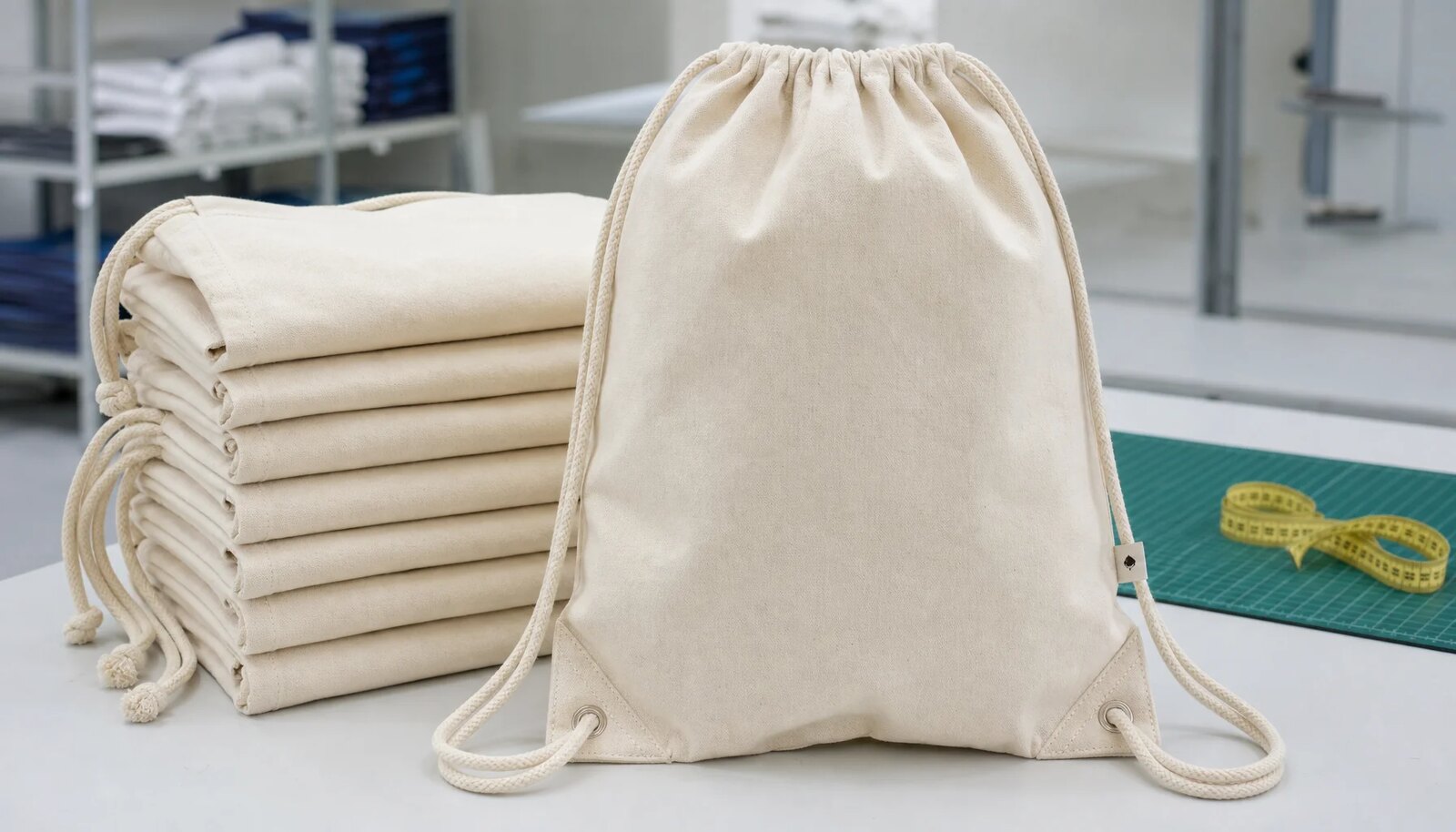
Define the bag's job before asking for price
A useful sourcing plan starts with the role of the bag. A cotton drawstring backpack used as folded-garment packaging can be lighter and simpler than a customer-facing launch-kit bag. A reusable retail accessory needs stronger lower corners, smoother cord movement, cleaner sewing, better print durability, and tighter cosmetic control. If the RFQ only says cotton drawstring backpack with logo, suppliers may quote different products while using similar words.
Write one operational sentence at the top of the RFQ: what the bag will carry, where it will be seen, and how long the brand expects it to last. For example: natural cotton drawstring bag for one hoodie and insert card, ecommerce launch kit, reusable customer carry item. That sentence helps the supplier choose the right GSM, cord, reinforcement, packing method, and sample route.
A strong quote package is short but complete. It should include finished size, finished GSM, cotton input, cord, reinforcement, print method, print area, label method, packing, carton data, tolerances, sample stages, and documentation needs. This prevents false savings from thinner fabric, excluded setup charges, weak cartons, missing barcode labels, or simplified seams.
- Define whether the bag is packaging, giveaway, launch kit, retail accessory, ecommerce insert, or reusable carry item.
- Compare suppliers only after they quote the same build sheet.
- Treat a vague low price as an incomplete offer until exclusions are clarified.
- Keep brand presentation, warehouse receiving, and documentation requirements in the same RFQ.
Turn sustainability language into evidence
Eco apparel brands often choose cotton because it feels familiar, tactile, and aligned with lower-plastic presentation. Procurement still needs to name the input. Conventional natural cotton, certified organic cotton, recycled-content cotton blends, bleached cotton, dyed cotton, and buyer-nominated fabric all affect price, MOQ, color control, documentation, and lead time.
Natural unbleached cotton commonly has a warm tone and may show seed flecks, slubs, or small shade differences between lots. That can support a low-intervention look, but it must be controlled. Define what is acceptable, such as light flecks or minor slubs, and what is not acceptable, such as oil marks, mildew odor, dark contamination, stains, broken yarns, or large shade swings within the same shipment.
Claims require evidence before artwork or product copy is approved. For organic programs, ask whether scope certificates and transaction certificates are available where applicable. For recycled-content programs, request a recycled-content declaration and supporting supplier documents or test reports where relevant. Requirements vary by market, claim wording, certification chain, and customer policy, so do not assume one document fits every sale channel.
- Name the cotton input instead of writing only eco cotton.
- Request documentation that matches the actual claim, material, supplier chain, and market need.
- Approve a physical standard for natural flecks, slubs, shade, stains, odor, and contamination.
- Use lab dips for dyed cotton and confirm MOQ per color before artwork is locked.
Choose GSM and size from real contents
Finished fabric GSM is one of the clearest cost and quality levers. For many apparel-brand programs, 140-170 GSM finished cotton is a practical range. Around 140 GSM can work for light garment packaging, event distribution, or simple inserts. Around 160-170 GSM usually gives better opacity, hand feel, and shelf presence for launch kits, retail use, and repeat carry. Heavier options are possible, but they increase material cost, carton weight, and sometimes sewing time.
Ask how GSM is measured. A quote based on greige fabric weight, pre-wash fabric, or supplier shorthand may not match the finished product. Put the target and tolerance in the PO, such as 160 GSM +/-5%, and require production fabric to be checked before cutting. That gives both the buyer and inspector a measurable standard.
Size should come from the actual contents. A 34 x 42 cm finished bag is common for apparel and promotional use; 38 x 45 cm is better for bulkier kits or a more generous carry profile. Test the folded garment stack, insert card, tissue, hangtag, and accessory set. Close the drawcord and judge the filled shape. Flat dimensions overstate usable volume because side seams, top channel, shrinkage, and fill shape reduce capacity.
- Specify finished GSM and tolerance, not only light, medium, or heavy.
- Use the same GSM and size across suppliers when comparing quote tiers.
- Pack the sample with real garments and inserts before approving size.
- Measure the finished sewn bag, not cut panels or supplier mockup dimensions.
Specify construction where failures happen
Cotton drawstring backpacks look simple, but most failures come from predictable stress points. The drawcord channel must be folded and stitched so the cord slides without tearing the fabric. The lower cord points take repeated tension whenever the user closes the bag or wears it. Side seams need clean finishing because loose threads, raw edges, and weak stitch density show quickly on a reusable item.
The RFQ should name the reinforcement method. Lower corners may be sewn into a reinforced fold, bar-tacked, stitched around a cord loop, or finished with eyelets. Metal eyelets can look neat, but they need suitable finish and correct setting pressure. Sewn reinforcement avoids metal but depends on stitch density, placement, and fabric strength. For retail, launch-kit, or reusable programs, include a cord-pull check during sampling and inspection.
Cord choice affects feel, function, and cost. Cotton cord supports a natural hand feel. Recycled polyester cord may improve abrasion resistance or color consistency depending on the program. Many bags use 4-6 mm cord, but the final diameter should match the channel and fabric weight. A cord that is too thin can feel cheap or cut into fabric; one that is too thick can jam in the channel and add bulk.
- Specify lower-corner reinforcement instead of writing only reinforced corners.
- Confirm cord material, color, diameter, length, knot style, and channel size.
- Check smooth opening and closing on the approved sample.
- Add cord-pull testing when the bag is expected to be reused.
Select print and branding by artwork risk
Decoration is where quotes often stop being comparable. Screen printing is usually efficient for one-to-three-color solid logos, slogans, and repeat campaign artwork. The cost depends on screen setup, separations, color matching, ink coverage, registration, print labor, curing, and inspection. A small one-color chest-style logo and a large three-color full-front graphic are different production jobs.
Transfer, digital, or DTG-style options may be better for gradients, fine detail, multiple artwork versions, or short quantities. These methods still need testing on the actual cotton. Fabric texture can break small lines, reduce opacity, or make tiny text unreadable. On dyed cotton, ask whether a white underbase is needed and how it affects hand feel. For any print method, approve a strike-off or pre-production sample at actual size.
Labels and hangtags need the same detail. A woven side label can make the bag feel retail-ready, while a printed internal mark may be simpler and cheaper. The PO should state label size, fold type, color, wording, placement from fixed edges, and tolerance. If barcode labels are required, confirm readability and placement before packing starts.
- Use screen print for bulk-friendly solid artwork with limited colors.
- Request a strike-off for fine text, gradients, large coverage, or dyed fabric.
- State print size and placement in centimeters from fixed bag edges.
- Define label type, fold, dimensions, placement, and barcode requirements.
Control MOQ with a clean SKU map
MOQ is rarely just one number. A factory may calculate minimums by fabric purchase, dyed body color, print setup, label production, cord color, cutting efficiency, and packing format. One natural cotton body, one print, one label, one cord, and bulk packing is the easiest structure to price. Multiple body colors, artwork versions, labels, or retail packs create separate production streams.
Before requesting quotes, build a SKU map. List every body color, print design, label version, cord color, packing method, barcode, carton mark, and destination. This is especially important for seasonal drops, collaborations, and regional campaigns. Marketing variation has value, but it should appear as real cost and lead-time complexity.
Ask whether the MOQ applies to the total order or to each variation. A 5,000-unit order split across five colors and three prints is not the same as 5,000 identical units. If mixed production is possible, ask how it changes sampling, unit price, inspection, shortage risk, packing accuracy, and lead time. Avoid mixed cartons unless the receiving warehouse can verify them without slowing intake.
- Create the SKU map before the RFQ is sent.
- Ask MOQ per body color, print design, label version, cord color, packing method, and destination.
- Standardize the base bag where campaign variation can move to inserts or hangtags.
- Keep cartons separated by SKU unless the warehouse has clear mixed-carton rules.
Model bulk pricing by tier and landed cost
Bulk pricing only helps when every tier uses the same specification. Ask suppliers to quote 500, 1,000, 3,000, 5,000, and 10,000 units while holding size, GSM, cotton input, cord, reinforcement, print, label, packing, carton quality, and tolerances constant. If the 10,000-unit quote quietly changes from 160 GSM to 140 GSM, the price break is not meaningful.
Use a simple tier worksheet to compare the cost curve. For example: 500 units may carry the highest unit price because setup and sampling are spread over fewer bags; 1,000 units may reduce print and cutting inefficiency; 3,000 units may improve fabric purchasing; 5,000 units may support better line efficiency; 10,000 units may reduce unit cost further but increases inventory, artwork-change, and storage risk. Ask the supplier to show fixed charges separately from scalable unit charges.
A practical landed-cost worksheet should include: ex-factory unit price, screen or artwork setup, sample cost, label or barcode setup, packing material, inland transport, export documentation, inspection, freight, duty assumptions, warehouse handling, and expected rework or sorting allowance. Also collect units per carton, carton dimensions, gross weight, net weight, carton count, and total CBM. The buyer is purchasing usable units received correctly, not only a low ex-factory price.
- Request one specification quoted at 500, 1,000, 3,000, 5,000, and 10,000 units.
- Separate fixed charges from unit costs wherever possible.
- Compare landed cost with carton data, gross weight, and CBM.
- Do not over-order for a price break if artwork, season timing, or claim language may change.
Use sampling as the approval gate
A sample is useful only when it reflects the intended bulk route. A showroom sample made from substitute fabric or a different print process can support early discussion, but it should not become the production standard. For approval, request a pre-production sample made with the intended finished GSM, cotton color, cord, reinforcement, label, print method, print size, and packing fold. If any component is substituted, record the difference.
Sample review should be measured. Record finished width, height, channel depth, cord length, print size, print placement, label placement, visible stitch quality, and any approved deviations. Load the bag with the actual garments or kit contents. Pull the drawcord closed several times and watch the corners, channel, and seams. Fold the bag as it will be packed and check whether the fold crosses the logo or leaves a hard crease.
Keep one signed or sealed golden sample, plus photos and written measurements. Reference the approved sample date in the PO and inspection plan. If the supplier later changes fabric lot, cord, label, ink, reinforcement, or packing fold, that change should be approved before production continues. The golden sample becomes the standard for final inspection and dispute resolution.
- Request a pre-production sample using bulk-intended materials and processes.
- Measure size, channel depth, print placement, label placement, and cord length.
- Test with real contents and repeated cord-pull handling.
- Reference the golden sample in the PO and final inspection checklist.
Lock packing, cartons, and warehouse rules early
Packing affects unit price, environmental goals, freight, and receiving accuracy. Bulk flat packing by count can reduce packaging material and works well for event distribution, later kitting, or warehouse repacking. Individual polybags, paper bands, barcode labels, hangtags, or retail-ready packs may be necessary for ecommerce and retail channels, but each adds labor, material, volume, and inspection points.
If the brand wants to reduce plastic, state that early while still defining the required level of dust, moisture, and handling protection. Paper bands may support presentation but can tear or shift. Individual bags protect units but increase material use and carton volume. Bulk packing is efficient, but the receiving team must be able to count and separate units accurately.
Carton planning belongs in the quote. Ask for units per carton, carton dimensions, net weight, gross weight, carton count by SKU, and carton marks. Cartons packed too tightly can crease bags or mark prints. Oversized cartons raise freight cost and may crush. If goods ship to a 3PL or retailer, send routing rules before packing starts, including carton labels, barcode format, pallet rules, carton weight limits, and mixed-carton restrictions.
- Choose bulk, individual, or retail packing based on the sales channel and receiving workflow.
- Quote polybags, paper bands, hangtags, barcode labels, and carton marks as visible line items.
- Confirm carton dimensions, gross weight, carton count, and SKU split before shipment.
- Request packed-carton photos before shipment release.
Write inspection logic into the purchase order
Quality control works when requirements are measurable. Cotton has normal variation, and printing on fabric is not the same as printing on coated paper. The PO should state tolerances for finished size, GSM, shade, print placement, print color, label placement, stitching, cord strength, packing count, and carton marks. Common commercial tolerances might include finished size at +/-1 cm and fabric weight at +/-5%, but the actual standard should be agreed before production.
Inspection should cover the full route. Fabric checks include GSM, shade, odor, stains, weaving defects, slubs, flecks, and contamination. Sewing checks include dimensions, seams, channel construction, loose threads, raw edges, reinforcement, and cord function. Print checks include placement, registration, opacity, color, curing, cracking, bleeding, smearing, and rub resistance. Packing checks include SKU count, barcode readability, carton quantity, gross weight, carton marks, and mixed-SKU accuracy if used.
If using AQL, agree on inspection level, sample size, defect categories, and acceptance rules before production. A practical defect classification may treat safety hazards, wrong product, wrong barcode for ecommerce, or missing required claim documentation as critical; open seams, failed cord pull, wrong GSM, major print defects, or incorrect carton count as major; and small loose threads or minor natural slubs within the approved standard as minor. If not using formal AQL, still define how many units will be checked and what happens when defects are found.
- Put size, GSM, shade, print, label, stitching, cord, and packing tolerances in the PO.
- Define critical, major, and minor defects before final inspection.
- Check beginning, middle, and end of production for shade and print consistency.
- Agree on repair, sorting, replacement, discount, or shipment approval rules before production starts.
Specification comparison for buyers
| Commercial choice | Typical cost impact | MOQ impact | Main buyer risk |
|---|---|---|---|
| 140 GSM natural cotton, one-color screen print, bulk packed | Lowest practical cost for simple apparel packaging or event use | Usually easier MOQ if natural body color and one artwork | May feel too light for reusable retail programs; confirm finished GSM, opacity, and seam strength |
| 160-170 GSM natural cotton, reinforced corners, cotton cord | Moderate increase from fabric weight, sewing time, and cord specification | Still manageable if body color, print, and label versions are limited | Good balance for launch kits and repeat carry, but natural shade variation must be approved |
| Dyed cotton body with Pantone-referenced logo | Higher due to dyeing, lab dips, shade control, and possible color MOQ | MOQ often applies per body color, not only total order quantity | Bulk shade can vary; require lab dip, bulk shade approval, and color-lot separation |
| Certified organic or recycled-content cotton program | Higher or variable depending on certified supply, documentation, and chain requirements | MOQ may rise because certified or recycled materials are purchased separately | Documentation requirements vary by market, claim, and certification chain; verify before approving claims |
| Two-sided or multi-color print | Higher setup, registration, curing, and inspection cost | MOQ may apply per artwork and per print position | Misregistration, cracking, opacity issues, and longer sampling route |
| Woven side label, hangtag, barcode label, individual pack | Higher labor and material cost; may increase carton volume | MOQ may apply per label version, barcode, packing format, or retail channel | Packing accuracy and label placement become inspection points; late barcode changes delay shipment |
| Bulk flat packed by SKU in export cartons | Lower packing material and faster production | Easier if each carton contains one SKU | Requires reliable warehouse counting; less protection than individual packs |
| Retail-ready individual packing | Higher unit cost, handling time, and sometimes freight volume | Can create MOQ by packing format or barcode version | More defects to inspect: wrong barcode, torn band, dusty unit, poor fold, missing hangtag |
Buyer checklist before sampling
- Define the use case: garment packaging, trade-show giveaway, ecommerce insert, launch kit, retail accessory, or reusable customer carry item.
- State finished width and height in centimeters, plus tolerance such as +/-1 cm unless the program requires tighter control.
- Specify finished fabric GSM and tolerance, for example 160 GSM +/-5%, and ask whether production fabric is checked before cutting.
- Name the cotton input: conventional natural, certified organic, recycled-content blend, bleached, dyed, or buyer-nominated fabric.
- For organic, recycled, or other environmental claims, request supporting documentation before approving hangtags, product pages, carton marks, or sales copy.
- Set the appearance standard for natural cotton, including shade range, seed flecks, slubs, stains, oil marks, odor, weaving defects, and contamination.
- Confirm cord material, diameter, color, length, knot style, channel construction, and lower-corner reinforcement.
- Send vector artwork with print size, Pantone or color reference, print position from top and side edges, and minimum readable text size.
- Ask whether setup, color matching, second print position, labels, label sewing, hangtags, barcode labels, cartons, and carton marks are included.
- Separate MOQ by body color, print artwork, label version, cord color, packing type, and destination warehouse.
Factory quote questions to send
- What finished fabric GSM are you quoting, what tolerance applies, and how is GSM checked before cutting?
- Is the cotton conventional, organic-certified, recycled-content, bleached, dyed, or unbleached natural, and what documentation can be supplied for any claim?
- Can you provide scope certificate, transaction certificate, recycled-content declaration, supplier declaration, or relevant test reports where applicable to the claim and supply chain?
- What are the finished bag dimensions after sewing, and what tolerance applies to width, height, drawcord channel depth, and print placement?
- What seam construction, stitch density, reinforcement method, eyelet type if any, and cord diameter are included in the price?
- Does the unit price include screen setup, artwork separation, color matching, labels, label sewing, hangtags, barcode labels, cartons, and export carton marks?
- What is the MOQ per fabric type, body color, print design, label version, cord color, packing method, and shipment destination?
- Can you quote the same specification at 500, 1,000, 3,000, 5,000, and 10,000 units, with fixed charges shown separately?
- What is the maximum print area, and how does pricing change for additional colors, heavy ink coverage, or a second print position?
- Which print inks or transfer materials are used, and what checks are performed for curing, cracking, rubbing, bleeding, and opacity on cotton?
Quality-control points to confirm
- Finished fabric GSM should be checked from production fabric before cutting and recorded against the agreed tolerance, commonly +/-5% unless a tighter range is written into the PO.
- Fabric appearance should match the approved standard for shade, seed flecks, slubs, stains, oil marks, odor, weaving defects, and unacceptable contamination.
- Dyed fabric should be checked against the approved lab dip or bulk shade standard under consistent lighting, with lot-to-lot variation controlled before cutting.
- Finished bag dimensions should be measured after sewing and pressing, not from cut panels, because seam take-up, channel folding, and handling affect final size.
- Common commercial size tolerance should be written clearly, such as +/-1 cm for width and height, with separate tolerance for channel depth and print placement if needed.
- Stitching should be even and secure, with no skipped stitches, broken seams, open seams, loose threads, or exposed raw edges where clean finishing is required.
- Lower cord points, eyelet areas, bar tacks if used, and channel exits should be checked because these are the main stress areas during repeated pulling.
- Cord pull checks should confirm that knots, seams, channels, and eyelets do not fail under the intended fill weight and normal customer handling.
- Print registration, color, opacity, placement, edge sharpness, and surface finish should be checked from the beginning, middle, and end of production.
- Printed areas should be checked for under-curing, tackiness, cracking after bending, rubbing transfer, pinholes, bleeding, ghosting, and misalignment between colors.