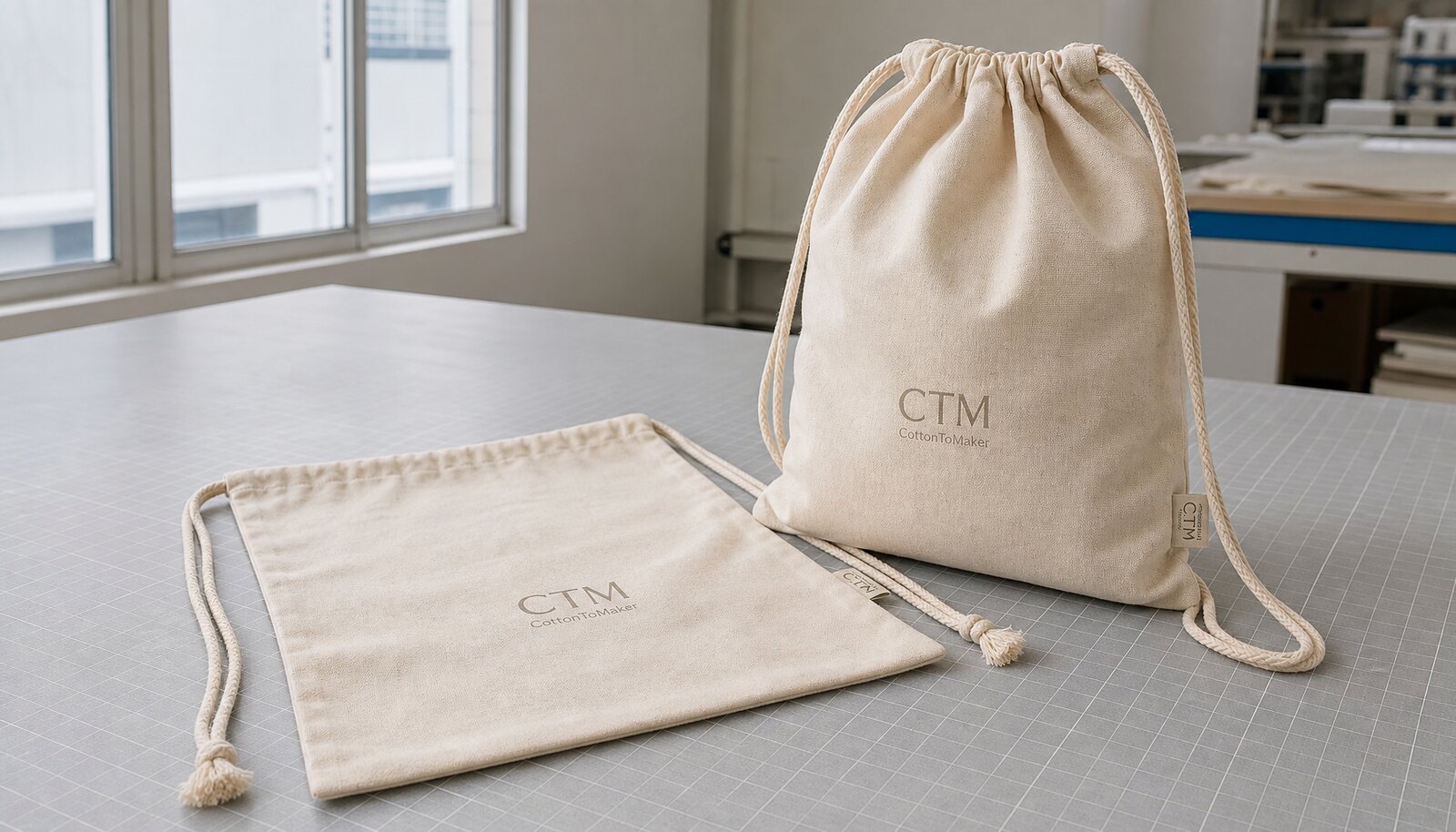
Why boutique wineries buy this bag, and why the order still needs a real spec
Cotton drawstring backpacks for boutique wineries usually serve as tasting-room retail items, event merchandise, member gifts, or packaging for a small curated gift set. On the surface the item seems straightforward: sew a cotton bag, add a logo, pack it in a carton, ship it out. In procurement terms, though, it is a branded soft good with enough variables to create avoidable cost if the buyer leaves the spec vague. Fabric weight, logo method, bag size, carton count, and pack format all affect the final experience and the landed cost.
The real buyer challenge is that the bag sits at the intersection of branding and logistics. A winery team often wants a natural, understated look that feels aligned with the estate, but the warehouse wants a case pack that is easy to receive, stack, and count. A sourcing plan that ignores either side can create problems: too-light fabric that looks promotional instead of premium, a print that loses clarity on textured cotton, or cartons that waste cube because they were packed for appearance rather than shipping efficiency.
A strong buying plan starts with use case. If the backpack is for a tasting-room purchase, presentation matters most. If it is meant to hold brochures, a corkscrew, and a single bottle, load-bearing and seam durability matter. If it is part of a wholesale program, carton discipline and barcode labeling become as important as the bag itself. Buyers who define the use case early can make better trade-offs instead of chasing the cheapest quote.
For B2B procurement, the bag should be treated as a controlled branded component, not a generic promo item. That means the RFQ should identify the fabric, artwork, size, packing, and QC language before price comparisons begin. Once those basics are fixed, suppliers can quote on the same basis, and the buyer can compare actual value instead of comparing vague descriptions.
Useful buyer rule: if the supplier cannot tell you how the bags will be packed, how the cartons will be labeled, and what the acceptance criteria are, the quote is not ready for procurement review yet.
- Define the end use first: retail display, gift set, event giveaway, or light carry item.
- Write the product as a branded component with pack and QC requirements, not only as a sewing item.
- Use a spec sheet before requesting quotes so all suppliers answer the same question.
Fabric choice: the weight range that fits winery branding without creating a freight problem
For this product, the most practical starting range is usually 10 oz to 12 oz cotton canvas, or roughly 230 to 340 GSM, depending on the exact weave and finish. That range gives the backpack enough body to present well in a tasting room, enough stiffness to hold its shape better than thin promo cotton, and enough flexibility to stay economical in carton packs. Very light fabric can save unit cost, but it often reads as disposable. Very heavy fabric can create a premium feel, but it also increases bulk and freight cube without always improving the buyer experience.
If the bag is meant to hold brochures, a wine club booklet, a key tag, or a small accessory, the lower-middle portion of the range is usually sufficient. If the program expects a 750 ml bottle, or if the winery wants the bag to feel more substantial on shelf, the upper end is safer. The key is not only the GSM number but the finished hand-feel. A tightly woven 240 GSM canvas can behave more like a premium bag than a loosely woven 280 GSM fabric that wrinkles and drapes poorly.
Cotton finish matters as much as weight. Bleached cotton changes the look and can make a logo pop, while natural or unbleached cotton gives a softer, more artisanal appearance that many boutique wineries prefer. Pre-shrunk or washed finishing can improve stability, but it should be stated clearly because finish changes can affect final dimensions and carton fit. Ask the factory whether the bag has been prewashed, whether shrinkage has been controlled after the first wash, and whether the fabric lot is from one mill batch or mixed lots.
Buyers should also think about seam stress. A backpack-style drawstring bag with bottle carry needs stronger corners and a stronger top channel than a bag used only for brochures. If bottle carry is in scope, ask the factory to test the load with an actual full bottle and not just with hand pressure. That test should be documented in a sample note or pre-production approval file so there is no argument later about what the bag was designed to hold.
The most useful spec language is measurable: finished GSM, weave, shrinkage, body dimensions, and intended contents. That is far better than writing only 'natural cotton gift bag' and hoping the factory fills in the gaps.
- 230 to 280 GSM is usually enough for light retail carry and brochure sets.
- 280 to 340 GSM gives a fuller, more premium look and better shape retention.
- If bottle carry is included, ask for a tested load assumption and reinforced corners.
Branding method: how to keep the logo clean on textured cotton
The logo decision is usually where a simple bag becomes a production risk. On textured cotton, tiny type, thin lines, and fine gradients can lose clarity. For that reason, a bold one-color screen print often remains the most dependable choice for many boutique winery programs. Screen print is especially practical when the mark is simple, the reorder plan is likely, and the buyer wants predictable color and lower per-unit setup cost. It is less forgiving if the artwork is delicate, but it is easier to control than a low-quality digital transfer on rough fabric.
A woven side label, sewn patch, or combined label-plus-print approach is worth considering when the winery wants a more finished retail look. This is particularly useful when the front artwork should stay small and understated. A woven label on the seam or inside edge can carry brand identity without forcing the logo to fight the weave on the main panel. That said, label methods introduce their own minimums, attachment risk, and position tolerances. If the buyer uses labels, the RFQ should state the exact label size, weave density, backing, fold type, and stitch method.
Heat transfer can work for detailed artwork, but it should be used carefully on cotton canvas. Buyers should ask the supplier to show a sample on the exact body fabric, not on a smooth substitute. If the logo uses thin serif text or small vineyard line art, the buyer should confirm line thickness in millimeters or point size so the factory knows what cannot be reproduced reliably. There is a big difference between artwork that looks acceptable on a screen and artwork that survives sewing-room and print-room realities.
For repeat procurement, the strongest control is a real approved sample. The buyer should check the print under daylight and warm indoor light, because wineries often display products in mixed lighting conditions. If the logo is too small, too delicate, or too low-contrast, it can disappear on natural cotton. In procurement terms, the best design is not the one that looks most sophisticated in a PDF; it is the one that prints cleanly, packs cleanly, and still looks premium after handling.
A practical rule: if the artwork cannot survive being reduced slightly for manufacturing tolerance, it is probably too fragile for cotton canvas.
- Use screen print for bold, simple marks and stable reorder programs.
- Use woven or sewn labels when the brand wants premium detail without overloading the front panel.
- Avoid very fine reversed text or tiny line art unless the factory has already proven it on the same fabric.
Supplier route: direct factory, trading company, or local decorator, and how each changes your risk
The supplier route matters because it changes who controls fabric, who controls print quality, and who is responsible for carton packing accuracy. A direct factory with in-house cutting, sewing, print application, and packing usually gives the buyer the best visibility into production control. That does not automatically make them cheaper in every case, but it makes the source of defects easier to identify. If the logo is off-center or the carton count is wrong, the buyer knows whether the fault came from the sewing floor, the print line, or the packing team.
A trading company can still be useful when the buyer needs multiple products consolidated into one shipment or when the brand is testing several designs at once. The tradeoff is that the middleman may not own the factory schedule, fabric lot, or packing discipline. That creates risk when the order is small but brand-sensitive. For a boutique winery program, the key question is not whether the supplier is a trader or a factory; it is whether that supplier can show evidence of control over the exact steps that matter to the buyer.
A local decorator or domestic print partner can be attractive for urgent event programs because they shorten transit time and can sometimes run small quantities. However, if the base bags are imported stock, the buyer needs to confirm consistency across the incoming inventory. There is a real risk that the base fabric, color, or bag cut varies between lots, especially if the buyer restocks later. Local finishing helps speed, but it does not remove the need for a fabric and carton control plan.
For procurement, the safest way to compare routes is by control points: Who owns fabric booking? Who signs off the print proof? Who packs the carton count? Who labels the pallet? If the answer changes at every step, the buyer needs a tighter documentation trail. If one source handles all steps under one roof, the buyer should still ask for photos and inspection records because 'in-house' is only useful when it is verifiable.
Good sourcing practice is to separate commercial pricing from process control. A low quote is not valuable if it comes from a supplier that cannot guarantee repeatability, carton count, or sample traceability.
- Direct factory sourcing is strongest when one plant controls cutting, printing, sewing, and packing.
- Trading companies can help consolidate programs, but the buyer should identify where production is actually happening.
- Local decoration can be useful for speed, but consistency of base stock must be checked before reorder planning.
A supplier decision matrix: what procurement should compare beyond unit price
The best comparison is not a line-by-line spec sheet alone. Buyers should compare the supplier's actual ability to deliver the same finished result repeatedly. The matrix below is more useful than a simple price table because it shows the decision points that matter in factory-facing buying: control of fabric, control of branding, carton discipline, and reorder risk. When a quote looks cheap, this matrix helps identify whether the savings come from genuine efficiency or from hidden shortcuts.
For cotton drawstring backpacks for boutique wineries carton packing plan decisions, the carton side matters just as much as the bag spec. A supplier that can quote a good piece price but cannot give carton dimensions, weight, and pallet plan is only half quoting the job. Conversely, a factory that can give complete packing data may have a slightly higher piece price but lower freight risk and fewer warehouse disputes. Procurement buyers should assess the full combination, not just the sewing cost.
- Compare the route, not just the bag: fabric control, branding control, packing control.
- Ask which part of the spec drives cost so you know what can be simplified safely.
- Use the matrix to judge reorder risk, not only the first shipment price.
Quote comparison matrix for procurement buyers
Use this matrix to compare supplier offers on a true procurement basis. It is designed for winery programs where appearance, carton handling, and repeatability matter. If a supplier cannot answer one of these lines clearly, that line becomes a risk item in the sourcing decision.
In practice, the best offer is often not the lowest unit price. It is the offer that gives you the clearest control over fabric lot, artwork approval, pack count, and carton labeling. That clarity saves time in production and reduces disputes at receiving.
- Write decisions in measurable language, not only descriptive wording.
- Ask for sample photos plus one physical approval sample for important orders.
- Keep quotation, sample approval, and inspection notes tied to the same spec version.
Carton packing plan: how to size the carton, build the inner pack, and avoid receiving problems
This is the part many buyers under-specify. Because cotton drawstring backpacks are light but bulky, the carton plan can affect freight cost, carton damage, and warehouse labor more than the stitching itself. A good carton packing plan begins with the finished bag dimensions, then decides the inner pack, then sets outer carton dimensions, then checks palletization. Do not let the factory choose the pack count first and the carton size later; that usually leads to crushed product or wasted cube.
For most boutique winery orders, flat packing is the default because it protects the bag shape and keeps the case pack predictable. A flat-packed bag should be folded in a way that avoids sharp crease lines across the printed area. If the logo is centered on the front panel, fold the bag so the print is not pressed hard against a seam or the carton wall. Inner polybags are useful when the buyer wants cleanliness, moisture protection, or SKU separation, but they add plastic and can slow unpacking at receiving. Ask whether the warehouse actually needs polybags or whether a clean, flat-packed carton is enough.
Carton dimension logic should come from the product, not from whatever carton size happens to be available. The carton should be sized to hold the chosen pack count with modest headroom, not to jam the contents tightly. Too much empty space creates movement and deformation during transit; too little creates crushing. A practical carton target is the smallest size that preserves product shape with enough allowance for inner pack materials and label visibility. Buyers should ask the factory for three things together: inner pack count, outer carton dimensions, and gross weight. Those three numbers let procurement compare freight, storage, and unloading effort.
Examples help here. A smaller retail-only bag may ship well in inner packs of 10 or 20, then 50 to 100 per outer carton depending on thickness. A heavier canvas bag with printed artwork may need a lower outer carton count to avoid crushing the print surface. If the order is going to a 3PL or distributor, ask the factory to separate by SKU and carton mark each outer case clearly. If the order is for direct-to-store or event use, you may prioritize compact cartons and faster truck loading instead of retail-grade shelf appearance inside the case.
A carton plan should also include receiving instructions. Tell the supplier whether the warehouse wants carton labels on two adjacent sides, whether barcode labels must match the PO or SKU master, and whether case packs need to stay consistent across the whole shipment. If the receiver counts by case, a mixed case pack creates delays. If the receiver cross-docks onto pallets, carton height and corner strength become more important than pretty packing photos. The best pack plan is the one your warehouse can process quickly without rework.
- Start with the finished bag size, then choose inner pack count, then determine outer carton size.
- Prefer flat-packed bags unless a shaped presentation is required for retail display.
- Ask for carton dimensions, gross weight, and label placement together so freight and receiving can be planned at the same time.
Carton dimension logic, inner pack examples, and palletization notes buyers can actually use
The most useful carton plan is one the warehouse can receive without guessing. For a light cotton drawstring backpack, a buyer might ask the factory to test several pack structures in sample development: for example, 10 pieces per inner pack and 50 pieces per outer carton for a premium, more protective setup; 20 pieces per inner pack and 100 pieces per outer carton when the bag is thinner and the logo can tolerate moderate compression; or a lower case pack if the bag is heavier canvas and the shipment route is rough. The right answer depends on the bag thickness, the print area, and how the warehouse receives inventory. The factory should not choose the pack solely to minimize carton count.
When comparing carton dimensions, think in terms of cube efficiency and handling. A carton that is too tall can become unstable on pallets. A carton that is too large can exceed the receiver's lift limits or create dead space in the truck. If the bags are flat, the carton depth usually needs enough room for the folded stack and a little protection margin. If the bags include a print patch or raised label, you may need extra clearance so the top layer does not emboss the layer below. Ask the supplier for a packing photo from a similar bag, not just a line drawing.
Palletization should be discussed before production ends, especially for distributor or warehouse delivery. Ask how many cartons per layer, how many layers per pallet, whether corner boards are included, and what the maximum pallet height will be after stretch wrap. A stable pallet usually matters more than a pretty one. If the cartons are lightweight, they can still shift during transport if the wrap is weak or the pallet pattern is unstable. If the goods are going to a climate-controlled warehouse, you still want clean palletization because the receiving team needs count accuracy and quick scan access.
Receiving SOPs matter here too. The warehouse should receive by carton label, not by opening each bag unless there is a sampling requirement or damage issue. The supplier should place the PO number, SKU, color, quantity per carton, carton number, and gross weight on the outer case. If the order includes multiple colors or artwork versions, carton marks should be unambiguous so the receiver does not confuse variants. A buyer who adds these requirements early will spend less time on dock disputes later.
As a rule: if the supplier cannot explain how the cartons will sit on a pallet and how the warehouse will identify each SKU, the packing plan is not done yet.
- Test at least two carton counts before finalizing production if the bag thickness or print method is uncertain.
- Set a maximum pallet height and ask for the pallet pattern in writing.
- Use clear carton marks and SKU separation to reduce intake time and cross-dock errors.
MOQ, lead time, and scheduling: how to avoid buying too early or too late
MOQ in this category is rarely just about sewing capacity. It is usually driven by setup costs, fabric reservation, and branding complexity. A simple one-color print on stock cotton may be feasible at a lower MOQ because the factory can reuse screens or print settings and does not need to reserve special components. If the order adds a custom woven label, special cord color, or custom-dyed fabric, MOQ can rise because the supplier must source or reserve extra materials. Buyers should ask which cost element is driving the MOQ so they can simplify the spec intelligently if needed.
Lead time should be managed as a sequence, not a single number. First comes artwork confirmation and size signoff. Then sample production or strike-off approval. Then fabric booking and production slot reservation. Then cutting, printing, sewing, packing, and final inspection. A supplier saying '30 days' may be accurate, but only if the buyer has already approved the design and the materials are available. If artwork changes late, that timeline can move quickly. For a winery launch or seasonal promotion, buyers should back-plan from the event date and build in time for sample correction, carton approval, and transit.
Procurement teams should also avoid comparing lead times without asking when the clock starts. One supplier may start the timer after deposit, another after sample approval, and another only after final artwork confirmation. That difference matters. If the winery needs a fixed launch date, the buyer should ask for a milestone schedule with dates or working-day counts for each stage. The factory should also confirm whether any trim or fabric is imported from a secondary mill, because cross-border sourcing can add variability even if the sewing plant is efficient.
A practical planning rule for seasonal winery items is to order early enough to allow one corrective sample round if needed. That is usually the hidden schedule risk. When the first sample misses a print size, cord length, or carton count target, the buyer still needs time to correct it before bulk production. If the buyer does not leave room for that loop, the order may ship on time but with unresolved compromises. That is how many 'on time' orders become disappointing orders.
Best practice is to freeze what can be frozen: artwork, bag dimensions, pack count, carton label content, and delivery term. The more items that are fixed before the production slot is booked, the lower the schedule risk.
- Ask the supplier what drives MOQ: print setup, label MOQ, fabric reserve, or cord color.
- Treat lead time as milestones, not as a single date range.
- Leave room for one sample correction cycle before the bulk line starts.
QC and acceptance thresholds: how to write factory-facing criteria that can actually be inspected
Good QC language should be measurable. For cotton drawstring backpacks, the buyer needs criteria for size, stitching, print placement, print durability, cord function, carton count, and carton integrity. A factory can only control what it understands, so vague phrases like 'nice appearance' or 'good quality' should be replaced with thresholds. For example, define the acceptable range for body width and height, the acceptable variation in print placement, and the allowed level of shade variation. The more important the branding, the tighter those tolerances should be.
Inspection should also separate major and minor defects. A broken seam, missing cord, or badly misaligned logo is a major defect because it affects function or brand presentation. A loose thread that can be trimmed may be a minor defect if it does not affect use. Smudged print, crushed carton corners, or count discrepancy are usually major enough to stop acceptance or trigger a rework discussion. A buyer should agree in advance with the supplier on which issues require replacement, rework, or discount.
A sensible inspection plan uses an AQL framework or an equivalent sampling method. The exact AQL level depends on the order size and the buyer's risk tolerance, but the important part is that the supplier knows the inspection will not be purely subjective. Ask for a final inspection that samples from multiple cartons, not just the top layer. If the order includes multiple colors or artwork versions, inspect each variant separately. That catches lot-to-lot inconsistency before shipment leaves the factory.
Measurable tests can be simple. Check stitch density and seam continuity on sample units. Pull on the drawcord to ensure the channel remains secure. Compare print size and placement to the approved sample. For bottle-carry programs, place a real bottle in the bag and confirm that the seam and cord top do not distort badly under load. For carton quality, inspect the board strength, closure tape, label readability, and any signs of compression. If the packing plan includes polybags, verify that the inner packs are the correct count and that the bags are not trapped moisture-wise.
The strongest QC record is a combination of photos, measurements, and the sealed golden sample. Photos alone are not enough if the buyer later needs to prove that the inspected lot differed from the approved reference.
- Write size, placement, and count tolerances into the PO or quality agreement.
- Classify likely defects in advance: print misregistration, broken stitches, cord failure, shade variation, carton damage.
- Use an AQL-based final inspection or an equivalent sampling rule so acceptance is not subjective.
Specification comparison for buyers
| Decision area | Option that usually works best | Why buyers choose it | What to verify before approval |
|---|---|---|---|
| Fabric weight / hand-feel | 10 oz to 12 oz cotton canvas or about 230 to 340 GSM | Balanced for boutique retail appearance, light carry, and reasonable carton cube | Ask for finished GSM or oz, weave type, shrinkage expectation, and whether the lot is mercerized or bleached |
| Logo application | 1-color screen print for simple marks; woven side label or sewn patch for premium positioning | Keeps artwork clean on textured cotton and avoids overcomplicating the build | Confirm print size, ink opacity, line thickness, wash/rub resistance, and whether one setup fee covers all colors |
| Drawcord construction | Self-fabric cord or cotton cord with reinforced eyelets and stitched top channel | Matches the natural look and lowers the risk of hardware corrosion or awkward shine | Check cord diameter, end finishing, knot security, and whether the channel stitch count is adequate |
| Supplier route | Direct factory with sample room, in-house print control, and carton-packing capability | Best for controlling artwork placement, fabric consistency, and carton count accuracy | Verify that the same plant cuts, prints, sews, and packs; if not, identify who owns each step |
| MOQ strategy | Start with a simple spec on stock cotton, then add complexity only when sell-through is proven | Reduces setup charges and avoids overbuying a niche seasonal item | Ask which element is driving MOQ: fabric reserve, printing screen, label MOQ, or special cord color |
| Packing format | Flat-packed in polybags, then packed into export cartons with defined inner packs | Protects shape, improves cube efficiency, and makes warehouse receiving easier | Confirm inner-pack count, carton dimensions, gross weight, carton marks, and whether cartons are master-packed or SKU-separated |
| Pallet plan | Standard palletization with stack height set by carton strength and freight mode | Prevents crushed cartons and speeds dock receipt for distributor or DTC operations | Ask for pallet pattern, layer count, corner protection, wrap method, and maximum pallet height |
| Lead time control | Freeze artwork, sample approval, and packing spec before production booking | Helps the factory reserve fabric and print windows without rework | Check whether lead time starts after sample approval or after deposit, and what happens if artwork changes |
| QC level | Factory inspection with measurable tolerances, then pre-shipment AQL inspection | Gives the buyer a usable acceptance standard instead of subjective wording | Specify AQL level, defect classification, carton count tolerance, and sample size for final inspection |
Buyer checklist before sampling
- Specify fabric weight in GSM or oz, weave type, and acceptable shade range; do not approve a quote that says only 'cotton'.
- Approve the actual artwork size on the actual fabric, not just a digital proof, because texture changes how small logos read.
- Write the drawcord type, cord diameter, eyelet detail, and top-channel construction into the purchase order.
- Choose the carton pack count before production begins and make sure it matches your warehouse labor, not just the factory's default.
- Request carton dimensions, gross weight, and pallet pattern so freight can be compared on a landed-cost basis.
- Ask for a pre-production sample plus a sealed golden sample, and tie the final shipment to that approval reference.
- Use a defect list in advance: off-center print, broken stitches, shade variation, loose cords, and crushed cartons should be explicitly named.
- Require AQL inspection language in the PO or quality agreement, including sample size and acceptable defect thresholds.
- Get carton photos with labels visible before balance payment, especially if the order is being shipped to a distributor or 3PL.
- If reorders matter, record the fabric lot, print screen version, and label version used on the approved sample so future matching is possible.
Factory quote questions to send
- What finished fabric weight are you quoting, and can you state it in GSM or oz with the weave structure and expected hand-feel?
- Is the logo screen printed, heat transferred, stitched, woven into a label, or a combination, and what setup fees apply to each method?
- What is the exact MOQ by color, artwork version, and production route, and which part of the quote is driving the MOQ?
- How many pieces do you recommend per inner pack and per export carton for this bag size, and what carton size do you get from that plan?
- Can you provide carton dimensions, gross weight, net weight, and estimated carton count for an order of 5,000, 10,000, or 20,000 units?
- What is the lead time after sample approval, and which steps happen before the clock starts: artwork signoff, fabric booking, or deposit?
- What AQL level do you normally inspect to, and how do you classify major versus minor defects for print, seam, and packing issues?
- Can you confirm whether your plant cuts, prints, sews, and cartons the bags in-house, or which processes are subcontracted?
- Can you quote EXW and FOB separately so we can compare freight, origin handling, and carton cost accurately?
- What carton marks, barcode labels, and pallet labels can you apply for our warehouse receiving process?
Quality-control points to confirm
- Fabric weight must be within the agreed finished GSM or oz tolerance, with no obvious thin areas, weave flaws, or mixed shade bands in the same lot.
- Stitching must be straight and secure at the base corners, cord channel, and top seam; loose threads, skipped stitches, and broken seam intersections should be treated as defects.
- Print color should match the approved sample within a reasonable visual tolerance under normal lighting, with no pinholes, smearing, cracking, or major misregistration.
- Logo placement must stay inside the approved placement window; for small front panels, off-center placement is immediately visible and should be tightly controlled.
- Cord length and tension should be consistent across the lot, with the backpack closing evenly from both sides and no jammed, twisted, or frayed cord sections.
- Carton count must match the packing list, and inner packs should be consistent so receiving teams can verify the shipment without opening every case.
- Carton strength should survive normal warehouse handling, stacking, and transport vibration without crushing the bag body or deforming the printed face.
- A final inspection should sample finished units from multiple cartons and compare them to the sealed golden sample for color, feel, size, and overall finish.
- Common reject examples should be named in advance: broken print lines, off-center logos, weak cord channels, torn eyelets, oil stains, and carton label mismatch.
- If palletized, cartons should be stable, evenly stacked, and protected from corner compression, with no loose wrap or overhanging boxes.