Why This RFQ Needs More Than a Product Name
Cotton drawstring backpacks for artisan bakeries sound straightforward on a line sheet. In real sourcing, the phrase can hide very different products. One supplier may price a lightweight 150 to 180 GSM cotton promotional sack. Another may quote 300 to 340 GSM cotton canvas with soft cotton drawcords, reinforced exits, and a screen-printed logo. A third may include woven labels, hangtags, individual bags, barcode stickers, and stronger export cartons. The product name stays the same, but the cost, durability, handfeel, presentation, and inspection risk change completely.
For a bakery, the backpack is not just a carrier. It may sit beside sourdough loaves at retail, arrive in a bread subscription welcome kit, hold holiday pastries, support a farmers market launch, or move through several stores in a regional campaign. The bag has to look natural and well-made, but it also has to satisfy procurement: clear unit pricing, realistic MOQ, consistent repeat orders, accurate cartons, workable lead time, and a quality standard that can be inspected before shipment.
A good RFQ slows the process down at the right moment. It defines the expected load, finished dimensions, cotton weight, fabric look, drawcord, reinforcement, print method, packing format, sample approval steps, and QC criteria before the supplier builds the price. That is not overengineering. It is how a buyer makes sure every factory is quoting the same bag and how the approved sample becomes the repeatable production target.
- Start the RFQ with use case, target load, sales channel, destination, and required in-warehouse date.
- Ask suppliers to quote the same size, fabric, cord, print, label, and packing method at the same quantity tiers.
- Do not compare quotes until setup charges, sampling, packing, and freight basis are separated from the unit price.
- Make a physical pre-production sample the production standard, not a digital mockup.
- Use measurable QC criteria so defects are not negotiated after goods are packed.
Recommended Base Specification for Bakery Buyers
For many bakery retail and loyalty programs, a practical starting point is a flat cotton drawstring backpack around 34 x 42 cm finished size, made from 8 oz to 10 oz cotton canvas. In metric terms, this often falls around 270 to 340 GSM, although the exact conversion depends on weave, yarn, and finishing. This range gives better body and opacity than a lightweight cotton promo bag while still folding neatly for export cartons and backroom storage.
State finished size, not just nominal size. A panel that starts at 34 x 42 cm before sewing can finish smaller once the top channel is folded, side seams are closed, and threads are trimmed. For procurement control, the RFQ should say that width and height are measured flat after sewing. A +/-1 cm tolerance is realistic for many cotton backpacks. If the bag must line up perfectly on retail hooks or in a display bin, discuss tighter visual controls before awarding the order.
Flat construction is usually the safest base for bakery merchandise and event programs. It is economical, compact, and leaves a clean front panel for the logo. A gusset can help with bulkier gift sets, but it also changes fabric consumption, carton volume, sewing time, and how the print sits when the bag is filled. If a gusset is needed, specify the depth and whether it is measured folded flat or opened. Do not let that detail be decided after pricing.
- Base size: 34 x 42 cm finished size, flat after sewing, with +/-1 cm tolerance.
- Base fabric: 8 oz to 10 oz cotton canvas, approximately 270 to 340 GSM.
- Economy alternative: 6 oz cotton, roughly 180 to 220 GSM, for light handouts only.
- Heavier alternative: 10 oz to 12 oz cotton canvas for jars, flour packs, coffee bags, and premium gift sets.
- Base construction: flat backpack with stitched top channel, reinforced lower cord exits, and clean internal seams.
- Optional details: gusset, woven side label, inner care label, hangtag, belly band, barcode, or individual packing.
Fabric Weight, Cotton Type, and Tolerance
Fabric weight is one of the biggest drivers of both price and perceived quality. A 180 GSM cotton bag and a 320 GSM cotton canvas bag can share the same outside dimensions, yet they will not drape, cover contents, or carry weight in the same way. Lightweight cotton reduces material cost and carton weight. Heavier cotton gives more body, opacity, and reusable feel, but it raises fabric cost, cutting weight, sewing handling time, and freight weight. Decide the quality tier before asking factories to compete on price.
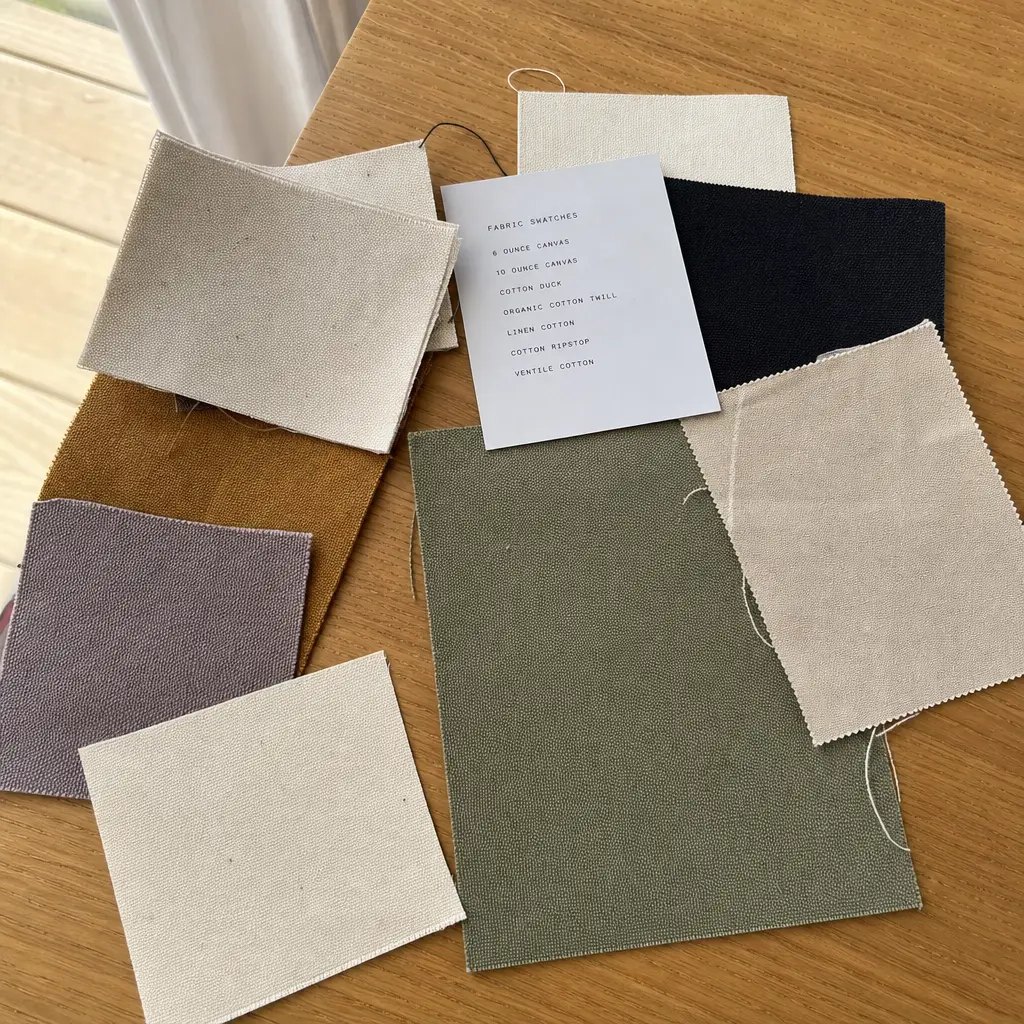
Natural unbleached cotton often suits artisan bakery branding because it has a warm cream tone and may show small seed flecks. That look can support a flour-sack, farmers-market, or handmade identity. It is not as uniform as coated paper or synthetic fabric, though. Shade can shift by lot, and recycled cotton blends may show more fiber variation depending on the yarn source. The RFQ should say what natural character is acceptable and what is not. Seed flecks may be fine. Oil marks, dark contamination, holes, mildew odor, and foreign fibers should not be accepted.
Treat GSM and oz as specifications, not loose marketing words. Ask the supplier to state both where possible and confirm the production tolerance. A +/-5% fabric weight tolerance is often a reasonable discussion point for textile goods, but it should only be used when the mill, supplier, and buyer accept it in writing. If the bakery requires certified organic or recycled cotton, request the certificate type, certificate holder, transaction documentation process, and whether the claim covers the finished backpack or only the fabric.
- State the target fabric weight in GSM and oz to avoid conversion ambiguity.
- Ask whether the fabric is greige, natural unbleached, bleached, dyed, washed, or finished.
- Define whether the cotton is conventional, organic, recycled blend, or certified material.
- Request a physical fabric swatch or sample before approving shade and handfeel.
- Agree the fabric-weight tolerance, such as +/-5% only if accepted by both buyer and supplier.
- Separate natural cotton character from defects that should trigger rejection.
Size, Construction, and Sewing Details
Finished dimensions affect both customer use and warehouse efficiency. If the bag is too small, a pastry box, coffee pouch, or gift bundle may not fit. If it is too large, the contents look lost, the material cost rises, and carton efficiency drops. The RFQ should define finished width, finished height, top channel depth, gusset depth if used, and the measurement condition: empty, flat, relaxed after sewing. Measurements should come from fixed points, not from a photo or a catalog thumbnail.
Sewing is where many low quotes quietly remove value. Stitch density, seam type, reinforcement, and thread trimming all influence durability and presentation. For a cotton drawstring backpack, ask how the factory builds the side seams, bottom corners, top channel, and lower cord exits. The lower side opening is especially important because the drawcord becomes the shoulder strap there. Reinforcement may be a bartack, box stitch, extra row of stitching, folded seam, or fabric tab depending on the factory’s normal construction.
Cosmetic standards deserve the same attention. Bakery customers notice texture, cleanliness, and simple visual quality. Crooked stitching, puckered seams, uneven corners, and loose threads make a cotton bag feel cheap even when the fabric is correct. The approved sample should show the exact construction planned for bulk production, and the inspection checklist should use that sample as the physical reference.
- Specify finished width and height, not only catalog or cut size.
- Use a realistic tolerance, commonly +/-1 cm for width and height unless a stricter tolerance is agreed.
- Define top channel depth because it affects closure function and printable area.
- Ask for stitch density target or factory standard, then verify consistency on the pre-production sample.
- Require reinforcement at lower cord exits for retail, gift, and heavier-use programs.
- Inspect loose threads, skipped stitches, broken stitches, open seams, puckering, and needle damage.
Drawcord Specification and Load Performance
The drawcord is both the closure and the backpack strap. If the RFQ leaves it undefined, a supplier may choose the cheapest trim that closes the bag. That can mean thin synthetic cord, a shiny finish that clashes with natural cotton, straps that are too short, unfinished ends, or cord that twists and frays during handling. For bakery positioning, cotton cord, braided cotton rope, or flat cotton tape often feels more aligned with the product story. Polyester can still be appropriate when strength, colorfastness, or cost is the priority, but it should be chosen deliberately.
Cord size affects comfort more than buyers sometimes expect. Round cord around 6 to 8 mm usually feels better than very thin cord when the bag carries coffee, flour, jars, or boxed pastries. Flat cotton tape around 10 to 15 mm can spread weight across the shoulder, although it changes the appearance and may need a wider channel. Cord length also matters. Too short, and the bag may not close properly or may sit too high. Too long, and the straps hang awkwardly in store displays or cartons.
Use real load examples in the RFQ. Durable is too vague. A supplier can respond more usefully if the buyer says the bag may hold two 250 g coffee bags, one 1 kg flour pack, a boxed pastry set, or only leaflets and loyalty cards. The factory should not be asked to guarantee unlimited load, but it should build and inspect against the agreed use.
- Specify cord material, diameter or tape width, color, end finish, and total length.
- Match the top channel size to the selected cord so the bag opens and closes smoothly.
- Ask whether cotton cord shrinkage or dye transfer is a concern for dyed trims.
- Include reinforced lower cord exits when the bag may carry more than light paper items.
- Test cord pull at top channel and lower exits during sample review and final inspection.
- State expected load examples instead of using only terms like strong or heavy duty.
Print, Branding, and Artwork Controls
Most bakery cotton drawstring backpacks are well suited to screen printing. A one-color or two-color screen print works for logos, shop names, slogans, simple illustrations, and seasonal marks. It is usually economical at medium and bulk quantities, and the finish sits naturally on cotton canvas. Common bakery brand colors include black, dark brown, burgundy, navy, forest green, cream, and warm gray. The final ink appearance will still be influenced by the cotton base color, fabric texture, and curing quality.
Heat transfer is useful when artwork includes gradients, many colors, photographic elements, or small details that are difficult to screen print cleanly. It can also help with shorter artwork-version runs. Buyers should approve the edge feel, surface gloss, flexibility, and adhesion before bulk production. Embroidery can look premium for a small mark, but stitch-count cost rises quickly, lighter fabrics may pucker, and a large filled graphic is usually not a good fit. Woven side labels and hangtags can add retail value, but they bring separate MOQs, approvals, and lead time.
Artwork instructions need to be production-ready. Send vector AI, EPS, or print-ready PDF files, final print dimensions, Pantone references, placement from top edge and centerline, and any known issues with fine lines or small type. Logo on front is not enough. A stronger instruction is: one-color screen print, 18 cm wide, centered on front panel, top of logo 12 cm below finished top edge, Pantone Black C, placement tolerance +/-5 mm if supplier agrees.
- Use vector artwork for screen printing and label production.
- State print size in centimeters and define placement from fixed reference points.
- Approve color on actual cotton, not only on screen or coated paper Pantone chips.
- Request a strike-off when using natural cotton, dark fabric, large solid ink, fine text, or heat transfer.
- Ask whether each logo version, store name, or seasonal design needs a separate screen charge.
- Define print defects: smearing, pinholes, poor coverage, cracking, wrong placement, wrong color, and ink contamination.
MOQ, Price Tiers, and Quote Comparability
MOQ is rarely a single number. The finished backpack MOQ may be different from the fabric MOQ, printing MOQ, custom cord MOQ, woven label MOQ, hangtag MOQ, barcode label MOQ, and packing MOQ. A factory may accept 300 pieces for a standard natural cotton bag but require 1,000 pieces for a custom dyed cord or 3,000 pieces for a custom woven label. These limits should be visible before the buyer selects a supplier.
Matched tier pricing is the cleanest way to compare quotes. Ask each supplier to quote 500, 1,000, and 3,000 pieces using the same finished size, fabric, cord, reinforcement, print area, label, and packing method. This shows whether savings come from fabric buying, setup absorption, cutting efficiency, sewing productivity, or carton packing. It also stops a supplier from quietly changing the product just to hit a target price.
If the bakery has multiple shops, franchise locations, or seasonal artwork, quote the base construction separately from version-specific costs. For example, a supplier may be able to produce one 3,000-piece fabric and sewing run split into three 1,000-piece screen print versions, if the production plan supports it. Confirm whether screens, labels, strike-offs, packing labels, and revised samples are charged per version.
- Request matched pricing at 500, 1,000, and 3,000 pieces.
- Separate base bag MOQ from fabric, print, trim, label, hangtag, and packing MOQs.
- Ask whether stock natural cotton is available or must be purchased per order.
- List setup charges separately from the unit price.
- Request repeat-order pricing and confirm whether screens and approved standards can be reused.
- Compare landed program cost, not only factory unit cost.
Packing, Cartons, and Receiving Requirements
Packing should be decided before quoting because it affects unit cost, labor, carton dimensions, carton weight, inspection time, and warehouse receiving. Bulk packing at 50 to 100 pieces per export carton is often efficient for importers, distributors, and bakery chains that hold inventory and repack locally. Individual packing may be worth the extra cost for ecommerce fulfillment, direct-to-store allocation, or retail programs that need a clean shelf presentation.
Carton gross weight becomes more important as fabric gets heavier. A carton quantity that works for a 6 oz bag may be uncomfortable or unsafe with 10 oz or 12 oz canvas. Instead of only asking for a fixed pieces-per-carton count, ask suppliers to propose carton dimensions, net weight, gross weight, and board grade. If the buyer has a manual handling limit, pallet pattern, or warehouse receiving rule, include it in the RFQ. Practical receiving can matter more than squeezing the last few units into a carton.
Cleanliness and odor control matter because the product carries a bakery brand, even when the backpack is not food-contact packaging. Cartons should be dry, clean, and free from musty, smoky, oily, or strong chemical odor. For bulk-packed goods, carton liners or inner poly protection may be useful. For individual polybags, define bag material, warning text if required, barcode placement, venting, and whether recycled-content material is preferred.
- Quote bulk pack and individual pack as separate options.
- Request pieces per carton, carton dimensions, net weight, gross weight, and carton material.
- Keep carton gross weight practical for manual handling, especially for 10 oz to 12 oz fabric.
- Define shipping marks: PO number, item code, color, quantity, carton number, destination, and barcode if required.
- Inspect carton dryness, odor, crushing, count accuracy, and label accuracy before shipment.
- Include pallet size, stack height, and carton orientation if the buyer controls inbound logistics.
Sampling and Approval Workflow
A clear sampling path prevents expensive rework. Start with a reference sample if the buyer still needs to check size, construction, cord feel, and fabric hand. Next, approve a print strike-off on the selected fabric so color, coverage, edge sharpness, and adhesion are judged on the real cotton base. Then approve a full pre-production sample made with actual bulk fabric, actual drawcord, final print method, final label or hangtag, production stitching, reinforcement, folding, and packing method.
Do not release mass production from a digital mockup alone. Mockups make fabric look smoother, placement look perfect, and colors look cleaner than they may be in production. Substitute fabric is also risky because cotton shade, weave, GSM, shrinkage, and print absorption can change the result. For an artisan bakery program, even a small cream-tone shift or a slightly awkward logo position can make the bag feel off-brand.
The approval record should be measurable. Record finished width and height, cord type and length, fabric weight, print size, print placement, label position, stitching method, reinforcement, packing format, and carton plan. Photograph the approved sample from the front, back, inside seam, cord exit, logo close-up, and packed carton arrangement. The buyer and factory should each keep an approved sample for production and inspection reference.
- Use reference sample, strike-off, and pre-production sample as separate approval stages when timing allows.
- Make the pre-production sample from actual bulk materials and final production methods.
- Measure and record dimensions instead of only signing a sample visually.
- Approve print color, adhesion, placement, and handfeel on actual cotton.
- Keep one signed sample with the buyer and one with the factory.
- Do not allow bulk cutting or printing until the written spec and physical sample are aligned.
QC Plan and Acceptance Criteria
Quality control turns the approved sample into inspection checkpoints. For cotton drawstring backpacks, inspection should cover fabric weight, shade, surface defects, finished dimensions, top channel, seam construction, reinforcement, stitch quality, cord function, print color, print placement, print adhesion, labels, packing count, carton markings, and carton condition. If the buyer uses a third-party inspector, these requirements should be in the inspection booking before the inspector arrives.
AQL inspection is common for bulk consumer textile goods, but defect classes need to be defined. Critical defects may include sharp contamination, mildew, severe odor, wrong product, wrong artwork, or unsafe packaging. Major defects may include open seams, missing reinforcement, wrong size outside tolerance, poor print adhesion, heavily skewed logo, stains, missing labels, or incorrect count. Minor defects may include small loose threads, slight shade variation within approved tolerance, or sewing irregularities that do not affect use or presentation.
Functional checks matter because the bag is worn as a backpack. Inspectors should open and close the drawcord, pull the cord at the lower exits, check whether the cord slips or frays, and review stitching around stress points. Print checks should happen after proper curing time. If goods are packed too early, ink can transfer, block, or feel tacky. Packing checks should confirm that quantity, carton marks, barcode labels, and PO references match the buyer’s receiving documents.
- Define critical, major, and minor defects before production starts.
- Measure dimensions across a sample quantity, not only on one showroom sample.
- Check logo placement from top edge, side seam, and centerline using a ruler.
- Test drawcord movement and stress points, especially lower exits and top channel stitching.
- Inspect fabric for stains, holes, weak slubs, foreign fibers, mildew, and odor.
- Verify carton count, labels, gross weight, dryness, and shipping marks before release.
Specification comparison for buyers
| Spec decision | Recommended option | When it fits | Buyer risk to check |
|---|---|---|---|
| Fabric weight | 8 oz to 10 oz cotton canvas, approximately 270 to 340 GSM depending on mill conversion and finish | Retail bakery merchandise, bread club welcome items, loyalty gifts, market programs, and light gift bundles where a reusable feel matters | 5 oz to 6 oz cotton, often around 150 to 200 GSM, can look thin, show contents, wrinkle heavily, and fail seam or cord-pull checks more easily |
| Finished size | 34 x 42 cm finished size, measured flat after sewing, with +/-1 cm width and height tolerance unless otherwise approved | Packaged pastries, coffee bags, flour packs, small apparel, recipe cards, and bakery event kits without making the bag feel oversized | If a supplier quotes cut size instead of finished size, the delivered bag may be 1.5 to 3 cm smaller after seam allowance and drawcord-channel folding |
| Fabric composition | 100% cotton canvas or a specified recycled/organic cotton blend, with natural unbleached, bleached, dyed, or printed fabric clearly stated | Natural bakery positioning and like-for-like material cost comparison across suppliers | Recycled blends and natural cotton may show shade variation, seed flecks, and fiber specks; define acceptable character versus rejectable defects before sampling |
| Drawcord material | 6 to 8 mm round cotton cord or 10 to 15 mm flat cotton tape, matched to approved sample and routed through a stitched top channel | Bakery retail bags carried on shoulders with light to moderate contents, where comfort and brand fit matter | Unspecified cord may be thin polyester, short, shiny, fray-prone, or uncomfortable; confirm diameter, length, end finish, shrinkage, and color tolerance |
| Cord exits and reinforcement | Reinforced lower side exits with bartack, box stitch, or folded seam reinforcement included in the quote | Bags used for boxed pastries, coffee, jars, flour packs, or mixed gift sets | Weak cord exits are a common failure point; require pull checks and confirm whether reinforcement is standard or an upgrade charge |
| Print method | One-color or two-color screen print for most bakery logos; heat transfer for complex multi-color graphics; embroidery for small premium marks | Screen print usually balances durability, cost, and cotton-compatible handfeel for medium and bulk bakery programs | Fine serif text, large solid ink areas, light ink on natural cotton, and printing over slubby fabric need strike-off approval and adhesion checks |
| MOQ structure | Request 500, 1,000, and 3,000 pieces using the same size, fabric, cord, print area, label, and packing basis | Comparable pricing across material purchasing, print setup, cutting efficiency, and carton packing | Different MOQs, packing methods, or fabric weights create misleading comparisons and can turn the lowest quote into the highest-risk quote |
| Packing format | Bulk pack 50 to 100 pieces per export carton, or quote individual recycled-content polybags, belly bands, hangtags, and barcodes separately | Bulk pack suits importers, distributors, and bakery chains that repack locally; retail packing suits direct-to-store or ecommerce workflows | Individual packing increases material, labor, carton volume, inspection points, and compliance review; carton gross weight should remain practical for manual handling |
| Sample approval | Pre-production sample made with actual bulk fabric, actual drawcord, final print, labels, stitching, reinforcement, and packing method | Brand-sensitive bakery programs where shade, feel, logo placement, and durability must match the approved standard | Digital mockups and substitute-fabric samples do not control cotton shade, fabric body, print coverage, cord feel, or final size |
Buyer checklist before sampling
- Define the commercial use: bakery merchandise, loyalty gift, subscription welcome item, holiday gift set, retail add-on, event giveaway, distributor resale item, or direct-to-store campaign.
- Describe the expected load in everyday terms, such as leaflets only, two coffee bags, one 1 kg flour pack, boxed pastries, small jars, apparel, or a mixed gift bundle.
- Specify finished bag size in centimeters, measurement method, width and height tolerance, top channel depth, seam allowance expectation, and whether the size is flat or gusseted.
- Specify fabric composition, construction, and weight: for example, 100% cotton canvas, natural unbleached, 10 oz or about 320 GSM, with the acceptable GSM tolerance stated.
- Clarify whether cotton must be conventional, recycled blend, organic, GOTS-certified, OCS-certified, or another certified material, and request certificate scope before relying on claims.
- Define drawcord material, diameter or tape width, color reference, total cord length, end finishing, routing method, and reinforcement at side or bottom entry points.
- Send vector artwork with final print size, print location, Pantone references, ink type if required, minimum line thickness concerns, and whether the logo must be centered to the bag or print panel.
- Ask suppliers to quote 500, 1,000, and 3,000 pieces on the same specification, with any lower MOQ option clearly marked as an exception or sampling run.
- Separate unit price, screen charge, artwork setup, strike-off charge, pre-production sample cost, label cost, hangtag cost, inner packing, carton cost, inspection support, and freight basis.
- Require a pre-production sample using actual bulk materials and the final production method before bulk cutting, printing, sewing, trim purchasing, or packing material production begins.
Factory quote questions to send
- What exact fabric are you quoting: composition, weave, GSM, oz weight, finish, color state, and whether it is stock fabric or purchased after order confirmation?
- What GSM or oz tolerance do you apply in production, and will you allow the buyer or inspector to verify fabric weight against the approved sample?
- Is the quoted bag size cut size or finished size, measured flat after sewing, and what width, height, channel, and gusset tolerance do you guarantee?
- What drawcord material, diameter or tape width, color, end finishing, routing, and total cord length are included in the quoted unit price?
- Are reinforced cord exits, bottom corners, bartacks, extra rows of stitching, or folded seam reinforcements included, or are they optional cost adders?
- Which print method are you quoting, how many colors are included, what maximum print area is included, and what artwork limitations apply to fine text or solid ink coverage?
- Are screen charges, artwork setup, strike-off sampling, pre-production sample cost, courier freight, repeat-order screen charges, and revised-sample fees included or listed separately?
- What MOQ applies separately to the finished bag, fabric order, custom fabric color, custom cord color, woven label, hangtag, individual packing, carton label, and each artwork version?
- Can you quote 500, 1,000, and 3,000 pieces using the same fabric, same finished size, same drawcord, same print size, same label, and same packing method?
- What is your standard export carton quantity, carton size, net weight, gross weight, carton board grade, and maximum recommended carton gross weight for 8 oz, 10 oz, and 12 oz versions?
Quality-control points to confirm
- Fabric weight should be verified in GSM or oz against the approved pre-production sample using an agreed tolerance, such as +/-5% when the mill and buyer accept that range.
- Finished width and height should be measured flat after sewing across a defined sample size, with results recorded against the agreed +/-1 cm or buyer-approved tolerance.
- Top drawcord channel width, channel stitching, and cord movement should be checked because tight channels can block smooth closing and loose channels can distort the upper edge.
- Natural cotton shade, dyed color, or bleached whiteness should be compared with the approved physical sample under consistent lighting, because phone photos hide undertones and batch differences.
- Acceptable natural cotton character, such as small seed flecks, should be separated from defects such as oil marks, mildew odor, holes, dark contamination, yarn slubs that weaken fabric, or foreign fibers.
- Print color should be compared with the Pantone target and approved strike-off on the actual cotton base, with realistic tolerance agreed for natural or slub fabrics.
- Logo placement should be measured from the top edge, side seam, and centerline; common controls include +/-5 mm for small logos and tighter review for retail-facing marks if agreed.
- Print adhesion should be checked after curing by rub, tape-style, or wash-style method appropriate to the ink or transfer system, especially for large ink areas and heat transfers.
- Cord pull strength should be checked at both the top channel and lower side exits, because these points carry the load when the bag is worn as a backpack.
- Seams should be inspected for skipped stitches, broken stitches, open seams, puckering, needle cuts, uneven topstitching, missing bartacks, loose threads, and inconsistent stitch density.