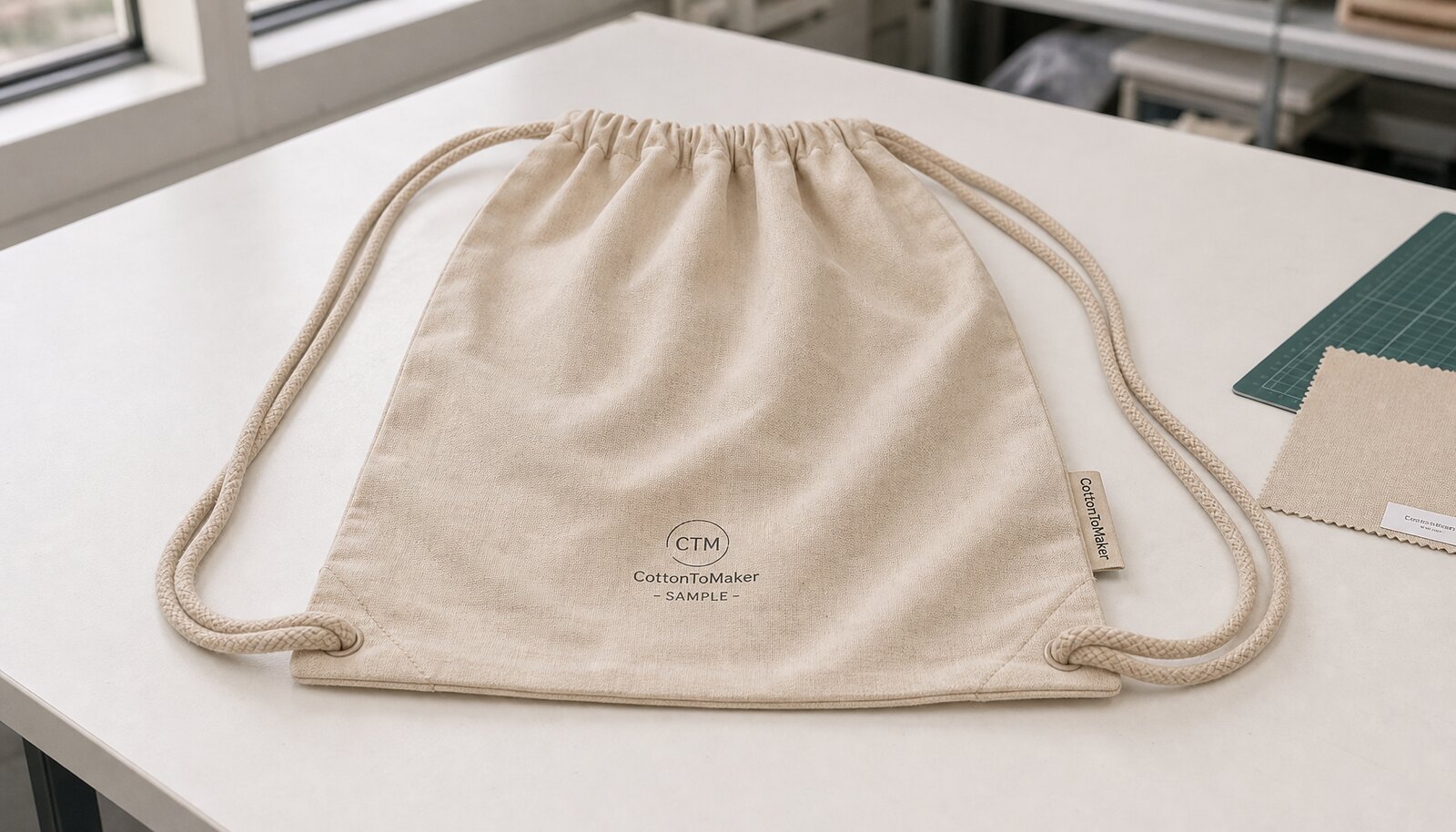
Start With the Use Case, Not the Price
When buyers search for a cotton drawstring backpack wholesale supplier, the first mistake is to ask for a price before the spec is clear. A bag for a retail gift set is not the same as a giveaway piece for a trade show, and a school backpack alternative is not the same as a lightweight promo pouch. The supplier can only quote accurately when you define the function first: carry weight, target market, logo position, and expected display quality.
A better RFQ starts with the commercial job the bag has to do. If it must look premium on a shelf, the fabric, print method, and packing should reflect that. If it is meant for a cost-sensitive campaign, the spec should stay simple and repeatable. Ask the factory to quote one baseline version and one upgraded version so you can compare where the real cost jumps happen. That comparison is often more useful than a single unit price.
- Define the use case before you ask for a quote.
- Ask for a baseline spec and one upgrade spec.
- Do not compare quotes that use different fabric weights or print methods.
- State whether the bag is for retail, promotion, or distribution.
Choose the Fabric Weight That Matches the Job
For cotton drawstring backpacks, fabric weight is one of the biggest cost and performance drivers. In practice, buyers usually look at a range from about 120gsm to 240gsm depending on the expected use. A lighter fabric can work for event giveaways or low-load promotional packs, while a heavier cotton canvas gives better structure, better print appearance, and a more durable feel. If the bag has to survive repeated use, do not let the quote stay vague on GSM.
The right choice also depends on how the bag will be folded, shipped, and displayed. A thick bag can look better in retail, but it increases carton volume and sometimes slows sewing. A thin bag may pass a low-cost target but can wrinkle, show contents, or distort under load. If you want a balanced wholesale spec, many buyers land in the middle range because it supports stable printing, reasonable hand feel, and predictable production.
- 120-140gsm suits light promotional use.
- 140-180gsm is a practical middle range for most wholesale programs.
- 180-220gsm feels more retail-ready and holds shape better.
- Ask the factory to confirm shrinkage behavior and fabric finish.
Compare Print Methods Before You Lock Artwork
Print method changes more than appearance. It also changes MOQ logic, setup charges, lead time, and the chance of rejection. Screen printing is usually the most cost-effective for simple logos and larger quantities because the setup is straightforward and the result is stable. Embroidery and woven labels can lift the perceived value, but they add labor and sometimes require thicker fabric to look clean. Heat transfer can help with multi-color art or smaller runs, but it needs careful wash and rub testing.
For cotton bags, keep the artwork practical. The cleaner the logo, the easier it is to control cost and consistency. Ask for the print area, print size, color count, and Pantone reference if the brand needs color matching. If the logo sits near a seam or cord channel, ask the supplier how they will avoid distortion. Many quote disputes come from artwork that was never sized to the actual panel.
- Use screen print for simple logos and volume.
- Use embroidery or a woven label when the brand needs a premium finish.
- Use transfer only when the design detail justifies the extra handling.
- State the artwork size and placement in millimeters, not just in words.
Check the Construction Details That Affect Durability
A good cotton drawstring backpack is more than a body panel with cords. The cord diameter, channel construction, and stress-point reinforcement decide whether the bag feels solid or cheap. For most wholesale programs, a 4-5 mm braided cotton cord is a safer choice than a thin cord because it is more comfortable on the shoulder and less likely to fray quickly. Reinforced eyelets or stitched cord channels also matter, especially if the bag will carry books, shoes, or event kits.
Ask the supplier to describe how the bottom seam, corner reinforcement, and top hem are built. A simple drawstring bag can still fail early if the needle density is inconsistent or the bartacks are too short. If you want a cleaner retail look, request matched seam lines and trimmed thread ends. If you want lower cost, keep the build simple, but do not remove the reinforcements that protect the cord exits and load points.
- Specify cord diameter and cord finish.
- Ask whether the cord exits use eyelets, stitched channels, or a folded hem.
- Confirm bartack location at load points.
- Define whether the bag needs a bottom gusset or flat panel construction.
Build a Quote the Factory Can Price Correctly
A strong quote request should give the factory enough data to avoid assumptions. At minimum, include size, fabric weight, color, print method, print size, quantity ladder, packing requirement, and destination terms. If you skip one of those fields, the supplier may quietly fill the gap with a cheaper assumption that changes later during approval. That is how you get quote drift, sample surprises, and a final price that no longer matches the original email.
You also want the quote to be broken into parts. Ask for the body price, print setup, label or embroidery cost, packing cost, and any special handling. That way, when you compare suppliers, you can see whether one factory is cheaper because it is using a thinner fabric, skipping the label, or excluding packaging labor. A lump-sum number may look attractive, but it is hard to audit if something goes wrong.
- Ask for pricing by quantity tier, not one flat number.
- Separate body, print, label, packing, and freight-related items.
- Request any one-time setup charges in writing.
- Confirm whether sample costs are deductible from bulk orders.
Understand MOQ Logic Before You Push for a Lower Run
MOQ is not just a sales tactic. For cotton drawstring backpacks, minimums are driven by fabric roll usage, print setup, sewing line efficiency, and packing labor. A supplier may have room to lower MOQ if the spec is simple, but a multi-color logo, premium label, or retail packing format can push the order back up. That is why two buyers can ask for the same product and get very different minimums from the same factory.
If your volume is uncertain, ask the supplier to quote both the standard MOQ and a simplified version of the bag. For example, you might keep the same size and fabric but reduce the print to one color, drop the insert card, or use bulk packing instead of individual polybags. That approach helps you see what actually drives cost. It also gives you a fallback if your final purchase order lands below the original target.
- Lower MOQ usually means higher unit price.
- Simple specs reduce setup and production waste.
- Retail packing often raises MOQ or adds a surcharge.
- Ask if the factory can mix colors within one order or only within one print run.
Use Sample Approval to Catch Problems Early
Do not treat the sample as a formality. For a cotton drawstring backpack, the sample is where you verify the things that are expensive to fix later: fabric hand feel, print clarity, cord balance, seam alignment, and actual size. If you only approve based on a photo, you can miss issues such as puckering at the print area, uneven cord tension, or a bag that shrinks more than expected after finishing.
Ask for the right sample stage. A pre-production sample should reflect the actual fabric and build, while a printed strike-off should confirm the artwork before the full run starts. When the sample arrives, measure it, inspect the stitching, and compare it against the approved spec sheet rather than your memory. If the factory sends a revision, note exactly what changed and get the update confirmed before bulk cutting begins.
- Check size, cord length, and opening width against the spec sheet.
- Look for print registration, color density, and edge clarity.
- Inspect loose threads, seam waviness, and cord symmetry.
- Approve the sample in writing before bulk starts.
Packing and Cartons Can Change the Real Landed Cost
Packing is often treated as a small detail, but it affects labor, carton count, and freight volume. If you need individual polybags for retail or distribution, that should be written into the RFQ. If you are buying for wholesale or internal fulfillment, bulk folding may be enough and can reduce cost. The point is to state it clearly because the factory will otherwise choose the simplest packing that fits its default workflow.
Ask for carton size, piece count per carton, and whether the bags are folded flat or lightly stuffed to preserve shape. A drawstring backpack that is packed too loosely can arrive with uneven counts or higher cube volume. A bag packed too tightly can crease hard and look poor on arrival. You want a packing spec that protects the product without paying for unnecessary handling.
- State whether you want retail packing or bulk packing.
- Confirm inner pack count and master carton count.
- Ask for carton dimensions before you approve the order.
- Request outer marks that match your receiving process.
Map the Production Timeline and the Risk Points
A realistic production plan for cotton drawstring backpacks usually moves through artwork confirmation, fabric booking, sample approval, cutting, printing, sewing, inspection, and packing. The exact timeline depends on whether the factory has the fabric in stock and whether your logo is simple or layered. A clean order with final artwork and approved material can move much faster than a spec that is still changing during sampling. The hidden time loss is almost always in back-and-forth approvals, not in sewing alone.
The main risk points are fabric shade variation, delayed artwork signoff, and late changes to packing or labeling. If your order has multiple colors, ask whether the supplier will dye the fabric first or source from existing stock. If your print uses several colors, confirm how proofing will work and who signs off the sample. The more decisions you lock early, the less likely the factory is to pause the line while waiting for answers.
- Finalize artwork before sampling if possible.
- Lock packing and carton marks before bulk production.
- Allow time for material booking and print approval.
- Expect more delay when the order combines multiple colors or custom labels.
Avoid the Mistakes That Make Quotes Useless
The most common sourcing mistake is comparing two quotes that do not describe the same product. One supplier may be quoting 120gsm fabric, another 180gsm. One may include a woven label, the other may not. One may pack in individual polybags while the other is quoting bulk-folded cartons. If you do not normalize those details, the lowest quote is usually just the least complete one.
The second mistake is treating the cotton drawstring backpack as a simple item that does not need technical control. In reality, the bag needs clear acceptance criteria on fabric, size, print, and packing, just like any other branded textile product. If you give the factory a clean spec sheet, a sample signoff process, and a quote breakdown request, you will get better comparisons and fewer surprises at production.
- Do not compare quotes with different fabric weights.
- Do not accept a quote that hides setup or packing charges.
- Do not approve bulk changes without a revised sample or written note.
- Do use one spec sheet across all suppliers.
Specification comparison for buyers
| Spec decision | Recommended option | When it fits | Buyer risk to check |
|---|---|---|---|
| Fabric weight | 140-180gsm cotton canvas for most bulk programs | Promotional retail, events, school packs, and reusable daily carry | Too-light fabric may feel flimsy; too-heavy fabric raises cost and folding bulk |
| Print method | Single or two-color screen print on the front panel | Simple logos, repeat orders, and high-volume wholesale programs | Fine lines can fill in; ink hand feel and cure quality must be checked |
| Branding method | Woven side label or small embroidery for premium positioning | Retail sets, gift programs, and brands that want a more finished look | Small labels can distort on curved seams; embroidery can stiffen thin fabric |
| Cord and closure | 4-5 mm braided cotton cord with reinforced eyelets or stitched channels | Standard use where comfort and easy closure matter | Thin cord cuts into the shoulder; weak ends fray during use and packing |
| Packing format | Flat-folded bulk pack with master carton counts fixed in the RFQ | Wholesale and distributor shipments where cube efficiency matters | Loose folding creates inconsistent carton counts and higher freight volume |
Buyer checklist before sampling
- Confirm the end use: giveaway, retail resale, school pack, event kit, or daily carry.
- Lock the size, usable capacity, and any load expectation before asking for a quote.
- Choose a fabric weight in GSM and state whether you want plain cotton, cotton canvas, or a blended option.
- Specify logo placement, number of print colors, and the approved artwork format.
- Decide whether the bag needs reinforcement at the cord exits, corners, or bottom seam.
- Set the packing method: bulk fold, individual polybag, insert card, barcode label, or mixed pack.
- Ask for unit pricing by quantity tier, plus any setup, sampling, or packaging extras.
- Define sample approval rules and measurement tolerances before bulk production starts.
Factory quote questions to send
- What exact fabric weight, weave, and finish are you quoting for the bag body?
- Is your unit price based on one logo position, one print color, and one size only?
- What are the sample cost, print setup cost, and any label or embroidery charges?
- How does the MOQ change if we choose a simpler print, fewer colors, or bulk packing only?
- Which measurements do you guarantee, and what tolerance range do you allow on final goods?
- Are cord, eyelets, bartacks, woven label, and care label included in the quoted spec?
- What packing method is included, and how many pieces per inner pack and master carton?
- What lead time should we expect after artwork approval, sample signoff, and deposit?
- Can you separate production price from freight-ready packing or retail-ready packing?
- What file format do you need for print approval, and will you send a digital layout for signoff?
Quality-control points to confirm
- Verify fabric GSM, hand feel, and color against the approved sample or strike-off.
- Measure body size, cord length, and opening width on a random carton sample.
- Check that the print is centered, legible, and consistent in ink density or stitch fill.
- Inspect the cord channels, bartacks, and bottom corners for secure reinforcement.
- Pull-test the cord exits and stress points to look for seam creep or loose threads.
- Confirm that labels, care marks, and any barcode stickers are in the agreed position.
- Review folding method, carton count, and bag cleanliness before sealing the cartons.
- Open cartons from the top and bottom of the lot to check for shade variation and packing errors.