Why salon chains need a supplier scorecard, not only a low price
A cotton drawstring backpack looks simple on a quotation sheet, but a salon chain rollout turns it into a multi-variable procurement item. The same bag may be used as a gift-with-purchase for shampoo and conditioner, a retail add-on near the checkout counter, a stylist education kit, a staff event bag, or a franchise opening pack. Each use case changes the risk profile. Bottles add weight and hard edges. Retail display raises expectations for fabric appearance and print alignment. Multi-location distribution makes carton labels and packing accuracy as important as the bag itself.
A cotton drawstring backpack supplier scorecard for salon chains gives every bidder the same framework. Instead of asking only for a unit price, the buyer scores fabric reliability, construction details, print capability, sample discipline, packing control, lead-time realism, and quality evidence. This matters because the cheapest quote often looks attractive before the buyer adds setup charges, repacking labor, rejected print lots, rushed freight, or store-level sorting errors.
Procurement teams should use the scorecard before paying a deposit. A supplier that cannot answer technical questions during quoting is unlikely to become more disciplined during production pressure. The scorecard should also help non-technical stakeholders understand trade-offs: a heavier cotton may improve hand feel but raise freight; individual bagging may protect goods but conflict with plastic-reduction goals; custom dyeing may support brand color but extend the schedule. The best supplier is not always the lowest-price supplier. It is the supplier whose process fits the salon chain’s campaign, quality level, and distribution model.
- Score evidence, not adjectives: request fabric swatches, photos of corner reinforcement, print samples, carton layouts, and sample tags.
- Use a weighted scorecard so critical items such as print accuracy, reinforcement, and delivery reliability count more than nice-to-have services.
- Treat the first order as a production-system test if the salon chain expects repeat seasonal campaigns or franchise rollouts.
- Attach the approved specification and sample reference to the purchase order so price, quality, and inspection standards are connected.
- Do not compare quotes until bag size, fabric weight, print method, packing method, Incoterm, and inspection expectations are normalized.
Build the scorecard around real salon-chain buying risks
A useful scorecard should reflect how salon chains actually buy and distribute promotional products. A single-store salon may only need a good-looking bag at a low price. A chain must manage brand standards, franchise requirements, regional campaigns, warehouse receiving rules, and launch dates. The scorecard should therefore separate supplier capability into categories that can be inspected, compared, and discussed with finance or marketing.
A practical weighting model might place 25% on product specification and construction, 20% on print and branding control, 15% on MOQ and commercial clarity, 15% on packing and logistics readiness, 15% on quality-control process, and 10% on communication and documentation. The exact weighting can change, but the point is to prevent unit price from dominating the decision. If the bag is part of a paid retail kit, quality and presentation deserve more weight. If the bag is a one-day giveaway, the chain may accept lighter fabric but still needs safe packing and accurate delivery.
Use the scorecard as a conversation tool, not just an internal spreadsheet. Send the same RFQ package to all suppliers and ask them to return answers in the same format. When suppliers respond, highlight gaps rather than immediately negotiating price. Missing carton dimensions, vague GSM, unclear sample timing, or no defined inspection process are not small details; they are signs that the buyer may face surprises after deposit.
- Suggested 1-5 score: 1 = no evidence, 2 = vague answer, 3 = acceptable answer, 4 = evidence provided, 5 = evidence plus proactive risk control.
- Must-pass items should include exact fabric specification, approved pre-production sample, print placement tolerance, reinforcement method, and final inspection access.
- Commercial score should include setup charges, repeat-order pricing, payment terms, carton data, and whether price is valid for the required production window.
- Operational score should include ability to manage multiple artwork versions, store allocation, barcode labels, and carton numbering.
- Documentation score should include specification sheet, sample approval record, first-piece approval, inspection report, and packing list accuracy.
Define the salon use case before selecting fabric and construction
The most common sourcing mistake is asking suppliers to quote “cotton drawstring backpack with logo” before defining what the backpack must carry. A giveaway bag handed out with sachets or a voucher does not need the same construction as a reusable bag carrying two 300 ml bottles, a paddle brush, a cape, and training documents. When the expected load is not stated, many suppliers quote the lightest acceptable cotton and basic corner stitching because that keeps the price competitive.
For salon chains, the use case should be written into the RFQ. State whether the bag is a free promotion, gift-with-purchase, paid retail item, stylist education kit, staff welcome pack, or franchise opening pack. Then list the likely contents and approximate weight. Include any hard-edged items such as pump bottles, hair tools, boxed products, or printed binders. These items stress seams and bottom corners differently from soft textiles.
Construction decisions flow from the use case. A light event bag may only need a standard folded top channel and simple cord. A retail kit should have better fabric hand feel, cleaner print, stronger drawcord, and more controlled packing. A training kit used repeatedly by stylists should have reinforced bottom corners and a cord that remains comfortable when the bag is loaded. A franchise opening pack may require less premium construction than a retail item but much stronger packing accuracy because each location must receive the correct quantity.
- Light customer giveaway: 5 oz to 6 oz natural cotton can work when contents are light and the bag is not expected to carry heavy bottles repeatedly.
- Retail gift-with-purchase: 7 oz to 8 oz cotton canvas usually gives a better hand feel and supports higher perceived value.
- Stylist education kit: specify reinforced corners, stronger cord, and a practical load check because the bag may be reused beyond the event.
- Franchise opening pack: prioritize SKU allocation, carton labels, shipping dates, and repeatable branding over unnecessary decoration upgrades.
- Premium salon brand: review fabric slubs, natural cotton tone, print hand feel, and fold marks because the backpack becomes part of the customer experience.
- Eco-positioned campaign: define what “eco” means in procurement terms—natural cotton, recycled content, reduced plastic packing, reusable design, or certified material if required.
Fabric weight, GSM, and material language that make quotes comparable
Many suppliers quote cotton drawstring backpacks by ounces, while others list GSM. A useful comparison needs the nominal fabric weight, the actual tolerance, the weave or finish description, and the final approved sample. As a rough guide, 5 oz cotton is often around 170 gsm, 6 oz around 200 gsm, 7 oz around 230 gsm, and 8 oz around 270 gsm. This conversion is not exact because cotton fabric construction, finishing, and supplier practice vary. The buyer should not rely on the ounce label alone.
Avoid vague phrases such as “thick cotton,” “canvas style,” “eco cotton,” or “promotional cotton.” These terms give suppliers room to change fabric while claiming the description is the same. A stronger RFQ says, for example, natural cotton canvas, target 7 oz, actual GSM tolerance to be declared, finished size 34 x 42 cm, black cotton drawcord, reinforced bottom corners, one-color screen print, bulk packed 100 pieces per carton. The more precise the material language, the easier it is to compare quotes and inspect bulk goods.
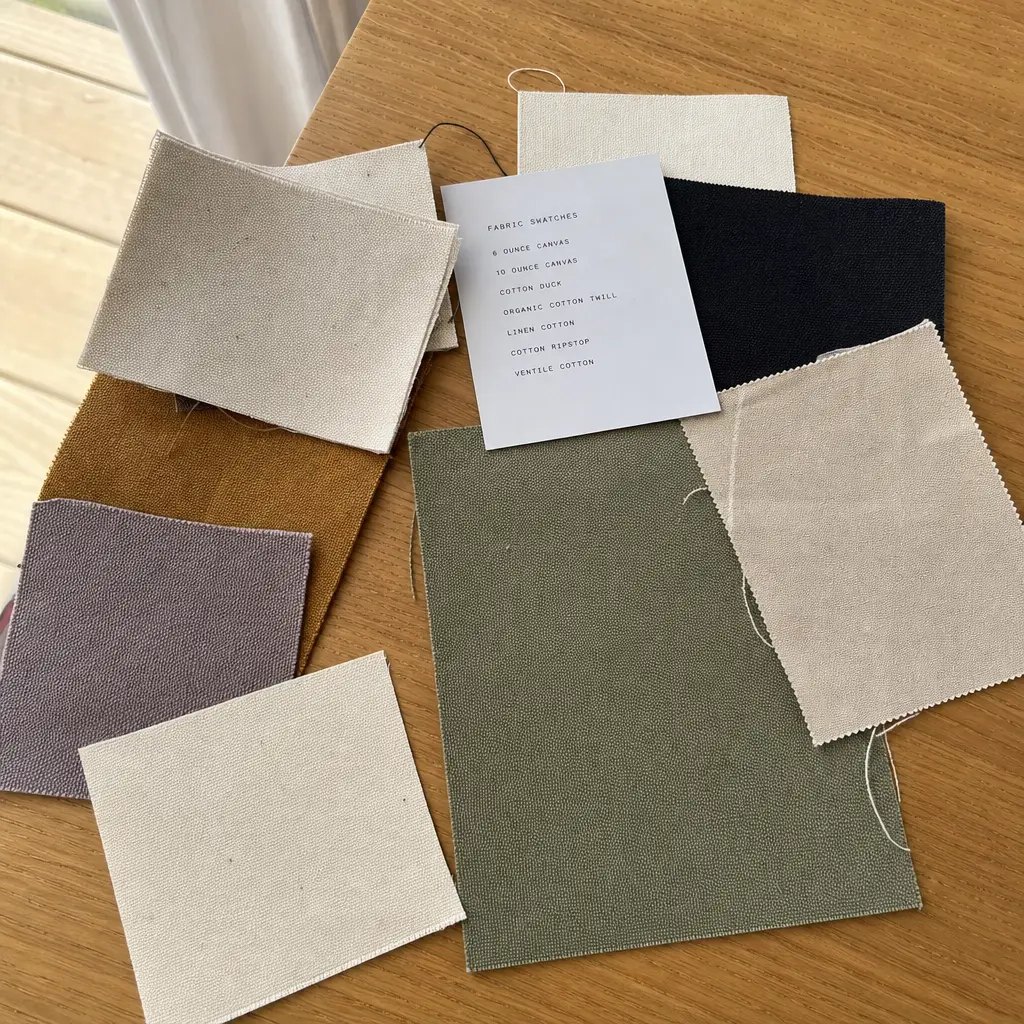
Dyed cotton needs special attention. Brand teams may request black, blush, copper, sage, or another salon identity color. Custom dyeing can affect MOQ, cost, lead time, shrinkage, and colorfastness. If the chain expects repeat orders, the buyer should keep a physical fabric standard and understand that lot-to-lot shade variation is possible. Natural cotton also varies in tone, so if the brand requires a very clean cream or white appearance, request swatches before sampling.
- Quote natural, bleached, and dyed cotton separately because each option can change MOQ, fabric lead time, and shade-control risk.
- Ask for actual GSM tolerance, such as a stated percentage or range, rather than accepting a single marketing number with no inspection rule.
- Compare total fabric consumption, not only fabric weight; a smaller heavy bag can cost less than a larger light bag.
- For dark cotton, test white or light-color print opacity on the real fabric before approving production.
- For light cotton, check show-through by placing typical salon bottles or printed inserts inside the sample.
- If washing is relevant, test shrinkage and print performance after a basic wash process; if the bag is not intended for washing, state that clearly in the product information.
Construction details: drawcord, channels, corners, and load expectations
Cotton drawstring backpacks fail most often at predictable points: bottom cord corners, top channel seams, drawcord ends, and side seams. Salon products can make those weak points more obvious because bottles create concentrated weight and hard pressure areas. A supplier that understands bag construction should be able to explain how the cord is anchored, how the corner is reinforced, what stitch density is used, and what load the bag is expected to tolerate.
The drawcord is not only a trim choice. Cord material, diameter, softness, color, and stretch affect both durability and user comfort. Cotton cord supports a natural look but can absorb moisture and may fray if poorly finished. Polyester cord may be smoother and more consistent but changes the product’s material story. A very thin cord may reduce cost but feel uncomfortable when the bag carries bottles. For salon retail kits, buyers should physically load the sample and wear it briefly to check whether the cord digs into the shoulder.
Corner reinforcement should be specified rather than assumed. Options include reinforced fabric patches, bar-tacks, folded seam reinforcement, metal eyelets, or stitched cord loops. Metal eyelets may look clean but can conflict with metal-free packing goals or create rust risk if quality is poor. Fabric reinforcement is often appropriate for cotton bags, but it must be stitched correctly. Ask for close-up photos from the bulk line and inspect symmetry, stitching density, and whether the cord path creates tearing force at one point.
- Specify finished bag size and opening direction, not only flat panel dimensions from a supplier catalog.
- Define cord material, color, approximate diameter, length, and whether knots or finished ends are required.
- Check that the top channel allows smooth opening and closing without catching the printed panel or side seam.
- Require reinforced bottom corners for bags carrying bottles, tools, or repeated-use training materials.
- Ask the supplier to perform and document a practical load check using the target product weight or an agreed test weight.
- Inspect seam allowance and stitch density; uneven or narrow seam allowance increases the chance of open seams after use.
Print method decisions for salon logos and campaign artwork
Most salon chain backpacks use screen printing because it is economical at volume, stable for solid logos, and suitable for natural cotton. A one-color black salon logo on natural cotton is usually straightforward. However, white ink on black cotton, metallic-looking brand colors, fine hairline typography, delicate script fonts, gradients, or photographic campaign graphics require more review. The supplier should recommend a method based on fabric color, artwork detail, order quantity, and durability needs—not simply quote the cheapest print option.
Screen print cost is usually driven by number of colors, print size, ink type, and setup. Heat transfer can handle complex artwork and small runs, but it may create a different hand feel, visible film edge, or cracking risk if the transfer quality is not suitable. Digital printing can support multi-color graphics but must be tested on the chosen fabric. Embroidery is less common for drawstring backpacks because it adds cost, can distort lighter cotton, and may be uncomfortable on thin panels, but it may suit premium small runs if construction supports it.
The artwork approval process should include more than a digital mockup. A PDF proof can show scale and placement, but it cannot prove ink opacity, fabric absorption, print hand feel, or exact shade. Salon brands often have strict identity colors, so a physical strike-off or pre-production sample is valuable. For repeat programs, keep an approved print sample in a sealed reference set and require future batches to match it within agreed tolerance.
- Provide vector artwork, Pantone references, print width and height, and measured placement from top edge and side edges.
- State whether print placement tolerance is measured from the finished bag edges or from the panel before sewing.
- Review thin text, script fonts, QR codes, and fine lines at actual print size before approving screens.
- For dark fabric, approve opacity and edge sharpness on the real cotton, not on a paper proof.
- After curing, perform dry rub, light scratch, and fold-flex checks to catch weak ink adhesion before packing.
- For multi-version orders, create an artwork matrix listing file name, logo, print color, quantity, carton mark, and destination.
MOQ logic: what changes the minimum order quantity
MOQ is not only a total piece count. For cotton drawstring backpacks, minimum order quantity can be affected by fabric color, fabric dyeing, drawcord color, print artwork, label type, packaging, and allocation requirements. A salon chain ordering 10,000 bags across five regional logos can create more complexity than one 10,000-piece national logo. If the RFQ does not show each version, suppliers may quote a general MOQ and then revise it after artwork and packing details are revealed.
Procurement should build a quantity matrix before collecting final quotes. List each bag body color, print design, print color, label, packing method, and destination. Natural cotton with one black logo may be a standard production run. Custom dyed cotton matching a brand color may require lab dips and fabric dyeing MOQ. A woven side label may have its own MOQ. Store-level carton labels may not change the bag MOQ, but they affect packing labor and error risk.
For salon chains with many franchisees or regional promotions, the buyer can sometimes reduce MOQ pressure by standardizing the bag body and cord, then varying only the print. Another option is to keep the national logo on the backpack and customize the kit insert or carton label by region. These decisions should be made before supplier negotiation because they affect setup charges and production flow.
- Ask suppliers to state MOQ by bag body color, drawcord color, print artwork, woven label, care label, and packing method.
- Group artwork versions by same print size and ink color where possible to reduce setup and screen changes.
- For small campaigns, consider standard natural cotton with custom print instead of custom dyed fabric.
- If the supplier offers unusually low MOQ, verify whether fabric is in stock and whether repeat batches can match the first order.
- Clarify overage and shortage tolerance by version, especially for franchise packs where each location expects an exact quantity.
- For annual programs, discuss blanket orders only when storage responsibility, fabric lot control, price validity, and release schedule are documented.
Supplier evidence to score before deposit
A scorecard should reward suppliers who provide evidence without repeated chasing. Strong suppliers can show relevant cotton drawstring backpack samples, explain fabric weight options clearly, identify print limitations before sampling, and provide carton data early. They should also be able to describe their sewing line, printing process, inspection stages, and packing workflow in practical terms. A polished quotation is useful, but production evidence is more valuable.
For salon chains, supplier evaluation should include version-control capability. A campaign may have different logos for education, retail, and franchise channels. If the supplier cannot reference artwork file names, sample dates, and revision numbers during quoting, the same weakness may cause mix-ups during printing. Ask how they prevent old artwork from being used after a revision and who approves first-piece production before mass printing continues.
The scorecard should also identify who is responsible for quality decisions. If the supplier is a trading company, is the sewing factory allowed to change fabric if stock runs out? Who approves rework? Who decides whether a print shade is acceptable? If the supplier uses separate sewing and printing workshops, how are panels transferred, counted, and protected? Clear answers reduce the risk of blame-shifting when deadlines are tight.
- Factory identity: confirm whether the supplier sews, prints, packs, exports, or coordinates outside workshops.
- Sample relevance: review existing bags close to the required fabric weight and construction, not unrelated tote bags only.
- Quote completeness: check whether setup charges, sample charges, carton dimensions, packing cost, labels, and inspection support are included.
- File control: require suppliers to reference artwork version names and sample approval dates in writing.
- QC readiness: ask whether the supplier accepts defect categories and inspection rights before production starts.
- Communication test: score how accurately the supplier repeats your specification, not how quickly they send a generic price.
Sample approval standards that prevent bulk production mistakes
A cotton drawstring backpack sample is not just a photo approval item. It is the control document for fabric, finished size, drawcord, stitching, print, label, and packing. If a supplier sends a sample with substitute fabric or a temporary print method, it can still help with layout review, but it should not be treated as the approved pre-production sample. The final approval sample should match the bulk order as closely as possible.
Salon chains often work against fixed launch dates, so teams may be tempted to approve from digital proofs or rushed photos. That is risky for cotton bags because fabric texture, natural cotton tone, print opacity, cord comfort, and corner strength cannot be judged accurately from a screen. A physical pre-production sample is especially important for dark fabric, premium retail kits, multi-color printing, and any order carrying heavier bottles.
The sample approval record should be written. Include sample date, supplier name, fabric weight, finished dimensions, drawcord details, print method, artwork version, label version, packing method, and any approved deviations. If the buyer accepts a minor imperfection in the sample, state whether it is approved for bulk or must be corrected. Ambiguous sample feedback creates room for disagreement during inspection.
- Measure finished width and height flat and record the accepted tolerance for bulk goods.
- Verify fabric weight against the quoted GSM or ounce weight using supplier records or buyer-side testing if required.
- Load the bag with the expected salon products and pull the drawcord to observe corner distortion, seam strain, and cord comfort.
- Compare print color under consistent lighting with the approved Pantone target or physical brand sample.
- Confirm label position, seam allowance, care label, country-of-origin label, and any retailer-required markings.
- Approve one sealed sample for the factory, one for the buyer, and one for inspection reference whenever possible.
- Do not approve mass production until the sample status is clear: layout sample, print strike-off, revised sample, or final pre-production sample.
Packing choices for salon chain distribution
Packing is often where a good bag order becomes expensive to handle. Bulk packing may be cheapest at the factory, but it can push labor to the importer, distributor, or salon chain warehouse. If backpacks must be sent by store, education class, franchise opening kit, or regional campaign, the supplier needs packing instructions before quoting. Otherwise, the unit price may exclude the work that matters most to the rollout.
The packing decision should balance protection, sustainability, presentation, and warehouse speed. Individual polybags protect against dust and moisture, but they add cost and may conflict with plastic reduction policies. Paper bands or kraft sleeves can look cleaner for retail programs, but they offer less moisture protection and can shift in transit. Bulk bundles reduce material use but require cleaner cartons and careful compression control so bags are not crushed or deeply creased.
Carton planning deserves early attention because cotton bags are dense and can become heavy. Overfilled cartons can split, deform, or create receiving problems. Underfilled cartons waste freight space. For salon chains, carton labels should match the warehouse or store receiving process. A strong label may include PO number, SKU, bag version, artwork version, quantity, carton number, destination code, barcode, and gross weight. If the supplier supports store-level allocation, request a packing mockup or sample carton label before bulk packing starts.
- Bulk carton packing: lowest factory labor and suitable when the buyer will repack domestically.
- Individual bagging: better dust and moisture protection with cleaner warehouse handling, but adds material cost and plastic.
- Paper band or kraft sleeve: useful for retail presentation when moisture exposure and band slippage are controlled.
- Store-level allocation: reduces downstream sorting but requires accurate data files, carton numbering, and a packing audit.
- Mixed cartons: only use when carton labels clearly identify contents and receiving teams agree to the format.
- Export cartons: request dimensions, gross weight, net weight, units per carton, carton ply, and estimated CBM for freight planning.
Specification comparison for buyers
| Supplier option | What to verify | Commercial advantage | Buyer risk to control |
|---|---|---|---|
| Direct sewing factory | cord material proof, reinforcement close-ups, load-test photos, approved sample tag, and bulk-line first-piece record | Better sample-to-bulk control and faster production feedback | May be weaker on export paperwork or branded packing unless checked early |
| Trading company | Factory name, production photos, trim-source proof, and who owns QC decisions | Can coordinate small mixed orders and extra services | Markup can hide real factory capability and slow defect decisions |
| Specialized bag workshop | cord diameter, eyelet or reinforced channel, bottom corner reinforcement, seam allowance, bar-tack position, and load target | More practical for detailed construction, trims, and repeat programs | Capacity may be limited during peak seasons |
| Low-price general supplier | 6-10 oz cotton canvas, 210D polyester, rPET, or blended cotton with shrinkage and colorfastness expectations set before sampling | Useful for simple promotional runs with loose specs | Material downgrades, weak packing, and vague inspection scope can erase savings |
| Retail-ready supplier | fold direction, cord protection, bundle count, carton compression, moisture bag, and retail label position | Can handle labels, SKU separation, carton marks, and receiving rules | Higher unit cost must be compared against reduced warehouse work |
| Compliance-focused supplier | Fabric records, labeling review, test plan, and production traceability | Safer for retail programs and repeat brand orders | Documentation claims need evidence, not only sales language |
| Local sample room plus bulk factory | Signed sample, bulk factory handoff, first-piece photos, and deviation owner | Good for complex branding before large production | Sample room quality may not match bulk line unless handoff is controlled |
Buyer checklist before sampling
- Define the backpack use case: free giveaway, gift-with-purchase, retail add-on, stylist education kit, staff event bag, or franchise opening pack.
- Set the finished size in centimeters and list expected contents, including the heaviest bottle, pump, brush, cape, printed booklet, or tool kit weight.
- Choose fabric weight by function: 5 oz to 6 oz for light promotions, 7 oz to 8 oz for heavier salon retail use, and heavier only if freight and hand feel justify it.
- State whether cotton must be natural, bleached, dyed, recycled cotton blend, organic cotton, or pre-shrunk if required by the brand or retail channel.
- Provide vector logo files and specify Pantone colors, print size, print position, printable area limits, and preferred print method.
- Require a pre-production sample using the correct fabric, drawcord, stitching, reinforcement, label, print process, and packing method.
- Set measurable tolerances for finished size, fabric weight, print placement, logo color, drawcord length, seam strength, carton count, and packing version.
- Confirm MOQ by fabric color, print design, drawcord color, label type, and packing version—not only by total order quantity.
- Request carton dimensions, gross weight, net weight, units per carton, carton material, carton mark layout, and whether cartons are export-grade.
- Decide whether goods are packed bulk, individually polybagged, paper banded, retail sleeved, or allocated by salon location.
Factory quote questions to send
- Are you the sewing factory for the cotton drawstring backpacks, the printer, or a trading coordinator using outside workshops?
- What fabric weights can you quote for natural cotton and dyed cotton, and what is the actual GSM tolerance for each option?
- What is your MOQ by fabric color, print design, drawcord color, label type, and packing version for this backpack style?
- Can you make a pre-production sample with the exact fabric weight, exact drawcord, exact reinforcement, exact print method, and final packing?
- Which print method do you recommend for our artwork and fabric color, and what are the limitations for fine lines, ink opacity, gradients, or Pantone matching?
- What reinforcement is included at the bottom drawcord corners, what stitch density is standard, and how do you test for tearing under load?
- What are the normal production lead times after sample approval for 1,000, 5,000, 20,000, and 50,000 pieces?
- What quote elements are included: printing setup, sample charge, woven label, care label, individual bag, paper band, carton, barcode label, inspection support, and export documents?
- What are the carton dimensions, units per carton, gross weight, net weight, and estimated CBM for the quoted specification?
- Can you support store-level packing or mixed carton allocation, and what data file format do you need for carton labels?
Quality-control points to confirm
- Fabric weight verified against the approved sample, with tolerance agreed before production and checked before cutting.
- Finished size measured flat after sewing, with width and height tolerance stated in centimeters and recorded by size lot.
- Drawcord length, diameter, color, fiber content, and hand feel matched to the approved sample.
- Bottom corner reinforcement checked for patch position, stitching density, symmetry, bar-tack quality, and tear resistance.
- Top channel and drawcord movement checked so the bag opens and closes smoothly without cord snagging or twisting.
- Print placement measured from top edge and side edges, not judged by eye only; tolerance must be stated before mass printing.
- Logo color checked against Pantone target or approved physical sample under consistent lighting, especially for repeat programs.
- Ink adhesion, dry rub, light scratch resistance, and curing quality tested before packing, especially on dyed cotton.
- Seams inspected for skipped stitches, loose threads, open seams, puckering, needle damage, and uneven seam allowance.
- Fabric surface checked for stains, oil marks, slubs beyond the approved standard, dye streaks, holes, and unacceptable odor.