Why Cotton Drawstring Backpacks Fit Yoga Studio Procurement
Yoga studios sourcing drawstring backpacks face a specific use profile: members carry a mat, towel, water bottle, and change of clothes, then wash the bag frequently. A cotton drawstring backpack at 340 GSM handles this load and laundering better than the 210D polyester giveaway bag that dominates the promotional market. The cotton hand, breathability, and natural aesthetic also align with studio retail positioning — members will pay $18–28 for a cotton bag they keep, versus a polyester bag they discard after one class.
For procurement teams, the sourcing problem is not finding a supplier — hundreds of factories quote cotton drawstring backpacks. The problem is that most quotes are built on a promotional-grade spec: 6 oz (200 GSM) cotton, single-stitch seams, polyester cord, and plastisol print. These bags fail within weeks of studio use. This guide defines the spec thresholds, supplier evidence, and quote comparison points that separate a production-grade cotton drawstring backpack from a promotional-grade one dressed up in a cotton label.
- Target spec: 340 GSM cotton canvas, braided cotton cord (5 mm), water-based screen print, bar-tack reinforcement at 6 points
- Avoid: 6 oz / 200 GSM cotton, polyester cord, plastisol print, single-stitch seams — these fail in 2–3 months of studio use
- Retail price anchor: $18–28 for a 340 GSM cotton drawstring backpack — cost landed should be $3.80–5.20 depending on order size and shipping route
Fabric Weight and GSM: The First Cost Driver
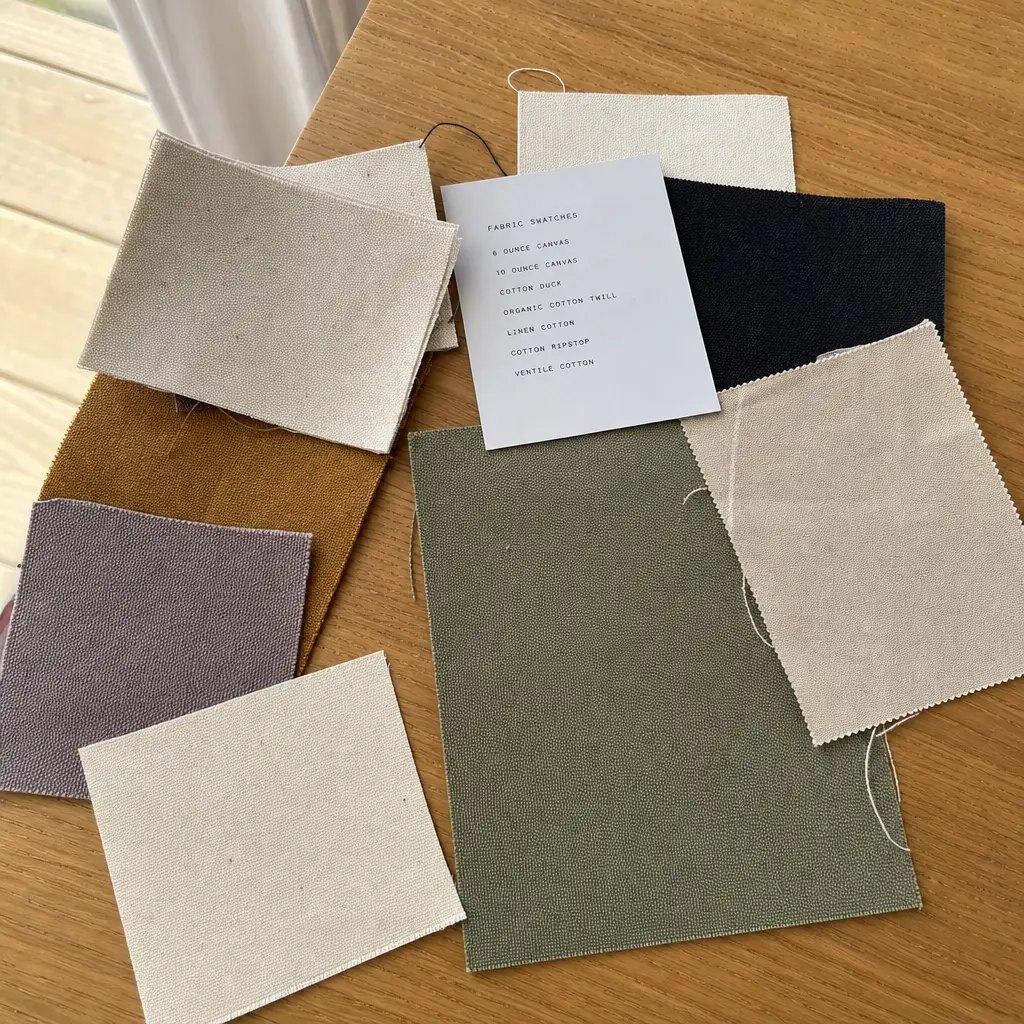
Fabric weight is the single largest cost component in a cotton drawstring backpack — typically 45–55% of the ex-works unit price. Suppliers manipulate this variable more than any other. A quote that reads '10 oz cotton canvas' can mean anything from 280 GSM to 360 GSM depending on whether the supplier is quoting before or after shrinkage, using imperial or metric conversion, or simply rounding up. The only reliable specification is GSM verified by a mill test report, and the only reliable verification at QC is weighing a 10×10 cm swatch and multiplying by 100.
For yoga studio use, 340 GSM (approximately 10 oz) is the practical floor. Below this, the bag sags under a 2 kg load, the cord channel tears at the exit point, and the bottom seam fails after repeated washing. Above 400 GSM, the bag becomes stiff, the drawstring action is sluggish, and the cost premium does not translate to longer service life in a studio context. The tradeoff is between 310 GSM for a budget tier and 340 GSM for a retail tier — anything heavier is over-engineering for this use case.
- Request GSM in writing on the PI — '10 oz' is ambiguous, '340 GSM' is verifiable via mill test report
- Tolerance: ±5% of quoted GSM is industry standard; reject lots exceeding this
- Cost impact: moving from 280 GSM to 340 GSM adds approximately $0.45–0.65 per bag at 3,000 pcs
- Shrinkage: pre-shrunk fabric costs 8–12% more but prevents post-print distortion after first wash
Cord Material: The Hidden Failure Point
The drawstring cord is the most common point of failure on a cotton drawstring backpack, yet it is the spec most buyers leave undefined. A quote that says 'cotton cord' can mean 100% cotton, a cotton-polyester blend, or a polyester cord with a cotton-like texture. The difference matters: a 100% braided cotton cord at 5 mm diameter has a natural hand, holds a knot well, and ages with the bag. A polyester cord substituted to save $0.08 per bag feels slick, frays at the aglet, and snaps under load.
The substitution happens because braided cotton cord costs $0.12–0.18 per meter while polyester cord costs $0.04–0.06 per meter. On a bag using 1.6 meters of cord, the saving is $0.13–0.19 per unit — enough to win a price-sensitive quote. The verification is a burn test on the pre-production sample: cotton smells like burning paper and leaves a soft grey ash; polyester smells like burning plastic and leaves a hard bead. This test takes 15 seconds and should be a standard sample approval step.
- Specify '5 mm braided 100% cotton cord with metal aglet' — do not leave cord material open to supplier interpretation
- Burn test at sample approval: cotton = paper smell, grey ash; polyester = plastic smell, hard bead
- Cord breaking strength: minimum 15 kg for studio use — members pull bags by the cord when loaded
- Aglet: metal crimped aglet, not plastic — plastic aglets crack and fall off after 3–4 months
Print Method Tradeoffs: Water-Based vs. Plastisol
Yoga studios positioning around sustainability and natural materials undermine that message the moment a plastisol print lands on the bag. Plastisol is the default print method on low-cost cotton drawstring backpacks because it is fast to set up, forgiving on uneven fabric, and cheap at high volume. It also sits on the surface as a thick PVC film, feels stiff to the hand, cracks after 15–20 wash cycles, and is incompatible with the eco-positioning most studios use to justify the retail price.
Water-based screen print absorbs into the cotton fiber, leaves no film, and moves with the fabric. The tradeoff is setup complexity — water-based ink requires tighter color matching, longer drying time, and higher reject rates on dark fabric. For a 1–2 color logo on natural cotton, water-based is the correct choice and adds $0.10–0.15 per bag over plastisol. For 4+ color designs on dark cotton, water-based becomes impractical and DTG (direct-to-garment) is the alternative, though DTG costs $0.80–1.20 per bag and has lower volume throughput.
- Specify print method explicitly in RFQ: 'water-based screen print' — 'screen print' alone allows plastisol substitution
- Cost delta: water-based adds $0.10–0.15 per bag over plastisol at 3,000 pcs, 1-color print
- Wash test: plastisol cracks visibly after 15–20 washes; water-based survives 40+ washes without cracking
- DTG alternative: viable for 4+ color designs, but adds $0.80–1.20 per bag and limits order to 500–1,000 pcs per run
Supplier Route Comparison: Factory vs. Trading Company vs. Cut-and-Sew Workshop
The supplier route determines the spec ceiling, QC control, and cost structure more than any negotiation tactic. Three routes dominate cotton drawstring backpack supply: a weaving-and-cut-and-sew factory that controls fabric sourcing and printing in-house; a cut-and-sew workshop that buys fabric and print externally; and a trading company that coordinates between multiple workshops. Each route has a distinct cost profile and risk profile, and the choice depends on order size, spec complexity, and whether the buyer can conduct or commission a factory audit.
An integrated factory with in-house weaving and printing offers the tightest spec control and lowest unit cost at 5,000+ pcs, but requires a higher MOQ and longer lead time for fabric preparation. A cut-and-sew workshop offers lower MOQ (500–1,000 pcs) and faster sampling, but fabric lot variance and print quality depend on external partners the buyer cannot audit directly. A trading company adds 8–15% margin but manages multi-workshop coordination — useful for buyers running multiple bag categories without a dedicated sourcing team.
- Integrated factory: best for 5,000+ pcs, tight spec control, 35–45 day lead time, MOQ 3,000 pcs per design
- Cut-and-sew workshop: best for 1,000–3,000 pcs, fast sampling, 25–35 day lead time, fabric lot variance risk
- Trading company: best for multi-category buyers, 8–15% margin overhead, 40–55 day lead time, limited spec control
- Audit signal: if a supplier cannot provide a fabric mill test report within 48 hours, they are likely a workshop buying fabric externally
MOQ Logic: Why Low MOQ Quotes Often Cost More
Suppliers quoting MOQ below 1,000 pcs on cotton drawstring backpacks are almost always cutting a cost corner the buyer cannot see. The constraint is fabric: cotton canvas is woven in 1,000–1,500 meter rolls, and a drawstring backpack uses approximately 0.45 meters. A 500-pc order uses 225 meters — less than one roll, which means the supplier is either using stock fabric (unknown GSM, unknown dye lot, unknown shrinkage) or buying a partial roll at a 15–25% premium per meter. Either way, the spec suffers.
The practical MOQ for a production-grade cotton drawstring backpack is 1,000 pcs per color and 3,000 pcs per design. This allows the supplier to pull a full fabric roll, control the dye lot, and run print setup efficiently. Buyers who need 500 pcs for a pilot should accept a higher unit cost ($6.50–8.00 instead of $3.80–5.20) and specify 'stock fabric acceptable for pilot, production lot to use made-to-order fabric at 3,000 pcs MOQ.' This frames the pilot as a sampling stage, not a production spec.
- Fabric roll size: 1,000–1,500 meters; one bag uses ~0.45 meters; MOQ below 1,000 pcs forces stock fabric or partial roll
- Stock fabric risk: unknown GSM, unknown dye lot, unknown shrinkage — spec variance between sample and production lot
- Pilot order strategy: accept $6.50–8.00 unit cost for 500 pcs, specify stock fabric for pilot only, lock production spec at 3,000 pcs
- Color split: negotiate 2-color split within one design MOQ — most integrated factories accept this at 1,500 pcs per color
Sample Approval: What to Check Before Signing the PI
The pre-production sample (PPS) is the last point at which a buyer can correct a spec without paying a rework charge. Most buyers approve the PPS based on visual appearance — logo placement, color match, general construction. This is insufficient. A PPS for a cotton drawstring backpack should be tested against four physical criteria: fabric GSM, cord material, print adhesion, and seam strength. These tests take 20 minutes total and catch 80% of the spec substitutions that appear in production.
The PPS should also be used to lock the top-stitch and bar-tack diagram. Suppliers reduce cost by removing bar-tacks or lowering stitch density during production, and the PPS is the reference point for the final QC. Require a diagram showing bar-tack locations (four cord exit points, two bottom corners) and stitch density (8–10 stitches per inch on stress seams). Attach this diagram to the signed PPS approval and reference it in the QC checklist.
- GSM test: weigh 10×10 cm swatch × 100 — compare to quoted GSM, tolerance ±5%
- Cord burn test: cotton = paper smell, grey ash; polyester = plastic smell, hard bead
- Print cross-hatch test: blade cross-hatch, 3M tape pull — ink transfer >5% is a fail
- Seam pull test: 5 kg load on bottom seam for 30 seconds — no slippage or thread break
- Bar-tack diagram: four cord exit points + two bottom corners, attached to signed PPS approval
Packing and Carton Logic: Avoiding Freight and Handling Damage
Packing is the most overlooked cost driver in cotton drawstring backpack sourcing because it sits between production and freight — neither the factory nor the buyer owns it clearly. The practical spec is individual polybag per bag, 100 pcs per carton, carton dimensions 55×40×35 cm, gross weight 22–24 kg. This carton is handlable, stackable, and fits standard sea freight palletization. Suppliers quoting 'bulk packed 200 pcs per carton' are reducing polybag cost ($0.03 per bag) but creating a carton that exceeds 25 kg, incurs handling damage, and cannot be palletized efficiently.
Carton dimensions also affect landed cost through dimensional weight. A 55×40×35 cm carton at 22 kg ships at actual weight in sea freight but may ship at dimensional weight in air freight. If the buyer is air-freighting a rush order, the carton should be repacked to 50 pcs per carton (55×35×30 cm, 11–12 kg) to stay under both weight and dimension thresholds. This repacking costs $0.05 per bag but saves 30–40% on air freight.
- Standard: individual polybag, 100 pcs per carton, 55×40×35 cm, 22–24 kg gross
- Avoid: bulk pack 200 pcs per carton — exceeds 25 kg, handling damage, poor palletization
- Air freight repack: 50 pcs per carton, 55×35×30 cm, 11–12 kg — saves 30–40% on dimensional weight charges
- Polybag spec: 0.03 mm PE, self-sealing — thinner bags tear during unpacking, thicker bags add unnecessary cost
Lead Time and Schedule Risk: What '30 Days' Actually Means
A supplier quoting '30 days lead time' on a cotton drawstring backpack is almost always counting from fabric arrival, not from order confirmation. The actual schedule is: 7–10 days for fabric weaving and preparation (if made-to-order), 3–5 days for print setup and approval, 15–20 days for cutting and sewing, 2–3 days for QC and packing. Total: 27–38 days from fabric order to ex-works. Add 5–7 days for fabric arrival if the supplier does not hold stock, and the real lead time from deposit to ex-works is 32–45 days.
Schedule risk concentrates at two points: fabric preparation and print setup. If the supplier orders fabric after receiving the deposit (standard practice), any delay in fabric weaving pushes the entire schedule. If the print setup requires color approval (water-based print on colored cotton), the buyer must approve the print strike-off within 48 hours or the schedule slips. Buyers with fixed launch dates should require the supplier to pre-order fabric against a forecast and lock the print strike-off approval window in the PO.
- '30 days' typically means 30 days from fabric arrival to ex-works — real lead time from deposit is 32–45 days
- Fabric preparation: 7–10 days for made-to-order cotton canvas — longest single schedule component
- Print strike-off: require 48-hour approval window — delays here cascade into cutting and sewing
- Schedule buffer: add 7 days to quoted lead time for orders shipping before a fixed launch date
Landed Cost Comparison: Ex-Works Price Is Not Your Cost
Comparing supplier quotes on ex-works price is the most common error in cotton drawstring backpack sourcing. A quote at $3.80 ex-works and a quote at $4.20 FOB can land at the same cost depending on freight, duty, and inland handling. The correct comparison is landed cost per unit, calculated as: ex-works price + inland freight to port + sea freight + duty + inland freight to warehouse, divided by units. For a 3,000 pcs order shipping from Shenzhen to Long Beach, the freight and duty add $0.55–0.85 per unit, making the $3.80 ex-works quote actually $4.35–4.65 landed.
The landed cost calculation also reveals when a higher ex-works quote is cheaper. A supplier quoting $4.20 FOB (freight included to port) with cartons packed at 100 pcs (efficient palletization) may land at $4.75–5.05 per unit, while the $3.80 ex-works supplier with 200-pc cartons (poor palletization, dimensional weight penalty) lands at $4.90–5.30. The $0.40 ex-works difference reverses at landed cost. Always request carton dimensions and gross weight in the quote to run this comparison before selecting a supplier.
- Landed cost formula: ex-works + inland freight + sea freight + duty + inland delivery, per unit
- Freight and duty add $0.55–0.85 per unit on a 3,000 pcs order, Shenzhen to Long Beach
- Carton packing affects landed cost: 100 pcs per carton palletizes efficiently; 200 pcs triggers dimensional weight penalty
- Always compare at landed cost, not ex-works — a $0.40 ex-works difference can reverse at landed cost
Specification comparison for buyers
| Supplier option | What to verify | Commercial advantage | Buyer risk to control |
|---|---|---|---|
| Direct sewing factory | cord material proof, reinforcement close-ups, load-test photos, approved sample tag, and bulk-line first-piece record | Better sample-to-bulk control and faster production feedback | May be weaker on export paperwork or branded packing unless checked early |
| Trading company | Factory name, production photos, trim-source proof, and who owns QC decisions | Can coordinate small mixed orders and extra services | Markup can hide real factory capability and slow defect decisions |
| Specialized bag workshop | cord diameter, eyelet or reinforced channel, bottom corner reinforcement, seam allowance, bar-tack position, and load target | More practical for detailed construction, trims, and repeat programs | Capacity may be limited during peak seasons |
| Low-price general supplier | 6-10 oz cotton canvas, 210D polyester, rPET, or blended cotton with shrinkage and colorfastness expectations set before sampling | Useful for simple promotional runs with loose specs | Material downgrades, weak packing, and vague inspection scope can erase savings |
| Retail-ready supplier | fold direction, cord protection, bundle count, carton compression, moisture bag, and retail label position | Can handle labels, SKU separation, carton marks, and receiving rules | Higher unit cost must be compared against reduced warehouse work |
| Compliance-focused supplier | Fabric records, labeling review, test plan, and production traceability | Safer for retail programs and repeat brand orders | Documentation claims need evidence, not only sales language |
| Local sample room plus bulk factory | Signed sample, bulk factory handoff, first-piece photos, and deviation owner | Good for complex branding before large production | Sample room quality may not match bulk line unless handoff is controlled |
Buyer checklist before sampling
- Specify fabric weight as GSM (e.g., 340 GSM) in RFQ, not just '10 oz' — request mill test report from the supplier
- Define cord material as '5 mm braided 100% cotton cord with metal aglet' — require burn test on pre-production sample
- State print method explicitly: 'water-based screen print', not 'screen print' alone — plastisol is the default cheap substitute
- Require bar-tack reinforcement at all four cord exit points and two bottom corners — not just 'reinforced stitching'
- Set color fastness threshold: Grade 4 wash (ISO 105-C06), Grade 4 rubbing (ISO 105-X12) — request test results
- Demand carton dimensions (e.g., 55×40×35 cm) and gross weight (22-24 kg) in quote — not just 'standard export packing'
- Ask for actual production lead time excluding sample approval and fabric arrival — '30 days' often starts after deposit and fabric order
- Require top-stitch density of 8-10 stitches per inch on stress seams (drawstring channel, bottom seam) — low-density stitching is a hidden cost cut
Factory quote questions to send
- What is the actual GSM of the cotton canvas, and can you provide the mill test report for the lot used in production?
- Is the cord 100% braided cotton or a cotton-poly blend? What is the cord diameter (mm) and breaking strength (kg)?
- Is the print water-based or plastisol? Can you confirm the ink type in writing on the PI?
- What is the stitch density per inch on the drawstring channel and bottom seam?
- Is there bar-tack reinforcement at the cord exit points and bottom corners? How many bar-tacks per bag?
- What dye process is used for colored cotton — reactive or direct? What is the wash fastness grade (ISO 105-C06)?
- What is the MOQ per color and per design? Can you accept a 2-color split within one design MOQ?
- What are the exact carton dimensions (cm), gross weight (kg), and units per carton? Is each bag individually polybagged?
- What is the production lead time starting from fabric arrival and deposit receipt, excluding sample approval?
- Can you provide a top-stitch and bar-tack location diagram with the pre-production sample?
Quality-control points to confirm
- Fabric GSM verification: weigh a 10×10 cm swatch, multiply by 100 — tolerance ±5% of quoted GSM
- Cord material burn test: cotton smells like burning paper, leaves grey ash; polyester smells like plastic, leaves hard bead
- Print adhesion test: cross-hatch with blade, apply 3M tape, pull — ink transfer exceeding 5% is a fail
- Seam strength: pull bottom seam to 5 kg load for 30 seconds — no seam slippage or thread breakage
- Color fastness wash test: wash sample at 40°C with white cotton adjacent — staining on white exceeding Grade 3 is a fail
- Cord channel function: draw cord 50 times — cord must move smoothly without jamming or fraying at exit points
- Dimension check: finished bag ±1.5 cm of specified dimensions — larger variance indicates cutting template drift
- Metal aglet pull test: pull aglet with 3 kg force — no separation from cord