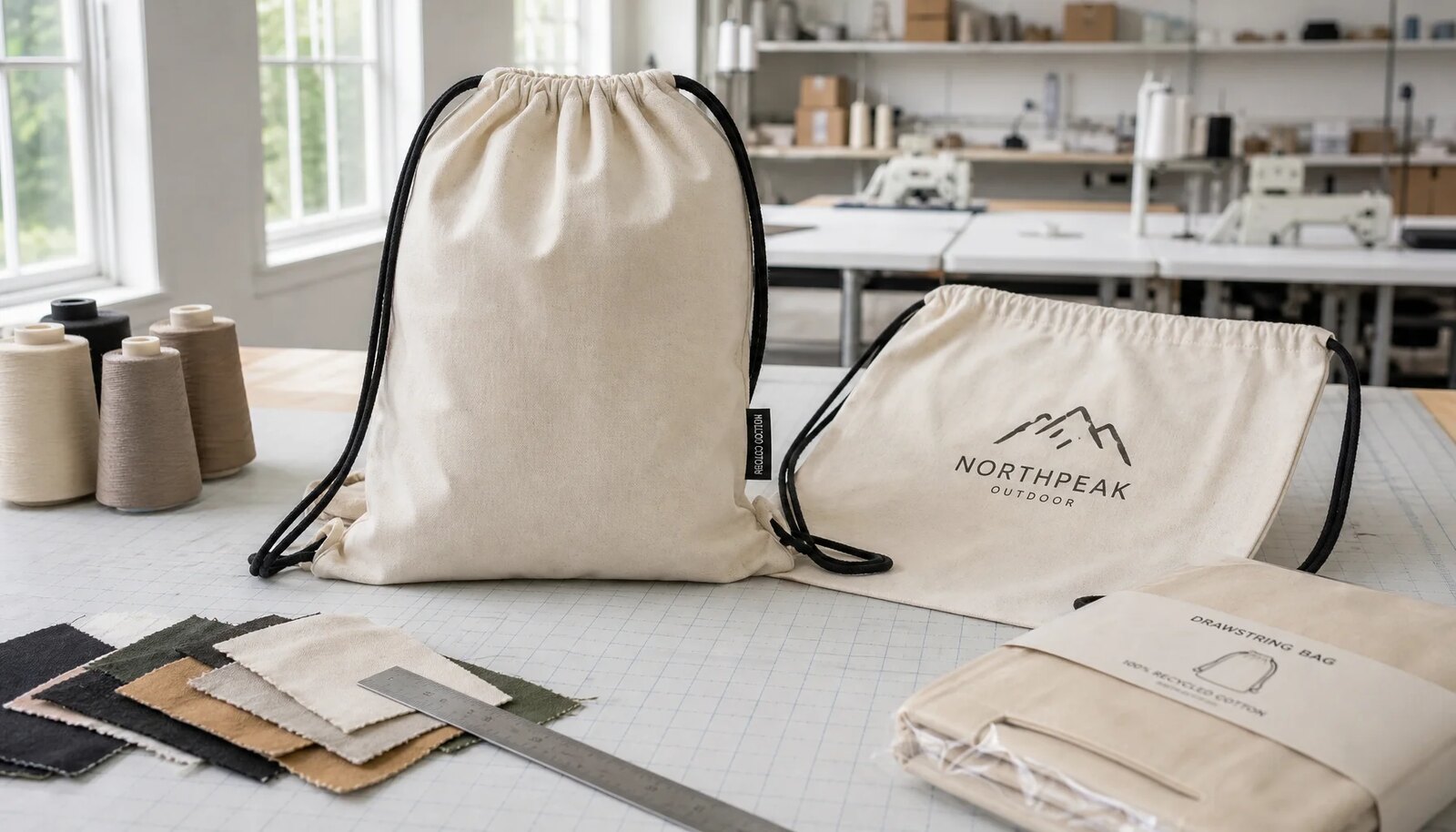
Why Craft Fair Bags Need Tighter Supplier Control
Custom cotton drawstring backpacks look simple, so RFQs are often too loose. A buyer may send a logo, target quantity, and delivery date, then receive quotes that cannot be compared. One supplier may quote a thin cotton giveaway with basic cords and bulk packing. Another may include heavier canvas, reinforced corners, print strike-offs, barcode labels, and stronger export cartons. Both may call the item a cotton drawstring backpack, but the cost drivers and failure risks are different.
Craft fairs create visible product stress. Visitors carry show guides, vendor catalogs, craft supplies, notebooks, water bottles, and small purchases. Exhibitors may reuse the same bag over several event days. If fabric feels weak, ink smells, cords tear through corners, or the print rubs off, the problem is seen by the exact audience the brand is trying to impress.
A useful supplier compliance checklist turns assumptions into measurable buying requirements. The goal is not to over-specify every promotional order. The goal is to stop suppliers from winning the quote by quietly reducing fabric weight, cord quality, reinforcement, inspection support, or packing accuracy.
- Treat the backpack as an event-use item, not only a logo carrier.
- Compare prices only after GSM, finished size, construction, print method, and packing are aligned.
- Separate light giveaway quality from retail merchandise quality before quoting.
- State expected contents so the supplier can judge reinforcement and cord strength.
- Keep one sealed approval sample with the buyer and one matching sample at the factory.
- Require written approval for changes to fabric, cord, ink, label, packing, or carton quantity.
Define Use Case, Load, and Finished Size First
The first compliance point is the use case. A visitor giveaway may only need to hold a guide and a few flyers. A workshop supply bag may carry scissors, yarn, tools, paper patterns, or class materials. A sponsor kit may be filled before it reaches the venue. A retail bag must feel strong enough for customers to buy and reuse. Each use case changes the minimum fabric weight, reinforcement, print durability, packing method, and inspection level.
Finished dimensions should be written clearly. Do not rely on a catalog size unless the supplier confirms it means finished flat size after sewing, pressing, and top-channel folding. Ask for width, height, channel depth, and tolerance. If the backpack must fit a folder, kit box, catalog, or pre-packed bundle, provide those dimensions and request usable internal space. A deep top channel can make a 35 x 42 cm bag hold less than expected.
Tolerance should also be set before production. Cotton can shift through cutting, printing cure heat, pressing, and sewing. For many drawstring backpacks, plus or minus 0.5 cm to 1 cm is practical, but the exact tolerance depends on size, fabric weight, and construction. What matters is that the same rule appears in the RFQ, sample approval, PO, and inspection plan.
- Classify the order as giveaway, exhibitor kit, retail item, workshop bag, sponsor package, VIP gift, or staff use.
- List expected contents, such as brochures only, catalogs plus samples, or pre-packed craft kits.
- Use finished flat dimensions after sewing and pressing, not only cutting panel dimensions.
- Define top-channel depth because it reduces usable bag height.
- Ask the supplier to confirm whether measurements are taken flat, loaded, or after pressing.
- Repeat the approved tolerance on the sample form and inspection checklist.
Choose Cotton GSM, Composition, and Finish
Most cost gaps begin with vague fabric language. Lightweight cotton around 110-140 gsm can work for simple brochure giveaways. Mid-weight cotton around 180-220 gsm gives a better hand feel for sponsor bags and general craft fair use. Heavier canvas around 270-340 gsm, often described as 8 oz to 10 oz, suits retail merchandise or reuse-focused programs. Heavier fabric improves perceived value but increases unit cost, sewing difficulty, carton weight, and freight cost.
Cotton type affects both appearance and compliance. Natural cotton has a craft-friendly look but may show seed specks, slubs, and shade variation. Bleached cotton gives a cleaner print background but should be checked for yellowing, stains, and odor. Dyed cotton supports brand color but adds shade approval, dye-lot control, and colorfastness expectations. Cotton-poly blends may reduce cost or shrinkage, but they should not be sold as all-cotton if the marketing claim requires pure cotton.
If organic, recycled, or certified cotton is required, ask what the claim covers. The claim may relate to fiber, fabric, mill records, transaction documents, or finished goods. Broad wording such as eco-friendly cotton is not procurement evidence. For importer, retail, or brand programs, documents should connect to the order, material lot, supplier, and finished quantity.
- 110-140 gsm: low-cost giveaway, lighter hand feel, lower freight weight, limited load capacity.
- 180-220 gsm: balanced event bag with stronger feel and practical promotional value.
- 270-340 gsm or 8-10 oz: retail-style canvas feel with higher cost and carton weight.
- Natural cotton: define acceptable slubs, seed marks, shade variation, and print contrast.
- Bleached cotton: inspect cleanliness, odor, yellowing, and stain rejection limits.
- Dyed cotton: approve shade range, dye lot, and colorfastness expectations before bulk.
- Organic or recycled cotton: request order-specific documentation if the claim will be marketed.
Specify Construction Where Bags Usually Fail
The load path runs through the top channel, side seams, cord exits, and bottom corners. Weak bags usually fail where the cord pulls against the lower corners or where the channel rubs during repeated opening and closing. Craft fair users may keep adding purchases and printed materials throughout the day, so a bag that passes a quick visual check may still fail in use.
Top-channel construction should be defined. A single-fold channel may be cheaper but can fray depending on fabric. A double-fold channel looks cleaner and is usually more durable. The channel must be wide enough for smooth cord movement without consuming too much usable height. Side seams should be specified if the buyer needs lockstitch, overlock, French seam, or another finish. Stitch density and locked stitch ends should be checked in inspection.
Bottom reinforcement deserves close attention. Basic bags may tie cords into the bottom side seams. Stronger options include sewn corner tabs, bar-tacks, triangular reinforcement patches, or eyelets. Metal eyelets can look polished but add cost and may create corrosion or metal-part questions in some channels. Fabric tabs usually fit a cotton craft aesthetic and avoid metal hardware. Whatever method is chosen, require close-up sample photos and a simple pull or loaded hang test.
- Specify top-channel depth, seam type, seam allowance, stitch density, and reinforcement method.
- Define cord material and diameter, such as 5 mm cotton cord or 6 mm braided polyester cord.
- State the cord attachment method: knot, sewn tab, eyelet, patch, or bar-tack.
- Check that cords slide smoothly without twisting, tearing fabric, or trapping in the channel.
- Use a loaded hang test with realistic event contents instead of an abstract strength claim.
- Review close-up photos of channels, seams, lower corners, and cord exits before sample approval.
Control Print, Labels, and Artwork Placement
Craft fair artwork may be a one-color sponsor logo, a detailed illustrated event graphic, or several regional designs. Screen printing is often the best choice for simple logos, solid graphics, and repeat quantities. Water-based or pigment inks can feel softer on cotton, but curing still matters. Poor curing can cause odor, rubbing, transfer, or cracking. Natural cotton texture can also break fine details, so the supplier should confirm minimum line thickness and provide a strike-off on the actual fabric.
Digital printing can support full-color artwork and multiple versions, but buyers should check color accuracy, fabric absorption, hand feel, and rub resistance. Heat transfer can work for small runs or detailed art, but edges, flexibility, and adhesion must be reviewed. Embroidery can look premium for a small logo, but it may pucker lighter cotton and is not ideal for large front graphics. Woven side labels, hangtags, and kraft belly bands add value, but each adds setup, placement, and packing checks.
Print placement depends on production sequence. If panels are printed before sewing, sewing alignment may shift final placement. If finished bags are printed after sewing, seams and channels may affect platen pressure. Ask the supplier which method they use and what placement tolerance they can hold. A digital proof is not enough; approve a physical strike-off and a full pre-production sample.
- Screen print: best for simple logos, sponsor marks, solid colors, and repeat production.
- Digital print: useful for many artwork versions, but verify color, texture, and rub performance.
- Heat transfer: practical for small runs, but inspect edge visibility, flexibility, and adhesion.
- Embroidery: suitable for small premium marks, but risky on lightweight cotton or large designs.
- Woven side label: effective if sewn into the seam before final assembly.
- Set print placement tolerance, such as plus or minus 0.5 cm to 1 cm from the approved position.
- Judge color against the physical strike-off on actual cotton, not only the digital proof.
Understand MOQ and Price Break Logic
The MOQ for custom cotton drawstring backpacks is rarely one simple number. A natural cotton bag with a one-color screen print may have a low minimum because fabric is available and setup is simple. Dyed fabric may require a higher minimum because dyeing has a batch size. Custom cord color, private woven labels, special hangtags, unusual GSM, individual packing, or retail labels can each create a separate minimum.
Artwork versioning is a common source of cost surprises. A craft fair organizer may need 3,000 pieces across six sponsor designs. That is not the same as 3,000 pieces of one design. Each artwork can require screen setup, ink mixing, print alignment, drying space, inspection separation, and carton control. If the quote assumes one design, later changes may trigger extra fees or longer lead time.
Build a quantity matrix into the RFQ. List fabric color, artwork version, print color count, label type, packing method, and destination. Ask for price breaks at realistic quantities and confirm whether the price still applies when the order is split by design or shipment. This prevents the supplier from quoting a clean total quantity that does not match the actual buying program.
- Confirm MOQ per fabric color, not only total PO quantity.
- Confirm MOQ per print design, print color count, and print method.
- Check separate minimums for dyed cotton, custom cord, woven labels, hangtags, and special packing.
- List all artwork versions with exact quantities and carton separation requirements.
- Ask whether sample fees, screen fees, label setup fees, and packing setup fees are one-time or refundable.
- Request price breaks at practical levels such as 500, 1,000, 3,000, 5,000, and 10,000 pieces.
- Do not approve a quote that assumes one artwork when the order contains multiple designs.
Request Evidence and Right-Sized Compliance Documents
Supplier compliance is not only a company profile. For cotton drawstring backpacks, practical evidence often shows more than sales language. Ask for production photos, close-ups of stitching and cord attachments, fabric swatch cards, print workshop photos, packing examples, carton marks, and sample inspection formats. A supplier that can explain shrinkage, print curing, reinforcement, and defect handling is usually safer than a supplier that only pushes a low unit price.
Identify who controls each process. Sewing, printing, dyeing, labeling, and packing may not happen in one facility. Subcontracting is not automatically a problem, but it must be disclosed. If printing is outsourced, who approves the strike-off? If dyeing is outsourced, who controls shade tolerance? If packing happens elsewhere, who prevents design mixing? The PO should make the main supplier responsible for final quality and documentation.
Formal compliance requirements depend on the market, channel, and end user. Retail or importer programs may require restricted-substance declarations, fiber content review, packaging material declarations, barcode checks, country-of-origin information, and market-specific labeling review. School, children’s workshop, or youth-event use may require additional safety review depending on jurisdiction and product positioning. Organic or recycled claims need material documentation tied to the order, not generic sustainability wording.
- Request product-specific evidence instead of catalog images or rendered mockups.
- Confirm whether cutting, sewing, printing, dyeing, labeling, inspection, and packing are in-house or subcontracted.
- Ask for supplier-stamped records with date, buyer name, PO reference, and product description.
- Match documents to actual fabric, ink, cord, label, hangtag, and packaging materials.
- Avoid broad claims such as compliant, non-toxic, organic, or eco-friendly without scope and evidence.
- Keep an approval trail covering RFQ, quote, artwork, swatch, sample, inspection, and shipping documents.
- Assign one supplier contact responsible for deviations, rework decisions, and document collection.
Use Samples to Lock the Bulk Standard
A correct sample process saves more money than aggressive negotiation. Do not approve only a beauty sample made from leftover fabric if bulk production will use different cotton, cord, ink, or packing. The pre-production sample should represent the actual production route: approved fabric weight, final color, actual cord, final print method, final label, intended stitching, and intended packing.
Sample approval should be measurable. Check finished width and height, top-channel depth, seam construction, cord movement, reinforcement, and print behavior when flexed. Load the bag with realistic craft fair contents and hang it by the cords. For natural cotton, decide whether seed marks and slubs are acceptable. For bleached or dyed cotton, inspect stains, shade consistency, and print contrast. Corrections should be closed in writing before mass cutting or printing starts.
Control sample identity. Label the approved sample with supplier name, date, item code, fabric description, print method, artwork version, and approval status. Photograph the front, back, inside, top channel, side seams, bottom corners, labels, packing, and carton marks if available. The factory should keep an identical signed sample so defects are judged against the same standard.
- Approve a fabric swatch first when GSM, color, or cotton type is critical.
- Approve a print strike-off on the same cotton before mass printing.
- Approve a blank construction sample if reinforcement and cord function need early review.
- Use a sealed pre-production sample as the standard for sewing, print, labeling, and packing.
- Record approved measurements and tolerances on the sample approval form.
- Photograph approved details from front, back, inside, seam, cord, corner, and packing views.
- Do not allow bulk cutting or mass printing until sample corrections are closed in writing.
Compare Quotes by Total Delivered Readiness
A useful quote should show what is included, excluded, and likely to change. Request fabric GSM and composition, finished size, print method, print colors, print area, cord type, label type, packing format, carton quantity, estimated carton dimensions, sample cost, setup cost, lead time, Incoterm, payment terms, and quote validity. Without these fields, a low price may simply mean thinner fabric, smaller size, weaker cord, no reinforcement, loose packing, or limited inspection support.
Landed cost changes with fabric weight and packing. A 10 oz canvas backpack may be the right retail choice but will increase carton weight and freight. Individual polybags protect cotton from dirt but add labor, materials, and possible packaging compliance review. Kraft bands, hangtags, and barcodes improve presentation but require artwork approval and packing accuracy. Compare suppliers by cost per usable approved unit, not only FOB price per piece.
Change-order rules also matter. Craft fair programs often adjust sponsor logos, delivery addresses, event dates, or carton sorting requirements. These changes can affect screens, labels, packing labor, and production sequence. If the quote validity is short, fabric stock may disappear before deposit. If payment terms require balance before inspection evidence, buyer leverage is weaker. Make these commercial terms visible before supplier selection.
- Separate bag body, print, labels, hangtags, packing, cartons, export handling, and inspection costs.
- Request EXW and FOB options when comparing inland logistics and export responsibility.
- Ask for estimated carton cube and gross weight so freight can be modeled early.
- Define rework, replacement, reinspection, and defect responsibility in commercial terms.
- Compare all suppliers using the same GSM, size, artwork, cord, reinforcement, and packing standard.
- Confirm quote validity and whether fabric stock is reserved only after deposit.
- Ask whether split destinations, partial shipment, or event-site delivery changes the price.
Set Packing and Final Inspection Rules
Packing is often ignored until cartons arrive mixed, dusty, overweight, or hard to distribute. A basic sponsor giveaway may need bulk packing by 50 or 100 pieces per carton with an inner liner. A retail program may require a defined fold, individual bag or kraft band, barcode, SKU separation, and accurate carton marks. A distributor may need cartons sorted by event city, sponsor, booth kit, or customer PO.
Cotton picks up dust and moisture easily, especially natural and bleached fabric. Bags should be packed only after prints are fully cured and dry. Warm or damp printed bags can trap odor, create transfer marks, or stick together. Cords should be tucked, tied, or arranged according to the approved presentation. If individual polybags are avoided for sustainability reasons, still define carton liners, inner bundles, and clean handling rules.
Final inspection should connect product checks with packing checks. Inspectors should verify GSM, finished dimensions, print, seams, cords, reinforcement, labels, stains, odor, carton quantity, carton marks, and packing list accuracy. First-carton photos are a simple control before the supplier packs the full order incorrectly. Random opened-carton photos before shipment release help catch mixed designs and quantity errors.
- Define folded size and whether cords are tucked inside, tied, wrapped, or left visible.
- Choose bulk packing, bundle packing, individual polybag, kraft band, hangtag, or retail-ready packing before quoting.
- Use carton liners or inner bags when natural cotton must stay clean during long transit or storage.
- Set carton quantity by gross weight and receiving rules, not only cube efficiency.
- Separate artwork versions by carton unless mixed cartons are clearly labeled and approved.
- Require first-carton photos showing fold, inner packing, quantity, carton marks, and sealing method.
- Release shipment only after final packing photos, carton marks, and inspection evidence are reviewed.
Specification comparison for buyers
| Supplier option | What to verify | Commercial advantage | Buyer risk to control |
|---|---|---|---|
| Direct sewing factory | cord material proof, reinforcement close-ups, load-test photos, approved sample tag, and bulk-line first-piece record | Better sample-to-bulk control and faster production feedback | May be weaker on export paperwork or branded packing unless checked early |
| Trading company | Factory name, production photos, trim-source proof, and who owns QC decisions | Can coordinate small mixed orders and extra services | Markup can hide real factory capability and slow defect decisions |
| Specialized bag workshop | cord diameter, eyelet or reinforced channel, bottom corner reinforcement, seam allowance, bar-tack position, and load target | More practical for detailed construction, trims, and repeat programs | Capacity may be limited during peak seasons |
| Low-price general supplier | 6-10 oz cotton canvas, 210D polyester, rPET, or blended cotton with shrinkage and colorfastness expectations set before sampling | Useful for simple promotional runs with loose specs | Material downgrades, weak packing, and vague inspection scope can erase savings |
| Retail-ready supplier | fold direction, cord protection, bundle count, carton compression, moisture bag, and retail label position | Can handle labels, SKU separation, carton marks, and receiving rules | Higher unit cost must be compared against reduced warehouse work |
| Compliance-focused supplier | Fabric records, labeling review, test plan, and production traceability | Safer for retail programs and repeat brand orders | Documentation claims need evidence, not only sales language |
| Local sample room plus bulk factory | Signed sample, bulk factory handoff, first-piece photos, and deviation owner | Good for complex branding before large production | Sample room quality may not match bulk line unless handoff is controlled |
Buyer checklist before sampling
- Define the craft fair use: visitor giveaway, exhibitor kit, workshop supply bag, retail merchandise, sponsor package, VIP bag, or staff accessory.
- Specify finished flat size with tolerance, including width, height, top-channel depth, usable internal space, and measurement method.
- Choose cotton by GSM or oz weight and state whether it is natural, bleached, dyed, organic, recycled cotton, or a cotton-poly blend.
- Set visual standards for natural cotton, including acceptable slubs, seed marks, shade variation, odor, stains, mildew marks, and oil spots.
- Define construction: double-fold channel, seam type, stitch density, seam allowance, bottom-corner reinforcement, cord exit, and cord attachment method.
- Specify cord material, diameter, color, end finish, knot method, and whether cotton, polyester, recycled, or blended cord is acceptable.
- Provide vector artwork with print size, Pantone or CMYK targets, print method preference, minimum line thickness, and placement tolerance.
- Request a fabric swatch, print strike-off, blank construction sample if needed, and pre-production sample made with bulk materials.
- Set inspection points for GSM, dimensions, print registration, seam strength, cord pull, stains, odor, labels, packing, and carton marks.
- Confirm MOQ by fabric color, print design, print color count, cord color, label type, packing format, and shipment split.
Factory quote questions to send
- Are you the cut-and-sew factory, or will sewing, printing, dyeing, labeling, inspection, or packing be subcontracted?
- What fabric GSM, oz weight, composition, weave, finish, shrinkage expectation, and available stock colors are included in this price?
- Is the quoted size the finished bag size after sewing and pressing, and what measurement tolerance will be used?
- What MOQ applies per fabric color, artwork, print color count, cord color, label type, packing style, and shipment lot?
- Which print methods can you run in-house, and what are the minimum line thickness, curing requirements, and maximum print area?
- How do you control print placement if panels are printed before sewing versus finished bags printed after sewing?
- Which sample stages are included: swatch, print strike-off, blank construction sample, packing mockup, pre-production sample, or sealed approval sample?
- Will the pre-production sample use the same bulk fabric, cord, ink, label, thread, stitch method, and packing as the final order?
- What lead time applies after artwork approval, sample approval, deposit, and material confirmation, and where are the schedule risks?
- How many pieces per carton are quoted, what are the estimated carton dimensions and gross weight, and can they meet our receiving limits?
Quality-control points to confirm
- Fabric weight should match the approved GSM or oz weight within the agreed tolerance, often plus or minus 5%, and the hand feel should match the sealed sample.
- Finished size should remain within the buyer-approved tolerance, commonly plus or minus 0.5 cm to 1 cm depending on bag size and fabric behavior.
- Top channels must open and close smoothly without trapped cords, twisting, fraying, skipped stitches, tearing, or excessive friction.
- Cord length and diameter must be consistent, with no oily marks, sharp tips, loose knots, frayed ends, strong odor, or color bleeding onto cotton.
- Bottom corner attachments should pass the agreed pull or loaded hang check using realistic event contents, not only a light visual review.
- Print color, opacity, curing, registration, and position must match the approved strike-off; cracking, transfer, odor, blur, and ink stains should be rejected.
- Seams should show correct stitch density, locked ends, no open seams, no skipped stitches, no heavy puckering, and no loose thread clusters after trimming.
- Natural cotton slubs are acceptable only within the approved standard; oil stains, mildew, holes, needle damage, and severe weaving defects need rejection rules.
- Labels, hangtags, barcodes, country-of-origin information, warning statements if applicable, and carton marks must match the PO before shipment release.
- Cartons should have suitable strength, dry liners if required, clean sealing, accurate quantity, and gross weight suitable for manual handling or retail receiving rules.