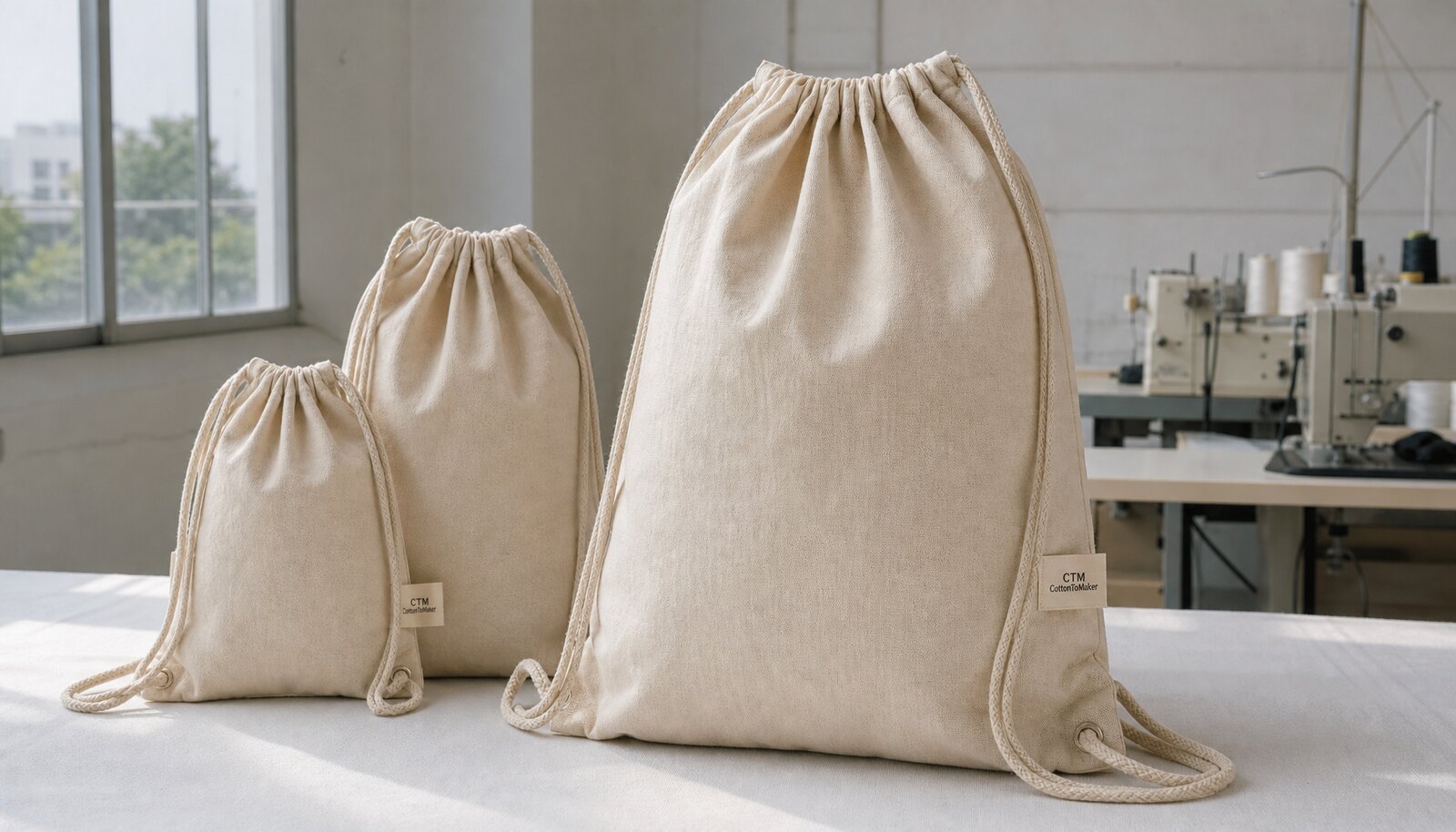
Start with the fundraiser math, not the product photo
A school fundraiser bag order should be treated as a sourcing decision, not a quick comparison of catalog prices. The bag has a job to do: protect fundraising margin, arrive on time, and be simple enough for volunteers to distribute without surprises. That means the buying decision starts with the sales model. Is the bag being resold, given away as a premium item, or bundled with other merchandise? Each use case supports a different fabric weight, decoration choice, and packaging plan.
The most common mistake is asking suppliers for quotes before the buyer has fixed the target role of the bag. If the school wants the lowest possible unit cost, keep the spec simple and consistent. If the school wants the bag to feel like retail merchandise, accept that the cost floor will rise. A clear use case keeps the later pricing discussion honest and avoids rounds of re-quoting that waste time and weaken leverage.
- Set the resale price or giveaway budget before asking for supplier quotes.
- Decide whether the bag must feel lightweight, durable, or premium; do not try to optimize all three at once.
- Keep the first order simple if the school needs a dependable event date more than a fashion-style product.
Lock the spec before you ask for prices
For cotton drawstring backpacks, the price is driven less by the logo and more by the combination of fabric weight, finished size, cord quality, and sewing complexity. A 120-140 GSM natural cotton bag is usually a sensible entry-level spec for a fundraiser. It keeps the budget under control and gives a familiar canvas-like hand feel. Move up to 160-180 GSM if the bag will carry heavier items or needs a more substantial retail feel. That increase improves perceived value, but it also affects freight weight and carton planning.
The cleanest RFQ is one that removes ambiguity. Do not ask for a generic large bag or a premium drawstring backpack. State the finished dimensions, desired fabric GSM, cord diameter, decoration area, print color count, packing format, and any label requirement. If the school committee keeps revising the artwork or adding packaging details after quote collection starts, the price comparison stops being meaningful.
- Spec fields to freeze first: finished size, fabric GSM, cord diameter, print method, print location, and packing method.
- Treat labels, hangtags, and individual polybags as separate cost items unless the supplier explicitly includes them.
- Do not compare a heavyweight canvas quote against a lighter bag and call the difference a margin issue; it is a different product.
Use the supplier route that matches the order size
Supplier route matters because not every quote reflects the same level of control. A direct factory usually gives the buyer the clearest view of sewing, printing, and packing. That is valuable when the school expects repeat annual orders or needs a consistent baseline from one event to the next. Trading companies and sourcing agents can be useful when the order includes other items or when the internal buying team is small, but the factory identity and QC ownership still need to be verified. Domestic decorators can be the right answer for a rush event, but they rarely win on larger bulk pricing.
The table is most useful when you read it as an operational map, not a shopping list. The key question is not only who is cheapest, but who can make the same bag twice without drifting. For fundraiser work, repeatability is worth money. If a low quote comes with weak answer quality, vague shipping terms, or no sample discipline, the buyer is carrying hidden risk instead of saving money.
- Direct factories are strongest when the order is large enough for volume pricing and repeatability matters.
- Trading companies are strongest when the buyer needs coordination across bags, labels, and freight.
- Domestic decoration shops are strongest when speed matters more than absolute unit cost.
Build a quote request that forces comparable answers
A procurement RFQ should do more than ask for a price. It should force every supplier to quote the same bag. The simplest way to do that is to give the supplier one page of specs and one page of pricing instructions. The spec page defines the product. The pricing page defines the breaks, the delivery term, and the required breakdown. If one supplier is quoting a bag with bulk packing and another is quoting with individual polybags and a carton insert, the unit prices cannot be compared cleanly.
Ask for a line-item structure. A useful quote shows the bag body, print setup, print unit cost, sample cost, packing charges, carton data, and shipping term separately. That makes it easier to see where the quote is actually competitive and where it is padded with assumptions. It also gives the buyer something to negotiate besides the final total.
- Request 1,000 / 3,000 / 5,000 piece pricing in the same format from every supplier.
- Ask for both EXW and FOB if you want to separate factory cost from shipping cost.
- Require carton dimensions and pieces per carton before you approve the quote.
- Ask whether the sample charge is refundable against bulk production or not.
Read bulk pricing as a range, not a promise
Bulk pricing on simple cotton bags usually falls in steps rather than moving smoothly. The first volume jump often gives the biggest reduction because setup and proofing are spread over more units. After that, the unit price still improves, but the curve flattens. That is why a buyer should not ask for a single unit price. A useful pricing plan needs breakpoints so the team can see how the order behaves at different quantities.
For budgeting, the following planning bands are useful when the spec is simple: 1,000 pieces of a natural cotton bag with one-color print and bulk packing may land around 1.20-1.90 per bag ex-works; 3,000 pieces may land around 0.88-1.40; 5,000 pieces may land around 0.72-1.15. Those are sourcing bands for planning, not market guarantees. They assume a standard production slot, normal decoration complexity, and no extra packaging or special certifications. If a supplier is far outside those bands, ask what changed before dismissing the quote or accepting it.
- Use the same spec, same term, and same packing assumption for every price break.
- Treat screen setup, sample charges, and packaging changes as separate line items.
- A quote with a low unit price but large hidden fees may be worse than a cleaner all-in structure.
Turn the quote into landed cost before anyone approves it
A factory price alone does not tell the school what the bag really costs. The decision should be based on landed cost: ex-works price plus setup, samples, packing, freight, import reserve, and a modest contingency. This is the number that needs to fit the fundraiser math. It is also the best way to compare suppliers who quote different terms or include different packaging assumptions.
A simple example helps. If a 3,000-piece order of a 140 GSM natural cotton bag with one-color print is quoted at 1.05 ex-works, the bag subtotal is 3,150. Add setup, sample, origin handling, freight, and a small reserve for damage or rework, and the landed unit cost can move meaningfully higher. The exact total depends on the lane and the packing plan, but the structure of the math is what matters. If the school plans to resell the bag, reverse the formula and set a maximum landed cost before placing the order.
- Use one landed-cost worksheet for all suppliers so the board sees the same math.
- Keep a 3-5% contingency for replacements, local delivery variance, or rework.
- If the sell price is fixed, start from the target margin and work backward to a maximum landed cost.
Approve the sample like a buyer, not like a fan of the artwork
A digital mockup is only a layout tool. It cannot prove that the fabric, stitching, cord movement, or print behavior will work in production. The sample should match the actual production method as closely as possible: same fabric category, same decoration process, same cord, and same construction details. If the supplier sends a lighter sample or substitutes another print process, the approval is not meaningful.
Sample review should be disciplined. Measure the finished dimensions. Check the logo placement against a ruler. Fold the bag several times to see whether the print cracks, lifts, or wrinkles in a way that will bother users. Load the bag with the kind of items students will actually carry, such as books, shoes, or a water bottle. If the cords bite into the tunnel, the seams pucker, or the print shifts when the bag is pulled, the sample needs to be revised before bulk fabric is cut.
- Approve one sample version only and mark it with date and revision number.
- Reject photo-only approval if the sample uses a different fabric, color, or print method.
- Keep one internal approver and one backup approver so the committee does not reopen the file after sign-off.
Choose decoration and packing that protect margin
Decoration choice changes both unit cost and defect risk. For simple school logos, one-color screen print is usually the most efficient option because setup is manageable and the result is easy to repeat. If the artwork has multiple colors or fine detail, transfer methods may preserve the artwork better, but they introduce different failure points such as edge lift or cracking after repeated folding. Embroidery can look premium, but it often makes more sense only when the bag is positioned as a higher-priced item and the order volume is smaller.
Packing also affects the economics. Bulk packing is usually the least expensive route and the easiest for receiving teams to handle. Individual polybags can help protect the print and keep bags cleaner, but they add labor, material, and carton volume. If the bags are going straight from receiving to an event table or storage room, bulk packing is often the right default. If the bags are being distributed through retail-style channels or held for a long time, a protective polybag may be worth the added cost.
- Screen print is usually best for one-color logos and clean repeatability.
- Use transfer methods only when artwork detail is worth the extra process risk.
- Choose polybags only when protection or presentation clearly justifies the extra cost.
Set QC rules the receiving team can actually use
Quality control for a fundraiser bag should be written in measurable terms, not generic phrases like good workmanship. The receiving team needs a simple list of pass-fail checks so they can inspect cartons and release the shipment with confidence. Critical defects should be zero: wrong size, missing cords, open seams, wrong print, torn fabric, or incorrect carton count. Then define the acceptable variation for non-critical items such as slight shade differences or small thread tails.
A practical starting point for a standard order is zero critical defects, major defects capped at 2.5% of the inspected sample, and minor defects capped at 4.0%. Those thresholds are not a substitute for your internal QA standard, but they give the buyer a concrete place to begin. Keep the measurement checks explicit: finished size, logo placement, cord action, seam strength, print integrity, carton dimensions, and gross weight. If the supplier cannot support that level of specificity, the order has too much room to drift.
- Finished size tolerance: +/- 1.5 cm from the approved sample or drawing.
- Logo placement tolerance: +/- 5 mm from the approved position.
- Cord and tunnel construction should survive a 5 kg static pull for 10 seconds without seam tear or slip beyond 5 mm.
- Seam allowance should be at least 8 mm where specified, with no skipped stitches or open seam sections.
- Loose thread tails should be trimmed to no more than 10 mm, with no long hanging ends at cord exits or corners.
- Carton count must match the packing list exactly, and carton weight should stay within +/- 5% of the approved plan.
Plan the calendar around approvals, not just sewing time
Lead time should be counted from the point where artwork and sample approval are complete, not from the purchase order date. In school work, the committee review cycle often takes longer than the sewing run. That means the buyer should build in time for proofing, sample comments, payment processing, production scheduling, inspection, and transit. If the order is tied to a fixed event date, that buffer is not optional.
The most common schedule failure is approving the artwork before the bag spec is stable. Once the factory has quoted, sampled, and booked material, every small revision can push the ship date and increase the risk of rushed freight. The safer sequence is simple: lock the spec, approve the sample, confirm production capacity, then release the order. If a supplier promises a very short lead time without discussing sampling or freight, verify the dates carefully before committing.
- Count lead time from sample approval, not from initial PO submission.
- Reserve extra time for committee comments, correction rounds, and shipping variability.
- Ask for a production schedule with the approval deadline, cut date, and ship date clearly listed.
Specification comparison for buyers
| Supplier route | Typical cost profile | Operational strength | Main risk | Best fit |
|---|---|---|---|---|
| Direct factory in mainland China | Low to low-mid on larger runs | Strong control over sewing, print, and repeat orders | Requires disciplined RFQ control, factory verification, and freight planning | 1,000+ pieces, annual repeat programs, and simple one-color artwork |
| Factory in Vietnam or Cambodia | Low-mid to mid | Often steady stitching quality and consistent output | Fewer bag-specialist factories and less quote competition | Buyers who want stable execution and can accept a slightly higher floor price |
| Factory in India | Mid | Strong cotton ecosystem and familiarity with natural-fabric programs | Finishing and decoration consistency can vary by plant; sampling matters | Cotton-forward programs and buyers prioritizing fabric sourcing proximity |
| Trading company or sourcing agent | Mid to high | Can coordinate bags, labels, and shipping with fewer internal touchpoints | Margin stacking can hide the true factory cost and QC ownership | Small teams that need project management support or mixed-product shipments |
| Domestic decorator or print shop | High | Fast approvals and easy communication for rush runs | Not competitive for larger bulk pricing and may depend on blanks or subcontract sewing | Short deadlines, local pickup, or sub-500-piece runs |
| Material | 6-10 oz cotton canvas, 210D polyester, rPET, or blended cotton with shrinkage and colorfastness expectations set before sampling | Before price comparison | Different cloth weights, backing, or certification claims make quotes hard to compare | |
| Construction | cord diameter, eyelet or reinforced channel, bottom corner reinforcement, seam allowance, bar-tack position, and load target | Before sampling | Weak stress points create returns and failed inspections | |
| Decoration | screen print, transfer, embroidery, woven label, or drawstring tag tested against folding and abrasion | Before artwork approval | The wrong method can crack, bleed, pucker, or fail on the chosen fabric |
Buyer checklist before sampling
- Write one spec sheet before requesting quotes: finished size, fabric GSM, cord type, print size, artwork colors, pack count, carton target, and delivery term.
- Ask every supplier for 1,000 / 3,000 / 5,000 piece pricing so the breakpoints are visible instead of hidden in a single unit price.
- Separate one-time charges from recurring unit cost. Screen setup, file prep, sample charges, labels, and carton marks should be itemized.
- Request a physical sample or strike-off that uses the same fabric, same cord, and same decoration method as production.
- State the landed-cost assumptions before comparing quotes: freight lane, import reserve, carton volume, and local handling.
- Set QC limits in writing: finished size tolerance, logo placement tolerance, pull strength, and defect limits.
- Confirm carton plan early: pieces per carton, carton dimensions, gross weight target, and whether the bags ship bulk packed or polybagged.
- Freeze artwork and packaging copy before the factory cuts material so committee changes do not erase the price advantage.
Factory quote questions to send
- What is the finished GSM of the cotton fabric, and is that measured on the finished cloth or the raw roll?
- What is the exact finished bag size, and what tolerance can you hold on width and height?
- Are sewing, printing, and packing done in-house, or does any step move to a subcontractor?
- What is included in the unit price: bag body, cords, print, label, polybag, carton, and outer marks?
- Please quote 1,000 / 3,000 / 5,000 pieces and show the setup fee separately from the per-piece price.
- What is your true MOQ per artwork and per color, and what changes if we add a second print color?
- Can you provide both EXW and FOB pricing so I can compare factory cost against landed cost?
- What is the sample cost, sample lead time, and will the sample use the same fabric and print method as the bulk order?
- What is your standard production lead time after artwork and sample approval, and what normally delays it?
- What inspection report, in-line photo set, or final QC photos can you provide before shipment?
Quality-control points to confirm
- Use the approved pre-production sample as the reference for every measurement and visual check.
- Finished bag width and height should stay within +/- 1.5 cm of the approved sample or drawing.
- Logo placement should stay within +/- 5 mm of the approved position, and the print should not look visibly off-center at arm's length.
- Seam allowance should be at least 8 mm where specified, with no skipped stitches, open seams, or broken thread that exposes the seam line.
- Loose thread tails should be trimmed to no more than 10 mm, with no long hanging ends at cord exits, corners, or print areas.
- Cord channels must run freely and evenly. The cord should pull without jamming, twisting, or one side traveling faster than the other.
- Cord and tunnel construction should survive a 5 kg static pull for 10 seconds without seam tear, slip beyond 5 mm, or hardware failure.
- Print should show no smearing, major pinholes, sticky ink, or cracking on the first fold. For heat-applied graphics, reject any edge lifting.
- Use zero critical defects, major defects not above 2.5% of the inspected sample, and minor defects not above 4.0% as a practical starting point for a standard fundraiser order.
- Carton count must match the packing list exactly. Carton dimensions should stay within +/- 1.5 cm of the approved carton spec and gross weight within +/- 5%.