Why sample approval matters for yoga studio procurement
A cotton drawstring backpack for a yoga studio is usually a low-to-mid-cost textile item, but it carries a high brand visibility load. It may be handed to new members, sold at reception, filled with retreat materials, issued to teacher training students, or distributed across several studio locations. In each case, the sample is not just a visual logo approval. It is the buyer’s best chance to confirm fabric hand feel, cord comfort, seam strength, logo durability, packing presentation, and production repeatability before money is committed to bulk production.
Yoga and wellness buyers often care about tactile and visual details that a generic promotional bag quote may not cover. Natural cotton can include seed flecks, slubs, shade movement, creasing, and dimensional change. These may be acceptable for a natural aesthetic, but they should be defined. A bag that looks suitable in a supplier photo can still feel too thin, have cords that cut into shoulders, show weak corner tabs, or arrive with a logo creased through the center because packing was never approved.
For B2B procurement, the signed pre-production sample should function like a physical specification sheet. The purchase order and sample tag should state the fabric weight, finished dimensions, tolerances, cord details, decoration method, placement measurements, reinforcement, label position, and packing method. If the record only says "sample approved" without measurable specifications, final inspection becomes subjective and disputes become harder to resolve.
- For free giveaways, avoid over-engineering details that the user will not notice, but still control logo quality and basic seam strength.
- For retail sale, prioritize fabric hand feel, inside finishing, consistent print placement, and clean packing because the bag must justify a selling price.
- For retreat kits, test realistic load capacity because bottles, towels, manuals, and apparel put stress on lower cord attachments.
- For teacher training programs, check whether notebooks, manuals, and apparel fit without forcing the top opening or overstressing cords.
- For franchise or multi-location orders, control color, logo versions, carton marks, and repeat-order specifications so every location receives the correct SKU.
- For launch-date campaigns, build time for one revision round, print strike-off approval, final inspection, and shipping buffer before the event date.
Start with a procurement-grade product brief
A strong sample begins with a clear product brief, not with the phrase "standard cotton drawstring bag." Factories use that phrase differently. One supplier may interpret it as a 5 oz promotional bag with light cord, while another may quote an 8 oz canvas backpack with reinforced tabs. Both may be technically cotton drawstring backpacks, but they are not equivalent products for a yoga studio retail or retreat program.
The brief should state the intended use, expected contents, target quantity, delivery deadline, artwork version count, packing method, and quality level. It should also explain whether the bag is a free item, a paid retail SKU, or part of a premium membership bundle. A factory does not need confidential margin data, but it does need to understand whether the buyer wants the lowest acceptable cost or a more durable, retail-ready construction.
Also clarify care expectations. Cotton is often assumed to be washable, but a printed cotton drawstring backpack is not automatically suitable for repeated machine washing. Washing may shrink the body, soften or crease the print, increase wrinkling, affect dye shade, and change cord length. If the studio wants to claim washability or expects members to wash the bag, request shrinkage and print-appearance checks before approving bulk.
- State the intended load: socks and leaflet, towel and bottle, apparel set, training manual, or mixed retreat kit.
- State the commercial channel: giveaway, reception retail, online merchandise, staff issue, retreat pack, or franchise order.
- Provide artwork in vector format when possible, with print size, color references, placement, and version names.
- List required labels: woven side label, care label, brand hang tag, barcode sticker, or location-specific carton mark.
- Confirm whether the product should use natural cotton, bleached cotton, dyed cotton, recycled cotton, or certified organic cotton.
- Define whether the bag is expected to be washable, spot-clean only, or sold without a wash claim.
- Ask the supplier to quote base construction and optional upgrades separately so cost decisions are visible.
Specify fabric weight, construction, finish, and shrinkage
Fabric weight is one of the clearest drivers of cost, hand feel, durability, print result, and freight. For cotton drawstring backpacks, buyers commonly see cotton in the 5 oz to 10 oz range, roughly about 170 to 340 GSM depending on weave and finishing. For many yoga studio applications, 8 oz cotton canvas around 260-280 GSM is a practical starting point because it feels more substantial than a giveaway pouch, supports screen printing, and still closes reasonably well at the top channel.
Lighter fabrics, such as 5-6 oz cotton, can work for simple handouts and low-load event kits. They are usually easier to cinch and lighter to ship, but they may wrinkle more, show contents more clearly, and feel less suitable for paid merchandise. Heavier fabrics, such as 10 oz canvas, improve body and perceived value but increase sewing bulk, carton weight, shipping cost, and stiffness at the drawstring mouth. The best fabric is not always the heaviest fabric; it is the one that matches the user load, price point, and packing method.
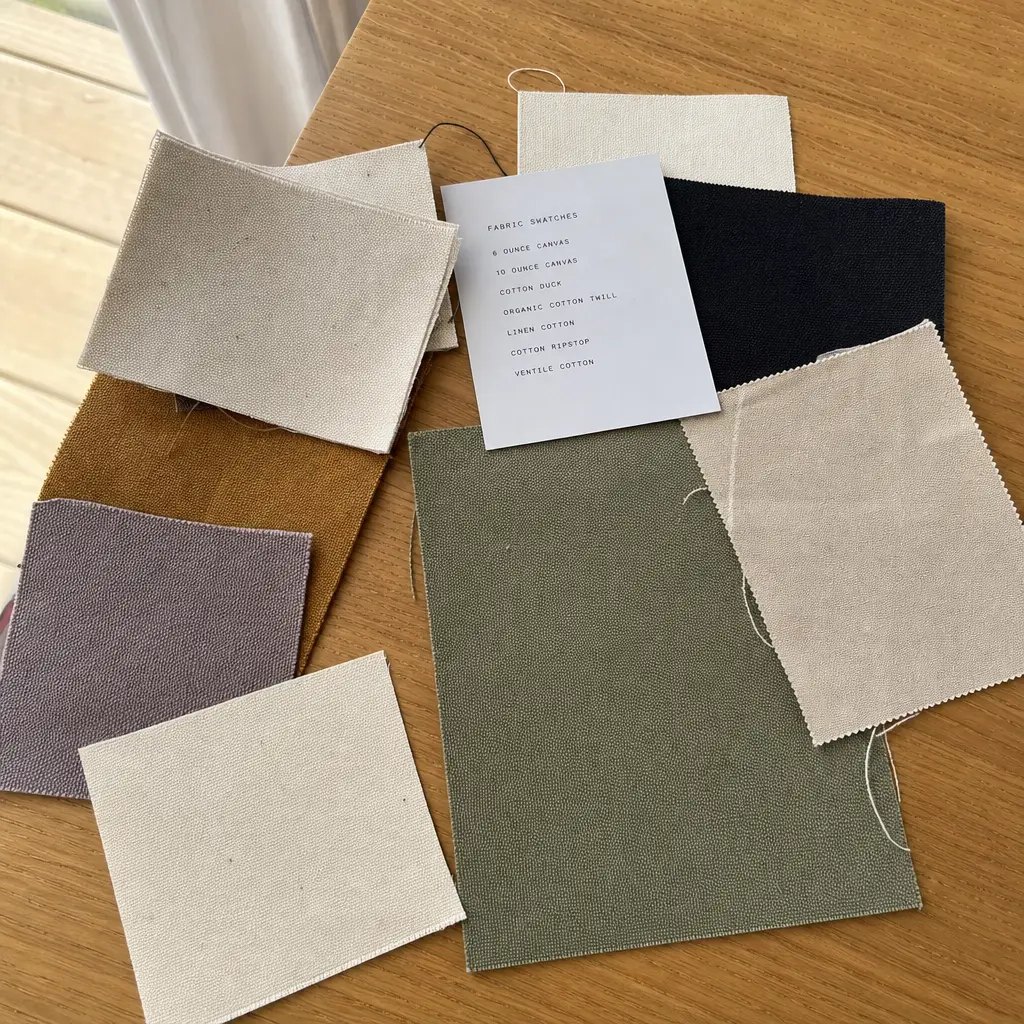
The term cotton canvas is not enough for procurement approval. Ask for oz, GSM, weave, finish, color process, and shrinkage expectation. Natural unbleached cotton may show seed flecks and shade variation. Bleached cotton provides a cleaner base but may have a different hand feel. Dyed cotton can match a brand palette, but it introduces dye-lot control, crocking risk, and potentially higher MOQ. If the bag may be washed or steamed, controlled shrinkage should be discussed before the sample is approved.
- 5 oz / about 170 GSM: economical for light giveaways; limited perceived value and lower load confidence.
- 6 oz / about 200 GSM: common promotional grade; useful for simple member gifts and small event packs.
- 8 oz / about 260-280 GSM: balanced option for studio merchandise, welcome kits, retreat bags, and moderate use.
- 10 oz / about 330-350 GSM: more structured and premium, but heavier, bulkier, and potentially harder to cinch.
- Natural unbleached cotton: warm wellness look, but seed flecks and shade movement must be accepted in writing.
- Bleached cotton: cleaner surface for bright prints, but check hand feel, cost, and minimums.
- Dyed cotton: useful for brand colors; check dye-lot approval, rub fastness, shade tolerance, and MOQ.
- Recycled or organic cotton: require documentation scope before marketing the claim; do not rely on wording alone.
Control finished size, usable capacity, and measurement tolerance
A common adult cotton drawstring backpack size for yoga studio use is around 35 x 45 cm. That size usually accommodates grip socks, a small towel, a water bottle, a folded tee, a notebook, and a welcome leaflet without looking oversized. However, the correct size should be confirmed with actual contents. A retreat manual may require more width; a lightweight gift pack may look better in a smaller bag; a very tall bag may hang awkwardly when worn with long cords.
Finished size affects more than user capacity. It changes fabric yield, cutting efficiency, carton quantity, freight volume, and unit cost. A buyer may approve a sample that is 1.5 cm wider than quoted without noticing, only to find that bulk production is smaller because the factory follows the purchase order rather than the sample. To avoid this, the sample tag should state the exact finished width and height, how measurements are taken, and the allowed production tolerance.
Measure the bag flat on a table after it has relaxed from folding or compression. Do not pull the fabric aggressively to reach the target measurement. Width should be measured from side seam to side seam; height should be measured from top edge to bottom seam. If the top channel takes up a large portion of the height, also check usable internal height and opening width. For non-washed cotton drawstring backpacks, +/-1 cm is a common practical tolerance, but the agreed tolerance should match the construction and finishing.
- Measure finished width flat from side seam to side seam after relaxation.
- Measure finished height from top edge to bottom seam, excluding loose cords and tags.
- Check usable opening width after cords are installed; a tight channel can reduce easy access.
- Pack the real kit and verify that the bag closes without forcing the cords or deforming the top.
- Wear or carry the loaded sample briefly to check hang height, shoulder comfort, and balance.
- Record cord length from channel exit to lower attachment so bulk shoulder fit can be compared.
- Confirm whether sample dimensions are before pressing, after pressing, or final packed dimensions.
- Write tolerance in the purchase order; do not leave size control to verbal agreement.
Review cord, top channel, and lower reinforcement like failure points
The cord system is one of the most important construction areas on a cotton drawstring backpack. It determines how easily the user opens the bag, how comfortable the backpack feels on the shoulders, and how well the product survives repeated use. Yoga buyers often concentrate on the front logo, but most field failures happen at the top channel, cord abrasion points, lower tabs, or side seams.
Cotton cord gives a natural look and pairs well with unbleached canvas, but quality varies. It can fray, shed fibers, or absorb moisture if poorly finished. Polyester cord is usually smoother, more consistent in color, and more abrasion resistant, but it may feel less natural. A typical comfortable studio backpack cord may be around 6-8 mm in diameter, though the correct size depends on the bag weight, channel width, and load. Diameter should be measured, not guessed by touch.
Lower attachment construction should be inspected from the outside and inside. Some bags use fabric tabs inserted into the lower side seams; others route cord through reinforced corners or eyelets. Either method can work if the fabric layers, seam allowance, stitch density, and reinforcement are adequate. For bags carrying bottles, books, or retreat materials, specify bar tacks, extra rows of stitching, or reinforced tabs before quoting, because these details may not be included in a low-cost base price.
- Specify cord material, diameter, color, finished length, and end treatment: knot, heat seal, metal tip, wrapped end, or raw end.
- Check that the top channel width allows the cord to slide smoothly without jamming at side seams.
- Open and close the sample 30-50 times and inspect channel stitches for strain or skipped stitches.
- Load the bag with the intended contents or a defined test weight, then pull both cords firmly.
- Inspect lower tabs from inside the seam to confirm they are caught with enough seam allowance.
- Ask whether bar tacks or reinforcement patches are included in the quoted unit price.
- Reject loose, uneven, or twisted cord installation if it affects comfort, closure, or appearance.
- Confirm whether cord color is stock or custom dyed; custom colors may change MOQ and lead time.
Approve logo decoration on real fabric, not only on a digital mockup
Most yoga studio cotton drawstring backpacks use screen printing because it is efficient for solid logos, studio names, class slogans, simple icons, and one-to-three-color artwork. Water-based screen print is often suitable for natural cotton because it can provide a softer hand feel than heavier ink systems. However, the final result depends on fabric texture, ink color, curing, print size, and artwork detail.
Fine-line lotus marks, small type, circular mandalas, delicate Sanskrit lettering, and QR codes can lose clarity on coarse canvas. Small gaps may close, thin lines may break, and edges may soften. Large solid ink areas can become stiff, crease during packing, or show cracking if curing and folding are not controlled. Dark dyed bags may require a white underbase for opacity, which adds cost, changes hand feel, and introduces registration tolerance between layers.
The sample approval should include actual print size and placement measurements. Do not approve only by visual centering, because a relaxed cotton bag can look centered in a photo even when the logo is off by more than a buyer would accept in bulk. Measure from the top edge, side seams, and bottom seam. For many orders, a print placement tolerance around +/-0.5 cm to +/-1 cm may be practical, depending on bag handling and equipment, but it should be agreed with the factory.
- Request a print strike-off on production fabric for fine artwork, new ink colors, dark fabric, or large solid print areas.
- Confirm print method, ink type, number of colors, screen charges, and whether an underbase is needed.
- Approve artwork at actual size, not only as a scaled PDF or photo.
- Measure logo position from fixed bag edges and seam lines; record the target and tolerance.
- Dry-rub and damp-rub the printed area with a clean white cloth to screen for poor curing or pigment transfer.
- Fold the printed panel according to the intended packing method and inspect after overnight compression.
- Check whether print hand feel matches the product positioning: soft, matte, bold, raised, glossy, or intentionally minimal.
- For QR codes or small text, test readability after printing on fabric, not just in the artwork file.
Define what the pre-production sample is allowed to approve
Not every sample has the same approval value. A fabric swatch approves material and shade. A size sample approves pattern and basic construction. A print strike-off approves artwork, ink color, and print behavior on fabric. A packing sample approves fold method, labeling, bundle count, and carton presentation. A true pre-production sample should combine final bulk fabric, final cord, final thread, final decoration method, final label, final size, and the intended packing approach.
If a factory must make an early sample with substitute materials, that can still be useful, but it must be labeled as a reference sample. For example, the buyer may approve size and construction while fabric GSM and cord color remain pending. This distinction is important because disputes often happen when the buyer assumes the sample is final and the supplier believes some components were only temporary.
Sample version control matters for multi-location yoga groups and repeat orders. Every sample should have a tag with order name, SKU, version number, date, fabric GSM, finished size, cord specification, artwork file name, print color reference, label detail, packing method, and approval signature. The factory should keep a signed counter sample, and the buyer should keep a matching sample for final inspection and future reorders.
- Use Version 1 to test construction if final materials are not ready, but mark substitute components clearly.
- Use a print strike-off when logo detail, ink color, underbase, or print hand feel is a key risk.
- Approve the final pre-production sample only when material, size, decoration, reinforcement, label, and packing match the order.
- Seal or label the approved buyer sample so it is not confused with earlier rejected versions.
- Require the factory to keep a counter sample on the production floor for sewing, printing, and packing reference.
- Attach photos of the signed sample tag to the purchase order file.
- List pending items in writing; do not let open issues become assumed approvals.
- For reorders, compare new fabric swatches and print samples against the retained approved sample.
Run practical buyer-side QC checks before bulk approval
Many common problems can be found without laboratory testing. A studio buyer or procurement team can perform simple checks for load handling, cord function, print curing, odor, size, shade, and packing creases. These tests do not replace professional inspection for large orders, but they help identify issues early enough for the factory to correct the sample before bulk cutting or printing.
The checks should simulate normal use rather than extreme abuse. Pack the bag with the actual intended contents or a defined weight. Open and close the drawstring repeatedly. Carry it by the cords. Rub the logo. Fold it as it will be packed. Leave it compressed overnight. Check the inside seams, not just the front panel. If the sample shows early signs of tearing, ink transfer, heavy odor, or seam opening, the risk is too high to ignore.
Record results in a sample approval worksheet. Include load weight, number of pull cycles, measurement results, rub-test results, defects, photos, and revision requests. Clear feedback with arrows and measurements is more effective than general comments such as "make it stronger" or "logo looks off." Factories can correct specific measurable issues more quickly.
- Load test: pack the intended kit or about 2-3 kg for moderate studio use; carry briefly and inspect stress points.
- Pull test: open and close the drawstring 30-50 times and check cord abrasion, channel strain, and smoothness.
- Corner test: pull each lower attachment firmly and inspect for stitch popping, seam opening, or fabric tearing.
- Dry rub test: rub the printed logo with a white cloth and check for powdering or color transfer.
- Damp rub test: repeat with a slightly damp white cloth and check for bleeding, tackiness, or ink lift.
- Fold test: fold the logo area as packed, compress overnight, then inspect cracking, sticking, and transfer.
- Odor test: seal the sample in the intended bag overnight; check for chemical, mildew, or heavy carton odor.
- Measurement test: confirm finished size, cord length, logo placement, label position, and carton or packing dimensions.
- Lighting test: review fabric and print under daylight and studio lighting to catch shade surprises.
Understand MOQ, quotation structure, and cost trade-offs
MOQ for cotton drawstring backpacks is influenced by more than the number of finished bags. It may be driven by fabric stock, dye-lot minimums, custom cord color, woven label minimums, print setup, artwork version count, packing materials, and carton sorting. A supplier may offer a lower MOQ for stock natural cotton with one-color screen print, then require higher quantities for dyed fabric, custom-colored cords, organic certification documentation, or multiple studio location logos.
When comparing quotes, separate fixed charges from unit costs. Screen setup, artwork preparation, sampling, courier fees, label development, and packing mockups do not behave the same way as fabric, sewing, and printing labor. A 300-piece quote may look expensive because fixed costs are spread across fewer units; a 1,000-piece quote may reduce the unit price but increase inventory risk. Procurement buyers should ask suppliers to show optional upgrades separately, including heavier fabric, reinforced tabs, individual packing, hang tags, and barcode labels.
Version complexity is a common hidden cost for yoga studios with several locations. If every location wants a different color, city name, instructor slogan, or carton mark, the order becomes several smaller production lots. That increases setup time, sorting risk, inspection complexity, and sometimes MOQ. A more controlled approach is to standardize fabric, size, cord, and main logo while changing only a small location line, hang tag, or carton label when necessary.
- Stock natural cotton usually supports lower MOQ than custom dyed cotton.
- Dyed cotton may require fabric shade approval and dye-lot minimums before cutting.
- Each screen color can add setup charge, registration risk, and approval time.
- Custom woven labels and custom cords may have MOQs separate from the bag quantity.
- Heavier GSM increases fabric cost and freight weight at the same time.
- Reinforcement is usually a small cost compared with product failure, but it must be specified in the quote.
- Individual polybags, belly bands, hang tags, and barcode labels add both material and packing labor.
- Multiple artwork versions require stronger version control at printing, inspection, and carton packing.
- Urgent small orders usually need stock materials, simple print colors, and simplified packing.
Approve packing, carton details, and receiving requirements
Packing is part of the product specification, not an afterthought. A cotton drawstring backpack with a large front print can be damaged visually by a hard fold through the logo. Newly printed ink may be sensitive to compression if it is not fully cured. Natural cotton can absorb odor or moisture if cartons are weak, stored poorly, or shipped through humid conditions without protection. The sample approval should include how the bag is folded, bundled, labeled, and cartoned.
The best packing method depends on distribution. A studio selling bags at reception may need individual polybags, paper belly bands, hang tags, barcode stickers, or a clean retail-facing fold. A retreat team that will fill bags manually may prefer bulk bundles without individual bags to reduce unpacking time. A franchise buyer may require cartons marked by location, SKU, color, artwork version, and purchase order number to reduce receiving errors.
Carton math affects landed cost and warehouse handling. Too few pieces per carton increases carton count and freight volume; too many pieces per carton can over-compress prints, deform cords, bend hang tags, and create cartons that are too heavy for easy manual handling. Ask for pieces per inner bundle, pieces per export carton, carton dimensions, net weight, and gross weight before finalizing the purchase order.
- Approve the exact fold direction and confirm the main logo is not sharply creased through the center.
- Define whether bags are flat packed, half folded, quarter folded, rolled, individually bagged, or bulk bundled.
- Confirm pieces per inner bundle and pieces per export carton.
- Request carton dimensions, net weight, and gross weight for freight estimates and receiving planning.
- Specify carton marks: PO number, SKU, color, artwork version, studio location, quantity, and gross weight.
- Use moisture protection or inner liners when shipping natural cotton through humid routes or long transit times.
- Confirm whether retail hang tags, barcode labels, warning labels, or care cards are included in unit cost.
- Check that packing does not cause ink transfer, cord deformation, label bending, or heavy wrinkles.
- Keep one packed sample or approved packing photo in the file for receiving and reorder reference.
Specification comparison for buyers
| Spec decision | Recommended option | When it fits | Buyer risk to check |
|---|---|---|---|
| Fabric weight | 8 oz cotton canvas, typically about 260-280 GSM, with written GSM tolerance | Yoga studio welcome kits, retail counter bags, retreat merchandise, teacher training packs, and moderate daily use | A lighter substitute fabric may pass photos but feel promotional; a heavier fabric raises unit cost, carton weight, and top-channel stiffness |
| Fabric construction | Plain-weave cotton canvas or drill with controlled shrinkage; pre-shrunk if washability is required | Repeat orders, logo placement consistency, and bags that may be steamed, pressed, or lightly washed | Uncontrolled shrinkage can reduce finished dimensions, distort the logo, and create mismatch between approved sample and bulk |
| Finished size | Common adult size around 35 x 45 cm, measured flat after relaxation, tolerance usually +/-1 cm unless otherwise agreed | Fits a small towel, grip socks, water bottle, folded tee, notebook, and welcome leaflet | Small size changes affect fabric yield, carton quantity, usable capacity, cord length, and perceived retail value |
| Cord type | 6-8 mm cotton cord for natural positioning, or polyester cord for smoother abrasion resistance | Cotton suits wellness branding; polyester suits heavier use, frequent opening, and stronger color consistency | Thin cords cut into shoulders; rough cotton cords can shed; low-grade cord may fray, twist, or stretch in use |
| Cord attachment | Lower corner tabs or reinforced bottom eyelet areas with bar tacks or dense lockstitch reinforcement | Retreat kits, teacher training bags, retail merchandise, and bags carrying bottles, books, or apparel | Decorative tabs without enough seam allowance can pull out; poor stitch density can fail before the fabric does |
| Top channel | Folded channel wide enough for cord diameter plus movement, with secure side openings | Bulk orders where smooth opening and closing matter to user experience | A narrow channel jams; excessive bulk at side seams strains stitches and prevents full closure |
| Logo method | Water-based screen print for one to three solid-color logos on natural or light cotton | Yoga studio names, simple icons, class slogans, retreat marks, and franchise merchandise | Fine lines may fill on canvas; dark bags may need an underbase; insufficient curing can cause rub-off or transfer |
| Logo placement | Measured from top edge, side seams, and bottom seam; approved at actual size on production fabric | Brand-standard logos, QR codes, city names, instructor program marks, and retail labels | Visual centering on a relaxed sample can hide bulk variation; packed or filled bags may shift logo appearance |
| Inside finishing | Overlocked or bound seams, adequate seam allowance, reinforced top channel and lower stress points | Retail and membership bags expected to be handled repeatedly | Loose threads, skipped stitches, narrow seam allowance, or fraying may not show in supplier photos but appear after use |
Buyer checklist before sampling
- Define the commercial use before sampling: free giveaway, paid retail SKU, new-member kit, retreat pack, teacher training kit, or franchise merchandise. The durability and finishing requirements are different for each use.
- Approve a physical pre-production sample for retail, paid membership, retreat, teacher training, or multi-location programs. Use photo approval only for low-risk visual revisions after the main physical sample has been reviewed.
- Record the target fabric weight in both oz and GSM, the acceptable GSM tolerance, the fabric color, finish, weave, and whether the sample fabric is final bulk material or a substitute.
- Measure finished width and height flat after the bag has relaxed from folding. For a non-washed cotton drawstring backpack, a practical bulk tolerance is often about +/-1 cm for width and height, but it must be written before production.
- Weigh the complete sample bag and request a fabric GSM report or swatch weight confirmation. A complete bag weight is not a substitute for GSM, but it helps detect material or cord changes in bulk.
- Specify cord material, diameter, color, finished length, end treatment, top-channel width, and lower attachment construction. Do not approve simply as standard cotton cord.
- Load the sample with the actual intended contents or a defined test load, such as 2-3 kg for moderate studio use, then pull both cords and inspect lower tabs, side seams, and top-channel stitching.
- Rub the printed logo with a dry white cloth and a slightly damp white cloth. Note any powdering, tackiness, color transfer, cracking, or ink lift before approving print curing.
- Fold the sample in the intended packing method, leave it compressed overnight, and check whether the print sticks, creases sharply, transfers, or cracks along fold lines.
- Compare fabric shade and print color against approved references under daylight and typical studio lighting. Warm studio lighting can make natural cotton, off-white, beige, and muted ink colors look different.
Factory quote questions to send
- Is the quoted fabric greige, natural unbleached, bleached, dyed, washed, recycled cotton, organic cotton, or certified organic cotton? What certificates or transaction documents are included if any claim is made?
- What is the target fabric weight in oz and GSM, and what production tolerance will you guarantee? For example, will bulk be controlled within +/-5% GSM?
- What fabric construction is quoted: plain canvas, drill, twill, muslin, or another weave? Is the fabric pre-shrunk or controlled for shrinkage?
- What shrinkage should we expect in width and length after one gentle wash or steam exposure, if the bag is expected to be washable or steam-pressed?
- Is the pre-production sample made from the same bulk fabric, cord, thread, label, ink, and packing method as the quoted production? If not, list every substitute component.
- What is the finished bag size measured flat, and what tolerance applies after sewing, pressing, and packing? Does the quoted size include the top channel?
- What cord material, diameter, finished length, color, end finishing, and lower corner reinforcement are included in the base price?
- Are bar tacks, double rows of stitching, reinforced fabric tabs, wider seam allowance, heavier thread, or bound seams included, or are they priced as upgrades?
- Which logo method is included: water-based screen print, pigment print, plastisol-style ink, heat transfer, embroidery, woven label, digital print, or another method?
- How many print colors, screens, setup charges, artwork versions, print placements, and strike-offs are included in the quoted price?
Quality-control points to confirm
- Finished size should be measured flat after the bag has relaxed. A common tolerance for non-washed cotton drawstring backpacks is about +/-1 cm for width and height, but washed, garment-dyed, or handmade effects may require a wider written tolerance.
- Fabric GSM should be verified by supplier report, cut swatch, or agreed internal method. For commercial production, a practical tolerance such as +/-5% should be agreed before bulk cutting.
- Fabric shade should be compared to the signed swatch or approved sample under consistent light. Define acceptable natural cotton seed flecks, slubs, specks, and shade variation before production.
- Fabric shrinkage should be discussed if the bag may be washed, steamed, or humid-stored. If washability is claimed, request a simple dimensional change test and print appearance check after washing.
- Cord diameter should be checked with a caliper or diameter gauge, not only by touch. Bulk cords should match the approved diameter, color, softness, and finished length.
- Cord pull and attachment strength should be checked by loading the bag and pulling both cords repeatedly. Inspect lower tabs, side seams, and top-channel stitching for seam opening, stitch popping, or fabric tearing.
- Top-channel width should be compatible with cord diameter. The cord should slide smoothly without jamming at side seams or creating excessive stress on the folded channel.
- Print placement should be measured from fixed edges and seam lines. Do not judge placement from a hanging, folded, or filled bag without measurement.
- Ink curing should be checked by dry rub, damp rub, light scratch, fold, and overnight compression checks before releasing bulk production or shipment.
- Artwork detail should be reviewed at actual print size on the production fabric. Coarse canvas can soften sharp lines, close small gaps, and reduce QR-code readability if artwork is too fine.