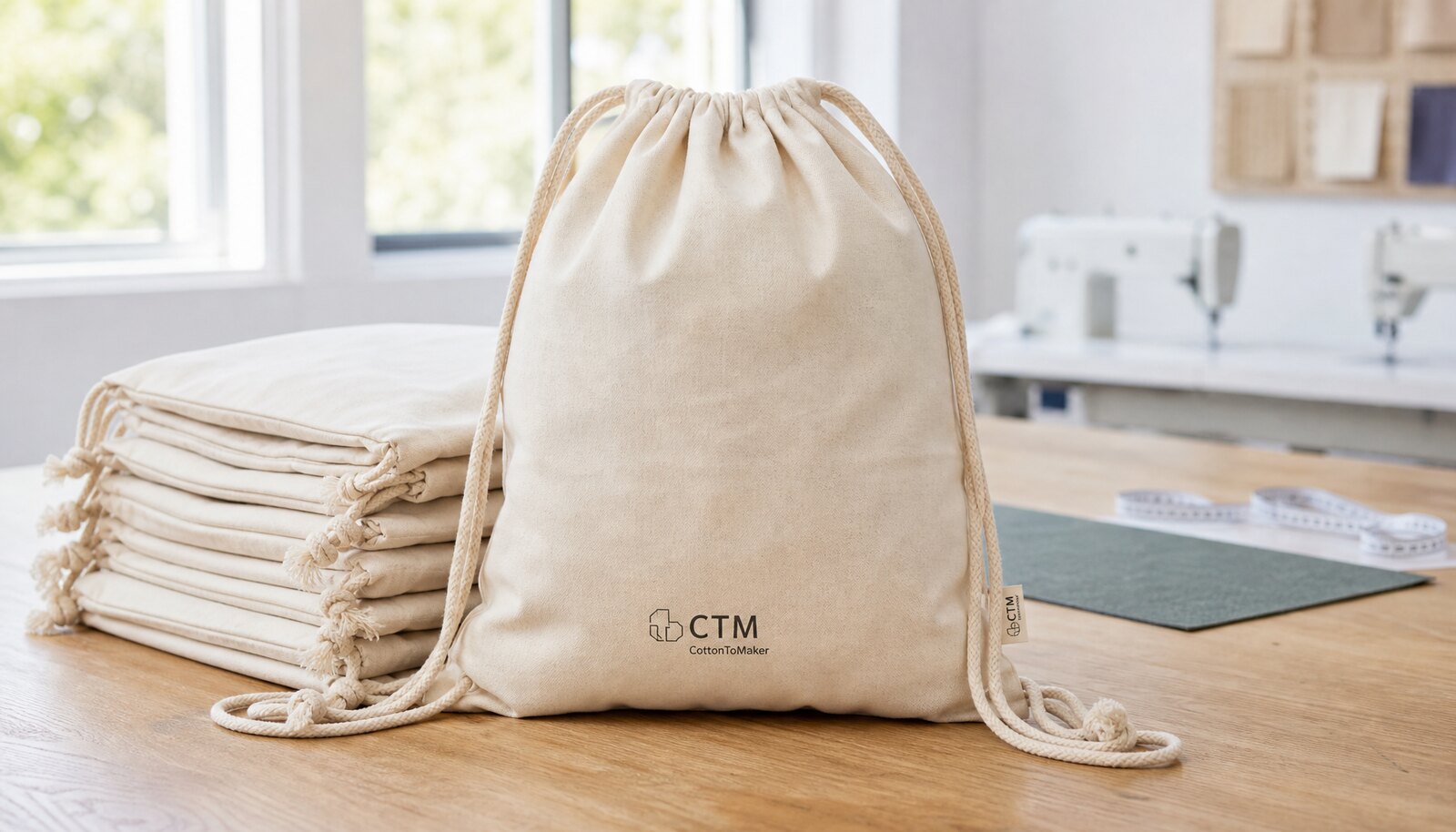
1. Why this RFQ deserves more care than the product looks like it needs
Cotton drawstring backpacks are simple to the eye, which is exactly why procurement teams can lose margin on them. A supplier quote may look competitive while quietly changing the fabric weight, stitch density, cord quality, print method, or packing method. By the time the cartons arrive, the bag may still be usable, but it may not look or feel like the product your gift shop actually needs.
For gift-shop programs, the bag has to satisfy two different buying logics at once. Retail teams care about shelf appeal, hand-feel, and the way the printed logo sits on the front panel. Procurement teams care about repeatability, landed cost, and the ability to reorder the same item without re-approving the entire program. An RFQ that is too loose usually creates two problems: the first sample looks better than bulk, or the quote excludes the cost of the features that matter most.
The best RFQ for this category acts like a short technical brief. It should let suppliers quote the same finished item, using the same assumptions about decoration, packing, inspection, and shipping basis. That is how you get useful comparison data instead of a stack of prices that cannot be compared without another round of clarification.
- Write the RFQ as a purchase spec, not as a creative brief.
- Use one SKU definition for each size and artwork version.
- Make supplier assumptions visible instead of letting them guess.
2. Start with the use case: resale, packaging, or promotion
Before you write a spec line, decide what the bag is actually doing in the gift shop. A cotton drawstring backpack used as a resale item needs a better finish, cleaner stitching, and a more balanced hang on display. A bag used mainly as gift packaging can be lighter and simpler. A bag used for events or promos often needs the fastest lead time and the lowest total landed cost, even if the finish is basic.
This distinction matters because it changes the acceptable tradeoff between price and presentation. If the bag is part of a premium branded set, the print position and seam finish can influence the store’s perception of the entire basket or bundle. If the bag is only a carrier for other items, the buyer may care more about bulk packing, carton efficiency, and low unit cost. Put that decision into the RFQ so suppliers know whether they are quoting retail-grade or utility-grade product.
A practical way to write the use case is to include one short line in the inquiry: what the bag will carry, where it will be sold, and whether appearance or cost has priority if there is a conflict. That one sentence often prevents mismatched quotes better than several pages of generic detail.
- State whether the bag is for resale, giveaway, amenity use, or gift packaging.
- Include the approximate load or contents the bag must carry.
- Say whether shelf appearance or lowest landed cost is the primary priority.
3. Build the bag spec before the artwork spec
Many RFQs start with a logo file, but procurement gets better results when the physical build is defined first. Size, fabric, cord, and sewing construction determine the true unit cost and the visual result. Artwork is easier to change than construction, and a strong bag body will make a simple print look better than a weak bag with a complicated graphic.
For this category, specify finished dimensions rather than only cut size. Finished size is what the buyer and store team see after the bag is sewn and cinched. If you need a standard retail shelf profile, also state whether the bag should hang flat or have enough body to hold a shape when empty. For example, a lightweight souvenir item may work with a softer drape, while a retail tote-like backpack often benefits from a more substantial hand-feel.
Cotton type matters as well. Natural cotton can have visible fiber variation, which is normal and should not be treated as a defect unless your brand standard says otherwise. Bleached or dyed cotton looks more consistent on shelf, but it usually costs more and can add lead time if the color is custom. If the bag will be printed, make sure the supplier tells you how the chosen fabric weight affects ink opacity, registration, and print surface smoothness.
Construction details should be explicit. Ask for a folded top hem, the depth of the cord channel, the type of side seam finish, and any bartacks at stress points. Those items are cheap to specify and expensive to correct after bulk order. If the bag is expected to carry heavier merchandise, ask the factory to reinforce the bottom seam and cord tunnel; do not leave that decision to the factory’s normal style sheet.
- Define finished width and height in centimeters or inches, not only the style name.
- Specify cotton type, target fabric weight, and whether natural variation is acceptable.
- State seam style, hem style, and any reinforcement points in the RFQ.
4. Fabric weight, cord choice, and construction: what to ask for and why
Fabric weight is one of the most abused numbers in this category because it sounds objective but is often quoted loosely. Buyers sometimes hear a fabric range rather than a measured result, and the difference shows up immediately in hand-feel and drape. For gift-shop sourcing, the point is not to chase the highest GSM number; it is to match the bag’s use case and shelf positioning. Thin fabric can be acceptable for low-cost packaging or giveaway programs, but it can look flat and less durable in retail. Heavier fabric feels more premium, but it increases cost and can make the bag less flexible if the pattern is not cut well.
A sensible RFQ should ask the supplier to recommend a fabric range and explain the tradeoff. That forces the supplier to show their judgment rather than simply quoting the cheapest stock cloth. Ask whether the quoted fabric is plain weave, whether any pre-shrinking or finishing is used, and whether fabric lot variation is controlled before cutting. If the factory works from greige or partially finished cloth, ask how they manage shade consistency across the roll.
Cord choice deserves more attention than it usually gets. A slightly better cord diameter can improve pull feel and reduce customer complaints about fraying or bunching. Ask for cord material, diameter, finish, and length after knotting or locking. If the bag is meant to hang in a gift shop, cord symmetry matters visually. If the cords are uneven or the knot sits awkwardly, the product looks cheaper even when the fabric is acceptable.
Ask for a sample specification that includes how the top tunnel is formed and whether the cord exits are reinforced. The tunnel is where low-cost bags often fail after repeated pulling. If the bag is sold as a keepsake or reusable retail item, that is a real quality issue, not a cosmetic one.
- Ask for a fabric range recommendation instead of accepting a vague “standard cotton” answer.
- Confirm cord diameter, finish, and length after assembly.
- Require reinforcement at cord exit points if the bag will be used repeatedly.
5. Print method, artwork limits, and the durability claims you should verify
Decoration is where quote comparisons often break down. Two suppliers may both say “one-color print,” but one is quoting a screen print with good opacity and curing control while the other is quoting a transfer process with lower setup and different wear behavior. If the bag is for a gift shop, the print needs to look clean on day one and stay acceptable through normal handling in-store and during customer use.
Screen printing is usually the first route to compare for simple logos because it tends to be stable, repeatable, and cost-efficient at volume. However, the RFQ should still define the number of colors, the print area, the print position, and the accepted visual result. Do not rely on a supplier to choose the image scale for you. If the logo is too small, it disappears on the shelf. If it is too large, it can distort when the bag cinches.
Transfer methods can make sense for short runs, multicolor graphics, or seasonal art, but they change the test you should ask for. Instead of asking only whether the print “lasts,” ask for a concrete rub test or adhesion check. If the supplier claims strong durability, request how they measure it. A useful RFQ question is: what test do you use to check whether the print cracks, lifts, or offsets after handling, folding, and carton compression?
If your brand is sensitive to appearance, ask for a strike-off on the actual bag fabric, not just a paper proof. Cotton surface texture changes ink behavior. A flat mockup can hide opacity problems, registration drift, or print positioning issues that appear immediately on a sewn sample.
- Define artwork size, placement, and color count in the RFQ.
- Ask what durability test the supplier uses for the proposed print method.
- Approve a sewn-and-printed sample, not just a digital proof.
6. MOQ, sample cost, and quote structure: how to compare suppliers on equal terms
MOQ often looks like a simple number, but in practice it is a bundle of limits. Fabric booking, print setup, cord sourcing, packing materials, and sewing line efficiency can each create a different minimum. If you compare only the unit price, you can miss the real cost of getting the order started. A supplier might offer a low price at 3,000 units but charge heavily for sample revisions, special packing, or custom cord color. Another might quote higher per piece but have a lower setup burden and faster release time.
The most useful way to structure the RFQ is to ask for three quote routes. First, a stock-fabric route with standard cord and one-color print. Second, a stock-fabric route with your requested print and retail packing. Third, a fully custom route if you need custom fabric, color, or finish. This reveals what is truly driving cost. It also helps you understand which levers matter if you later need to reduce MOQ or protect margin.
Sample cost should be handled separately from bulk price. Ask whether sample fees are credited against the first order, what changes trigger a revised sample charge, and whether the sample can be made on final fabric or a close substitute. If the supplier only offers a “look sample” and not a sewn production sample, do not treat it as an approval basis for bulk. You need to know whether the sample matches the factory route the bulk order will actually use.
For quote comparison, request the supplier’s price basis in the same layout every time: unit price, setup charge, sample charge, packing charge, local charges, Incoterm, estimated freight, and total landed cost per destination. If a supplier resists this format, that is a signal that their quote may not be decision-ready.
- Ask for stock-fabric, custom-print, and fully custom pricing separately.
- Clarify whether sample charges are refundable or creditable.
- Compare unit price and total landed cost, not unit price alone.
7. Supplier vetting: how to separate a real factory from a middleman risk
A quote is only useful if you know who actually controls the bag, the print, and the packing. In this category, a buyer can receive a polished offer from a trading company that does not own the sewing line or the print workshop. That is not automatically a problem, but it changes how you manage quality and schedule. The risk is not simply that a middleman exists; the risk is that the responsible party is unclear when something goes wrong.
Ask the supplier to identify the sewing factory, the printing location, and the packing site. Request photos of the production area, the sewing machines used for the bag style, and examples of similar completed cartons. If they are a direct factory, they should be able to speak clearly about machine types, line capacity, and internal QC steps. If they cannot name the actual production site, the buyer should treat the offer as a managed sourcing service, not a factory quote.
One practical vetting test is to ask a technical question that a real bag maker should answer directly: how are the cord tunnel, top hem, and stress points reinforced? Another is to request the inspection method they use before packing. A genuine producer should be able to explain stitch density, seam allowance, and how they handle loose threads or repair limits. If the answers stay generic, or if every question is redirected to “we will check with our factory,” the buying team should be cautious.
For trading-company quotes, ask what changes from sample to bulk if the factory changes. This is especially important when the print subcontractor is not fixed. If the bag body is sewn in one site and the print happens elsewhere, write that into the purchase order so the responsibility chain is visible. A buyer should know exactly who owns a seam defect versus a print defect versus a packing mistake.
- Ask for the actual sewing, printing, and packing locations.
- Verify whether the quote comes from a factory, a trading company, or a mixed model.
- Require named responsibility for sewing defects, print defects, and packing errors.
8. A usable RFQ template structure for procurement teams
A useful RFQ is short enough for a supplier to answer accurately and detailed enough that the response can be compared without follow-up calls. The most effective format is usually one page of commercial data plus one page of technical requirements and artwork notes. You do not need a long narrative; you need clarity. Each line should either define the product, remove ambiguity, or create a decision point for suppliers.
Start with commercial fields: product name, size, target quantity, destination, trade term, delivery window, and whether the order is repeatable. Then add technical fields: fabric type, fabric weight range, cord type, closure style, print method, color count, artwork size, and packing requirements. Finally add acceptance fields: sample approval rule, QC threshold, carton inspection requirement, and what happens if the first run misses spec. This is the part many buyers leave out, and it is the part that helps later when a supplier asks for scope relief.
It also helps to include a “supplier to confirm” section. That section should ask the supplier to repeat back the assumptions they used to price the order. If they quote on a different print method, different bag size, or different pack-out than the RFQ requested, you can catch it early. In procurement terms, that is more valuable than a long list of decorative preferences.
For more efficient comparison, ask every supplier to quote using the same line items. If one supplier blends sample, setup, and freight into a single number, request an itemized rewrite. An RFQ that produces itemized answers is easier to negotiate and easier to hand off to finance or logistics for approval.
- Use a one-page commercial block plus a one-page technical block.
- Include a supplier-confirmation section so assumptions are visible.
- Require itemized quotes to support landed-cost comparison.
9. QC acceptance criteria you can paste into the RFQ
Quality control should be written so an inspector can apply it without interpretation. Generic phrases like “good workmanship” are too vague for a purchase order. The RFQ should list the measurable items the inspector will check, the defect types that are rejectable, and the acceptable ranges for the rest. If the supplier says the bag is “within normal tolerance,” ask them to define normal in centimeters, stitches, and defect counts.
A practical starting point is to set separate standards for critical, major, and minor defects. Critical defects are those that make the bag unusable or unsafe, such as open seams, missing cords, or severe contamination. Major defects are those that affect function or retail acceptance, such as crooked print placement, missed bartacks, or obvious size out-of-range issues. Minor defects are cosmetic issues that do not affect use but still matter in retail, such as loose threads or slight shade drift within an agreed band.
For inspection methods, ask for a random sampling plan and the test actions that will be performed. That can include visual inspection, measurement of dimensions, pull checks on the cord and seam, and carton count verification. If you want something truly actionable, write the defect examples right into the RFQ: seam skip over a defined length, print misregistration beyond the agreed limit, visible stains, broken needle holes, or a cord that slips out after cinching. The more concrete the list, the less room there is for argument at inspection.
If the product will be sold in a retail environment where first impression matters, add a visual acceptance line. For example: bags must hang evenly, lie flat without twisting, and show no obvious puckering at the top hem. That may sound obvious, but it is exactly the kind of issue that is ignored if it is not written down.
- Use critical/major/minor defect categories.
- Define measurable tolerance bands for size and print placement.
- List concrete reject examples: open seams, stains, misregistration, cord failure, and visible puckering.
10. Packing, freight, Incoterms, and a side-by-side quote comparison framework
A bag quote is not complete until the buyer knows how it moves to destination. Freight and packing assumptions can change the true landed cost more than the price difference between two suppliers. If one factory packs 50 pieces per carton and another packs 100, the carton count, gross weight, pallet efficiency, and freight cost all change. The cheapest ex-factory quote can become the most expensive delivered order once cartons are counted properly.
Ask for the Incoterm in the RFQ: EXW, FOB, CIF, DDP, or another basis you use internally. If you are comparing suppliers across regions, keep the trade term consistent so the numbers can be compared. For freight-sensitive gift-shop orders, request carton dimensions, gross weight, and estimated carton cube. These three numbers help logistics teams estimate whether the shipment fits sea freight, consolidation, or a faster air fallback if the season slips.
The best way to compare offers is a simple side-by-side framework. Put each supplier in a column and list the same cost lines across the rows: unit price, sample fee, setup fee, packing cost, internal freight, export handling, destination freight, duty estimate, and total landed cost. Add another line for lead time and another for payment terms. This format exposes the real differences quickly. It also prevents procurement from approving a low unit price that only looks low because it excludes freight or packing.
If you need a replenishable gift-shop line, ask for the carton spec and pack-out to stay stable across reorders. Stable carton data makes warehouse planning easier and reduces the chance that a reorder suddenly needs different palletization or receiving instructions. That is a practical savings, not just an operational nice-to-have.
- Compare quotes on the same Incoterm and the same pack-out basis.
- Request carton dimensions, gross weight, and carton count for each SKU.
- Use a landed-cost table, not a unit-price-only decision matrix.
Specification comparison for buyers
| Sourcing route | How the quote is usually structured | Commercial advantages | Main risk or tradeoff | Best for gift-shop buyers when... |
|---|---|---|---|---|
| Direct factory with bag sewing in-house | Usually the lowest ex-factory price, with separate lines for fabric, print setup, sewing, packing, and sometimes sampling | Better control over construction, easier sample-to-bulk matching, stronger accountability on seam and stitch defects | Requires more due diligence to confirm they really sew bags themselves and are not outsourcing print or finishing | You want repeat orders, stable specs, and the ability to hold one factory accountable for production quality |
| Trading company with a fixed factory partner | Often a single blended price; may include sourcing, coordination, and export handling in the margin | Can quote faster, support mixed assortments, and help if your team needs one contact for several SKUs | Factory identity may change if not locked early; sample quality can differ from bulk if subcontracting is not controlled | You need speed, mixed products, or a buyer-side team that values coordination more than the lowest possible unit cost |
| Print subcontracting model under a bag supplier | Bag and print may be split into separate cost elements or hidden in one bundled price | Useful when the bag maker is strong on sewing but not decoration, especially for basic bag bodies with simple graphics | Higher risk of blame-shifting if print adhesion, registration, or curing fails because the print house is not contractually visible | You are buying decorated bags and want clear responsibility for the decoration step rather than only the finished carton |
| Stock bag with decoration only | Lowest setup burden; quote often focuses on print, label, or packaging rather than full custom sewing | Fastest path to small runs and seasonal programs; good when the shop can accept standard fabric and standard cord color | Less control over size, fabric hand-feel, and retail differentiation; stock may be discontinued after one season | You need a short lead time, smaller MOQ, or a simple branded giveaway rather than a fully bespoke retail item |
| Fully custom fabric, color, and packing program | Highest quote complexity because weave/dye, cord color, print, labels, and carton spec all affect cost | Best brand consistency and shelf differentiation; easier to build a private-label look across gift-shop locations | MOQ and lead time rise quickly; more steps can fail if sample approval is not tightly managed | You need a long-term gift-shop line and can justify setup cost across multiple reorder cycles |
| Material | 6-10 oz cotton canvas, 210D polyester, rPET, or blended cotton with shrinkage and colorfastness expectations set before sampling | Before price comparison | Different cloth weights, backing, or certification claims make quotes hard to compare | |
| Construction | cord diameter, eyelet or reinforced channel, bottom corner reinforcement, seam allowance, bar-tack position, and load target | Before sampling | Weak stress points create returns and failed inspections | |
| Decoration | screen print, transfer, embroidery, woven label, or drawstring tag tested against folding and abrasion | Before artwork approval | The wrong method can crack, bleed, pucker, or fail on the chosen fabric |
Buyer checklist before sampling
- Define the selling channel first: souvenir resale, museum shop, hotel amenity, event bundle, or retail gift packaging.
- Write one SKU spec per size and decoration version so suppliers cannot mix assumptions in one quote.
- Fix finished dimensions, target fabric weight, cord type, and print placement before asking for price.
- State whether the bag must hold a practical load, such as folded apparel, books, or a small gift set.
- Ask for sample cost, production setup charge, and whether the sample fee is credited after bulk order.
- Request separate pricing for stock fabric, custom fabric, custom cord color, and different print methods.
- Ask for Incoterms, port or destination basis, and whether freight is included or excluded.
- Demand a written QC standard covering size tolerance, stitch quality, print defects, odor, and carton accuracy.
- Require one signed physical reference sample for procurement and one retained at the factory.
- Ask suppliers to identify whether sewing, printing, and packing are done in-house or subcontracted.
Factory quote questions to send
- What is your exact manufacturing role: direct factory, trading company, or factory plus print subcontractor? Please name the sewing location and the decoration location.
- Which parts of this order are produced in-house, and which parts are outsourced to another site?
- What fabric weight range do you recommend for this bag size and retail price point, and why?
- Please quote separately for stock natural cotton, bleached cotton, and custom-dyed fabric if available.
- What is the finished size, cut size, seam allowance, and cord tunnel depth you will use for this quotation?
- What is the maximum print area, print method, color count, setup charge, and reprint charge if artwork changes after sampling?
- Is the quoted MOQ driven by fabric booking, printing setup, sewing line efficiency, or packing materials?
- What are the sample fee, sample lead time, and sample revision lead time? Is the sample fee refundable against bulk?
- What are your standard pack-out quantities, polybag method, carton size, and gross weight by SKU?
- Which Incoterm is this price based on, and what local charges are excluded?
Quality-control points to confirm
- Use a written AQL standard for production inspection. A common starting point for general soft goods is AQL 2.5 for major defects and AQL 4.0 for minor defects, unless your internal standard is stricter. Require the supplier or your inspector to state the sampling plan on the inspection report.
- Size tolerance: define finished width and height separately, for example ±1.0 cm on small bags and ±1.5 cm on larger bags, then confirm that the bag remains visually square and functional after cinching.
- Fabric defects: reject holes, slubs that break through the weave, oil stains, color contamination, and visible thin spots that show through normal indoor light when the bag is held at arm’s length.
- Stitching: inspect seam skip, open seam, loose thread, uneven stitch density, puckering at the top hem, and missed bartacks. A practical RFQ line is to reject any open seam, any broken seam line, or any unsecured stress point.
- Cord performance: both cords should pull evenly, slide without sticking, and not fray excessively at the cut end. Ask for a pull-and-release check on a sample of units, and reject cords that jam, slip out, or unravel after normal cinching.
- Print quality: check color match against the approved sample, sharp edge definition, registration between colors, and adhesion after rubbing. Reject cracked, sticky, offset, or under-cured print; ask the factory to confirm the curing method and test standard used.
- Print position: define the allowed positional drift, such as no more than 1.0 cm from the approved centerline or top reference point, and reject artwork that visibly tilts, sits too low, or is cut off by a seam.
- Odor and cleanliness: bags should be free from strong finishing chemical odor, visible dust, oil marks, and loose trim threads. If your retail channel is sensitive, add a simple smell check at carton opening before store acceptance.
- Packing accuracy: count by inner pack and carton, verify barcode or carton mark accuracy, and require a packing list that matches carton contents. Reject mixed sizes in the same carton unless the PO explicitly allows it.
- Carton strength: if the bags are shipped in high cube volumes or stack on a distribution pallet, ask for a carton compression or drop-test method from the supplier or test lab and define whether cartons must remain intact after normal handling.