Start With the Reorder Use Case, Not the Bag
A cotton drawstring backpack reorder for a coffee roaster should begin with the reason the bags are needed. A bag sold beside whole bean coffee has different requirements from a bag handed out at a trade show or packed into a wholesale partner kit. If procurement treats every reorder as a repeat of the last PO, the order may arrive technically correct but commercially wrong for the next campaign.
Define the use case before asking for quotes. A cafe merch reorder may need cleaner folding, individual polybags, barcode labels, and more consistent print placement. A trade show giveaway may prioritize unit cost, carton count, and delivery date. A seasonal gift bundle may need the bag to fit one 12 oz coffee bag, a tasting card, and a small brewing accessory without looking overstuffed.
This step also prevents unnecessary specification creep. Not every reorder needs heavier fabric, a new label, or a more expensive print method. The strongest reorder brief tells the supplier what must stay the same, what can change, and what business outcome the bag supports.
- State the intended use: retail merch, event giveaway, subscription insert, wholesale kit, holiday bundle, or staff item.
- List the contents the bag must hold, including coffee bag size, cards, samples, coupons, or small accessories.
- Identify whether the priority is retail finish, lowest landed cost, fast delivery, or exact match to a previous production run.
- Separate fixed specs from flexible specs before requesting quotes.
Build a Reorder Spec Pack From the Previous Order
The most useful procurement document for a reorder is a compact spec pack built from the last approved order. Do not rely on memory, supplier screenshots, or a product page description. Pull the previous PO, invoice, approved artwork, sample approval email, packing photos, and retained physical sample. These records reduce ambiguity and make it easier to compare supplier quotes on equal terms.
Measure the retained sample instead of copying only the old supplier's stated dimensions. Record flat width, height, print size, print distance from the top edge, print distance from side seams, cord diameter, cord length, grommet or eyelet type, seam style, label placement, pieces per carton, and carton dimensions if available. If the last order had issues, record those too. A reorder is the best time to correct weak seams, poor folding, missing carton marks, or inconsistent print color.
For coffee roasters, the spec pack should include practical fit notes. For example, state whether the bag needs to hold one flat-bottom 12 oz coffee bag, two retail bags, a sample flight, or event materials. Suppliers can quote more accurately when they understand the actual load and presentation standard.
- Attach front, back, inside, closure, print, label, and packing photos of the approved sample.
- Include artwork files in editable vector format where possible, plus Pantone or brand color references.
- Record measurements from the physical retained sample, not only from the old invoice.
- Flag previous defects or customer complaints so the reorder improves instead of repeats them.
Choose Fabric Weight for Feel, Load, and Freight
Fabric weight is one of the first specs to verify because it affects hand feel, durability, print behavior, carton weight, and freight. Many branded cotton drawstring backpacks fall into a practical range around 120 to 200 GSM, with 140 to 160 GSM often used when buyers want a balance between cost and perceived quality. The right choice depends on whether the bag is a light event giveaway or a reusable cafe merch item.
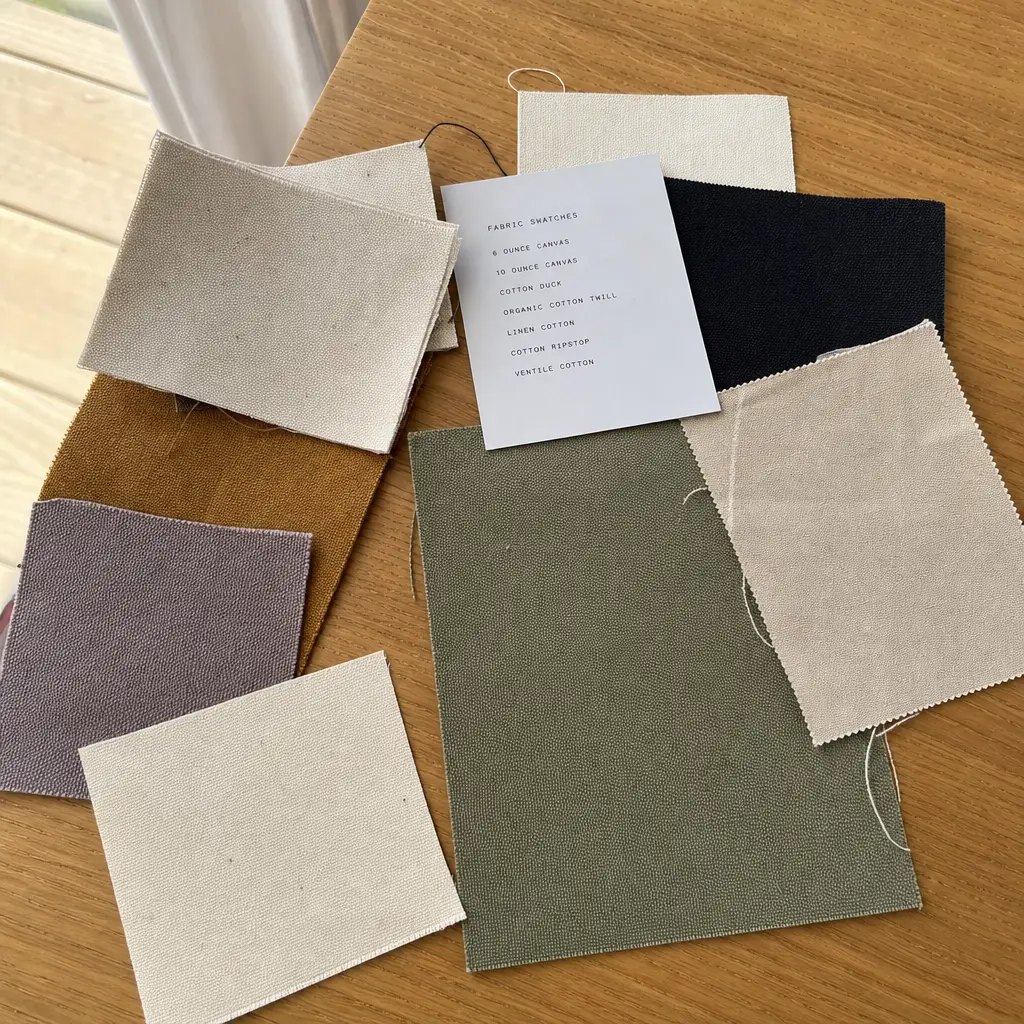
A reorder should confirm the actual fabric available now. Cotton shade, flecking, weave density, and shrinkage can vary between fabric lots. Natural cotton is especially sensitive to visual variation because the appeal often comes from an unbleached or minimally processed look. Ask whether the supplier is using the same fabric source as before and whether the current lot can be swatched before sampling.
Avoid setting a GSM number without a tolerance. Instead, define a target and acceptance range. For example, a buyer may specify 150 GSM with a plus or minus 5% control tolerance, subject to sample approval. If the supplier proposes a substitute, require a swatch and pre-production sample before authorizing bulk cutting.
- For light giveaways, consider whether 120-140 GSM is acceptable for the brand impression and expected load.
- For cafe retail and reusable bags, compare 140-160 GSM or heavier options through samples, not only price sheets.
- For premium merch, heavier cotton may improve feel but can increase landed cost through weight and cube.
- Ask for fabric lot confirmation before bulk production if shade consistency matters.
Keep Print Matching Under Control
Print drift is one of the most visible reorder problems. A logo that was warm white on the first run can become bright white on the next. Fine text can fill in, a small icon can lose detail, and a centered print can shift low enough to look accidental. These issues are not unique to coffee roasters, but they are more noticeable when the bag sits in a cafe retail environment beside carefully designed packaging.
Specify the same print method if the goal is continuity. Water-based screen print, plastisol, heat transfer, digital print, and woven labels each create a different surface and hand feel. Heat transfer can be useful for low quantities or complex graphics, but it will not feel like a screen print. A woven label can look more retail-ready but changes the visual hierarchy of the bag. If the method changes, treat the order as a new product approval, not a simple reorder.
Request a strike-off on the actual bag fabric, especially for natural cotton where the base color affects ink appearance. For simple roaster logos, confirm ink color, opacity, edge sharpness, and print placement. For multi-color artwork, add registration checks. If a supplier claims the old screen can be reused, ask whether it is still in usable condition and whether any storage or setup charge applies.
- Provide vector artwork, Pantone references, print dimensions, and placement measurements.
- Ask for a fabric strike-off instead of approving only a digital mockup.
- Compare the strike-off with the retained sample under consistent lighting.
- Define whether minor shade variation is acceptable or whether a revised strike-off is required.
Check Construction Details That Affect Reuse
The closure system is easy to under-specify because it looks simple. In practice, cord material, cord diameter, channel stitching, reinforcement, grommet quality, and knot finishing all affect how the backpack performs after repeated use. A roaster giving the bag to loyal customers or selling it as cafe merch should care about whether the drawstring pulls smoothly and whether the lower corners hold under normal load.
Start by matching the previous sample. Measure cord diameter and length, inspect whether the cord is cotton or polyester, and note whether the lower attachment uses a grommet, sewn tab, eyelet, or reinforced seam. Cotton cord may better match a natural cotton bag, while polyester may resist abrasion differently. The choice should be deliberate, not whatever the supplier has available at the time of reorder.
Be careful with compliance statements around metal components. If bags are sold into markets with chemical or material restrictions, ask the supplier for relevant declarations or test reports rather than relying on a broad verbal promise. Requirements can depend on market, product claims, component chemistry, and retailer policy.
- Open and close the sample repeatedly to check cord movement and channel stitching.
- Confirm whether lower corners are reinforced and how the cord is secured.
- Ask the supplier to identify the grommet, eyelet, or hardware material if metal parts are used.
- Do not approve a substitute cord or closure component without a physical sample.
Plan Quantity Around Roastery Demand Signals
MOQ is not only a supplier constraint. It is a demand planning decision. Coffee roasters often reorder backpacks around events, seasonal coffee launches, subscription promotions, wholesale partner programs, or cafe retail sell-through. The right reorder quantity should reflect actual usage, storage limits, cash flow, and the next likely reorder window.
Review how the last batch moved. Separate bags sold at retail from bags given away, packed with coffee bundles, used internally, or transferred to wholesale accounts. If the last order disappeared quickly during a single event, that does not automatically mean the same quantity is needed for normal cafe sales. If bags sat in storage because the pack size was too high, ask for a split shipment or a lower MOQ quote, even if the unit price rises.
Ask suppliers to quote price breaks clearly. A quote for 300, 500, 1,000, and 2,000 pieces can show whether a higher quantity is truly economical after storage and freight. Also clarify MOQ by bag color and print design. A natural cotton version and a black cotton version may not be treated as one MOQ if fabric, print setup, or production scheduling differs.
- Calculate average monthly use by channel: cafe sales, events, online bundles, wholesale kits, and internal use.
- Add a buffer only for known demand drivers, such as a confirmed trade show or holiday campaign.
- Request price breaks and MOQ rules by color, design, and print location.
- Avoid ordering a higher quantity only to reach a lower unit price if storage or obsolescence risk is high.
Map Lead Time Backward From the Event Date
A reorder can be faster than a first order, but only if fabric, artwork, components, capacity, and approvals are already aligned. Build the schedule backward from the date the bags must be in your warehouse or cafe, not from the date you want to place the PO. Include time for quote review, sample production, sample shipping, internal approval, bulk production, inspection, export handoff, freight, customs, inland delivery, and receiving.
Coffee roasters often discover schedule risk late because the bag is tied to a campaign deadline: a coffee festival, a new origin launch, a holiday gift set, or a wholesale customer activation. If the bags arrive two weeks after the event, the lowest unit price no longer matters. Ask the supplier to give milestone dates, not only a total lead time. A schedule with fabric arrival, print start, sewing completion, packing, and inspection dates is easier to manage.
For urgent orders, ask what can be accelerated without changing the approved product. Air freight, partial shipment, stock fabric, or simplified packing may help. But speed can also introduce risk if sampling is skipped or substitutes are used without approval. Any rush plan should state what is changing and who accepts the tradeoff.
- Set the required in-warehouse date before requesting quotes.
- Ask for milestone dates and update frequency during production.
- Keep sample approval separate from bulk production lead time.
- Use partial shipment only when carton labeling and allocation are clear.
Compare Landed Cost, Not Just Unit Price
Cotton drawstring backpacks are not expensive individually, but they can take meaningful carton space. That makes landed cost comparison important. A lower FOB price may lose its advantage after freight, duty estimate, brokerage, inland transport, inspection, carton handling, repacking, or storage are included. Procurement should compare the cost per usable bag delivered to the final receiving point.
Ask each supplier for carton dimensions, pieces per carton, gross weight, net weight, and total carton count. These details help a freight forwarder estimate cost more accurately. Confirm Incoterms as well. EXW, FOB, CIF, DDP, and delivered warehouse quotes are not directly comparable unless the missing cost lines are added back into the model.
For tariff or duty planning, avoid relying on a generic product category statement. Classification can depend on material, construction, intended use, country of origin, and current customs rules. Ask your broker or freight forwarder to confirm the correct classification and duty estimate before committing the PO, especially when changing supplier country or material composition.
- Compare quotes using one landed cost spreadsheet with the same assumptions for every supplier.
- Include sample fees, courier charges, inspection, freight, duty estimate, brokerage, and inland delivery.
- Request carton cube and weight before choosing the supplier.
- Ask a customs broker to confirm classification and duty assumptions for the actual product.
Write QC Criteria Before Production Starts
Quality control is most useful when the buyer defines acceptance criteria before production. AQL levels, defect lists, measurements, photos, and retained samples give the supplier and inspector a common reference. Without those controls, disputes often become subjective: the supplier says the bags are acceptable, while the buyer says they do not match the previous order.
For a reorder, the retained sample should be the benchmark, but it should not be the only benchmark. Add written tolerances for the features that matter: dimensions, GSM, print size, placement, print color, drawstring function, seam integrity, stains, odor, label placement, carton packing, and count accuracy. State which defects are critical, major, or minor. Broken drawstrings, open seams, wrong artwork, missing labels, and severe stains should usually be treated more seriously than a loose thread that can be trimmed.
If using third-party inspection, confirm the sampling plan and inspection scope. Inspection fees vary by provider, location, day count, and test requirements, so request a current quote rather than relying on a fixed assumption. For smaller or less critical reorders, supplier final QC photos plus a receiving inspection may be enough. For event-critical or retail-facing orders, a pre-shipment inspection can prevent a late discovery after the balance has been paid.
- Attach buyer-defined tolerances to the PO or production approval email.
- Classify defects so the inspector knows what triggers rejection or rework.
- Request final production photos before shipment, including print close-ups and packed cartons.
- Keep one approved sample and one production sample for the next reorder cycle.
Specification comparison for buyers
| Decision area | Option to compare | Best fit for coffee roasters | Procurement risk to control |
|---|---|---|---|
| Bag material | Natural cotton, dyed cotton, recycled cotton blend | Natural cotton suits roastery merch, origin launches, cupping events, and retail bundles where a plain fabric look supports the brand | Different mills can produce different shade, hand feel, shrinkage, and lint level even at the same stated GSM |
| Fabric weight | 120 GSM, 140-160 GSM, 180-200 GSM | 140-160 GSM is a practical middle range for holding one or two 12 oz coffee bags plus light promotional items | Very light fabric can feel promotional; heavier fabric raises material cost, carton weight, and freight cost |
| Print method | Water-based screen print, plastisol screen print, heat transfer, woven label | Water-based screen print works well for simple roaster logos on cotton; woven labels suit a more retail-oriented bag | Changing print method on a reorder can alter color, opacity, texture, wash behavior, and logo sharpness |
| Closure construction | Cotton cord through hem, cord with reinforced eyelets, cord with metal grommets | Reinforced eyelets or metal grommets are useful when bags are expected to be reused by cafe customers | Grommet material, crimping, and placement must match the approved sample; do not assume the supplier will repeat the previous component |
| Size | Small promo pouch, standard 38 x 43 cm backpack, oversized backpack | A standard backpack size usually fits coffee bags, event literature, brew cards, small merch, and cafe giveaway items | Oversizing increases fabric and freight cost; undersizing can make the bag unsuitable for retail bundles or trade show kits |
| Supplier model | Original factory reorder, trading company reorder, new supplier resourcing | Original factories reduce artwork and sampling friction; new suppliers can be useful when pricing, compliance, or capacity has changed | A new supplier needs a full spec pack and retained sample review, not only photos from the previous order |
| Inspection approach | Internal photo review, supplier final QC, third-party PSI, receiving inspection | For event-critical or retail-facing orders, combine supplier QC photos with buyer-defined acceptance criteria and receiving checks | Inspection must be tied to written tolerances; vague requests like 'same as before' are hard to enforce |
| Cost basis | FOB quote, EXW quote, DDP estimate, landed cost model | Landed cost is best for comparing suppliers because backpacks are bulky relative to unit value | Low unit price can be offset by inland freight, carton cube, duty, brokerage, rework, repacking, or late-arrival costs |
Buyer checklist before sampling
- Pull the previous PO, approved artwork file, Pantone references, packing spec, invoice, and at least one retained physical sample before requesting quotes.
- Confirm the end use: cafe retail bag, trade show giveaway, subscription insert, wholesale partner kit, seasonal gift bundle, or staff event bag.
- Measure the retained sample: flat width, height, drawstring length, cord diameter, print size, print placement, seam allowance, and carton pack count.
- Ask the supplier to confirm fabric composition, GSM, weave, color, mill or source continuity, and whether current fabric is from stock or new production.
- Request a current fabric swatch if the fabric lot has changed, especially for natural cotton where shade and flecking can vary.
- Confirm print method, ink type, number of colors, Pantone references, print location, maximum print area, and whether existing screens or setup files can be reused.
- Set buyer-defined tolerances for dimensions, GSM, shrinkage, print placement, print color, seam defects, stains, loose threads, and packing errors.
- Clarify MOQ by bag color, print design, print color count, and shipment split; ask whether multiple cafe locations or event drops can share one production run.
- Build a reorder calendar backward from the event date, allowing time for quote review, sampling, sample revision, bulk production, inspection, freight, customs, and receiving.
- Compare landed cost rather than only FOB price, including freight, duty estimate, brokerage, inland transport, sample charges, inspection, and repacking if needed.
Factory quote questions to send
- Will this reorder be made by the same factory and production line as the previous order? If not, what has changed?
- What fabric composition, weave, GSM, and color will you use, and is it from stock or a new fabric lot?
- Can you send a current fabric swatch and one pre-production sample made with the actual fabric, cord, grommet or eyelet, and print method?
- What print method and ink system are included in the quote? Are existing screens, films, or digital setup files available for this reorder?
- What are the MOQ rules by bag color, logo design, print color count, and shipment split?
- What is included in the unit price: bag, cord, grommet or reinforcement, print setup, labels, hang tags, individual polybags, master cartons, and export packing?
- What lead time applies to sample production, sample revision, bulk production, inspection, and shipment handoff?
- What buyer approvals are required before bulk production starts, and what happens if the approved sample is not matched?
- Can you provide carton dimensions, gross weight, net weight, pieces per carton, and estimated total carton count before shipment?
- Which Incoterms are quoted, and what port, airport, or warehouse handoff location is used?
Quality-control points to confirm
- Fabric GSM: define an acceptable buyer tolerance before production, commonly around plus or minus 5% for routine control and wider only if approved in writing.
- Fabric color and shade: compare current fabric against the retained sample under consistent lighting; approve natural cotton shade variation only within an agreed visual standard.
- Bag dimensions: measure flat width and height against the approved sample; define tolerance by size, such as plus or minus 1 cm unless the buyer requires tighter control.
- Print color: match approved Pantone or retained sample visually under standard light; use instrument readings only if both buyer and supplier agree to the method and tolerance.
- Print placement: measure from top edge and side seams; reject obvious off-center prints or placement outside the written tolerance.
- Print adhesion and finish: check for cracking, tackiness, smearing, pinholes, poor opacity, heavy hand feel, or ink bleeding into the cotton weave.
- Drawstring function: open and close repeatedly during inspection; cord should pull smoothly, remain even, and show no immediate fraying or slipping at the closure points.
- Cord and grommet or eyelet strength: perform a buyer-defined pull test suitable for the intended load; record method and pass/fail criteria in the inspection sheet.
- Seam construction: inspect side seams, bottom corners, top channel, bartacks if used, and loose threads; classify open seams, broken stitches, and holes as major defects.
- Shrinkage: test if washability is part of the product promise; define the wash method, number of cycles, and acceptable length and width change before ordering.