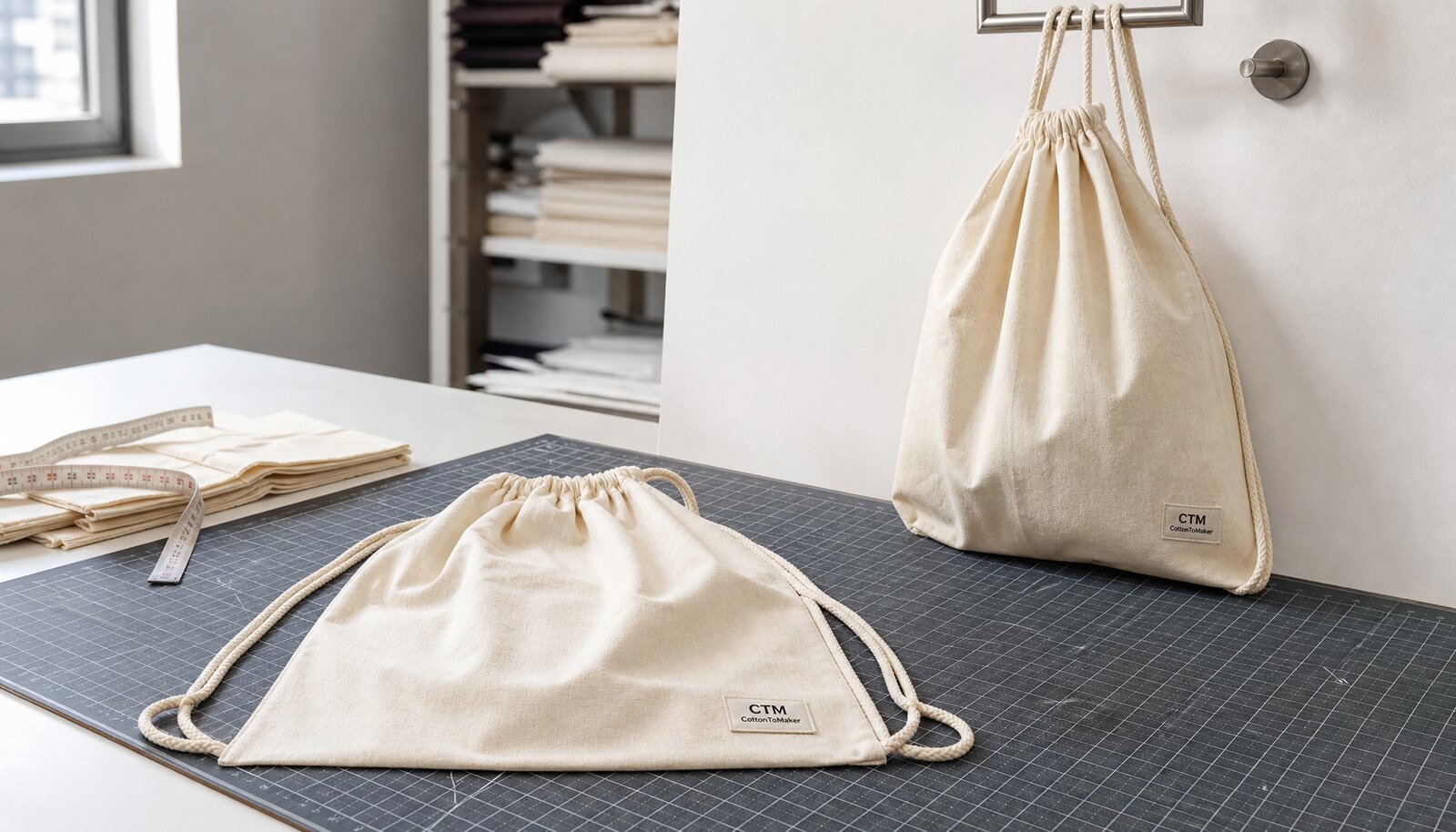
Why boutique wineries need a different QC standard
A cotton drawstring backpack for a boutique winery is not a generic promo bag. It is usually handled in a tasting room, given away with a purchase, or sold in a small retail mix where appearance and first-touch quality matter more than the absolute lowest unit cost. The bag may sit next to bottles, menus, club mailers, or point-of-sale materials, so loose threads, odor, lint, and weak print are visible immediately. That means your inspection standard has to reflect brand presentation as well as functional strength.
The use case also changes the failure mode. A light giveaway bag may only need to carry brochures, a corkscrew, and a small tasting note insert, while a retail bag may need more body and a stronger cord channel. If the supplier does not know the real content and carry weight, they will quote a soft fabric and thin stitching that looks acceptable in a photo but fails in use. Write the end use into the RFQ first, then judge every quote against that use.
- State the contents the bag must hold, not just the bag size.
- Separate tasting-room giveaway specs from retail merch specs.
- Treat odor, loose fibers, and crooked branding as real defects, not cosmetic noise.
- If the bag will be reused by guests, raise the fabric weight and seam standard.
Set the fabric and construction before you talk price
Start with the finished fabric weight, because the rest of the quote depends on it. For a light winery giveaway bag, 140-160 gsm cotton is usually enough if the contents are soft and the bag is not expected to be reused heavily. For a more durable retail or staff bag, move to 180-220 gsm cotton twill or a similar woven cotton with more body. The important point is finished GSM after finishing, not a vague fabric type on a quote sheet. If the supplier only says cotton, you do not yet have a usable specification.
Construction details matter just as much as fabric weight. A drawstring backpack should have a reinforced top channel, a consistent seam allowance, and stress-point reinforcement where the cord enters and exits the body. If the bag has a bottom seam that carries load, ask for a stronger stitch density on that line. A thin fabric can still work if the load is low, but it needs clean sewing and a controlled shrinkage allowance so the approved sample matches bulk output.
- Ask for finished GSM, weave type, and shrinkage allowance in writing.
- Require seam allowance and stitch density on the top channel and load seams.
- Confirm whether the fabric is unbleached, dyed, or prewashed before quoting.
- Do not approve a quote that describes the fabric only as cotton.
Branding controls that keep the winery logo readable
For most boutique winery programs, 1-color screen print is the safest decoration method when the artwork is simple and the brand wants a clean, low-risk finish. It is easier to control than small embroidery on a thin bag, and it usually gives better repeatability on larger logo areas. If the brand wants a more premium look, a woven side label or sewn patch is often better than forcing a complex multi-color print onto a soft cotton surface. The right method depends on logo shape, placement, and how much handling the bag will get.
Do not let the artwork spec stay generic. Tell the supplier the exact print position, logo width and height, minimum line weight, and acceptable placement tolerance. Ask for a physical color reference rather than relying on a screen image. Fine lines, small text, and gradients are common failure points on cotton bags because the weave can distort the edge and the print can spread slightly into the fiber. If the brand mark must sit near the seam or drawcord channel, add a placement board or a clear print window in the sample stage.
- Use 1-color screen print for simple logos and tighter cost control.
- Use a woven label or sewn patch when the brand wants a more premium, durable finish.
- Reject artwork with tiny text or thin lines that will blur on woven cotton.
- Lock print position with a measured sample, not just a digital mockup.
Sample approval should test fit, finish, and handling
A proper pre-production sample should be built from the bulk material and decorated with the final method. A sales sample or showroom piece is useful for design review, but it is not strong enough for approval if the fabric, print, or cord construction may change later. Measure the finished size, compare the color against the approved standard, inspect the label position, and look closely at the seams around the cord channel. If the sample is not made from the same lot or the same process, it is only a concept piece, not an approval sample.
Then test the bag the way it will actually be used. Load it with the expected contents, close and open the cord repeatedly, and make sure the top edge does not distort. If the bag is sold in retail, rub it gently against a surface to see whether the print scuffs or the fibers shed too much. You do not need a lab-level program for every item, but you do need a repeatable approval ritual. A sample sign-off without a basic functional test usually becomes a production dispute later.
- Approve only a sample made from bulk materials and final decoration.
- Measure size, print placement, cord length, and label position on the sample.
- Load-test the bag with the expected contents before sign-off.
- Keep one signed reference sample for production and inspection comparison.
Factory inspection points that matter most
Use a clear defect framework: critical, major, and minor. A broken cord, a seam that opens under normal handling, or a mixed-size shipment should be treated as critical or major, not as an acceptable variation. For the winery channel, a crooked logo or dirty pack can also become a commercial issue because the bag is tied to the brand presentation at the point of sale. If you use AQL, set it before production starts and make sure the factory knows which defects are zero tolerance.
Inspection should not be limited to the top layer of cartons. Pull random samples from different cartons and different positions in the pallet or stack, then inspect under neutral light. Measure dimensions, compare print placement to the signed sample, and check the cord channel for smooth pull and even closure. If the production is a mixed-color or mixed-art order, inspect by lot, not just by shipment. That is how you catch a run where one color or one style drifted out of spec.
- Treat broken seams, cord pull-through, and mixed-size packing as major defects.
- Inspect cartons from different stack positions, not only the top layer.
- Use AQL or a written defect threshold before production starts.
- Compare the first random sample against the signed reference sample during inspection.
Packing and labeling can make or break retail readiness
Packing is part of quality, not an afterthought. For retail or gift-shop use, individual polybags help protect the bag from dust, but the bag must be dry before packing or you can trap moisture and create odor issues. If a hang tag, barcode sticker, or insert card is needed, define the position and content before the quote is finalized. A clean fold matters as well, because a sloppy fold makes even a good bag look cheap when the carton is opened.
Distributor orders need a different pack logic. They care about receiving speed, count accuracy, and carton efficiency. That means you should specify the units per inner pack or master carton, the carton strength, the outer mark format, and whether each carton needs a count sheet. Do not let the factory decide this on its own. A carton that is too large wastes freight, while a carton that is too soft crushes cord ends and creates avoidable rework at receiving.
- Confirm whether the bag ships bulk folded, polybagged, or retail-ready.
- Require dry goods only before polybagging to avoid trapped moisture and odor.
- Specify barcode and label placement so the receiving team can scan fast.
- Write carton count, carton size, and outer mark rules into the order.
How to compare quotes line by line
Do not compare bag quotes on unit price alone. A low number can hide a lighter fabric, a cheaper print method, or a packing format that adds labor later. Ask every supplier to quote on the same basis: finished size, finished GSM, decoration method, packing format, and the same trade term. If one supplier includes sample fees, inner packs, or carton labeling and another does not, the price spread is not meaningful yet. Standardize the quote request first, then compare the numbers.
The most common hidden cost drivers are setup charges for print, minimums for color or label, special fold requirements, and inspection or repacking costs. For winery programs, you should also ask for quote data at more than one quantity so you can see how the unit cost behaves at reorder levels. A practical RFQ should ask for unit price at the target order quantity, the next reorder tier, the sample fee, the print setup fee, packing cost, and the freight basis. That gives procurement a real comparison instead of a marketing quote.
- Request the same basis from every supplier: size, GSM, print method, pack format, and trade term.
- Ask for quote lines on sample fee, setup fee, packing, and inspection if those items are not included.
- Compare price at the target order size and at the reorder size, not only at one quantity.
- Make the supplier state what is excluded, especially freight, duty, and repacking.
MOQ and lead time logic for seasonal winery buying
Boutique wineries rarely buy in a flat, uninterrupted pattern. Orders cluster around club releases, harvest events, holiday gifting, and tasting-room refreshes. That makes MOQ and lead time a sourcing risk, not just a commercial detail. A lower MOQ can be useful when artwork changes often or when the winery wants to test a new retail item, but the buyer should understand that small quantities may raise unit cost or reduce the choices available for fabric and decoration. The right answer is not always the lowest MOQ. It is the MOQ that matches the buying cycle without forcing a spec compromise.
Lead time is safest when the specs are frozen before material booking. If the artwork, pack format, or label position keeps changing, the factory will keep moving the production slot. As an example, simple one-color cotton bag programs often quote a shorter production window after approval than multi-color print or outsourced decoration, but that number only means something if the sample has already been signed off. Build time into the schedule for sampling, corrections, and pre-shipment inspection. If your launch date is fixed, keep a buffer for rework and transit risk.
- State MOQ separately for each color, each artwork, and each packing format.
- Freeze artwork and packing before material booking if the launch date is fixed.
- Leave time for sample approval, not just bulk sewing and shipping.
- Use reorder programs to lock fabric and label construction when the design is stable.
Landed cost depends on the sourcing route you choose
A direct factory quote usually gives the cleanest view of the true production cost, especially if the factory controls sewing, print, and packing under one roof. That route works well when you have repeat demand and can manage communication tightly. A trading company can simplify the buying process and consolidate multiple items, but the price may carry an extra margin and less visibility into where the risk sits. A domestic converter can be useful for very small or urgent runs, but the bag spec may shift if they have to source fabric or decoration from multiple vendors.
For a lightweight bag, freight and packing can distort the landed cost more than buyers expect. If the carton is inefficient, the bag may look cheap at ex-factory but expensive once freight, duties, and last-mile charges are added. Model the total landed cost with the same pack format, the same carton count, and a realistic allowance for inspection or rework. For recurring winery programs, the cheapest first quote is not always the best sourcing route if it creates a poor reorder structure.
- Compare direct factory, trading company, and domestic converter on the same landed-cost basis.
- Include freight, duty, packing, inspection, and rework allowance in the model.
- Watch carton cube and pack efficiency because lightweight bags can be freight-sensitive.
- Check whether the first order price still works on reorder quantities.
Write the PO so inspection disputes do not stall shipment
The purchase order should restate the approved sample reference, the exact fabric specification, the print file version, the packing format, and the defect tolerance. If any of those points stay vague, the factory can argue that the shipment matches the order even when it does not match the buyer expectation. This is especially important for winery branding because a small visual defect can become a shelf-facing problem. The PO should be a control document, not just a payment document.
Add production hold points so the factory knows when approval is required. At minimum, capture bulk material confirmation, pre-production sample sign-off, in-line check, and final inspection. If a supplier needs to substitute fabric, cord, or pack material, the change should require written approval before the line continues. That discipline prevents the most common dispute: the buyer thinks a sample was approved, while the factory thinks a similar material is acceptable. On a branded bag, similar is not enough.
- Restate the approved sample number and print file version in the PO.
- Include the fabric spec, stitch spec, pack format, and defect tolerance in writing.
- Require written approval for any material or decoration substitution.
- Set hold points for bulk material, pre-production sample, in-line check, and final inspection.
Specification comparison for buyers
| Spec decision | Recommended option | When it fits | Buyer risk to check |
|---|---|---|---|
| Sourcing route | Direct cut-and-sew factory with in-house print and packing | Single-brand orders with repeat replenishment and one or two simple logo colors | Confirm one owner for sewing, print, and carton marks so defects do not get split between vendors |
| Sourcing route | Factory plus specialist decorator | Multi-color art, embroidery, or a mixed product program with more than one finish | Watch for longer lead time, extra handling, and unclear responsibility when print quality misses the sample |
| Fabric weight | 140-160 gsm cotton | Light tasting-room giveaway bags or insert bags that will not carry heavy contents | Thin cloth can go transparent, shrink more, and show weak seams after use |
| Fabric weight | 180-220 gsm cotton twill or canvas-style cotton | Retail merch, staff bags, or repeated guest use where the bag needs more body | Make sure the quote states finished GSM after finishing, not just greige fabric weight |
| Branding method | 1-color screen print | Simple logo artwork with clean edges and tight cost control | Check for ink cracking, off-register placement, and color drift between sample and bulk |
| Branding method | Woven side label or sewn patch | Premium winery branding, small logos, or when print area should stay minimal | Inspect label edge fray, crooked stitching, and brand color mismatch |
| Cord and reinforcement | Cotton cord with bar-tacked stress points and a reinforced channel | Standard pull-close use with regular handling in tasting rooms or event kits | Verify the cord does not pull through the channel and the two sides close evenly |
| Packing route | Individual polybag with size or barcode sticker and master carton count sheet | Retail and distributor orders that need clean receiving and easy stock control | Check moisture protection, mixed pack risk, and carton count accuracy |
Buyer checklist before sampling
- Define the end use: tasting-room giveaway, retail merch, staff utility, or event kit, and state the expected carry weight.
- Lock the finished bag size, fabric GSM, weave type, and whether the bag must stay unwashed, prewashed, or colorfast after spot cleaning.
- Approve the logo file, print position, maximum print area, and color standard against a physical swatch or Pantone reference.
- Specify cord type, cord length, channel width, and whether the stress points need bar-tacks, binding, or extra seam allowance.
- Decide if the bag needs an inner polybag, hang tag, barcode sticker, insert card, or retail-ready folding method.
- Set MOQ by color, by artwork, and by packing format so the supplier does not hide a split minimum inside one number.
- Request a pre-production sample made from bulk materials before any mass production approval.
- Write the inspection standard, defect tolerances, and rework rule into the PO before production starts.
Factory quote questions to send
- What finished fabric GSM, weave, shrinkage allowance, and color process are you quoting for the backpack body?
- Is the quoted price based on a production-ready sample, or does it still assume substitutions after approval?
- Which decoration method is included, what are the setup charges, and how many colors are covered in the unit price?
- What is the MOQ by color, by print design, and by packing format?
- Can you share the stitch spec for the body seams, cord channel, and stress points, including seam allowance and stitch density?
- What is the sample lead time, sample fee, and whether the sample fee is refundable after bulk order confirmation?
- What is the bulk lead time after sample approval, material booking, and print confirmation?
- How do you control print placement, print color, and label alignment during inline production?
- What packing format is included in the unit price, and what changes the carton count, carton size, or outer mark cost?
- What is your policy if the final inspection finds loose stitches, mixed sizes, print drift, or damaged cartons?
Quality-control points to confirm
- Fabric GSM matches the approved sample and stays within the agreed tolerance, typically plus or minus 5 percent on finished material.
- Finished dimensions stay within the agreed tolerance, usually plus or minus 1 cm on body size and plus or minus 1 cm on cord length.
- Body seams, top channel, and stress points show no skipped stitches, broken threads, seam gaps, or loose ends longer than 3 mm.
- Stitch density on load-bearing seams is consistent across the lot, with no visible weak areas or thread tension damage.
- Cord channels are smooth, cord movement is even, and both sides close symmetrically without catching or bunching.
- Print position stays within the approved placement window, and color matches the signed reference sample under normal daylight inspection.
- Logo edges are clean, with no pinholes, smearing, ghosting, or heavy ink build-up that cracks when the bag is folded.
- No oil marks, dirt, odor, broken needles, raw-edge fray, or fabric flaws are visible on random inspected pieces.
- A load test using the agreed sample weight does not cause seam failure, cord pull-through, or distorted bag shape.
- Packing counts, barcode stickers, carton marks, and master carton seals match the purchase order and packing list exactly.