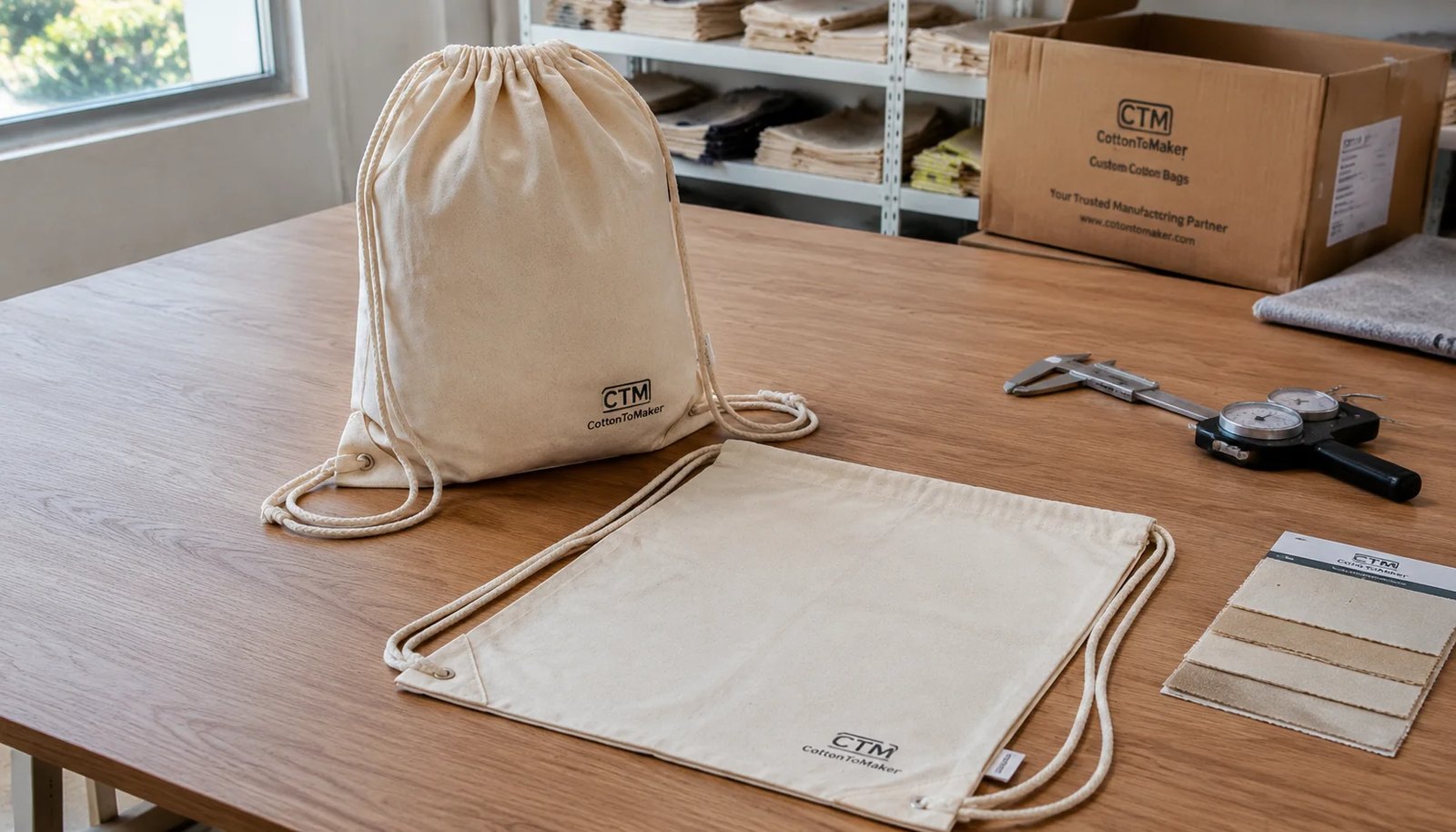
Why natural grocers need a stricter backpack inspection plan
Cotton drawstring backpacks for natural grocers sit between a promotional bag and a reusable carry product. Shoppers may receive them during a wellness event, buy them near checkout, or use them to carry produce, snacks, and small packaged goods. That means the bag must look natural and simple, but it still needs to survive real shoulder carry. A weak promotional specification can create torn corners, stained fabric, poor logo clarity, and complaints from store teams.
The most common sourcing mistake is treating the product like a plain cotton pouch with two cords. A backpack has load points. The lower corners, cord channel, seam allowance, and fabric weight all affect durability. A quality inspection checklist should be written before the RFQ is sent, because the supplier’s quote will change depending on fabric GSM, reinforcement method, print standard, packing method, and inspection tolerance.
- Use the checklist to compare quotations on the same construction, not only the same size.
- Separate natural fabric character from defects: seed specks may be acceptable, oil stains are not.
- Decide whether the bag is a giveaway item or retail item before approving fabric and print quality.
- Put load expectations in the RFQ, such as light daily carry versus event literature only.
Set the base specification before requesting prices
A workable specification for cotton drawstring backpacks starts with finished size, fabric weight, drawcord type, reinforcement, print area, and packing. For natural grocers, a common adult backpack size is around 38 x 42 cm. Smaller sizes may work for children’s events or produce kits, but they can disappoint adult shoppers. Larger bags require more fabric and stronger lower corner construction, otherwise the product looks generous but fails faster.
Fabric weight should be stated in both ounces and GSM when possible. A 6 oz cotton canvas is often around 200 GSM, while 8 oz is often around 260-270 GSM depending on construction. Do not rely only on the word canvas. Some suppliers use canvas to describe a wide range of plain weave cottons. If the bag is intended for repeated use, 6 oz is usually the lower practical point; if it is sold as a retail reusable item, 8 oz gives a more substantial hand feel.
- Typical adult size: 38 x 42 cm, adjusted for your merchandising plan.
- Light event use: 5 oz to 6 oz cotton may be acceptable if load is low.
- Reusable grocery positioning: 6 oz to 8 oz is usually safer.
- Premium retail feel: 10 oz can work, but test closure and shoulder comfort.
- Finished size tolerance: plus or minus 1 cm is realistic for many sewn cotton bags.
Fabric inspection: GSM, shade, shrinkage, and natural cotton appearance
Natural grocers often prefer unbleached cotton because it looks less processed. Buyers should remember that unbleached cotton is not perfectly uniform. Small seed specks, slight shade variation, and natural yarn character can be acceptable if agreed in advance. The inspection plan should define what is acceptable natural character and what is a defect. Dark oil spots, mildew marks, heavy stains, dirty handprints, and strong odor should not be accepted as natural cotton features.
GSM inspection is more useful than a quick hand-feel judgment. During pre-production, cut and weigh fabric swatches or use a GSM cutter if available. For final inspection, compare random bags against the approved sample and weigh panels or complete units if practical. If the supplier quotes 270 GSM but ships closer to 200 GSM, the bag will feel thinner, print coverage may change, and durability may drop. A typical acceptance tolerance is plus or minus 5 percent, but retail programs may set tighter rules.
- Approve one fabric swatch for color, texture, thickness, and acceptable seed specks.
- Record fabric weight in GSM and oz, then attach it to the purchase order.
- For dyed cotton, approve lab dip under the lighting used by your brand team.
- Check wet and dry rubbing risk when using dark dyed fabric with light clothing.
- Reject mildew odor, damp cartons, oily marks, and heavy shade mismatch within the same carton.
Construction points that decide whether the backpack survives use
The lower cord exit is the highest-risk area on a cotton drawstring backpack. When a shopper wears the bag, the cord pulls against the lower corners while the contents push downward. If the cord is only passed through a narrow seam with one line of stitching, the fabric can tear. Better constructions use folded corner tabs, bar tacks, boxed stitches, or reinforced patches. The exact method can vary by factory, but the buyer should approve it on a physical sample and test it with weight.
The top cord channel also needs attention. If the channel is too tight, the bag will not close smoothly. If it is too loose and the stitching is uneven, the top looks cheap and the cords twist. Seam allowance should be consistent, thread ends trimmed, and the mouth should gather evenly. For cotton backpacks sold through grocery channels, the product does not need luxury bag finishing, but it should not look like a rushed event giveaway.
- Lower corner reinforcement should be visible and repeatable in mass production.
- Bar tacks should not cut the fabric or create needle damage.
- Cord channel width must allow smooth opening and closing after printing and pressing.
- Side seams should have no open seams, skipped stitches, or heavy puckering.
- Load test samples with realistic contents such as 3-5 kg if that matches expected use.
Print quality: choose the method around artwork and fabric
For natural grocery branding, water-based screen print is often the most suitable method for cotton drawstring backpacks. It gives a softer feel than heavy plastisol, works well on cotton, and supports simple logos, slogans, and event graphics. The limitation is that very fine details, small reverse text, and pale colors on natural unbleached cotton can lose sharpness. If the artwork includes small certification marks, ingredient illustrations, or QR codes, the factory should test print before bulk production.
Digital printing can support multi-color artwork and gradients, but it may cost more and requires careful testing on textured cotton. Heat transfer can deliver sharp artwork, yet it may feel less natural and can crack or peel if the wrong film is used. Embroidery is durable but not always suitable for thin fabric or large logos because it adds cost, puckering risk, and weight. The correct choice depends on order volume, brand look, fabric color, and inspection standard.
- Approve print strike-off on the same fabric and color as production.
- Set print placement tolerance, for example plus or minus 5 mm from approved position.
- Measure logo size after drying, not only from the artwork file.
- Check ink coverage over cotton seed specks and weave texture.
- Rub test printed areas for smudging, cracking, poor curing, or color transfer.
- Avoid placing large stiff prints across fold lines if bags are packed tightly.
MOQ logic and cost drivers behind supplier quotations
MOQ for cotton drawstring backpacks is not only a factory preference. It is tied to fabric purchase minimums, dyeing lots, cutting efficiency, print setup, sewing line arrangement, packing materials, and export carton planning. A supplier may accept a low quantity for natural unbleached cotton because fabric is available, but require a higher MOQ for custom dyed cotton. Similarly, one-color screen print has a lower setup burden than four-color artwork.
When comparing quotes, avoid treating the lowest unit price as the best offer until you know what is included. A quote may exclude sample fees, screen charges, lab dips, reinforced corners, individual packing, barcode labels, carton marks, or inspection rework. For importers and distributors, the more useful comparison is packed unit cost with carton data and expected defect risk. A slightly higher factory price can be cheaper landed if it reduces rework, air courier replacement samples, and rejected cartons.
- Fabric weight increase raises material cost and often carton weight.
- Custom dyeing adds lab dip time, dye lot MOQ, and shade control risk.
- More print colors add screen setup, registration time, and inspection points.
- Reinforced corners add sewing time but reduce failure complaints.
- Individual polybags help retail allocation but increase material, labor, and packing volume.
- Bulk packing lowers packing cost but needs cord-tangling controls.
Sample approval sequence that prevents mass production disputes
A good sample process separates fabric, construction, print, and packing approvals. If the buyer approves only one attractive photo sample, many details remain open. The production fabric may be different, the print may be placed slightly lower, the drawcord may be thinner, or the carton packing may crease the logo. Natural grocers with multiple store locations should also review how the bag will arrive at store level, not only how it looks on a sample table.
The pre-production sample should be made with actual bulk fabric, actual drawcord, actual print method, and intended sewing construction. It should be signed, dated, and kept as the reference for final inspection. If the order uses several colors or artwork versions, approve one master construction sample and separate color or print strike-offs. This keeps approval work efficient while still controlling the important variables.
- Fabric swatch: approves GSM, weave, color, and natural cotton character.
- Fit sample: approves size, shape, cord length, and wear comfort.
- Print strike-off: approves ink color, opacity, edge definition, and placement.
- Pre-production sample: approves final construction before bulk cutting.
- Packing sample: approves folding, polybag, label, carton quantity, and carton marks.
- Sealed sample: used by factory QC and third-party inspector during final inspection.
Final inspection checklist with practical acceptance thresholds
Final inspection should use a defined sampling plan, commonly based on AQL, but the defect list must be tailored to cotton drawstring backpacks. Generic soft goods inspection will miss product-specific risks such as weak cord exit corners, uneven cord length, blocked cord channels, print cracking, or unacceptable natural cotton stains. Classify defects before inspection so the factory knows what will cause rejection and what can be accepted within limits.
For many B2B orders, critical defects include safety issues, foreign objects, mold, strong chemical odor, and needle fragments. Major defects include open seams, torn corners, severe stains, wrong artwork, wrong size beyond tolerance, missing reinforcement, and print defects visible at normal viewing distance. Minor defects may include small loose threads, slight natural slubs, or tiny print imperfections outside the main logo area, depending on the approved standard.
- Measure finished width and height on random pieces from different cartons.
- Pull cords firmly to confirm no immediate seam tearing or cord slippage.
- Open and close each inspected unit several times to test channel function.
- Compare print color against approved strike-off under consistent lighting.
- Inspect both front and back panels for stains before folding hides them.
- Count pieces per carton and compare with packing list and carton marks.
- Photograph defects with ruler or reference sample for quick supplier discussion.
- Do not approve shipment if damp cartons, mildew smell, or widespread staining is found.
Packing and carton control for grocery distribution
Packing is not only a logistics detail. Cotton drawstring backpacks can crease, absorb moisture, pick up carton dust, or arrive with tangled cords if packed poorly. For natural grocers, presentation matters because store staff may open cartons directly for retail display or event distribution. The buyer should decide whether each bag needs individual packing, an inner bundle, barcode labeling, hangtag, or simple bulk packing.
Individual recyclable polybags or paper bands can keep units clean and simplify store allocation, but they add cost and may conflict with low-plastic merchandising goals. Bulk folding by 25 or 50 pieces per inner pack reduces material use but requires careful cord arrangement. Cartons should be dry, export-strength, and not overfilled. Over-compressed cartons can create hard creases through the printed logo, especially if the ink is not fully cured before packing.
- Confirm fold direction so the logo is not sharply creased through the center.
- Use carton liners if the route has moisture or dust exposure risk.
- Separate light natural cotton bags from dark printed materials that may transfer color.
- Specify inner pack quantity for store allocation, such as 25 pcs per bundle.
- Include PO number, SKU, color, carton number, gross weight, net weight, and quantity on carton marks.
- Request carton dimensions early for freight quoting and warehouse slot planning.
Lead time risk: where cotton backpack schedules slip
Lead time is often quoted too simply. A supplier may say production takes a certain number of days, but that timer usually starts after deposit, artwork approval, fabric approval, sample approval, and packing confirmation. For cotton drawstring backpacks, schedule risk appears in fabric sourcing, dyeing, print strike-off approval, bulk printing, and final inspection. If the buyer’s artwork changes after screens are made, the timeline resets.
Natural cotton available in stock can shorten the process, while custom dyed fabric adds lab dip and dye lot approval. A realistic schedule should show each milestone: RFQ clarification, sample making, sample courier, buyer approval, fabric preparation, cutting, printing, sewing, trimming, packing, inspection, and shipment handover. Importers should build buffer time before store events because rejected print or fabric problems cannot always be fixed overnight.
- Fastest route: stock natural cotton, one-color print, existing construction, bulk packing.
- Higher-risk route: custom dyed fabric, multi-color print, several SKUs, individual retail packing.
- Approval delays are buyer-side risks; reserve time for internal brand review.
- Printing before fabric shrinkage or stabilization can cause placement variation.
- Final inspection should be scheduled before the cargo handover date, not on the same day.
- For event orders, keep a decision date after which artwork and specifications are frozen.
Specification comparison for buyers
| Spec decision | Recommended option | When it fits | Buyer risk to check |
|---|---|---|---|
| Main fabric weight | 6 oz to 8 oz cotton canvas, roughly 200-270 GSM | Reusable grocery events, staff giveaways, wellness promotions, and light retail merchandise | Below 180 GSM may feel promotional and show contents; above 10 oz may increase freight and reduce drawstring closing performance |
| Cotton type | Natural unbleached cotton or dyed cotton with documented color approval | Natural grocers wanting an earthy look, lower-dye appearance, or brand colors with controlled shade | Unbleached cotton has seed specks and shade variation; dyed cotton needs lab dip approval and wet/dry crocking review |
| Bag size | About 38 x 42 cm for adult use, adjusted after fit sample | General grocery shopper use with light produce, leaflets, small packaged goods, or event kits | Oversized bags need stronger cord and seam reinforcement; undersized bags feel like gift pouches, not backpacks |
| Drawcord | 8-10 mm cotton rope or strong braided cotton cord | Natural material positioning and comfortable shoulder carry | Thin cord cuts into shoulders and fails at eyelets; cotton cord can shrink if not pretested |
| Corner reinforcement | Double-folded lower corners with bar tack or boxed stitch | Any order expected to be worn as a backpack rather than used only as packaging | Simple single stitch at cord exits is a common failure point during load testing |
| Logo print method | Water-based screen print for simple natural grocery branding | One to three solid colors, medium order quantities, softer hand feel | Fine reverse text and pale ink on natural cotton may lose clarity; require strike-off and wash/rub review |
| Packing method | Individual folded bag in recyclable polybag or bulk folded by 25-50 pcs, with carton liner | Retail distribution, store allocation, and warehouse handling | Over-tight folding can crease printed logos; bulk packing can cause cord tangling if not controlled |
| Inspection standard | AQL-based final inspection plus in-line checks on stitching and print registration | Importers and distributors needing predictable acceptance rules before shipment | If defects are not classified in advance, suppliers and buyers argue over stains, slubs, print pinholes, and shade variation |
Buyer checklist before sampling
- Define use case clearly: retail resale, loyalty gift, produce campaign, employee kit, or event giveaway.
- Set target fabric weight in oz and GSM, not only the word cotton or canvas.
- Approve fabric hand feel, color, shrinkage, and visible cotton seed specks before bulk cutting.
- Confirm finished size tolerance after sewing, normally within plus or minus 1 cm unless tighter control is required.
- Specify drawcord material, diameter, length, color, and whether cord ends need knots, metal tips, or heat-sealed alternatives.
- Require reinforced lower cord exit corners with bar tack, boxed stitch, or another approved construction.
- Approve print strike-off on the actual production fabric, not on a different white cotton swatch.
- Set acceptable logo position tolerance, commonly plus or minus 5 mm for screen print placement.
- Define stain, oil mark, weaving slub, loose thread, and print pinhole limits in the inspection plan.
- Run load testing on a filled backpack sample using the expected carry weight, not an unrealistic empty-bag review.
Factory quote questions to send
- What exact fabric construction are you quoting, including cotton type, weave, oz weight, GSM, and finished width?
- Is the quoted fabric greige, bleached, dyed, or natural unbleached, and what shade variation should we expect between lots?
- What is your MOQ by fabric color, by print color count, and by backpack size?
- Which print method is included in the quote, and what print size, ink type, and number of colors are covered?
- Are screen setup, sample mold, print plate, lab dip, courier, and testing costs included or listed separately?
- What drawcord material and diameter are included, and is reinforcement at the lower cord exit included in the sewing cost?
- What sample stages do you provide: fabric swatch, print strike-off, fit sample, pre-production sample, and packing sample?
- What is the normal tolerance for finished size, fabric weight, print placement, and carton quantity?
- What inspection standard do you accept for final QC, and can an external inspection company inspect before shipment?
- What is the production lead time after all approvals, and which steps can delay the schedule?
Quality-control points to confirm
- Fabric GSM within agreed tolerance, commonly plus or minus 5 percent unless the order requires tighter control.
- Finished backpack size within approved tolerance after sewing and pressing.
- No unacceptable oil stains, dirty marks, mildew odor, strong chemical smell, or obvious foreign fibers.
- Seams straight, no skipped stitches, no open seams, no broken needle damage, and no heavy puckering.
- Lower drawcord exit points reinforced and able to pass agreed load test without tearing.
- Drawcord length equal on both sides and comfortable for adult shoulder carry.
- Logo print color, size, position, opacity, and edge sharpness match approved strike-off.
- Print has no major cracking, bleeding, pinholes, ghosting, or fabric contamination inside the print area.
- Bag mouth closes smoothly without cord blockage, twisting, or tight tunnel stitching.
- Packing count correct by inner pack and carton, with clean folding and no print-to-print sticking.