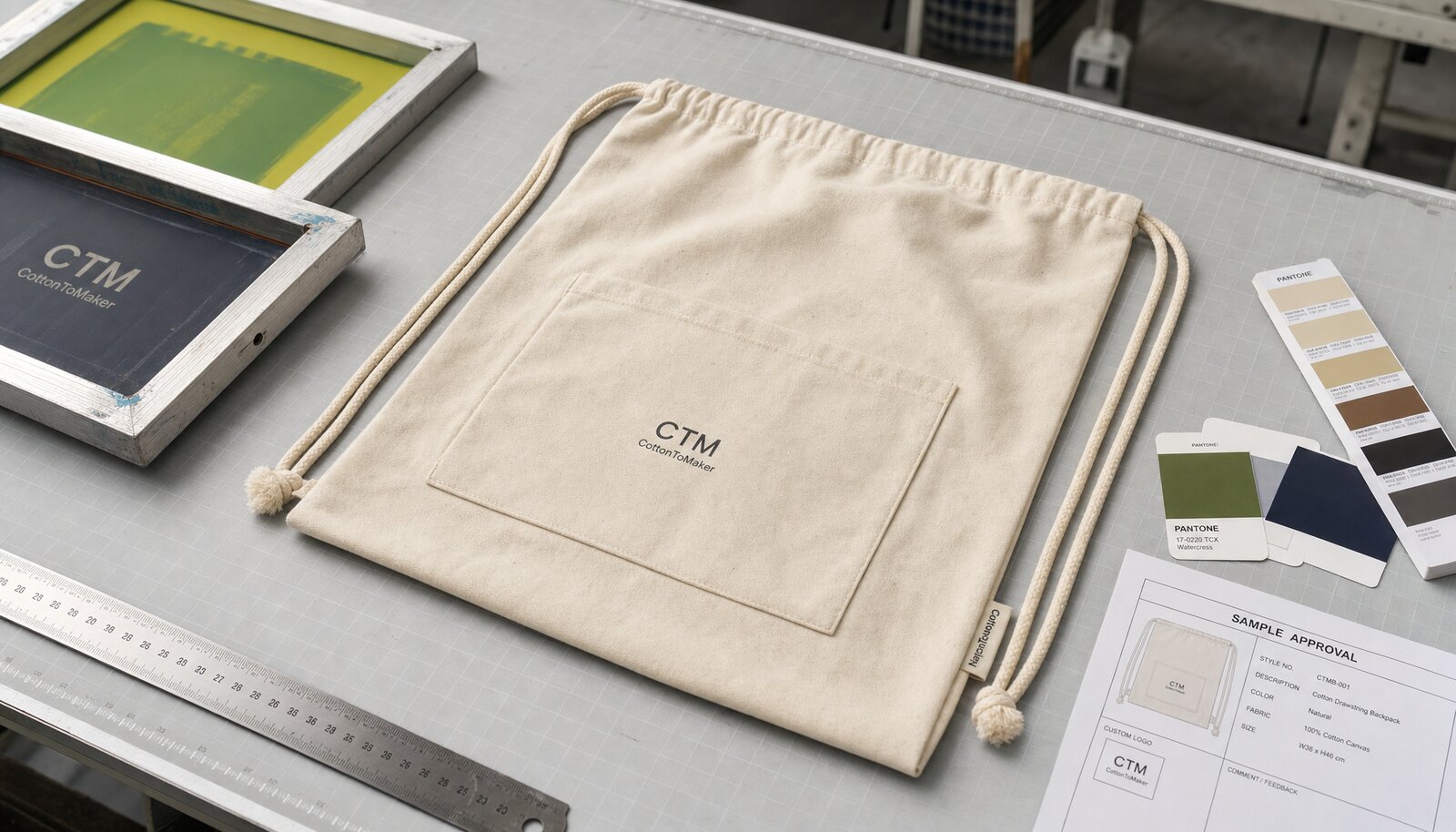
Start with the real risk, not the mockup
A cotton drawstring backpack looks easy to buy because the product is familiar. The trouble is that the decoration is printed on a soft sewn item, not on a rigid flat surface. Cotton can stretch, skew, wrinkle, gather at the cord channel, and show yarn texture through the ink. A clean logo file matters, but it does not prove how the logo will behave on the final bag.
For corporate gifting, the error is public. The backpack may be handed out at a trade show, packed with onboarding materials, shipped to client offices, or photographed at an internal event. If the print is too low, too pale, crooked, cracked, or pressed into a pocket seam, the buyer notices it after the cartons arrive, when the timeline is already tight.
That is why proofing should be treated as a production control step. A digital layout can confirm the idea. A strike-off shows print behavior on cotton. A sewn pre-production sample shows final placement and construction. A packing review shows whether the approved logo still looks right after folding, stacking, and transport.
A useful cotton drawstring backpacks print proofing checklist for corporate gifting removes guesswork. It defines the bag, the artwork, the sample route, the approval references, the tolerances, and the inspection method. It also helps procurement compare suppliers on real capability, not only on the first unit price quoted.
- Do not treat a digital mockup as a bulk production approval.
- Approve the print on production-equivalent cotton whenever color, opacity, or logo clarity matters.
- Use a sewn sample to judge placement, drawstring pull, seams, pockets, and fold behavior.
- Keep one signed approval sample with the buyer and one retained by the factory when possible.
Lock the backpack specification before the logo
The bag body controls the print result. Before discussing logo size, the RFQ should state the finished bag width and height, cotton composition, target GSM, fabric color, cord type, corner reinforcement, eyelets if used, pocket details, label position, and packing requirement. If the quote only says “cotton drawstring bag with logo,” the supplier may price the simplest construction and leave important decisions for later.
Size should be based on use. Common corporate gift sizes often sit around 34 x 42 cm or 35 x 45 cm, but the right size depends on what goes inside. A notebook, catalog, drink bottle, folded T-shirt, or product sample can change the feel of the bag once filled. Ask the internal team what will be packed, then share approximate fill weight and insert dimensions with the supplier.
Construction details shrink the safe print area. A front pocket introduces a seam ridge and extra fabric layer. Metal eyelets and reinforced corners create no-print zones near the lower edge. A bulky cord channel gathers the top panel when closed, which can make artwork near the top look distorted. These details need to appear on the placement diagram, not just on the sewn sample.
Also ask whether the print is applied before sewing or after sewing. Printing cut panels can give the printer a flatter surface, but placement must allow for sewing tolerance. Printing finished bags shows final positioning more directly, but seams and cords may limit access. Neither route is automatically better. What matters is that the supplier explains the process and the measurement points.
- Specify finished size, fabric GSM, fabric color, cord type, corner construction, pocket, eyelets, and label details.
- Share intended contents and approximate fill weight when the bag will carry more than paper inserts.
- Mark cord channels, pocket seams, side seams, bottom hems, eyelets, and reinforced corners as placement constraints.
- Confirm whether production prints cut panels or finished sewn bags.
Choose cotton GSM and shade with the print in mind
Fabric weight changes both cost and brand impression. For many corporate gifting programs, 140-150 gsm cotton is a practical baseline: light enough for event distribution, but usually more stable than very thin promotional cloth. When the backpack must carry heavier inserts or needs a firmer hand feel, 180 gsm is often the safer choice.
GSM does not tell the whole story. Natural cotton, bleached cotton, dyed cotton, recycled-content cotton, and cotton blends can all print differently. Natural cotton has a warmer base and may include small flecks or slubs. White or bleached cotton gives a cleaner ground for many logo colors. Dyed cotton can make pale ink look dull unless the printer adjusts opacity and proves the result on the actual fabric.
Shade control deserves an explicit decision. Natural cotton can vary by lot. Dyed fabric may shift between sample and bulk if the color standard is vague. If the campaign has multiple delivery waves or repeat orders, ask for a shade band, lab dip, or retained fabric reference. If the brand color is strict, avoid approving color only from a screen image.
The surface of the cotton matters too. A loose weave can blur small type. A textured yarn can make a solid logo look slightly uneven. These are not always defects, but they should be visible in the proof. The buyer should judge the sample at normal viewing distance and close range so the final approval reflects both brand appearance and textile reality.
- Use 140-150 gsm for many standard event, onboarding, and conference programs.
- Move toward 180 gsm for heavier contents, firmer hand feel, or higher perceived value.
- Confirm whether the fabric is natural, bleached, dyed, recycled-content, or blended.
- Approve shade and print color using a physical reference when consistency matters.
- Request the strike-off on production-equivalent fabric, not a convenient substitute.
Select the print method by artwork behavior
Screen printing is usually the efficient choice for bold one-color or two-color logos. It suits company marks, event names, sponsor graphics, and simple campaign artwork. The proof should focus on opacity, registration, edge sharpness, curing, and whether the ink sits cleanly on the cotton texture.
Heat transfer has a different role. It can work well for gradients, many colors, detailed artwork, and designs that are awkward to separate into screens. The buyer should check the transfer edge, hand feel, adhesion, fold resistance, and whether any adhesive halo is visible. If bags will be folded through the logo or stored under carton pressure, do not skip the packing review.
Embroidery may look premium on heavier canvas-style constructions, but it can be risky on lightweight drawstring backpacks. Needle tension can pucker thin cotton, small letters may lose shape, and backing may be visible inside the bag. Use embroidery only after the supplier confirms the fabric can support the stitch density and the artwork has been simplified for thread.
The method affects quote structure. Screens, films, color matching, transfer setup, embroidery digitizing, strike-offs, and sample time all change the real cost. Ask for separate pricing when the artwork allows comparison. A supplier who says “logo included” without naming the method is leaving procurement with too little information.
- Use screen print for simple, bold artwork and repeatable corporate marks.
- Use heat transfer for gradients, fine detail, or many-color artwork.
- Use embroidery only on constructions that can tolerate stitch tension and backing.
- Ask the supplier to confirm minimum line width, minimum text height, and minimum gap size.
- Compare setup cost, unit cost, sample time, bulk time, and QC risk by method.
Make artwork approval measurable
Artwork approval should be precise enough for production staff to follow without interpretation. Supply vector artwork in AI, EPS, SVG, or print-ready PDF format. Fonts should be outlined, linked images should be embedded at production quality, and every version should have a clear file name and revision date. A PNG or JPG can help conversation, but it should not be the final production source unless the supplier confirms it is suitable.
Logo size needs numbers. “Medium logo” or “large front print” is not a production instruction. State the width and height in millimeters, and define what is included in the measurement. Does it include a tagline, registered mark, background shape, or only the main symbol? For multi-logo orders, every version needs its own approved size.
Placement also needs reference points. The logo may be measured from the top seam, side seam, bottom hem, pocket seam, bag centerline, or cord channel. The correct reference depends on construction. If the bag will be viewed while worn, inspect a lightly filled sample with the cords pulled. A logo that is centered on a flat table can look high, low, or slightly twisted once the top gathers.
Color approval should be physical when the brand color matters. Pantone references help, but cotton is not coated paper. Fabric shade, ink opacity, curing, and lighting all influence the result. A signed strike-off or approved PP sample is usually the most practical standard for corporate gifting orders.
- Supply final vector artwork with fonts outlined and revision details visible.
- State print width and height in millimeters for each logo version.
- Define whether measurements cover the visible artwork or the full print box.
- Show placement distances from seams, centerline, cord channel, pocket, and bottom hem.
- Use Pantone, signed strike-off, or approved sample for color review.
Use proofing gates that test the final product
A strong proofing route has four gates: digital layout, strike-off, sewn pre-production sample, and packing sample. Each gate answers a different question. The digital layout checks size and placement intent. The strike-off checks decoration behavior. The sewn sample checks final appearance. The packing sample checks whether the bag survives the way it will actually be folded and shipped.
The strike-off should use the selected print method and production-equivalent cotton. If the supplier must use substitute fabric, mark the result as preliminary. Opacity, edge definition, and color can change when the fabric base changes. Strike-offs are especially important for white ink, light colors on dyed cotton, fine type, large solid shapes, metallic effects, and strict brand colors.
The sewn pre-production sample is the key approval item. Inspect it flat, lightly filled, drawn closed, and folded. Look at the logo from normal distance first, then close up. Check whether seams, eyelets, pockets, reinforcement triangles, or the cord channel interfere with the design. If the bag has a pocket, confirm that the print does not bridge a seam ridge unless the supplier has already proved it can be done cleanly.
Packing review is where many small problems reveal themselves. Fold the approved sample using the proposed method, stack it like the carton load, and check for creasing, blocking, print transfer, dust pickup, odor, and abrasion. Heat transfers and heavy ink deposits need special attention here because a logo can look fine at the print table and still arrive with pressure marks.
- Use the digital layout for discussion and dimensional approval.
- Use the strike-off for ink, transfer, or embroidery behavior on cotton.
- Use the sewn PP sample for placement, construction, drawstring effect, and hand feel.
- Use the packing sample for fold direction, print protection, carton loading, and presentation.
- Require reapproval if artwork, fabric, print method, placement, or packing changes after sign-off.
Set tolerances before bulk production starts
Tolerances protect both buyer and supplier. They should be practical, written, and measurable. For many sewn cotton drawstring backpacks, finished size tolerance around ±5-10 mm is realistic, depending on fabric, sewing process, and construction. Logo placement tolerance is often discussed in the same ±5-10 mm range, but the factory should confirm what it can hold for the chosen process.
A tolerance is incomplete without a reference point. “Centered” is not enough. State whether placement is measured from the bag centerline, top seam, side seam, pocket seam, bottom hem, or print-box edge. If production prints cut panels before sewing, the buyer should understand how sewing allowance and fabric movement are controlled.
Print size tolerance should be written as well. If the approved logo is 100 mm wide, decide what variation is acceptable. With screen print, registration, edge definition, and ink coverage may matter more than a small size shift. With heat transfer, alignment, adhesive edge, cut line, and press marks deserve closer review.
Color tolerance can be difficult to express numerically unless formal measurement is used. For most corporate gifting orders, the practical standard is visual match to the signed strike-off or PP sample under consistent light. If exact Pantone matching is requested, confirm whether the supplier can realistically approach it on the selected cotton.
- Agree finished bag size tolerance before production, commonly around ±5-10 mm depending on construction.
- Agree logo placement tolerance and the exact measurement points.
- Confirm print size tolerance for width and height after curing or pressing.
- Classify serious defects before inspection: wrong artwork, wrong color, peeling print, cracked ink, broken seam, missing label, or nonfunctional cord.
- Use the signed sample and approved defect list as the QC reference.
Build quote comparisons around real cost drivers
A low unit price can hide the work that makes a corporate gift order reliable. Fabric GSM, bag size, fabric dyeing, drawstring material, eyelets, pocket construction, print method, number of colors, logo size, labels, individual packing, carton marks, sampling, inspection support, and inland handling all affect cost. A clean quote makes those items visible.
Ask the supplier to separate unit price from one-time charges. Screens, films, color matching, transfer setup, embroidery digitizing, strike-off fees, PP samples, packing insert setup, and courier cost should not be blended into a vague line item. The split matters when the order may repeat, because setup costs and repeat unit costs behave differently.
MOQ can also change once details are known. A supplier may have one MOQ for blank stock bags, another for dyed fabric, another for custom cord color, and another for logo versions. If procurement needs 2,000 bags split across four departments, that may become four print runs with separate setup and carton marking.
A good RFQ reduces back-and-forth. Provide bag size, target GSM, fabric color, quantity by version, artwork files, print location, print size, print method preference if any, packing requirements, delivery window, destination, inspection expectations, and any sustainability or material restrictions. The more complete the RFQ, the less likely the quote will move after proofing.
- Compare fabric, construction, decoration, sampling, packing, and QC support before choosing on unit price.
- Separate one-time setup charges from recurring per-piece charges.
- Ask for MOQ by fabric color, print version, print color, label, insert, packing, and carton mark.
- List quote exclusions such as courier, inspection, spare bags, testing, barcodes, and inland transport.
- Confirm when lead time starts: artwork approval, deposit, material confirmation, or signed PP sample.
Control version count before it controls the order
Corporate gifting orders often expand quietly. One group wants the master logo. Another adds a regional office. A sponsor requests co-branding. The event team wants a date. Each small artwork change can create a new screen, transfer sheet, color match, packing insert, carton mark, production count, and inspection line.
The simplest control is to standardize the base bag. Keep the same fabric GSM, fabric color, finished size, cord, pocket, label, and packing method across versions whenever the campaign allows. Then vary only the artwork. If print size, placement, and ink color also stay consistent, the supplier may be able to run production more smoothly.
Version control should live in a written approval sheet. Include artwork file name, revision date, version name, approved quantity, print color, print size, placement, packing requirement, and carton mark. If one region needs 400 pieces and another needs 1,600, the split should appear in the PO and production record.
Decide early how cartons should be separated. For fulfillment centers, version separation and carton labels may be essential. For a simple internal giveaway, mixed cartons might be acceptable. Either choice affects labor, packing time, carton marks, and the risk of a correctly printed bag going to the wrong destination.
- Keep one shared bag body across versions wherever possible.
- Limit version changes to the artwork element that truly needs to vary.
- Approve each version with file name, revision date, quantity, color, size, placement, and carton mark.
- Ask whether shared ink, shared placement, or common logo size can reduce setup complexity.
- Confirm whether cartons must be separated by version, destination, department, or event date.
Inspect decoration, sewing, and packing together
Final QC should not look only at the logo. A bag can have perfect artwork and weak stitching. It can also be sewn well with a logo that is too pale or too low. The inspection plan should cover artwork version, fabric shade, print position, print size, color, edge definition, curing, adhesion, cord function, seams, reinforcement, labels, odor, packing, carton quantity, and carton marks.
Start with measurable checks. Measure logo placement from the approved reference points. Measure print width and height. Compare color to the signed strike-off or PP sample under consistent light. Check edge definition for bleeding, ghosting, registration shift, screen blockage, pinholes, powder marks, excess adhesive, transfer halos, or contamination around the logo.
Then check how the backpack works. Pull the cords several times. Inspect the cord channel, side seams, bottom corners, eyelets, reinforcement stitching, and pocket seams. Fill a sample with realistic contents and close it. The logo should not warp beyond the approved visual standard, and the seams should not pull into the print area.
Packing inspection is the last defense before shipment. Confirm fold direction, individual packing if specified, carton quantity, version labels, moisture protection, carton strength, and whether printed surfaces rub against hardware or rough seams. Open packed samples after compression when possible. If there is odor, blocking, ink transfer, cracking, or dust pickup, it is better to catch it before the cartons leave the factory.
- Measure placement and print size against the approved sample and specification sheet.
- Inspect color against a physical reference, not a phone photo or PDF alone.
- Check curing, adhesion, rub resistance, fold marks, cracking, transfer lift, and ink offset.
- Test cord pull, cord channel stitching, seams, corners, eyelets, pockets, and realistic fill behavior.
- Include packing, carton marks, version separation, odor, moisture, and contamination in final inspection.
Specification comparison for buyers
| Spec decision | Recommended option | When it fits | Buyer risk to check |
|---|---|---|---|
| Fabric weight | 140-150 gsm cotton for standard corporate gifting; 180 gsm when the bag needs a firmer hand feel or will carry heavier inserts | Conference kits, employee onboarding packs, university events, distributor gifts, and light retail-style giveaways | Very light cloth can wrinkle through the logo, show yarn texture, reduce ink opacity, and make the finished bag feel lower value than the brand intended |
| Fabric color | Natural or white cotton when color accuracy is important; dyed cotton only after checking ink opacity and shade consistency on bulk-equivalent fabric | Orders with strict logo colors, repeat campaigns, sponsor branding, or multiple regional versions under one brand system | Dyed fabric changes perceived print color; natural cotton can vary by lot if no shade band, lab dip, or retained sample is agreed |
| Print method | 1-2 color screen print for bold logos; heat transfer for gradients, fine detail, or many colors; embroidery only on heavier constructions after stitch test | Simple corporate marks, sponsor logos, event names, QR-style detail, or artwork that cannot be separated cleanly | Screen print can lose micro detail below about 0.3-0.5 mm line width; transfers may crease or lift if folded tightly or under-cured; embroidery can pucker light cotton |
| Artwork placement | Measured placement box on the sewn bag, with safe distance from side seams, bottom hem, eyelets, reinforced corners, pocket seams, and cord channel | Programs where the logo must remain centered when the bag is filled, stacked, photographed, or worn | Approving placement from a flat PDF can miss sewing pull, fabric skew, cord gathering, and panel distortion after the drawstring is tightened |
| Proofing route | Digital layout, print strike-off on production-equivalent fabric, sewn pre-production sample, and packing review before bulk release | Corporate gifting orders where brand presentation, repeatability, and delivery timing matter | A swatch proves ink behavior but not final appearance; a sewn sample proves placement, stitching interaction, cord tension, and fold behavior |
| MOQ structure | Quote MOQ separately for blank bags, fabric color, print versions, print colors, labels, inserts, individual packing, and carton marks | Multi-department gifting, regional campaigns, co-branded events, and staggered delivery programs | A low total MOQ can become expensive if every version needs a screen, transfer sheet, ink mix, packing insert, carton mark, or production slot |
| Packing spec | Bulk pack by 25-100 pcs for budget programs; individual polybag, paper band, tissue, or interleaving only when cleanliness, sorting, or print protection requires it | Internal giveaways, event kits, retail-ready gifts, and shipments routed through third-party fulfillment centers | Overpacking adds cost and material waste; underpacking can cause print abrasion, odor pickup, dust, folding marks, moisture issues, or poor presentation on arrival |
| QC tolerance | Written tolerances for logo position, print size, color reference, edge definition, curing, stitch strength, cord function, odor, and carton loading | Any order inspected before shipment or distributed to employees, clients, prospects, or event attendees | Without numeric and visual standards, inspection becomes subjective and remake discussions become slow |
| Lead time structure | 7-10 working days for sampling plus 20-35 days for bulk after signed sample approval, adjusted for stock fabric, print colors, version count, and packing complexity | Seasonal gifting, event deadlines, HR onboarding cycles, annual sales meetings, and distributor campaigns | Lead time should start from approved artwork, deposit if required, material confirmation, and sample sign-off, not only from PO date |
Buyer checklist before sampling
- Final vector artwork supplied in AI, EPS, SVG, or print-ready PDF, with fonts outlined and no low-resolution embedded logo files
- Exact print size confirmed in millimeters, including maximum width, maximum height, and whether the size is measured by visible artwork edge or total print box
- Approved bag body specification: finished bag size, fabric composition, target GSM, fabric color, cord type, eyelets or reinforced corners if any, pocket if any, and sewing construction
- Fabric shade control confirmed: natural, bleached, dyed, or recycled-content cotton; approved lab dip or shade band if color matching matters
- Print method selected by artwork complexity, fabric color, durability expectation, fold behavior, and budget, not only by the lowest quoted unit price
- Placement diagram showing distance from top seam or cord channel, side seams, bottom hem, pocket seam if present, eyelets, and any no-print zones
- Color reference defined with Pantone, brand master sample, or approved physical strike-off, plus an agreed review method under consistent light
- Sample approval route documented: digital layout, print strike-off on production-equivalent fabric, sewn pre-production sample, packing sample, and retained approval sample
- MOQ confirmed separately for blank bag quantity, fabric color, custom dyeing, print version, print color count, labels, packing inserts, and carton markings
- Quote split into unit price and one-time charges for screens, films, transfer setup, embroidery tape, strike-off, PP sample, labels, packing inserts, and courier fees
Factory quote questions to send
- What finished bag size, fabric GSM, cord type, and construction are included in the quoted price, and are dimensions measured before or after sewing tolerance?
- Which cotton GSM do you recommend for this artwork size and intended fill weight, and can you show print appearance differences between 140 gsm, 150 gsm, and 180 gsm?
- Is the quoted fabric natural, bleached, dyed, recycled blend, or greige-finished cotton, and how will shade consistency be controlled from sample to bulk?
- Will the strike-off be printed on production-equivalent fabric, not substitute fabric, and will you retain one signed reference sample at the factory?
- Can you quote screen print, heat transfer, and embroidery separately if the artwork allows comparison, with setup cost, per-piece cost, sample time, and production time shown separately?
- How many setup charges apply: screens, films, color matching, strike-off, transfer artwork, embroidery digitizing, sewn PP sample, labels, packing inserts, and carton marks?
- What minimum line width, minimum text height, and gap size do you recommend for the chosen print method on this cotton fabric?
- What exact printable area and safe margin will you use to avoid cord channels, side seams, bottom hems, eyelets, pockets, reinforcement triangles, and sewing distortion?
- What placement tolerance can you hold in bulk for this construction, for example ±5 mm or ±10 mm, and is it measured from centerline, seam, or print-box edge?
- What color tolerance do you normally accept for cotton printing: approved strike-off visual match, Pantone reference under D65 light, or another method?
Quality-control points to confirm
- Artwork version control: bulk production must use the same file name, revision date, logo size, color reference, and placement diagram approved at sample stage
- Fabric consistency: bulk fabric should match approved composition, target GSM, color, weave feel, and shrinkage behavior; no obvious mixed shade panels within one bag or carton
- Finished size check: measure bag width and height after sewing and before packing against the approved tolerance, commonly ±5-10 mm depending on construction
- Logo placement tolerance: measure from agreed reference points such as bag centerline, top seam, side seam, bottom hem, or pocket seam; avoid visual judgment only
- Print size tolerance: confirm finished print width and height against approved millimeter dimensions, especially after curing, pressing, transfer application, or fabric movement
- Color tolerance: inspect against a physical Pantone chip, approved strike-off, or signed PP sample under consistent light; do not approve or reject only by digital PDF color
- Print edge definition: reject heavy bleeding, ghosting, registration shift, screen blockage, pinholes in solid fills, powder marks, excess adhesive, or visible transfer halos
- Opacity and coverage: confirm that fabric color or yarn texture does not make the logo appear uneven, weak, streaky, or patchy at normal viewing distance
- Curing and adhesion: rub, fold, and light scratch checks should not cause smearing, cracking, flaking, transfer lift, or color transfer to adjacent bags
- Stitching near print zone: check for puckering, needle damage, broken stitches, skewed panels, and seam pull that distorts the printed logo