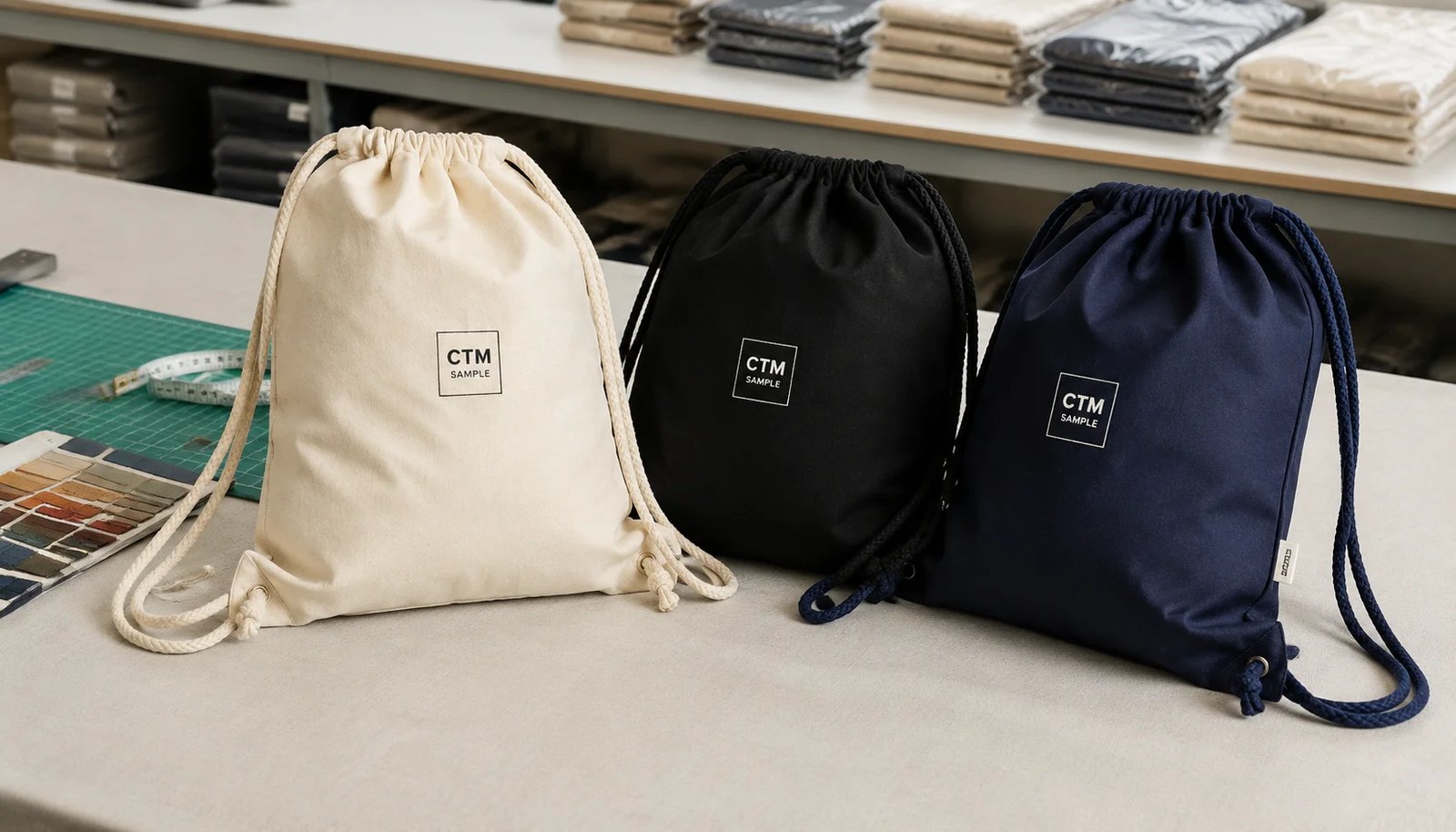
Start with the buying problem, not the bag
For museum shops, the real challenge is not finding a cheap cotton drawstring backpack. It is setting an MOQ that fits the shop calendar, the exhibit theme, the replenishment pattern, and the storage space without tying up cash in the wrong color or artwork version. A bag that looks simple on paper can still become expensive if the buyer splits volume across too many SKUs or leaves decoration details undefined. Procurement teams often discover that the unit price is only one piece of the equation; setup fees, packing choices, and variant count can matter just as much.
The right starting point is the commercial use case. Is this bag a permanent retail item on the museum floor, a temporary exhibit tie-in, a school program giveaway, or a member-store add-on? Each use case changes the target margin, the acceptable fabric feel, and the tolerance for decoration complexity. A permanent retail item usually needs better handfeel, stronger stitching, and cleaner print registration. A temporary exhibition item can justify a lower-cost construction if the museum only needs a short selling window. The quote request should make that distinction explicit so suppliers are not guessing at the wrong production spec.
Museums also have a different buying pattern from general merchandisers. Sales are often seasonal, tied to opening dates, traveling exhibitions, education events, or store relaunches. That means the buyer must decide whether the initial order is meant to cover one launch cycle or to establish a repeatable core item. If the bag is likely to be reordered, keep the spec stable and avoid unnecessary custom details that complicate replenishment. If it is a one-time exhibit program, it may be reasonable to trade some repeat flexibility for faster delivery or a lower MOQ.
The practical rule is simple: define the selling job before defining the bag. Once the use case is clear, the rest of the quoting conversation becomes more precise. A supplier can then price the same base style against different MOQ strategies, such as one color, one artwork version, or a limited run with retail-ready packing. That gives the museum buyer a realistic view of what flexibility actually costs.
- Define the sales channel first: permanent retail, exhibit-specific, education program, or seasonal promotion.
- State whether the bag must sit on shelf as merchandise or move as a lower-price impulse item.
- Keep the first RFQ to one main style until the cost structure is clear.
- Say whether the order is for one museum, multiple branches, or a shared gift-shop program.
- Tie the purchase to a launch date, not just a quantity target, so lead time can be judged properly.
Choose fabric weight for retail feel and print stability
Cotton drawstring backpacks are usually quoted in the 140-180 GSM range for museum retail use, but the right number depends on how the product is sold. Around 140-150 GSM gives a lighter, softer bag with lower fabric cost. That can work for budget souvenirs, school visits, and volume programs where price sensitivity is high. Around 160-180 GSM gives better body, a more substantial shelf presence, and cleaner screen printing, which matters when the bag is displayed beside premium exhibit merchandise or sold in an institutional gift shop with higher expectations.
Do not let suppliers replace GSM with vague wording like heavy cotton or premium cotton. Ask for the exact fabric weight, weave type, and whether the fabric is washed or unwashed. If the bag is dyed, confirm whether the price includes fabric dyeing before sewing or after sewing, because those methods affect color tone, shrinkage, and the risk of shade variation between lots. For natural cotton bags, also ask whether the fabric is bleached, unbleached, or finished with a softener, since those details influence the bag’s appearance under museum lighting.
Fabric behavior matters as much as nominal weight. A lighter fabric can still look acceptable if the weave is tight and the sewing is tidy. A heavier fabric can still feel cheap if the weave is open, the bag is poorly pressed, or the print sits unevenly on the surface. Buyers should ask for a swatch or fabric sample before approving bulk, especially if the museum already has a reference product in the shop. The handfeel should be compared under the same conditions the end customer will experience: on a shelf, in indoor lighting, and after packing and unpacking.
For museum shops, a useful framing is this: choose the lightest fabric that still supports the visual standard of the store. That avoids overbuying weight where it does not add value. It also helps the buyer maintain a retail price that makes sense for souvenir traffic. If the bag is expected to carry catalogs, notebooks, or educational materials, the minimum practical fabric weight may need to move upward so the product does not feel underbuilt in real use.
- 140-150 GSM: lower cost, lighter handfeel, better for budget souvenirs.
- 160-180 GSM: better structure, stronger retail presence, cleaner print edges.
- Washed cotton: softer finish, but confirm shrinkage and shade consistency.
- Plain weave: economical and predictable; light canvas: more body and more shelf value.
- Request fabric swatches with the quote, not only photos or spec wording.
Match print method to artwork and order size
For most museum shops, one- or two-color screen print is the default answer. It keeps unit cost controlled and gives reliable coverage on cotton fabric. If the artwork is simple, such as a museum logo, an exhibit title, a date line, or a short phrase, screen printing is usually the cleanest route for MOQ planning because setup is predictable and repeat runs are straightforward. It also helps standardize future replenishment if the item becomes a core souvenir.
If the design contains fine type, gradients, tonal art, or photographic detail, the buyer should not assume standard screen print will hold the detail. In those cases, direct digital print or a mixed decoration route may work better, but the cost profile changes. Digital print can reduce the need for multiple screens, but it may require stricter fabric control and may not be the best choice for very large volume orders. The buyer should compare not just print price but the effect on MOQ, color consistency, tactile feel, and re-order speed.
Ask the supplier exactly what is included in the print quote. A fair quote should say whether the price includes screens, setup, flash curing, color matching, strike-off, and any extra charge for oversized artwork. If the bag has print on both sides, or if the front and back use different artwork, the price and lead time should show that separately. The more clearly the decoration work is broken out, the easier it is to compare suppliers without hidden assumptions.
Museum buyers should also think about wear and handling. A screen print with a durable ink system can hold up well in day-to-day retail use, but artwork with fine lines near a seam or cord channel can distort during sewing and filling. That is why a physical strike-off matters. It shows whether the artwork can survive the actual construction method, not just the flat graphic file. For procurement, that is a better risk control step than debating print method in the abstract.
- Use screen print for simple logos and exhibit graphics.
- Use digital print only when the artwork truly needs it.
- Ask for print strike-off approval on the actual fabric, not just a PDF.
- Confirm whether the quote includes one side or both sides.
- Check if small text, registration marks, or fine lines are likely to soften in production.
Set MOQ logic around colorways and artwork versions
The hidden MOQ problem is usually not the bag body. It is the number of variants. A museum shop order with one bag body, three colors, and two artwork versions can create six production combinations before packing is even discussed. That is where suppliers add setup charges and where buyers lose price comparisons if each vendor interprets the mix differently. The more fragmented the order becomes, the more the buyer pays for changeovers, screens, labels, and packing separation.
A practical approach is to decide which variable is fixed and which variable can flex. For example, keep the bag color fixed and vary the print, or keep the print fixed and vary the color. If the museum wants a core item plus a short-run exhibit tie-in, it is often better to keep the body spec and packaging identical while only changing the print panel. That simplifies inventory, reduces the chance of a stranded SKU, and makes future reorders easier to price.
When comparing supplier quotes, ask how MOQ is calculated. Some suppliers quote per color, some per artwork version, some per size, and some by total order quantity with an implied minimum per variant. Those are not interchangeable. A total order of 3,000 units may sound large, but if it is split into six low-volume variants, the effective MOQ may still be too small for efficient production. The buyer should ask for the price impact of adding one more color or one more screen before the order is split.
For museum programs, the safest variant strategy is often to start with one body color and one print version, then test whether the market justifies a second color or alternate art in the next replenishment cycle. That keeps the initial order cleaner and protects the buyer from paying a setup premium for options that may not move at retail.
- Keep one dimension of variation under control: color, print, or size.
- Treat each artwork version as a separate cost event.
- Ask for the exact MOQ impact of each additional color or screen.
- Clarify whether minimums apply per SKU or across the whole PO.
- Avoid splitting a launch into too many small variants before demand is proven.
Compare supplier options with the right commercial lens
Not all sourcing routes behave the same. A direct factory can usually handle fabric, sewing, printing, and packing with fewer handoffs, which helps on quote clarity and schedule control. A trading company may offer easier communication or broader product bundling, but the buyer should watch for duplicated margin, uncertain subcontracting, and weaker control over print and seam quality. For a museum shop, where consistency and delivery timing matter, it is worth knowing exactly who will touch the product.
The lowest quoted unit price is not the same thing as the best procurement outcome. If a quote omits label attachment, carton marks, sample charges, or a separate fee for print setup, it will look cheaper than it really is. Buyers should compare suppliers on the same basis: fabric spec, decoration method, packing, sample cost, lead time, payment terms, and production ownership. Ask whether the factory keeps fabric inventory in-house or sources it per order, because that can change the risk of delay.
A strong quote also reveals process control. If the supplier can identify the sewing line, the print process, and the packing stage, they are more likely to understand how to hold the product standard. If the response is vague about who handles which step, that is a warning sign for schedule slippage. This is especially important when the order must hit an exhibition opening or a launch event, where late delivery has a direct commercial cost.
A useful procurement habit is to send one RFQ to all candidates with the same assumptions and no room for interpretation. Use the same dimension sheet, same decoration file, same packing requirement, and same delivery window. Then compare not only the numbers but the quality of the response. A supplier that asks smart clarifying questions is often easier to work with than one that returns a fast quote based on guesswork.
- Direct factory: better visibility on process control and production timing.
- Trading route: useful when the buyer needs a mixed assortment from one contact.
- Mixed sourcing: high risk unless each process owner is named in the quote.
- Ask whether printing, sewing, and packing are in-house or subcontracted.
- Require the supplier to quote on the same packaging and Incoterm basis.
Use sample approval to prevent expensive bulk mistakes
A cotton drawstring backpack sample should do more than confirm the shape. It should lock the final fabric handfeel, print placement, cord thickness, seam finish, label position, and carton marking plan. For museum shop programs, the print usually carries the commercial value, so a clean strike-off is worth more than a perfect-looking blank sample. A blank sample can tell you very little about the finished retail product if the artwork is the main reason the customer buys it.
The most efficient sample path is a pre-production sample plus a print strike-off on the final fabric. If the supplier cannot provide that, the buyer should at least require a photo-based approval with exact measurements and a signed artwork placement sheet. Avoid approving from a low-resolution mockup when the actual bag size and print window matter. A bag can look balanced in a digital proof and still fail once the seams, cord channel, and hem are introduced.
Use the sample stage to ask practical questions, not just aesthetic ones. How does the cord pull? Does the top hem stay flat? Is the print centered after the bag is filled? Are the side seams reinforcing the weight properly? Is the bag size still correct after pressing or light washing? These are the details that decide whether the product looks curated or careless on a museum shelf.
The buyer should also document sample approval in writing. One approval email should state which sample is approved, which measurements are locked, and which details are still open. That reduces the chance that the supplier treats a later correction as a change order. In procurement terms, the sample is not just a prototype; it is the reference point for release to bulk production.
- Measure body width, height, and cord channel before final approval.
- Compare actual print color against Pantone or a previously approved reference.
- Check that side seams, bottom corners, and cord exits do not distort the artwork.
- Approve the sample with written notes on what is locked for bulk.
- Require the supplier to keep a physical reference sample or approved signed photo set.
Control packing details before the quote is accepted
Packing is often the point where a clean factory quote becomes a messy landed-cost problem. Museum buyers may want bulk packing for distribution, or retail-ready packing for shelf display. Those are different jobs. Bulk packing is cheaper and faster, but retail-ready packing may be necessary if the bag is going straight to store shelves, a branded display fixture, or direct-to-customer fulfillment. The packing decision should be made alongside the price request, not after the bag has already been quoted.
The quote should state pieces per polybag, pieces per carton, carton dimensions, carton gross weight, and any barcode or hangtag work. If the supplier does not mention these items, the buyer should assume they are not included. That is where rework, relabeling, and freight surprises usually come from. Even a small packing change can affect labor time, carton count, and shipping density, which then changes the landed cost.
For museum channels, clear SKU separation is important. If the order includes multiple colors or multiple artwork versions, the packing list and carton marks need to make that obvious so the receiving team can stock it quickly and avoid mix-ups. Ask whether each carton will contain one SKU only or a mixed assortment. Mixed cartons can be useful for some distributors, but they make receiving and shelf replenishment more complicated.
Also check whether the supplier can provide transit-friendly protection. Cotton bags can crease, pick up dust, or transfer print residue if packed poorly. Even if the product is not individually wrapped for retail, it should still be packed to avoid visible damage on arrival. That is a commercial quality issue, not just a logistics detail.
- Bulk pack when the museum or distributor will handle final retail presentation.
- Use retail-ready packing when the product must go direct to shelf.
- Confirm carton marks and SKU labels before production starts.
- Ask for carton dimensions and gross weight to estimate freight correctly.
- Verify whether one carton contains one SKU or a mixed assortment.
Read lead time as a production schedule, not a promise
For this product, lead time is driven by fabric booking, print setup, sample approval, sewing capacity, and packing load. A buyer comparing quotes should ask which step is the long pole. Some suppliers can sew quickly but wait on fabric. Others hold fabric but slow down at the print stage. The quote should separate sample timing from bulk timing so the buyer can see where the real risk sits. That separation is especially important when a museum opening date or seasonal launch is fixed and cannot move.
If the order is tied to an exhibition opening, allow time for approval delays and freight booking. A fair schedule is one that survives a small artwork correction without pushing the whole PO off the calendar. That means the supplier should be able to state a clear cutoff for sample sign-off, a fabric arrival window, and a bulk completion estimate. A date range is more useful than a single optimistic promise because it exposes where the schedule is tight.
Ask what happens if artwork changes after sample approval. A reliable supplier should explain whether the change affects only printing or also re-cutting, re-sewing, or re-packing. If any part of the process has already started, a change can add both time and cost. This is one reason museum buyers should freeze the art file early. The simpler the approval chain, the less likely the order is to slip.
A good procurement habit is to build in a release calendar. Mark the date when the sample must be approved, the date when bulk fabric needs to be booked, and the date when the museum wants the finished goods on site. Working backward from the retail launch creates a realistic schedule and avoids the common mistake of treating all lead time as a single undifferentiated number.
- Separate sample lead time from bulk lead time.
- Ask which step depends on imported fabric or outside printing.
- Build in approval slack before the museum launch date.
- Request the supplier’s critical path, not only the total number of days.
- Clarify the cost of artwork changes after sample sign-off.
Build landed cost instead of comparing unit price only
Unit price alone can hide the real cost of a cotton drawstring backpack order. A low quote may leave out screen charges, woven labels, carton marks, bag-in-bag packing, or inland handling. For museum shops, the landed cost should include sample fees, freight assumptions, packing labor, and any color change or artwork revision charges. Buyers who compare only the ex-factory price often end up with the wrong supplier because the quote structure was incomplete.
A practical quote comparison should line up the same commercial assumptions from each supplier. If one supplier quotes 160 GSM fabric with one-color screen print and bulk packing, every other quote should be translated to the same basis before the buyer compares it. That is how you avoid choosing the cheapest-looking price that later becomes the most expensive order. The same principle applies to payment terms: a quote with a lower unit price but a large upfront fee may be less attractive than a quote with clearer milestone timing.
One-time charges should be visible, not buried. Common examples include screen making, logo setup, sample development, woven label tooling, and carton artwork creation. Repeat-order pricing should also be shown separately if the buyer expects the product to be reordered. That lets procurement calculate whether the initial run is a launch cost or a long-term supply item. For museum buyers, that distinction affects budgeting and future planning.
The cleanest way to compare suppliers is to ask for a line-item quote or at least a clearly itemized spec sheet. If the supplier resists this, the buyer should assume there are hidden assumptions in the price. Clear costing is not just an accounting preference; it is a quality-control tool because it forces both sides to agree on what is actually being made.
- Normalize fabric weight, print count, packing method, and MOQ basis.
- Separate one-time setup charges from repeat-order unit cost.
- Compare total landed cost, not only ex-factory price.
- Ask for a split between product cost, setup cost, and packing cost.
- Check whether freight, taxes, and duties are included or excluded.
Turn the quote into a procurement spec sheet
The best RFQ for a cotton drawstring backpack is not a loose email. It is a compact spec sheet that can be compared line by line across vendors. For museum shops, the spec sheet should include the final dimensions, fabric GSM, weave or finish, color references, decoration method, print placement, cord type, packing format, and MOQ basis. The more of this information that is locked before quoting, the less likely the buyer is to run into revisions after the price has been approved.
A usable spec sheet also makes internal approvals easier. Retail teams, visual merchandising teams, and procurement teams do not always care about the same details. Procurement needs cost and risk control, retail needs product appearance, and operations needs packing and replenishment simplicity. If the quote package makes each of those concerns visible, it is easier to get sign-off without another round of interpretation.
Add a short decision matrix when you send the RFQ. For example, ask each supplier to quote the same bag in a standard version and a retail-ready version. Or ask for a base quote plus the cost of adding a second artwork version. This helps the museum see what flexibility costs before it commits. It also prevents later scope creep because the buyers have already seen the pricing impact of optional features.
In practice, the right spec sheet saves time on both sides. Suppliers answer faster when they do not need to ask basic questions, and buyers compare more accurately because every quote is based on the same assumptions. That is the foundation of a clean MOQ decision.
- State final dimensions, GSM, color, print size, and cord spec in one sheet.
- Include pack-out details and carton labels in the RFQ, not after award.
- Ask suppliers to price both standard and retail-ready packing if relevant.
- Keep artwork files and placement references attached to the request.
- Use the spec sheet as the approval record when moving to bulk.
Specification comparison for buyers
| Spec decision | Recommended option | When it fits | Buyer risk to check |
|---|---|---|---|
| Fabric weight | 140-180 GSM cotton | Museum shops needing a balance of handfeel, print clarity, and price | Too light can look thin and wrinkle easily; too heavy raises cost and bulk |
| Fabric construction | Plain weave or light canvas | Most retail souvenir programs and art museum gift shops | Loose weave can show print bleed and uneven dye uptake |
| Print method | 1-2 color screen print | Simple logos, exhibit names, store branding, and high repeat volume | Fine lines, gradients, and small text may lose sharpness |
| Decoration route | Woven label or side label for brand mark | When the bag itself must stay clean and the logo must survive heavy handling | Label placement can be misread if the artwork proof is not fixed early |
| MOQ approach | MOQ by color + print version | When the museum wants several exhibitions, branches, or seasonal themes | Low total quantity can still create high setup cost if each version is too fragmented |
| Packing format | Bulk packed by carton with size labels and inner poly only if needed | For importers and distributors optimizing freight and warehouse handling | Retail-ready packing can add labor and slow production if not specified clearly |
| Supplier route | Direct factory with print and packing control | When artwork consistency and quote transparency matter more than the lowest unit price | Factories without in-house printing may subcontract and stretch lead time |
| Sample path | Pre-production sample plus print strike-off | When artwork placement, color match, and seam behavior matter | Skipping strike-off often causes approval delays after bulk fabric is cut |
| Lead time model | Fabric booked first, then print and bulk sewing | For museum buyers tied to exhibition dates or opening windows | Artwork approval delays can move the whole schedule if milestones are not written into the PO |
Buyer checklist before sampling
- Confirm the exact bag size, drawcord length, and target capacity before asking for prices.
- State fabric weight in GSM and whether the buyer wants washed cotton, natural cotton, or dyed fabric.
- Lock the print method, number of colors, print size, and artwork file format before comparing quotes.
- Specify if the order needs retail packing, barcode stickers, hangtags, master carton marks, or polybags.
- Request pre-production sample approval points for fabric handfeel, print placement, and stitching finish.
- Ask each supplier to quote the same MOQ basis, same color count, same packing, and same Incoterm.
- Ask whether one-time setup fees are separated from repeat-order pricing.
- Confirm whether the supplier’s MOQ applies per color, per artwork version, per size, or per all three combined.
- Request carton size, gross weight, and carton pack count before comparing freight impact.
- Verify whether decoration, labels, and packing are done in-house or by subcontractors.
Factory quote questions to send
- What is your MOQ by color, by artwork version, and by size?
- Is the quote based on 140 GSM, 160 GSM, or 180 GSM cotton, and what is the fabric shrinkage allowance?
- Which print method is included, and what is the setup charge per color or per screen?
- Does the price include woven label, side label, hangtag, or only the bag body?
- What is the pre-production sample cost, and is it refundable after order confirmation?
- How many days are needed for sample approval, fabric sourcing, bulk production, and packing?
- What carton packing specification is included, and how many pieces per master carton?
- Do you subcontract printing or sewing, or is the whole order handled in-house?
- What QC standard do you use for seam strength, print alignment, and size tolerance?
- Can you quote the same product with and without retail packing so we can separate packaging from the bag cost?
Quality-control points to confirm
- Fabric weight should match the approved GSM within a reasonable commercial tolerance, and the handfeel should not become too limp or too stiff versus the reference sample.
- Print position should stay within the approved artwork window, with no visible skew, shade variation, or ink cracking after light flexing.
- Drawcord tension should pull smoothly without uneven channel bunching, snagging, or one-side length mismatch.
- Top hem and side seams should be straight, with no skipped stitches, loose threads, or weak corner reinforcement.
- Bag size should remain within the agreed tolerance after sewing and, if needed, after washing or pressing.
- Carton packing should keep the piece count, color count, and SKU label consistent with the PO and packing list.
- Sample approval should cover front, back, interior finish, label position, and the actual carton mark format before bulk release.
- Inspect cord exit points for fraying, seam damage, or tearing when the bag is loaded and pulled.
- Check that print ink does not transfer onto adjacent bags during packing or transit handling.
- Verify that the bag opens and closes smoothly with a realistic fill weight, not only when empty.