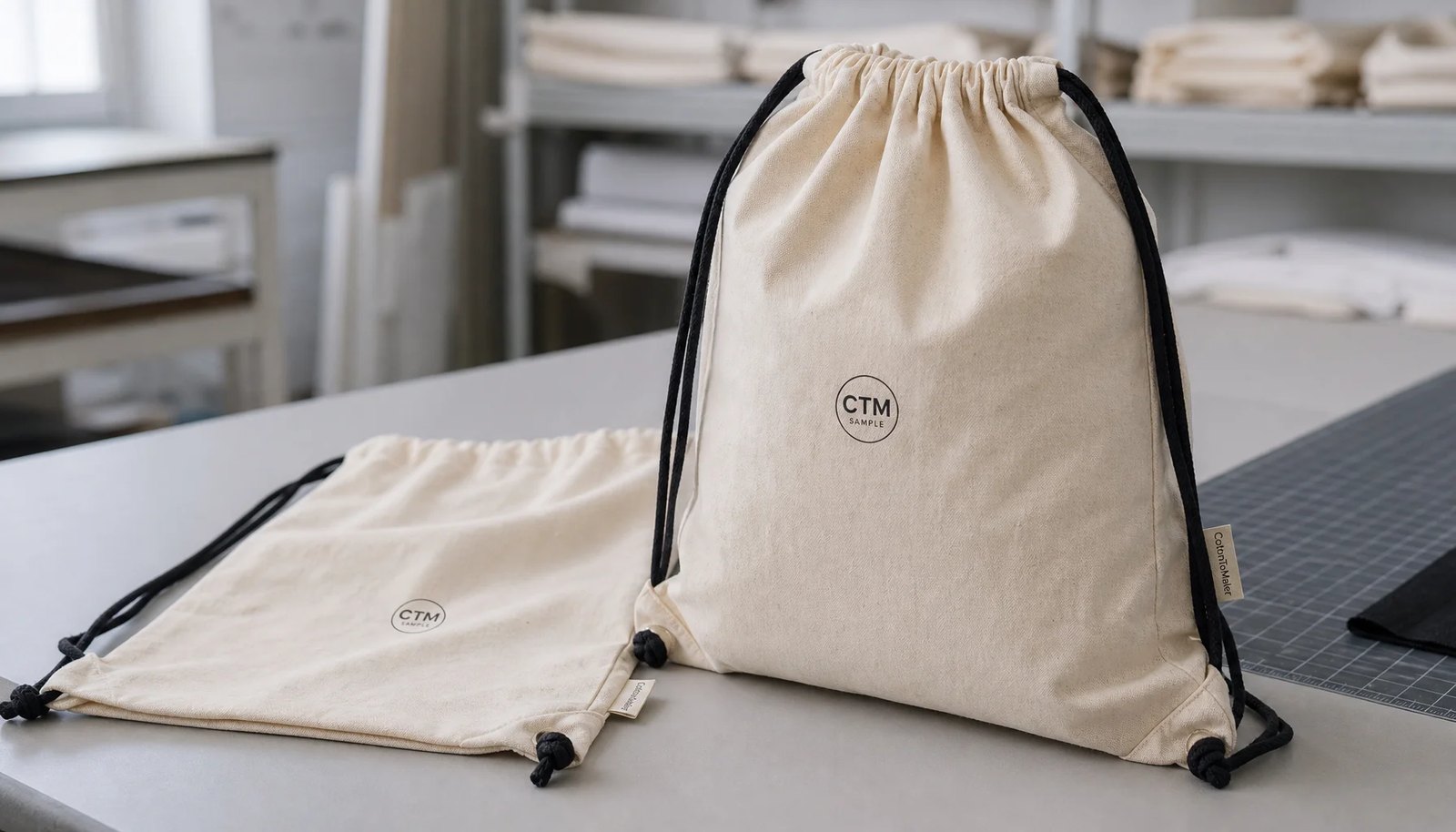
Start MOQ Negotiation With the Real Quantity Problem
For university bookstores, MOQ negotiation on cotton drawstring backpacks is rarely about one simple number. The factory is balancing fabric purchasing, cutting efficiency, print setup, sewing line changeover, packing labor, and carton handling. If the buyer only asks, "What is your lowest MOQ?", the answer may be low but the quote will recover cost through higher unit price, limited color options, weak packing, or long lead time.
A better negotiation starts by defining the order structure. A 1,000 piece order in one natural cotton fabric with one screen print is very different from 1,000 pieces split across four fabric colors, six department logos, two packing styles, and staggered deliveries. The first version is one production run. The second version behaves like many small runs, even if the total quantity looks healthy on a spreadsheet.
- Negotiate MOQ by fabric color, artwork version, and shipment lot, not only total order quantity.
- Use one base backpack body for multiple campus departments when possible.
- Keep size, cord, and sewing construction consistent if artwork versions must vary.
- Expect a lower MOQ on natural cotton than on custom dyed cotton because fabric sourcing is easier.
- Treat split delivery as a cost item; storage and repeat carton handling are not free.
Choose Fabric Weight Before You Discuss Price
Cotton drawstring backpacks for bookstore use usually sit between light promotional bags and more durable campus merchandise. A thin 4 oz or 5 oz cotton fabric may meet a giveaway budget, but it can look limp on a retail peg and may not handle textbooks, hoodies, or water bottles well. For bookstore resale or orientation kits with real carrying use, 8 oz cotton canvas is often a practical middle point. Buyers wanting a more premium handfeel may move to 10 oz, but the added material cost and carton weight should be priced deliberately.
Factories may quote fabric in GSM while buyers think in ounces. The conversion is not always exact because cotton construction, finishing, and moisture content affect handfeel. Do not accept vague wording such as "heavy cotton" or "canvas quality". Put the weight into the RFQ as GSM and ounce equivalent, then require the factory to state tolerance. For example, an 8 oz cotton canvas is commonly around 270 gsm, while 10 oz is commonly around 340 gsm. The finished backpack weight should also be sampled, because fabric weight alone does not capture size, cord, and reinforcement.
- Use 6 oz cotton only for budget giveaways where load and resale appearance are not critical.
- Use 8 oz cotton canvas for most university bookstore drawstring backpacks.
- Use 10 oz cotton canvas when the product needs a stronger retail feel or alumni gift positioning.
- Specify natural, bleached, or dyed cotton because dyeing changes MOQ and lead time.
- Record GSM tolerance and finished bag weight on the approved sample sheet.
Understand the Factory MOQ Logic
A cotton drawstring backpack looks simple, but its MOQ is driven by several small minimums that stack together. Fabric mills may have minimum roll quantities. Dye houses may have vat minimums. Printers need screen setup and ink preparation. Sewing lines lose time when switching cord, thread, artwork, or packing method. Carton labels and barcode stickers also create handling time when assortments are complicated.
When a buyer wants a lower MOQ, the cleanest concession is usually to keep the raw material and production process stable. A factory can often help with a smaller total quantity if the buyer accepts natural cotton fabric, one bag size, one print position, and bulk packing. The same factory may resist if the order requires PMS dyed fabric, four print colors, individual retail polybags, and multiple ship-to addresses. The point is not to remove useful requirements, but to know which requirements are expensive at low volume.
- Natural cotton usually supports lower MOQ than custom dyed fabric.
- One front print position is easier to negotiate than front plus back printing.
- One or two solid screen print colors are easier than full-color artwork.
- Standard cotton cord is easier than custom color cord at low quantity.
- Bulk carton packing is easier than unit packing with hangtags and barcode stickers.
Print Method Changes the MOQ Conversation
Most university bookstore logos and event graphics can be handled by screen printing. It is reliable on cotton, cost-effective for repeat orders, and suitable for solid mascot art, school names, orientation graphics, and department marks. The setup cost sits in the screen making and color separation. That means the unit price improves as quantity increases, but small artwork splits can make the order expensive even when the bag itself is basic.
Heat transfer or digital transfer may be useful when artwork has gradients, photos, or many colors, but the buyer should test handfeel and durability on cotton. Transfers can look sharp at sample stage and then crack, peel, or feel plastic if the wrong film or curing process is used. Embroidery is possible on heavier cotton, but it may pull the fabric, add cost, and slow production. For MOQ negotiation, the lowest-risk route is usually a one or two color screen print with a defined print size and position.
- State print size in inches or centimeters, not only "large logo".
- Give Pantone references, but allow a practical tolerance for cotton fabric absorption.
- Request a print strike-off before bulk production, especially on dyed cotton.
- Define print position tolerance, such as +/-0.25 in from the approved sample.
- Require cured ink testing by rub test or wash simulation when the bag will be retailed.
Build a Quote Sheet That Exposes Hidden Cost
A low unit price is not automatically the best quote. Cotton drawstring backpacks can carry separate charges for sample making, print screens, artwork adjustment, color matching, barcode labels, hangtags, inner polybags, export cartons, and domestic trucking to port. If the buyer compares only FOB unit price, a supplier with incomplete pricing may look better than a supplier who has included the real bookstore requirements.
Use a quote sheet that forces each supplier to break down the same fields. The factory does not need to disclose its internal margin, but it should show what is included and what is excluded. This is especially important when negotiating MOQ. A factory may accept 500 pieces instead of 1,000 pieces, but add a fabric surcharge, setup fee, or sample charge. That can be acceptable if it is visible and still beats the cost of excess inventory.
- Quote unit price by quantity breaks such as 300, 500, 1,000, and 2,000 pieces.
- Separate bag cost, print setup, sample fee, packing cost, and label cost.
- List Incoterm clearly: EXW, FOB, CIF, or DDP should not be mixed in comparison.
- Request carton size, carton weight, and pieces per carton for freight estimates.
- Compare landed cost per approved usable bag after rejects, not only supplier unit price.
Use Samples as Negotiation Control, Not Decoration
Samples are where many MOQ mistakes become visible. A nice photo sample can be made from substitute fabric, stock cord, or a different print process. That may help visualize the design, but it does not prove that the bulk order will meet the bookstore's quality expectation. For a low-MOQ order, the buyer should be especially careful because the factory has less production volume to absorb rework.
The strongest approval sequence is a material swatch, then a print strike-off, then a pre-production sample using bulk materials. The approved sample should be measured, photographed, and written into the purchase order as the production standard. If the bookstore or university licensing office must approve artwork, build that timing into the schedule before production starts. A factory should not cut bulk fabric while artwork approval is still uncertain.
- Measure the sample flat and record top width, height, cord length, and print placement.
- Check fabric handfeel against the quoted GSM instead of relying on appearance.
- Load test the sample with realistic campus items such as apparel, notebooks, and a bottle.
- Rub the printed area with a white cloth to detect poor curing or excess ink transfer.
- Keep one sealed approved sample with the factory and one with the buyer.
Set QC Thresholds Before the PO Is Issued
Quality control language should be practical and measurable. For cotton drawstring backpacks, the common failures are size variation, crooked printing, stains on natural fabric, weak side seams, cord channel tearing, loose threads, and packing count errors. A bookstore receiving team does not want to discover these issues during a campus launch week. The inspection standard must be agreed before production, not argued after shipment.
For many bookstore orders, a general inspection level with defined critical, major, and minor defects is enough. Critical defects include unsafe sharp objects, mold, severe contamination, or wrong licensed logo. Major defects include incorrect size beyond tolerance, broken seams, wrong print color, obvious print misplacement, and wrong packing. Minor defects include small thread ends or tiny natural cotton slubs within the agreed fabric standard. The buyer should define what is acceptable for natural cotton because small specks and slubs are normal, while oil marks and stains are not.
- Size tolerance: commonly around +/-0.5 in for width and height unless tighter control is paid for.
- Print position tolerance: commonly around +/-0.25 in to +/-0.5 in depending on artwork and placement.
- Seam strength: bottom corners and cord channel should withstand normal load without tearing.
- Stain control: no oil marks, large dark stains, mold, or strong odor on retail goods.
- Packing accuracy: carton count, barcode, and assortment ratio should match the purchase order.
Packing Choices Affect Both MOQ and Receiving
Packing is often treated as an afterthought, but it changes labor cost, carton volume, and bookstore receiving efficiency. For orientation giveaways, bulk packing in master cartons may be the best choice. It reduces plastic use, lowers packing labor, and speeds distribution. For bookstore shelf or peg retail, individual polybags, hangtags, barcode stickers, and size or color labels may be necessary. Those details must be included in the MOQ negotiation because they add handling time.
Carton planning also affects landed cost. A slightly oversized backpack or stiff cord arrangement can reduce pieces per carton and increase freight cost. If the order ships by air because of a late approval, carton volume becomes even more painful. Ask for packing details at quote stage: pieces per carton, carton dimensions, gross weight, net weight, and whether cartons can pass normal handling without crushing or bursting.
- Use bulk carton packing for event distribution when individual retail presentation is not needed.
- Use individual polybags only when resale, cleanliness, or barcode scanning requires it.
- Specify suffocation warning requirements if polybags are used in regulated markets.
- Put carton labels on at least two sides for faster warehouse receiving.
- Avoid mixed artwork cartons unless the bookstore has agreed to the assortment and label format.
Plan Lead Time Around Approval Bottlenecks
The production lead time for cotton drawstring backpacks is not only sewing time. It includes material booking, sample making, artwork approval, print screen preparation, cutting, printing, curing, sewing, trimming, inspection, packing, and export handling. For a standard natural cotton backpack with one screen print, the schedule is usually much easier than a custom dyed fabric order with multiple artwork versions. Still, a bookstore launch date can fail if approval responsibilities are unclear.
The biggest schedule risks are late logo approval, unclear Pantone matching, delayed packing artwork, and changes after the pre-production sample. University bookstores often need coordination between the bookstore buyer, campus marketing, licensing, athletics, or an outside design agency. The factory can hold a production slot for only so long. If the buyer wants MOQ flexibility and a firm delivery window, artwork and sample approvals must be managed tightly.
- Allow sample time before bulk production instead of treating it as optional.
- Freeze artwork before the factory prepares screens or print plates.
- Confirm fabric availability before promising a campus event delivery date.
- Add buffer for holidays, port congestion, customs checks, and bookstore receiving windows.
- Use air freight only as a planned exception because it can erase savings from MOQ negotiation.
Negotiate Without Creating Production Risk
The best MOQ negotiation gives the buyer a workable quantity while keeping the factory process stable. Instead of pushing only for the lowest number, offer tradeoffs that reduce production friction. For example, combine department orders into one natural cotton base bag, keep the same print size, use one cord color, and accept one shipment date. In return, request a lower MOQ, clearer quantity breaks, or waived repeat screen charges.
Do not reduce MOQ by accepting unclear leftovers, unapproved substitute fabric, or skipped sampling. Those concessions can produce short-term savings and long-term complaints. If the order is for resale, the product must look consistent on the shelf. If it is for orientation, it must survive real student use. If it carries a licensed university logo, the print must meet approval standards. MOQ is negotiable; the critical product standard should not be.
- Good concession: one base fabric and one cord for multiple artwork versions.
- Good concession: flexible ship window in exchange for a lower setup surcharge.
- Good concession: repeat order commitment if the first lot sells through.
- Risky concession: accepting mixed fabric lots without shade or weight control.
- Risky concession: skipping pre-production sample to save a few days.
Specification comparison for buyers
| Spec decision | Recommended option | When it fits | Buyer risk to check |
|---|---|---|---|
| Fabric weight | 8 oz cotton canvas or 10 oz for heavier retail positioning | 8 oz works for orientation giveaways and bookstore resale; 10 oz fits premium alumni or campus merchandise programs | Quotes using only GSM without ounce conversion can hide a lighter cloth; request actual GSM, ounce weight, and finished sample weight |
| Bag size | Approx. 14 x 18 in with tolerance stated at +/-0.5 in | Fits notebooks, light apparel, water bottle, and campus event kits without oversizing freight cartons | Oversized panels increase fabric consumption and may push MOQ or carton volume higher than expected |
| Drawcord | 5-6 mm cotton cord with knotted ends or metal-free tips | Good for campus bookstore safety expectations and easier recycling claims than polyester cord | Thin cord cuts into shoulders and creates complaints even when the fabric passes inspection |
| Print method | Screen print for one to three solid colors; heat transfer only for complex artwork | Screen print keeps unit cost stable and durable for school logos, mascots, and simple orientation graphics | Low MOQ orders with many logo colors can trigger high setup charges or poor ink coverage on natural cotton |
| MOQ negotiation lever | Consolidate colors, sizes, and print placements under one fabric and one cut | Best when several departments or bookstore seasons can share the same base backpack | Splitting 300 pieces into five artwork versions may price like five small jobs, not one order |
| Sample approval | Pre-production sample using bulk fabric, bulk cord, and actual print ink | Necessary before campus bookstore resale, alumni programs, or licensed logo production | A photo sample made on substitute fabric does not prove shrinkage, print handfeel, or cord strength |
| Packing method | Individual polybag only when resale needs it; otherwise master carton bulk pack with carton labels | Bulk packing saves cost for orientation or event distribution; polybag supports shelf display and barcode control | Unspecified packing causes quote gaps, repacking charges, or carton labeling problems at receiving |
| Supplier route | Direct factory for repeat programs; trading company for mixed small categories | Direct factory is stronger for MOQ negotiation on one backpack style; trader helps combine unrelated bookstore SKUs | A low trader MOQ can hide higher rework risk if fabric, printing, and packing are handled by separate vendors |
Buyer checklist before sampling
- Define one base backpack size, fabric weight, cord type, and seam construction before requesting MOQ concessions.
- Separate unavoidable requirements from preferences: licensed logo accuracy, retail barcode packing, and campus delivery date should not be traded away.
- Request MOQ by fabric color, print design, and shipment lot, not only one headline MOQ for the whole order.
- State whether the order is for resale, orientation giveaway, donor gift, or event kit because packing and QC levels differ.
- Require a pre-production sample made with bulk fabric, actual cord, final print method, and approved packaging.
- Build the quote sheet with unit price, setup charges, sample fees, packing cost, carton dimensions, lead time, and payment terms.
- Compare landed cost per usable bag, not only EXW or FOB unit price.
- Reserve time for licensed logo approval, print strike-off review, and carton label correction before production starts.
- Set acceptance criteria for fabric GSM tolerance, size tolerance, print position tolerance, seam strength, and color matching.
- Avoid reducing MOQ by accepting leftover fabric unless shade, shrinkage, and re-order continuity are documented.
Factory quote questions to send
- What is your MOQ per fabric color, per print design, and per shipment for this cotton drawstring backpack?
- Which fabric weight are you quoting in GSM and ounces, and what tolerance do you allow on bulk fabric?
- Is the quoted cotton fabric greige, bleached, dyed, or finished after washing, and will shrinkage be tested?
- What cord diameter, cord material, and reinforcement method are included in the price?
- Which print method is included, how many colors, what print size, and what setup charges apply?
- Can you make a pre-production sample using bulk fabric and actual ink before mass production?
- What are the sample lead time, bulk production lead time, and earliest ship date after sample approval?
- Are individual polybags, hangtags, barcode stickers, and carton labels included or charged separately?
- What are the carton dimensions, estimated gross weight, and pieces per carton for freight calculation?
- What inspection standard do you support for size, sewing, print defects, stains, and packing accuracy?
Quality-control points to confirm
- Fabric weight should be verified from bulk fabric before cutting, with the agreed GSM or ounce tolerance recorded.
- Finished bag size should be measured flat at top width and height, with tolerance normally kept around +/-0.5 in unless specified tighter.
- Drawcord length, diameter, knot security, and channel opening should be checked because cord failures are common in low-cost backpacks.
- Side seams and bottom corners should be inspected for skipped stitches, loose threads, seam slippage, and reinforcement accuracy.
- Print color, print position, ink coverage, curing, and rubbing resistance should be checked against the approved strike-off.
- Natural cotton fabric should be inspected for oil marks, weaving slubs, stains, shade variation, and excessive odor.
- Packing should match the purchase order: polybag, barcode, hangtag, carton label, carton count, and assortment ratio.
- A final random inspection should include functional loading, visual defects, measurement, print adhesion, and carton drop risk where required.