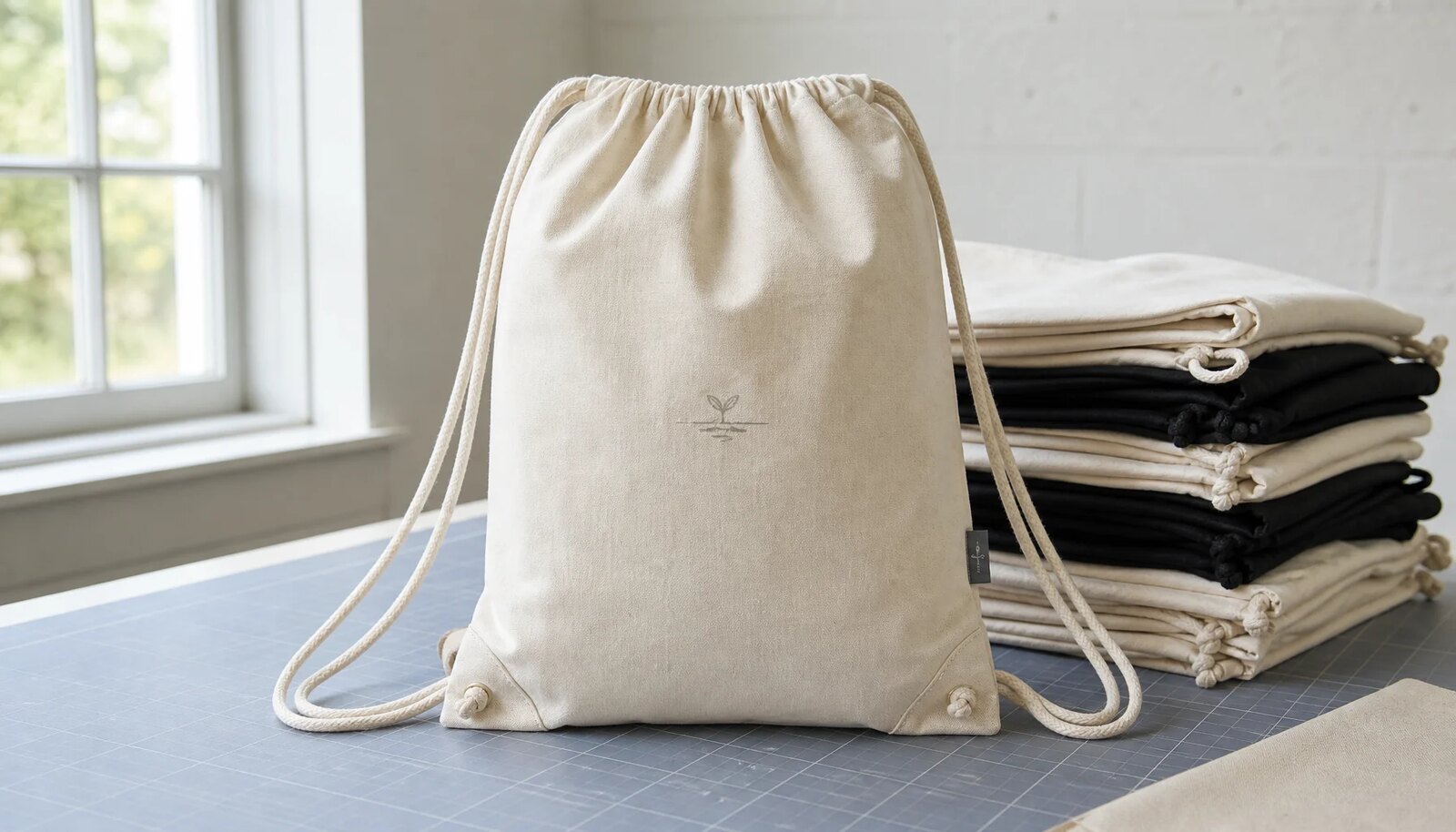
Start With the Event Use Case
A cotton drawstring backpack looks like an easy item until the order is tied to a real event date, a sponsor logo, a packing plan, and several thousand attendees. The right material for a one-day seminar handout is not always right for a university orientation kit, volunteer bag, staff pack, product launch giveaway, or VIP hospitality gift. A 35 x 42 cm bag that works for a leaflet and pen may feel underbuilt once it carries a bottle, catalog, hoodie, charger, and lanyard.
Begin the RFQ with the job the bag has to do. Tell the supplier what will go inside, how it will be distributed, whether it will be pre-kitted, how long attendees are expected to carry it, and whether the brand wants a light promotional feel or a reusable retail-style finish. Those details affect GSM, weave, cord diameter, corner reinforcement, print method, fold method, and carton labeling. They also reduce the chance of receiving a low-spec quote dressed up with attractive sample photos.
For procurement teams, the practical split is light carrier versus reusable event bag. A light carrier can prioritize unit cost and fast production. A reusable attendee bag needs better structure, print stability, cord comfort, and stronger load points. Sponsor visibility changes the calculation too. A slightly stronger material may be worth very little if the logo is crooked or the small sponsor marks print poorly, so material and decoration should be specified together.
- Write the event type, distribution method, and expected use duration into the RFQ.
- List expected contents and estimated total fill weight, even if the number is approximate.
- State whether the target is budget promotional, standard conference kit, staff use, or premium gift.
- Tell suppliers whether bags will be bulk distributed, pre-kitted, shipped to multiple venues, or handed out individually.
Size and Load Come Before GSM
Many buyers ask for a fabric weight first. It is usually better to confirm size and load first. Common event drawstring backpacks often fall around 33 x 40 cm, 35 x 42 cm, or 38 x 45 cm, but those sizes are not interchangeable when a folder, apparel item, folded brochure, boxed sample, or welcome kit must fit without forcing. Ask for finished size measured flat after sewing and pressing, not cutting size. Cotton can shift during sewing, seams consume fabric, and pressing can change the final dimension slightly.
Load matters because the first failure point is rarely the middle of the cotton panel. It is usually the top channel, cord entry, bottom corner, seam, eyelet, or reinforcement patch where the pull is concentrated. A bag carrying only a program sheet and pen can be much simpler than one carrying a bottle, catalog, T-shirt, and sponsor sample. If the fill is heavier, connect the load assumption to the construction: stronger cord, wider channel, reinforced corners, secure stitching, and a load or pull check.
Write the tolerance instead of leaving it to factory habit. For many standard event bags, a finished-size tolerance of +/-0.5 cm to +/-1.0 cm is workable. If the bag must hold a rigid insert, tablet sleeve, boxed kit, or pre-packed folder, tighter control may be needed and should be agreed before sample approval. In large kitting projects, inconsistent bag size can slow the packing line even when the end user never notices.
- Specify finished dimensions in centimeters and confirm measurement is after sewing and pressing.
- Provide target contents and approximate fill weight so the factory can assess construction risk.
- Use a written finished-size tolerance rather than accepting an undefined standard tolerance.
- Test the sample with the actual event contents before approving bulk production.
Choose a GSM Range That Matches the Job
GSM affects more than thickness. It changes hand feel, print behavior, carton weight, freight cost, sewing speed, and perceived value. A 140-160 gsm cotton drawstring backpack is a light promotional option. It can work for school visits, indoor handouts, mailer inserts, charity walks with light contents, and low-budget campaigns where the bag is mostly a branded carrier. The tradeoff is easy to feel: lighter cotton wrinkles faster, may show the outline of contents, and can look disposable beside higher-quality event materials.
For many event planners, 180-220 gsm cotton canvas or twill is the most useful starting range. It usually offers enough structure for registration packs, campus events, sponsor programs, staff kits, and attendee bags carrying a notebook, lanyard, brochure set, and small merchandise item. If you are using this cotton drawstring backpacks material selection guide for event planners to build a first supplier brief, sample this range before moving lighter or heavier.
A 240-280 gsm canvas can make sense for VIP kits, hospitality programs, premium sponsor gifts, retail-style merchandise, or heavier contents. Still, heavier is not automatically safer. Thick fabric can increase cutting effort, sewing difficulty, needle wear, carton weight, and freight cost. If the fabric is not in stock, it can also stretch the schedule. More importantly, a high-GSM body with weak corners is still a weak bag. Upgrade the whole construction, not only the fabric panel.
- Use 140-160 gsm only when contents are light and the brand can accept a thinner promotional feel.
- Use 180-220 gsm for most standard conference, orientation, and reusable giveaway bags.
- Use 240-280 gsm for premium or heavier fills, paired with stronger cord and corner reinforcement.
- Require GSM to appear on the quote, sample tag, purchase order, and final production spec.
Specify Weave, Texture, and Color Route
Cotton is not one fixed material. Plain weave, canvas, and twill can look and perform differently even when the GSM is similar. Plain weave can be economical and suitable for simple graphics, especially on lighter-use bags. Canvas usually gives a sturdier face and more substantial event-bag feel. Twill may provide a smoother diagonal texture and a more refined hand, depending on yarn, finishing, and weight. Ask the supplier to name the weave instead of accepting broad phrases such as cotton cloth, thick cotton, or canvas bag.
Texture changes decoration results. Rough, open, or heavily slubbed cotton can break fine print edges, reduce QR-code readability, and make small sponsor logos look softer than expected. Natural cotton can be attractive when the event brief allows an unbleached look, but flecks, seed marks, yarn variation, and slubs are part of that choice. Approve those features with a physical swatch. Otherwise, normal natural variation can become a receiving dispute.
Color route has a direct effect on risk and timeline. Natural stock cotton is usually lower development risk because the fabric does not need custom dyeing. Bleached white gives a cleaner base for bright artwork, but it can show dirt during packing and venue handling. Stock dyed colors such as black, navy, red, or green may be available if the supplier holds inventory. Custom dyed cotton needs lab dips, buyer approval, written shade tolerance, and schedule buffer. For dark dyed fabric, ask about dry rub, wet rub, and crocking onto light cords, labels, apparel, or printed inserts.
- Ask for weave, GSM, and surface description together; one without the others is incomplete.
- Approve physical swatches under normal event lighting, not only supplier photos.
- Define whether natural flecks, slubs, and shade variation are acceptable or rejectable.
- For custom colors, build time for lab dips and write a shade tolerance into the production approval.
Match Decoration to Fabric and Artwork
Decoration should be selected after the artwork, fabric surface, quantity, and brand standard are clear. Screen printing is widely used for cotton drawstring backpacks because it is efficient for bold logos, event names, sponsor marks, and simple artwork. It is often the best-value route for one to four colors at medium and high quantities. The quality, however, depends on mesh, ink type, squeegee control, curing, artwork line weight, and fabric texture. On rough cotton, small reversed text can close up, thin lines can fill in, and large ink blocks can feel stiff.
Digital transfer and heat transfer can be useful for gradients, full-color sponsor artwork, short runs, or late artwork changes. They avoid multiple screens and can handle complex graphics. The main risks are hand feel and durability. On textured cotton, a transfer may sit on top with a visible edge, crack over folds, or lift if temperature, pressure, or dwell time is wrong. Approve the transfer on the final cotton fabric, not on a paper proof or a smoother substitute bag.
Embroidery, woven patches, printed patches, and sewn labels can make an event bag feel more considered. A small woven side label may be cleaner than a large front print for a premium program. A patch can create a retail-style finish and reduce some print-edge issues on textured fabric. Embroidery can look strong but may pucker lighter cotton, especially with dense stitches or large filled areas. For any sewn decoration, specify placement tolerance, stitch color, backing, trim quality, and loose-thread standard. The right method is the one that repeats cleanly across the order, not just the one that looks best in a digital mockup.
- Use screen print for bold one- to four-color artwork and stable repeat quantities.
- Use transfer methods for complex color artwork, but test adhesion, edge feel, and cracking.
- Use patches, labels, or embroidery for premium programs, with attention to puckering and stitch cleanup.
- Set print placement tolerance, commonly +/-0.5 cm to +/-1.0 cm depending on artwork size and bag shape.
Engineer Cords, Channels, and Corners
The drawstring system carries a large share of the quality risk. Buyers often focus on the cotton body and front logo, while attendee complaints come from cords that are too thin, channels that snag, knots that pull through, eyelets that loosen, or bottom corners that tear. The quote should state cord material, diameter, color, draw length, top-channel width, knot finish, and reinforcement type. A line that says drawstring included is not specific enough for B2B comparison.
Cotton cord supports a natural-material story and can feel soft, but it may fuzz, absorb moisture, and stretch differently from synthetic cord. Polyester cord is often more stable and abrasion resistant, though it may not suit a strict cotton-only brief. Blended cord can be a practical compromise. Diameter should match the load and the channel. A thin cord can dig into the shoulder and look cheap. A thick cord can jam if the top channel is too narrow. For many standard event bags, 5-8 mm is a useful discussion range, but the final choice should be tested with the real bag size and expected fill.
Bottom reinforcement should fit the use case. Options include fabric corner patches, stitched buttonholes, metal eyelets, bar tacks, and reinforced seams. Eyelets can look clean but may pull out if set poorly or used on fabric that is too light. Fabric patches suit natural cotton bags, but they need secure stitching and enough area to spread the stress. For bags carrying bottles, catalogs, apparel, or multi-item kits, ask for a pull test or hanging load check. A capable supplier should be able to explain how the cord and corner construction are verified before packing.
- Specify cord fiber, diameter, color, draw length, and knot or end treatment.
- Check that the top channel is wide enough for the chosen cord and sewn straight across the bag.
- Require reinforced corners for reusable event bags and any bag carrying more than light paper.
- Ask for a load or pull test standard and request photos or inspection notes before shipment.
Compare Quotes on One Controlled Spec
Cotton drawstring backpack quotes can look similar while describing different products. One supplier may price 150 gsm plain weave natural cotton with bulk packing and one-color print. Another may include 220 gsm canvas, stronger cord, reinforced corners, two-color print, individual polybags, and carton labels by venue. If procurement compares only unit price, the cheaper quote may simply be a lower-specification bag.
A controlled RFQ makes every bidder price the same finished size, GSM, weave, color route, decoration method, print size, cord, reinforcement, packing format, inspection expectation, and delivery requirement. Ask suppliers to show assumptions clearly. If a quote does not name the GSM, cannot confirm cord diameter, or relies on phrases such as high quality cotton, treat it as incomplete until clarified. Price comparison becomes much cleaner once vague descriptions are replaced with measurable specifications.
The cost drivers are usually predictable: fabric weight, fabric availability, dyeing, cutting, sewing, print setup, number of print colors, embroidery or patch processes, cord type, labels, inner packing, carton cube, inspection, and freight. MOQ can change with custom fabric, special trim, or decoration setup. Request tiered pricing for realistic quantities such as 1,000, 3,000, and 5,000 pieces, and ask which charges are fixed. That helps buyers decide whether moving from a very light fabric to 180-220 gsm creates enough quality value to justify the added spend.
- Send one specification sheet to every bidder before requesting final pricing.
- Ask suppliers to separate unit cost, setup charges, packing charges, and optional upgrades where practical.
- Compare carton volume and freight impact, not only ex-factory unit price.
- Clarify quotes that omit GSM, decoration method, cord detail, packing format, or lead-time start point.
Use Samples as Production Evidence
A sample should predict bulk production. It should not merely prove that the logo can be placed on a bag. For first-time orders, request a pre-production sample using the intended fabric, GSM, color, cord, reinforcement, decoration, label, and packing method. A similar existing sample can help at the early discussion stage, but it should not become the approval standard. If a buyer approves a substitute sample, the factory may assume the details are flexible unless the written spec says otherwise.
Review the sample like an inspector and like an attendee. Measure the finished size flat. Fill it with the expected contents. Pull both cords repeatedly. Open and close it several times. Watch whether the top channel twists, whether the bottom corners distort, and whether the fabric feels appropriate beside the rest of the event materials. Inspect print edges, color, placement, cure, and hand feel. If the order includes QR codes, sponsor marks, or small legal copy, scan and read them at actual size on the selected fabric.
Document the approval. Keep one signed sample with the buyer or inspection team and make sure the supplier keeps a matching reference. If changes are needed, write them as production instructions: increase cord length, move logo down 1 cm, change print color, reinforce corners, adjust fold method, or reduce inner pack quantity. Informal chat notes are not enough for critical corrections. If timing forces photo approval, request close-ups of the fabric face, print edge, cord entry, bottom reinforcement, label, inside seams, and packing. Photo approval is more dependable for repeat orders than for a new event program.
- Approve a production-intent sample, not a similar bag from the showroom.
- Test the sample with actual event contents before release.
- Write every sample correction into the production spec and PO revision.
- Keep a signed reference sample for inspection, receiving, and dispute resolution.
Put QC Criteria in the PO
Quality control should be agreed before production starts. The purchase order or production spec should include measurable checks: finished size, GSM, color, shade range, print placement, print quality, stitch defects, cord function, reinforcement strength, label placement, packing count, and carton marks. A supplier may have an internal standard, but standard quality is too vague for event procurement, especially when the delivery date is fixed and replacement time is limited.
Classify defects by event impact. Critical defects may include wrong logo, wrong color, unsafe metal parts, severe print peeling, open seams, missing cords, wrong carton destination, or major shortages. Major defects may include crooked print, unacceptable stains, weak corner reinforcement, visible holes, incorrect label placement, or badly imbalanced cords. Minor defects may include small loose threads, slight natural slubs within the approved standard, or light wrinkles from packing. The final classification should match the event brand standard and use case.
For larger or high-visibility orders, consider in-process checks as well as final inspection. In-process checks can catch fabric substitution, print color error, or sewing problems before thousands of units are packed. Final inspection confirms quantity, workmanship, function, and packing. If using AQL inspection, agree on the sampling plan, defect definitions, and acceptable limits before production begins. Even when the supplier performs internal QC only, ask for a report or photo set showing size checks, print checks, cord function, reinforcement checks, and carton count verification against the signed sample.
- Put tolerances and defect criteria in the PO, not only in email discussion.
- Use the signed sample as the standard for color, hand feel, decoration, and construction.
- Ask for inspection evidence before shipment when the event date leaves little recovery time.
- Make packing accuracy part of QC, because event shortages can be as damaging as product defects.
Plan Packing, Labeling, and Delivery
Packing is part of the product specification, not an afterthought for the warehouse. A bag may be packed well for export and still be awkward for an event team. If bags feed a kit assembly line, inner pack quantities should match the line setup. If bags go to several venues, carton labels should identify event name, destination, item code, color, logo version, quantity, and carton number. If bags are handed out individually, polybags may keep light cotton clean, but they add cost, labor, and packaging waste.
Cotton creases, and decoration can be damaged by poor packing. Heavy pressure may leave fold marks across the print. Loose packing can increase carton cube and freight cost. Tight packing can deform cords, flatten patches, or cause ink transfer if decoration is not fully cured. The packing spec should define fold method, pieces per inner pack, pieces per master carton, carton dimensions, gross weight target, carton mark format, and whether warning labels, barcode labels, hangtags, or desiccants are needed for the destination market.
For multi-site events, allocation accuracy is as important as product workmanship. A short carton or mixed carton can create on-site confusion even when the bags themselves are well made. Ask the supplier to provide a packing list that matches the buyer allocation sheet and to avoid mixing colors, logos, or venue destinations unless mixed packing is explicitly approved. If sustainability is a priority, discuss alternatives to individual polybags, such as fixed paper-banded inner packs or bulk flat packing, while still protecting light-colored cotton from dust and handling marks.
- Define fold method, inner pack count, master carton count, and carton label content before production.
- Use venue-specific carton marks for multi-location events.
- Balance print protection, cleanliness, cost, and packaging-waste goals when choosing polybags.
- Require packing lists that match the buyer allocation sheet exactly.
Specification comparison for buyers
| Spec decision | Recommended option | When it fits | Buyer risk to check |
|---|---|---|---|
| Finished size | Common event range: 33 x 40 cm to 38 x 45 cm | Registration kits, student orientations, staff packs, sponsor giveaways, volunteer bags, and light merchandise packs | Confirm finished dimensions are measured flat after sewing and pressing; set a practical tolerance such as +/-0.5 cm to +/-1.0 cm unless rigid inserts require tighter control |
| Fabric weight | 140-160 gsm cotton | Budget giveaways, light indoor events, mailer inserts, school visits, charity walks, and short-use promotional handouts | Can feel thin, wrinkle quickly, and show contents; verify the quoted fabric is not below the named GSM range |
| Fabric weight | 180-220 gsm cotton canvas or twill | Most conference kits, campus events, registration bags, staff packs, and reusable sponsor programs | A strong starting point, but still needs suitable cord, channel width, and corner reinforcement for heavier fills |
| Fabric weight | 240-280 gsm cotton canvas | VIP kits, hospitality gifts, retail-style merchandise, apparel packs, catalogs, or bottle-and-brochure kits | Higher GSM can raise sewing difficulty, carton weight, freight cost, and lead-time risk when fabric is not in stock |
| Fabric weave | Plain weave cotton | Low-cost bags with simple one-color artwork and light contents | Open or uneven surfaces can reduce print edge definition; approve the artwork at actual print size on the real fabric |
| Fabric weave | Canvas or twill | Programs needing better structure, cleaner print edges, and a more durable hand feel | The word canvas is used loosely; require GSM, weave description, sample swatch, and signed sample approval |
| Fabric color | Natural or unbleached cotton | Fast timelines, lower fabric development risk, sustainability-oriented briefs, and designs that accept natural flecks | Shade, seed flecks, slubs, and yarn variation must be approved as part of the look, not disputed after bulk production |
| Fabric color | Bleached, stock dyed, or custom dyed cotton | Brand programs needing clean white, black, navy, campaign colors, team colors, or venue-specific color coding | Custom colors require lab dips, shade tolerance, crocking checks, and more schedule buffer |
| Decoration | Screen print, usually 1-4 colors | Bold logos, event names, sponsor marks, and medium to high quantities | Specify print size, Pantone references, placement tolerance, ink type, curing checks, and whether screen charges are included |
Buyer checklist before sampling
- Define finished size in centimeters, measurement method, and tolerance; for standard event bags use +/-0.5 cm to +/-1.0 cm unless inserts require tighter control.
- List the expected contents and estimated fill weight, including bottles, catalogs, hoodies, chargers, brochures, samples, folders, or notebooks.
- Choose a target GSM range rather than asking for a generic cotton bag; use 140-160 gsm for light giveaways, 180-220 gsm for most event kits, and 240-280 gsm for premium or heavier use.
- Specify weave and hand-feel expectations: plain weave, canvas, twill, smooth face, visible slub, natural texture, or firmer structure.
- State the fabric color route: natural stock cotton, bleached cotton, stock dyed fabric, or custom dyed fabric with lab dip approval.
- Define acceptable shade variation for natural cotton, including flecks, slubs, yarn marks, and whether shade must match a signed swatch.
- Provide artwork size, placement, number of colors, Pantone or brand references, print method preference, file format, and minimum readable text size.
- Ask whether the quoted decoration is water-based screen print, plastisol print, discharge print, pigment print, digital transfer, heat transfer, embroidery, woven patch, or sewn label.
- Set decoration tolerances, such as print placement within +/-0.5 cm to +/-1.0 cm, no visible skew, no cracking, no peeling, and no unacceptable bleeding.
- Define cord material, cord diameter, cord color, draw length, knot finish, top-channel width, and bottom reinforcement method.
Factory quote questions to send
- What finished size, seam construction, fabric GSM, weave, and fabric color route are included in the unit price?
- Will GSM, weave, color, cord specification, decoration method, packing, and tolerance be shown on the proforma invoice or production spec sheet?
- Is the fabric stock natural cotton, bleached cotton, stock dyed cotton, organic cotton, recycled cotton blend, or another construction, and what documentation can you provide if a claim appears in our marketing?
- What GSM tolerance do you work to for this fabric lot, and can you provide a swatch or fabric test reference before bulk cutting?
- For natural cotton, what shade range, fleck level, slub level, and surface irregularities should we expect in production?
- For dyed cotton, what lab dip process, shade tolerance, colorfastness check, and crocking check are included?
- Which decoration method is quoted, what is the maximum print area, and are screen charges, setup fees, film charges, digitizing fees, or patch mold fees separate?
- What ink system or transfer type will be used, and what cure, adhesion, dry rub, wet rub, or wash checks do you perform before packing?
- What minimum line width and minimum text height do you recommend for our artwork on this fabric surface?
- What cord material, diameter, color, knot finish, draw length, and top-channel width are included in the base quote?
Quality-control points to confirm
- Finished size should match the signed specification within written tolerance; for standard event bags, +/-0.5 cm to +/-1.0 cm is common, while inserts, folders, or boxed kits may require tighter control.
- Fabric GSM should be checked against the agreed range before cutting or during inspection; a quote without GSM allows substitution and should be corrected before PO release.
- Fabric composition and claim language should match the approved brief; organic, recycled, Fairtrade, or similar claims require valid documentation, not a sales description.
- Fabric surface should be inspected for stains, holes, oil marks, broken yarns, heavy slubs, shade panels, and weaving faults outside the approved reference sample.
- Natural cotton should be judged against an approved shade and fleck standard so normal seed marks are not confused with contamination or production defects.
- Dyed fabric should be checked for shade consistency across panels, visible crocking on light cords or labels, and unacceptable shade difference between sample and bulk.
- Print placement should remain centered, level, and within tolerance, commonly +/-0.5 cm to +/-1.0 cm depending on artwork size and bag construction.
- Print quality should show no ghosting, bleeding, pinholes, cracking, peeling, heavy ink buildup, poor curing, or color break across folds, seams, or fabric texture.
- Fine artwork, sponsor marks, small legal copy, and QR codes should be checked at actual size on the selected fabric because textured cotton reduces edge clarity.
- Stitching should be even and secure, with straight top channels, no skipped stitches, no open seams, no broken thread, no loose thread nests, and clean trimming.