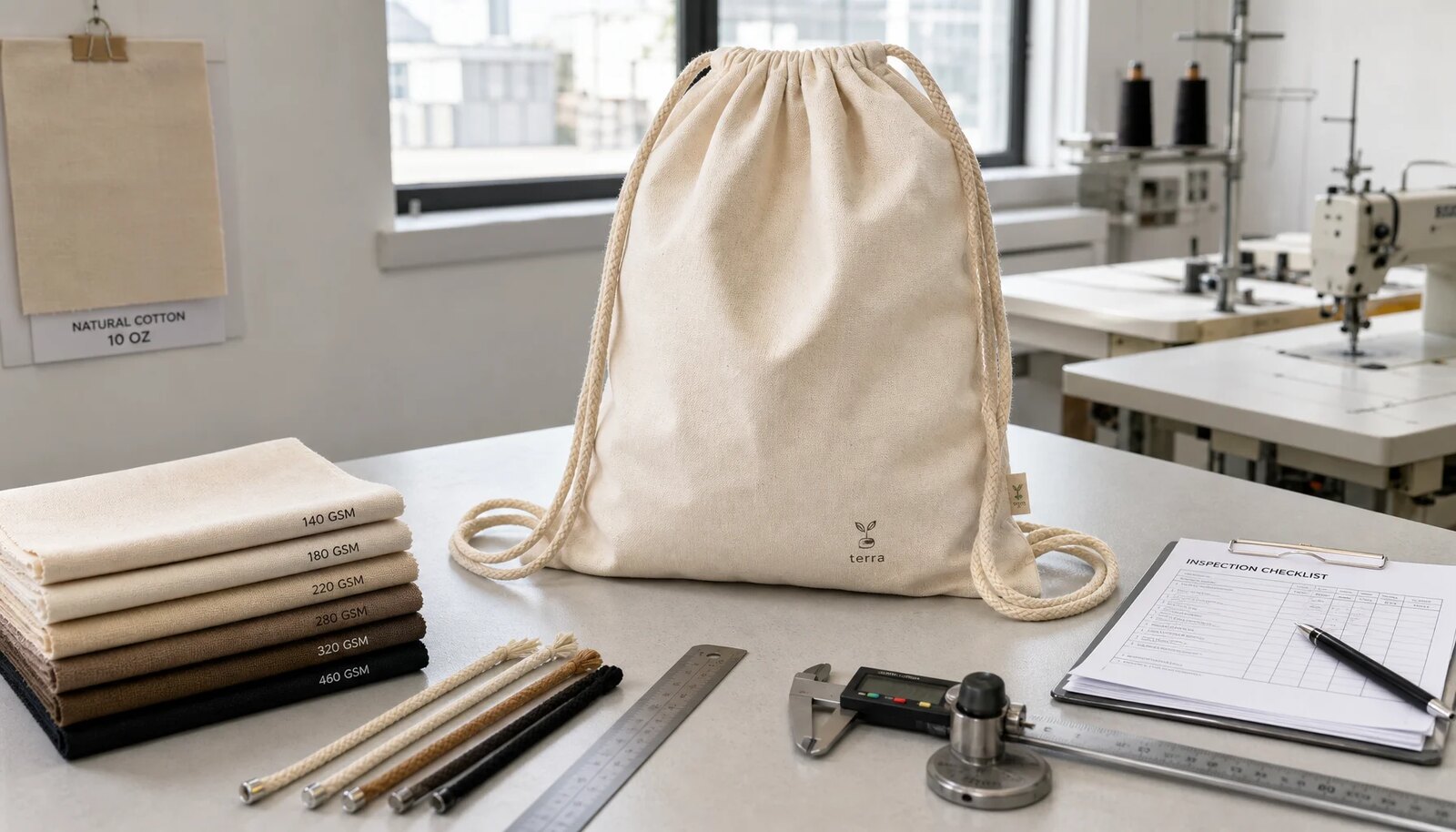
Start With the Market Job, Then Build the Spec
A cotton drawstring backpack for farmers market vendors has a more specific job than a generic promotional pouch. It may carry recipe cards, seed packets, staff aprons, market tokens, sponsor inserts, small produce bundles, samples, or a few POS accessories behind a stall. It may also be sold as low-cost merchandise. Those uses place different demands on fabric body, cord strength, print durability, seams, folding, and carton packing.
Procurement should begin by naming the role of the bag. A quote that says cotton drawstring backpack can hide several very different products: 6 oz natural cotton with a narrow cord, 8 oz cotton with reinforced side seams, or 10 oz canvas with a stronger braided drawcord. The product name looks tidy on a quote sheet. The actual performance, carton weight, and landed cost will not be tidy unless the specification is written clearly.
Before requesting price, write a short operating profile. Identify whether the order is for a giveaway, CSA pickup bag, sponsor kit, retail item, staff utility bag, or seasonal reorder. Set the expected maximum load, the largest item that must fit, the number of uses expected, likely washing or steam exposure, and whether the bag must arrive retail-ready. This profile gives suppliers enough context to quote the right construction and gives buyers a practical basis for rejecting substitutions.
A useful cotton drawstring backpacks material selection guide for farmers market vendors should also separate appearance from performance. Natural cotton, visible texture, and simple printing may fit a local market well. The bag still needs controlled tolerances, stable seams, and a drawcord that opens and closes smoothly after repeated handling. The strongest RFQ connects the desired look to factory-level details.
- Classify the program before quoting: giveaway, CSA pickup, sponsor kit, retail merchandise, or vendor utility.
- List the expected contents and maximum load in lb or kg.
- Decide whether the bag must survive washing, rain exposure, repeated folding, seasonal storage, or resale display.
- Convert the use case into measurable specs for fabric, size, cord, seams, print, label, and packing.
Choose Fabric Weight by Finished GSM
Fabric weight is usually the biggest material decision. It affects cost, handfeel, print surface, durability, carton weight, and freight. In bag sourcing, cotton is often described in oz/yd2 and sometimes in gsm. The common conversion is approximate: 6 oz/yd2 is about 200 gsm, 8 oz/yd2 is about 270 gsm, 10 oz/yd2 is about 340 gsm, and 12 oz/yd2 is about 400 to 410 gsm. Buyers should specify finished fabric weight because greige fabric, washed fabric, and finished fabric may not test the same.
For very light market promotions, 6 oz cotton can be acceptable when the bag holds paper inserts, coupons, recipe cards, or seed packets. It is usually a weak choice for jars, boxed samples, produce bundles, or repeated vendor use. An 8 oz cotton is the practical baseline for many farmers market programs because it gives better body while keeping cost and freight manageable. A 10 oz cotton improves handfeel, panel stability, and resale positioning. A 12 oz canvas should be reserved for premium or heavier use where the added sewing and shipping cost has a clear reason.
Do not compare weight labels alone. Two 8 oz fabrics can behave differently if one is tightly woven and the other is loose, if one has a smoother print face, or if one shrinks more after finishing. A loose weave can distort under uneven load and make printed edges look rough. A tighter fabric may cost more but hold shape better and support cleaner screen printing. Ask for finished GSM, weave type, fabric width, and yarn count if the mill or factory can provide it.
Shrinkage deserves attention because market bags may be steamed, stored in humidity, or washed by end users. If inserts, folded brochures, or retail packaging must fit, a 3% to 5% size change can matter. Ask whether the cotton is washed, sanforized, pre-shrunk, or untreated, then write the acceptable shrinkage range into the sample approval record.
- Use 6 oz/about 200 gsm only for very light promotional use.
- Use 8 oz/about 270 gsm as the standard reusable starting point.
- Use 10 oz/about 340 gsm for resale, heavier contents, or better structure.
- Use 12 oz/about 400-410 gsm for premium canvas programs with a clear business case.
- Set a finished GSM tolerance, commonly +/-5%, and state the test method if formal testing is required.
Control Cotton Finish, Shade, and Claims
Natural cotton fits many farmers market programs because it looks simple, familiar, and close to the produce setting. It also brings normal variation: flecks, seed marks, slubs, lint, and shade differences between lots. These are not always defects. They become defects when the purchase order and approved sample say they fall outside the accepted standard. For natural cotton, approve a shade band rather than relying on one perfect panel.
Bleached or controlled off-white cotton gives a cleaner look and stronger logo contrast. It can help with sponsor programs, retail photography, fine-line artwork, and multi-location branding where bags from different lots may be seen together. The tradeoff is that lighter cotton shows dirt, storage marks, and yellowing more easily. Ask about whiteness control, heat exposure during printing, and finishing-chemical compliance documentation if your sales channel requires it.
Dyed cotton can help vendors separate programs by season, market location, sponsor, or product category. It can also hide dirt better than natural or white cotton. The procurement load is higher, though. Dyed fabric often changes MOQ, lead time, and inspection needs. Dark fabric may require high-opacity ink, discharge printing, transfer decoration, or artwork changes. If rain exposure or washing is likely, add dry-rub, wet-rub, and wash checks.
Material claims need discipline. Organic cotton, recycled cotton, fair-trade cotton, and similar terms should not appear on packaging, hang tags, product pages, or customer copy unless the supplier can provide appropriate certificates or transaction documents. When no claim is required, conventional cotton with verified weight, shade control, and inspection may be the more practical, lower-risk choice.
- Approve natural cotton with an accepted shade band and surface standard.
- Define whether flecks, slubs, seed marks, and lint are acceptable appearance features or defects.
- Require lab dip or strike-off approval for dyed cotton before bulk fabric booking.
- Confirm documentation before using organic, recycled, or other sourcing claims.
- Keep one sealed reference sample at the buyer side and one at the factory side.
Match Decoration to Cotton Texture
Decoration is highly visible, and it is often where vague specifications become expensive. For simple farmers market logos, 1- or 2-color screen printing is usually the most economical and repeatable option. It works best when the artwork sits on a flat panel away from seams and the cotton face is tight enough to hold clean edges. The RFQ should define ink type, Pantone target, print size, placement, curing method, and inspection standard.
DTF and heat transfer can be useful for multicolor artwork, gradients, short runs, sponsor names, or multiple vendor versions. They also introduce different risks: visible film edges, heavier handfeel, cracking at folds, peeling from insufficient heat or pressure, and transfer marks during tight packing. If bags will be folded through the logo or stored for months, approve the exact fold and run adhesion, fold, and rub checks on the actual fabric.
Embroidery, woven labels, and patches can add perceived value for paid merchandise, but they are not automatically better. Embroidery can pucker lighter cotton unless stabilizer and stitch density are correct. Patches add bulk and may interfere with folding. Woven labels must be straight, secure, and consistently caught in the seam. These options make the most sense when the resale price, brand standard, or retail presentation supports the added cost.
Placement should be measured from finished seams, not estimated by eye. State the top-edge distance, side centering, print dimensions, and acceptable shift. Keep artwork away from the top channel, bottom fold, side seams, corner reinforcement, and heavy packing creases where possible. A simple placement drawing in the RFQ can save multiple sample rounds.
- Use screen print for simple repeat logos where unit cost and consistency matter.
- Use DTF or transfer for multicolor artwork only with adhesion, rub, fold, and wash checks.
- Specify Pantone targets, opacity expectations, cure standard, and registration tolerance.
- Measure print placement from finished edges and seams.
- Confirm whether screens, setup, strike-offs, and one correction round are included in the quote.
Engineer the Cord and Sewing Details
The drawcord system is a functional part of the backpack. Customers notice whether the bag opens smoothly, closes evenly, and feels secure on the shoulder. Cotton cord supports a natural look but can stretch, flatten, and soil more easily. Braided polyester cord is usually more consistent and abrasion-resistant, though it feels less natural. For many cotton drawstring backpacks, 3 mm to 5 mm cord is a practical range, but the right size depends on bag dimensions, fabric weight, and intended load.
The top channel must be wide enough for the cord to slide without bunching. A narrow channel can look tidy in a sample and still frustrate users in daily handling. Specify finished channel width, opening style, seam placement, reinforcement, and whether the cord exits through stitched buttonholes, sewn gaps, or metal eyelets. Eyelets should be used only when rust resistance, smooth edges, setting strength, and fabric tearing are inspected.
Bottom corners and side seams take uneven load from jars, folded textiles, produce bundles, and boxed samples. Light giveaways may use simpler construction. Reusable or resale bags need adequate seam allowance, clean edge finishing, and reinforcement at stress points. Ask for stitch type, stitch count, thread color, seam allowance, and reinforcement locations. A common practical stitch density range for cotton bags is around 8 to 10 stitches per inch, but the factory should confirm what it can hold for the chosen fabric weight.
Labels should be treated as construction details, not decoration afterthoughts. A side woven label that is crooked, loose, or inconsistently placed can make an otherwise good bag look poorly controlled. Define label size, fold, position from top or bottom seam, thread color, and whether the label must be fully caught in the side seam.
- Specify cord material, diameter, length, color, knot method, and fray control.
- Define top channel width and inspect smooth opening and closing.
- Reinforce cord exits, bottom corners, and side seams for reusable programs.
- Avoid metal eyelets unless rust, edge, and pull checks are included.
- State stitch count, seam allowance, thread color, and label position in the production spec.
Build an RFQ That Quotes the Same Bag
A strong RFQ prevents suppliers from pricing different bags under the same product name. Send finished dimensions, target finished fabric weight, cotton finish, print method, print area, cord details, seam details, label requirements, packing method, carton expectations, delivery term, and required documentation. Add the intended use case so the supplier understands whether the product is a light insert bag or a reusable paid item.
Ask for line-item pricing where possible. Separate fabric, cutting, sewing, printing, cord, labels, hang tags, inner packing, master cartons, sample charges, setup charges, testing, inspection, documentation, and rush fees. A single all-in price can hide changes in fabric weight, cord quality, print size, packing, or inspection scope. Line items make negotiation clearer and help explain why one quote is much lower than another.
MOQ should be broken down by the variables that create factory cost. Natural stock cotton may have a lower MOQ than custom dyed cotton. One logo version may have a lower MOQ than ten vendor-specific versions. Certified organic or recycled cotton can carry different minimums because documentation and fabric sourcing are involved. Packing style also affects minimums when retail inserts, hang tags, or individual polybags are required.
Lead time should be tied to approval triggers. Ask for timing after artwork approval, sample approval, fabric booking, deposit, bulk production start, final inspection, and shipment release. Farmers market programs are seasonal, so a late shipment can reduce the useful selling period even if the unit price looked attractive at sourcing.
- Send every supplier the same finished spec sheet.
- Ask for price by component, not only total unit price.
- Confirm MOQ by fabric, color, logo, label, cord, and packing configuration.
- State delivery terms such as EXW, FOB, CIF, DAP, or DDP clearly.
- Require written buyer approval for substitutions after sample approval.
Approve Samples With Measurements
A pre-production sample is the control standard for bulk production. It should use the actual bulk fabric or approved production fabric, actual cord, actual print method, actual thread, actual label, and intended fold method. If a supplier sends an approximate style sample, mark it as reference only. Do not approve it as the bulk standard unless the material and process match the order.
Inspect the sample as the end user will handle it. Open and close the drawcord repeatedly. Fill it with the target load. Check whether the corners pull, whether the channel twists, and whether the cord feels comfortable. Fold it as it will be packed and check whether the logo cracks, transfers, or develops a hard crease. If the bag may be washed or steamed, test that exposure before approval.
Create a measurement sheet. Record finished width, finished height, channel width, cord length, print width, print height, print placement, label placement, unit weight, stitch count, seam allowance, and fold position. Photos help, but written measurements make final inspection enforceable. If the factory keeps one sealed approved sample and the buyer keeps one, both sides share the same reference.
When revisions are needed, write them as production instructions. Replace vague feedback such as stronger cord or better print with measurable changes: increase cord diameter from 3 mm to 4 mm, move the logo 25 mm higher, change fabric from 6 oz to 8 oz, hold print shift within 2 mm, or add reinforcement at bottom corners.
- Separate reference samples, material swatches, strike-offs, and approved pre-production samples.
- Measure the sample and attach the data to the approval record.
- Test load, opening, pulling, folding, rubbing, and wash or steam exposure where relevant.
- Approve the final fold and packing method with the product sample.
- Confirm that bulk will match the approved sample in fabric, finish, cord, print, label, thread, and packing.
Set Tolerances Before Cutting
Quality control should be defined before fabric is cut. After cutting, the factory has fewer practical ways to correct wrong weight, shade, size, or construction. Define critical, major, and minor defects for this specific product. Critical defects may include mold, contamination, unsafe sharp parts, wrong certified material claim, or prohibited materials. Major defects may include wrong fabric weight, open seams, missing cords, severe print failure, wrong logo, wrong size outside tolerance, or incorrect packing by SKU. Minor defects may include small thread ends, slight shade variation within the approved band, or small cosmetic marks that do not affect saleability.
Agree practical tolerances. Finished fabric weight is often controlled around +/-5% unless a tighter lab-tested standard is required. Finished bag width and height may use +/-10 mm for many soft cotton bags, while print placement and label position may need tighter limits such as +/-2 mm to +/-5 mm depending on artwork and equipment. The exact numbers should be agreed with the supplier because soft goods move during cutting, sewing, washing, and pressing.
Inspection scope should reflect risk. A reorder with the same factory and same approved spec may need final random inspection. A first order, new print method, dyed fabric, certified material claim, retail packing, or tight seasonal deadline may justify fabric inspection before cutting, first-article review, during-production inspection, and final inspection before shipment. Use formal AQL sampling if your procurement process requires it; otherwise, still define sample quantity and pass/fail rules.
Print and seam tests should be simple enough to repeat. Dry rubbing can reveal poor curing or crocking. Folding can show transfer cracking. A light wash or steam check can reveal shrinkage, bleeding, or print adhesion issues. A cord pull check can catch weak knots and poorly reinforced exits. The goal is not to make inspection complicated. The goal is to remove room for interpretation.
- Define critical, major, and minor defects in writing before production.
- Set tolerances for GSM, size, channel, cord length, print location, and label position.
- Use first-article checks for new materials, new suppliers, or new decoration methods.
- Inspect seams, stress points, print, cord, labels, shade, packing, and carton marks.
- Require inspection photos for front, back, print closeups, seams, channel, cord exits, labels, cartons, and marks.
Plan Packing, Cartons, and Receiving
Packing is part of the product specification because it affects print appearance, warehouse efficiency, carton volume, and landed cost. Cotton drawstring backpacks may be bulk packed, bundled by inner pack, individually polybagged, folded with hang tags, or packed for ecommerce fulfillment. Each option changes labor, materials, carton utilization, and the way the bag looks when opened.
Approve the fold method during sampling. A sharp fold through a heavy ink area or transfer can cause cracking, pressure marks, or gloss changes. Loose cords can tangle and slow distribution. Hang tags and inserts can leave marks on light natural cotton if packed tightly. Ask the factory to show the exact folding and packing sequence, then attach it to the purchase order or packing instruction.
Carton data should be reviewed before final shipment. Request carton dimensions, gross weight, net weight, unit count, inner count, carton board strength if relevant, and palletization plan if the order is large. Heavier 10 oz and 12 oz bags can reduce units per carton and increase freight. Overpacked cartons may compress prints and distort folds, while underfilled cartons waste shipping space.
Warehouse receiving matters when there are multiple markets, sponsor logos, colorways, or SKU versions. Carton marks should show purchase order number, SKU, color, logo version, quantity, carton number, and destination if needed. Avoid mixed cartons unless the distribution plan intentionally requires them. Sorting mixed versions after delivery can cost more than the small packing savings gained at the factory.
- Approve fold direction, logo position in fold, and cord placement.
- Choose bulk pack, inner bundle, individual polybag, or retail fold based on distribution.
- Request carton dimensions, gross weight, net weight, inner count, and master count.
- Separate colorways, logo versions, and packing styles by carton unless mixed cartons are specified.
- Match carton marks to purchase order, packing list, SKU, and warehouse receiving needs.
Compare Landed Cost and Supplier Control
The lowest ex-factory unit price is not always the lowest cost. A cheaper bag may use lighter fabric, looser weave, thinner cord, simpler seams, smaller print area, bulkier packing, or no inspection allowance. Those differences can create defects, late rework, repacking costs, sorting labor, customer complaints, or unusable inventory. Procurement should compare cost per accepted delivered unit, not just quoted unit price.
A landed-cost view includes ex-factory price, sample fees, setup charges, screen or plate charges, labels, packing materials, testing, inspection, freight, duty, customs handling, inland transport, defect allowance, and replacement timing. It should also include operational costs such as separating mixed cartons, relabeling SKUs, repacking creased goods, or managing short shipments. These costs are easier to prevent with a precise RFQ than to recover after receipt.
Supplier control is part of risk. Ask what the supplier manages directly and what is subcontracted: fabric sourcing, dyeing, printing, sewing, labeling, inspection, and packing. Subcontracting is not automatically a problem, but undisclosed subcontracting makes accountability harder. For programs with certified material claims, multiple logo versions, or retail packing, visibility matters as much as price.
The right specification should match the bag’s real role. A light sponsor handout does not need 12 oz canvas and embroidery. A paid merchandise item should not be built like a one-day giveaway. The best outcome is a bag that meets the load, look, reuse cycle, and delivery window without unnecessary cost or hidden production risk.
- Compare accepted delivered cost, not only ex-factory price.
- Include setup, testing, inspection, freight, duty, packing, and defect allowance.
- Score supplier risk by material control, print control, sewing control, inspection process, and lead-time clarity.
- Ask which processes are in-house and which are outsourced.
- Do not approve material, cord, print, or packing substitutions without written confirmation.
Specification comparison for buyers
| Specification decision | Typical B2B target | Best fit for farmers market programs | Procurement risk to control |
|---|---|---|---|
| Finished fabric weight | 6 oz/yd2, about 200 gsm | Sponsor handouts, paper inserts, coupons, recipe cards, seed packets, one-day events | Can feel thin, stretch under uneven loads, and show weaker print opacity on loose weaves |
| Finished fabric weight | 8 oz/yd2, about 270 gsm | Standard reusable market bags, CSA paperwork bags, light retail merchandise, staff distribution | Do not treat all 8 oz cotton as equal; confirm finished GSM tolerance, weave density, shrinkage, and seam strength |
| Finished fabric weight | 10 oz/yd2, about 340 gsm | Paid merchandise, multi-season vendor use, heavier mixed contents, cleaner shelf presentation | Higher unit cost and freight weight; check whether the panel folds neatly and the cord tunnel is not bulky |
| Finished fabric weight | 12 oz/yd2, about 400-410 gsm | Premium canvas programs, heavier utility loads, structured retail display bags | May require heavier needles, slower sewing, larger cartons, and stronger cords; inspect needle damage and corner bulk |
| Natural cotton finish | Unbleached shade band approved by signed sample | Rustic, local, produce-adjacent branding where cotton flecks are acceptable | Define acceptable flecks, slubs, lint, seed marks, shade range, and carton-to-carton tone variation |
| Controlled white finish | Bleached or optic-controlled off-white cotton | Cleaner retail look, high logo contrast, consistent photography, sponsor programs | Ask for whiteness tolerance, yellowing risk after heat or storage, and chemical compliance documentation |
| Dyed cotton finish | Lab dip approval plus written bulk shade tolerance | Color-coded market programs, darker retail bags, stain-hiding utility bags | MOQ and lead time may rise; require colorfastness checks for dry rub, wet rub, rain exposure, and washing |
| Drawcord construction | 3-5 mm braided cotton or polyester cord | Most reusable cotton drawstring backpacks | Specify diameter tolerance, finished length, knot method, fray control, and pull test instead of accepting generic cord |
| Logo method | 1-2 color screen print with Pantone target | Simple market logos, repeat programs, predictable bulk production | Define ink type, cure method, registration tolerance, rub/fold test, and print position from finished seams |
Buyer checklist before sampling
- Define the commercial role: free giveaway, CSA pickup bag, vendor utility bag, sponsor kit, ecommerce item, or paid farmers market merchandise.
- Set a realistic maximum load in lb or kg, then test the sample with actual contents such as recipe cards, seed packets, leafy produce, jars, boxed samples, tokens, or POS accessories.
- Specify finished bag width and height, top channel width, seam allowance, cord length, cord diameter, label position, print location, fold direction, and tolerances.
- Choose fabric by finished weight and performance: 6 oz for very light use, 8 oz for standard reusable programs, 10 oz for resale or heavier carry, and 12 oz only when premium structure is worth the cost and freight.
- Request fabric construction details: finished GSM or oz/yd2, weave type, fabric width, yarn count if available, finish, shade band, pre-shrink treatment, and expected shrinkage.
- State whether cotton is conventional, organic, recycled, blended, natural, bleached, dyed, washed, or untreated; require documentation before using any material claim in customer-facing copy.
- Define decoration fully: artwork file, number of colors, Pantone references, print method, ink or transfer type, print dimensions, placement, cure method, and whether artwork may cross folds.
- Specify cord material, diameter tolerance, finished length tolerance, color, knot method, aglet or heat-cut requirement if used, channel opening style, and bottom corner construction.
- Ask for a pre-production sample made with actual bulk fabric, actual cord, actual logo method, actual label, actual thread, and intended fold/packing method.
- Measure sample width, height, channel width, cord length, unit weight, print size, print placement, label placement, stitch count, seam allowance, and carton fold position before approval.
Factory quote questions to send
- What exact cotton construction is included in the quote: finished GSM or oz/yd2, weave, yarn count if available, fabric width, finish, and tolerance?
- Is fabric weight measured before washing/finishing or after finishing, and what GSM variation do you normally control in bulk production?
- Is the cotton natural, bleached, dyed, recycled, organic, blended, washed, sanforized, or untreated, and what certificates or transaction documents can support any claim?
- What shrinkage should we expect after one cold wash, steam exposure, or heat pressing, and what shrinkage limit can you write into the production specification?
- What finished size tolerance can you hold for bag width, bag height, top channel width, seam allowance, print position, label position, and cord length?
- Which print process is included: screen print, DTF, heat transfer, discharge, embroidery, patch, or woven label, and what setup charges apply to each artwork version?
- What ink, transfer film, thread, or label material will be used, and what Pantone, opacity, registration, cure, rub, fold, and wash standards can be inspected?
- What cord material, construction, diameter, finished length, knot method, and pull-strength target are included in the quoted price?
- Where are fabric sourcing, cutting, printing, sewing, labeling, inspection, and packing performed, and which party is responsible for defects at each stage?
- What is the MOQ by fabric weight, fabric color, certified material claim, logo version, label version, cord color, and packing configuration?
Quality-control points to confirm
- Finished fabric weight should match the approved specification, commonly within +/-5% unless the purchase order states a tighter tolerance and test method.
- Finished dimensions should be measured after sewing and before packing; a practical tolerance is often +/-5 mm for small dimensions and +/-10 mm for bag height/width, but the buyer and factory should agree exact limits.
- Top channel width should be consistent enough for smooth cord movement; inspect for twisted channels, tight spots, skipped stitches, uneven openings, and puckering around cord exits.
- Seams should show no open seams, skipped stitches, raw exposed edges, broken thread, heavy puckering, needle cutting, or loose thread bundles that affect use or presentation.
- Stress points should be reinforced consistently at cord exits, bottom corners, side seams, and any label or patch attachment points specified in the sample.
- Print placement should be checked from finished seam references; simple logo registration or placement shift is often held to 2-3 mm when artwork and equipment allow, but the agreed tolerance should be written before bulk.
- Ink or transfer should pass agreed dry rub, fold, cure, adhesion, wash, or steam checks without tackiness, peeling, cracking, heavy crocking, ghosting, or transfer marks onto adjacent cotton.
- Cord diameter, material, color, length pair matching, knot security, pull resistance, and fray control should match the approved sample; cord ends should not unravel during normal opening and closing.
- Natural cotton shade should match the approved shade band, with no obvious mixed tones inside one carton and no flecks, slubs, stains, lint, or seed marks beyond the accepted standard.
- Metal eyelets, if used, should show no rust, sharp edge, loose setting, cracking, fabric tearing, plating discoloration, or staining after humidity exposure appropriate to the shipping route.