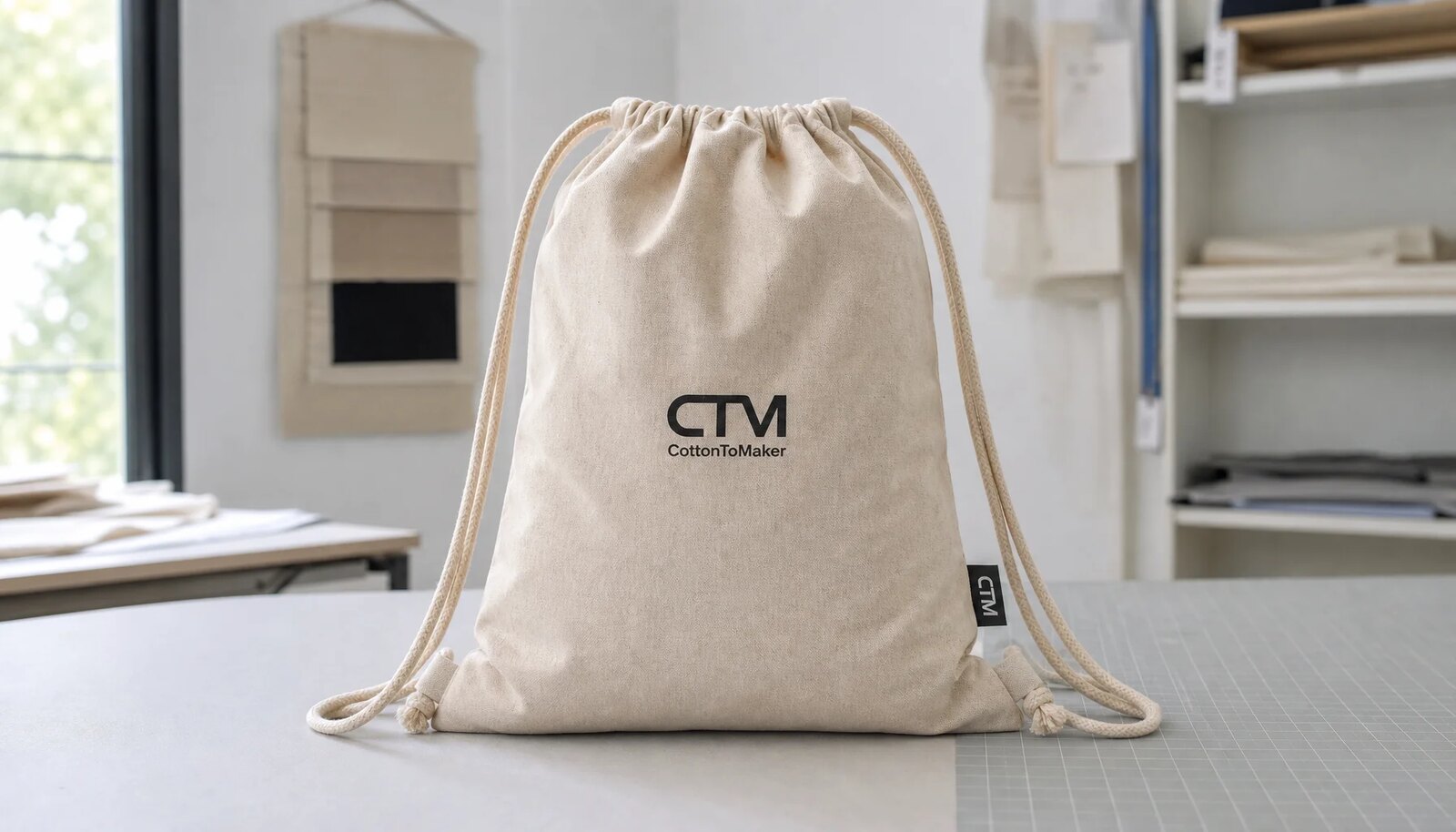
Start With the Use Case, Not the Rectangle
Logo placement on a cotton drawstring backpack is not only a design choice. For procurement, it affects quote accuracy, sample approval, inspection, packing, and whether the finished gift does its job in the room where it will actually be handed over. A logo that looks perfectly centered on a flat PDF can move visually once the bag is sewn, filled, folded, or pulled closed. Cotton fabric gathers near the channel, curves around contents, and shows pressure from seams and cords.
Begin with the commercial moment. Is the bag a conference handout grabbed from a registration desk? An employee onboarding pack with documents, a bottle, and apparel inside? A distributor gift that needs to look polished in a carton? A campus kit photographed in stacks? Each situation points to a different logo decision. Event buyers often need recognition from several steps away, so a clear front-center screen print may beat a subtle label. Executive gifting may call for quieter branding, such as a woven side label or sewn patch, because perceived value matters more than long-distance visibility.
A useful cotton drawstring backpacks logo placement guide for corporate gifting should therefore work backward from use. Tell the supplier how the item will be distributed, what it will carry, whether it will be cinched, and how recipients are expected to see it. That context lets the factory recommend a safer print zone, decoration method, fabric weight, and tolerance. Without it, the quote may be technically complete but commercially weak.
- State whether the bag will be distributed empty, filled, folded into a kit, or packed individually.
- Define the primary viewing distance: close-up unboxing, arm's-length handover, event visibility, or group photography.
- List likely contents, including approximate size and weight, before finalizing the logo zone.
- Ask the supplier to show the logo on a finished bag body with cords installed, not only on a flat panel proof.
Map the Finished Bag Before Artwork Approval
A cotton drawstring backpack is not a clean print rectangle. The top channel uses fabric for the drawcord. Side seams add thickness and shadows. The bottom seam can pull inward under load. Some styles include bartacks, reinforced corners, eyelets, or triangular cord tabs. These construction details reduce the usable branding area and change how a logo reads once the bag is handled.
The placement drawing should be based on finished dimensions, not cut panel dimensions. That sounds small, but it is one of the easiest ways to avoid confusion. A cut panel changes after folding, stitching, turning, and pressing. A finished-body template should show total finished width and height, top channel depth, cord exits, side seam position, bottom seam, reinforcement points, and the safe logo window. The artwork should then be placed using fixed finished references.
Common measurement methods include distance from the finished top edge to the logo top edge, distance from the side seams to the logo centerline, or distance from the finished bottom seam to the logo baseline. The PO should say which one controls. Avoid broad phrases such as centered on front, slightly lower, or standard placement. They leave too much interpretation for the sewing line, printing table, and inspector.
Front-center placement gives the strongest visibility for most corporate giveaways. Upper-front placement can be better for filled kits because the lower panel may bulge. Lower-front placement gives wide logos space away from the drawcord area, but it can look low when the bag is empty. Side labels and patches can look more retail, but they should be chosen intentionally, not as a substitute for a visible main mark when event recognition is required.
- Create a finished-body template before approving any logo position.
- Exclude top channel, cord path, side seams, bottom seam, and reinforcement points from the safe branding window.
- Measure placement from finished edges or seams, with dimensions stated in millimeters.
- Check the proposed logo zone on an empty, filled, and cinched sample before bulk approval.
Specify Size, GSM, and Construction Clearly
Many sourcing problems start with a loose phrase like standard cotton drawstring bag. Suppliers may quote different finished sizes, cotton weights, cord types, seam constructions, and reinforcement methods while appearing to answer the same RFQ. Those differences change both price and logo behavior. A 340 x 420 mm bag offers a different print window than a 300 x 400 mm bag. A deep top channel reduces upper-front space. A lighter fabric wrinkles more and can make small details look less crisp.
For many corporate gifting programs, 140 to 180 gsm cotton is a practical starting range for screen-printed drawstring backpacks. It usually gives enough stability for bold artwork while staying realistic for volume orders. Lighter 120 to 140 gsm cotton can work for cost-driven giveaways with light contents, but buyers should keep decoration simple and avoid dense embroidery. Heavier 180 to 220 gsm cotton can support a more structured feel, sewn patches, or heavier contents. Above 220 gsm, the bag may feel more substantial, but cost, sewing time, folded thickness, and freight weight can rise.
Construction details also belong in the specification. Confirm whether the bag uses self-fabric cotton cords, braided cotton cords, polyester cords, or another drawcord. State cord color, cord diameter if relevant, top channel depth, corner reinforcement, and whether metal eyelets are required. Cords can rub the print, heavier cords can pull the top panel differently, and corner reinforcements can change folding. Logo placement is easier to control when the physical bag is defined first.
- Quote finished bag size in millimeters, with acceptable finished-size tolerance.
- Specify cotton GSM, fabric color, weave or texture expectation, and whether natural cotton specks are acceptable.
- Confirm cord material, cord color, cord diameter, top channel depth, and corner reinforcement method.
- Match GSM to contents weight, decoration method, and desired gift positioning instead of choosing only by unit price.
Choose the Decoration Method Around Risk
Screen printing is the workhorse for cotton drawstring backpacks. It suits bold corporate marks, campaign graphics, and one- to three-color artwork. It can be efficient for larger orders, but it still needs precise production detail. Specify final print width and height, color count, Pantone references, registration expectations, opacity requirement, and whether an underbase is needed. White ink on natural, colored, or darker cotton needs particular care because fabric texture and base shade affect perceived brightness.
Heat transfer is useful when the artwork is full color, includes gradients, uses variable names, or arrives late. It can deliver crisp detail, but the process has its own controls. The factory should confirm transfer type, press temperature, dwell time, pressure, peel method, cooling time, and packing method. Buyers should request adhesion and fold checks because transfer edges can lift, crack, shine, or imprint if materials and handling are not controlled.
Embroidery can make a small mark feel premium, but it is not automatically better. It works best for simple icons, initials, and short wordmarks on stable fabric. Fine text, complex crests, outlines, gradients, and dense fills may lose clarity or pucker the panel. Woven labels and sewn patches are useful alternatives when the buyer wants texture without loading the bag body with stitches. A woven side label is subtle and repeatable. A sewn patch gives stronger presence but needs stitch control, backing decisions, and protection during packing.
The right method is the one that matches the artwork, order quantity, deadline, and visibility requirement. Ask the supplier to flag artwork risks before sampling. If the brand mark has thin lines or tiny text, it may need a simplified one-color version. If the gift is premium, a smaller patch may look stronger than an oversized print. If the bag must be seen across a booth aisle, the cleanest screen print may be the better business choice.
- Use screen print for bold, high-visibility corporate logos with limited solid colors.
- Use heat transfer for full-color artwork, names, short runs, or artwork likely to change late.
- Use embroidery only when the logo is simple enough and the fabric can support the stitch density.
- Use woven labels or sewn patches when texture, durability, or premium presentation matters more than the lowest decoration cost.
Turn Brand Files Into Production Specs
Procurement should not send only a logo file and expect production to infer the rest. A usable artwork package includes vector artwork, final logo size in millimeters, measured placement drawing, color references, and notes on allowed simplification. AI, EPS, SVG, or production-ready PDF files are usually preferred. Raster artwork may work for some transfers if the resolution is high enough at final size, but low-resolution files will create soft edges, especially on textured cotton.
Minimum detail matters on cotton. Thin strokes can break up. Reversed text can fill in. Tiny icons can disappear into the weave. QR codes can fail if they are too small, printed with poor contrast, or distorted by a curved panel. Instead of guessing, ask the factory to confirm minimum stroke width, minimum letter height, and minimum QR code size for the exact fabric, color, and decoration method. Put those limits into the approval record.
Color should be specified in a way that matches the process. Pantone references help for screen printing, but coated versus uncoated standards can lead to different expectations. Embroidery should use thread card references or approved thread samples. Woven labels need both ground and thread colors. For cotton, the approved pre-production sample should become the controlling visual standard because fabric shade, texture, ink film, thread, and lighting all influence the final appearance.
This is also the point to decide whether the buyer needs a backup logo. A simplified one-color version can protect timelines if the original artwork is too detailed, too expensive to reproduce, or unsuitable for the selected decoration method. It is better to approve that fallback during sourcing than to improvise it after sampling fails.
- Send vector artwork plus final logo dimensions and measured placement drawing.
- Ask the supplier to confirm minimum stroke width, minimum letter height, and any simplification needed.
- Specify color references by method: Pantone for print, thread card for embroidery, woven thread colors for labels.
- Keep a simplified one-color version ready for screen print, embroidery, labels, or cost-sensitive alternates.
Build an RFQ Suppliers Can Quote Evenly
A strong RFQ keeps suppliers from quoting different bags under the same description. Include finished bag dimensions, fabric GSM, fabric color, cord details, quantity by colorway, decoration method, logo size, logo position, artwork file, packing requirement, carton marking, inspection expectation, and delivery date. If the bag will hold a gift kit, include approximate contents and weight. That single detail can affect fabric choice, logo zone, final carton packing, and production risk.
Ask for itemized pricing. The quote should separate the bag body, decoration, screen setup, embroidery digitizing, woven label tooling, patch tooling, sample charge, packing, carton marking, inland freight, and export support where applicable. This makes comparisons cleaner. One supplier may look cheaper because the quote excludes setup, sample freight, or carton labeling. Another may look higher because the quote includes a true pre-production sample and event-ready packing.
Also ask what can be reused. Screens, embroidery digitizing, woven label tooling, and patch tooling may reduce cost on repeat orders, depending on storage and production policy. For repeat corporate gifting programs, that matters. The first order should set up the future order trail, not just solve the immediate event.
Lead time should be broken into milestones: artwork review, sample production, sample transit, buyer approval, bulk production, inspection, packing, and shipment. Corporate gifting often has a fixed event or onboarding date. A single answer such as 30 days is too vague to manage risk. If sample approval slips, the buyer needs to know whether the remaining schedule can absorb it without sacrificing inspection or packing quality.
- Quote by finished specification, not by a generic bag description.
- Request itemized costs for bag, decoration, setup, tooling, sampling, packing, and carton labels.
- Ask which setup files or tooling can be reused for repeat orders and what repeat charges apply.
- Require a timeline by milestone: artwork, sample, approval, bulk, inspection, packing, and shipment.
Approve Samples the Way Recipients Will Use Them
A PDF proof can confirm spelling, approximate scale, and intended layout. It cannot approve how a cotton drawstring backpack behaves. A pre-production sample should use the actual cotton GSM, fabric color, cord color, construction, decoration method, logo size, and placement. If the factory substitutes fabric, cord, or decoration, treat the sample as limited. A print on smoother substitute cotton may look sharper than bulk. A sample without final cords cannot reveal cord interference.
Review the sample in stages. First, lay the empty bag flat and measure logo position from the agreed finished references. Second, fill the bag with intended contents or a realistic substitute and check whether the logo remains visible and proportionate. Third, cinch the drawcords normally and look at the gathered top, cord path, and panel distortion. Fourth, view the bag from the actual handover distance. If it is an event giveaway, take a few steps back. A logo that passes a desk review may still be too small for a crowded venue.
Document the approval with discipline. Take dated photos of the bag flat, filled, cinched, folded, and packed if packing affects the decoration. Record the final logo size, measurement method, placement dimensions, fabric shade, cord color, and any accepted deviations. Attach the approval record to the PO. Replace vague feedback with measured instructions: move logo top edge 12 mm lower, align centerline to finished panel center, or increase side clearance to 40 mm. Those phrases are easier to inspect than make it more centered.
- Approve only a sample made with the final or clearly declared materials and decoration process.
- Measure from finished seams or finished edges and record the measurement method.
- Review the sample flat, filled, cinched, folded, and packed if packing may affect the logo.
- Attach sample photos, measurements, and accepted deviations to the purchase record.
Set Tolerances Before Bulk Production
Placement tolerance should be agreed before production starts, not debated after cartons arrive. For many front screen prints, plus or minus 5 mm is a practical tolerance when the artwork has healthy margins from seams and the drawcord area. For embroidery, woven labels, and sewn patches, plus or minus 3 mm is often more appropriate because tactile decoration makes small shifts easier to see. Tighter control may be possible, but it can slow production, increase sorting, and raise cost.
The measurement point must be named. If the PO says only logo centered, people may measure different things. One inspector may use the outer artwork box. Another may use the visual center of the icon. A sewing operator may align to the print table fixture. State whether placement is measured to the logo center, top edge, baseline, left edge, or outer artwork box. Then state the finished reference: top edge, side seam, bottom seam, or panel centerline.
Inspection should combine numbers and judgement. Measurable checks include finished bag width and height, logo size, logo placement, quantity per carton, and carton labels. Visual checks include ink opacity, color consistency, registration, bleed, pinholes, cracking, scuffing, heat press shine, transfer edge lift, embroidery puckering, loose threads, patch straightness, label fraying, and contamination. If a third-party inspection is used, the buyer may apply an AQL plan. Even without one, the PO should define critical, major, and minor defects so the supplier knows what requires rejection, sorting, or concession.
Check bag dimensions before judging logo alignment. A logo can be printed in the right place on a bag that is sewn too narrow or too tall, and the final result will still look wrong. The inspection sequence should start with the finished product, then decoration placement, then decoration quality, then packing.
- Set placement tolerance by decoration method and logo sensitivity.
- Define the measurement point and the finished reference edge in writing.
- Check bag dimensions before judging logo placement, because both affect visual alignment.
- Separate critical, major, and minor defects for print, embroidery, labels, patches, and packing.
Protect the Decoration Through Packing
A logo can be produced correctly and still arrive damaged. Fresh screen prints can scuff if decorated faces rub together. Heat transfers can show shine, pressure marks, or lifted edges if folded sharply or stacked before cooling. Embroidery and patches can imprint into nearby fabric when cartons are over-compressed. Cotton can pick up lint, loose threads, or color transfer when packing is rushed. For event-driven corporate gifting, transit damage is painful because replacement time is usually short.
Packing should match the distribution workflow. Bulk packing may work for simple event handouts where staff unload cartons and distribute bags quickly. Individual polybags, paper sleeves, belly bands, or insert cards may be better for employee welcome kits, retail-style gifts, or programs where the bag goes into a larger gift box. Each option affects labor, carton count, plastic use, receiving speed, and presentation. Procurement should specify the packing style instead of letting the factory default to the cheapest option.
Folding direction matters. Avoid sharp creases through transfers, dense ink areas, patches, or embroidery. If decorated faces touch, request separation sheets or individual packing when needed. Ask the factory to confirm curing, cooling, and handling time before folding. These steps are not decorative extras; they protect the brand mark the buyer paid to place.
Carton control is part of brand control. Confirm inner pack count, master carton count, carton marks, PO number, SKU or event code, colorway, logo version, gross weight, and carton dimensions. If the order includes multiple departments, languages, regional logos, or event dates, carton labels should make sorting obvious at receiving. Final inspection should include packed cartons, not only loose bags.
- Confirm curing, cooling, and handling time before decorated bags are folded.
- Specify folding direction so decorated areas are not sharply creased or rubbed.
- Use separation sheets or individual packing when transfers, prints, patches, or embroidery need protection.
- Label cartons by PO, colorway, logo version, quantity, and destination or event code.
Choose the Sourcing Route by Control Need
Integrated production, where one supplier controls sewing and decoration, often gives procurement the clearest accountability. The supplier can align cutting, sewing, print window, decoration sequence, inspection, and packing in one flow. This route is useful when the artwork is fixed, placement consistency matters, and the delivery date is firm. The buyer still needs measured proofs, samples, and tolerances, but there are fewer handoffs where responsibility can blur.
A split route can make sense when buyers want blank bag inventory first and local decoration later. This can support regional artwork, late campaign details, local language versions, or smaller repeat batches. The risk is that decorators need a placement template based on the actual finished bag, not the nominal size in the first quote. If blank bags vary in width, height, shade, or seam position, local decoration can vary as well. Buyers should confirm whether the decorator has fixtures or jigs to hold consistent placement.
Blank bags with hang tags, belly bands, stickers, or branded inserts can be the lowest-risk route when artwork approval is uncertain and the date cannot move. The branding is less permanent than direct decoration, but the buyer gains flexibility. That tradeoff should be made openly. It may be right for regional launches, temporary campaigns, or programs where the bag itself should stay reusable without a large logo.
Compare routes by landed cost and risk, not unit price alone. Include sampling, setup, rework risk, inspection, packing, freight, and timeline. A lower quote can become expensive if placement defects require sorting or replacement. A slightly more structured route may save the program when the brand mark, carton labels, and delivery date all need to land cleanly.
- Use integrated production when artwork is fixed and consistent placement is the priority.
- Use blank stock plus local decoration when artwork changes late or regional versions are required.
- Provide local decorators with actual finished samples and measured placement templates.
- Clarify who owns defects at each handoff: bag sewing, decoration, packing, transport, and final inspection.
Specification comparison for buyers
| Logo placement or method | Best-fit use case | Procurement specification to request | Buyer risk to control |
|---|---|---|---|
| Front-center screen print | High-visibility event gifting, trade shows, campus programs, onboarding packs, and bulk giveaways | Finished logo width and height in mm, center point measured from finished side seams and top finished edge, ink colors, Pantone references, underbase requirement, placement tolerance | A flat proof can look balanced while the filled or cinched bag makes the mark appear too high, too low, or slightly warped |
| Upper-front print | Gift kits filled with notebooks, apparel, brochures, product samples, bottles, or items that make the lower panel bulge | Top clearance from finished upper edge or top channel, logo baseline height, safe gap from drawcord path, filled-and-cinched sample photo | The gathered top can squeeze the artwork, pull cords over it, or make a straight logo look angled |
| Mid-front print | General corporate gifting where the bag is handed over flat, photographed, or used with light contents | Artwork centered within the usable finished front panel, excluding top channel, side seams, bottom seam, and safe margins | Bulky contents can curve the panel and distort circles, QR codes, thin rules, or small type |
| Lower-front print | Wide horizontal logos, campaign names, or artwork that needs distance from the cord channel | Distance from bottom finished seam, side seam clearance, visual balance check on empty and filled bag | The logo may look dropped when empty or be hidden by a hand, table edge, stacked gift item, or folding line |
| Small side woven label | Subtle premium cue, retail-style gifting, secondary brand mark, or repeat program where the front panel should stay clean | Label size, fold type, woven thread colors, exact seam position, stitch line, label tolerance, colorfastness or rub expectations | It is too small for event visibility and should not be the only branding when recognition from distance matters |
| Sewn cotton, felt, woven, PU, or leather-look patch | Executive gifts, premium kits, limited editions, or programs needing texture and stronger perceived value | Patch material, thickness, edge finish, stitch color, backing, placement drawing, patch tolerance, packing protection | Patch thickness can pucker lighter cotton, leave pressure marks, slow sewing, and increase folded volume |
| Embroidery on bag body | Small premium marks, initials, simple icons, or short wordmarks on stable mid-weight or heavyweight cotton | Stitch count estimate, digitizing file, thread color references, backing method, minimum fabric GSM, trim standard | Fine letters fill in, dense fills pucker fabric, and heavy stitching can pull the panel out of shape |
| Heat transfer print | Short runs, variable names, gradients, full-color artwork, or late artwork changes | Transfer type, finished size, press temperature and dwell time, peel method, adhesion test, fold test, packing method | Edges can lift, crack, mark, or imprint if application, cooling, folding, and stacking are not controlled |
| Blank bag plus branded insert, hang tag, belly band, or sticker | Late artwork approval, regional campaigns, reusable blank stock, or low-risk temporary branding | Tag size, paper weight, attachment method, barcode or event label, insertion method, carton sorting plan | Branding may be removed from the bag, separated during distribution, or feel less permanent than direct decoration |
Buyer checklist before sampling
- Define the gifting scenario: conference handout, employee onboarding pack, campus kit, distributor gift, product sample bag, retail-style kit, or internal campaign.
- Confirm finished bag width and height, usable front panel area, fabric GSM, fabric color, drawcord material, cord color, cord diameter, and expected contents weight before placing the logo.
- Choose the logo zone on a finished-body template that shows top channel depth, seam allowances, cord exits, side seams, bottom seam, bartacks if used, and the normal drawcord path.
- Specify logo position in millimeters from finished seams or fixed finished edges, including whether the measurement is to logo center, top edge, baseline, left edge, or outer artwork box.
- State the intended visible brand area after the bag is filled and cinched, not only the flat print area on an empty panel.
- Send vector artwork in AI, EPS, SVG, or production-ready PDF, with Pantone or brand color references and a simplified one-color fallback where needed.
- Confirm minimum stroke width, smallest readable text height, QR code size if used, and whether gradients, shadows, outlines, or very fine marks must be simplified for cotton texture.
- Ask the supplier to quote bag body, decoration, screen setup, digitizing, label or patch tooling, sample making, packing, carton labeling, inland freight, and export support as separate line items.
- Request a pre-production sample using actual fabric color, GSM, cord color, construction, decoration method, logo size, and packing method before approving bulk production.
- Approve the sample flat, filled, cinched, and viewed at normal handover distance; attach dated photos and measurements to the PO or approval record.
Factory quote questions to send
- What are the finished bag dimensions after sewing, and what dimensional tolerance do you hold on width and height?
- What is the usable logo area after excluding top channel, drawcord path, side seams, bottom seam, and any bartacks or reinforcement points?
- Can you provide a measured placement drawing using finished seams or finished edges rather than cut panel edges?
- Which logo zone do you recommend for this artwork, fabric GSM, bag size, and intended contents, and what is the maximum safe logo size in millimeters?
- For this artwork, do you recommend screen print, heat transfer, embroidery, woven label, sewn patch, or another method, and what artwork changes are needed?
- What minimum stroke width, minimum text height, and minimum QR code size do you recommend on this cotton weave and color?
- What is the MOQ by bag color, cotton GSM, decoration method, number of print colors, logo position count, and packing style?
- Does the quote include screen setup, embroidery digitizing, label weaving, patch tooling, color matching, pre-production sample, packing, carton marking, and sample freight?
- Can screens, digitizing files, woven label tooling, or patch tooling be reused for repeat orders, and what repeat setup or storage charge applies?
- What placement tolerance can you hold for screen print, heat transfer, embroidery, woven labels, and sewn patches on the finished bag?
Quality-control points to confirm
- Logo position is measured from finished seams, finished top edge, finished side edge, or another fixed finished reference point, not from cut fabric edges before sewing.
- The PO defines whether placement is measured to the logo center, top edge, baseline, left edge, or outer artwork box.
- Finished bag dimensions are checked first because a correct logo on an out-of-tolerance bag can still look wrong.
- Approved logo placement is checked in at least three states: flat, filled with representative contents, and cinched with drawcords pulled normally.
- For front screen print, a practical placement tolerance is often plus or minus 5 mm unless the artwork is close to seams or requires tighter alignment.
- For embroidery, woven labels, and sewn patches, a practical placement tolerance is often plus or minus 3 mm because shifts are more visible on tactile decoration.
- Top channel, drawcord exits, knots, cord ends, bartacks, and side seams do not cover, rub, or visually interrupt the approved logo area during normal use.
- Print opacity, ink film, edge sharpness, registration, and color appearance match the approved sample on the actual cotton color and GSM.
- Fine text, icons, thin lines, and QR codes if used remain legible at normal handover distance and after the bag is filled.
- No visible ink bleed, haloing, pinholes, cracking, scuffing, heat press shine, transfer edge lift, ghosting, or color contamination appears on decorated panels.