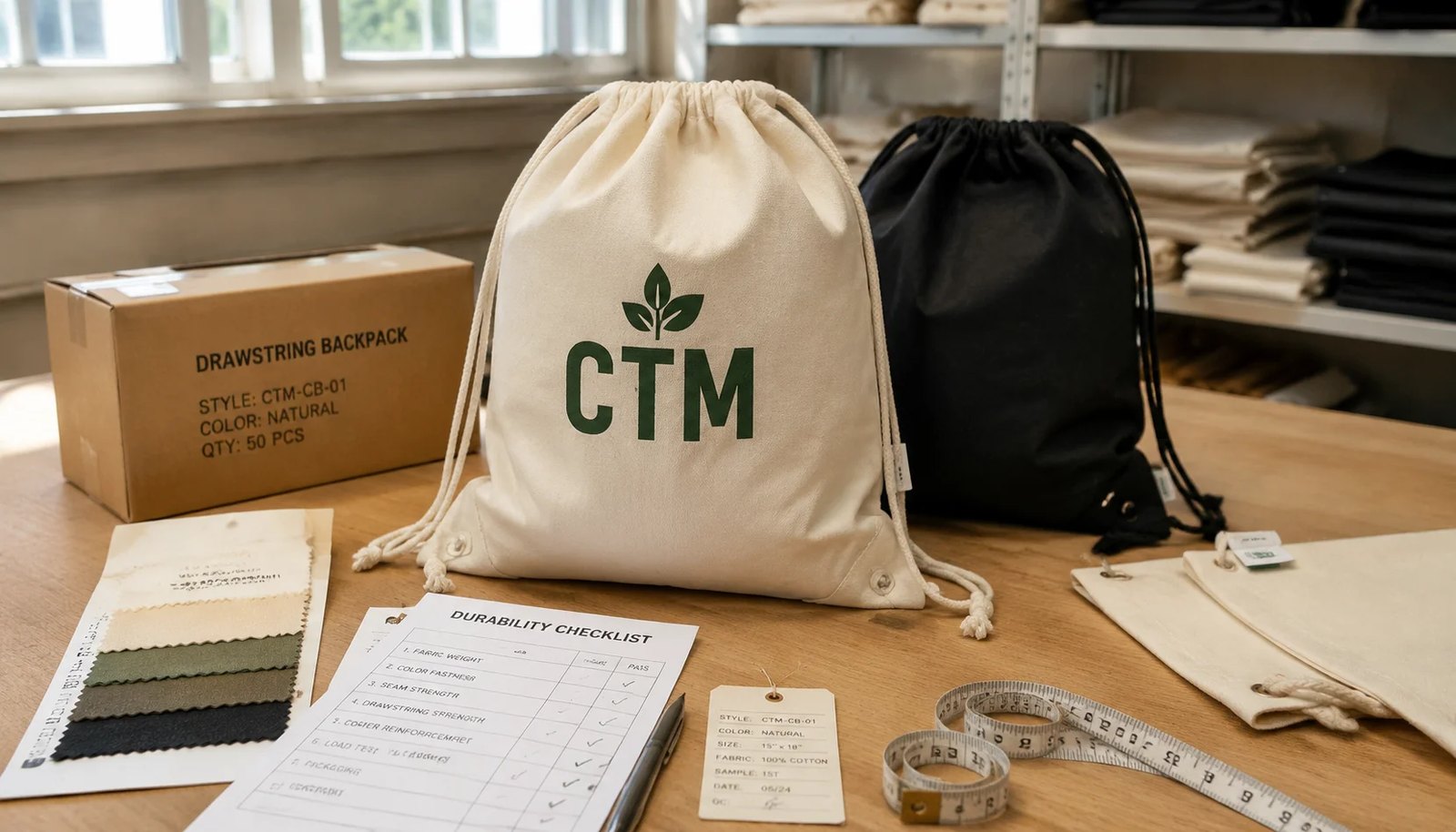
Why durability is the main buying problem for natural grocer backpacks
Natural grocers usually sell or give away drawstring backpacks as a reusable utility item, not a one-day event giveaway. That changes the buying logic. The bag may carry produce, boxed dry goods, personal items, a water bottle, and sometimes heavier packaged products. If the fabric bags out, the corners tear, or the print cracks after a few uses, the buyer does not just face returns. The brand also loses the reusability message that justified the program in the first place.
Most failures on cotton drawstring backpacks are not caused by one dramatic defect. They come from small spec shortcuts stacked together: low GSM fabric, weak corner construction, thin cords, loose stitch density, and oversized print coverage on a bag that folds and flexes. A useful durability checklist therefore has to connect the retail use case to the actual production details that factories quote, sew, print, pack, and inspect.
- Common first failure points: bottom corners, drawcord knots, side seam opening, print cracking on fold lines
- Common hidden cost: a cheap quote that excludes reinforcement, preproduction sample, and proper export packing
- Most reliable approach: define use case first, then write durability thresholds into RFQ and sample approval
Choose the right base fabric before comparing prices
For this product, fabric is the biggest durability driver and usually the biggest quote variable after labor. Buyers often request cotton drawstring backpacks without defining whether they want sheeting, plain weave, or canvas. That creates quote noise. One supplier prices 140 GSM sheeting, another prices 270 GSM canvas, and both call the item cotton. The lower quote looks attractive until the sample collapses under load or the print looks weak because the surface is too soft and irregular.
For natural grocer use, 8 oz to 10 oz cotton canvas, roughly 270 to 340 GSM, is the practical starting range for a durable reusable backpack. At this weight, the bag has enough body to hold shape, survive repeated opening and closing, and support reinforced cord exits. If the target is a value promotional item rather than a true retail reusable, 220 to 250 GSM may still work, but only with smaller loads and conservative print coverage. Recycled cotton can be suitable, but buyers should expect more GSM variation, more slub, and less crisp print definition unless the supplier has stable fabric control.
- Light promo use: about 180 to 220 GSM, only if load expectations are low
- Reusable retail sweet spot: about 270 to 340 GSM
- Heavier premium feel: 12 oz canvas can work, but weight and freight rise quickly
- State whether prewashed, enzyme washed, or unwashed finish is acceptable because shrinkage and hand feel will differ
Construction details that separate a usable backpack from a return problem
A drawstring backpack is simple, but its stress pattern is not. The body fabric carries load vertically, while the cords create concentrated force at the lower corners and channel openings. That means seam design matters as much as fabric weight. On factory drawings, insist on side seams with consistent stitch density, a double-fold top channel, and reinforced bottom corners where the cords pass through or anchor. If the style uses metal eyelets, specify plating and pull resistance, but for grocery use, reinforced self-fabric corners are often more reliable than decorative eyelets that can loosen in wash or transit.
Cord selection is another area where cheap quotes hide risk. A 5 mm cord saves money, but it feels harsh on shoulders and can cut into the corner seams faster. A better range is 8 mm to 10 mm braided cotton cord or a cotton-feel cord with a stable core. Knot retention should be reviewed on the actual sewn sample because some smooth cords slip under repeated pull. Also look at the cord channel width. If it is too narrow or sewn unevenly, users will experience jerky opening and closing and assume the whole bag is low quality even if the fabric is acceptable.
- Prefer reinforced lower corners with extra fabric layer or dense bar-tacks
- Use balanced left-right cord travel in the top channel
- Avoid decorative features that add failure points unless the retail program truly needs them
- Request close-up production photos of corner construction before bulk approval
Set durability test thresholds that factories can actually follow
Many buyers write durable quality in their PO but do not state measurable acceptance criteria. That is how disputes start. A practical checklist should include repeatable tests tied to likely retail use. For a grocery-focused cotton drawstring backpack, it is reasonable to set a static load test and a repeated lift test. One example is loading the bag to an agreed weight, such as 8 kg to 10 kg depending on size and intended use, then suspending it for a fixed period without seam opening, cord slip, or corner distortion beyond the approved tolerance. The exact load target should match your use case and sample size, not a generic number copied from another bag category.
Beyond load, buyers should define seam and print performance. Side seams and reinforcement points should show no broken stitches, skipped stitches, or visible tearing after repeated lifting cycles. Printed logos should withstand dry rub and basic folding without surface tack or severe cracking. If the bag may be washed by consumers, include a wash test on the actual print and fabric combination. Generic fabric lab data is not enough because the sewing tension, print ink deposit, and curing profile all affect end performance.
- Use a static load test with an agreed weight and time period
- Add repeated lift cycles to simulate normal carrying use
- Review print rub resistance on dark and light inks separately
- If washability matters, test the final bag, not only base fabric yardage
- Document pass or fail with photos tied to sample code and PO number
Print method choices affect durability more than buyers expect
For natural grocers, branding is usually simple: one-color or two-color front logo, eco messaging, or a store slogan. That makes screen printing the most commercially sensible choice in most orders. Water-based screen print gives a softer hand and suits natural cotton surfaces well, while pigment systems may be better for darker fabrics. The key durability factor is not the print method name alone but whether the print size, ink deposit, and curing are appropriate for a flexible bag that folds at the center and corners.
Heat transfer can look sharp for low MOQ artwork or many color gradients, but it introduces a film layer that may crease, lift, or feel less natural on cotton backpacks. Embroidery is durable, yet on lightweight bags it can pucker the panel and add cost fast. Buyers comparing quotes should ask suppliers to state the exact method included and whether print setup, strike-off, and color matching are part of the unit price. A low quote sometimes assumes the smallest possible logo size and standard ink only, then adds cost later when artwork is finalized.
- Best default for wholesale runs: screen print with approved strike-off
- Large solid blocks require careful cure control to avoid cracking
- Embroidery can distort panels unless fabric weight and backing are planned
- Place logos away from heavy fold lines when possible
MOQ logic, sample stages, and why small runs often create bigger risk
Buyers often aim for the lowest possible MOQ to test a new retail program. That is reasonable, but it affects quality planning. Below about 500 pieces per color, factories may use available stock fabric, simplified print setup, or less efficient cutting and packing arrangements. Unit cost rises while process control may not improve. For cotton drawstring backpacks, 500 to 1000 pieces per color is usually the point where the supplier can justify proper fabric sourcing, dedicated print setup, and cleaner packing consistency. If the order is split across many colors with low quantity each, ask how that changes dye lot control and schedule.
Sample sequence should not stop at one sales sample. For durability-sensitive grocery programs, use at least two gates: a preproduction sample in actual fabric and actual print method, then a top sample pulled from first bulk output if the order is meaningful enough. Early sample approval should include dimensions, GSM confirmation, seam construction, cord feel, print cure, and packing trial. If the first sample uses substitute material because the final fabric is not booked yet, note that clearly so the team does not approve construction and assume performance will match later.
- Sales sample shows shape, not full production reliability
- Preproduction sample should use real bulk fabric and print process
- Top sample helps catch drift after mass production starts
- Low MOQ plus many SKUs usually means weaker color and packing efficiency
How to compare supplier quotes without missing hidden cost drivers
A backpack quote should be broken into understandable cost drivers, even if the supplier gives only one unit price. Fabric weight and width, print setup, cord type, reinforcement labor, packaging format, and inspection level all influence the final number. If one quote is much lower, it is usually because one of these inputs is thinner, fewer, or excluded. Natural grocer buyers should be especially careful with replacement risk. A bag that saves a small amount at order stage but fails in store promotions or consumer use is rarely a true savings.
When comparing quotes, normalize the spec line by line. Put all suppliers on the same fabric GSM, same bag size, same print area, same cord diameter, same reinforcement, and same packing. Then compare lead time, sample charges, and quality evidence. A detailed quote that includes preproduction sample, barcode labeling, and stronger carton packing may be commercially better than a cheaper quote that excludes them and leads to later add-ons or rework.
- Core quote drivers: GSM, size, print colors, reinforcement, cord material, packing ratio
- Lower price often comes from lighter fabric or simpler corners, not better efficiency
- Ask for price breaks at 500, 1000, 3000, and 5000 pieces for planning
- Compare ocean freight impact if one supplier proposes heavier fabric or denser packing
Sample approval criteria that prevent bulk production drift
Sample approval should function as the factory reference standard, not as a visual suggestion. That means the approved sample needs written criteria attached to it. For this bag, include measured body size, finished GSM range, cord diameter, logo size and placement, seam count, reinforcement shape, and any visible acceptable variation. If natural cotton shade is part of the branding, note whether minor seed specks or slub are acceptable. If not, move to a cleaner combed fabric or bleached base before printing.
One frequent mistake is approving a good-looking sample without verifying what was not shown. For example, the front panel may look fine, but the buyer never checked the inside seam finish, cord knot security, or whether the channel was sewn straight over a larger run. Another common issue is approving print color under one light source only. For chain retail distribution, evaluate the sample under daylight and indoor store lighting because dark green or earthy brand colors can shift visibly.
- Attach a signed spec sheet to the approved sample
- Measure logo placement tolerance, not just visual centering
- Photograph inside seams, corners, and cord knots for reference
- Keep one sealed approval sample for inspection comparison
Packing, carton planning, and landed-cost issues buyers should not leave until the end
Packing affects both cost and complaint rate. Cotton drawstring backpacks are often compressed to reduce carton count, but over-compression can crease printed areas, transfer ink, and flatten the product so badly that receiving teams think the goods are substandard. A practical packing plan is flat packing in small inner quantities, often 10 to 25 pieces per polybag if polybags are allowed, with outer cartons sized to protect corners and reduce shifting. If sustainability policy limits plastic, define the acceptable alternative early, since it can affect moisture protection and carton presentation.
From a landed-cost perspective, buyers should model not just ex-works unit price but also packing density and carton weight. A slightly heavier 300 GSM bag may increase product cost yet improve stackability and reduce damage claims if the program expects long shelf life. Carton marking also matters for distributors and store routing. If cartons mix colors or PO lines without clear labels, the receiving cost rises quickly. Good bag production can still turn into a poor import if the outer pack is underplanned.
- Approve units per carton, carton dimensions, and gross weight before bulk packing
- Avoid overfilled cartons that distort the top channel and print face
- Match carton strength to shipping route and warehouse handling
- Add color and size labels that support distributor receiving speed
Lead time risks and the sourcing workflow that keeps the order stable
Lead time for cotton drawstring backpacks is rarely just one block number. Fabric booking, dyeing or stock allocation, print screen preparation, sample approval, sewing, final inspection, and vessel booking all have separate risk points. A realistic wholesale program should treat lead time as a chain. For example, late artwork approval can push screen preparation; delayed fabric confirmation can change actual GSM availability; and a rushed packing stage can create count errors right before shipment. Procurement teams should ask suppliers to split the timeline by milestone rather than promising one broad delivery date.
Natural grocer programs often align with seasonal promotions, store openings, or sustainability campaigns, so schedule slippage hurts more than normal replenishment business. The safest workflow is to freeze the full spec before bulk fabric is booked, approve the preproduction sample early, and schedule at least one inline review if the order is large enough. If the order includes multiple print colors or multiple destinations, decide whether split shipments are acceptable. That choice can save a campaign when one colorway is delayed but the base style is ready.
- Typical risk points: artwork delay, fabric substitution, print curing bottleneck, packing count errors
- Request milestone dates for sample, material booking, production start, inspection, and ship window
- Inline photos are useful, but they do not replace measurable quality checkpoints
- Decide in advance whether partial shipment is allowed
Specification comparison for buyers
| Spec decision | Recommended option | When it fits | Buyer risk to check |
|---|---|---|---|
| Base fabric weight | 8 oz to 10 oz cotton canvas, about 270 to 340 GSM | Best range for natural grocers that want reusable bags with visible structure and better abrasion life | Below about 220 GSM often looks flat after first wash and may fail early at cord stress points |
| Fabric type | Combed cotton canvas or recycled cotton canvas with even weave | Use when branding needs a cleaner print surface and shelf-ready appearance | Open weave or irregular recycled blends can distort print edges and reduce seam holding consistency |
| Bottom corner reinforcement | Self-fabric reinforcement patch or bar-tack reinforcement at cord exit | Needed for higher load use such as produce, bottled drinks, and weekly shopping trips | Single-layer corners without reinforcement are common quote-lowering shortcuts and the first failure point |
| Drawcord material | 8 mm to 10 mm braided cotton cord or cotton-poly core cord with colorfast cover | Good for comfort and repeated pull cycles in grocery retail use | Thin cords cut into shoulders, knot slip risk increases, and cord fray appears quickly in store returns |
| Print method | Water-based screen print for simple logos, pigment print for darker fabrics, heat transfer only for small runs | Screen print is the most stable option for medium and large wholesale quantities | Large solid print areas can crack if under-cured; heat transfer may peel on crease lines during use |
| Closure channel construction | Double-fold hem with balanced left-right cord channel width | Important when stores want smooth opening and closing across all bags in a shipment | Narrow or uneven channels create pull resistance and cord twist complaints even when fabric quality is acceptable |
| MOQ planning | 500 to 1000 pieces per color for efficient material and print setup | Works for chain rollout, regional distribution, or private-label grocery promotions | Very low MOQ usually raises unit price, limits fabric dye options, and can reduce testing and preproduction attention |
| Packing format | Flat packed in PE bag by 10 to 25 pieces, outer carton by size and color with drop-test ready carton strength | Best for import shipments that need count accuracy and lower creasing | Over-compressed packing may flatten print, transfer color, and create false QC complaints on arrival |
Buyer checklist before sampling
- Set a target load use before quoting: light promo carry, weekly grocery carry, or mixed retail use with heavier packaged goods.
- Specify fabric by oz and GSM, not only by phrases like thick cotton or canvas quality.
- State finished bag size, cord length, cord thickness, and whether corner reinforcement is mandatory.
- Define print method, print size, print position tolerance, and acceptable hand feel after cure.
- Request preproduction sample in actual production fabric, not substitute stock fabric.
- Include seam construction requirement: stitch density, lockstitch or chain stitch use, and bar-tack locations.
- Set durability acceptance criteria for load test, seam slippage, print rub resistance, and cord pull cycles.
- Approve carton dimensions, pack quantity, inner polybag rules, and shipping marks before bulk production.
- Ask for fabric and print test evidence tied to the exact item construction, not generic lab reports from other bags.
- Tie final balance payment to passed inline and final inspection criteria, not only shipment date.
Factory quote questions to send
- What exact fabric composition and finished GSM are you quoting, and what is the normal production tolerance?
- Is the quoted fabric plain weave, canvas, or blended recycled cotton, and how does that affect print clarity and shrinkage?
- How are the bottom corners reinforced where the cords exit, and can you send close-up photos of that construction?
- What cord diameter, material, and knot method are included in the price?
- Does the quote include screen setup, strike-off, preproduction sample, and carton drop-test suitable packing?
- What is the standard stitch density per inch or per 3 cm on side seams and channel hems?
- What load test or pull test do you normally run for this bag style before packing?
- If the artwork uses large solid logo areas, what print curing process do you use to reduce cracking or offset transfer?
- What is the MOQ by color, and how does the unit price change at 500, 1000, 3000, and 5000 pieces?
- What lead time applies to lab dip, sample approval, bulk fabric booking, production, and export booking separately?
Quality-control points to confirm
- Finished fabric GSM should stay within agreed tolerance, commonly plus or minus 5 percent unless a tighter range is approved.
- Bag body dimensions should be checked across at least 10 pieces per lot with agreed tolerance, commonly plus or minus 1 cm.
- Cord channels must open and close smoothly without trapped seams, skipped stitches, or unequal left-right cord travel.
- Bottom corners and cord exit points should show reinforcement exactly as approved sample, with no raw-edge exposure.
- Print position should stay within approved tolerance and show no pinholes, ghosting, under-cure tackiness, or offset transfer.
- Seams should have no open stitches, broken threads, severe puckering, or backstitch failure at load points.
- Spot cleanability and dry rub resistance should be reviewed on printed and unprinted areas for retail shelf appearance.
- Carton count, assortment, barcode labels, and shipping marks must match the packing list and PO exactly.