Start With the Use Case
Farmers market vendors use drawstring backpacks differently from school giveaways or event swag. The bag gets opened and closed all day, overfilled with produce or flyers, carried by one shoulder, set on damp tables, and folded back into a stall bin. That means the weak points are predictable: the cord channel, the bottom seam, the top hem, and the print area where the fabric bends most often.
Before you quote a run, define the real load and environment. A lightweight 180 to 220 GSM cotton bag may work for branded handouts, but it will age fast if vendors stuff it with canned goods, bottled drinks, or heavier market items. For repeat market use, most buyers should start at 240 to 340 GSM and let the load target drive the final spec.
- Define the intended load in kilograms, not as light, medium, or heavy.
- Separate marketing use from functional retail use; the bag should be spec'd for the worse of the two.
- If the buyer cannot state the load, the factory will usually choose the cheapest acceptable fabric and trim.
Choose the Fabric First
The fabric decision drives durability more than the logo does. For cotton drawstring backpacks, the most common workable range is 220 to 340 GSM in plain weave canvas or duck. Lower GSM keeps the bag soft and cheap, but it also reduces tear resistance and makes the cord channel easier to distort. Higher GSM gives a better hand feel and more structure, but it increases sewing difficulty, unit weight, and freight cost.
Pay attention to finish, not just GSM. A tightly woven 10 oz or 12 oz canvas can outperform a loosely woven heavier cloth if the yarn quality and weave density are better. Ask the factory to quote the same style in two GSM options so you can compare material cost, sewing behavior, and landed weight. For market vendors, that comparison is usually more useful than chasing the lowest quoted fabric cost.
- Use 220 to 260 GSM for light promotional use or small retail accessories.
- Use 280 to 340 GSM for recurring market carry, branded resale, or heavier contents.
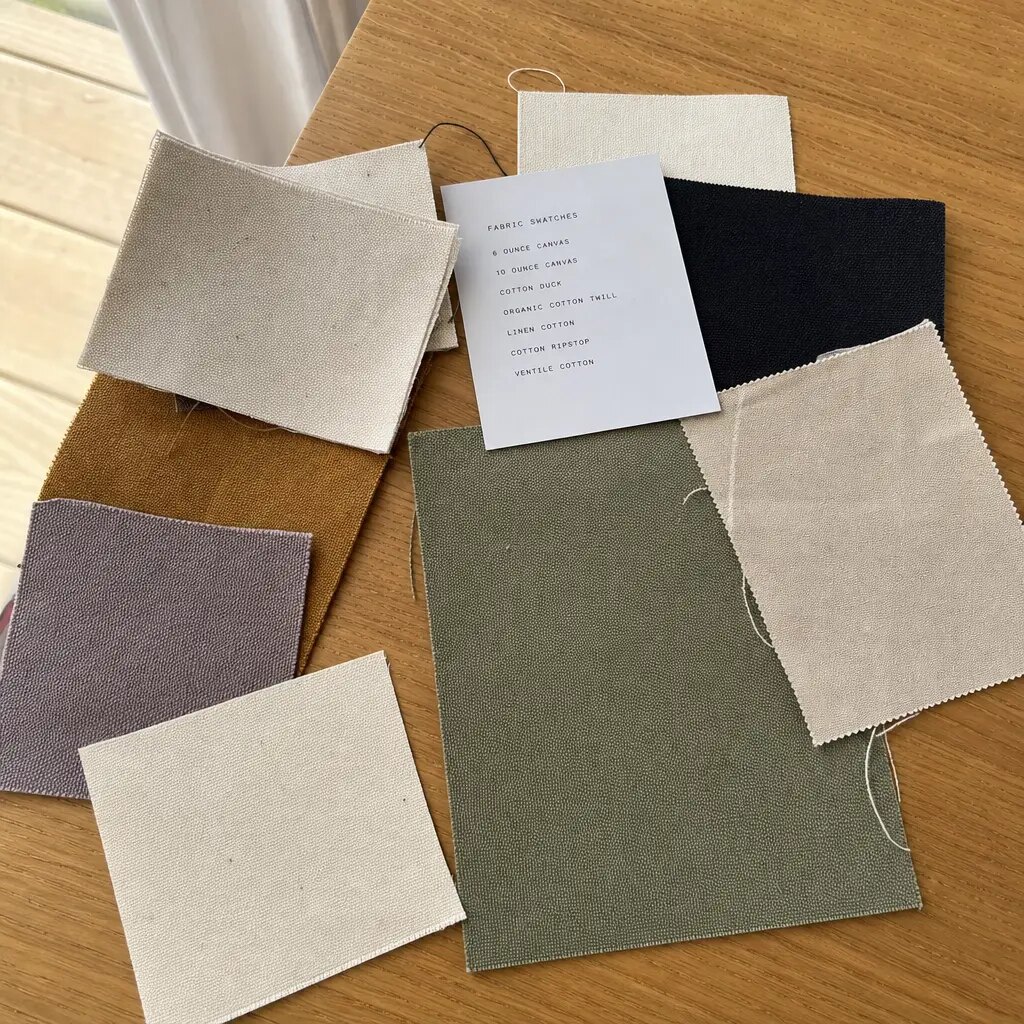
- Request a fabric swatch with weight, weave count, and wash-finish notes before you approve bulk.
Build the Bag for Stress Points
The first bags to fail usually do not fail in the middle of the panel. They fail where the cord cuts into the fabric, where the top hem collapses, or where the bottom seam opens after repeated loading. Good construction uses a reinforced cord channel, clean seam allowance, and bartacks or double stitching at the high-stress points. A bag that looks fine on a table can still fail after a week of vendor use if the internal seam build is weak.
Specify the cord material with the same care as the fabric. Cotton rope feels premium, but pure cotton cord can stretch, fuzz, or abrade faster than a cotton-poly blend. For practical market use, a 4 to 6 mm cord is common, with enough surface area to avoid cutting into the shoulder. Ask for cord length from knot to knot, not just nominal cut length, so the finished bag hangs evenly when loaded.
- Require reinforcement at the cord entry and the bottom corners.
- Avoid very thin cord on heavy canvas; it looks neat in sample form and fails in use.
- Make the factory confirm whether the top channel is single-fold or double-fold, because that changes durability and cost.
Compare Sourcing Routes Before RFQ
The buying risk is not only the bag spec. It is also the sourcing route. A direct factory usually gives the best control over fabric weight, stitching method, and logo placement, but only if the factory is actually making the goods in-house. A trading company can simplify communication and bundle multiple items into one shipment, yet you need stronger evidence on where the bag is made and which QC process is real.
If you are buying for a retail or distributor program, compare the route as carefully as the price. A stock bag with custom print is the fastest path, but it limits material control. A fully custom run takes longer and has a higher MOQ, yet it is often the better commercial choice when the bag must carry heavier loads or support consistent brand presentation across seasons.
- Choose the route that matches your risk, not just your unit cost target.
- Ask every supplier to quote on the same Incoterm and the same pack count.
- Do not compare a stock blank quote against a fully custom quote without separating the base bag and decoration cost.
Use the Sample to Break the Bag
A sample should be treated as a test object, not as a display item. Load it, bend it, fold it, and move the drawcord through the channel repeatedly before you approve the bulk run. If the bag is for market vendors, the sample must survive repeated shoulder use, not just a single fill-and-photo session. Minor issues like rough seam ends, uneven cord tension, or weak top folds become major complaints after the first few weeks of field use.
Keep a reference sample sealed and labeled by date, artwork version, and approved dimensions. The production bag should match that reference, not the first optimistic sample the factory sends. If the printed logo sits slightly high, if the cord length differs, or if the fabric feels softer because the mill changed finishing, treat that as a production change and force a new approval. That discipline prevents quote drift later in the season.
- Run a fill test with the target load and carry the bag by the cord and by the shoulder.
- Compare the production sample against the sealed reference sample, not against memory.
- If the factory substitutes fabric lot or cord supplier, require a fresh sample before bulk starts.
Set QC Thresholds That Matter
A decent QC plan for cotton drawstring backpacks should focus on failures the end user will actually notice. Use a reasonable AQL structure for visual defects, but add functional tests for seam strength, cord pull-through, size stability, and print durability. The bag does not need laboratory overkill; it needs enough testing to catch the failure modes that would trigger complaints from distributors or retail buyers.
Put the acceptance criteria into the purchase order. For example, agree on the acceptable GSM range, dimensional tolerance, print placement tolerance, and any wash or rub target. If the bag is destined for frequent handling at outdoor markets, ask for a simple pull test on a loaded bag and a rub test on the print area. The factory may already do some of this informally, but it should be written down before mass production starts.
- Use AQL 2.5 for major defects and 4.0 for minor defects as a starting point.
- Require no seam opening, no cord slip, and no print failure on the approved load test.
- Hold the supplier to the signed sample for color, placement, and construction details.
Control Print Durability and Brand Appearance
For market vendors, the print has to survive folding, abrasion, and occasional damp handling. Screen print is usually the lowest-risk option for simple logos on cotton because it can sit well on the fabric and scale across a larger run. Heat transfer can work for short runs and complex graphics, but some transfer types crack at the fold line or lose edge sharpness after repeated use. Embroidery looks durable, yet it adds weight, cost, and a backing layer that can change the inside hand feel.
Pick the decoration method based on the end use. If the bag will be carried daily and washed occasionally, a one-color screen print or a woven side label often gives a better durability-to-cost ratio than full multicolor decoration. If the bag is positioned as retail merchandise, the print should be measured for placement, edge sharpness, and opacity so the logo looks consistent across the whole shipment.
- Ask for the print process, curing method, and whether the factory uses water-based, plastisol, or transfer decoration.
- Specify logo placement tolerance before strike-off approval.
- If the bag will be folded into a carton, place the logo outside the main fold line when possible.
Quote MOQ, Lead Time, and Packing as One System
MOQ is not just a production gate; it is a cost lever. A small run often carries a high setup charge because the mill, cutting room, sewing line, and print department all need to be prepared for your artwork. Once the MOQ is met, the unit price usually improves faster on the fabric and printing side than on the sewing side. That is why buyers should ask the factory to show the cost difference between 500, 1,000, and 3,000 pcs, not just give one single price.
Lead time needs to include sampling, approval, bulk production, and packing. A supplier that promises a fast factory schedule but leaves out strike-offs, material booking, or carton labeling is not giving a useful schedule. For seasonal market programs, build in buffer time for fabric shortages and rework. If the bag has a printed logo and a sewn label, the decoration queue can become the bottleneck even when sewing capacity is available.
- Ask for a split quote: fabric, sewing, print, packing, and freight basis.
- Confirm whether MOQ changes by color, artwork, or packaging style.
- Get the carton count, carton dimensions, and gross weight before you compare freight quotes.
Use an RFQ That Forces Real Comparison
A strong RFQ does not over-explain the design; it removes ambiguity. Include the target fabric weight, exact size, cord type, print method, label placement, pack count, and approval sample requirements. Add one line about the bag's use case so the factory understands whether you care more about load strength, visual retail appeal, or lowest landed cost. That context changes how the supplier balances material and sewing choices.
The best RFQs also ask for evidence, not promises. Request photos of similar production, the factory's in-house test method, and whether they can supply a measurement sheet with each sample. If the bag is going to distributors or retail buyers, ask the supplier to quote on the same unit basis for all options so you can see where the cost actually moves. That makes the comparison useful instead of cosmetic.
- Send one base spec and one alternate spec so the supplier can quote tradeoffs clearly.
- Ask for separate pricing on artwork setup, sample charges, and bulk production.
- Require the supplier to state any expected material substitutions before they quote.
Specification comparison for buyers
| Spec decision | Recommended option | When it fits | Buyer risk to check |
|---|---|---|---|
| Direct factory cut-and-sew | Best for buyers who need control over fabric, stitching, and branding | Useful for 1,000 to 20,000 pcs when you want one accountable source | Verify they actually sew and print in-house, not through hidden subcontractors |
| Trading company or sourcing agent | Best when you need one PO across several product lines | Fits mixed-category programs or buyers who lack local factory coverage | Margin opacity can hide the real factory spec and reduce accountability |
| Stock backpack with custom print | Best for short lead times and lower MOQ | Works for promo runs, event merch, and first-time buyers testing demand | Blank quality can vary by lot and print placement may be limited |
| Fully custom size and trim package | Best for brand-specific retail programs | Fits buyers who need exact dimensions, cord length, or lining | Higher MOQ and longer sampling cycle can slow launch timing |
| Domestic decorator using imported blanks | Best when speed matters more than lowest unit cost | Good for replenishment or small regional programs | Base bag quality and print durability may be inconsistent across blank sources |
| Low-MOQ boutique supplier | Best for samples, pilot drops, and ecommerce tests | Fits small initial buys under 1,000 pcs | Limited fabric weights, narrow color range, and less leverage on cost |
| Multi-country dual sourcing | Best for risk spreading across regions | Useful when you need continuity for seasonal programs | Spec drift can happen if each factory interprets the construction differently |
| Marketplace catalog supplier | Best for price discovery and fast quotation | Useful in early sourcing when you need comparison quotes | QC evidence, test reports, and factory traceability may be weak or incomplete |
Buyer checklist before sampling
- State the intended load in kilograms and the real use case, such as produce carry, market handouts, or retail resale.
- Lock fabric weight in GSM and accept a tolerance range before quoting starts.
- Specify seam reinforcement at the cord channel, bottom corners, and stress points.
- Choose the print method based on abrasion, fold marks, and wash resistance, not only on setup cost.
- Require a pre-production sample and a sealed reference sample before bulk approval.
- Define size tolerances, shrinkage allowance, and cord length tolerance in writing.
- Set carton pack count, master carton strength, and label placement before mass production.
- Ask for the factory's in-house test method and the sample reports they can actually share.
- Compare all quotes on the same Incoterm, same carton count, and same artwork assumption.
- Reserve a tolerance for replacements or overage so reorders do not require a new approval cycle.
Factory quote questions to send
- What is the final fabric weight after finishing, and what tolerance do you hold on GSM?
- What seam construction do you use at the cord channel, side seams, and bottom stress points?
- Which print method will you use for this artwork, and how many wash or rub cycles do you target?
- Is the sample made on the same line and with the same materials as mass production?
- What is the MOQ per color, per artwork, and per size if I split a program across variants?
- How long do sampling, lab dips or strike-offs, and bulk production take after approval?
- What carton pack count, carton size, and gross weight should I expect per order?
- What in-house QC or third-party test evidence can you share for pull strength, colorfastness, or shrinkage?
Quality-control points to confirm
- Set a fabric weight target, commonly 220 to 340 GSM depending on the load, and allow no more than a 5 percent deviation from the approved spec.
- Measure finished bag dimensions against the approved sample and keep length and width within the agreed tolerance, usually plus or minus 0.5 cm for small bags.
- Inspect the cord channel, bartacks, and side seams for skipped stitches, weak lock-off points, loose thread tails, or needle damage.
- Run a pull or lift test on the filled bag and require the seam and cord area to survive repeated lifts at the agreed load without opening.
- Confirm logo placement, registration, and ink coverage against the signed-off sample before bulk packing starts.
- Check dry rub and fold resistance so the print does not crack heavily at the fold line or transfer onto other goods in transit.
- Review shrinkage after a wash or wetting test if the bag will be used in food or outdoor retail settings.
- Verify that all cords are equal length, both ends are sealed or secured, and no cord can slip through the channel.
- Open carton samples at random and confirm count accuracy, polybag usage, size labels, and carton marks match the purchase order.
- Reject any lot with odor, staining, foreign fibers, or mixed shade that would show up on shelf or at market stalls.