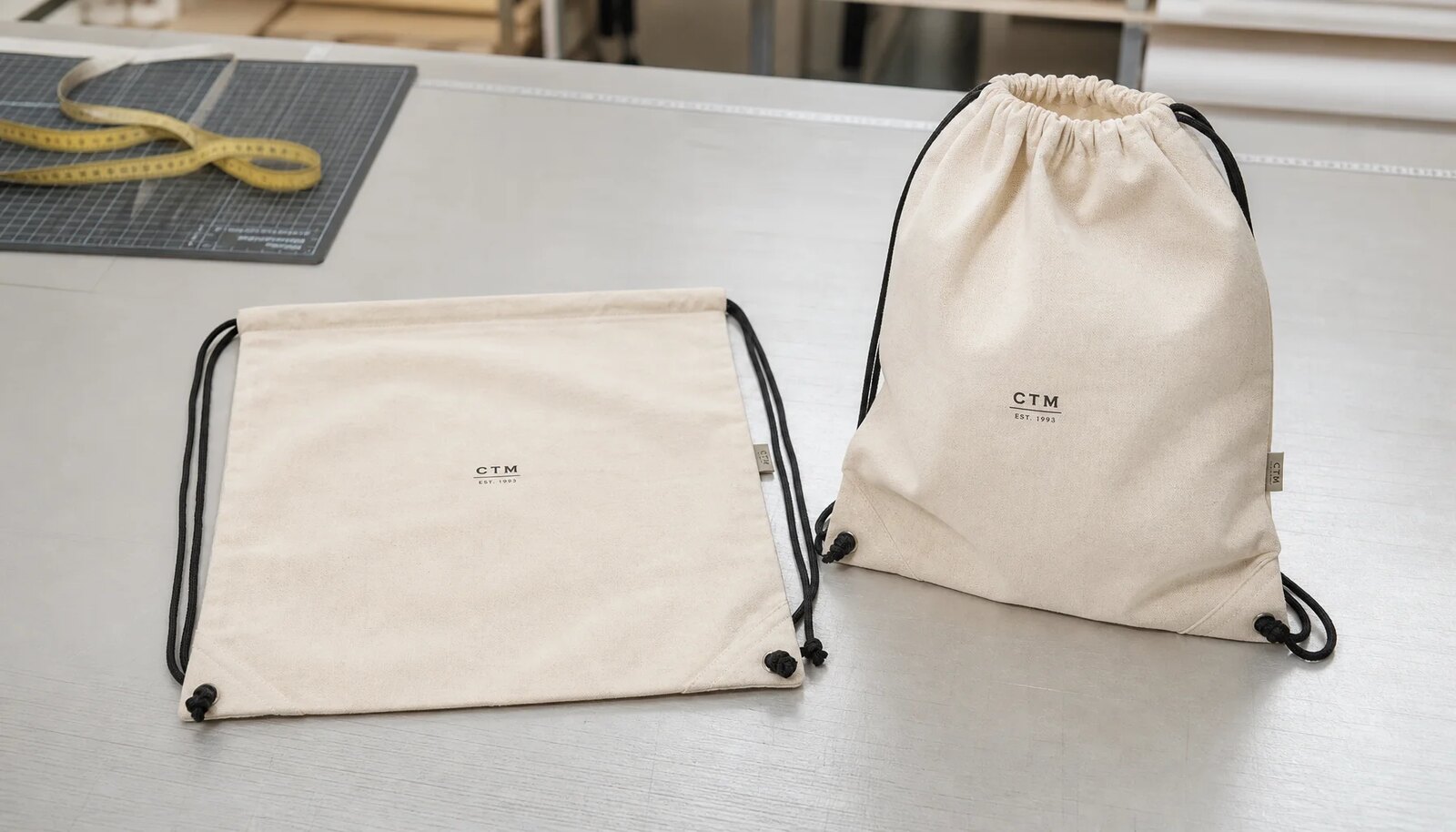
Start With the Craft Fair Load, Not the Product Name
A cotton drawstring backpack sounds simple until it reaches a craft fair booth. It may carry handmade candles, ceramics, small books, boxed kits, art prints, notebooks, packaged food, folded apparel, or workshop tools. Sometimes the bag is sold as merchandise. Sometimes it is a kit container. Sometimes it is a branded carrier that customers keep using after the event. Those jobs ask more from the bag than a thin giveaway sack can usually deliver.
For procurement, the first decision is not the logo or even the size. It is the use case. A low-cost flyer bag can be built around price and basic handling. A retail craft fair backpack should feel substantial, close smoothly, hang neatly on display, and survive a realistic load test without looking damaged. A workshop kit bag may need a stronger cord, conservative seam allowances, and clear pass-fail rules because the contents are heavier or more angular.
Put the load into the RFQ in ordinary language before asking for prices. For example: two paperbacks, one candle jar, postcards, a water bottle, and folded apparel. Then convert that into a test target, such as a 5 kg loaded hang for 30 minutes if it reflects the intended contents. This keeps suppliers from quoting very different bags under the same name.
- State whether the bag is for resale, giveaway, kit packaging, subscription packing, or branded purchase carryout.
- List expected contents instead of relying only on a photo reference or finished size.
- Use one sample load target across suppliers so quote comparisons stay fair.
- Ask each factory to quote the same fabric, reinforcement, cord, print, packing, and inspection assumptions.
- Treat vague terms such as heavy cotton, standard rope, and reinforced style as placeholders until they are defined.
Specify Cotton Fabric by Weight, Weave, Finish, and Tolerance
Fabric is the biggest driver of handfeel, cost, print result, and durability. For wholesale cotton drawstring backpacks for craft fairs, 8 oz to 10 oz cotton canvas is a practical starting range for resale or repeated use. As a rough reference, 8 oz cotton canvas is often about 270 GSM and 10 oz is often about 340 GSM. The conversion is not exact. Weave, yarn, finishing, washing, and pressing all change how the finished bag feels and behaves.
Do not let the RFQ stop at thick cotton or premium canvas. A 270 GSM twill can feel different from a 270 GSM plain-weave canvas. Washed cotton may feel softer but can introduce more shrinkage and size variation. Natural cotton gives a warm handmade look, but shade may shift from cream to grey-beige between lots. Bleached cotton gives a cleaner base for bright printing. Dyed cotton supports brand color programs, but it adds lab dips, dyeing minimums, crocking checks, and lead time.
The buyer should ask whether the quoted weight is greige, finished, washed, or taken from stock records. Bulk fabric should be checked before cutting, not after the issue appears in packed goods. For natural cotton, define whether slubs, seed marks, and shade variation are acceptable product character or defects beyond a limit.
- Write the spec as 8 oz cotton canvas, approximately 270 GSM, +/-5% bulk tolerance, natural finish, or another equally clear construction.
- Ask whether GSM is measured before finishing, after finishing, after washing, or from supplier records.
- Request production-equivalent swatches when shade, texture, or print opacity matters.
- Confirm whether washing, steaming, pressing, pigment dyeing, or calendaring will affect size and handfeel.
- Define acceptable slubs, specks, cotton-seed marks, and natural shade variation before inspection.
Control Finished Size, Capacity, and Measurement Method
Finished size often causes avoidable disputes. A supplier may quote the cut panel size, sewn flat size, or size before pressing. The buyer usually needs finished usable size: the space available after side seams, bottom seam, and the top cord channel have consumed fabric. Common finished sizes include 35 x 40 cm and 38 x 42 cm, but the right size depends on what the bag must hold and how it will be displayed or packed.
The top channel matters more than many buyers expect. A deeper channel may help cord movement, but it reduces usable height. Heavy canvas also has less drape than thin cotton, so a book, candle box, or A4 print sleeve may not fit as easily as the same nominal size suggests. Test the sample with real contents. If the bag must hold a boxed kit, do not approve it from flat dimensions alone.
Set the measurement method in writing. A common starting tolerance for standard cotton drawstring backpacks is +/-1 cm for width and height. The method should say the bag is measured flat, unfilled, after normal pressing or finishing, from finished edge to finished edge, without stretching. Use that same method for sample approval, in-line checks, and final inspection.
- State finished flat width and height, not only cut size, catalog size, or mockup size.
- Define cord-channel depth and usable opening because both affect capacity and closing feel.
- Test the approved sample with the actual products the bag will carry.
- Use a written tolerance, such as +/-1 cm for width and height, unless the program requires a different range.
- Confirm that sample, bulk production, and inspection teams all measure the same way.
Engineer the Lower Cord Exit as a Load Point
The lower cord exit is where many drawstring backpacks fail first. When a user pulls the cords closed, force concentrates at the lower corners. When the loaded bag is carried, the cord rubs and pulls against the same area again and again. A single punched hole through cotton may look fine in a photo, but it is weak for a retail craft fair bag that may carry jars, books, or boxed goods.
Durable constructions include a self-fabric triangle patch, a double-layer lower corner, a reinforced buttonhole, a fabric loop, bar-tack reinforcement, or a metal eyelet set through reinforced fabric. No option is automatically best. A fabric patch often suits a natural craft product. An eyelet can look clean and help the cord move, but only if it is set securely through reinforced fabric with no sharp edge, loose washer, rust risk, or fabric cutting.
Inspection must include the inside as well as the outside. The exterior may look tidy while the inner seam allowance is too narrow, the patch is misaligned, or raw fabric is exposed. Visual review is not enough. Test the corner after loading and repeated cord pulls, then check for tearing, patch lift, eyelet movement, seam opening, and distortion beyond the approved sample.
- Require lower exit reinforcement for resale, workshop kits, and any use beyond light paper giveaways.
- Name the construction clearly: buttonhole, fabric loop, patch, double-layer corner, eyelet, or another approved method.
- If eyelets are used, require reinforced fabric beneath, secure setting, smooth edges, and no loose washers.
- Check inner construction for raw edges, seam allowance, thread security, and patch placement.
- Use pass-fail language: no tearing, no eyelet movement, no patch detachment, and no seam opening after testing.
Define Drawcord Material, Diameter, Length, and Comfort
The cord is both a functional part and a value signal. A thin cord can make a heavy cotton backpack feel cheap, and it can dig into the shoulder when the customer carries books, jars, or supplies. For many 8 oz to 10 oz cotton drawstring backpacks, 6 mm to 8 mm cord is a sensible range. Still, approve the exact cord on a physical sample because softness, braid, stiffness, and surface texture vary by supplier.
Cotton cord supports a natural look and fits handmade, eco-positioned, or minimalist branding. Polyester cord usually gives better abrasion resistance, more consistent color, and lower shrinkage variation. Some buyers choose a cotton body with polyester cord to keep the bag appearance natural while improving performance. Others prefer cotton cord for a cleaner material story. The best choice is the one that passes handling tests and fits the brand position.
Length needs the same discipline. Too short, and the bag may not open fully or sit comfortably over the shoulder. Too long, and it can tangle, drag, or look messy on a booth rack. Knots should not slip through the channel or the lower exit. Cotton ends should not unravel excessively. Heat-sealed polyester ends should not feel sharp.
- Approve cord material, diameter, color, length, knot style, and end finish in the sealed sample.
- Specify a diameter range, such as 6-8 mm, instead of accepting standard drawstring cord.
- Check shoulder comfort with the intended load, especially for bags sold as merchandise.
- Run 30-50 open-close cycles to review channel friction, cord fraying, and knot security.
- Measure cord length variation during inspection and reject bags that cannot open fully or wear comfortably.
Set Sewing Specs Inspectors Can Verify
Good fabric cannot compensate for weak sewing. Loose tension, narrow seam allowance, inconsistent stitch density, skipped stitches, or missing back-tacks can turn a sturdy-looking bag into a return risk. For cotton drawstring backpacks, lockstitch side and bottom seams with secure back-tacks are a common construction. A typical stitch density of 8-10 stitches per inch often works, but the agreed range should match the fabric weight, thread, and machine setup.
Define defects before production starts. Major defects usually include open seams, broken stitch clusters, skipped stitches at stress points, loose top-channel stitching, severe puckering, raw edges that can fray, and misaligned lower reinforcements. Minor defects may include a short untrimmed thread or slight stitch waviness that does not affect function or retail appearance. This classification helps inspectors make repeatable decisions instead of negotiating every flaw after cartons are packed.
Seam allowance deserves attention too. Very narrow allowance can pull out under load. Excessively wide or uneven allowance reduces usable capacity and can make the bag bulky. If the supplier proposes French seams, overlocked seams, bound seams, or another construction, it should be declared before sampling and reflected in the sealed sample.
- Specify seam type, stitch density, seam allowance, thread color, and back-tack locations.
- Use a starting stitch-density target such as 8-10 SPI unless the approved sample validates another range.
- Classify defects as critical, major, or minor so inspection is not based on personal opinion.
- Inspect side seams, bottom seam, top channel, lower corners, and reinforcement stitching separately.
- Reject open seams, skipped stitches at stress points, broken stitch clusters, and loose top-channel stitching.
Run Practical Durability Tests Before Bulk Approval
Durability testing does not need to be complicated for every order. The goal is to repeat a few simple checks that reflect real craft fair use. Test the finished bag as a system: fabric, side seams, bottom seam, top channel, lower cord exits, knots, cord surface, and print. GSM alone does not prove the product will perform once the bag is filled, pulled closed, worn, folded, and packed.
A useful baseline for many craft fair merchandise bags is a 5 kg loaded hang test for 30 minutes. Put the weight inside the finished bag and hang it by the drawcords as a customer would carry it. After the test, inspect for seam opening, fabric tearing, cord slippage, knot failure, lower-corner damage, channel distortion, and excessive shape change. If the buyer’s product mix is lighter or heavier, adjust the load, but keep the method consistent between sample approval and bulk inspection.
Movement testing catches issues that a static load can miss. Open and close the bag 30-50 times. Pull both cords firmly several times. Check whether the cord snags, frays, twists the channel, or abrades the cotton. If the backpack is sold as a retail item, it should remain saleable after the test. A giveaway bag may have a lower appearance standard, but the pass criteria still belong in writing.
- Static load test: hang the packed bag by the cords with 5 kg for 30 minutes, or use a buyer-defined load.
- Open-close test: run 30-50 full cycles and inspect cord movement, fraying, channel distortion, and stitching.
- Cord pull test: apply repeated firm pulls to both cords and inspect lower exits, knots, and channel seams.
- Seam review: allow no functional seam opening, broken stitch cluster, tearing, or reinforcement detachment.
- Retail appearance review: reject severe distortion, dirty transfer, print cracking, or visible damage that makes the bag unsaleable.
Match Print Method to Cotton Texture and Carton Pressure
Decoration must survive more than the approval photo. Screen printing is usually a strong option for wholesale cotton drawstring backpacks when the artwork is a solid logo, bold illustration, or one to three spot colors. It works well on natural canvas when line detail is suitable for the fabric texture. Results still depend on ink type, mesh, squeegee pressure, curing, and operator control. Under-cured ink can crack, powder, or transfer onto nearby bags.
Heat transfer, digital transfer, and similar methods help with gradients, photographic artwork, many colors, or short design splits. The tradeoff is edge durability, handfeel, and response to folding and compression. A transfer may look excellent on a flat strike-off and then peel, gloss, block, or offset when the bags are folded and stacked in cartons. If the order will be packed in tight bundles, test the print after folding and pressure.
Placement should be measured from finished edges, not guessed from a mockup. Artwork near the top channel can distort when the bag closes. Artwork near side seams or lower corners may be affected by seam bulk and folding. The specification should include print size, position, color standard, tolerance, and approval process for each artwork version.
- Use screen print for solid brand marks, repeat wholesale orders, and durable cotton merchandise designs.
- Use transfers for complex graphics only after fold, rub, adhesion, blocking, and packing-pressure checks are approved.
- Confirm underbase requirements for dark dyed fabric so opacity matches the approved strike-off.
- Specify print placement from finished top edge, side seams, and bottom edge, with an agreed tolerance.
- Check dry rub, fold handling, curing, blocking, and offset before approving bulk shipment.
Build MOQ and SKU Splits Around Real Cost Drivers
MOQ is not just a number. It is shaped by fabric sourcing, dyeing minimums, cutting efficiency, sewing-line setup, print setup, labeling, packing, and SKU separation. A low MOQ may be possible for stock natural cotton, standard cord, one print color, and standard cartons. The same factory may need a much higher MOQ for custom dyed fabric, matched cord, woven labels, hangtags, individual packaging, or several artwork versions.
For craft fair programs, the most efficient structure is often one base bag with multiple designs. Keep the body fabric, size, cord, reinforcement, labels, and packing method the same. Then split artwork by inner bundle or carton. This creates assortment for booths, galleries, schools, distributors, or retail collections without multiplying sewing complexity. It also makes inspection easier because all construction defects are judged against one base specification.
Ask for itemized pricing. The quote should separate the base bag, print setup, per-color or per-position print charge, artwork split fee, sample charge, label cost, special packing charge, and custom material surcharge. With the costs visible, procurement can choose where customization adds value and where it creates avoidable risk.
- Lowest-complexity MOQ: stock natural cotton, standard cord, one print color, shared construction, standard cartons.
- Balanced retail MOQ: one base bag with multiple artwork versions separated by bundle or carton.
- Higher-complexity MOQ: custom dyed fabric, matched cord, woven label, hangtag, individual packing, and multiple prints.
- Ask suppliers to itemize setup charges, artwork split fees, label costs, and packing charges.
- Avoid changing body color, cord color, label, print, and packing at the same time unless volumes support it.
Approve Samples in a Risk-Controlled Sequence
A polished sales sample is useful, but it is not enough for production approval. Sales samples may use available fabric, a senior sample sewer, and extra decoration care. They show concept and basic capability. The pre-production sample is the real reference because it should use the intended fabric, cord, reinforcement, print method, finished size, labels, and packing approach.
A steady sequence prevents late surprises. Start with the blank construction sample: fabric handfeel, finished size, cord comfort, seams, reinforcement, and load-test result. Approve swatches or lab dips if shade matters. Then approve the print strike-off on actual production fabric. Finally approve a pre-production sample that combines every production detail. Keep one sealed sample with the factory and one with the buyer or inspector.
For orders with several designs, a fully sewn bag may not be required for every artwork if the base construction is identical. Still, each artwork should have an approved strike-off or printed panel showing color, opacity, line clarity, placement, handfeel, and curing. Build approval time into the calendar, especially when bags are tied to fixed craft fair dates.
- Concept sample: review general construction, size, material feel, and supplier capability.
- Blank construction sample: approve fabric, cord, seams, reinforcement, and load-test performance.
- Print strike-off: approve color, opacity, placement, registration, curing, and handfeel on production fabric.
- Pre-production sample: approve the exact production recipe before bulk cutting and sewing.
- Sealed sample: use as the reference for in-line checks, final inspection, and dispute resolution.
Specification comparison for buyers
| Spec decision | Recommended option | When it fits | Buyer risk to check |
|---|---|---|---|
| Fabric weight for craft fair resale | 8 oz to 10 oz cotton canvas, commonly about 270-340 GSM before wash or special finish; agree a GSM tolerance, often +/-5% for bulk fabric | Retail merchandise, museum shop items, workshop kits, bookstore packs, and branded craft fair purchase carriers that need a sturdier handfeel than a light promotional sack | Quotes may substitute 5 oz to 6 oz plain cotton, which can feel thin, show contents, distort under load, and tear sooner at cord exits or seams |
| Fabric construction and finish | Plain-weave canvas or twill confirmed by swatch, with natural, bleached, dyed, or washed finish stated in the RFQ | Natural cotton suits handmade and eco-positioned branding; dyed cotton suits controlled brand colors; washed cotton suits softer handfeel | Same GSM can feel different by weave and finishing; natural shade variation, dye crocking, shrinkage, and wash-related size change must be checked before cutting |
| Finished size and tolerance | Common finished sizes include 35 x 40 cm or 38 x 42 cm; state finished flat measurement method and tolerance such as +/-1 cm for width and height | Fits candles, books, small boxed goods, art supplies, workshop materials, brochures, and light apparel without oversized booth storage | Supplier may quote cut size instead of finished size; cord-channel depth, seam allowance, shrinkage, and pressing can reduce usable capacity |
| Cord channel construction | Folded top channel with even stitch line, adequate opening for the cord diameter, back-tacks at stress points, and no raw edge exposure | Needed for repeated opening and closing at craft fairs, workshops, markets, and retail events | Too narrow a channel creates snagging and abrasion; weak channel stitching can pop when the user pulls both cords tight |
| Lower cord exit reinforcement | Self-fabric triangle patch, double-layer lower corner, reinforced buttonhole, fabric loop, or metal eyelet set through reinforced fabric | Recommended for paid resale, heavier contents, or any bag expected to carry more than flyers and lightweight textiles | Metal eyelets alone are not proof of durability; poorly set eyelets can cut cotton, pull loose, rust, or deform if the fabric beneath is not reinforced |
| Drawcord material and diameter | 6 mm to 8 mm cotton cord for natural appearance, or soft polyester cord where abrasion resistance, color consistency, and lower shrinkage variation matter more | Cotton cord fits craft and natural branding; polyester cord fits repeat use, heavier handling, humid shipping, and stronger color-matching needs | Thin cords reduce cost but dig into shoulders, fray faster, stretch or slip at knots, and can abrade the channel |
| Seam construction | Lockstitch side and bottom seams with secure back-tacks; typical stitch density 8-10 SPI unless the supplier validates another construction | Wholesale programs where bags are handled repeatedly during packing, receiving, booth setup, and customer use | Skipped stitches, loose tension, uneven seam allowance, needle damage, or chainstitch-only seams can open during load testing |
| Print method | Screen print for solid 1-3 color logos and repeat orders; heat transfer or digital transfer for gradients, many colors, or short artwork splits | Screen print suits durable brand marks on natural canvas; transfers suit complex graphics and small design runs | Ink can crack if under-cured or too thick; transfers can peel, block, gloss, or offset when cartons are compressed |
| MOQ structure | Keep one body fabric, one cord, one reinforcement style, and split artwork by bundle or carton where possible | Useful for distributors, galleries, schools, craft-event organizers, and brands needing multiple designs without changing the bag body | Too many body colors, cord colors, labels, and artwork versions increase dyeing minimums, setup charges, packing labor, and inspection complexity |
Buyer checklist before sampling
- Define the intended load in plain product terms, such as two paperbacks, one candle jar, postcards, a water bottle, and folded apparel, then convert it into a test load such as 5 kg for sample approval.
- Specify fabric in oz and approximate GSM, and require the supplier to state whether the weight is greige, finished, washed, or stock-fabric data.
- Identify weave and finish: cotton canvas, twill, plain cotton, natural, bleached, dyed, enzyme-washed, or pigment-washed, because each affects handfeel, shrinkage, shade control, print result, MOQ, and lead time.
- Set finished size, cord-channel depth, and measurement tolerance in writing; for standard cotton drawstring backpacks, width and height tolerance of +/-1 cm is a common starting point.
- Require reinforced lower cord exits for retail resale, kit bags, workshop bags, or any use beyond light paper giveaways.
- Approve drawcord material, diameter, length, color, knot style, and end finish on a physical sample; do not accept generic terms such as standard rope without diameter and material.
- Define sewing requirements, including seam type, stitch density, seam allowance, back-tack locations, skipped-stitch limits, loose-thread trimming, and reinforcement at stress points.
- Set sample durability targets: 5 kg loaded hang for 30 minutes, 30-50 open-close cycles, and repeated firm cord pulls with no tearing, seam opening, patch detachment, eyelet movement, or cord slippage.
- Require print strike-off approval on the actual production fabric, including print color, opacity, registration, placement, curing, handfeel, and adhesion checks.
- Compare quotes using the same assumptions for MOQ, artwork splits, sample stages, packing, inner bundle count, pieces per carton, carton dimensions, gross weight, carton liner, and inspection access.
Factory quote questions to send
- What exact cotton fabric is quoted, including oz, GSM, weave, yarn style if known, and whether the weight is measured before finishing, after finishing, after washing, or from stock records?
- What tolerance will you apply to bulk fabric GSM, and how many fabric locations or rolls will be checked during incoming or in-process inspection?
- Is the fabric natural, bleached, stock dyed, custom dyed, pigment dyed, washed, or otherwise finished, and what shade approval method applies: swatch, lab dip, bulk cutting, or sealed sample?
- What finished size is included, how will width and height be measured flat, what is the cord-channel depth, and what tolerance applies to each dimension?
- What shrinkage range should we expect after steam, pressing, washing, or humid storage, and will the pre-production sample represent the same finishing process as bulk?
- How is the lower cord exit reinforced: self-fabric patch, double-layer corner, buttonhole, fabric loop, metal eyelet through reinforcement, bar-tack, or another construction?
- What drawcord material, diameter, color, length, knot style, and end finish are included, and what tolerance applies to cord length and diameter?
- What seam type, stitch density, seam allowance, thread type, and reinforcement method will be used at side seams, bottom seam, top channel, lower corners, and cord exits?
- Which print method is quoted, how many colors are included, what ink or transfer type is used, and what curing, rub, fold, or adhesion test is performed before packing?
- For dark cotton or saturated fabric colors, is an underbase included, how will print opacity be judged, and what fabric crocking or colorfastness check will be used?
Quality-control points to confirm
- Bulk fabric GSM should be measured from production fabric and remain within the agreed tolerance, commonly +/-5% unless a different range is approved in writing.
- Fabric shade should match the approved swatch, lab dip, or sealed sample under a consistent light source, with natural cotton variation reviewed before cutting where possible.
- Finished bag dimensions should be measured flat after normal pressing or finishing, using the approved method; a typical tolerance is +/-1 cm for width and height on standard sizes.
- Cord-channel depth and usable opening should match the approved sample so the bag closes smoothly and capacity is not reduced by an oversized fold or uneven channel.
- Side seams, bottom seams, and top-channel seams should show no skipped stitches, broken threads, open seams, needle cutting, severe puckering, or uneven seam allowance at stress points.
- Stitch density should match the agreed range, for example 8-10 stitches per inch, with secure back-tacks at seam starts, seam ends, and high-load locations.
- Lower cord exit reinforcement should remain secure after loaded hang and cord-pull checks, with no tearing, patch detachment, eyelet movement, raw fabric exposure, or distortion beyond the approved limit.
- Drawcord length, diameter, knot position, and end finish should be consistent within the approved tolerance; knots or sewn ends must not slip through the channel.
- Cord movement through the top channel should be smooth during 30-50 open-close cycles, with no severe snagging, channel twisting, cord fraying, or rapid fabric abrasion.
- Print color, opacity, registration, and placement should match the approved strike-off under normal viewing light, with placement tolerance stated from finished edges, not estimated from photos.