What a real cost breakdown should show
A cotton drawstring backpack is easy to describe but difficult to compare when the RFQ is incomplete. One supplier may price 6 oz cotton sheeting, polyester cord, no reinforcement, bulk packing, and EXW terms. Another may quote 10 oz canvas, cotton rope, reinforced lower corners, screen setup, export cartons, and FOB terms. Both quotes may say “cotton drawstring backpack,” but they are not the same product.
For a salon chain, the bag often moves through multiple hands: factory, forwarder, warehouse, regional distributor, salon staff, and final client. It may carry retail bottles, education materials, client gifts, or training kits. Cost control matters, but a bag that tears, smells musty, arrives dirty, or looks too thin can damage store-level execution.
A useful cost breakdown separates the product cost from setup, packing, inspection, and freight assumptions. Procurement does not need the factory’s internal margin. It does need enough detail to understand why a quote is higher or lower and which specification changes reduce cost without weakening the bag.
- Compare quotes only after normalizing GSM, finished size, cord, reinforcement, print method, packing, MOQ, and Incoterm.
- Treat CBM, carton weight, and packing method as cost drivers, not shipping details to check later.
- Ask suppliers to show one-time charges separately from the recurring unit price.
- Use estimated landed cost per usable bag as the final comparison, not only EXW or FOB unit price.
Start with the salon-chain use case
The first buying question should be what the bag must carry. A sachet giveaway does not need the same structure as a retail gift set with shampoo and conditioner bottles. A staff education backpack carrying notebooks, tools, or training documents needs stronger construction than a lightweight client handout.
Define a simple load profile before collecting prices. For example: two 300 ml bottles plus one brochure and appointment card, or ten sample sachets plus a coupon. The factory can then quote an appropriate fabric weight and reinforcement instead of choosing the lightest option to win the price comparison.
Distribution also affects cost. Bags handed out immediately at salons may be bulk packed. Retail kits need cleaner folding, individual protection, barcode labels, or shelf-ready presentation. Store allocation labels can save warehouse labor, but they require accurate packing data before production is finished.
- Client giveaway: 6 oz to 8 oz cotton, simple print, bulk or grouped packing.
- Gift-with-purchase: 8 oz canvas, clean logo, comfortable cord, controlled folding, carton labels by SKU.
- Retail bottle kit: 8 oz to 10 oz canvas, reinforced corners, cleaner packing, possible barcode or polybag.
- Staff training event: 10 oz canvas, larger size, stronger seams, cartons labeled by region or event.
- Distributor program: stable standard spec, repeatable carton quantity, clear SKU and campaign labels.
Fabric GSM, cotton type, and visible value
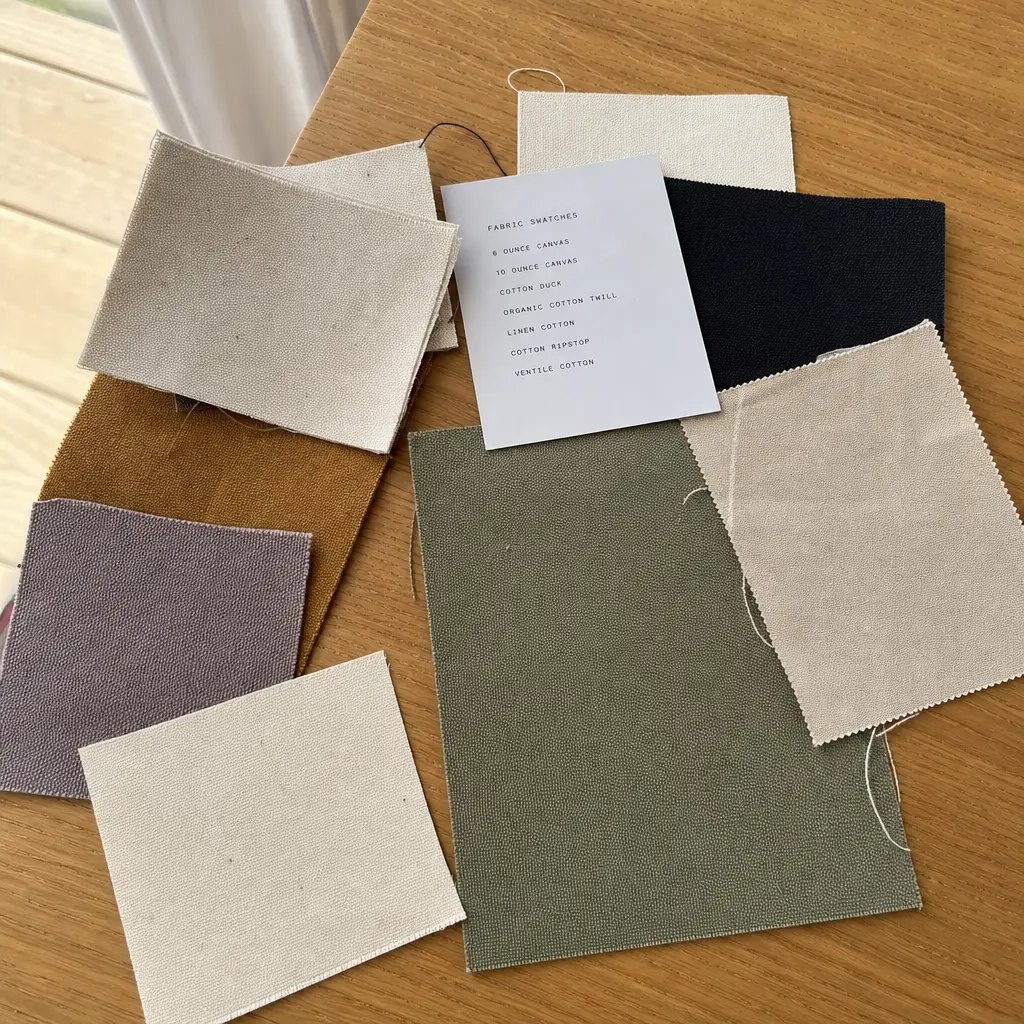
Fabric is usually the most visible cost driver. Heavier cotton increases material cost, weight, and often carton volume, but it also improves handfeel and supports heavier salon products. A 38 x 42 cm backpack in 6 oz cotton can look similar in a small photo to the same bag in 10 oz canvas, but it will not feel the same in a client’s hand.
Ask for both oz and gsm. As a practical reference, 8 oz cotton canvas is often around 270 gsm, while 10 oz is around 340 gsm. Do not accept “canvas” or “eco cotton” without a number. Also ask when the fabric weight is measured, because dyeing, washing, and finishing can change handfeel and weight.
Natural cotton can fit a clean, low-plastic salon campaign, but seed flecks, slubs, and shade variation must be approved intentionally. If the brand wants a very clean luxury look, bleached or dyed cotton may be better, but it adds MOQ, lab dip approval, shade tolerance, and lead time.
- 5 oz to 6 oz: lowest cost for flyers, sachets, or very light inserts; less structure and more wrinkling.
- 8 oz / about 270 gsm: balanced option for most salon promotions and moderate product loads.
- 10 oz / about 340 gsm: stronger handfeel for retail kits, training materials, and heavier bottle loads.
- 12 oz and above: premium and sturdy, but often unnecessary for promotional backpacks and more expensive to ship.
- Natural cotton: lower processing and natural appearance, but define acceptable flecks and slubs.
- Dyed or bleached cotton: cleaner color direction, but requires shade approval and usually higher MOQ.
Finished size and pattern efficiency
Finished size changes both fabric consumption and freight volume. Many buyers request a large bag to be safe, then pay for unused panel area and larger cartons. Around 38 x 42 cm is a common adult-use size for salon chain backpacks because it can hold brochures, product bottles, and light tools without looking oversized. For sachets and coupons, 34 x 40 cm may be enough.
Always specify finished size, not only cutting size. Seam allowance, bottom stitching, and the drawstring channel reduce usable dimensions. A factory quoting a cutting size may deliver a smaller finished bag than expected. State how the measurement is taken: flat width from side seam to side seam and height from top edge to bottom seam.
Pattern efficiency is worth discussing. A 1 cm or 2 cm change may improve fabric utilization and reduce waste. Ask the supplier if a nearby dimension lowers cost, but test the revised size with actual salon products before approval.
- Use a written tolerance, such as ±1 cm for normal sewn cotton goods.
- Check whether 250 ml or 300 ml bottles fit without straining side seams.
- Keep the logo away from side seams, bottom seams, and the drawstring channel.
- Ask whether minor size adjustment improves fabric yield before finalizing the PO.
- Do not oversize unless the bag genuinely needs to hold training binders, robes, or boxed kits.
Cord, reinforcement, and construction cost
Drawstring backpacks usually fail at the lower corners, side seams, or cord channel. Low quotes often save money through thinner cord, narrow seam allowance, fewer stitches, no reinforcement, or weak corner construction. These choices may be invisible in a catalog image but obvious when a salon loads the bag with bottles.
Cord choice affects appearance and cost. Cotton rope supports a natural brand position and feels more premium than basic polyester cord, but it costs more and can increase packed volume. Polyester cord can be strong and economical, but may not match a natural cotton positioning. Flat cotton cord can improve shoulder comfort for staff events.
Lower-corner reinforcement should be specified when bags carry bottles, boxed products, books, or tools. Options include metal eyelets, stitched fabric tabs, bar-tacked loops, or reinforced channel construction. Each has tradeoffs, so approve the exact method on the sample and include it in the inspection checklist.
- Specify cord material, diameter or width, color, and end finish.
- Confirm whether metal eyelets, bar tacks, or fabric tabs are included in the unit price.
- Require a load test using the expected salon contents.
- Check inside seams, not only the outside appearance.
- Avoid very narrow channels that restrict cord movement and increase pull resistance.
Branding cost: screen print, transfer, label, or embroidery
For most salon chains, 1-color or 2-color screen printing is the most cost-efficient branding method. It is practical for repeat programs, simple logos, and medium to large orders. Cost changes with color count, print size, ink coverage, registration difficulty, and PMS matching.
Large solid prints can stiffen the front panel and reveal more texture variation on natural cotton. Fine text, gradients, and distressed artwork require more proofing. PMS approval should happen on the actual cotton base, not only on a digital mockup or paper color chip.
Heat transfer can work for gradients or short tests, but it may feel like a film on cotton and should be tested for peeling, cracking, and handfeel. Woven labels are useful for premium retail kits, yet they add setup, label MOQ, sewing labor, and leftover label control. Embroidery can look premium on heavier canvas but is usually more expensive and may distort lighter fabric.
- Screen print: best for simple salon logos and repeat chain programs.
- Heat transfer: useful for complex artwork or low-volume launches; test adhesion and handfeel.
- Woven label: premium detail but adds MOQ, setup, sewing, and inventory control.
- Embroidery: test on the actual fabric before approval, especially below 10 oz canvas.
- Define print area, placement from top edge, center line, and tolerance such as ±5 mm.
MOQ logic and setup charges
One bag can have several minimums. A supplier may accept 500 pieces for stock natural cotton with a standard cord and simple print. Custom dyed fabric may have a mill MOQ. Custom cotton rope may have a separate cord MOQ. Woven labels, barcode stickers, and special packing can add minimum charges even when the sewing MOQ is met.
For salon chains, it is often smarter to test with stock natural or black cotton before committing to custom dyeing, custom cord color, and retail packaging. Once the chain confirms the campaign format and reorder volume, deeper customization becomes easier to justify.
Setup charges should not be hidden inside the unit price unless the supplier clearly explains how repeat orders will be handled. A first order may include screens, label molds, sample revisions, and courier freight. A repeat order using the same approved artwork should not be compared as if it has the same setup burden.
- Ask for MOQ by bag body, dyed fabric, cord, print, woven label, polybag, barcode, and store sorting.
- Separate screen charges, label setup, sample charges, and courier freight from the unit price.
- Confirm whether unused custom labels or cords are stored, shipped, or discarded.
- Check if repeat orders receive a lower setup cost when artwork and specification are unchanged.
- Be cautious with unusually low custom MOQ quotes; they may rely on substitute materials.
Quote normalization and landed-cost comparison
A strong quote comparison sheet should show the same fields for every supplier. At minimum, include unit price, setup charges, sample cost, packing cost, inspection cost, Incoterm, named port or place, carton quantity, carton dimensions, gross weight, CBM, lead time, and payment terms. Without these fields, procurement may choose the lowest unit price and later discover higher freight, excluded setup, or weaker packing.
Use a simple landed-cost format. Start with product unit price multiplied by quantity. Add allocated setup charges, sample charges if they are not credited, packing upgrades, inspection, inland or ocean/air freight estimate, destination charges, duties, and taxes where applicable. Divide by the expected usable quantity. If the cheaper quote has higher defect risk or missing packing, it may not be cheaper once landed.
Incoterms must be compared carefully. EXW shifts more logistics responsibility to the buyer. FOB includes delivery to the named port under agreed terms. CIF, DDP, and other terms include different cost and risk points. Never compare an EXW unit price against an FOB or DDP quote without normalizing the freight basis.
- Example comparison fields: supplier, spec version, quantity, unit price, setup, sample, packing, inspection, freight basis, Incoterm, CBM, lead time, and total landed estimate.
- Allocate one-time setup over the order quantity so small campaigns show the true per-bag impact.
- Compare 8 oz versus 10 oz, bulk versus individual packing, and 1-color versus 2-color print as separate options.
- Check CBM before approval; bulky packing can erase savings from a low product price.
- Keep the approved quote format for repeat orders so price increases can be traced to fabric, labor, freight, or specification changes.
Sample approval and production QC
A digital mockup should not release bulk production for a salon-chain order. The pre-production sample should use the actual fabric, cord, reinforcement, print method, logo size, fold, and packing. If the sample uses substitute stock fabric, mark it clearly and require a final material sample before production.
Document the approved standard. Record finished size, GSM, cord, reinforcement, print color and placement, folding method, packing, carton label, and accepted natural cotton appearance. Photos are useful, especially for cotton flecks, slubs, print coverage, corner construction, and inside seams.
Inspection should happen against measurable tolerances. A practical baseline may include fabric GSM tolerance, size tolerance, print placement tolerance, AQL defect levels, and a defined cleanliness standard. For salon brands, odor, stains, mildew marks, oil spots, mixed shades, and dirty packing should be treated as important defects, not cosmetic afterthoughts.
- Keep one signed or photo-documented approved sample with the buyer and one with the factory.
- Load-test the sample with the intended retail bottles or training contents.
- Check print curing through dry and light damp rub tests.
- Inspect across cartons, not only top samples from the first carton opened.
- Verify carton labels, SKU, barcode, store allocation, and quantity before shipment release.
Packing, carton labels, and cleanliness
Packing can affect cost, cleanliness, and store execution. Bulk packing is economical and reduces plastic, but it can create counting errors and wrinkles. Individual polybags protect retail presentation and long storage but add cost, labor, and waste. Grouped inner packs, such as 10 pieces per inner bag or paper band, are often a practical middle ground for internal distribution.
Carton planning should be finished before the purchase order is locked. Cotton bags compress, but over-compression can crease printed panels. Very heavy cartons are more likely to burst or be dropped. A buyer-specific warehouse limit should be followed; many manual handling environments prefer cartons kept around or below 18–20 kg gross weight.
Salon chains should also plan allocation early. If cartons must be labeled by region, store, campaign, or SKU, the supplier needs clean data before packing starts. Late allocation changes can delay inspection and shipment, so label files should be treated like artwork: controlled, approved, and versioned.
- Bulk pack when bags are unpacked by salon staff and minor wrinkles are acceptable.
- Use grouped inner packs for easier warehouse counting without full retail polybagging.
- Use individual polybags for retail shelves, e-commerce kits, humid routes, or long storage.
- Avoid folding directly through heavy logo ink whenever possible.
- Carton marks should show PO, SKU, color, quantity, gross/net weight, carton number, destination, and store allocation if needed.
Specification comparison for buyers
| Cost bucket | Typical cost impact | What changes the price | Buyer check before approval |
|---|---|---|---|
| Fabric and cutting | High | GSM, cotton type, finished size, fabric waste, dyed or natural base, washing or finishing | Request gsm and oz, finished size, tolerance, fabric swatch, and whether shade/slubs are approved |
| Sewing and construction | Medium to high | Seam allowance, stitch density, drawstring channel, reinforced corners, eyelets, bar tacks, fabric tabs | Load-test the sample with actual salon products and inspect corner reinforcement and inside seams |
| Cord and hardware | Low to medium | Cotton rope vs polyester cord, diameter, color, metal eyelets, cord tips, custom dyeing | Specify material, diameter/width, color, end finish, and whether hardware is included in the unit price |
| Branding and setup | Medium | Screen colors, print size, ink coverage, heat transfer film, woven label setup, embroidery, PMS matching | Separate one-time screen/setup charges from unit price and approve print on actual cotton fabric |
| MOQ and small-order premium | Medium | Stock fabric vs dyed fabric, custom cord, woven label MOQ, packing labor minimums | Ask for the practical MOQ by component, not only the advertised bag MOQ |
| Packing and labeling | Low to medium | Bulk pack, grouped inner packs, individual polybags, barcode stickers, store allocation labels, export cartons | Confirm packing method, carton marks, pcs/carton, carton dimensions, gross weight, and CBM |
| Sampling and approval | Low but important | Prototype, pre-production sample, revision sample, courier freight, retained samples | Approve a physical sample using actual fabric, cord, print, reinforcement, and packing before bulk production |
| Inspection and quality control | Low to medium | Third-party inspection, rework, lab tests, retained samples, extra sorting for cleanliness | Define AQL, tolerances, defect list, cleanliness standard, and who pays for reinspection if goods fail |
| Freight and landed cost | Medium to high | Incoterm, CBM, gross weight, port, carton efficiency, air vs sea, destination handling, duties/taxes | Normalize quotes to the same Incoterm and compare estimated landed cost per usable bag, not only unit price |
Buyer checklist before sampling
- Define the bag use: retail gift set, client giveaway, staff training kit, distributor sample pack, store opening event, or e-commerce insert.
- List the expected contents, such as two 300 ml bottles, brochures, coupons, sachets, combs, or training documents, and set a realistic load test.
- Specify finished size, not cutting size, with measurement method and tolerance, such as 38 x 42 cm finished size with ±1 cm tolerance.
- Request fabric weight in both gsm and oz; avoid vague descriptions such as cotton, canvas, eco cotton, or natural bag without a numeric GSM.
- Choose cord material, diameter or width, color, end finish, and lower-corner reinforcement before comparing supplier prices.
- State the branding method, number of print colors, maximum print area, PMS needs, placement tolerance, and whether setup charges are separate.
- Separate one-time and variable costs: screen setup, label setup, sample charge, courier freight, packing, barcode labels, inspection, and freight basis.
- Ask for carton quantity, carton dimensions, gross weight, net weight, CBM, port, Incoterm, and shipment-ready date in every quote.
- Confirm packing: bulk, grouped inner packs, individual polybag, barcode sticker, retail insert, or store allocation labels.
- Approve a physical pre-production sample with actual fabric, actual cord, actual reinforcement, actual print, actual fold, and actual packing.
Factory quote questions to send
- What fabric weight is quoted in gsm and oz, and is it measured before or after dyeing, washing, or finishing?
- Is the fabric stock natural cotton, bleached cotton, dyed cotton, recycled cotton blend, organic cotton, or custom woven canvas?
- What finished bag size, cutting size, seam allowance, and drawstring channel construction are included?
- What cord material, diameter or width, color, and end finishing are included, and are eyelets, bar tacks, or fabric tabs priced separately?
- Which print method is quoted, how many colors are included, what is the maximum print size, and what are the setup charges?
- Are screen charges, sample charges, artwork adjustment, PMS ink matching, woven label setup, packing labels, and courier freight included or separate?
- What MOQ applies for the bag body, print, dyed fabric, custom cord color, woven label, barcode label, and individual packing?
- What is the sample lead time, revision lead time, and bulk production lead time after deposit and sample approval?
- What are the carton dimensions, pcs per carton, gross weight, net weight, and estimated CBM for the quoted quantity?
- Which Incoterm is quoted, at which named place or port, and what costs are excluded from the price?
Quality-control points to confirm
- Measure fabric GSM from random panels or retained swatches and compare with the approved specification.
- Check finished size flat, including width, height, drawstring channel height, bottom seam, and size tolerance after pressing.
- Load the bag with the agreed salon products and pull both cords repeatedly to test channel movement, lower corners, and seam stress.
- Inspect eyelets, bar tacks, fabric tabs, cord knots, seam ends, skipped stitches, loose threads, and inside seam security.
- Compare print color and placement against the approved sample under consistent light, allowing only the documented tolerance.
- Rub-test print dry and lightly damp to identify poor curing, cracking, powdering, tackiness, peeling, or ink transfer.
- Inspect print registration, pinholes, smudges, ink coverage, edge sharpness, and logo alignment across multiple cartons.
- Check cotton appearance for stains, oil marks, mildew odor, heavy slubs outside approval, mixed shades, loose fibers, or contamination.
- Review folding and packing so printed panels are not over-compressed, dirty, damp, or sharply creased through the logo.
- Verify carton marks, SKU labels, barcode labels, store allocation labels, carton count, and quantity per carton against the purchase order.