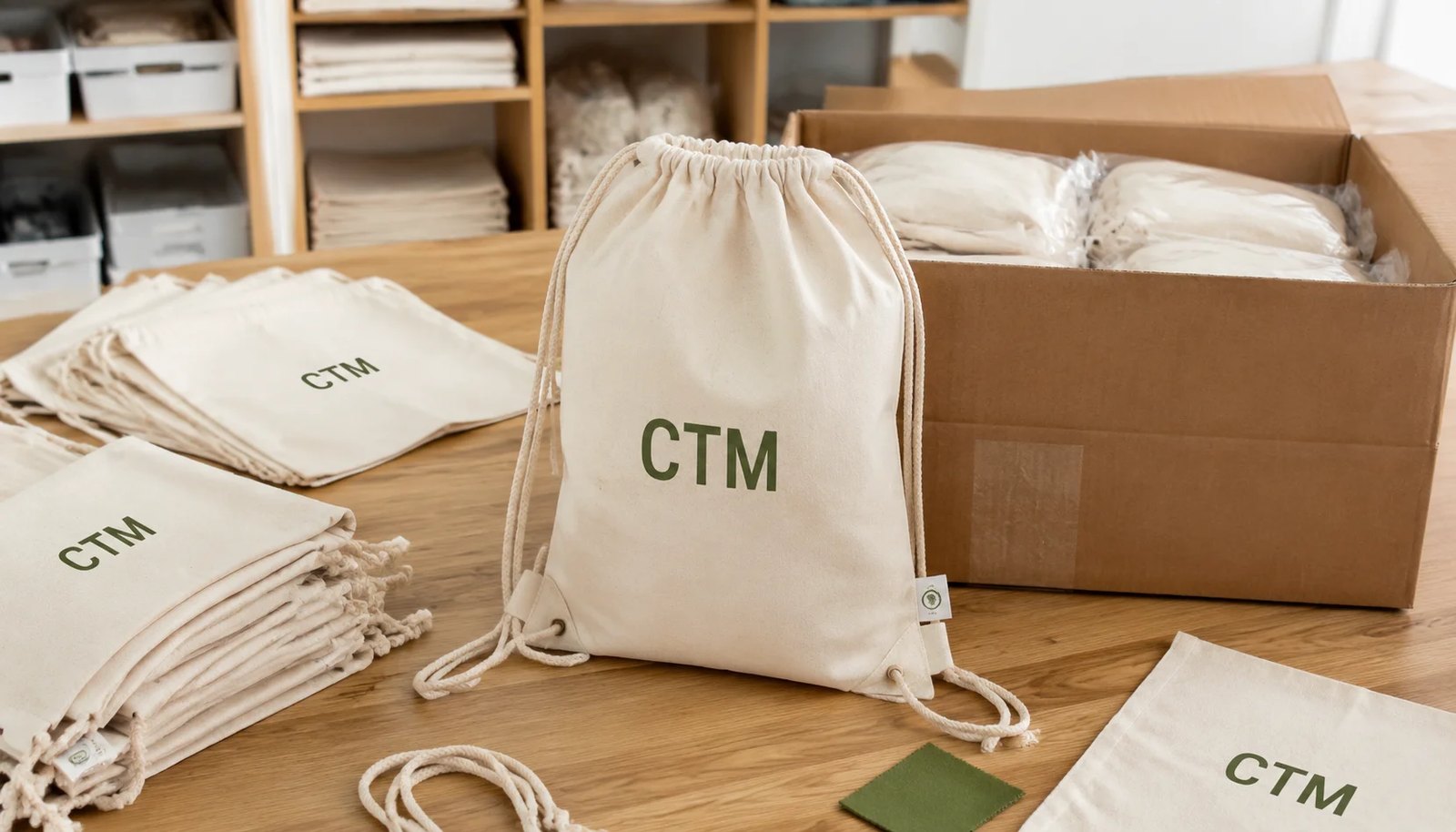
Why carton planning matters more than the bag spec alone
Many buyers treat cotton drawstring backpacks as a simple sewn item and spend most of their time on size, print, and unit price. For natural grocer retail programs, carton planning often creates the bigger cost swing. A bag that looks competitive at ex-factory level can become the expensive option once units per carton, carton crush resistance, and container cube are calculated. This is especially true for natural cotton products because the fabric traps air, folds inconsistently if not standardized, and marks easily when packed too tightly after printing.
Carton planning also affects store operations. Procurement may buy for a distributor or chain that receives into a central DC, breaks down by region, and then sends small quantities to stores. If cartons are too heavy, too large, or mixed without a clear inner pack, warehouse teams lose time counting and relabeling. If cartons are too weak, the product arrives with corner crush, print rub, or dusty bags. The buying problem is not only 'what backpack should we buy' but 'what shipping plan preserves margin and receiving accuracy from factory to shelf.'
- Freight cost is driven by both weight and cube; most cotton backpack programs hit cube limits first.
- Natural cotton bags can wrinkle and print-transfer if packed before ink is fully cured.
- A good carton plan reduces shortage disputes because counts are easier to verify.
- Overpacked cartons save carton count but often lose money through damage and handling inefficiency.
Start with the right backpack build for a natural grocer retail program
For most natural grocer buyers, the practical base bag is a simple cotton drawstring backpack in 5 oz to 6 oz cotton canvas, around 170-200 GSM. This range gives enough body for a clean retail feel without inflating shipping cube too aggressively. It works well for seasonal promotions, wellness events, produce loyalty programs, and checkout-area resale where the bag carries light to medium contents. If the backpack is positioned as a premium reusable item rather than a low-price add-on, 8 oz canvas around 230-270 GSM is usually the safer floor.
The common mistake is specifying only '100% cotton' with a rough size and logo file. That leaves too much room for suppliers to quote different constructions. One factory may quote plain sheeting with soft handfeel that folds compactly but lacks seam strength. Another may quote tighter canvas that prints better and wears longer but consumes more freight space. Buyers comparing those quotes are not comparing like with like. A proper RFQ should lock the fabric weight range, finished size, drawcord spec, seam construction, and whether natural slubs are acceptable.
- Entry retail spec: 170-200 GSM natural cotton canvas
- Premium reusable spec: 230-270 GSM canvas
- Typical finished size: 35 x 40 cm or 38 x 42 cm
- Common drawcord: cotton rope or polyester-cotton cord, about 6-8 mm diameter
- Side seams should be backstitched at stress points to reduce cord-pull failure
Fabric weight and print method change the carton outcome
Fabric choice does not only change durability; it changes how many pieces fit per carton, how sharply the bag can be folded, and how likely the print is to block or offset. Lighter 140-150 GSM cotton can look cost-effective but often feels too thin once a logo is screen printed, particularly on natural unbleached fabric with visible seed specks. Heavy coverage artwork can stiffen the panel and create fold memory lines that make the bags look crushed at store opening. A medium canvas at 170-200 GSM is often the better shipping compromise because it holds shape without excessive bulk.
For printing, one-color or two-color screen print is usually the cleanest commercial choice. Digital printing has a place for small runs or detailed artwork, but on natural cotton it can produce more shade variation and a softer edge depending on pretreatment and fabric texture. Heat transfer is less common for this category because it can increase panel stiffness and affect folding. If the design uses a large solid block, the supplier should state the ink system and curing method. Otherwise, bags packed too quickly can transfer ink onto adjacent units, especially in hot container conditions.
- Natural cotton color variation can slightly affect print appearance from lot to lot.
- Large flood print areas increase drying time and raise packing risk.
- Tighter weave canvas usually gives sharper print edges than loose sheeting.
- If artwork is heavy, request a folded printed sample, not only a flat printed strike-off.
How to set pack count and carton size without paying for air
A practical pack plan for cotton drawstring backpacks is 10 pieces per inner polybag and 100 pieces per export carton, then adjust based on fabric weight and final folded thickness. This is not a rule; it is a starting point. At 170-200 GSM with a standard one-side screen print, 100 pieces per carton usually stays within a manageable weight range and keeps the carton easy to count. At 230-270 GSM, 80 pieces per carton may be more realistic if you want to avoid over-compression and panel creasing.
The right carton size depends on the folded dimensions of the actual sewn bag, not on the nominal finished size only. Some factories force a small carton to reduce CBM, but compression can break the print surface, distort drawcord channels, and create a poor first impression when the retailer opens cartons. Better buying practice is to define a maximum carton weight and ask each supplier to recommend the carton dimensions that meet that limit while maintaining product presentation. Then compare freight cube per 1,000 pieces instead of chasing the smallest box on paper.
- Typical inner pack: 10 pcs in clear polybag or paper band if plastic reduction is required
- Typical master carton: 80-120 pcs depending on GSM and fold thickness
- Target gross carton weight: around 10-14 kg for easier manual handling
- Use flat-packed bundles with consistent fold direction to improve carton fill rate
- Do not mix SKUs in one carton unless the importer specifically wants mixed assortments
MOQ logic: how order splits create hidden cost and packing errors
Cotton drawstring backpack MOQs are usually driven by raw fabric booking, print setup, and sewing efficiency. A supplier may quote 1,000 pieces because that is commercially acceptable for one natural fabric body and one simple print. But if the buyer wants three artworks, two cord colors, and split packing by store program, the real production logic changes. The factory may still accept the total quantity, yet each split absorbs extra setup time, labeling work, and packing control. That often shows up later as mixed-carton mistakes or unexpected surcharges.
For natural grocer programs, one of the best cost controls is to standardize the bag body and vary only the logo where possible. If the same 170-200 GSM natural cotton bag is used across multiple campaigns, the factory can book fabric more efficiently and maintain better carton consistency. Buyers should ask for a quantity ladder at 1,000, 3,000, and 5,000 pieces with clear notes on what is included. The quote should separate base bag cost, print cost, and packing upgrade cost so commercial teams can see whether a lower MOQ is really worth the operational complexity.
- MOQ usually applies per design or per print setup, not only per total order volume.
- Natural fabric body standardization reduces waste and speeds replenishment.
- Split packing by store or region should be quoted as a separate service line.
- Small artwork variants can be economical if the base sewing spec is identical.
Sample approval should include folding, packing, and carton fit
Many approvals stop at a pre-production sample of the bag itself. That is not enough when the buying problem is shipping carton planning. Procurement teams should approve a sample set that includes the finished printed bag, the actual fold method, the inner packing arrangement, and ideally a trial master carton layout. Without this, the approved bag may fit the spec but still fail in transit because the fold line lands directly on a printed area, or because the drawcord knots create uneven stack height that bulges the carton.
A useful sample workflow starts with a blank sample for size and construction, then a printed sample for artwork and ink behavior, then a pre-production sample packed exactly as the bulk order will ship. If the order value justifies it, ask the supplier to provide one sample carton with the intended count or a reduced-count simulation using the same carton board. This lets the buyer evaluate carton compression, barcode placement, and whether store receiving teams can open and count the product efficiently.
- Blank sample: verify dimensions, seams, cord routing, and handfeel
- Printed sample: verify artwork size, color, registration, and cure quality
- Packed PP sample: verify fold method, inner pack count, and presentation after unpacking
- Carton sample: verify board strength, marks, labels, and stacking behavior
QC thresholds that matter for cotton backpack shipments
The highest-value QC points for this product are usually simple and measurable. Fabric GSM should be within the agreed tolerance. Finished size should stay within the defined sewing tolerance. Print should be placed consistently and resist rubbing after curing. Drawcord lengths should match within a small tolerance so the backpack closes evenly. Side seams should be secure with no skipped stitches, no open seam ends, and no severe puckering that affects bag shape. Natural cotton will always have some variation, but that does not excuse poor workmanship or visible stains.
Carton-level QC is just as important as unit-level inspection. Carton count errors are common on low-complexity textile items because factories treat them as easy orders. A buyer should require random carton count verification, review of carton marks, and confirmation that inner packs match the purchase order. If the goods are shipping during humid seasons, it is reasonable to inspect for mildew odor and moisture-sensitive print transfer before loading. These are practical retail risks, not theoretical ones.
- Example size tolerance: ±1 cm on width and height
- Example print placement tolerance: within ±0.5-1 cm of approved position
- Cord length should be consistent enough that top opening closes evenly
- No visible oil, mold, rust marks, or dark storage stains on natural cotton
- Carton count should match PO exactly; no partial carton substitutions without approval
Lead time planning: where backpack orders usually slip
Standard lead time for cotton drawstring backpacks depends on fabric availability, print queue, and packing complexity. For a straightforward natural cotton bag with one-color print, a typical factory planning example may be around 7-10 days for sample revisions and 25-35 days for bulk after final approval. Dyed fabric, custom woven labels, multiple artworks, or specialized packing can extend this. The risk for buyers is assuming this is a simple cut-and-sew item and leaving no buffer for sample comments or carton artwork approval.
The shipping carton plan itself can cause delay if discussed too late. Factories often book standard cartons first, then discover the buyer wants lower carton weight, barcode labels, or retailer-specific marks. Repacking at the end of production is slow and expensive. To avoid this, the purchase order should freeze the pack method, carton dimensions target, and labeling format before mass production starts. If the program is seasonal, backward planning from vessel cutoff is safer than planning from factory completion date because textile goods often lose days in final packing and loading coordination.
- Natural stock fabric shortens lead time; dyed custom shades lengthen it.
- Printed sample approval can be the slowest pre-production stage if artwork changes repeatedly.
- Retail barcode and carton mark formats should be approved before bulk packing.
- Leave schedule buffer for final inspection and any carton remake requirement.
Comparing supplier quotes: use landed logic, not ex-factory price only
Two quotes can differ by only a few cents on unit price and still end with a meaningful landed-cost gap once packing is included. One supplier may quote 170 GSM cotton with 100 pieces per carton and efficient cube. Another may quote heavier cotton, looser fold, and larger cartons. The second quote may look only slightly higher on unit price but cost more per delivered piece because the container carries fewer units. This is why procurement should request estimated carton dimensions and CBM per 1,000 pieces from every supplier quote.
A practical quote comparison sheet should break out at least these items: bag unit cost, print cost, packaging cost, carton specification, units per carton, estimated CBM, and sample charges if any. From there, the buyer can estimate a rough delivered cost. Even if the exact ocean rate changes, the relative cube efficiency still identifies which quote is operationally stronger. For replenishment programs, also compare the supplier's willingness to maintain the same fold and carton pattern across repeat orders, because inconsistency creates warehouse friction that never appears on the initial quote.
- Request quote breaks at 1,000 / 3,000 / 5,000 pcs for like-for-like comparison.
- Separate packaging upgrades from bag price so cost tradeoffs are visible.
- Ask for estimated CBM per 1,000 pcs, not only carton size per master carton.
- A slightly higher unit price can be cheaper landed if packing density is better.
Common production mistakes and how to prevent them in the PO
Most avoidable issues come from vague purchase orders. If the PO says 'cotton drawstring backpack, natural, logo print' the factory fills in the blanks based on its cheapest normal method. That may mean lighter fabric, thinner cord, bulk-packed cartons, or a print placement that looks different from the merchandising team's expectation. The PO should include the approved sample reference, fabric GSM range, finished dimensions, print file version, print size, fold method, packing count, carton markings, and acceptable substitutions policy. If substitutions are not allowed, state that clearly.
Another frequent mistake is failing to define what a commercially acceptable natural cotton surface looks like. Some buyers like seed specks and slub variation because it signals an organic or raw look. Others want a cleaner retail appearance. If this is not stated, disputes follow after shipment. The same applies to wrinkle tolerance. Cotton backpacks will not arrive perfectly pressed, but severe creasing caused by over-compression is preventable. The PO should define whether presentation matters more than maximum pack density so the supplier can optimize accordingly.
- Attach approved sample photos or sample code to the PO.
- Lock print file revision so old artwork is not used in bulk.
- State whether natural flecks are acceptable or should be minimized.
- Define whether inner polybag openings must be taped, sealed, or left loose for easy counting.
Specification comparison for buyers
| Spec decision | Recommended option | When it fits | Buyer risk to check |
|---|---|---|---|
| Base fabric weight | 5 oz to 6 oz cotton canvas, about 170-200 GSM | Best for value retail programs where the bag is a light-duty promotional or produce-adjacent carry item | Too light below about 150 GSM can distort after screen print, show seam grin, and collapse badly in cartons |
| Premium fabric upgrade | 8 oz cotton canvas, about 230-270 GSM | Fits when stores want a sturdier reusable feel and lower customer return risk | Heavier GSM reduces units per carton and raises freight cost if carton cube is not recalculated |
| Bag size for grocery retail | Approx. 35 x 40 cm finished size with 8 mm cotton cord | Useful for natural grocer gift, promo, or light shopping programs without oversized shelf packaging | Large sizes often trigger carton bulge, inconsistent fold lines, and poor shelf-backroom handling |
| Print method | 1-color or 2-color screen print on one side | Most economical for natural cotton fabric and medium to large runs | Large solid coverage can offset onto adjacent bags in hot containers if ink cure standard is not defined |
| Packing style | Flat folded, 10 pcs per inner polybag, 100 pcs per export carton | Works for most importer replenishment flows and simplifies receiving counts | Loose bulk packing may reduce packing labor cost but increases wrinkle, transfer, and counting errors |
| Carton weight limit | Keep gross carton weight around 10-14 kg | Good for manual unloading and store-level handling without carton breakage | Overweight cartons are often packed to save carton count but increase drop damage and worker complaints |
| Carton board strength | 5-ply export carton for normal sea freight; 7-ply for long inland transit or high stacking | Useful when cartons move through importer DC, regional cross-dock, and store redistribution | Under-spec cartons crush during pallet stacking, especially with high-humidity natural fiber goods |
| MOQ logic | MOQ by fabric color and print setup, commonly 1,000-3,000 pcs per design | Best when buyers group the same base bag across store programs and vary only print artwork | Low-quantity split orders can create high unit cost and mixed-carton errors if pack plan is not frozen early |
| Carton markings | PO, style, color, quantity, made in, carton number, and barcode label if required | Necessary for import receiving accuracy and fast warehouse put-away | Missing or non-standard marks cause relabel cost, receiving delays, and higher shortage disputes |
Buyer checklist before sampling
- Define finished bag size tolerance, fabric GSM target, and drawcord material in the RFQ instead of only sending artwork.
- State whether the backpack is for promo use, resale, or repeated store use because this changes fabric weight and seam expectations.
- Set a maximum gross carton weight and target units per carton before suppliers quote.
- Require the supplier to quote carton dimensions, carton board spec, and estimated CBM per 1,000 pcs.
- Specify print method, print size, print position, and whether ink coverage is light logo work or large flood coverage.
- Request folded packing method with inner bag count and orientation so receiving teams can count quickly.
- Approve a pre-production sample that includes print, cord, seam construction, and folded packing sample.
- Include barcode, carton mark, and shipping label format requirements in the purchase order.
- Set AQL or internal acceptance thresholds for print position, seam defects, stains, and carton damage.
- Ask for a loading estimate by 20GP and 40HQ if the order may expand after sample approval.
Factory quote questions to send
- What fabric composition and finished GSM are you quoting, and what is the tolerance range after cutting and sewing?
- Is the quoted price based on natural cotton, bleached cotton, or dyed fabric, and does that change MOQ?
- What drawcord material, diameter, and end finishing are included in the price?
- What print method is included, how many colors, what print area, and what curing standard do you use to prevent offset?
- What is the proposed packing method: units per inner polybag, units per carton, carton dimensions, and gross/net weight?
- What carton board grade are you using, and is the quote based on 5-ply or 7-ply export cartons?
- What sample stages are chargeable: blank sample, printed sample, pre-production sample, and carton drop test sample?
- What is the MOQ by colorway and artwork, and what price break applies at 1,000, 3,000, and 5,000 pcs?
- What is the production lead time from artwork approval and deposit, and what part of the lead time is fabric booking versus sewing?
- Can you provide an estimated CBM and loading quantity per container for this exact pack plan?
Quality-control points to confirm
- Fabric GSM within agreed tolerance and visually consistent shade across shipment.
- Finished size within tolerance, with left-right panel alignment balanced after drawcord insertion.
- Print placement centered to approved position and cured well enough to resist rubbing and offset transfer.
- Drawcord length matched pair to pair, knots secure, and no fraying at cut ends.
- Seams even, no skipped stitches, no open side seams, and stress points backstitched.
- No oil marks, mildew smell, excessive wrinkles, needle damage, or visible dirt on natural cotton surface.
- Correct fold method and exact pack count per inner and per carton.
- Carton dimensions, carton marks, and barcode labels matched to shipping instructions.
- Cartons remain intact after normal handling with no bottom burst or corner crush at loading.