Start the quote with the use case, not only the bag name
A cotton drawstring backpack for a yoga studio can mean several different products. A free open-house gift can be light and simple. A paid retail item beside yoga mats needs better fabric, cleaner stitching, and more controlled branding. A retreat welcome bag may need extra capacity, individual packing, and a more premium natural look. When the RFQ only says 'cotton drawstring backpack bulk quote,' suppliers will quote different assumptions and the lowest price may not match the job.
The most useful first line of an RFQ describes where the bag will be used, what it will carry, and whether it is sold or given away. This allows a factory to select fabric weight, cord thickness, reinforcement, packing, and print method correctly. It also helps procurement teams compare quotes without mixing a 6 oz giveaway sack against a 10 oz retail backpack.
- For class launch giveaways, prioritize simple construction, stock fabric, low print color count (1-2 colors), and bulk packing (100 pcs/carton).
- For member onboarding kits, use stronger cord (6 mm cotton rope), better reinforcement (fabric triangle), and a bag size that fits a towel and apparel (38 x 45 cm).
- For studio retail shelves, specify cleaner finishing (French seams), individual packing (recyclable polybag), barcode or hangtag options, and stricter print placement (±3 mm).
- For retreat or event kits, add carton sorting by location, carton marks (PO#, item#, qty), and schedule buffer for freight (7-10 days).
Fabric weight and handfeel drive both cost and perceived value
Cotton drawstring backpacks are commonly quoted by fabric weight in ounces per square yard or GSM. For most yoga studio programs, 8 oz (270 GSM) cotton canvas is a practical lower-cost option, 10 oz (340 GSM) gives a noticeably better handfeel, and 12 oz (410 GSM) starts to feel more premium but can become stiff if the bag is small. Lighter 5-6 oz (170-200 GSM) cotton can work for very simple promotional pouches, but it often looks thin when used as a backpack and may show stress around the drawcord corners.
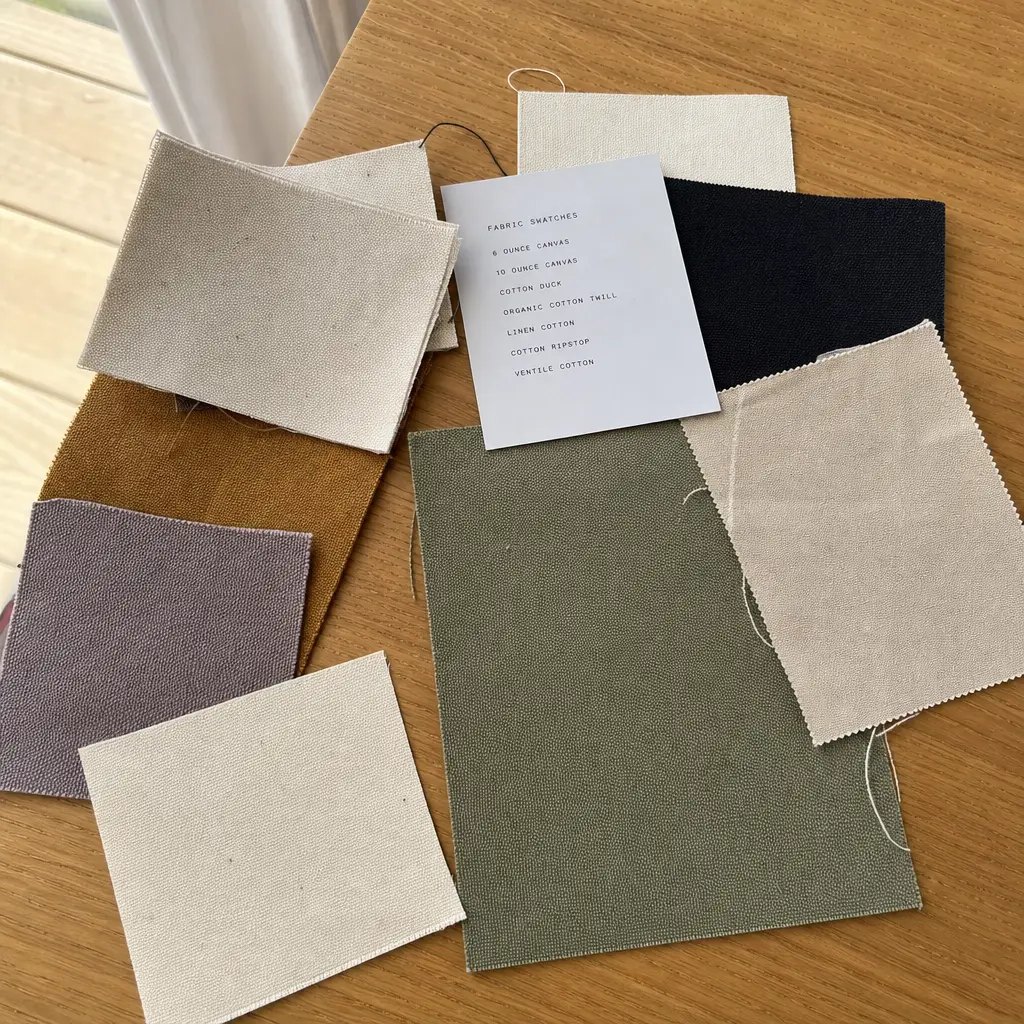
The fabric description should be specific. Natural cotton canvas, bleached cotton, dyed cotton, recycled cotton, and cotton-poly blends all behave differently in printing, shrinkage (typically 3-5%), shade consistency, and price. Unbleached natural cotton often has seed flecks and slight shade variation (±1.5 ΔE), which many wellness brands accept as part of the natural look. If your retail buyer expects a clean ivory color, that must be stated before sampling.
- Budget event bag: 6-8 oz (200-270 GSM) cotton, simple hem, one-color print, bulk carton packing.
- Standard yoga studio backpack: 8-10 oz (270-340 GSM) cotton canvas, reinforced corners, cotton cord, one to three-color screen print.
- Premium retail version: 10-12 oz (340-410 GSM) canvas, custom label, neat seam allowance, individual packing, tighter inspection (AQL 2.5).
- Avoid comparing quotes unless each supplier states fabric weight, fabric type, color process, and tolerance (±5% GSM).
Size, shape, and capacity should match real yoga studio contents
A drawstring backpack looks simple, but a few centimeters change its usefulness. A 34 x 42 cm bag can handle grip socks, a small towel, a T-shirt, and a water bottle. A 38 x 45 cm bag gives more room for a yoga towel, retail apparel, or welcome kit items. If the bag is too small, users pull hard on the cord and corner failures increase. If it is too large in thin fabric, it collapses and looks cheap.
Procurement teams should specify finished size after sewing, not only panel size before hemming. Cotton fabric, seam allowance (typically 1-1.5 cm), top channel construction (folded once or twice), and bottom corners reduce usable capacity. A quote should state whether the top channel is folded once or twice, whether side seams are overlocked or enclosed (French seam), and how the drawcord exits the channel. These details affect durability and appearance more than buyers often expect.
- Common finished size range: 34 x 42 cm to 38 x 45 cm for adult studio use.
- Recommended size tolerance: ±1 cm for finished width and height, unless another standard is approved.
- Top channel should be wide enough (3-4 cm) for the selected cord to move smoothly without bunching.
- Bottom corner stress points need reinforcement (fabric triangle or bartack) because they carry the weight when worn as a backpack.
Cord and reinforcement are the main durability risk
The drawcord is both the closure and the shoulder strap. A cord that looks acceptable in a flat sample can feel uncomfortable once the bag carries a towel and bottle. Cotton rope cord in the 6 mm diameter range is a common choice for yoga studio bags because it feels natural and fits the wellness positioning. Flat cotton tape (15 mm wide) can be comfortable but needs correct channel width. Polyester cord is cheaper and strong, but it may not match a natural cotton brand story.
The lower corner construction decides whether the bag survives real use. Metal eyelets (brass or nickel-free) are economical and fast, but they must be set firmly with proper reinforcement (fabric backing). Fabric triangle patches, bartacks, or sewn cord loops create a softer look and avoid metal hardware, but they require better sewing control. If the RFQ does not mention reinforcement, one supplier may quote a basic eyelet while another quotes a more expensive sewn reinforcement, creating an unfair comparison.
- State cord material (cotton rope), color (natural or black), diameter (6 mm), and approximate finished length (120 cm).
- Require a corner pull test sample photo or video for heavier retail programs (minimum 20 kg pull strength).
- For natural yoga branding, fabric reinforcement often looks better than shiny metal eyelets.
- For low-cost event programs, eyelets can be acceptable if fabric backing and setting quality are controlled.
Choose the print method according to artwork, not habit
Most yoga studio logos work well with water-based screen printing, especially when the artwork uses one to three solid colors. The print feels softer on cotton than heavy plastisol-style prints and suits natural canvas. However, fine mandala patterns, small serif text (<8 pt), and thin reversed lines need testing because the texture of canvas can fill in details. A factory should review the vector file before confirming the print method.
Heat transfer can reproduce gradients and detailed art, but buyers should consider handfeel, edge visibility, wash and rub resistance (AATCC 8, minimum 4), and compatibility with textured cotton. Embroidery is possible for small logos (<10 cm width) or premium patches, but it can pucker lighter fabric (<8 oz) and is not usually economical for large front graphics. The safest route is to approve a print strike-off on the actual selected fabric and keep that strike-off as the bulk production standard.
- Provide vector artwork (AI or EPS), Pantone references, print size (e.g., 12 x 8 cm), and placement from the bag edges (e.g., 5 cm from top).
- Define whether the logo is centered on the flat bag or visually centered when the bag is filled.
- For screen print, confirm setup charges, color count, maximum print size (e.g., 20 x 15 cm), and curing process (160°C for 3 minutes).
- For heat transfer, test edge adhesion, cracking risk, and surface feel on the selected fabric.
- For embroidery, control stitch count (max 10,000 stitches), backing (tear-away), puckering, and minimum fabric weight (8 oz).
MOQ logic: why the same bag can quote very differently
MOQ is not only a sales rule. It is usually driven by fabric availability, dyeing minimums, printing setup, labor efficiency, labels, and packing. If the buyer accepts stock natural or black cotton canvas, a factory may support a lower MOQ (500-1,000 pieces). If the buyer wants custom dyed sage green fabric, matching cord, woven label, retail hangtag, and individual barcode packing, the MOQ and sample timeline usually increase (2,000-3,000 pieces).
For yoga studios with multiple branch logos, the most efficient structure is often one shared bag body with separate print runs by logo. But each print design may still carry setup charges and minimum print quantity (e.g., 200 pieces per design). Procurement teams should request price breaks at realistic quantities such as 500, 1,000, 3,000, and 5,000 pieces, then compare the full program cost instead of only the lowest unit price.
- MOQ may apply per fabric color, per bag size, per artwork, per print color, or per total order.
- Stock fabric reduces risk and speeds up sampling, but shade may vary between batches (±1.5 ΔE).
- Custom dye needs lab dips, color approval, and larger material commitment (minimum 500 kg per color).
- Split shipments to multiple studios can add carton sorting and handling cost ($0.10-0.20 per piece).
- A quote below normal MOQ may exclude sample revisions, special labels, or strict packing.
Cost breakdown items that should appear in a serious quote
A useful bulk quote should show more than one unit price. It should explain what is included in the bag price and what is charged separately. For cotton drawstring backpacks, major cost drivers include fabric weight (8 oz vs 10 oz), bag size (34x42 vs 38x45 cm), cord type (cotton vs polyester), reinforcement method (eyelet vs fabric triangle), print method (screen vs heat transfer), number of print colors, label requirements, sample work, packing method (bulk vs individual), carton quantity, and export term (FOB vs CIF). If these items are hidden, procurement teams cannot tell whether a cheaper quote is efficient or incomplete.
For importers and distributors, the quote should also support landed-cost comparison. A slightly higher FOB price may produce lower damage risk, better carton efficiency, and fewer rejected units. Conversely, a premium retail packing method may increase carton volume and freight cost. The right quote format makes these tradeoffs visible before the purchase order is issued.
- Base bag price: fabric, cutting, sewing, standard cord, standard reinforcement.
- Branding charges: screen setup ($30-50 per color), print cost by color ($0.10-0.30 per piece), embroidery setup ($50-100), labels ($0.05-0.15 per piece), hangtags ($0.02-0.05 per piece).
- Development charges: artwork proof ($20-50), strike-off ($30-60), prototype ($50-100), pre-production sample ($100-200), courier ($50-100).
- Packing charges: individual bag ($0.05-0.10 per piece), paper band ($0.02-0.05 per piece), barcode sticker ($0.01-0.03 per piece), inner carton, master carton.
- Export charges: local transport ($100-300), documentation ($50-100), palletization if required ($20-50 per pallet), and trade term exclusions.
- Commercial comparison: request price breaks and carton data at each quantity level (500, 1,000, 3,000, 5,000 pieces).
Sample approval must test the exact production assumptions
A beautiful sample is not useful if it was made with different fabric, cord, or printing from the quoted bulk order. Sample approval should lock the real production standard: fabric weight (10 oz / 340 GSM), fabric color (Pantone 19-3911 TCX), handfeel, finished size (34 x 42 cm ±1 cm), seam type (French seam), cord length (120 cm), reinforcement (fabric triangle), logo position (5 cm from top), print color (Pantone 19-3911 TCX), and packing (individual polybag). The approved sample should be signed, dated, and photographed, with one retained by the buyer and one retained by the factory.
For yoga studio bags, the most common sample mistakes are off-center logos (>3 mm), too-small print (<8 cm width), cord that feels thin on the shoulder (<5 mm), and natural cotton shade surprises (±2 ΔE). A pre-production sample is especially important when the order includes custom dyeing, special labels, retail packaging, or multiple artwork versions. If timeline is tight, buyers can approve fabric and print strike-off first, then approve the sewn sample, but the risk should be understood.
- Measure finished width, height, top channel width, and cord length on the sample.
- Load the sample with a towel and bottle (2 kg) to evaluate cord comfort and corner stress.
- Rub the print with a dry white cloth and then a slightly damp cloth to screen for curing problems.
- Compare print color under consistent lighting (D65), not only in phone photos.
- Approve packing appearance if bags will be sold in studio retail areas.
Packing and carton planning affect freight, storage, and branch rollout
Packing is often treated as a minor line item, but it can create real cost differences. Bulk packing (100 pcs/carton) is economical for giveaways and internal distribution. Individual recyclable polybags, paper bands, hangtags, or barcode labels are useful for retail programs, but they add labor ($0.05-0.10 per piece), material cost, carton volume, and inspection points. If the buyer has sustainability rules, the packing instruction should name acceptable materials (e.g., 100% recycled polybag, FSC-certified paper band) instead of only saying 'eco-friendly.'
Carton planning matters when bags are shipped to several studio locations or distributor warehouses. The quote should state pieces per carton (100 pcs), carton dimensions (e.g., 50 x 40 x 30 cm), gross weight (e.g., 12 kg), net weight (e.g., 10 kg), and carton mark format (PO#, item#, color, qty, destination). Heavy cartons (>15 kg) may be cheaper per unit but harder for studio staff to handle. Loose packing may reduce creasing but increase freight volume. The right answer depends on whether the goods go to an importer warehouse, direct to branches, or into retail fulfillment.
- Bulk pack: lowest cost, suitable for event giveaways, but less protection per piece.
- Individual polybag: better handling and moisture protection, but more plastic and labor.
- Paper band or paper sleeve: good retail look, but less moisture protection in ocean freight.
- Carton sorting: required if different logos, branch names, or event dates must stay separate.
- Carton marks: include item number, color, quantity, PO number, destination, and carton sequence.
Lead time risk comes from approvals and materials, not only sewing
Factories can often sew cotton drawstring backpacks quickly once fabric, cord, print screens, labels, and packing are ready. Delays usually happen before sewing starts: unclear artwork (3-5 days), late Pantone approval (2-3 days), custom dyed fabric (10-15 days), label revisions (3-5 days), sample resubmission (7-10 days), or missing packing instructions (2-3 days). A realistic schedule separates artwork review, material sourcing, sample making, sample courier, approval, bulk production, inspection, and shipment booking.
For yoga studios planning grand openings, retreats, teacher training, or seasonal retail drops, the delivery date is not the only important date. Goods may need to arrive early enough for warehouse receiving (2-3 days), branch allocation (3-5 days), kit assembly (5-7 days), or retail merchandising (3-5 days). Buyers should build buffer into the project (minimum 2 weeks) and avoid approving bulk production while unresolved sample issues remain open.
- Stock fabric with simple screen print usually has the lowest schedule risk (20-25 days total).
- Custom dyed fabric adds lab dip approval (5-7 days) and dye lot risk (10-15 days).
- Multiple branch logos add proofing and print setup time (3-5 days per design).
- Retail packing adds label artwork (3-5 days), barcode verification (2-3 days), and packing inspection (2-3 days).
- Inspection should happen before final balance payment and before vessel or courier handover.
Specification comparison for buyers
| Spec Decision | Recommended Option | When It Fits | Buyer Risk to Check |
|---|---|---|---|
| Fabric weight | 8 oz (270 GSM) cotton canvas for low-cost class giveaways; 10 oz (340 GSM) for retail and membership kits; 12 oz (410 GSM) only when a heavier premium handfeel is required | Yoga studios usually need a soft, foldable bag that can carry a towel, grip socks, water bottle, and light apparel without feeling like a rigid tote | Quotes that only say 'cotton' or 'canvas' may hide thin 5-6 oz fabric; require GSM or oz, fabric composition (100% cotton vs cotton-poly blend), and pre-production swatch approval |
| Bag size | 34 x 42 cm (finished) for studio events; 38 x 45 cm (finished) for retail bundles or yoga towel sets | Larger size works when the bag must hold a folded yoga towel, change of clothes, and retail add-ons | Too narrow a width makes the bag look cheaper and limits usable capacity; request measured finished size tolerance (±1 cm), not only cutting size |
| Drawcord material | Cotton rope cord 6 mm diameter or flat cotton tape 15 mm wide; polyester cord only when stain resistance and lower cost matter more than natural positioning | Wellness brands usually prefer cotton cord because it matches the natural bag story and has a warmer handfeel | Thin cord (<5 mm) can cut into shoulders when the bag is loaded; require cord diameter, pull strength (minimum 20 kg), and corner reinforcement details |
| Corner reinforcement | Metal eyelets (brass or nickel-free) for budget bags; fabric triangle reinforcement or bartack sewn channels for a more natural look | Fabric reinforcement is better for yoga studios avoiding shiny metal hardware or wanting a softer retail finish | Poor eyelet setting can tear cotton fabric; require a photo of inside reinforcement and a pull test during inspection |
| Print method | Water-based screen print for one to three solid colors; heat transfer for complex gradients; embroidery only for small premium logos (<10 cm width) | Screen print is usually the most stable choice for studio logos, membership slogans, and event graphics | Fine mandala lines and small typography (<8 pt) may fill in on textured canvas; require artwork size, Pantone references, and a print proof on actual fabric |
| Fabric color | Natural (unbleached), black, stone, sage, or undyed cotton for broad yoga studio use; custom dye only for larger repeat programs (>3,000 pieces) | Natural cotton and muted colors match wellness retail shelves and reduce color development risk | Unbleached cotton has seed flecks and shade variation (±1.5 ΔE); custom dye can create MOQ, lab dip, and colorfastness issues |
| MOQ structure | Use factory stock fabric for 500-1,000 pieces; custom size, dye, or special cord normally moves the order into higher MOQ logic (2,000-3,000 pieces) | Useful for studio chains, event distributors, and subscription kit buyers balancing variety against unit cost | A low MOQ quote may exclude custom labels, export carton marks, or proper sample approval; compare what is included |
| Packing method | Bulk pack 100 pieces per carton for giveaways; individual recyclable polybag or paper band for retail resale | Bulk pack reduces cost and waste; retail packing protects the bag and improves shelf handling | Heavy cartons (>15 kg) can deform bags or increase warehouse handling claims; require carton dimensions, gross weight, and packing photos |
| Inspection level | Measure fabric weight, finished size, cord pull strength, seam strength, print placement (±3 mm), color (ΔE ≤1.5), and carton marks before shipment | Best for importers and studio buyers who need consistent appearance across branches or event locations | If the quote does not state inspection responsibility and defect limits, the buyer may receive mixed shades, weak seams, or off-center printing |
Buyer checklist before sampling
- Define the actual use case: free event gift, new-member kit, retail merchandise, retreat welcome bag, or distributor stock program.
- State finished bag size in centimeters (e.g., 34 x 42 cm ±1 cm), fabric weight in oz or GSM (e.g., 10 oz / 340 GSM), fabric color (Pantone or natural), cord type (cotton rope 6 mm), reinforcement method (eyelet or fabric triangle), and tolerance requirements.
- Send vector artwork (AI or EPS) with Pantone colors, print size (e.g., 12 x 8 cm), print position from bag edges (e.g., 5 cm from top), and whether the logo must stay visible when the bag is loaded.
- Separate must-have specs from upgrade options so suppliers can quote a base version and clear alternatives instead of guessing.
- Require a physical sample or pre-production sample on the selected fabric before approving bulk production.
- Compare quotes using the same packing method (bulk vs individual), carton quantity (100 pcs/carton), labeling requirements, export terms (FOB vs CIF), and destination port or warehouse.
- Set acceptance criteria for size tolerance (±1 cm), print placement tolerance (±3 mm), seam strength (minimum 15 kg), cord pull strength (minimum 20 kg), shade variation (ΔE ≤1.5), and carton labeling.
- Confirm whether the quoted MOQ applies per color, per artwork, per size, or per total order quantity.
- Reserve schedule time for artwork proofing (3-5 days), fabric sourcing (5-7 days), sample correction (7-10 days), bulk production (20-30 days), inspection (2-3 days), and freight booking (5-7 days).
- Keep an approved sample, fabric swatch, print proof, and packing photo as the control standard for reorders.
Factory quote questions to send
- What fabric weight are you quoting in oz and GSM, and is it 100% cotton, cotton canvas, recycled cotton, or a cotton-poly blend?
- Is the fabric stock available, or does it require weaving, dyeing, or minimum yardage commitment?
- What finished bag size (width x height), seam construction (overlocked or French seam), and size tolerance (± cm) are included in your quote?
- What drawcord type (cotton rope, flat tape, polyester), diameter (mm), length (cm), and reinforcement method (eyelet, fabric triangle, bartack) are included?
- Which print method do you recommend for our artwork (water-based screen, heat transfer, embroidery), and what is the maximum print area on this bag size?
- Does the quote include screen setup, digital proof, strike-off, pre-production sample, labels, hangtags, or special packing?
- What is the MOQ per color and per logo design, and how does the unit cost change at 500, 1,000, 3,000, and 5,000 pieces?
- What is the sample cost and sample lead time after artwork and fabric are confirmed?
- What is the bulk production lead time after sample approval, and what materials must be booked before approval?
- What carton quantity (pcs/carton), carton dimensions (L x W x H cm), gross weight (kg), and carton marking format are planned?
Quality-control points to confirm
- Fabric weight verified against approved swatch with ±5% GSM tolerance before cutting.
- Finished bag size measured after sewing, not only panel cutting size, with tolerance ±1 cm agreed in the purchase order.
- Drawcord length (e.g., 120 cm) and pull strength (minimum 20 kg) checked so the backpack can be worn without cord slipping out or tearing the lower corners.
- Seams inspected for skipped stitches, open seams, loose thread, uneven bartacks, and weak bottom corner reinforcement.
- Print color (ΔE ≤1.5), print size (±2 mm), print position (±3 mm), registration, curing, and rubbing resistance (AATCC 8, minimum 4) checked against approved strike-off.
- Natural cotton shade variation (±1.5 ΔE), stains, oil marks, seed flecks, and fabric slubs classified clearly so acceptable natural texture is not confused with defects.
- Metal eyelets, if used, checked for burrs, rust risk, loose setting, and fabric tearing around holes.
- Individual labels, hangtags, barcodes, care labels, and carton marks matched to the buyer’s packing instruction.
- Carton drop test (1.2 m, 3 edges, 6 faces), compression test (minimum 200 kg), and moisture protection (polybag inner liner) considered for sea freight or long warehouse storage.
- Final inspection sampling plan (AQL 2.5 for major defects, 4.0 for minor) agreed before shipment, with photos of defects, measurements, packing, and carton marks.