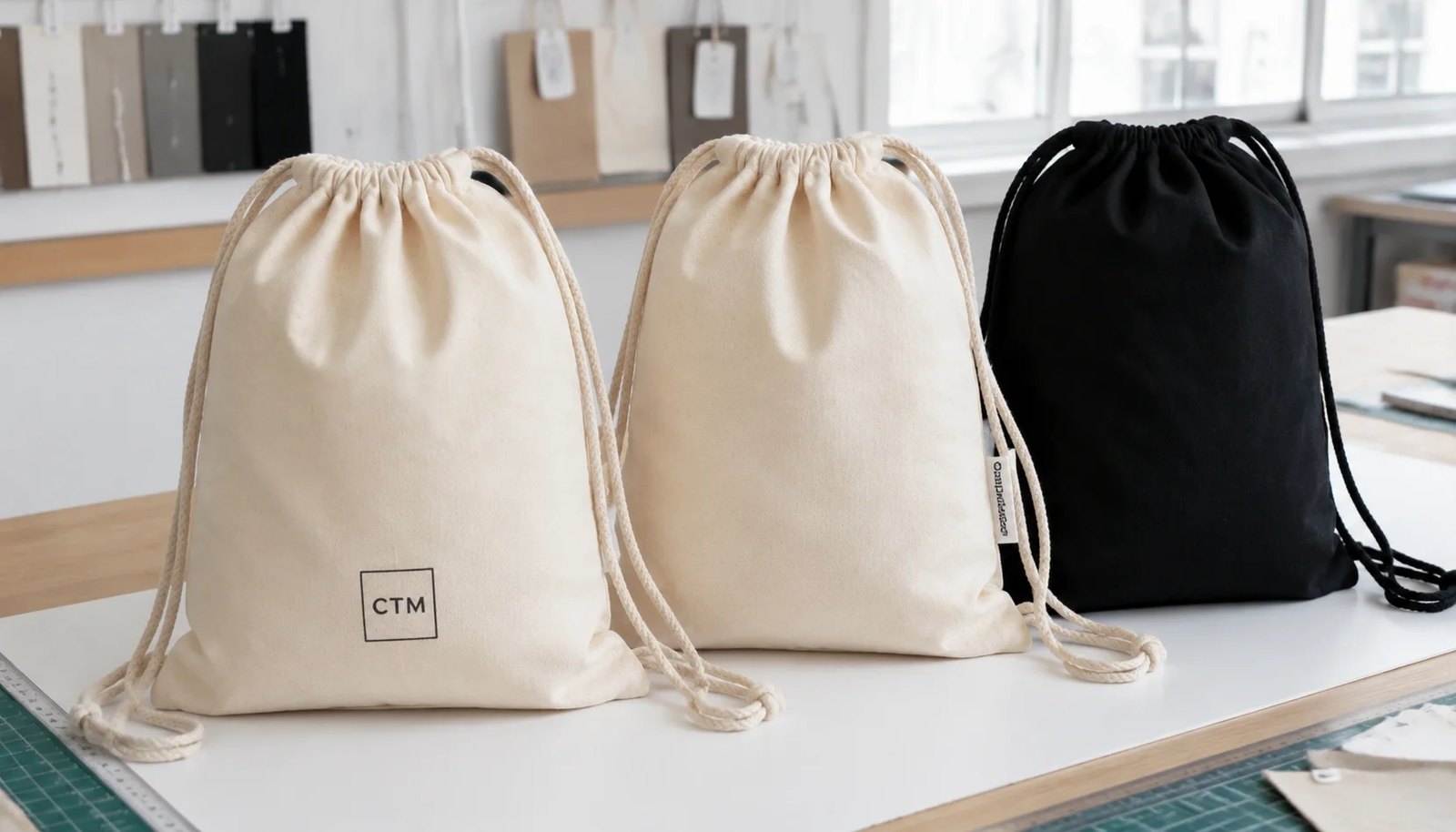
Why museum shop backpack quotes often fail at the RFQ stage
Museum shops usually buy cotton drawstring backpacks for a narrow commercial purpose: exhibition merchandise, educational program packs, family-activity kits, membership gifts, or a practical branded souvenir that needs to feel useful rather than overtly promotional. The product sounds simple, but the quote stage often fails because buyers and suppliers are not pricing the same bag. One factory assumes lightweight plain cotton, another assumes medium canvas, another includes one-color screen print, and another leaves sample cost or packing undefined. A comparison sheet may show four prices, but those prices are not for equivalent specifications.
For procurement teams, the problem is not finding the lowest visible unit rate. The real task is making suppliers quote the same fabric weight, same print area, same cord specification, same sample route, same packing method, and same trade term. Until that is done, the price column is mostly noise. Museum retail adds another constraint: the item must meet brand expectations in a modest volume environment, where overdeveloping the product wastes budget but under-specifying it creates a bag that feels like event giveaway stock instead of store merchandise.
A stronger RFQ for a cotton drawstring backpack bulk quote guide for museum shops should therefore remove ambiguity before price discussion starts. Size, GSM, print method, cord type, packing basis, sample stages, and approval criteria all need to be stated in the request. Suppliers that respond clearly to those fields are easier to evaluate commercially. Suppliers that answer with a one-line price and generic wording usually create re-quoting loops, sample disappointment, and late-stage cost corrections.
This is also where internal alignment matters. If retail, marketing, curatorial, and procurement each have different assumptions about what the bag should feel like or how it will be displayed, the RFQ becomes unstable. That instability is expensive because every later revision changes cost, lead time, or MOQ logic. A disciplined RFQ fixes the buying target early and turns quote comparison into a procurement exercise rather than a guessing exercise.
- Typical hidden quote gaps: fabric GSM omitted, print size omitted, cord material omitted, sample route not defined, trade term not aligned
- Museum-specific risk: a bag that looks acceptable as a free giveaway may still feel too thin or too rough on a paid retail shelf
- A usable RFQ reduces re-quoting cycles and gives finance, merchandising, and sourcing teams the same reference point
- Incomplete quotes often create false savings that disappear once sampling, freight cube, or packaging surcharges are added
Define the museum-shop use case before locking the specification
A cotton drawstring backpack should be specified from real use, not from a generic catalog template. The weight of intended contents, the expected retail price point, the audience, and the display method all affect the right construction. If the bag will hold a folded T-shirt, postcards, and a brochure, a lighter build may be commercially acceptable. If it must carry a small catalog, children's activity materials, a water bottle, or a bundled gift assortment, then fabric body and corner reinforcement matter much more. When this step is skipped, buyers either overpay for unnecessary heaviness or, more often, approve a bag that collapses on shelf and strains at the lower corners under normal use.
Museum shop programs differ widely. A permanent collection gift shop may want a clean, understated style that stays in assortment across seasons. A temporary exhibition store may only need an exhibition-branded run tied to a launch window. An education department may want the bag to function as part of a paid activity set or membership pack. These use cases do not require the same fabric, print, or MOQ strategy. The more precisely the buyer describes the end use, the more accurately the supplier can quote.
Use case also shapes aesthetic choices. Natural cotton often fits heritage, craft, archive, and sustainability-oriented themes, but it shows fiber flecks and more visible print variation. Dyed black or dark navy can look sharper and hide handling marks, yet may introduce higher MOQ or longer lead times if the color is not stock. A museum buyer who states intended shelf position, audience, target price, and likely carry load gives the factory enough context to recommend an appropriate level of construction instead of defaulting to its cheapest standard option.
A practical internal check is to ask four questions before issuing the RFQ. What will customers put in the bag? Is it a paid retail item or a free inclusion? Will it hang, stand folded, or be stacked? Is this a one-time exhibition run or a reorderable core item? Clear answers to those questions usually resolve many later specification debates.
- For brochure or light souvenir use: around 210 to 280 GSM may be enough if price sensitivity is high and load expectations are modest
- For books or heavier mixed items: around 280 to 340 GSM is usually a safer starting range
- For premium museum retail positioning: cleaner weave and stronger body often matter more than adding extra print colors
- A one-season exhibition run may justify stock material and custom print, while a core museum style may justify more developed details
Fabric, GSM, and handle feel: the cost driver buyers should normalize first
Fabric weight is usually the first major cost driver and the first area where supplier quotes drift apart. In a cotton drawstring backpack, the difference between 140 GSM and 300 GSM is visible as soon as the sample is handled. A light fabric creases more, hangs flatter, and can pull out of shape at the cord corners under load. A medium or medium-heavy canvas stands better on shelf, supports the print more cleanly, and gives the customer a stronger sense of value. For many museum shops, the workable middle ground is 8 oz to 10 oz cotton canvas, roughly 270 to 340 GSM, depending on target price and intended contents.
Buyers should avoid relying on ounce language alone unless the supplier also states finished GSM. Some vendors describe weight loosely, and not every quotation makes clear whether the number refers to greige weight or finished fabric. The RFQ should ask for finished GSM on the actual quoted material. That creates a common basis for comparison and makes sample-to-bulk inspection more defensible.
Fabric quality is not only about weight. Surface cleanliness, yarn regularity, shrink behavior, and handfeel all affect retail impression. A bag carrying refined museum graphics or fine line text usually benefits from a cleaner yarn surface than a rustic craft-themed program. Natural cotton is often the right aesthetic choice, but buyers should still define what level of slub, specking, or shade variation is acceptable. Otherwise, one supplier may treat visible natural variation as normal while another supplies a cleaner standard, and the buyer ends up comparing unlike products again.
It is also worth deciding early whether the bag needs a softer handfeel or a firmer body. Softer finishes can feel more natural in hand but may reduce the upright look on shelf. Firmer canvas often prints better and presents better in folded stacks. A good quote line should therefore state material type, finished GSM, color status, stock or custom basis, and any relevant note about handfeel or expected natural variation.
For procurement comparison, the practical rule is simple: normalize fabric before negotiating unit price. If one quote is based on 220 GSM and another on 300 GSM, the lower figure is not a meaningful savings. It is a different product.
- Useful RFQ wording: '100% cotton canvas, finished 280 to 300 GSM, natural color, medium-firm handfeel'
- Lighter than about 220 GSM usually needs strict load limits and may not suit paid museum retail programs
- Custom dyed cotton often raises MOQ and extends lead time because dye-lot setup is separate from cutting and sewing
- If the bag will be reordered, ask whether the same fabric source can be maintained across future runs
Choose the print method by artwork complexity and reorder plan
Museum shops often use logo marks, exhibition titles, line illustrations, object silhouettes, typographic layouts, or small-location branding on the front panel. That means print method should be selected from artwork complexity, required consistency, and likely reorder volume. For most one-color or two-color museum programs, screen printing remains the most practical choice. It offers stable economics in volume, good opacity on cotton canvas, and a clear approval path once the print area and color standard are set.
Within screen printing, buyers should still ask what ink route is being quoted. Water-based printing can give a softer handfeel on cotton and may suit natural-canvas designs that need a more integrated look. Plastisol may provide stronger coverage or sharper solids, especially on darker fabrics, but can feel heavier depending on application. The correct choice depends on artwork, substrate color, and the desired retail feel. A quote that simply says 'print included' is not detailed enough for real comparison.
Digital printing can be a useful option when exhibition artwork includes multiple colors, tonal transitions, or fine details that would make screens expensive. It is not automatically the better choice, though. Digital print changes the cost curve, may behave differently on textured canvas than on paper proofs, and can require closer color-expectation management from one production date to another. If a museum expects repeat orders with tight brand continuity, that should be discussed before approving the print route.
What buyers should lock down in the RFQ is specific: print size in centimeters, print position measured from fixed reference points, number of print colors, method, and whether Pantone matching is required or a close visual match is acceptable. It is also useful to state if line sharpness or small text readability is critical. Those details reduce surprise during sampling and help the factory recommend a method that matches both the artwork and the commercial objective.
For museum retail, the right question is not only 'Which print method is cheaper?' It is 'Which method gives acceptable visual control at our expected quantity and reorder pattern?' That is the procurement question that protects both budget and brand presentation.
- Screen print usually suits 500-plus units with simple artwork and repeat reorder potential
- Digital print may fit detailed exhibition graphics at lower quantities, but sample review needs to be stricter
- Include print size and placement in centimeters, measured from top hem, bottom seam, or side seam
- State whether color should match a Pantone reference, an approved sample, or a general visual standard
MOQ, customization level, and when a low minimum is not really cheaper
MOQ on cotton drawstring backpacks is driven by more than the sewing line. Material sourcing, print setup, cord color, labels, and packing complexity all affect the true commercial minimum. Buyers often focus only on the finished-goods MOQ, but the real question is how much of the product uses stock inputs and how much uses custom development. If the order uses stock natural canvas, stock cord, and a simple one-location print, a supplier may be able to quote a practical minimum in the 500 to 1000 piece range per design. Once the order shifts into custom dyed fabric, custom rope color, woven labels, or multiple print locations, the economic minimum rises even if the factory is technically willing to accept a smaller order with surcharge.
For museum shops, MOQ decisions should be tied to program type. A temporary exhibition launch often benefits from keeping the product close to stock materials while customizing only the print, because speed and inventory discipline matter more than perfect material uniqueness. A core museum-branded backpack that may stay in assortment across multiple seasons can justify more developed details because setup cost is spread over repeat orders. The procurement logic changes with the lifecycle of the SKU.
Low minimums can also create hidden inefficiencies. A supplier may agree to a small run, but only by slotting it into mixed production, limiting color options, accepting looser consistency, or charging more for sampling and setup. That does not always make the order wrong, but it should be visible in the quote. Buyers should ask directly which parts of the quoted product are based on stock components and which require custom preparation.
A practical way to negotiate is to separate decisions. Ask for one quote on a stock-material route and one quote on a more customized route. This lets the museum team see the cost of each added decision clearly. It also makes internal approval easier because merchandising can choose where brand value justifies extra spend.
In other words, MOQ is not a factory rule to argue about in isolation. It is a commercial signal showing how standard or customized the backpack has become.
- Lower MOQ usually means higher setup cost per unit and sometimes weaker process efficiency
- Stock natural canvas and stock black or natural cord often reduce both minimums and lead time
- Custom fabric dyeing tends to become more economical from around 2000 pieces upward, depending on the mill route
- Artwork splits by exhibition, language, or store program can break efficiency if each variant needs its own setup
How to compare supplier quotes on a like-for-like commercial basis
A strong quote comparison sheet separates product cost from development cost, packing assumptions, and delivery basis. If one supplier shows a lower unit price but quotes EXW, lighter fabric, no sample using production materials, and no carton detail, that quote is not commercially equivalent to an FOB quote that includes proper sample approval, stronger material, and a defined packing plan. Museum buyers importing mixed product lines feel this quickly because freight allocation, receiving efficiency, and damage control matter as much as the nominal piece price.
To compare correctly, normalize every offer into the same structure. Each supplier row should include finished size, fabric composition, finished GSM, fabric color basis, print method, number of colors, print dimensions, cord material and diameter, reinforcement details, sample charges, lead time, carton quantity, carton dimensions, trade term, and any excluded items. Once these fields are visible, the meaning of the unit price becomes much clearer.
It also helps to separate one-time and repeat-order costs. Screen charges, sample charges, artwork setup, and custom-label costs may matter on the first PO but not on a repeat buy. A museum team comparing only first-order unit prices can miss which supplier becomes more economical over time. By contrast, a quote with slightly higher initial setup may produce cleaner reorders later if the specification and process are controlled properly.
Freight impact should not be ignored. Textile bags can look inexpensive at the unit level while becoming inefficient if packed in oversized cartons or with unnecessary inner packaging. A quote that is lower by a few cents can lose its advantage once freight by cube, receiving labor, or repacking cost is considered. That is why carton dimensions and quantity per carton belong in the early quote stage, not as an afterthought once the PO is ready.
For procurement discipline, the simplest rule is this: do not compare visible prices until the specification fields are aligned. If the offers are not structurally comparable, the spreadsheet is only creating false confidence.
- Separate one-time costs from repeat-order costs before deciding which quote is actually cheaper
- Compare trade terms on the same basis, usually FOB to FOB or EXW to EXW
- Include carton cube in analysis because poor packing can erase a small unit-price advantage
- Record whether the quote includes labels, barcode stickers, hangtag insertion, or retail polybag
Build a sample approval process that tests retail readiness, not just dimensions
For museum-shop merchandise, sample approval should be treated as a commercial gate, not a formality. A useful process usually includes at least two stages: a layout or mockup approval to confirm artwork size and position, followed by a pre-production sample made in the actual or equivalent production fabric with the final print method and intended cord. The first stage avoids unnecessary remakes over placement. The second stage is where the real buying decision happens, because body, handfeel, print behavior, and overall retail impression cannot be judged accurately from flat artwork alone.
This matters especially for cotton drawstring backpacks because the same design can feel completely different depending on canvas weight and finishing. A development sample may confirm approximate size, but it often does not predict the final product's shelf presence. Museum buyers who skip the production-material sample frequently discover too late that the bag feels like promotional merchandise rather than a paid shop item.
Approval notes should include measurable acceptance criteria. Examples include finished size tolerance, print placement tolerance, minimum print opacity, acceptable fabric variation, cord diameter, and whether the lower corners pucker or distort under light load. Reviewers should also test the bag with realistic contents such as brochures, a child activity set, a paperback catalog, or a bundled souvenir mix. A bag that looks acceptable empty may fail the use test immediately.
Internal coordination is equally important. If retail, branding, and procurement each send separate comments to the supplier, the revision cycle becomes unclear and sample rounds multiply. A better process is to consolidate comments into a single annotated response with clear accept, revise, and hold points. That saves time and gives the factory a usable decision record.
A strong approval record should be retained with the PO. Photos of the approved sample front, back, side seam, top channel, cord exit points, and print close-up create a reference for bulk inspection and future reorders. That is a simple control step, but it prevents many later disputes about what was actually approved.
- Review the pre-production sample with realistic insert weight, not only when the bag is empty
- Measure print placement from two fixed points rather than judging it visually
- Lightly rub the print surface to identify under-cured or easily scuffing ink before bulk approval
- Keep photo records of approved sample details for final inspection and reorder reference
Quality control points that matter most on cotton drawstring backpacks
This product looks simple, but most shipment problems appear in a short list of predictable areas: fabric appearance, print placement and coverage, top-channel sewing, and lower corner stress points. On natural cotton, some slub and shade variation may be acceptable, especially when the aesthetic is intentionally natural. That does not mean all irregularity should pass. Oil marks, weaving bars, panel stains, holes, severe slubs in the print zone, and obvious shade mismatch within the same shipment should be controlled if the goods are intended for museum retail.
Print quality requires more than checking whether the logo exists on the front panel. Buyers should review centering against measured references, opacity on the actual canvas texture, edge clarity on fine lines, and consistency between early and later production units. Rougher natural canvas can break up small details or make a print look lighter than it did on a smoother sample. If line art or exhibition text is important, this point deserves specific inspection attention.
Sewing quality is often underestimated because a drawstring backpack has relatively few pattern pieces. The critical areas are the top channel that guides the cord and the lower corners where the cord exits and pulls against the seam. If these zones are weak, the bag may look acceptable at final inspection but fail quickly in customer use. A simple pull test and repeated open-close cycle on random units can reveal issues that a visual-only inspection would miss.
QC should also reflect the product's retail presentation. If the bags will be sold folded in stacks, inspect how they sit when folded and whether print transfer, excessive creasing, or distorted corners affect the front look. If they will be displayed hanging on pegs, check that the shape remains balanced and the print reads correctly from the front. Function and shelf appearance should be reviewed together.
The most effective quality approach is to define acceptance rules before production begins. Size tolerance, print tolerance, stain rejection standard, seam defect threshold, and carton-count accuracy should all be written into the order. That turns inspection from argument into verification.
- Set measurable print placement tolerance, for example within about 0.7 to 1 cm from approved reference depending on design size
- Reject visible stains, holes, needle cuts, major slubs in print area, and missed stitching at stress points
- Load random units with typical contents and cycle the cords several times to test real use
- Inspect presentation in the same folded or hanging format planned for store display
Packing, carton planning, and receiving details that affect landed cost
Packing is often treated as a minor operational detail, but for textile accessories it directly affects landed cost, handling speed, and in-store readiness. Cotton drawstring backpacks compress well, so a simple bulk packing route is usually the most efficient. Many museum programs work well with 25 or 50 pieces per master carton, with inner bundle count labels if there are multiple designs or language versions. That reduces plastic use, improves freight efficiency, and speeds receiving in a museum stockroom or central warehouse.
Individual polybags should be used only when the retail process clearly requires them, such as barcode control, hygiene expectations, or shelf-handling rules. Otherwise, they add cost and cube without improving the product itself. If polybags are necessary, the buyer should still ask whether self-adhesive strips, suffocation warnings, barcode placement, and insertion labor are included in the quote. These are small line items, but together they can change the landed picture.
Carton planning also matters when the backpack order ships alongside other gift-shop products. Oversized cartons reduce container utilization and can become awkward for manual warehouse handling. Buyers should request pieces per carton, carton dimensions, and gross weight during the quotation stage, then compare likely freight impact across suppliers. It is common for a slightly higher product unit price to become the better landed-cost decision because the supplier packs more efficiently.
Receiving details are another overlooked point. Clear outer-carton labels showing style, design, quantity, and PO reference reduce errors at intake. If mixed variants are being shipped together, bundle labeling becomes especially important. A museum store team should not have to open every carton to confirm which exhibition version is inside.
In short, packing is not admin noise. It is part of the procurement decision because it affects freight, labor, storage, and the condition in which the goods reach the sales floor.
- Target manageable carton weights, often below roughly 15 to 18 kg depending on warehouse practice
- Use outer-carton assortment labels if multiple artworks or programs ship together
- Request a flat folded packing standard so front prints do not transfer or crease excessively
- Clarify whether silica gel, barcode labels, size stickers, or hangtag insertion are included or extra
Lead time planning for exhibition launches, approvals, and repeat orders
Museum-shop timing is often less flexible than general gift retail because launch dates can be tied to exhibitions, education programs, donor events, or holiday windows. For that reason, a supplier's single total lead-time number is not enough. Buyers need the timeline broken into sample preparation, internal approval time, material readiness, production days, final inspection timing, and booking-ready date. On a simple stock-fabric backpack, sewing may be relatively fast once approval is complete. On a custom-dyed or multi-variant order, the delay often occurs before production starts, during material or print preparation.
The largest timing risk is often internal rather than factory-side. If design, merchandising, and procurement approvals happen sequentially with unclear owners, the factory calendar can slip while everyone still assumes the project is moving. That is particularly risky for exhibition-linked merchandise, where missing the opening window can reduce the commercial value of the order even if the product itself is fine.
A practical planning method is to build backward from the required shelf date. Add inbound transit, customs clearance if relevant, warehouse receiving, labeling or store allocation, then count back through production, sample approval, and artwork finalization. This exposes whether the current product route is realistic. It may show, for example, that stock fabric with one-color screen print is the only viable option for the date, while custom-dyed material would introduce unacceptable schedule risk.
Repeat orders should also be planned differently from first orders. Once the sample, print position, and packing format are approved, reorders can often move faster if the same material route remains available. Buyers should ask suppliers which approved details can be locked for future runs and which may still vary because of fabric lot or stock availability.
A quote that looks fast on paper is only useful if the milestones are believable. Procurement teams should ask for milestone dates, not just a promised total number of days.
- Request a milestone schedule rather than a single headline lead-time figure
- Flag seasonal capacity pressure, especially before holiday gifting periods
- Hold artwork, labels, and barcode files in production-ready format before PO release
- Add internal approval and freight-booking buffer instead of assuming the factory can absorb every timing change
Specification comparison for buyers
| Spec decision | Recommended option | When it fits | Buyer risk to check |
|---|---|---|---|
| Fabric weight | 8 oz to 10 oz cotton canvas, about 270 to 340 GSM | Best for museum shops that want enough body for books, brochures, small gift items, or paid retail presentation without moving into overly heavy utility-bag pricing | Quotes using 'cotton' only without GSM can hide lighter 140 to 220 GSM fabric that looks thin on shelf, prints flatter, and distorts faster at the cord corners |
| Fabric type | 100% cotton canvas with stated finished GSM and visible weave standard; cleaner yarn quality when artwork is refined | Use cleaner-surface canvas when the museum logo, exhibition title, or line illustration needs crisp print edges and a more polished retail look | Natural cotton variation is normal, but excessive slubs, dark seed specks, loose weave, or unstable shrinkage can reduce print consistency and create sample-to-bulk mismatch |
| Print method | Water-based or plastisol screen print for 1 to 3 colors; digital print only when artwork detail truly requires it | Screen print suits most museum logo programs, exhibition merchandise, and repeat souvenir orders because cost stays more stable at volume and reorders are easier to control | Digital print may improve complex artwork reproduction, but unit cost can rise, dark-ground performance may vary, and reorder color consistency needs closer review |
| Cord construction | 8 mm to 10 mm cotton rope or cotton-look cord with clear material declaration, knotted ends, and reinforced exit points | Good for family visitors, school groups, and gift purchases where comfort, repeat use, and perceived quality matter | Thin cords dig into shoulders, low-grade cords fuzz quickly, and undeclared blends can conflict with sustainability or fiber-content claims |
| Bottom construction | Flat single-panel body for budget retail; boxed bottom only when carrying books, bundled merchandise, or higher-volume gift packs | Flat construction works for brochure packs, apparel, postcards, and lighter souvenirs with lower sewing cost and easier carton packing | Some quotes include boxed bottoms without showing the added sewing, fabric usage, and carton cube impact, which can distort cost comparison |
| MOQ route | Use stock fabric and stock cord colors for 500 to 1000 pieces; custom dyed fabric typically from 2000 pieces upward | This route suits seasonal museum buying because it balances branding control, practical reorder speed, and lower development complexity | Very low MOQ offers often mean fewer color choices, mixed production scheduling, higher surcharges, or weaker control over consistency |
| Packing method | Individual polybag only if retail handling requires it; otherwise 25 to 50 pieces per master carton with bundle count labels | Bulk carton packing lowers landed cost and works well for museum stockrooms, central warehouses, and event-pack fulfillment | Unnecessary inner packing adds cost, plastic waste, and freight cube; missing bundle labels slows receiving and inventory checks |
| Sampling route | Digital layout, then pre-production sample in production fabric with actual print and cord before bulk | Necessary when artwork color, handfeel, fabric body, and store presentation matter to brand standards | Skipping the production-material sample is where many quote comparisons fail because approved visuals on paper or mockup do not predict the real bag |
| Trade term basis | Compare quotes on the same term, usually FOB if you are sourcing internationally | Makes supplier comparison more accurate because packaging, inland handling, and export assumptions are aligned | Comparing EXW from one supplier against FOB from another can make the cheaper quote look better than it really is |
Buyer checklist before sampling
- State exact finished bag size in centimeters and clarify whether tolerance is measured on the sewn finished bag laid flat
- Specify fabric as 100% cotton canvas with target finished GSM range, for example 280 plus or minus 5 percent, not vague terms such as 'thick cotton'
- Define fabric color as natural, bleached, black, or Pantone-referenced dyed cotton and note whether normal natural shade variation is acceptable
- List drawstring material, diameter, color, end finish, and whether cords are cotton, polyester, or blended
- Describe artwork size, print position from seams or top hem, number of print colors, and target print method
- State whether museum compliance needs exclude azo dyes, heavy metals, PVC components, or undeclared mixed-fiber substitutions
- Request sample stages: digital layout, pre-production sample in production material, revision rules, and approval gate before bulk
- Ask for packing details including pieces per carton, carton size, gross weight, fold method, and whether inner bundles are labeled by design
- Request lead time split by sample time, raw material readiness, production days, inspection date, and booking-ready date
- Confirm trade term, quote validity period, payment terms, and what triggers price adjustment before PO release
Factory quote questions to send
- What exact fabric construction are you quoting: cotton type, weave description, finished GSM, and whether the fabric is stock or custom?
- If the fabric is natural cotton, what level of slub, seed speck, and shade variation is considered normal in your inspection standard?
- What print method is included in the quote, and what artwork limitations apply for line detail, solid coverage, color matching, and print area?
- What print size and location are included, how are they measured, and what surcharge applies if artwork grows beyond that area?
- What cord material and diameter are included, and is the cord color stock, custom dyed, or matched only approximately?
- What reinforcement is used at the bag opening and lower cord-exit corners where stress is highest during repeated use?
- Does the sample charge include actual production fabric and final print method, or only a development sample for concept review?
- How many pieces per carton are planned, what are the carton dimensions and gross weight, and how will mixed designs be labeled if applicable?
- What defect criteria do you use for print misalignment, stains, seam tolerance, holes, needle damage, and loose threads during final inspection?
- What changes in cost and lead time if we move from natural cotton to dyed black, from one-color print to two-color print, or from stock cord to custom cord color?
Quality-control points to confirm
- Finished size tolerance should be written into the PO, commonly plus or minus 1 cm for body width and height on sewn textile bags unless the design requires tighter control
- Fabric GSM should be spot-checked from the approved bulk lot because large deviation from sample can change bag body, print appearance, handfeel, and packed weight
- Print position should be measured from fixed reference points such as top hem and side seam, not judged visually only
- Print color should be compared against approved artwork, Pantone reference if specified, or signed sample under consistent lighting before full production continues
- Print opacity and edge clarity should be checked on the actual fabric because rougher natural canvas can break fine lines or reduce fill coverage
- Cord anchoring and lower corner stress points should be pull-tested on sample and random bulk units to catch seam opening or distortion risk
- Top channel sewing should allow smooth cord movement without excessive twisting, trapped fabric, or skipped stitches
- Natural cotton fabric should be inspected for dark specks, heavy slubs, oil marks, weaving bars, holes, and cut-panel stains before cutting begins
- Needle damage, skipped stitches, loose threads, raw seam fray near cord channels, and puckering around reinforcement points should be checked inline and at final inspection
- Carton count, assortment, barcode labels, shipping marks, and outer-carton condition should match the packing list before shipment release