Why Spa Retailers Need a Dedicated Bulk Order Guide for Cotton Drawstring Backpacks
Spa retailers often treat drawstring backpacks as a simple add-on item, but the margin impact of a bad order is real. A bag that arrives with thin fabric (4 oz instead of 8 oz), weak seams (under 18 lbs pull test), or a faded print (Delta E > 2.0) cannot be sold at full retail. Worse, it damages your brand's quality perception. This guide walks through the specific decisions that protect your margin when ordering cotton drawstring backpacks in bulk.
Unlike generic tote bags, drawstring backpacks have unique failure points: the cord channel (where the drawstring rubs), the grommet (which can tear fabric), and the bottom seam (which bears the load). Each of these needs a spec decision before you send an RFQ. The table below summarizes the most critical choices and the risks you avoid by getting them right.
- Fabric weight: 6 oz (200 GSM) for giveaway, 8 oz (240 GSM) for retail; avoid 4 oz (140 GSM)
- Bottom gusset: 3" or 4" for structure; no gusset for giveaway only
- Drawstring: 3/16" cotton rope; metal grommet; cord lock optional
- Print method: water-based screen print for 500+ pcs; heat transfer for 100-300 pcs
Fabric Weight: Why 6 oz vs 8 oz Matters for Spa Use
The most common mistake spa buyers make is ordering a 4 oz (140 GSM) cotton bag because it is cheaper. That weight works for a lightweight giveaway but fails when a customer puts a damp towel and a water bottle inside. The bottom seam stretches, the fabric tears at the grommet, and the bag looks flimsy on the retail shelf. A 4 oz bag has a seam strength of only 10-12 lbs, which is insufficient for a 2 lb load.
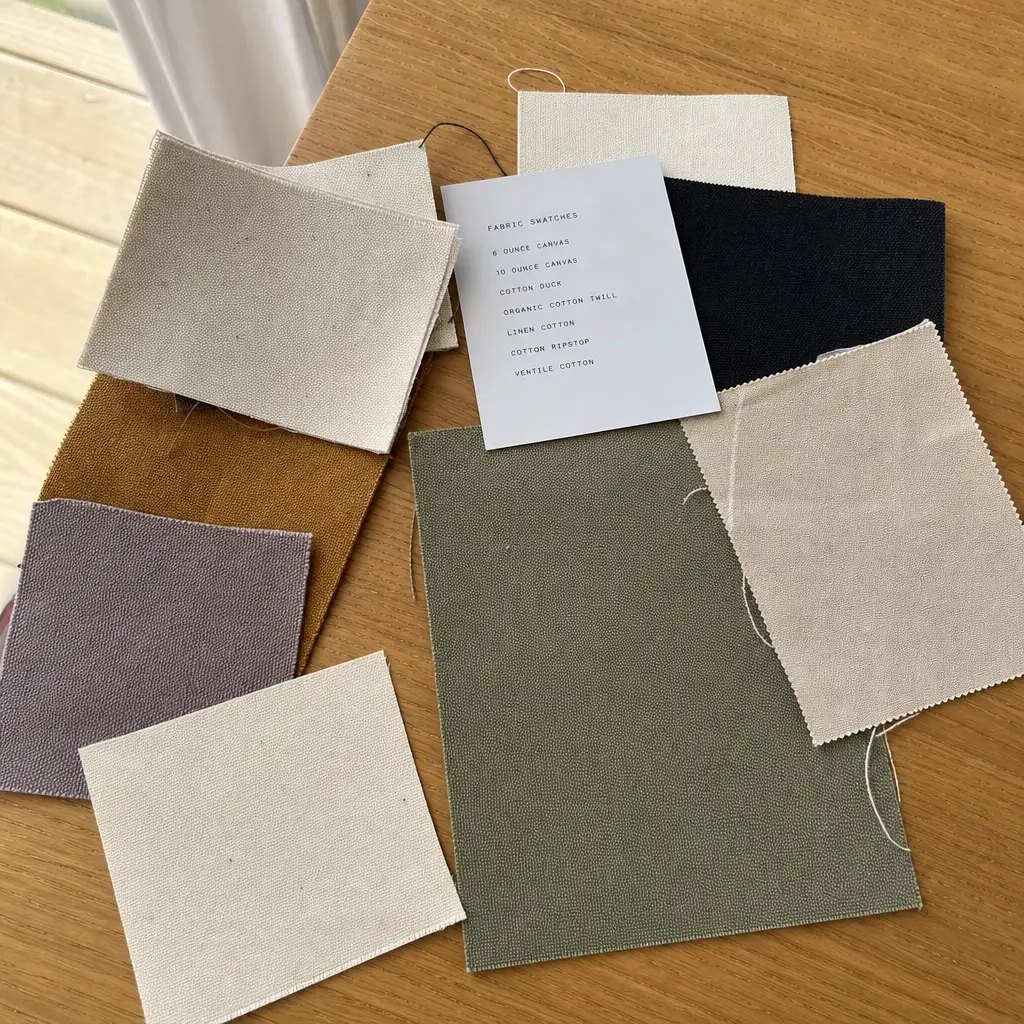
For a paid retail item, 6 oz (200 GSM) is the minimum. For a bag that will see regular use, 8 oz (240 GSM) gives a sturdy feel and better print surface. The fabric cost difference is typically $0.15-$0.25 per bag, which you can pass on to the customer as a premium option. Always request a 4"x4" swatch card before ordering to verify the fabric hand feel and weight.
- 6 oz (200 GSM): good for promotional giveaways, light use (towels, small items), lower cost ($0.80-$1.20 per bag)
- 8 oz (240 GSM): recommended for retail sale, holds shape, better print quality, seam strength 20+ lbs ($1.00-$1.50 per bag)
- Avoid 4 oz (140 GSM) for any bag sold to customers; it will generate returns and damage brand perception
Bottom Gusset: The Difference Between a Bag and a Sack
A flat drawstring bag without a gusset is essentially a sack. It does not stand up, items shift inside, and it looks cheap on a shelf. A bottom gusset of 3 to 4 inches gives the bag structure, allows it to stand upright, and makes packing easier for the customer. A gusseted bag also distributes load more evenly, reducing stress on the bottom seam.
If your spa sells bags as a retail item displayed on a shelf or rack, a gusseted bottom is non-negotiable. If the bag is a free gift given at checkout, a flat bottom may be acceptable to save cost. Specify the gusset width in your PO; otherwise, the factory will default to a flat bag. The gusset should be double-stitched with a 1/2" seam allowance for durability.
- 3" gusset: standard for retail display, fits a folded towel and small items; seam allowance 1/2"
- 4" gusset: better for bulkier items like a water bottle and change of clothes; requires 8 oz fabric for structure
- No gusset: only for giveaway bags; expect returns if sold; seam strength drops to 12-15 lbs
Drawstring and Grommet Specs: Small Parts, Big Failure Risk
The drawstring is the most used part of the bag. A thin poly cord (1/8" or less) will break after 10-20 pulls. For a spa bag, use a 3/16" cotton rope. It matches the natural aesthetic, feels substantial, and lasts. The grommet must be metal (brass or nickel-plated), not plastic. Plastic grommets crack in cold weather or after repeated use, leading to returns.
Also specify the cord length. A standard 36-inch cord is enough for most bags (12"-14" tall), but if your bag is deeper (16" tall), you may need 42 inches. Ask the supplier to include a cord lock if the bag is intended for active use, like a gym or yoga bag. Cord locks add $0.05-$0.10 per bag. Test the grommet pull strength: it must hold 15 lbs without tearing the fabric.
- Cotton rope 3/16" diameter: best for natural look and durability; cost $0.08-$0.12 per bag
- Metal grommets: required; brass or nickel-plated; cost $0.03-$0.05 per bag; plastic grommets cause returns
- Cord length: 36" standard for 12"-14" bags; 42" for 16" bags; add 2" for knot allowance
- Cord lock: optional, adds $0.05-$0.10 per bag, useful for active use; specify plastic or metal
Print Method: Screen Print vs Heat Transfer vs Woven Label
For bulk orders of 500+ pieces, screen printing with water-based ink is the most cost-effective and durable method for natural cotton. Water-based ink soaks into the fabric, so it does not crack or peel like plastisol. The downside: it requires a separate screen per color, so setup cost increases with color count. Setup cost is typically $30-$50 per color, with a per-unit cost of $0.10-$0.20 per color.
For smaller orders (100-300 pcs) or multi-color logos, heat transfer or a woven label may be better. Heat transfer has lower setup cost ($20-$30 per design) but may peel after 20-30 washes. Woven labels are premium but add $0.15-$0.30 per bag. For a spa retail bag, a single-color screen print on the front is the sweet spot: durable, cost-effective, and professional.
- Water-based screen print: best for 500+ pcs, 1-2 colors, durable finish (50+ washes), cost $0.10-$0.20 per color per bag
- Heat transfer: good for 100-300 pcs, multi-color, lower setup ($20-$30), shorter lifespan (20-30 washes), cost $0.15-$0.25 per bag
- Woven label: premium option, adds $0.15-$0.30 per bag, best for small logo on seam or bottom corner; no wash degradation
- Avoid plastisol ink: cracks after 5 washes, looks cheap on natural cotton; only use for promotional giveaways
MOQ Logic: How to Negotiate Without Overcommitting
Most factories set a MOQ of 500 pieces per design per color for screen-printed bags. That number is driven by the cost of cutting screens ($30-$50 each) and setting up the print line. If you need a lower MOQ, ask about heat transfer or woven labels, which have lower setup costs and can run at 100-300 pieces. Some factories also offer a 'sample MOQ' of 100 pcs at a higher unit cost ($2.00-$3.00 per bag).
When you get a quote, ask for a MOQ breakdown: how many pieces cover the setup cost, and how many cover the unit cost. Some suppliers quote 1000 pieces but the setup cost is the same as 500. In that case, you can negotiate a lower MOQ by paying a higher setup fee (e.g., $100 extra for 300 pcs). Always get the MOQ in writing per design and per color.
- 500 pcs per design per color: standard for screen print; setup cost $30-$50 per color
- 100-300 pcs: possible with heat transfer or woven label; unit cost 20-40% higher
- Ask for MOQ breakdown: setup cost vs unit cost; negotiate higher setup fee for lower MOQ
- Always get MOQ in writing per design and per color; avoid verbal agreements
Sample Approval: The Step That Saves Your Order
Never skip the pre-production sample (PP). A PP is made on the actual production fabric with the final print method and stencil. It is not a lab dip on a different fabric. Approve the PP in writing before production starts. If you approve a lab dip and the production fabric is different, the print color will shift by 1-2 Delta E, which is visible to the naked eye.
Check the PP for: fabric weight (weigh it with a scale), print color (compare to PMS swatch under D65 daylight lamp), seam strength (pull gently with a force gauge), grommet alignment (centered within 1/8"), and cord length (measure with a tape). Take a photo of the approved PP and include it in your PO as the reference. This eliminates disputes later. Reject the PP if any spec is off by more than 5%.
- Require a PP on production fabric, not a lab dip; request 1 bag for approval
- Check fabric weight (GSM), print color (Delta E < 2.0), seam strength (20+ lbs), grommet alignment, cord length
- Take a photo of the approved PP and attach to PO; include a ruler for scale
- Do not approve a PP that is made on different fabric weight; reject and request a new PP
Packing and Labeling: Retail-Ready vs Bulk
For spa retail, each bag should be individually polybagged. This keeps the bag clean, dust-free, and ready to hang on a rack. Without polybags, bags arrive dusty and wrinkled, and you have to repack them. The cost is about $0.03-$0.05 per bag, which is worth it. Use a 0.04 mm thickness polybag to avoid tearing.
Master cartons should hold 50 pieces each. This keeps carton weight under 22 kg (49 lbs), which avoids overweight surcharges from freight carriers (typically $50-$100 per carton for overweight). Label each carton with the PO number, design code, quantity, and net weight. If you sell through multiple locations, ask for carton labeling by store code. Include a moisture bag (silica gel) if shipping to humid regions.
- Individual polybag: $0.03-$0.05 per bag, 0.04 mm thickness, keeps bags retail-ready
- 50 pcs per master carton: keeps weight under 22 kg, avoids overweight surcharges
- Label cartons with PO number, design code, quantity, net weight; use waterproof labels
- Optional: store code labeling for multi-location retailers; silica gel for humid destinations
Lead Time and Schedule Risk: What Can Go Wrong
A typical lead time for 500-2000 cotton drawstring backpacks is 30-45 days after PP approval. That includes fabric weaving (10-15 days), cutting and sewing (10-12 days), printing (5-7 days), and packing (3-5 days). The biggest delay is fabric availability. If the factory does not have your chosen weight in stock, they need to order it, which adds 2-3 weeks. Always confirm fabric stock before placing the order.
To protect your schedule, ask the supplier to confirm fabric availability before you place the order. Request a production calendar with milestones: fabric ready (date), sample approval (date), production start (date), printing (date), packing (date), and ship date. If you need a rush order (15 days), expect to pay a 15-20% premium and accept that seam reinforcement may be skipped. For seasonal spa promotions, order 60 days in advance.
- Standard lead time: 30-45 days after PP approval; confirm fabric stock before order
- Biggest delay: fabric not in stock; confirm lead time for fabric sourcing (2-3 weeks)
- Request a production calendar with milestones; get weekly updates from supplier
- Rush orders: 15 days, 15-20% premium, risk of skipped seam reinforcement; order 60 days in advance for seasonal promotions
Landed Cost Comparison: FOB vs CIF vs DDP
The quote you receive is usually FOB (Free on Board), meaning the price includes the goods loaded onto the ship at the factory's port. You then pay for freight, insurance, customs, and inland delivery. CIF (Cost, Insurance, Freight) includes freight and insurance to your destination port, but not customs or inland delivery. DDP (Delivered Duty Paid) includes everything to your door.
For a first-time importer, CIF is often the simplest: you know the total cost to the port, and you handle customs clearance. For experienced buyers with a freight forwarder, FOB gives you more control over shipping costs. Always ask for a landed cost estimate that includes all fees: freight, insurance, duties (HTS code 4202.92.31, duty rate 17.6% for cotton bags), port handling, and inland delivery. A $0.50 difference in unit price can become $1.00 after shipping.
- FOB: goods loaded at factory port; buyer pays freight ($200-$500 per 20' container), insurance (0.5% of value), customs, and inland delivery
- CIF: includes freight and insurance to destination port; buyer pays customs (17.6% duty) and inland delivery ($100-$300)
- DDP: all costs included to buyer's door; simplest but most expensive (adds 10-15% to unit cost)
- Always ask for a landed cost estimate before comparing quotes; include all fees in a spreadsheet
Specification comparison for buyers
| Supplier option | What to verify | Commercial advantage | Buyer risk to control |
|---|---|---|---|
| Direct sewing factory | cord material proof, reinforcement close-ups, load-test photos, approved sample tag, and bulk-line first-piece record | Better sample-to-bulk control and faster production feedback | May be weaker on export paperwork or branded packing unless checked early |
| Trading company | Factory name, production photos, trim-source proof, and who owns QC decisions | Can coordinate small mixed orders and extra services | Markup can hide real factory capability and slow defect decisions |
| Specialized bag workshop | cord diameter, eyelet or reinforced channel, bottom corner reinforcement, seam allowance, bar-tack position, and load target | More practical for detailed construction, trims, and repeat programs | Capacity may be limited during peak seasons |
| Low-price general supplier | 6-10 oz cotton canvas, 210D polyester, rPET, or blended cotton with shrinkage and colorfastness expectations set before sampling | Useful for simple promotional runs with loose specs | Material downgrades, weak packing, and vague inspection scope can erase savings |
| Retail-ready supplier | fold direction, cord protection, bundle count, carton compression, moisture bag, and retail label position | Can handle labels, SKU separation, carton marks, and receiving rules | Higher unit cost must be compared against reduced warehouse work |
| Compliance-focused supplier | Fabric records, labeling review, test plan, and production traceability | Safer for retail programs and repeat brand orders | Documentation claims need evidence, not only sales language |
| Local sample room plus bulk factory | Signed sample, bulk factory handoff, first-piece photos, and deviation owner | Good for complex branding before large production | Sample room quality may not match bulk line unless handoff is controlled |
Buyer checklist before sampling
- Confirm fabric weight (GSM) in writing: 6 oz (200 GSM) minimum for giveaway, 8 oz (240 GSM) for retail; request a 4"x4" swatch card before order
- Require a pre-production sample (PP) on actual production fabric with final print/stencil; do not approve a lab dip on different fabric
- Specify gusset width (3" or 4") and drawstring cord diameter (3/16" cotton rope) in the PO; include cord lock if needed
- Ask for PMS color numbers for print ink; approve a physical color swatch under D65 daylight lamp
- Define acceptable seam strength: minimum 20 lbs pull test on bottom seam (ASTM D1683); reject if below 18 lbs
- Set packing standard: individual polybag (0.04 mm thickness), 50 pcs per carton, carton weight <22 kg, carton sealed with tape, no moisture inside
- Request a lead time calendar with milestones: fabric ready (date), sample approval (date), production start (date), packing (date), ship date
- Get a landed cost estimate including FOB or CIF price, freight, insurance, duties (HTS code 4202.92.31), port fees, and inland delivery
- Include a defect tolerance clause: no more than 2% of bags with loose stitching, print flaws, or grommet misalignment; AQL 2.5 for major defects
- Ask for photos of actual production line and packing area before shipment; request a video of seam pull test on 5 random bags
Factory quote questions to send
- What is your MOQ per design per color? Is that based on 500 pcs for screen print, or can you do 300 pcs with heat transfer or woven label?
- What fabric weight do you recommend for a retail spa bag that will hold a towel and a water bottle? Please quote both 6 oz (200 GSM) and 8 oz (240 GSM) options with per-unit cost difference.
- Do you offer water-based screen printing? What is the setup cost per color? What is the cost for a second color?
- How many days for a pre-production sample? Is the sample cost refundable with a bulk order? What is the sample cost for 1 bag?
- What is your standard packing? Can you polybag each bag individually and pack 50 per carton? What is the cost per polybag?
- What is your lead time for 500 pcs? For 1000 pcs? What could cause a delay (fabric availability, holiday, machine breakdown)?
- Do you test seam strength? What is your acceptable pull test result? Can you provide a test report for a similar bag?
- Can you provide a FOB quote to Shanghai port and a CIF quote to Los Angeles port? What is the estimated freight cost per carton?
- What is your defect return policy? Do you replace defective bags or issue a credit? What is the timeframe for claims?
- Can you share photos of similar cotton drawstring backpacks you have produced recently, including close-ups of grommet, seam, and print?
Quality-control points to confirm
- Fabric weight check: measure GSM on arrival using a fabric weight scale; reject if more than 5% below spec (e.g., 8 oz bag must be at least 7.6 oz)
- Seam pull test: sample 5 bags per 500; minimum 20 lbs on bottom seam using a pull tester (ASTM D1683); reject if any bag fails below 18 lbs
- Print adhesion: rub test with dry white cloth; no ink transfer after 10 rubs (AATCC 8); repeat with wet cloth for water-based ink
- Color match: compare print to approved PMS swatch under D65 daylight lamp; reject if Delta E > 2.0 (CIE Lab color difference)
- Grommet pull test: drawstring must hold 15 lbs without grommet tearing fabric; test 3 bags per 500; reject if any fails
- Stitching count: minimum 8 stitches per inch on all stress seams (bottom, gusset, cord channel); measure with a stitch gauge
- Packing check: each bag polybagged, carton sealed with tape, no moisture inside, carton weight <22 kg; reject if polybag is torn or missing
- Label accuracy: woven label must match approved artwork; no misspellings, wrong font, or incorrect fiber content; check with a magnifying glass