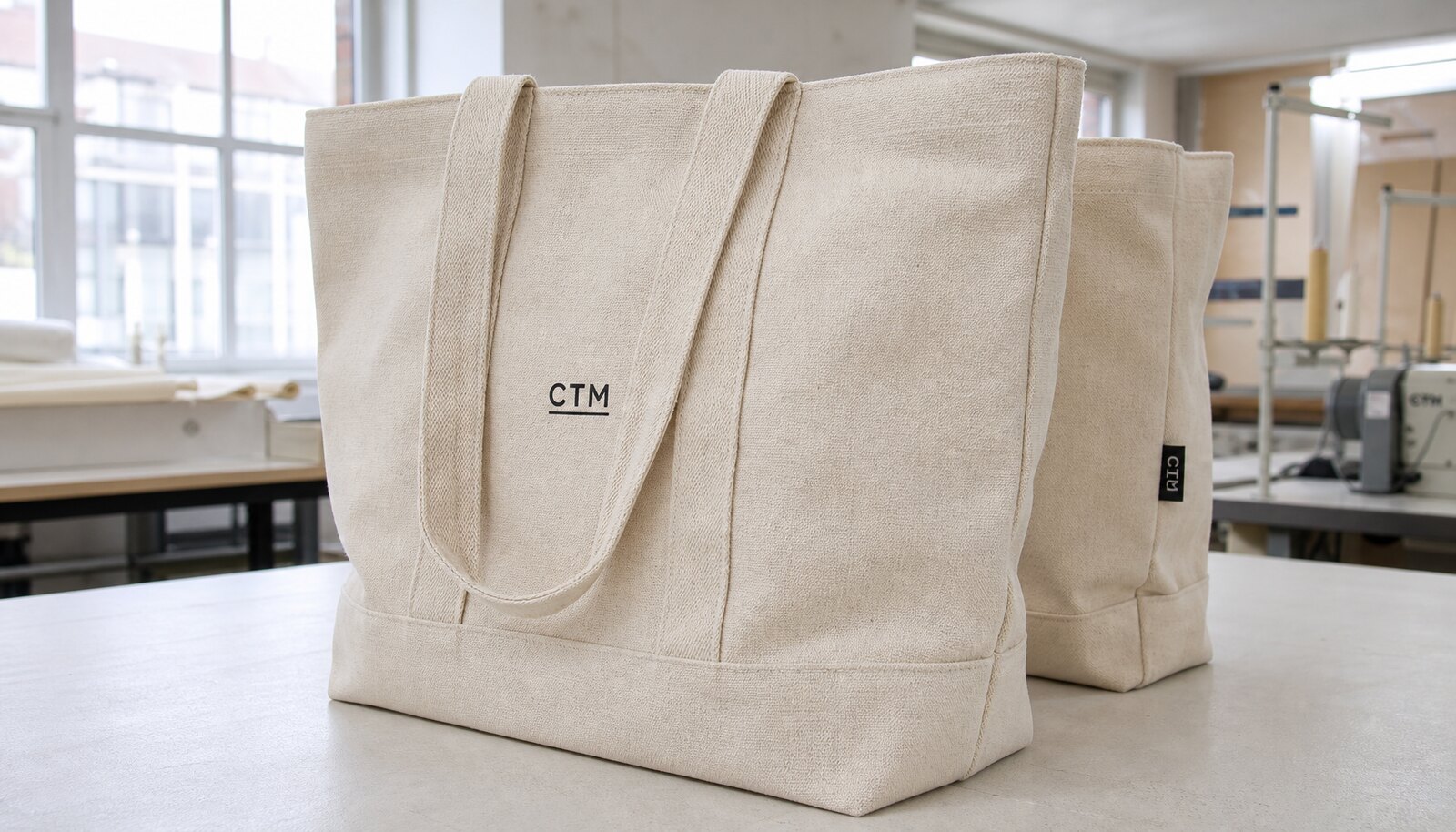
Start with the use case, not the artwork
Cotton canvas bag printing is easiest to source when the buyer starts with the end use. A promotional giveaway, a shelf-ready retail tote, and a private label carry bag may all look similar in a catalog, but the commercial requirements are different. A giveaway bag can tolerate lighter canvas, simpler seams, and a shorter life. A retail tote usually needs better structure, cleaner print placement, more consistent packing, and a clearer story on fabric and finish. Private label programs often add reorder control, traceability, and carton discipline because the bag becomes part of the customer experience, not just a branded handout.
That is why the first sourcing decision should be the expected use case, not the logo file. If the bag is supposed to carry books, groceries, or apparel, the fabric weight, handle construction, and reinforcement matter more than a low headline price. If the bag is meant for event distribution, the buyer may prioritize speed, lower MOQ, and simple one-color decoration. In both cases, the spec should make the product behave the way the channel needs it to behave. Otherwise, suppliers will quote different assumptions and the comparison will not be useful.
- Define the channel first: retail, promo, hospitality, wholesale, or private label.
- State the expected load and how the bag will be used in normal conditions.
- Decide whether repeat order consistency matters more than the lowest first-order price.
- Lock one product version before asking multiple suppliers to price it.
Choose fabric and construction together
For cotton canvas tote bags, the fabric is not just a cost line. It controls hand feel, structure, print clarity, wrinkle behavior, and how premium the bag looks on arrival. A lighter canvas can work for short-life promotions, but the bag may feel soft, wrinkle easily, and show distortion near the seams. Heavier canvas generally gives better structure and a more retail-ready appearance, but it also affects cost, sewability, and packing volume. The right answer depends on the route to market, not on a generic weight target alone.
Construction matters just as much as the cloth. Handle width, handle drop, seam allowance, bartacks, gusset depth, and reinforcement all influence how the bag carries load and how it survives repeated use. Buyers should also ask for fabric origin disclosure, not because origin is a branding point in every program, but because it is a practical traceability check. If a supplier cannot state the mill or source category, it becomes harder to manage reorders, shade consistency, and test records. On programs where color fidelity matters, it is also worth asking whether the fabric is piece-dyed, yarn-dyed, or taken from a stock roll with a known dye lot.
What you want from the supplier is not a vague promise of quality. You want a repeatable material spec that can be measured, traced, and re-ordered. That includes finished GSM, weave type, shrinkage expectation, color tolerance, and the exact body and handle construction used in the approved sample.
- Ask whether the quoted GSM is measured on the finished cloth or the raw roll before finishing.
- Request fabric origin disclosure, including mill or source country if the supplier can provide it.
- Specify handle width, handle drop, seam allowance, and reinforcement patch or bartack details.
- Ask for a swatch from the actual production lot, not a generic catalog sample.
- If the bag may be washed, define a shrinkage expectation in the spec rather than relying on a verbal assurance.
Compare sourcing routes by control, not by headline price
The same tote can come through very different commercial routes, and each route creates different risks. Factory-direct custom cut-and-sew usually gives the strongest control because one producer can manage fabric, sewing, print, and packing under one quality system. That is often the best fit for repeat private label programs and larger retail orders. Factory-direct stock body printing is better for launches and promos where the body is standard but the logo or packing still needs control.
Trading companies and sourcing agents can be useful if the buyer needs one point of contact across multiple factories or product categories, but the buyer should not assume that layer improves traceability. If the actual factory is hidden, the quote may be convenient but the risk is harder to audit. Local decorators on imported blanks are another real option, especially when the order is small or urgent. The limitation is upstream: the print may be good while the blank bag varies in GSM, seam quality, or handle reinforcement. The buyer should evaluate how much of the product the supplier actually owns, not just how friendly the sales quote looks.
- Use direct factory sourcing when repeatability and traceability matter.
- Use stock-body printing when speed and lower setup cost matter more than deep customization.
- Use a trading company only if the real factory and QC path are disclosed.
- Treat local decoration on blanks as a print service, not as full textile control.
Build the quote package so quotes are comparable
Most bad sourcing decisions start with a weak RFQ. If the request says only cotton tote with logo, suppliers will fill in the blanks differently. One may assume a stock bag, another a custom body, another a different packing method, and each will be correct within its own interpretation. The buyer then compares unit prices that are not actually describing the same product. That is where hidden cost enters the order.
A usable quote package should include a dimensioned tech pack, vector artwork, print size, bag color, fabric weight, handle spec, packing requirement, and carton expectation. It should also say what is excluded. If retail folding, barcode stickers, inner polybags, or sample fees are not part of the target price, state that. If mixed SKUs are not allowed in one carton, say so before the factory prices the job. For B2B procurement, the goal is not to create paperwork for its own sake. The goal is to make sure the supplier prices the same product that the buyer thinks is being bought.
- Include the approved artwork, a spec sheet, and a photo or sketch of the target fold.
- Separate one-time setup cost from recurring unit cost.
- Ask for carton dimensions and gross weight before freight is booked.
- State any excluded services so the supplier cannot quietly reintroduce them later as extras.
- Use one revision number across the RFQ, sample, and PO.
Ask capability questions that expose risk early
A supplier can look competitive on price and still be a poor fit if it cannot explain its own process. The most useful quote questions are the ones that reveal who controls the fabric, who owns the print method, and how problems are handled when the sample and bulk lot do not match. If a factory cannot state the actual fabric source, the print line used, or the person responsible for final inspection, that is a signal that the buyer may be dealing with a coordinator rather than a real manufacturer.
This is also where fabric origin disclosure becomes commercially useful. You do not need a marketing story. You need a traceable answer: what fabric was used, where it came from, how it was finished, and whether the same source can be reserved for the next run. The same applies to print-house capability checks. Ask whether the print is done in-house, what curing or drying method is used, what ink system is applied, and how the supplier verifies opacity, rub resistance, and placement. If they subcontract the print, ask who audits that subcontractor and how defects are assigned back to the order.
Sample-chain verification is another practical signal. Ask the supplier to identify the strike-off or sample ID, the PO or batch number, and whether a retained sample is stored against the approved spec. That makes reorders easier and reduces the common problem where a supplier says the old sample is lost and the new run is based on memory.
- Ask which mill or fabric source is used and whether the same source can be repeated.
- Ask whether printing is in-house or subcontracted, and how the supplier checks the print line.
- Ask for the defect handling path if the bulk lot differs from the approved sample.
- Ask whether the approved sample is retained and labeled by batch or PO.
- Ask who owns the screens, plates, or files if you reorder or move the program later.
Use samples as a chain, not a single milestone
For cotton canvas bag printing, the approved sample should be the control point that links the artwork, the material, and the production method. A strike-off alone is not enough if it was printed on a different canvas weight or with a different ink cure. A pre-production sample alone is not enough if no one has tied it to the approved artwork revision and fabric lot. The useful approach is a sample chain: artwork approval, strike-off or print proof, pre-production sample, bulk lot, and retained reference sample.
That chain matters because many sourcing problems show up only when the bag is made end to end. A print may look fine on paper but sit differently on a real seam line. A canvas weight may feel right in a swatch but drape differently once cut and stitched. A handle length may seem acceptable until the bag is packed and folded for retail. Buyers should inspect the sample under the same lighting and handling conditions they expect in the final use case, then measure it against the spec rather than against memory.
The practical rule is simple: do not approve a sample that is not made with the real production route. If the final bag will use a specific canvas lot, a specific ink system, and a specific folding or packing method, the sample should use those same inputs. Otherwise, approval may create confidence without actually reducing risk.
- Approve the sample against a retained gold sample and the current spec version.
- Measure body width, height, gusset, handle drop, and print placement before sign-off.
- Confirm that the sample uses the same fabric source, ink, and cure process as bulk production.
- Keep the sample ID, PO number, and approval date together in the reorder file.
- Review the bag after folding and handling, not only while it is flat on a table.
Match print method to artwork and fabric
Screen printing is usually the best fit for simple logos on cotton canvas because it gives strong opacity, a clean edge, and good repeatability at scale. The tradeoff is setup. Each color or screen adds cost and time, so the economics work best when the artwork is simple and the quantity justifies the setup. For many buyers, the choice is not screen print versus digital in the abstract. It is whether the design and order size are simple enough that screen print gives the best unit economics without sacrificing quality.
Transfer and digital methods have their place when the artwork is more complex or the run is smaller. They can handle gradients, fine detail, and shorter runs, but the buyer should still test how the image sits on canvas. Some methods can look crisp at first and still fail later on rub resistance, edge lift, or hand feel. Embroidery or woven labels can be useful when the brand wants a more tactile finish, but they change cost, lead time, and the way the bag drapes. The right answer depends on the fabric surface, the artwork, and the durability required by the channel.
This is also where a white underbase question becomes important on dark canvas. If the supplier uses an underbase, ask how it affects opacity, hand feel, and cure. If small text or reversed-out details are in the design, ask for a proof at production size rather than assuming it will print cleanly. Fine detail that looks good on a monitor often disappears once the artwork is transferred to stitched fabric.
- Use screen print for simple, bold logos with repeat volume.
- Use transfer or digital only when the design complexity justifies the tradeoff.
- Ask for a strike-off or proof at final size, not at a reduced display size.
- Reject artwork with hairline strokes or tiny reversed details if the supplier cannot prove clean production output.
- If the tote is dark, ask how the supplier handles underbase opacity and cure.
Set QC standards that fit the channel
QC for cotton canvas bag printing should be written as a practical control plan, not as a generic quality slogan. Most buyers start with a recognized sampling standard such as ISO 2859-1 or ANSI/ASQ Z1.4 at General Inspection Level II, then adjust defect acceptance by channel. For many programs, AQL 0 for critical defects, 2.5 for major defects, and 4.0 for minor defects is a reasonable baseline, but a retail program with strong brand sensitivity may require tighter limits. The important part is that the standard is agreed before production, not negotiated after defects are found.
The defect definitions should be specific enough that an inspector and a supplier will reach the same conclusion. Wrong logo, wrong color family, missing handle, open seam, and contamination that cannot be cleaned are critical defects. Off-position print beyond the agreed tolerance, weak bartacks, visible staining, or poor print coverage are usually major defects. Loose thread tails, packing wrinkles, and minor carton scuffing are often minor defects if they do not affect function or shelf presentation. If the bag is marketed as washable or built for heavy use, ask for rub-fastness, wash-fastness, and load-test evidence on the actual print method and canvas weight. Frame these as starting standards, then tighten them where your brand needs it.
A simple load test is often worth adding because it catches problems that visual inspection misses. Ask the supplier to state the intended working load and then verify the bag under that condition or a multiplier set by your internal standard. The test is not about laboratory perfection; it is about avoiding obvious seam or handle failures in the field.
- Write the defect table before production starts.
- Use a retained sample and a clear measurement sheet during inspection.
- Check more than the top layer of cartons at receiving.
- Ask for rub, wash, and load methods in the QC record, not just a pass/fail note.
- Adjust the acceptance limits to the channel instead of using one rule for every tote program.
Plan packing, freight, and reorder continuity
Packing is often treated as a small detail, but it affects warehouse handling, freight cost, and even print condition on arrival. Bulk packing is cheaper and faster, but retail and wholesale programs often need more controlled folding, barcode labels, carton marks, and one-SKU-per-carton discipline. If the tote is packed too tightly, the canvas can crease and the print can mark against itself. If cartons are mixed or mislabeled, receiving slows down and claims become harder to prove.
Before booking freight, confirm carton dimensions, gross weight, net weight, and carton count. If the order will ship by sea or go through warm transit, ask whether the supplier uses moisture protection or liners where appropriate. The goal is not to over-specify packaging. It is to avoid damage and to make the receiving process predictable. For buyers who reorder the same tote, the packing spec should be stored with the approved sample and the production file so the second order does not drift because someone reinterpreted the original packing instructions.
Commercially, the reorder file should include the approved spec version, sample photos, inspection result, carton standard, and any tool ownership terms. If the factory owns the screens or print files, the buyer should know that before the first order closes. If the buyer owns them, the contract should say so. Those details matter when the program scales or moves to a new supplier.
- Confirm whether mixed SKUs or mixed sizes are allowed in one carton.
- State fold direction so the print opens correctly on unpacking.
- Ask for carton photos or a pack-out sample before bulk shipment.
- Lock carton dimensions and counts before freight booking.
- Keep screen ownership, artwork files, and retained sample details in the reorder folder.
Specification comparison for buyers
| Sourcing route | Best fit | Price profile | Control and traceability | Buyer-side checks |
|---|---|---|---|---|
| Factory direct, custom cut-and-sew plus in-house print | Private label, retail programs, repeat orders, custom sizes | Higher setup cost, better economics when volume repeats | Highest control over fabric, pattern, sewing, print, and packing | Ask who buys the fabric, who prints it, who signs off on QC, and whether the approved sample is tied to the same production line |
| Factory direct, stock body plus print | Launch tests, seasonal promos, lower MOQs | Lower setup burden, fewer customization options | Good control if the stock body is stable and documented | Verify the stock code, GSM, color lot, and whether the supplier can change bodies mid-order |
| Specialist printer on imported blanks | Fast launches, small runs, local fulfillment | Usually higher unit cost, low setup complexity | Print quality can be strong, but textile control sits upstream | Check the blank supplier, blank GSM, seam quality, and whether the blank lot is traceable |
| Trading company or sourcing agent | Multi-SKU programs, buyers needing one contact | Convenient, but margin can be embedded in the quote | Depends on whether the factory identity and QC access are disclosed | Demand the actual factory name, recent test records, and a clear answer on who handles defects and rework |
| Domestic decorator or local print shop | Rush orders, market tests, simple one-color logos | Fastest turnaround, often the highest unit price | Strong on speed, limited control over the textile spec | Confirm the exact blank brand, print method, and whether any subcontracting is involved |
| Material | 8-12 oz cotton canvas, 120-220 gsm cotton, recycled cotton, or blended fabric selected by use case and target price | Before price comparison | Different cloth weights, backing, or certification claims make quotes hard to compare | |
| Construction | bag size, gusset, handle drop, seam allowance, stitch density, reinforcement patch, and loading expectation | Before sampling | Weak stress points create returns and failed inspections | |
| Decoration | screen print, heat transfer, embroidery, woven label, or hangtag matched to fabric texture and brand durability needs | Before artwork approval | The wrong method can crack, bleed, pucker, or fail on the chosen fabric |
Buyer checklist before sampling
- Send a dimensioned tech pack, not just artwork: bag size, gusset, handle drop, print area, fold direction, and target working load.
- Define the finished fabric weight, weave, color, and finish in writing, and state whether the bag will be washed, spot-cleaned, or sold as a dry-use item.
- Ask for fabric origin disclosure: mill or country of origin, fiber composition, finished GSM, and any finishing or coating applied to the cloth.
- Request a quote split by fabric, cutting and sewing, print, sampling, testing, packing, and export-ready carton spec so you can compare suppliers on the same basis.
- Approve a pre-production sample made on the exact fabric, print method, stitching route, and packing method that will be used in bulk.
- Lock the inspection standard before production starts: defect classes, AQL or internal sampling method, measurement tolerances, and load or rub test method.
- Confirm carton marks, SKU labels, net and gross weight, carton count, and whether mixed SKUs or mixed sizes are allowed in one carton.
Factory quote questions to send
- What is the finished GSM of the fabric you are quoting, and is that measured on the finished cloth or the raw roll before finishing?
- Which mill or fabric source are you using, and can you disclose the origin, composition, and any post-weave finishing?
- What print method are you pricing, what is the setup cost per color or design, and what is the rerun cost if artwork changes?
- Can you break the quote into fabric, sewing, printing, packing, sample, testing, and freight-ready carton cost?
- What exact bag body, handle construction, seam allowance, and reinforcement details are included in this price?
- What is your MOQ for stock bags with print only versus fully custom size, color, label, or packing work?
- Will the pre-production sample use the same fabric source, ink, curing process, and stitching line as mass production?
- Which inspection standard do you use for bulk goods, and what counts as a major versus a minor defect?
- What rub-fastness, wash-fastness, or load-test results can you provide for this print method on this canvas?
- If the strike-off or pre-production sample differs from the bulk lot, who pays for correction and how is approval handled?
Quality-control points to confirm
- Use ISO 2859-1 or ANSI/ASQ Z1.4 as a common starting point for bulk inspection, usually at General Inspection Level II, then tighten the plan if the bag is retail-facing or brand-sensitive.
- Treat AQL 0 for critical defects, 2.5 for major defects, and 4.0 for minor defects as a starting benchmark, not a universal rule; adjust to your channel, risk tolerance, and customer impact.
- Define critical defects clearly: wrong logo, wrong color family, missing handle, open seam, hole in a visible area, or contamination that cannot be cleaned.
- Define major defects as anything that affects function or brand presentation, such as off-position artwork beyond the agreed tolerance, weak bartacks, visible staining, or inconsistent print coverage.
- Use dimensional tolerances that reflect the product and channel. For many tote programs, body dimensions within about +/-1 cm, handle drop within about +/-1.5 cm, and print placement within a few millimeters are reasonable starting points, but they should be written into the spec before sampling.
- For dry rub resistance, many buyers ask for grade 4 on the gray scale under AATCC 8 or ISO 105-X12 as a starting target; for wet rub, grade 3 is often used as a baseline unless the use case is stricter.
- If the tote is marketed as washable, ask the supplier to state the test method used, then check color change, staining, and dimensional stability against your own acceptance limits.
- Run a simple load test at the intended working load, or at 1.5x working load if your internal standard calls for it, and require no handle pull-out, seam burst, or permanent distortion beyond the agreed limit.
- Inspect carton quality at receiving: count accuracy, one SKU per carton unless mixed cartons are requested, correct labels, dry cartons, and no crushing that can deform handles or transfer print.
- Ask for photos or a video of in-process QC, not just the final packing shot, so you can see whether defects are caught before cartons are sealed.