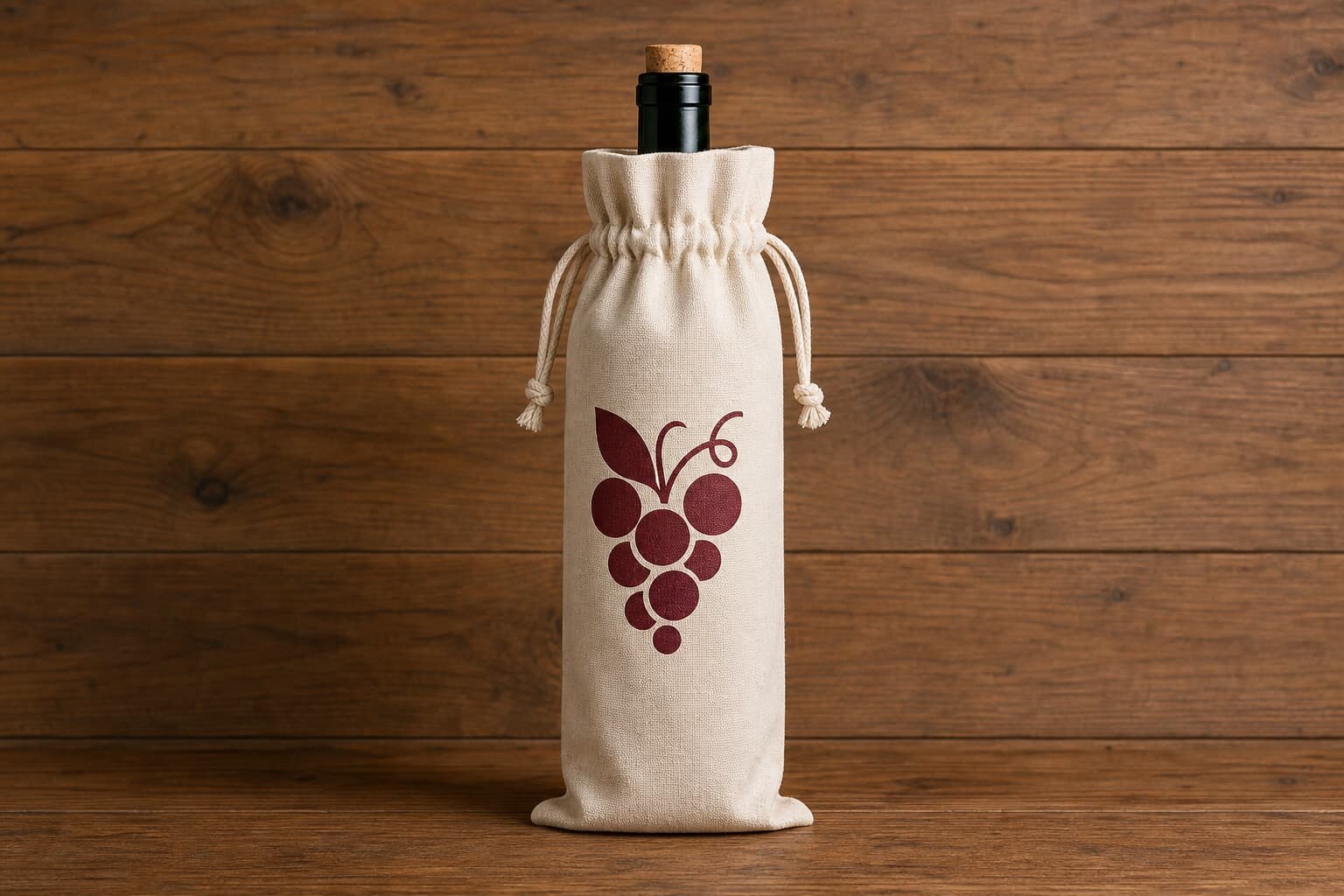
Why size mistakes happen on cotton bottle bags
The main buying problem is simple: many bottle bag orders are sized from assumptions instead of from the real bottle. A buyer writes 'for 750 ml wine bottle,' the supplier quotes a standard size, and everyone believes the bag will fit. But 750 ml only tells you volume. It does not tell you base diameter, shoulder width, neck shape, glass thickness, or the extra height created by a cork, capsule, or screw cap. That is why two bags quoted for the same 'wine bottle' can perform very differently in use.
On bulk orders, the error usually shows up late. The sample may fit one local bottle in the buyer office, while the production bottles at the destination market are slightly wider at the shoulder or heavier at the base. Then the bags arrive too tight, too loose, too short, or unstable. The fix is not complicated: define bottle geometry first, then specify bag dimensions, gusset, fabric weight, and handle construction as a fit system rather than as separate line items.
- Volume is not enough; measure height, base diameter, and shoulder width.
- A tight fit looks premium but increases insertion friction and seam stress.
- An oversized fit reduces shelf appearance and allows bottle movement in transit.
- Different factories may measure finished size differently unless the RFQ states the method.
Start with the bottle, not the bag
Procurement teams should build the RFQ from the actual product being packed. For each bottle SKU, record overall height, base diameter, maximum shoulder width, neck finish, closure type, and filled weight. If your program includes more than one bottle type, decide whether you want one universal bag or separate bag sizes. A universal size may simplify inventory, but it often creates wasted fabric, weaker presentation, and higher carton volume.
For single-bottle cotton bags, the two dimensions that most often get overlooked are shoulder width and cap height. A bottle can have a narrow base but still snag at the shoulder when inserted. A tall cork and capsule can also push the bottle above the hem line, making the bag look short even if the body fit is correct. Asking the factory to size only from base diameter usually leads to a bag that works on paper but feels wrong in the hand.
- Record actual bottle height to the highest point of cap, cork, or wax seal.
- Use the widest point of the bottle body when choosing gusset depth.
- Note filled bottle weight if the bag is intended for retail carry.
- If one bag must fit several bottles, identify the largest bottle as the control size.
How to choose finished bag dimensions that actually work
For most buyers, the best starting point is a gusseted bag rather than a flat bag. A flat bag can work for very slim bottles or low-cost promotions, but it tends to twist, print unevenly, and carry poorly. A gusset gives the bottle a base pocket and cleaner front panel. For a standard 750 ml Bordeaux bottle, many factories quote around 12 x 36 x 9 cm. That can be workable, but do not treat it as universal. Some Burgundy shapes need extra width or height, and heavier premium bottles benefit from a deeper base and stronger handle reinforcement.
Ask the factory to quote a finished size, not a cut panel size. Finished size reflects the real result after seam allowance, folding, and any wash or shrink effect. Also state tolerances. A common tolerance might be plus or minus 0.5 to 1.0 cm depending on construction and fabric, but that tolerance should be acceptable only if the bottle still inserts smoothly. On tight-fitting gift bags, even a 0.5 cm loss in gusset depth can create problems across a production lot.
- Typical single-bottle range: width 10 to 13 cm, height 34 to 38 cm, gusset 8 to 10 cm.
- For premium glass or Champagne-style bottles, allow more base room and stronger handle support.
- Define the top opening style because folded hems reduce usable height.
- State size tolerance in the PO and tie it to bottle fit acceptance, not just tape measurement.
Match cotton fabric weight to bottle load and retail use
Fabric weight affects more than cost. It changes structure, print quality, handle support, and how premium the bag feels. Lightweight cotton around 140 to 180 GSM can work for low-cost event giveaways, but it is usually too soft for a better retail bottle presentation. The bottle shape prints through the fabric, the bag collapses on shelf, and the seams take more stress when the customer lifts the bottle.
For most bottle programs, buyers should compare 220 to 280 GSM cotton for standard retail and 270 to 340 GSM canvas for a more premium or reusable bag. Heavier cloth improves body and durability, but it also adds material cost, carton weight, and sometimes higher MOQ if the mill stock is less common. If the bottle is heavy or the bag will be reused, the higher GSM often saves trouble by reducing seam distortion and handle complaints.
- 140 to 180 GSM: budget promotion, light use, limited structure.
- 220 to 280 GSM: good balance for standard branded bottle bags.
- 270 to 340 GSM: better structure for gift and premium retail programs.
- Ask whether the quoted GSM is greige, finished, or washed, because actual delivered weight can differ.
Print method and artwork limits should be decided with size
Bottle bag art is often small, but placement matters because the printable area is limited by seams, gussets, and handle attachments. Screen printing is usually the most practical choice for cotton bottle bags in bulk because it handles solid logos well, scales efficiently at volume, and stays relatively cost-effective. It also performs better than many low-cost transfers when the bag folds in cartons. If your art is photo-based, gradient-heavy, or low-volume, heat transfer may be considered, but it can stiffen the panel and change the hand feel.
The size of the bag affects the artwork window. A narrow front panel may not support a large centered logo without running too close to the side seams. The bottom area can distort if the print is too near the fold. This is why buyers should submit artwork placement with actual dimensions, not just a logo file. If the supplier prices only by color count without reviewing panel size, the quote can miss extra setup or reject risk.
- Screen print is usually the best default for simple branding on cotton bottle bags.
- Dark, heavy ink coverage on natural cotton may feel stiff and crack sooner at folds.
- Keep artwork clear of side seams, base fold, and handle stitch zones.
- Ask for print area dimensions in the quotation, not only '1-color logo included.'
MOQ logic: why size, color, and print can change the real minimum
Buyers often ask for a simple MOQ, but bottle bags usually have several practical minimums layered together. There may be one MOQ for sewing a standard shape, another for custom-dyed fabric color, another for print color setup, and another for custom accessories such as woven labels, hangtags, dividers, or drawstrings. A supplier may advertise a low MOQ, yet the quoted unit price assumes stock fabric, one print, and one size only.
When size changes, pattern efficiency changes too. A factory may accept mixed sizes in one order, but the cutting marker, wastage rate, and carton plan will differ. That can raise cost or extend lead time. The best way to compare quotes is to ask the supplier to separate the MOQ by component: base bag, fabric color, print design, and packaging variation. That immediately shows whether a low headline MOQ is commercially useful for your program.
- Standard stock-color bag sizes usually have the lowest workable MOQ.
- Custom fabric dyeing can push MOQ much higher than sewing alone.
- Mixed sizes may be possible, but ask whether pricing is blended or size-specific.
- Custom labels, inserts, and gift packaging can create separate trim minimums.
Sample approval: what to test before giving bulk go-ahead
A visual sample is not enough for bottle bags. The sample should be tested with the real bottle or a verified substitute with the same dimensions and weight. Insert and remove the bottle several times. Check whether the bottle catches at the shoulder, whether the handle balance feels centered, and whether the top opening still looks neat with the bottle inside. On double-bottle bags, test whether bottles collide or lean inward during carrying.
If your program is retail-facing, also look at how the bag stands on shelf or counter. Cotton bottle bags rarely stand perfectly unsupported, but the base should sit stable enough for packing and presentation. If the bottle tilts, the issue may be gusset geometry, not just fabric weight. This is the point where many buyers save the project: a proper pre-production sample catches sizing, print position, and construction issues before thousands of units are cut.
- Approve fit with a real bottle, not only a ruler measurement.
- Test insertion, removal, carrying balance, and shelf presentation.
- Check handle comfort under actual filled weight.
- For gift sets, confirm divider seams and bottle separation before bulk sewing.
Packing and carton planning affect landed cost more than many buyers expect
Bottle bags are soft goods, so buyers sometimes treat packing as a secondary issue. That is a mistake, especially when bag size increases to fit wider bottles. Extra width and gusset depth can inflate carton volume quickly, even if the fabric cost change looks minor. For importers and distributors, shipping efficiency matters almost as much as sewing cost. A bag that is 1 cm wider across thousands of pieces may require more cartons or reduce container loading efficiency.
Ask the supplier to quote carton details together with the bag spec: pieces per carton, carton size, gross weight, net weight, and whether bags are packed flat or bundled by SKU. Mixed-size programs should be packed and labeled in a way that your receiving team can count quickly. If the factory packs loose mixed sizes to save labor, the warehouse pays the price later in recounting and repalletizing.
- Ask for carton dimensions and gross weight during quote review, not after PO.
- Flat packing by size bundle usually speeds receiving and reduces count errors.
- Do not let gross carton weight rise too high for manual handling in destination warehouses.
- If the bag includes inserts or dividers, confirm whether they are assembled or packed separately.
Lead time and quote data: what a usable supplier quotation should include
A useful quote for cotton bottle bags should be more than unit price and lead time. Buyers need the supplier to state the exact size basis, fabric GSM, fabric composition, print method, handle type, sample charge policy, packing method, MOQ, and production lead time assumptions. Without that data, two quotes cannot be compared properly, even if the prices look close. One factory may quote a lighter cotton with minimal stitching, while another includes heavier canvas and reinforced handles.
Lead time should also be broken into stages. Sample development might take one schedule, lab dip or custom dye another, and bulk production another. If the supplier offers a short lead time, ask what conditions make that possible. Is stock fabric assumed? Is the print color simple? Is the order size below a threshold? A short promised lead time without production conditions is often just a sales estimate, not a capacity-based plan.
- Quote should state size, GSM, print, handle, packing, MOQ, and Incoterm basis.
- Ask for separate timing for sample, approval, material prep, and bulk sewing.
- Clarify whether lead time starts from PO date, deposit date, or artwork approval date.
- Request carton and weight estimates early so freight planning is not delayed.
Common buying mistakes and simple acceptance criteria
The most common mistake is buying by appearance only. A nice-looking sample can still fail in production if the size tolerance is loose, the GSM is downgraded, or the handle stitches are inconsistent. Another frequent mistake is over-specifying premium features for a low-cost promotion. Heavy canvas, webbing handles, woven labels, and individual polybags may create a beautiful bag, but they can also move the quote far outside the target cost without improving the real sales objective.
A better approach is to write acceptance criteria that connect directly to use. For example, the bottle must insert without forcing; the bag must carry the filled bottle without seam opening; the print must be centered within a stated tolerance; and the carton count must match the packing list. These are practical checks that both buyer and factory can understand. They turn a vague specification into a manageable production standard.
- Do not approve based on appearance alone; approve on fit and carry performance.
- Avoid premium add-ons unless they solve a specific retail or durability need.
- Write acceptance criteria tied to fit, seam integrity, print position, and carton accuracy.
- If the order is for multiple bottle shapes, define which one is the mandatory pass sample.
Specification comparison for buyers
| Spec decision | Recommended option | When it fits | Buyer risk to check |
|---|---|---|---|
| Single 750 ml wine bottle size | Approx. 12 x 36 x 9 cm gusseted bag | Standard Bordeaux and many Burgundy retail wine programs | Ask supplier whether height is body height only or includes top hem; some factories measure differently |
| Tall narrow bottle size | Approx. 10 x 38 x 8 cm | Olive oil, sparkling water, vinegar, or slim imported bottle shapes | Bottle may fit width but catch at shoulder if gusset is too shallow |
| Premium heavier bottle size | Approx. 13 x 38 x 10 cm with stronger handle attachment | Champagne-style or thick-glass gift bottles | Base stress and handle pull failure if fabric or stitch count is too light |
| Two-bottle format | Approx. 20 x 36 x 10 cm with inner divider | Gift sets, winery retail packs, festive promotions | Without divider, bottles knock together in transit and damage labels or glass |
| Fabric weight | 8 oz to 10 oz cotton canvas, about 270 to 340 GSM | Structured gift bags that must stand better and carry glass safely | Light 140 to 180 GSM cotton may quote cheaper but collapses, prints through, and wears faster |
| Print method | Screen print for simple logos; heat transfer only for photo art or short programs | Most bulk branding on cotton bottle bags | Large dark coverage can crack or feel stiff; confirm print area around gusset seams |
| Handle style | Self-fabric or cotton webbing handle, cross stitch reinforced | Retail carry use and bottle programs above 500 g total load | Unreinforced inserted cords can loosen on repeated carry |
| Packing method | Flat packed in master carton with size label by bundle | Wholesale, importer, and mixed-SKU programs | Loose mixed packing causes count errors and slower warehouse receiving |
Buyer checklist before sampling
- Measure the actual bottle, not just the nominal volume; record overall height, base diameter, shoulder width, and cap or cork height.
- Specify whether the bag size is finished internal size or finished external size, and confirm if tolerances are before or after sewing.
- State the bottle program clearly: Bordeaux 750 ml, Burgundy 750 ml, Champagne-style, olive oil, gift set, or mixed assortment.
- Choose cotton type and weight by use case: 140 to 180 GSM for light promo use, 220 to 280 GSM for standard retail, 270 to 340 GSM for structured gift carry.
- Confirm gusset depth based on the widest bottle point, not only the base diameter.
- Request handle construction details: handle width, length, reinforcement stitch, and attachment location from top hem.
- Approve a fit sample with the real filled bottle or a dummy bottle matching glass shape and cap height.
- Set print method and artwork limits early, especially if logos cross seams or sit near the bottom fold.
- Define packing: pieces per polybag if any, pieces per inner bundle, pieces per carton, carton size, and gross weight cap.
- Ask for quote lines separated by fabric, printing, trims, sampling, packaging changes, and shipping terms so comparisons stay clean.
Factory quote questions to send
- What finished size are you quoting, and is it measured externally or internally after sewing and washing?
- What bottle shape did you assume for this size recommendation: Bordeaux, Burgundy, Champagne, oil bottle, or custom sample?
- What is the actual tested fabric weight in GSM after finishing, and what tolerance do you allow lot to lot?
- What handle construction is included in the price: self-fabric, cotton webbing, rope, or ribbon, and how is it reinforced?
- Does your quote include a bottom board, divider, lining, drawstring, or closure, or are those separate add-ons?
- What print method are you quoting, what is the maximum print area, and how do you handle art that runs across gussets or seams?
- What is the MOQ by size, by fabric color, and by print design, and can mixed sizes share one production run?
- Will you make a pre-production sample using the final bottle dimensions and final artwork position before bulk sewing starts?
- What packing method is included, and what carton dimensions and gross weight do you estimate for the quoted quantity?
- What lead time do you need for sample approval, bulk production, and any custom-dyed fabric or custom woven label?
Quality-control points to confirm
- Check finished bag width, height, and gusset on a statistically reasonable sample from early, middle, and late production bundles.
- Test actual bottle insertion and removal; the bottle should slide in without forcing but should not tip excessively inside the bag.
- Verify bottom seam alignment and stitch density, especially on heavy bottle programs where base stress is highest.
- Inspect handle attachment for skipped stitches, weak bartacks, and uneven placement that causes crooked carrying balance.
- Confirm fabric GSM and weave consistency against the approved sample, because thinner substitute cloth changes fit and durability.
- Check print registration, opacity, curing, and rubbing resistance, especially on natural cotton where ink absorbency varies.
- Review inner divider size and seam position on two-bottle bags to ensure both cavities hold bottles upright.
- Measure carton count accuracy, carton dimensions, and gross weight so warehouse receiving and freight booking match the PO.