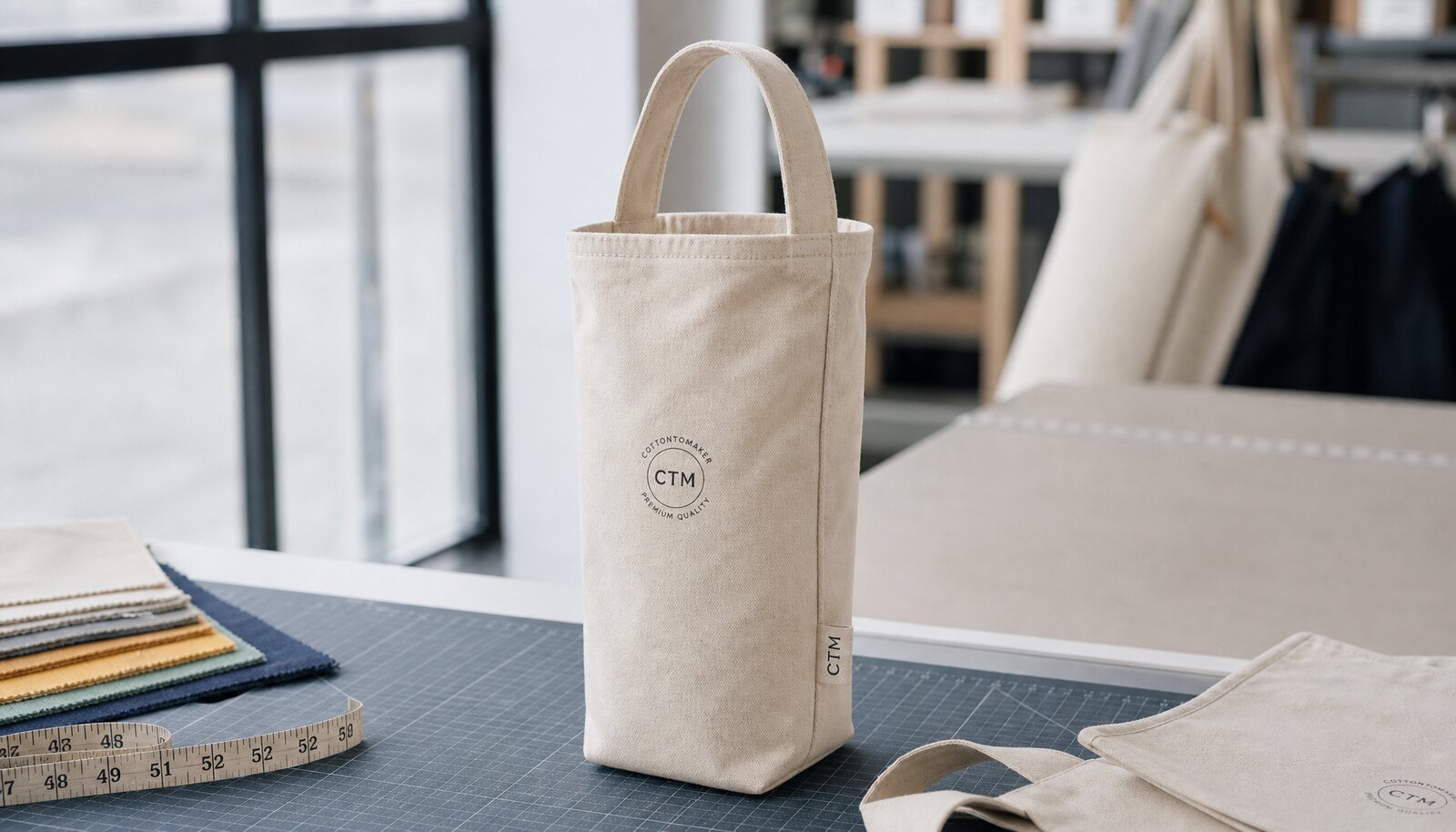
Start with the bottle, not the bag
A cotton bottle bag is a small sewn product with very little tolerance for vague sourcing instructions. Procurement teams often receive a marketing request that says "cotton wine bag with logo" and then ask several suppliers for a quick price. The problem is that suppliers may quote different internal sizes, different cotton weights, different print areas, and different packing methods while appearing to offer the same item. For B2B buyers, the right starting point is not the bag style. It is the bottle that must go inside, the way the bag will be used, and the standard the supplier must hold during production.
A good cotton bottle bag size and print guide should force measurable decisions early. The buyer should know whether the bag is for one exact bottle, a family of bottles, or a general promotional program. A wine importer may need a close fit for a standard 750 ml bottle. A distributor may need tolerance for wider olive oil bottles or spirit bottles. A retailer may care more about how the logo photographs when the bottle is inserted. These are different products from a factory standpoint, even if they look similar in a catalogue.
The commercial risk is that an underwritten RFQ produces quotes that cannot be compared. One factory may include a heavier fabric, a proper strike-off, and export cartons. Another may quote a thinner natural cotton sleeve with a smaller print and bulk packing. The lower price may not be a better offer; it may simply be a different specification. A stronger RFQ reduces this ambiguity before sampling, which protects both cost control and launch timing.
- Define the bottle family before discussing the bag size.
- State the use case: gifting, retail display, event promotion, ecommerce kit, or distributor packing.
- Separate structural requirements from branding requirements so suppliers can price both clearly.
- Ask suppliers to confirm their assumptions instead of filling gaps silently.
Measure bottle dimensions that actually affect fit
Bottle fit is controlled by more than total height. Measure the widest body diameter, shoulder width, body height, neck diameter, neck height, and any cap or closure that increases the top profile. A standard 750 ml wine bottle may fit a finished bag around 12 x 34 cm, but that should be treated as a starting reference, not a universal rule. Burgundy-style bottles, Champagne-style bottles, olive oil bottles, and square or rectangular specialty bottles can change the fit quickly.
Procurement teams should decide whether the fit should be snug, neutral, or forgiving. A snug fit can look premium because the cotton sits close to the glass and the logo remains centered. It also leaves less room for sewing variation, shrinkage, or bottle changes. A looser fit is safer when distributors pack mixed bottle shapes, but it can create wrinkles, a soft top, or an inexpensive appearance. If the buyer is not sure which route to take, ask the factory to quote one standard fit and one wider-fit option with the exact dimension difference.
Finished size is the key phrase. Cutting size is not enough because seam allowance, top hem, gusset construction, shrinkage, and drawstring channels all reduce usable space. Ask the supplier to state finished width, finished height, top opening, and gusset depth if applicable. If the bag must close with a drawstring, add top allowance so the closure does not squeeze the bottle neck or cover the printed logo. If the bag must stand with the bottle inserted, discuss bottom shape and gusset rather than relying on a flat sleeve.
- Measure widest diameter, total height, shoulder profile, neck height, and cap shape.
- Mark the bottle label zone if the bottle label must remain visible during display.
- Ask whether quoted dimensions are finished sewn dimensions or cutting dimensions.
- Set tolerances for width, height, and opening instead of accepting "about" sizing.
- Use a real bottle sample whenever fit affects resale, gifting, or retailer approval.
Choose a size architecture before requesting prices
A buyer does not need hundreds of bottle bag sizes, but the RFQ should make the size architecture clear. For a single-bottle wine program, the priority may be a clean front panel and enough top clearance for a drawstring. For a bottle-and-card gift set, the bag may need extra width or a small gusset. For an olive oil brand, the bottle may be shorter but wider, which changes both fabric usage and print placement. For multi-bottle gift packaging, a standard single-bottle sleeve will not scale without construction changes.
Size also affects cost beyond the obvious fabric area. A slightly larger bag may reduce fit complaints, but it can increase carton volume and make the product look less tailored. A very tight bag saves fabric but raises the risk of seam stress, difficult insertion, and rejections when bottle batches vary. Wider bags can move the logo away from the visual center if the supplier uses the same artwork placement rule as a narrower style. These are practical tradeoffs buyers should resolve before they ask for a final price.
When comparing suppliers, use decision boundaries rather than only target dimensions. For example, state the maximum bottle diameter the bag must accept, the minimum finished opening, and the maximum visible slack acceptable at the top. If a supplier recommends a different size, require a reason tied to construction or bottle fit. This prevents a factory from quoting a cheaper, smaller bag just to win the first comparison.
- Use a snug size only when the bottle SKU is fixed and sewing tolerance is controlled.
- Use a neutral size for retail programs where presentation and practicality must balance.
- Use a looser size for mixed-bottle distributor programs, but accept a less tailored look.
- Consider a gusset when the bag must stand better or hold a wider bottle.
- Request alternative size pricing only when the supplier explains the cost and carton impact.
Specify fabric GSM, finish, and shrinkage with sourcing in mind
Fabric GSM changes the feel, structure, print result, and packed volume of a cotton bottle bag. Lightweight cotton around 140-180 GSM can work for economical promotional orders where the bag is secondary to the bottle. It will usually feel softer, show the glass shape more clearly, and wrinkle more easily. A middle range of 180-220 GSM is a practical starting point for many retail and gift programs because it balances hand feel, printability, sewing efficiency, and cost. For a heavier bottle or a more premium presentation, 240-280 GSM is often worth quoting, but the buyer should expect higher material cost and more packed bulk.
Fabric finish matters because cotton is not a neutral print surface. Natural cotton has a warm, speckled look that many brands like, but it can make precise color matching harder. Bleached or off-white cotton usually gives better contrast for logos. Dyed cotton creates stronger brand color but adds shade-lot management and potential colorfastness questions. If the buyer requires recycled cotton, organic cotton, or another certification-related claim, that requirement must be stated at RFQ stage with documentation expectations. Do not assume a supplier's generic cotton bag automatically supports a sustainability claim.
Shrinkage is often ignored until the sample fits and the bulk run does not. If the bag may be washed, steamed, pressed, or exposed to humid storage, ask whether the fabric is pre-shrunk and what shrinkage tolerance the supplier expects. Even small shrinkage can reduce the opening or make a snug bottle impossible to insert smoothly. A serious supplier should be able to tell you whether the quoted fabric is stock fabric, dyed-to-order fabric, or a custom material with minimum fabric booking. That answer affects MOQ, price stability, and lead time.
- Quote 140-180 GSM only when a soft promotional feel is acceptable.
- Quote 180-220 GSM for standard cotton bottle bags used in retail or gifting.
- Quote 240-280 GSM when heavier glass, premium hand feel, or better opacity matters.
- Ask for production fabric swatches before approving print or final price.
- Confirm shrinkage, shade lot, fabric availability, and any certification documents before PO release.
Engineer construction details that survive real handling
The bottle bag carries a hard object with concentrated weight, so construction is not decorative. The base seam, side seam, handle connection, and drawstring channel are the highest-risk areas. A flat side-seam bag may be enough for a simple bottle sleeve, but a gusseted base can improve standing shape and make the bag feel more purpose-built. If a rope handle is used, the attachment method matters more than the rope itself. Ask whether the factory uses folded reinforcement, bar-tacks, double stitching, or another method appropriate for the load.
Top construction also deserves attention. A drawstring channel can make the bag look complete as a gift package, but it consumes vertical space and can distort the upper panel if stitched poorly. Cotton rope handles create a stronger carry function but add components, labor, and inspection requirements. A no-closure sleeve may be the cheapest and cleanest for bulk packaging, but it may not satisfy retail gifting expectations. Buyers should align the closure with how the bottle will be handed over, displayed, and transported.
Construction details should be written in measurable terms where possible. Instead of asking for "strong stitching," ask for seam type, stitch density, reinforcement location, and whether loose threads are trimmed. Instead of asking for a "nice gusset," specify gusset depth and whether the bottom should sit flat with the bottle inside. If the product is reusable, the buyer should raise the construction standard accordingly. A bag that only needs to present a bottle once can be built differently from a bag marketed as a reusable cotton carrier.
- Define side seam, base seam, gusset, top hem, drawstring channel, and handle style.
- Ask how stress points are reinforced, especially at the base and handle attachment.
- Check whether the top closure reduces usable height or covers the artwork.
- Specify stitch density or supplier standard, then verify against the approved sample.
- Match construction strength to actual use: presentation sleeve, gift bag, or carry bag.
Match print method to artwork and order economics
Print selection should be a procurement decision, not only a design decision. Screen printing is often the practical choice for one- or two-color logos on cotton bottle bags, especially when the order volume is repeatable and the artwork is simple. It can give a clean result on a flat panel, but it has setup considerations and is less efficient for very small changing designs. Heat transfer or digital transfer can handle gradients, small details, and multi-color artwork, but buyers must check hand feel, edge durability, cracking risk, and whether the transfer surface looks too synthetic for the brand. Woven labels, side labels, or sewn patches can look more premium and avoid large print defects, but they add sewing steps and component management.
Artwork must be evaluated against the fabric weave. Fine type, thin lines, distressed logos, and tight registration can fail on coarse or slubbed cotton even when they look perfect in a PDF. Natural cotton also changes color perception, so a Pantone reference is a target for discussion, not a guarantee that the print will look identical to coated paper. Ask for a strike-off on the same production fabric, using the same print method and ink system planned for bulk. A digital mockup is useful for layout approval, but it cannot prove ink density, edge sharpness, or hand feel.
Cost boundaries should be visible in the quote. For screen printing, ask how many colors are included and whether screen charges are separate. For transfer printing, ask whether the price changes by artwork size and whether minimum order quantities differ. For labels or patches, ask for component MOQ, sewing cost, and placement tolerance. If a supplier recommends a method different from your request, ask for a side-by-side reason: lower setup cost, better detail, better durability, faster lead time, or better match to fabric texture.
- Use screen print for simple logos, solid colors, and repeatable volume orders.
- Use transfer print when detailed or multi-color art is more important than natural fabric hand feel.
- Use woven labels or patches when subtle branding and repeat consistency matter.
- Reject print approvals based only on mockups when color, texture, or placement is critical.
- Ask what changes in price when print size, color count, or artwork complexity changes.
Control print area, placement, and brand readability
The narrow front panel of a bottle bag leaves little room for placement mistakes. A logo that looks centered on a flat empty bag may shift visually when a round bottle is inserted. A drawstring channel may cover the upper portion of the artwork. A side seam may pull the print off-center if the panel is not cut and sewn consistently. This is why the RFQ should define the print area in centimeters, the distance from the top edge, the distance from the side seams, and the maximum placement tolerance.
Brand teams often request "large front logo," but procurement needs to translate that into production language. State the final print width and height, the panel location, the safe margin from seams and top fold, and whether the artwork may cross any curved area. If the print must align with a bottle label or ecommerce image standard, tell the supplier before sampling. For retail buyers, also consider whether the logo remains visible when the bag is held by the drawstring or handle. A print that looks good flat but disappears in use is not a successful packaging decision.
Artwork files should be clean and production-ready. Provide vector artwork when possible, outlined fonts, Pantone references, and a note about acceptable simplification if small details cannot print well. If there is a legal mark, QR code, batch message, or retailer-required text, call it out separately because small text has higher defect risk on cotton. For QR codes in particular, buyers should test scannability after printing on the actual fabric, not after viewing the artwork file.
- Define print width, print height, and placement distances in centimeters.
- Keep a safe margin from side seams, base seams, top folds, and drawstring channels.
- Set a maximum placement tolerance, such as a specific millimeter shift if required.
- Test logo readability after the bottle is inserted and the bag is lifted.
- Use a printed strike-off as the approval standard, not only a PDF layout.
Build a supplier RFQ that reveals real cost drivers
A strong RFQ makes suppliers quote the same product. It should include bottle dimensions, finished bag size, fabric GSM, fabric finish, construction, print method, artwork size, label details, closure, packing, carton information, inspection expectations, MOQ, and lead time. If those details are missing, suppliers will make different assumptions. The procurement team may then spend days comparing prices that are not actually comparable.
Itemized pricing is especially useful for cotton bottle bags because several small decisions can move the unit cost. Ask for the blank bag cost, print cost, label or patch cost, special component cost, sample cost, packing cost, export carton cost, and any screen or tooling charge. This format helps buyers see whether a supplier is expensive because of material, printing, packing, or setup. It also makes it easier to adjust the specification without restarting the sourcing process. For example, the buyer may decide that a woven label is not worth the added cost but that a heavier GSM is worth keeping.
MOQ must be tied to the actual specification. A supplier's general MOQ for cotton bags may not apply to dyed fabric, custom GSM, multi-color print, or special packing. Ask for MOQ at the target specification and at one or two price breaks. Also ask which assumptions affect price validity: fabric in stock, artwork ready, no color change, standard carton, or no retailer-specific packaging. This prevents the common problem where a supplier quotes aggressively, then revises the price after sampling because the original quote did not include the real production details.
- Require the supplier to confirm every assumption used in the quote.
- Ask for itemized cost lines instead of one bundled unit price.
- Tie MOQ to exact fabric, color, print, construction, and packing requirements.
- Request price breaks that show whether volume changes materially improve cost.
- Clarify what specification changes will trigger a revised quote or lead time.
Approve samples with fit, print, and QC evidence
Sample approval should not be a casual photo review. The first sample check is fit with the real bottle. Insert the bottle, close the drawstring or handle if applicable, lift the bag, and place it on a flat surface. Look for seam strain, twisting, excessive slack, bottom instability, and whether the top allowance still looks intentional. Measure the finished dimensions after the physical test, because a flat measurement alone does not prove functional fit.
The second sample check is print performance. Inspect color, density, edge sharpness, registration, pinholes, and hand feel. Check logo placement while the bag is empty and after the bottle is inside. If the bag is folded for packing, unfold it and see whether crease lines interfere with the print. If a heat transfer is used, bend the fabric lightly and look for cracking or lifting. If screen print is used, rub the surface with a dry cloth and, if relevant to the use case, a slightly damp cloth to see whether the ink transfers easily.
The third sample check is construction and packing. Pull gently but firmly on handles, drawstrings, labels, side seams, and the base. Count stitches over a defined length if stitch density is part of the spec. Check for odor, oil marks, loose threads, skipped stitches, skew, stains, and uneven top hems. Then approve the fold method and carton pack using the same standard you expect in bulk. Once approved, keep a signed reference sample with date, supplier name, artwork version, fabric spec, and carton spec. This reference becomes the control point for repeat orders and final inspection.
- Approve fit with a real bottle, not only a measurement chart.
- Check logo placement when the bag is empty, filled, closed, and lifted.
- Record finished dimensions and print placement against the written tolerance.
- Keep an approved reference sample for production and repeat-order comparison.
- Do not release bulk cutting until sample comments are closed in writing.
Set inspection, packing, and shipment requirements before production
Quality control should be planned before the factory starts bulk sewing. At minimum, inspection should cover incoming fabric, print quality, sewing quality, finished dimensions, and packing. Fabric inspection should look for shade variation, stains, slubs beyond the approved standard, odor, and incorrect GSM. Print inspection should happen early enough to stop a problem before thousands of pieces are sewn or packed. Sewing inspection should focus on dimensions, seam strength, top hem, gusset, handle attachment, loose threads, and bottom shape.
For B2B orders, measurable acceptance criteria are more useful than subjective language. Instead of "good print," define print placement tolerance, acceptable color variation process, no major smudging, no severe pinholes in logo areas, and no visible cracking for transfers. Instead of "strong seams," define stress points to pull-test and identify unacceptable failures such as seam opening, broken stitches, or handle detachment. If the buyer uses an external inspection agency, the purchase specification should be clear enough for the inspector to check without guessing.
Packing is part of the QC plan because cotton bottle bags are light but can be bulky and moisture-sensitive. Confirm fold method, pieces per inner pack, pieces per master carton, carton dimensions, net weight, gross weight, carton marks, and whether desiccants or liner bags are needed for humid routes. Individual polybags may improve presentation but add cost, labor, and sustainability concerns. Bulk packing may reduce cost but can increase wrinkles or carton-handling marks. Review one packed master carton before mass packing starts so the buyer can catch count, fold, and carton issues before the whole order is sealed.
- Inspect fabric, print, sewing, finished size, and packing as separate checkpoints.
- Define measurable pass/fail points for size, placement, defects, odor, and seam failure.
- Perform print checks before final sewing or before mass packing where possible.
- Approve one packed carton before the factory completes all cartons.
- Keep carton specifications in the PO so freight estimates and warehouse receiving match the order.
Specification comparison for buyers
| Spec decision | Practical buyer option | Best-fit use case | Cost and sourcing impact | Verification boundary |
|---|---|---|---|---|
| Finished size for one 750 ml bottle | Common starting point around 12 x 34 cm finished size, adjusted after checking bottle diameter, shoulder, neck, and closure allowance | Standard wine, olive oil, vinegar, and similar single-bottle gift packaging | Small size increases can raise fabric use, carton volume, and print placement constraints; undersizing creates claims risk | Approve only after testing the actual bottle or a factory-made dummy with matching diameter and height |
| Fit strategy | Snug fit for premium gifting, neutral fit for mixed retail, looser fit for distributor programs with varied bottles | Buyers handling one exact SKU versus buyers packing several bottle shapes | Loose fit may reduce size claims but can look cheap; snug fit looks better but needs tighter sewing control | Define the largest acceptable bottle and the minimum opening width after seam and top-hem construction |
| Fabric weight | 140-180 GSM for economical promotion, 180-220 GSM for standard retail, 240-280 GSM for premium or heavier glass | Promotional giveaways, retail wine bags, higher-end gift packaging, or glass bottles with thicker walls | Higher GSM increases material cost and packed bulk; low GSM saves cost but may show the bottle outline and wrinkle more | Request GSM tolerance, fabric type, shrinkage expectation, and a production fabric swatch before bulk approval |
| Cotton fabric finish | Natural cotton for rustic look, dyed cotton for brand color, bleached or off-white for cleaner print contrast | Brands choosing between eco-style presentation, strong brand color, or higher logo visibility | Dyed fabric adds color control and potential bleed checks; natural cotton may make Pantone matching less exact | Check shade lot, dye fastness if relevant, and print contrast on the same fabric planned for production |
| Construction | Side-seam flat bag for simple bottle sleeves, bottom gusset for better standing shape, reinforced base for heavier bottles | Low-cost single-use gifting through to reusable retail bottle bags | Gussets, reinforcements, and clean top hems add sewing time but reduce deformation and seam stress | Measure bottom width, seam allowance, stitch density, and whether the bag stands with the bottle inserted |
| Closure or handle | Drawstring for gift closure, cotton rope handle for carry function, no closure for sleeve-style packaging | Wine gifting, event distribution, retail carry bags, or protective bottle covers | Rope, eyelets, cord channels, and handle stitching all add components and inspection points | Confirm that the closure does not cover the logo, choke the neck, or reduce the usable bag height |
| Print method | Screen print for simple volume logos, heat transfer for detailed or short-run artwork, woven label or patch for subtle branding | One- or two-color corporate logos, small-volume seasonal designs, or premium private-label presentation | Screen setup affects small runs; transfer can add hand-feel concerns; labels add sewing cost but reduce print registration issues | Approve a print strike-off on production fabric and test rub resistance, alignment, edge sharpness, and color consistency |
| Print area | Front panel centered with clear seam and top-fold margins, usually specified in centimeters rather than a vague percentage | Retail display, gift programs, and ecommerce product photos where the logo must read clearly | Large prints increase ink, setup, defect visibility, and placement risk on narrow panels | State logo size, distance from top edge, side seam clearance, and maximum placement tolerance in the artwork spec |
| Packing method | Flat-fold bulk pack, flat-fold with inner polybag, or retail-ready individual pack with carton marks | Distributor replenishment, ecommerce kits, retail programs, or humid long-route shipping | Individual packing improves presentation but adds labor, plastic/paper material, carton space, and handling time | Confirm folded size, pieces per inner, pieces per master carton, carton dimensions, gross weight, and moisture protection |
Buyer checklist before sampling
- Send a bottle sample or dimension sheet showing total height, widest diameter, shoulder shape, neck diameter, neck height, and label zone.
- Define whether the bag must fit one exact bottle SKU or a range of bottle shapes, and name the largest acceptable bottle.
- Specify finished bag dimensions, not only cutting dimensions, with tolerance for width, height, opening, and gusset if used.
- State fabric type, target GSM, color, shrinkage expectation, and whether natural, bleached, dyed, recycled-content, or organic cotton is required.
- Confirm construction details: side seam, bottom seam, gusset, top hem, drawstring channel, handle length, reinforcement, and stitch density.
- Provide artwork as vector files with Pantone references, final print size in centimeters, placement distances, and safe margins from seams and top fold.
- Select the print method or ask the supplier to quote alternatives with clear differences in MOQ, setup cost, hand feel, and lead time.
- Request itemized pricing for blank bag, print, labels, special components, sampling, packing, export carton, and any artwork or screen charges.
- Ask for sample lead time, print strike-off timing, bulk production lead time, and the point at which material booking becomes non-cancellable.
- Require a physical pre-production sample or approved reference sample before bulk cutting, especially when fit or print placement is critical.
Factory quote questions to send
- Which finished size do you recommend for our bottle, and what bottle dimensions did you use to calculate that size?
- Is your quoted size a finished sewn size or a cutting size, and what tolerance can you hold on width, height, opening, and gusset?
- What fabric will you use, what is the exact GSM range, and is the cotton natural, bleached, dyed, pre-shrunk, recycled, or certified?
- Is this fabric available from stock, or does it require weaving, dyeing, or minimum fabric booking before production?
- Which construction is included in the quote: side seam only, bottom gusset, drawstring channel, rope handle, bar-tack, label, or reinforcement?
- Which print method is quoted, how many colors are included, what is the maximum print area, and what setup cost applies?
- Can you provide a print strike-off on the same fabric planned for production, and what tests do you perform for rubbing, cracking, or wash/steam exposure?
- Can you separate the quote into blank bag cost, print cost, label or accessory cost, sample cost, packing cost, export carton cost, and tooling or screen charges?
- What is your MOQ for this exact fabric, GSM, color, print method, and packing method, and what price breaks apply at higher quantities?
- Which parts of this specification would trigger a revised price after sampling: fabric color, artwork size, print colors, gusset, handle, packing, or carton count?
Quality-control points to confirm
- Verify actual bottle fit using the buyer's bottle or a physical dummy with the same diameter, height, shoulder, and neck profile.
- Measure finished width, height, opening width, gusset depth, top hem, and logo position against the approved sample and purchase specification.
- Check fabric GSM, weave consistency, shade, visible slubs, stains, oil marks, odor, and whether the fabric matches the approved swatch.
- Inspect print density, registration, edge sharpness, pinholes, color shift, hand feel, cracking risk, and alignment on the production fabric.
- Perform dry and wet rub checks when the logo may contact hands, cartons, bottle labels, or humid packaging conditions.
- Pull-test side seams, base seam, drawstring channel, rope handles, bar-tacks, and label stitching at stress points.
- Confirm stitch density, seam allowance, loose threads, skipped stitches, needle holes, top-edge finishing, and bottom flatness.
- Check that the closure or handle does not cover the logo, tighten around the bottle neck incorrectly, or deform the front panel.
- Review folding method, inner pack count, carton count, carton marks, carton dimensions, gross weight, and moisture protection before mass packing.
- Keep an approved reference sample with date, artwork version, fabric spec, carton spec, and signed approval notes for repeat-order comparison.