Start With the End Use, Not the Artwork
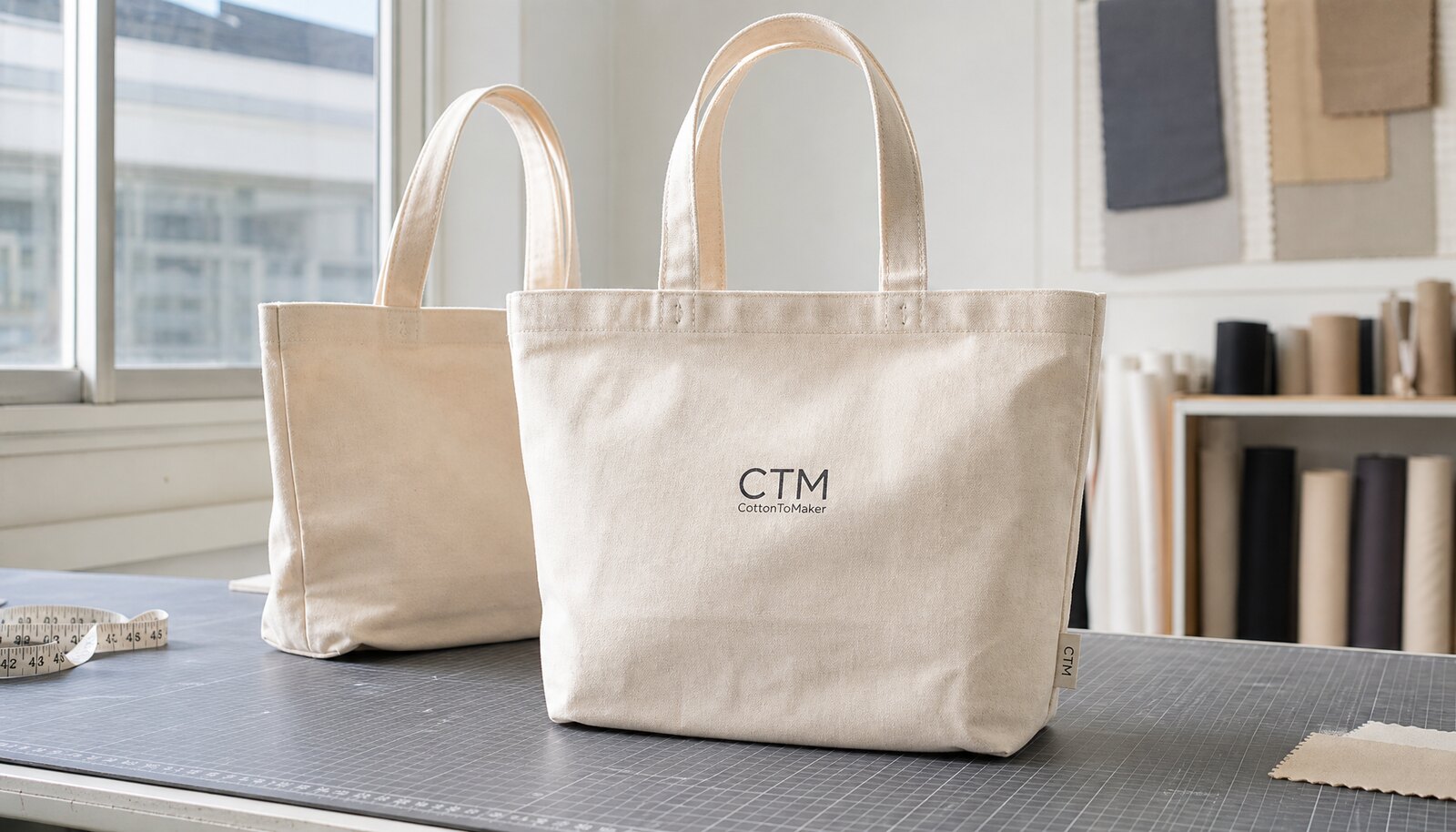
A cotton bag with logo is not one product. It is a fabric spec, a decoration method, a sewing standard, and a packing plan bundled into one purchase order. Procurement teams get better results when they start with the channel and the duty cycle, not the logo file. A bag for a trade show has a different commercial purpose than a bag sold at retail or handed out with product samples. If the bag is meant to be seen for a single day, cost and speed dominate. If it is expected to be reused, the buyer has to care about fabric opacity, handle strength, stitch quality, and whether the logo survives folding and friction.
The simplest way to avoid spec drift is to decide how much load the bag must carry and how visible the brand needs to be. A lightweight promo tote can work at 120 to 140 GSM when the bag carries paper collateral or small samples. A retail or corporate gift bag often starts closer to 150 to 180 GSM because the fabric feels more stable in hand and prints more cleanly. If the bag will carry bottles, boxed goods, or catalog bundles, the spec often needs 200 GSM or more, plus a stronger handle build. Those numbers are starting points, not rules, but they are far more useful than asking for a generic tote quote and hoping the supplier interprets the brand the same way you do.
- Use case should set the fabric, construction, and decoration method before price discussions begin.
- 120 to 140 GSM is usually promo territory; 150 to 180 GSM is a more practical retail or corporate starting point.
- If the bag needs to carry weight, handle reinforcement matters as much as fabric weight.
Build the Bag Spec Around Fabric, Structure, and Tolerances
Fabric weight is the first number buyers compare, but it does not tell the whole story. Two bags listed at 140 GSM can perform very differently if one uses a tighter weave and better finishing. For sourcing, it helps to define both the fabric target and the finished bag behavior. Buyers should specify whether they want plain cotton, canvas, dyed cloth, bleached cloth, or recycled cotton, because each one changes the handfeel, print result, and color consistency. If the brand wants a clean retail look, ask for the approved base cloth shade as part of the spec, not as an informal sample-room detail.
Construction details are where many orders quietly fail. A flat tote is cheaper, but a gusseted bag carries volume better and gives the print more visible area. A standard handle build often uses a reinforced seam with bar-tacks at the stress point, while a premium or heavy-use tote may need wider handles or a thicker folded handle tape. For a medium-weight cotton bag, 8 to 10 stitches per inch on main seams is a reasonable production target, with reinforcement at the handle ends. If the buyer needs a precise retail look, they should define seam allowance, handle width, gusset depth, and whether the bag needs a bottom insert or lining. The quote becomes much more reliable when those details are fixed up front.
Tolerance language should be written into the spec sheet. A useful starting point is plus or minus 0.5 cm on simple body dimensions, plus or minus 1.0 cm on handle length, and a maximum 5% deviation on fabric weight. That is specific enough to be enforceable without pretending cotton behaves like molded plastic.
- State the fabric type, GSM, base color, and any dye or bleach requirement.
- Define gusset depth, handle width, handle length, and seam allowance before asking for price.
- Use measurable tolerances so sample approval and mass inspection follow the same standard.
Choose the Decoration Method Before You Compare Quotes
Logo method affects cost, durability, visual character, and lead time. Screen printing is usually the default for a cotton bag with logo because it gives good value on simple art, especially one or two spot colors. It works best when the artwork is bold, the placement is fixed, and the buyer can approve a strike-off before production. The weak points are color drift, poor curing, and ink that becomes too heavy or too thin on the cloth. If the logo must be crisp and repeatable across reorders, the buyer should ask what ink system and curing process the factory uses, not just whether it can print the art.
Embroidery gives a different result. It reads premium on heavier canvas and can be durable on repeated use, but it is not free complexity. The digitizing file, stitch density, thread count, and backing all affect whether the logo sits flat or pulls the cloth. Fine detail can collapse, and lightweight fabric can pucker. Woven labels and sewn patches are useful when the brand wants a more restrained mark or needs a cleaner finish on a thicker bag. Heat transfer can handle complex artwork or a small run, but it needs a durability discussion because the method is only as strong as the adhesion and wash or rub resistance. For procurement, the practical question is not which method looks best on a mockup. It is which method produces the same result on the approved sample, the mass order, and the reorder six months later.
A good rule is simple: match the decoration to the bag body. Thin cotton and large solid logos usually favor print. Thick canvas and a premium positioning story can justify embroidery or a patch. If the artwork is highly detailed, expect either a higher print setup burden or a simplification of the logo for production.
- Use screen print for simple, repeatable artwork and controlled unit cost.
- Use embroidery only when the cloth is thick enough to support the stitch without distortion.
- Use labels or patches when the brand wants a premium mark with less ink coverage.
Compare Supplier Routes by Cost, Control, and Repeatability
The supplier route changes more than the invoice total. A direct factory usually gives the clearest cost structure and the best path to repeatability when the buyer has a stable spec. The factory owns the sewing and often the decoration process, which reduces handoffs and makes QC easier to trace. The tradeoff is that the buyer has to be more disciplined with the brief, because a weak spec will be optimized for whatever the factory thinks is acceptable. Sample rounds can also take longer if the order is custom or if the factory is balancing several production lines.
A trading company is useful when the program is messy: multiple bag types, mixed colors, multiple trim options, or a need to consolidate more than one factory capability into a single PO. That convenience comes with less line-of-sight. Buyers should expect more markup opacity unless the quote is broken into fabric, sewing, decoration, packing, and service fees. A trading company can still be the right answer when the buyer values coordination over the lowest ex-works price, but it is a mistake to treat the price as automatically comparable to a factory quote.
Domestic decorators and local print shops solve a different problem: speed. If the buyer needs a small run or a rush replacement, a stock blank plus local logo application is often the fastest path. The weakness is that the blank bag may not match the long-term retail spec, and the per-unit cost can be materially higher once the order scales. For repeat programs, the best commercial choice is usually the route that can reproduce the same cotton bag with logo with the fewest assumptions on the second order, not the route that wins by a small margin on the first invoice.
- Direct factory: best when repeat orders and stable specs matter most.
- Trading company: best when the buyer needs coordination across variants or more than one factory capability.
- Domestic decorator: best when speed matters more than long-term unit economics.
- Stock blanks are only useful if the blank quality already fits the brand standard.
Write the RFQ So the Factory Can Price the Same Product You Want
A useful RFQ removes guesswork. It should read like a production brief, not a marketing wish list. At minimum, the buyer should provide bag dimensions, fabric weight, base color, logo file, logo placement, decoration method, packing configuration, destination, and target ship date. If any one of those is missing, the quote may still arrive, but the factory will fill the gap with its own assumptions. That is how the first quote looks attractive and the second quote comes back as a change order. Good RFQs are concise, but they are specific enough that a supplier can price the same item twice and arrive at the same answer.
The RFQ should also force the supplier to separate the components of the price. Ask for fabric, cutting and sewing, logo application, sample charges, packing, and carton specification as distinct items when possible. If you need a one-color print on both sides, say that directly. If the artwork must match a Pantone target, say whether a visual match is enough or whether a tighter standard is required. If the bag needs individual polybags, barcodes, or retail hang tags, include those requirements in the same document. The point is not to create a long questionnaire. The point is to prevent the supplier from guessing on the parts of the order that later drive cost, delay, or rework.
One practical improvement is to attach an annotated spec sheet with the logo area, handle length, fold direction, and carton labels marked on a single page. That gives the buyer a reference point and makes the quote easier to compare across suppliers.
- Attach a dimensioned spec sheet, not only a logo file.
- State whether the print is one side or two sides, and whether the artwork is one color or multiple colors.
- Ask the supplier to separate bag making, decoration, sample fees, and packing when the quote is returned.
Read Quotes as a Cost Stack, Not a Single Number
A quote is only useful if it can be decomposed. For a cotton bag with logo, the real unit cost usually consists of the base bag, decoration, packaging, sample amortization, and freight or inland handling. That is why two prices that look close can represent very different offers. If Supplier A gives a lower unit cost but excludes setup, packing, or a second artwork proof, the final number can end up higher than Supplier B. Buyers get better decisions when they rebuild the quote into a cost stack and compare each line against the same spec.
Example math makes the point. Suppose a factory quotes a bag body at 0.38 USD, screen print at 0.09 USD, setup at 65 USD, fold and polybag at 0.04 USD, and carton allocation at 0.03 USD. On a 10,000-piece order, the setup adds 0.0065 USD per bag, so the ex-works total is about 0.5165 USD before freight and duty. If another supplier quotes 0.49 USD but uses a lighter blank, excludes sample work, and charges packing separately, the real comparison is not 0.49 versus 0.5165. It is the total landed cost and the risk of rework. That is why procurement teams should ask what is included in the headline number and what is only being assumed.
The other common trap is using the wrong comparison set. If one quote is based on one side print and another is based on two sides, the lower number is not cheaper. If one supplier priced a stock blank and the other priced custom cut-and-sew, the numbers are not interchangeable. A fair comparison only exists when the same GSM, same bag size, same decoration method, same packing, and same incoterms are being priced.
- Rebuild every quote as bag body + decoration + packing + setup + freight.
- Use sample amortization when comparing small and medium runs.
- Do not compare two prices until the same GSM, print coverage, and packing are confirmed.
Approve Samples in Stages and Tie Them to the PO
Sample approval should be staged because each sample answers a different question. A strike-off or print proof confirms the artwork placement, ink shade, and edge quality. A pre-production sample confirms the real fabric, seam construction, handle reinforcement, and packing method. The golden sample becomes the physical reference for mass production and should be signed off by the buyer and kept on file. If the order is important, the approval should be tied to the written spec sheet so the factory does not have to guess which version was accepted. In practice, many disputes begin because the sample was approved informally, but the PO referred to a different assumption.
The sample should be inspected the way the bulk order will be inspected. Measure the body, handle length, and gusset depth. Check the print for centerline, repeatability, and ink coverage. Pull lightly on the handle reinforcement and make sure the stitch pattern is even, not just present. If the sample is for retail or premium use, fold and refold it several times to see whether the print cracks or the shape collapses. The approval process should also include pack-out verification: inner quantity, carton marks, and whether the fold line hides or damages the logo. A sample that looks good in a photo but fails on the warehouse floor is not a production-ready sample.
If the order is large or the brand is sensitive, ask for a first article or top-of-line sample from mass production before the whole order ships. That adds one more checkpoint, which is usually cheaper than discovering a repeat defect across multiple cartons.
- Approve strike-off, pre-production sample, and golden sample separately if the order is sensitive.
- Measure the sample against the written spec, not against memory.
- Check the fold, carton mark, and logo visibility as part of sample sign-off.
Set QC Limits That Create Real Pass or Fail Decisions
QC only helps if the acceptance criteria are clear enough to act on. For a cotton bag with logo, the buyer should define what counts as acceptable variation in dimensions, color, stitch quality, and print position. A practical standard is plus or minus 0.5 cm on the body dimensions for a flat tote, plus or minus 1.0 cm on handle length, and plus or minus 5 mm on print placement against the approved centerline. If the bag has a strong brand color, the buyer may also want a tighter color target on the logo than on the cloth itself. The point is to prevent a subjective inspection from turning into a negotiation at the dock.
Defect thresholds should be written as examples, not vague language. A small thread tail can be acceptable if it trims cleanly and does not affect use. An open seam greater than 3 mm is a fail. A skipped stitch line longer than 2 cm is a fail. A handle bar-tack that is misaligned, incomplete, or visibly loose is a fail. For print, smudging, edge bleed, heavy pinholes, or visible rub-off on a clean white cloth are fail conditions. If the order has a premium feel requirement, the factory should also be required to ship clean, dry, odor-free goods with no water marks or staining. These are not academic standards. They are the defects procurement teams actually get stuck sorting after receipt.
A useful QC plan distinguishes between cosmetic defects and functional defects. Cosmetic issues may be acceptable in small amounts on promotional volume, but functional defects on handles, seams, or carton counts should trigger a hard stop.
- Use measurable tolerances for size, logo placement, and handle length.
- Treat open seams, loose bar-tacks, and print rub-off as functional failures.
- Separate cosmetic defects from functional defects before the inspection starts.
Treat Packing and Cartons as Part of the Product
Packing is part of what the customer receives, not a separate warehouse detail. A cotton bag with logo can look correct but still fail in transit if the fold line cuts through the print, the polybag traps moisture, or the carton is too weak for stacking. Retail buyers often prefer individual polybags or a controlled fold because presentation matters and dust protection helps on long routes. Sustainability-led buyers may prefer bulk packing to reduce plastic. Either choice is valid if it is written into the spec and reflected in the quote. What matters is that the packing method matches the channel.
Carton marks should be readable at receiving speed. Each outer carton should identify the item code, color, size, quantity, gross weight, net weight, and any destination-specific marks that the warehouse or forwarder requires. Mixed cartons are a common source of avoidable delay, especially when the order has more than one colorway. If the cartons exceed roughly 18 to 20 kg, manual handling gets harder and damage risk rises, so the buyer should ask the factory to balance count, carton size, and transport efficiency. The carton spec should also avoid crushing the handles or putting a hard crease through the logo panel. Those details sound small until they create a warehouse issue or a retail presentation complaint.
If the program will be reordered, keep the same fold direction, label position, and master carton spec on file. Consistency saves time on receiving and makes it easier to compare replenishment batches.
- Specify whether the order is retail packed, bulk packed, or mixed.
- Keep the fold away from the main logo area when possible.
- Use carton marks that let the warehouse sort color and size without opening the box.
- Confirm carton weight before freight booking so handling stays practical.
Plan Lead Time and Reorders as a Procurement Cycle
Lead time for a printed tote is not a single number. It is the sum of fabric booking, decoration setup, sample approval, cutting, sewing, packing, inspection, and shipment. A stock blank with one-color print can move quickly, while custom fabric color, embroidery, lining, or more complex packing adds steps. The buyer should not accept a delivery promise until the supplier has confirmed which steps are already done and which ones still depend on approval. In practice, the late stage is often sample approval rather than sewing capacity. If the artwork or sample sits for review, the schedule slips before production even starts.
Reorders are where disciplined procurement saves money. Keep the approved artwork, golden sample, fabric reference, packing spec, and carton mark file together so the supplier does not rebuild the order from scratch. If the factory keeps screens, embroidery files, or print settings on file, the next run is usually easier to quote and easier to match. Buyers should ask what has to be re-approved on a reorder and what can carry over. That is more useful than asking only for a lead-time estimate, because the real delay is often a missing decision rather than a missing machine slot.
The final decision should go to the supplier that matches the spec, shows the cost drivers, and can repeat the same cotton bag with logo on the next order without a spec reset. That is usually the lowest-risk commercial choice, even when it is not the cheapest number on the first quote.
- Do not treat lead time as fixed until artwork and sample approval are complete.
- Keep the golden sample, artwork files, packing spec, and carton mark file together for reorders.
- Choose the supplier that can repeat the same product with the fewest changes on the next PO.
Specification comparison for buyers
| Spec decision | Best supplier route | Typical cost / lead-time effect | QC risk to watch | When it fits |
|---|---|---|---|---|
| Lowest MOQ | Domestic decorator or local print shop | Lowest setup friction, but unit cost is often higher than factory sourcing; turnaround can be 2-7 business days if stock blanks are on hand | Blank body quality may differ from the long-term supply spec, so reorders can drift | Pilot run, event launch, or market test |
| Best unit price at scale | Direct factory with in-house print | Best at 1,000+ units and repeat programs; sample cycle is usually longer, but ex-works cost is usually lower | If the spec is vague, the factory may optimize for price and change fabric handfeel or packing | Repeat retail, corporate gifting, or ongoing promotions |
| Fastest turnaround | Stock blank bag plus local logo application | Fastest if the blank is already approved; cost is usually mid to high because you are paying for convenience and speed | The blank may be too light, too thin, or inconsistent for a branded retail standard | Rush events, replacement stock, or short-notice campaigns |
| Best for mixed SKUs | Trading company with factory network | Helpful when you need colorways, trims, and multiple bag types on one PO; pricing is usually less transparent and can add margin | If line items are bundled, it is harder to see where print, packing, and freight actually sit | Programs with several specs or shared sourcing coordination |
| Best premium finish | Direct factory with embroidery or woven patch | Decoration cost rises, and sample rounds take longer; the final look can justify the spend on thicker canvas | Stitch density can pull light fabric out of shape and reveal poor backing decisions | Premium brand gifts or retail bags with a heavier body |
| Best print consistency | Direct factory with strike-off control | Stable if the factory owns the print process and keeps the same screen, ink, and cure settings; usually more efficient on repeat orders | Color drift, poor curing, or small placement shifts become visible quickly on solid brand colors | Simple artwork that must repeat with tight brand control |
| Best custom structure | Cut-and-sew factory | Pattern work, sample rounds, and sewing complexity increase cost and lead time | Every structural change adds tolerance risk at the seams, gusset, and handles | Gusset changes, pockets, zippers, lining, or bottom inserts |
| Best for promo volume | Stock body with one-color print | Lowest design complexity and easiest to quote; cost usually tracks order volume more cleanly than custom builds | Thin fabric, weak handles, and print rub are the common failure points | Giveaways, conferences, and simple brand exposure |
Buyer checklist before sampling
- Lock finished bag size, gusset depth, handle length, and target finished weight before requesting price.
- Specify fabric by GSM or oz, weave style if relevant, and whether the cloth is natural, bleached, dyed, or recycled.
- Define the logo method, print size, print position, color count, and Pantone target if brand color matters.
- State handle construction, seam allowance, bar-tack plan, and any pocket, zipper, lining, or bottom insert requirement.
- Confirm packing method, inner pack quantity, carton marks, barcode requirements, and retail labeling rules before the quote is accepted.
- Ask for the sample sequence in writing: artwork proof, strike-off, pre-production sample, and golden sample.
- Set acceptable tolerances for dimensions, print alignment, seam finish, and color variation rather than relying on visual approval only.
- Confirm incoterms, destination port or warehouse, target ship date, and overrun or underrun tolerance before issuing the PO.
Factory quote questions to send
- What fabric GSM, weave type, and finished bag weight is this quote based on?
- Is the logo price based on one side or two sides, and one color or multiple colors?
- Are screen setup, plates, embroidery digitizing, and sample fees included or separate?
- What is the MOQ per color, per print version, and per packing configuration?
- What carton size, carton quantity, and inner packing method are included in the quote?
- What is the standard lead time after artwork approval and sample sign-off?
- What inspection standard or defect limit do you use before packing and shipment?
- What changes in cost if we switch from screen print to embroidery, woven label, or patch?
Quality-control points to confirm
- Fabric weight should land within plus or minus 5% of the ordered GSM, with no obvious thin spots, slubs, or loose weave in the body panel.
- Finished body dimensions should stay within plus or minus 0.5 cm on simple flat totes and plus or minus 1.0 cm on larger gusseted styles.
- Handle length should stay within plus or minus 1.0 cm, and both handles should match each other within 0.5 cm.
- Main seams should not show open gaps greater than 3 mm, and skipped stitches should not run more than 2 cm in a visible line.
- For medium cotton totes, a practical stitch target is 8 to 10 stitches per inch on main seams with clean bar-tacks or dense reinforcement at the handle ends.
- Logo placement should stay within plus or minus 5 mm of the approved centerline, with no visible twist on the print panel.
- One-color print should read solid and even, with no heavy pinholes, smudges, edge bleed, or rubbing that transfers to a clean white cloth after normal handling.
- Carton count, inner pack count, and carton marks should be exact; packing errors and mixed color cartons are a fail even when the bag itself is acceptable.