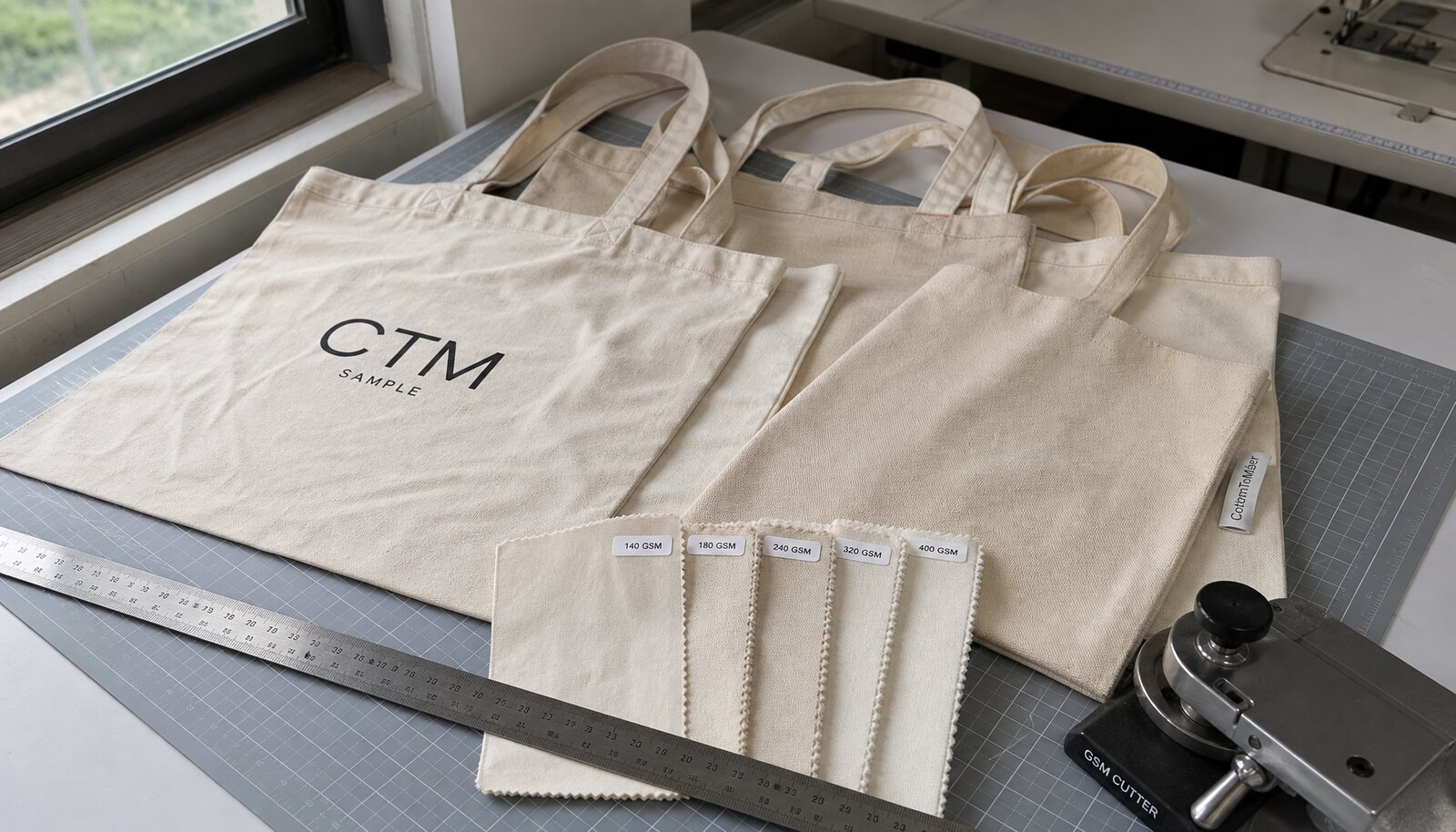
Why GSM Is a Commercial Spec, Not Just a Fabric Detail
For cotton bags, GSM means grams per square meter. Buyers also see fabric weight written in ounces, such as 5 oz, 8 oz, or 12 oz. These numbers are not decoration. They affect how the bag feels in hand, how much it can carry, how well the logo prints, how bulky the carton becomes, and whether the final price is still realistic for the program.
Many RFQs fail because the buyer asks for an organic cotton tote bag but does not define thickness. One supplier quotes 5 oz cotton, another quotes 10 oz canvas, and the prices look impossible to compare. The cheaper quote may not be wrong; it may simply be for a different bag.
- Use GSM when you need factory-level clarity across markets.
- Use ounce weight if your internal team or retail buyer already works in oz fabric terms.
- Ask suppliers to state both GSM and ounce weight so quotes can be compared side by side.
- Avoid vague terms such as thick cotton, premium canvas, or heavy duty unless they are supported by measurable GSM.
Common Cotton Bag Thickness Ranges Buyers Actually Use
There is no single best GSM for every cotton bag. A lightweight event bag and a premium retail tote should not share the same fabric. The right choice depends on bag size, handle length, expected load, logo coverage, packing method, and retail positioning.
As a practical starting point, lightweight cotton sits around 135-170 GSM, standard reusable cotton often sits around 200-270 GSM, and heavier cotton canvas usually starts around 340 GSM. Above 475 GSM, the bag moves into a heavy duty feel with higher sewing and freight implications.
- 135-170 GSM: suitable for light giveaways, document bags, and low-cost event use.
- 200-270 GSM: common for reusable retail totes and brand merchandise with moderate load.
- 340-410 GSM: better for premium canvas tote bags, fashion retail, and sturdier packaging.
- 475-540 GSM: used for heavy duty cotton canvas bags where structure and long-term use matter.
- Above 540 GSM: possible, but check sewing feasibility, folding, carton volume, and MOQ before quoting.
How GSM Changes Print Method and Logo Result
Print quality is not only about ink. Fabric thickness, weave openness, surface hairiness, and dye color all influence the final logo. A large solid logo may print cleanly on 10 oz canvas but look weak on a 4 oz open-weave cotton bag. Fine text may be sharp on smoother cotton but lose detail on coarse canvas.
For procurement, the key is to match artwork to fabric before sample approval. If the brand team sends a complex logo with gradients, very small text, or large ink coverage, the supplier should not quote only a basic one-color screen print without checking the fabric and artwork together.
- Screen print works well for simple logos, solid colors, and medium to heavy cotton fabric.
- Water-based ink gives a softer hand feel but may look less opaque on dark dyed cotton.
- Pigment print can be practical for promotional bags but should be checked for rub resistance.
- Heat transfer can help with detailed artwork but may feel plasticky on natural cotton if the film is large.
- Embroidery suits small premium marks on heavier canvas but can pucker thin cotton.
MOQ Logic Behind Different Cotton Bag GSM Choices
MOQ is often tied to fabric availability, not only sewing capacity. Natural cotton fabric in common weights may be available in lower quantities, while custom-dyed organic cotton canvas or unusual GSM may require a larger fabric lot. Buyers should ask what part of the MOQ is driven by fabric, dyeing, printing, or production setup.
If the RFQ requests a very specific GSM, custom color, special handle width, and low order quantity, suppliers may either increase the price or suggest a nearby stocked fabric. That alternative can be acceptable, but the buyer should approve it knowingly and document the revised GSM.
- Natural cotton in standard GSM usually supports more flexible MOQ than custom-dyed fabric.
- Organic cotton fabric may have different availability by weight and weave, especially for heavy canvas.
- Custom GSM fabric normally requires larger fabric preparation and longer lead time.
- Multi-color printing does not always raise fabric MOQ, but it can raise setup cost and sample time.
- Small changes, such as 270 GSM instead of 280 GSM, may reduce cost if the fabric is already available.
Sample Checks Before Approving Bulk Production
A hand sample made from substitute fabric is useful for shape confirmation, but it is not enough for final approval. For bulk cotton bags, the pre-production sample should use the same fabric weight, same print method, same handle construction, and same packing style planned for production.
Buyers should check the sample as a production tool, not as a showroom item. Measure the finished dimensions, carry realistic weight, inspect seams, rub the print, and fold it as it will be packed. Many bulk defects are visible at sample stage if someone checks the right details.
- Weigh or confirm actual GSM from fabric, not only from the sample tag.
- Measure body width, height, gusset, handle length, and handle width after sewing.
- Check whether the bag stands, folds, or collapses as expected for retail presentation.
- Inspect print edge sharpness, ink coverage, curing, and placement tolerance.
- Test handle comfort and seam strain with a realistic load for the intended use.
- Approve the packed sample if crease marks or carton compression could affect presentation.
Packing and Freight Impact of Thicker Cotton Bags
A higher GSM bag can look better and last longer, but it also increases carton volume and gross weight. This affects sea freight, air freight, warehouse handling, and retail storage. Procurement teams sometimes compare only unit price and miss the landed cost difference created by bulkier packing.
Folding method matters. Heavy canvas folded tightly may develop visible crease marks. Light cotton can be packed flat or folded in higher quantities per carton, but it may wrinkle more easily. If retail presentation matters, ask for packing photos or a packed sample before bulk packing starts.
- Request pieces per carton, carton dimensions, net weight, and gross weight in every quote.
- Ask whether bags are packed flat, half-folded, quarter-folded, or individually polybagged.
- Confirm if plastic-free packing, paper banding, or carton-only packing is required by the buyer.
- Check whether heavy canvas bags need larger cartons to avoid hard creases.
- For air shipment, compare volumetric weight, not only physical weight.
Lead Time Variables Buyers Should Put in the RFQ
Cotton bag lead time is not one single number. Fabric stock, dyeing, printing, curing, sewing, trimming, inspection, packing, and export booking all add time. A supplier can quote faster when the buyer selects stocked natural fabric and simple print. A custom-dyed heavy organic canvas bag normally needs more planning.
To avoid schedule risk, buyers should ask suppliers to split sample lead time and bulk lead time. Also confirm when the clock starts: after deposit, after artwork approval, after fabric approval, or after pre-production sample approval. Different factories use different starting points.
- Natural stock fabric plus one-color print is usually the simplest production path.
- Custom dyed fabric requires color lab dip approval before bulk dyeing.
- Heavy canvas may slow cutting and sewing, especially with reinforced handles.
- Large print coverage needs proper drying or curing time before sewing or packing.
- Peak season and fabric mill schedules can affect lead time more than sewing time.
Quote Data That Makes Supplier Comparison Possible
A usable quote should show more than a unit price. Without fabric weight, bag size, print method, packing data, MOQ, sample terms, and tolerance, the buyer cannot know whether suppliers are quoting the same product. The lowest offer may be based on lighter fabric, shorter handles, fewer stitches, or cheaper packing.
When comparing cotton bag suppliers, create a quote sheet that forces each supplier to fill the same fields. This reduces back-and-forth and makes technical differences visible before purchase order placement.
- Fabric type, GSM, ounce weight, color, weave, and tolerance.
- Finished bag size, gusset size, handle size, seam construction, and reinforcement.
- Logo method, artwork size, print colors, print position, and print tolerance.
- MOQ by fabric option, sample lead time, bulk lead time, and production start condition.
- Packing method, carton quantity, carton size, net weight, gross weight, and export marks.
- Inspection standard, acceptable tolerance, and whether third-party inspection is allowed.
Specification comparison for buyers
| Spec decision | Recommended option | When it fits | Buyer risk to check |
|---|---|---|---|
| Light promotional cotton bag | 4-5 oz cotton, about 135-170 GSM | Trade show giveaways, leaflet packs, low-load retail events, short campaign use | Logo may show through on natural fabric; thin handles can twist; not suitable for heavy catalogues or grocery weight |
| Standard retail tote | 6-8 oz cotton, about 200-270 GSM | Reusable shopping bags, brand merchandise, bookstore totes, apparel packaging | Confirm shrinkage after washing if buyer claims reusable lifestyle use; check print opacity on natural and dyed colors |
| Premium canvas tote | 10-12 oz canvas, about 340-410 GSM | Gift-with-purchase, museum shops, fashion retail, heavier daily carry | Higher fabric cost and carton volume; thick seams may need stronger needles and slower sewing speed |
| Heavy duty organic canvas bag | 14-16 oz canvas, about 475-540 GSM | Tool-style totes, bottle carriers, premium retail packaging, long-life brand programs | MOQ may rise due to fabric sourcing; folded packing can create crease marks; freight cost increases sharply |
| Printed logo on light cotton | Water-based screen print or simple one-color pigment print | Flat logos, low ink coverage, natural cotton bags, budget-sensitive campaigns | Large solid blocks can look uneven because the fabric surface is open and absorbent |
| Printed logo on thick canvas | Screen print with adjusted mesh and curing control, or embroidery for small marks | Premium bags where texture and durability matter more than the lowest unit cost | Fine text can fill in on coarse canvas; embroidery can pucker if backing and stitch density are wrong |
Buyer checklist before sampling
- State the target GSM or ounce weight and allow a tolerance, such as 270 GSM +/-5%, instead of writing only thin, medium, or heavy.
- Confirm whether the fabric is plain cotton, organic cotton, recycled cotton, or cotton canvas because the same GSM can feel different by yarn and weave.
- Specify bag size, gusset, handle size, handle attachment, and expected carrying load before asking suppliers to recommend thickness.
- Match print method to fabric weight, logo coverage, and bag color; do not approve a print quote without artwork size and Pantone or color reference.
- Request a pre-production sample using actual bulk fabric, actual print method, and actual handle construction before releasing full production.
- Ask for packed carton quantity, carton size, gross weight, and folding method because thick cotton bags can change freight cost more than expected.
- Check whether quoted MOQ is based on greige fabric availability, dyeing lot, printing setup, or sewing line efficiency.
- Confirm lead time by stages: fabric preparation, dyeing if required, cutting, printing, sewing, QC, packing, and export handover.
Factory quote questions to send
- What GSM and ounce weight are you quoting, and what tolerance will you control in bulk fabric?
- Is the fabric plain weave cotton, cotton canvas, organic cotton, or another construction, and is it in stock or made to order?
- For this bag size and handle design, what maximum recommended load do you suggest for normal retail use?
- Which print method are you quoting for our artwork: screen print, heat transfer, digital print, embroidery, woven label, or another method?
- Will the printed sample use the same fabric batch, same ink type, same curing process, and same print position as bulk production?
- What is the MOQ for natural fabric, dyed fabric, and custom GSM fabric, and what causes the MOQ difference?
- What are the packed carton dimensions, carton weight, pieces per carton, and folding method for this GSM?
- What sample lead time and bulk lead time are realistic after artwork approval and deposit, including fabric preparation?
Quality-control points to confirm
- Check actual fabric GSM with a cutter and scale from random fabric rolls or finished bag panels, not only from supplier declaration.
- Measure finished bag size after sewing and pressing because heavier canvas can lose more dimension at seam turnings.
- Inspect handle reinforcement, stitch density, bartack strength, and seam allowance, especially on bags above 10 oz.
- Rub test the print after curing and check for cracking, pinholes, poor edge definition, and ink bleed on dyed fabric.
- Review color consistency between fabric rolls, handles, gussets, and panels when the bag is dyed or washed.
- Check folding marks, lint, loose threads, needle holes, and carton compression before approving export packing.